Saturday, December 25, 2021

Accommodating 'Racialized' Victimhood

Accommodating 'Racialized' Victimhood

"Racialized students benefit from being taught by racialized teachers. The deleterious effects of the MPT [Math Proficiency Test] on racialized teacher candidates who have been unsuccessful in the test outweighs its benefits."
"Racialized teacher candidates have gone through an education system in which they have suffered discrimination and disadvantage."
"The candidates are then required to take 'high stakes' standardized tests which the available data shows they are more likely to fail."
Ontario Superior Court of Justice Divisional Court
 
"The mathematics part is all about logic. The pedagogical part is a lot of memory work."
"A lot of people who failed the test were educated outside of Canada. It wasn't about math skills, it was about memorization."
"Lots of people who come to Canada came as professionals. We are eager to contribute. But it was a bit of a trap."
Richard Atimniraye Nyelade, Cameroonian immigrant to Canada
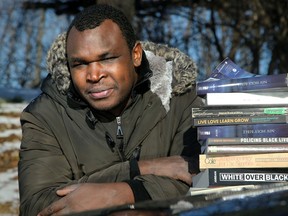
Richard Atimniraye Nyelade, who has his master's and bachelor's degrees from his native Cameroon and did another master's degree in Norway as well before coming to Canada in 2018, had no problems with the mathematics content questions, but didn't succeed on the pedagogy portion of the test.
That 'trap' has now been opened, expunged from the laws and regulations that saw a need to ensure that teachers in Ontario were in command of mathematics to the extent that they could adequately convey their knowledge to their students. A challenge from the Ontario Teacher Candidates' Council -- its membership comprised of immigrants to Canada aspiring to the teaching profession who found the math test to qualify as teachers beyond their scope of academic reach -- which saw fit to challenge the need to become proficient in math as teachers in the Ontario school system.

The judicial review they had requested with the argument that the test had a disproportionately negative effect on' racialized' candidates, convinced the progressive sympathies of the Ontario Superior Court of Justice Divisional Court that the requirements infringe on the Canadian Charter of Rights and Freedoms. In their December 17 decision it was noted that 'racialized' teachers were under-represented in Ontario and that alternatives to the MPT existed as options.

The math test for those wishing to be certified teachers was mandatory, but has now been judged to be unconstitutional. Abrading the rights of 'racialized' would-be teachers, but at the same time, impeding the rights of the children and students of the province to be adequately taught the important subject of mathematics. The Math Proficiency Test (MPT) was introduced alongside a number of provincial strategies meant to improve math skills of students as a result of provincial test scores dipping. 

All new teacher candidates wishing to teach in publicly funded schools were mandated to take the test. One of the founders of the Ontario Teacher Candidates' Council, Bella Lewkowicz, now an Ottawa teacher, heralded the decision as "a huge victory. It's not often that educators can claim victory over the Ministry of Education", she stated. A classic case of the trail wagging the dog.
 
Richard Atimniraye Nyelade, originally from Cameroon, failed to pass the test twice. He succeeded on the third try. He arrived in Canada in 2018, with his bachelors degree from his native country along with a master's from Norway, enrolling in a University of Ottawa teaching program, planning to teach in his first language, French. "I did it because, when you arrive as a newcomer, you want to be sure to contribute to society", he said. But obviously on his own terms, not on those that society deemed best for its student population.
 
There are 50 mathematics content questions to the test, along with another 21 questions related to math pedagogy. Applicants must score 70 percent on both parts of the test to qualify as a pass. Once the province began officially administering the test, demographic data indicated disparities in success rates where candidates identifying as Indigenous and Black enjoy sucess rates 20 percent under those of white candidates.
 
“There are pressing economic, social, and democratic reasons to want to make our society as numerate as possible. But making teachers take math tests is not a good way to go about it,” writes Sachin Maharaj.

Francophone candidates had lower success rates as well, as opposed to anglophones (in officially bilingual Canada francophones are certainly not considered 'racialized' or under-privileged). 55 percent of non-white candidates writing the test in French succeeded in comparison to 84 percent of white candidates writing in French; data that helped the court to form its opinion. Those whose first language is neither French nor English scored lower success rates.
 
Students in Quebec tested better than Ontario students in math where success is attributed to requiring student teachers to take courses in math methodology and content, instead of a high-stakes test. "I was in the middle of my program when they dropped this bomb" (the MPT requirement), commented Ms.Lewkowicz, who took the test and easily passed after graduation from University of Ottawa, and now teaching French in Ottawa.

The court ordered the regulator to grant certification to candidates who failed to pass the test, and that the test requirement be removed from the Ontario College of Teachers Act, legislation governing the teaching profession. The Ontario College of Teachers stated it had not been a party to the court proceeding. According to Mr. Atimniraye Nyelade, francophone candidates from countries like Senegal, the Ivory Coast and Haiti have encountered the same problem he did with the math test.

Yet another instance of new immigrants to a country where rather than integrating and adjusting to the values, priorities and legislation of their adopted country, steps are taken to cry foul and demand extraordinary treatment geared particularly to their shortcomings rather than taking responsible action to upgrade their qualifications to match expectations of any citizens, to prove they meet the required qualifications of a profession they wish to become part of.

Grade 2 teacher Vivian Mavraidis walks through her classroom at Hunter's Glen Junior Public School, which is part of the Toronto District School Board, during the COVID-19 pandemic. (Nathan Denette/The Canadian Press)


Labels: , , , , ,

Thursday, October 29, 2020

We're Waiting?!?!

We're Waiting?!?!

"Experts predicting that there's only a 40 percent chance of a negative result, that to me actually sounds pretty optimistic."
"Even if  you have fifty percent protection, we still won't know whether these vaccines actually move the needle on the things we need to move the needle on."
"In medicine we license drugs and vaccines all the time, despite lingering uncertainties regarding impact and safety. [We can't wait for absolute certainty.]"
"The point is to make the best choices we can, given the evidence we have and to continue collecting evidence so that we can revise our choices if the data turn southward."
Jonathan Kimmelman, professor, director, Biomedical Ethics Unit, McGill University
"None of those trials [in Phase III studies] currently under way are designed to detect a reduction in any serious outcome such as hospital admissions, use of intensive care, or death. [Even mild infections could qualify as an] event."
"In Pfizer and Moderna's trials, for example, people with only a cough and a positive laboratory test would bring those trials one event closer to their completion."
Peter Doshi, associate editor BMJ (British Medical Journal)

"We just don't know what to expect. You start asking yourself very practical questions: If something doesn't work fifty percent [of the time], then do we really have something?"
"Maybe we do as an emergency response initially, but a fifty percent level we would have to imagine over time has to get better than that."
Bruce Clark, president, CEO, Medicago
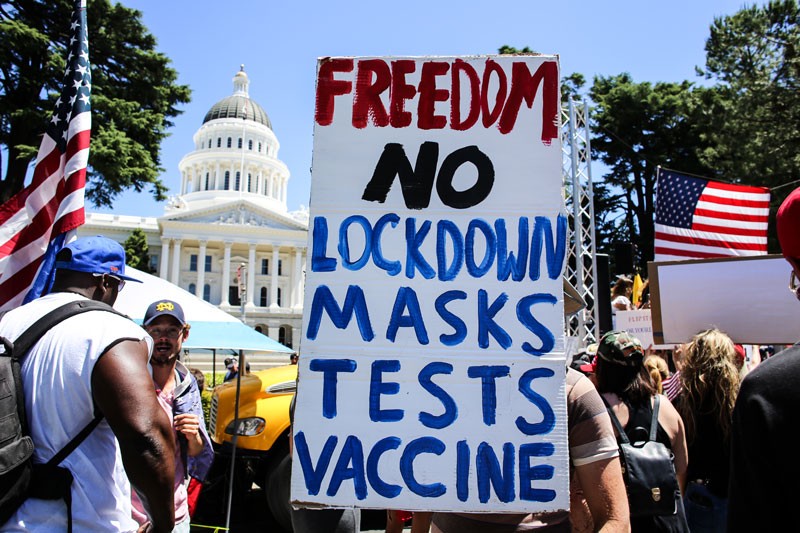
A protester holds a placard that says 'Freedom No Lockdown Masks Tests Vaccine'.

Protesters call for an end to COVID-19-based restrictions in Sacramento, California.   Credit: Stanton Sharpe/SOPA Images/LightRocket/Getty

When might a COVID-19 vaccine be available? When no fewer than 28 experts with a quarter-century each experience in the field were asked their opinion by a team from McGill University, the guess was around June 2021 as a best-case scenario, but more likely to come on stream in the fall of next year. The experts were also of the opinion that a 3-in-10 chance existed that an issue of safety would eventuate after approval was given to the first vaccine, requiring a warning accompany the vaccine. More concerning, that a 4-in-10 chance would arise when the first large field study might project a negative result. As in back to Square One.

Professor Kimmelman of McGill University who was the senior author of the paper points out that fewer than five percent of non-pandemic flu vaccines tested in humans get approved; long odds making him puzzled at the state of confident optimism by public health officials such as U.S. coronavirus chief Dr.Anthony Fauci who states his belief with a decided certainty that an effective and safe vaccine will be available in the near future. A more realistic view, suggests Professor Kimmelman, is that an effective vaccine will evade the near future.

There is no certainty that vaccines reaching Phase III  trials representing the final stage before approval may be given, will deliver normalcy back to the world. Proposed FDA and international standards for such vaccines are being raised; how good would be good enough?, added to which looms the logistical challenge in distribution of a two-dose vaccine, and inoculating the world community, much less persuading the young and individuals at low risk of contracting COVID to be vaccinated to help achieve the longed-for herd immunity effect.

Over two hundred vaccines against the SARS-CoV-2 virus are currently in development, eleven of which are now in Phase III studies -- each one of which involves tens of thousands of volunteers. These are double-blind and placebo-controlled blue-ribbon trials where no one is privy to who is being inoculated with the real vaccine and who a placebo. Designed to conclude after 150 to 160 COVID infections are seen among the study volunteers, a data safety and monitoring board would be set to determine whether fewer infections took place among the vaccinated group.

 
 What is of utmost importance, cautions Dr. Kimmelman, is whether a vaccine will prevent deaths, ICU admissions or hospitalizations. Where the difficulty lies is that hospital admissions and deaths from COVID-19 are uncommon -- so that of necessity it would require a large population over a prolonged period of time to acquire sufficient death numbers to determine the existence of a difference between the vaccine and placebo group.

A minimum target of fifty percent efficacy for a COVID-19 vaccine has been set by the U.S. Food and Drug Administration, so that a vaccine would be expected to be fifty percent superior over a placebo at preventing disease. Moderna's vaccine in an early-stage study produced neutralizing antibodies in 45 healthy 18- to 55-year-olds receiving two vaccinations 28 days apart, as reported in the New England Journal of Medicine. Side effects such as fatigue chills, headache or muscle aches occurred in over half the participants.

While AstraZeneca's vaccine produced an immune response in both the young and old, Reuters reported. It was left uncertain how well an antibody response translates into how well any vaccine can prevent COVID, however. In the same token, even a vaccine that works only half the time, offers an opportunity at keeping the potency of the epidemic at a lower level, particularly should it prevent severe disease and deaths.

And then there is the possibility that vaccines with protection of 30 percent could also have emergency authorization under FDA and international standards, when the debate turns to 'how low can you go?'
"The problem you could create is the following: You push a low-efficacy vaccine out on the grounds it's better than nothing. Right now, you've got zero. Thirty percent protection? Better than zero."
"It's a really difficult question to know at what point do you say, 'it's good enough'."
"What's the ideal? The ideal is we totally understand how this virus works, we get a vaccine, we know that it will stop this pathogen from being able to infect humans and we know that it lasts for a specified time, for example, ten years, and then you get a second vaccine."
"You can't wait until you truly understand the scope of the problem because people are dying."
Francoise Baylis, philosopher, university research professor, Dalhousie University
A technician works in a lab at Sinovac Biotech where the company is producing their potential COVID-19 vaccine CoronaVac during a media tour on Sept. 24, 2020 in Beijing, China. Photo by Kevin Frayer/Getty Images


Labels: , ,

Follow @rheytah Tweet