Russian Oligarchs' Penchant for Accidents, Suicide
Russian Oligarchs' Penchant for Accidents, Suicide
"When people die suddenly in Russia, you usually assume it's suspicious until you rule it out."
"It
becomes a lot more suspicious when all those people die in strange ways
and all are connected in some way to the oil and gas business."
"Putin is behind all of them, because he is the ultimate beneficiary. He is like the mafia boss."
Bill Browder, former foreign investor in Russia
"It could be security forces muscling into the energy sector. [But] these are guesses."
"We are just making guesses about a situation that is by definition opaque."
"Strange things happen. History is not required to make sense."
Seva Gunitsky, political science professor, University of Toronto
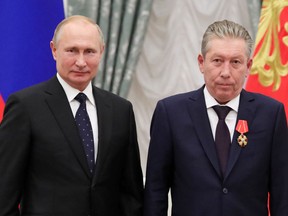
Russian
President Vladimir Putin and Lukoil Vice-President Ravil Maganov in
2019. Maganov was recently reported to have died after falling from a
hospital window.Photo by Mikhail Klimentyev/Sputnik/AFP via Getty ImagesFile
There
is nothing particularly new about political assassinations in Russia.
They happen with regularity; critics of the regime, its president,
suffer the consequences. Which doesn't stop the outrage of principled
people from breaking out of their cocoon of self-preservation from time
to time, succumbing to their outrage in however a brief period of
relieving themselves of the massive irritation they feel over the
Kremlin's political machinations in league with their president's
ambitions.
From
the time of the February invasion of Ukraine bizarre deaths of
prominent, wealthy, sometimes influential businessmen have occurred.
Mysterious deaths that on occasion also lethally victimize members of
their families. Mysterious mostly because the reason for these deaths
remains unknown. And those responsible are not about to enlighten the
puzzled onlookers who may themselves be the next victims.
From
mere days leading up to the invasion of Ukraine to the present time, a
line of up to eleven oligarchs and business executives, most with links
to Russia's largest corporations, and mostly involved with energy, have
been dispatched in accidents, suicides, murder-suicides and
suddenly-fatal health issues. One prominent Russian fell overboard from a
speeding boat in the Sea of Japan, just this past Saturday.
And
just before that occurred, the vice-president of Lukoil energy giant
lost his balance and fell from a window of a hospital where he was being
treated for an undisclosed malady. The series of strange fatalities has
aroused visions of a widespread menace despite Russia being a country
where assassinations are not uncommon.
Bill
Browder considers most of those deaths were simply murder scenes,
orchestrated by business rivals for greater assets from figures in the
energy industry, awash with wealth despite Western sanctions. He
believes these deaths were planned by the FSB the main
security-intelligence service of the country, and the trail points
directly to Vladimir Putin extracting his cut of resulting proceeds.
Not to be overlooked is that some of the dead had been incautious enough to speak their opposition of the war. "Let's
not forget that Putin does mix money and politics and I think he goes
after his enemies in both cases with equal amounts of cruelty and
potentially violence", said Marcus Kolga, a fellow of the Macdonald-Laurier Institute think-tank.
President
Putin lost no time making any measure of opposition to his invasion of
Ukraine a proposition of risk for anyone criticizing the "special
military operation" that has destroyed towns and villages, laid waste to
inner cities, killed thousands of Russian and Ukrainian servicemen and
many more thousands of innocent Ukrainian civilians.
Something
as offensive as calling the 'special military operation' a war,
referring to the brutality involved, or any other type of comment, can
net the offender up to 15 years in prison. It's possible that as an
alternative of the irreversible state of death, some of those marked out
for death would far have preferred the option of 15 years imprisonment,
but they had no choice in the matter.
Central Clinical Hospital in Moscow where Lukoil
executive Ravil Maganov is said to have died from a fall out of a sixth
floor window, September 1, 2022.Photo by Evgenii Bugubaev/Anadolu Agency via Getty Images
"He [his son] told her to talk to him now, to say goodbye, and to look after their two daughters."
"We reached the farm and tried to rush him to hospital, but he died on the way [a suicide by pesticide poisoning]."
Our only concern is running our livelihoods, we don't want to become rich or become politicians. We don't expect luxury, just roll back the laws."
Makhan Singh, 70, Sukhanwala, Punjab, India
"The government is not listening to our demands, these are laws that we do not want at all."
"We are all ready to get shot by the Delhi Police, rather than return home without the laws being repealed. We have already told our families we might die here."
Rana Rajvir Singh, trade union member, protest site, Singhu, outskirts of Delhi
"The new laws are totally anti-farmer and instead will benefit the private sector, who will start buying up land from impoverished farmers."
"The condition for farmers is only going to get worse and again, we will see a big rise in suicides."
Balvinder Singh, chief agricultural officer, Punjab Province
Protesting farmers at Singhu border area.
Two-thirds of India work in agriculture. Small-scale farming on an average of one acre or more per family. Otherwise known as subsistence farming. Where weather conditions can wipe out an entire crop and leave families reliant on whatever they can grow to see them through another year, must turn to small-scale loans to enable them to keep farming despite set-backs. And when those loans accumulate and other disasters intervene, despair sets in. If it isn't the debt load, it's seasonal flooding.
An estimated 3,300 farmers living and farming in destitution and perpetual worries committed suicide in the past twenty years in the district of Malwa where most farmers have a mere few acres of land to grow table crops. Theirs is a hard life made more difficult, they claim, by new laws known as the Farm Bills which are meant to permit large private corporations to dictate the price of produce. The end result is that small-scale farmers operating on narrow margins are squeezed for minimal profit.
Since 2016, the cost of land rentals and farm supplies have been rising at a rate faster than crop prices, leading to Malwa producing more than marginal crops; half of all farm suicides have occurred in the last four years. Farm supply price rises have been linked by some farming leaders to the government's measures to liberalize the farm economy, warning that suicide rates are increasingly likely to rise as a result of newly proposed agriculture laws to scrap fixed-price guarantees for crops in government markets.
In the state of Bihar, similar price-liberalization laws were previously implemented and farmers there point out that the sale price of 100 kg of rice has fallen from 1,900 rupees to 1,100 rupees. Lending credence at the very least to the critics claiming the three laws comprising the Farm Bills, will allow large private corporations to dictate the price of produce, the end result being that farmers' meagre profits will be even further squeezed.
According to the chief agricultural Punjab officer, 400 houses in Sukhanwala alone represent 90 percent of residents owing at least $3,500 to micro-finance companies and money lenders. Last month hundreds of thousands of farmers from Punjab and neighbouring states marched in a unity of purpose to India's capital New Delhi, to allow their grievances full rein and public view. An astonishing 250 million people participated in a nationwide strike in support of farmers on November 26, representing the largest demonstration ever to take place in world history.
New demonstrations are in the planning stages with a half-million farmers expecting to take part in a long-term protest to take place in New Delhi. The demonstrators are determined to travel to the capital in their tractors, packing along sufficient wheat, vegetables and clothing changes to sustain themselves for months in a prolonged show of strength and devotion to their cause, one of fair competition on behalf of small-scale farming enterprise.
There is support for claims of farmers' union leaders that local officials tend to be unsympathetic to their plight. In the Malwa region a general secretary of the ruling Hindu nationalist Aharatiya Janata Party, Sunita Garg, is unimpressed. "We are ready to make amendments to the Farm Bills, but we absolutely won't roll them back, we'll continue with the table talks." She is herself the owner of several Delhi factories, has a lavish home, sumptuous with designer luxury accents, even as outside elderly farmers prepare to bed down on the street for a 79th successive night of protest.
The Indian Supreme Court on Thursday refused the Indian government plea to ban the demonstrations, recognizing the farmers' right to protest. Under the radar is suspicion and distemper between Hindus and Sikhs in India, and the government's sensitivity to Sikh separatist sympathies, in support of a Sikh-sovereign homeland of their own, Khalistan. Ancient enmities persist, colouring relations between the two, ensuring that each in their own way continues to view the other as having malicious intent.
"The country has made up its mind, the country is committed to changes
in rules and regulations that the government is making to achieve the
dream of Atmanirbhar Bharat [referring to his plan
to make the country economically independent.]
"Agricultural reforms
that we undertook six months back have started benefiting farmers".
Indian Prime Minister Narendra Modi
Farmers protest Thursday on a highway at the
Delhi-Haryana state border in India. They have descended upon the
borders of New Delhi to protest new farming laws that they say will open
them to corporate exploitation.Manish Swarup/AP
This represents a general opinion site for its author. It also offers a space for the author to record her experiences and perceptions,both personal and public. This is rendered obvious by the content contained in the blog, but the space is here inviting me to write. And so I do.