Restoring A Vestige of Childhood in Ukraine
"These are children who live under constant shelling and are constantly in the risk zone. They're dealing with the trauma of survival, a direct struggle between life and death every day.""There were kids who were afraid of unfamiliar sounds and loud noises. There were those who didn't want to sit with their backs to the window, or to the door. There were kids who were constantly hugging, because you have to look for protection when there's the uncertainty of what's going on behind your back."Yulia Tischenk, staff psychologist Rehabilitation facility, Carpathian Mountains"They were all mentally and psychologically exhausted. Their nerves were shattered.""They have lung problems from being in shelters that aren't properly ventilated. They're breathing in toxic gases that are released from explosions.""Their vision deteriorates from being in the darkness, staring at screens. they have back problems from hunching over in shelters. They have poor motor skills from lack of movement.""There's basically no in-person social life for these children."Dmytro Vitvitsky, Creator, program operator"There are a lot of cases where unexploded shells go off.""Parents try to make sure the child does not walk anywhere, or go outside by themselves. It is hard, very hard. It affects the children very much. I can see it in my own child.""There was a boy whose father was a soldier who died on the front lines just before he arrived at the camp. He was trying as hard as he could to put on a brave face with the other children. But at one point he just ran to his room and cried into his pillow.""The child loses everything. Loses school, loses friends, loses their routine, even loses their mother and father -- all the familiar reference points. Each of their stories is different, but everyone's fate is broken."Victoria Avramenko, program mentor
 |
| A group of campers on the night of Ivana-Kupala (Courtesy of Strokatienoty Camp) |
As the children disembarked from the bus carrying them to the Alpine-style resort in the mountains of western Ukraine, it would have taken a keen eye to distinguish them from any other ordinary busload of children heading off to summer camp. Soon enough the symptoms of 'differences' became evident to the psychologists and teachers awaiting their arrival. Some of the children were withdrawn to the point they were unable to speak while others would begin fighting with no provocation or throw emotional fits.
Girls in particular tended to burst into tears and refuse their meals. They represented part of a program whose aim was to help Ukrainian children living on the front lines of the conflict with Russia that was created by a Ukrainian NGO based in the city of Lviv that brought psychologists, educators and physical therapists together to help treat the children for ailments caused by daily bombardment.
From regions where fighting rages on -- Kharkiv, Donetsk and Luhansk in the east, Zaporizhzhia, Mykolaiv and Kherson in the south. These are children who spend up to 15 hours daily in bomb shelters and cellars when their towns are bombarded with rockets, drones and artillery. It was to be expected that the children would suffer psychological trauma living in conflict zones, what is less recognized is that they can also suffer chronic physical ailments.
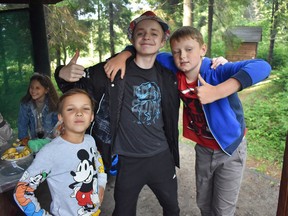 |
| Some of the Ukrainian children manage to put on a brave face despite struggling with overwhelming loss. Photo by Greg Gransden |
Schools in front line areas never returned to in-person learning following COVID as a result of the war, and the social isolation imposed on the children made their situation even more dire. These are children in their fourth year of online education, living in towns and cities where gyms and sport arenas were destroyed, and where mines and unexploded ordnance can be anywhere. Then there is the overwhelming loss many of the children struggle with.
Some of the children's parents have quite simply disappeared, or were stranded in areas under Russian occupation. Some of these children in their early teens have had to take on the role of the missing parents for their younger siblings. The rehabilitation camp programs were aimed to give the children a sense of normalcy, with film nights, field trips into the mountains, fishing, regular meals and free time to hang out with new friends.
Art therapy, storytelling, music and physical therapy were all offered, along with sessions with psychologists to equip the children to cope with stress, such as breathing exercises, to enable them to calm themselves and work their way through trauma. "They became calmer, they started to smile, they started laughing, they became more active, more alive. They started talking to each other. We can't cure them in two weeks, but we can stabilize them so they're not deteriorating", explained Vitvisky.
There was no charge for children to attend the camps. 124 children in total attended over the course of five two-week sessions. 300 applications for 20 places in the program were received by the final session. The camps had been funded by a German charity. The foundation is anxious to operate the camps again this year, but the funding has been elusive to this point.
It is always Russia in some way affecting Ukraine and the lives of the Ukrainian people. When the Chernobyl nuclear accident occurred, children were similarly affected. For years afterward Ukrainian children went abroad for summer relief as a charitable venture to bring some calm to affected children and restore a semblance of childhood normalcy for them. It was Soviet Russia that was responsible for depriving Ukraine of its own agricultural products and brought mass starvation to the country during the Holodomor.
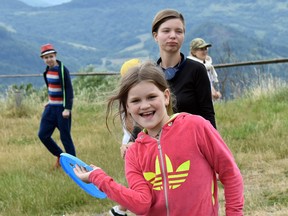 |
| The Ukrainian children suffer psychological trauma from being in conflict zones, but also chronic physical ailments. Photo by Greg Gransden |
"There is a real need there. Nobody prepared for this war. We weren't ready, neither psychologically nor physically.""When peaceful life begins and children return to normal life, go to school and go to kindergarten, it will be very difficult for them to adapt.""And we need to be prepared and we need to do some work today to help these children."Yulia Tischenko
Labels: Childhood Trauma, Psychological Harm, Russian Invasion of Ukraine, Summer Camps
posted by Pieface @ Tuesday, May 30, 2023