Wednesday, July 07, 2021

Out of Harm's Way

"[There was] heightened concern [over the fighting but Russia has no plans to send troops to assist Tajikistan]."
"We have repeatedly said many times that after the withdrawal of the Americans and their allies from Afghanistan, the development of the situation in this country is a matter of our heightened concern." "We’re monitoring it very closely and are noting that destabilization [of the situation] is taking place, unfortunately."
Kremlin spokesman Dmitry Peskov
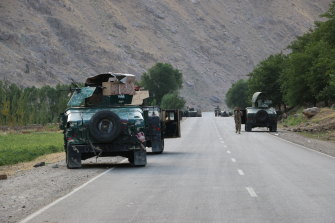
Feeling Afghan soldiers pause on a road at the front line of fighting between Taliban and security forces,  near the city of Badakhshan, northern Afghanistan on Sunday.
Fleeing Afghan soldiers pause on a road at the front line of fighting between Taliban and security forces, near the city of Badakhshan, northern Afghanistan on Sunday.  Credit:AP

The U.S.-led NATO mission in Afghanistan to free the country from its Islamist Taliban chokehold spent two decades attempting to do just that, and failed. Former Afghan President Hamid Karzai stated his regret that the foreign forces in his country failed in their objective, while adding that their presence and aid to the country had helped it enormously. Now, with their departure, all the advances in human rights, in improvements to living conditions, will go into reverse. Many foreign missions have closed in the capital Kabul, others are still operating on stiffly reduced staff levels. It is clear that foreign emissaries are loathe to leave the country, but they will.

One can only guess the conversations in t he Kremlin. Russia knows how defeat in Afghanistan feels, although from their own inimitable angle. Their decade in Afghanistan was even more disastrous and deadly to Soviet troops in direct confrontation with Afghan tribal fighters than what the U.S. and NATO troops encountered. Throughout its history Afghanistan has been occupied but no invasion has quelled the resistance of Afghans to foreign invasions, including that of Alexander the Great. Britain and Russia in the 19th century competed for 'control' of Afghanistan as a gateway for trade prospects and they too were repelled.

The irony is that while Soviet troops were mired down in Afghanistan in constant brutal combat, U.S. intelligence was training and supplying funds and weapons to fighters from the Muslim world that converged on Pakistan in the border area between Afghanistan and Pakistan, to help mount a resistance to Russian occupation. The 'fighters' that bedevilled the Russian troops became the seed of the Taliban and of al Qaeda. The very monstrous Islamist terrorists now threatening to retake Afghanistan in record time. They no longer even need the assistance of the Pakistan secret service to achieve their goal.

The Afghan forces, trained by NATO special forces in best fighting practices distinguished themselves in the opinion of Western forces by their propensity to simply go AWOL when the mood struck. And nor were they particularly assiduous pupils in modern warfare since what they faced was assymetric warfare and guerrilla tactics by an adversary far more motivated and in the passion of religious fervour. Afghan security forces were  unable to match the passion and the strength and reputation of the Taliban, and were not as well armed both with weaponry and with courage.

Just as Iraqi troops melted away in panic leaving their arms, armoured vehicles, rocket launchers and populations undefended at the advance of the Islamic State of Iraq and the Levant when it was on a roll, marching in to Syria and Iraq, capturing territory, expanding their 'caliphate', their fearsome reputations preceding them, sending panic into the hearts and souls of regular military, so too has the Afghan security forces reacted similarly. And who can blame them? As heedless of human rights and as wedded to mass murder and atrocity-commission under the banner of religion, as ISIL, the Taliban is facing little resistance now that foreign military troops are being withdrawn.  

Everything left behind in the U.S. departure; personal vehicles, armoured military vehicles, in the custody of the government of Afghanistan will now fall to the possession of the Taliban, a situation with a familiar ring; to the victor goes the spoils; as with the Islamic State, so too with the Taliban; cut of the same barbaric cloth, representing the very same ideal of  fundamentalist Islamist entitlements in vanquishing an enemy and inheriting the spoils of victory.
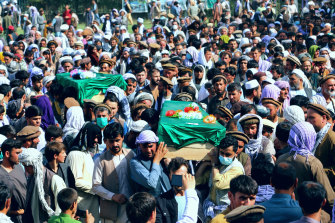
Afghans carry the body of civilians killed during fighting between the Taliban and security forces, during their funeral in Badakhshan province on Sunday.

Afghans carry the body of civilians killed during fighting between the Taliban and security forces, during their funeral in Badakhshan province on Sunday.   Credit:AP

So, an estimated one thousand Afghan troops fled the confrontation they faced with the Taliban, leaving their country rather than defending it from the hugely successful Taliban. Crossing the border into Tajikistan, the Tajik government accepted their presence for asylum, providing them with food and the assurance of safety from the Taliban, for the time being. Tajikistan's president ordered 20,000 of the country's military reservists to be mobilized at the border following the ingress of the Afghan troops in the face of Taliban advances.

International distress calls went out from Tajik President Emomali Rakhmon with allies. Russian President Vladimir Putin, despite Russia's large military presence in Tajikistan, a former satellite of the USSR, withheld offers of military assistance against the Taliban, assuring his Tajik counterpart that Moscow would give its support to the former Soviet republic in establishing its border if required, through a regional security bloc.

The Taliban have wasted no time. Even before the hasty departure of the U.S. troops and their allies, urged on by the Taliban, with promises that they would never again permit any attacks on America to be launched from the soil they once again inherit, while deeply engaged in peace talks with the government of Afghanistan in a blunt show of Islamist pretense, bloody lethal attacks were continually taking place with the Taliban terrorizing Afghan troops, national police and civilians alike, the death toll ever growing to ensure the message was received and well understood; resistance would be futile.

Two days following the vacating of the American main Bagram Air Base on the start of withdrawing all troops by the iconic date of September 11, six key districts in the northern province of Badakhshan bordering Tajikistan and China fell to the Taliban. Once again, Afghanistan is set to become their 'caliphate'. "The Taliban cut off all the roads and these people [1,037 Afghan servicemen] had nowhere to go but to cross the border", said a senior Afghan official.

In this handout photo released by Border Troops of the State Committee for National Security of the Republic of Tajikistan on Tuesday, June 22, 2021, Afghanistan's government soldiers sit at a bridge next to Tajikistan-Afghanistan border in Tajikistan. 134 servicemen of the government forces of Afghanistan were forced to retreat through of the Panj frontier detachment into the territory of the Republic of Tajikistan on Tuesday, June 22, 2021. The Taliban's march through northern Afghanistan gained momentum overnight with the capture of several districts from fleeing Afghan forces, several hundred of whom fled across the border into Tajikistan, officials said Sunday. More than 300 Afghan military personnel crossed from Afghanistan's Badakhshan province as Taliban fighters advanced toward the border, Tajikistan's State Committee for National Security said in a statement.
This group of Afghan soldiers fled to Tajikistan in June  Tajik border troops


Labels: , , , , ,

Monday, May 03, 2021

Surrendering Afghanistan : Taliban Central 'Improving Security'

The abandonment of Afghanistan will long be remembered by countries around the world as they weigh their choices between the US and authoritarian regimes. Already Saudi Arabia has recognized that Biden will not protect them from Iran, with his administration rushing headlong to rejoin the catastrophic nuclear deal and withdrawing support to the Kingdom in its fight against Iranian proxies in Yemen. Fearful for their future, the Saudis know they cannot stand alone against Iran and have opened talks with Tehran, a move that could only harm US interests in the region.
Richard Kemp, Gatestone Institute
Jihadists everywhere would be encouraged and empowered by a perceived US defeat at the hands of the Taliban, which was being trumpeted by Al Qaida within days of Biden's withdrawal announcement. Pictured: Security personnel and local residents gather on May 1, 2021 at the site of a car bombing where, in the attack the previous day, at least 24 people were killed and 110 wounded, in Logar province, Afghanistan. (Photo by AFP via Getty Images)

"It is like we are on an island. I can't drive more than four kilometres in any direction without hitting a Taliban checkpoint."
"We used to drive out to the villages to every district and talk to the people. Now that we cannot speak to the people, how can we know what their problems are?"
"Day by day the government [-controlled] area is getting smaller and smaller."
Mahmad Yusef Ayobi, head, Kunduz Province provincial council
 
"[All the highways out of Kabul] were unsecured, so we have posted our mujahedeen [Taliban fighters] to ensure security day and night."
"We are not restricting common people but are keeping watch of the movements of the enemies [the government of Afghanistan] and their military." 
Zabiullah Mujahid, spokesman, Taliban
Taliban soldiers sit on tank on the outskirts of Kabul.
Taliban soldiers on the outskirts of Kabul, Afghanistan, 1999. Amir Shah/AP Images

Under former President Trump's administration, talks with the Taliban were initiated. Ostensibly to persuade the Islamist fundamentalists to agree to reconciliation with the government of Afghanistan, democratically elected to represent the will of the people, anxious not to return to the era of viciously restrictive Taliban rule, to reach an agreement for peace and co-existence. All the while Americans were negotiating with the Taliban, there were violent, deadly attacks against Afghan government positions as well as American and NATO mission sites and allied troops.
 
No one can have been under any illusions that the Taliban had any agenda other than to defeat and destroy the elected government and to replace it with their own freedom-stifling rule. Where under the Taliban previous rule strict Sharia prevailed; no music, no dancing, no women permitted in public, men whipped for shaving, women beaten for not wearing complete body-and-face coverings. Death meted out to those who defied Sharia law. No school for girls, no work for women who had to be squestered within four walls. Women could be medically treated only in hospitals for women. Female surgeons in the operating room to wear burqas.

Farmers encouraged to grow opium poppies for Taliban profit. Boys and girls both sexually maltreated. Male teens surrendered for Taliban fighter training. Democracy once again relegated to oblivion. Return of the Islamic Emirate of Afghanistan. Afghanistan's police force and its military, trained over the past decade and more by NATO affiliate nations that entered Afghanistan led by the United States in 2002 
proved to be less than stellar students. Not quite committed to their jobs of protecting their country. Too many unauthorized stealth absences from duty, an unwillingness to face their obligations.
 
U.S. Black Hawk military helicopters fly over the city of Kabul, Afghanistan, on April 19. (Rahmat Gul/The Associated Press)
 
Taliban leadership refused to speak directly with representatives of the Afghanistan government leadership, considering them loyal to the U.S., appointed by the United States to act as the U.S. saw fit and for whom the Taliban had no love. They would speak directly to them, they insisted, on the final departure of all foreign troops from the soil of Afghanistan. The Taliban which now controls a larger proportion of the country since its ouster in 2003, shields al Qaeda and ISIS, both groups firmly established near the border with Pakistan.

There is, at this juncture, less confidence among the government of Afghanistan leaders than there is among the leadership of the Taliban that they will prevail. There will be conflict on the final departure of U.S. troops in September, bloodshed is inevitable. In the meantime, the Taliban consolidate and secure their positions installing new checkpoints on abandoned Afghan government troop security checkpoints. Abandoned because of a lack of manpower with the withdrawal of U.S. troops.

Afghan towns and cities are increasingly isolated, straining the Afghan government's capacity to function in the face of dozens of temporary Taliban checkpoints along main highways leading to and from the Afghan capital. The country's main north-south highway is checkered with Taliban checkpoints. Traffic cannot proceed without being stopped, the outposts along the major highways interrupt military resupply routes and the provision of government services.

The Taliban power plays encroaching on critical roads emphasize the undiminished group despite two decades of war, in preparation for a military showdown once foreign military support for Afghan security and support of the government is completed. A year earlier the head of Kunduz's provincial council, Mahmad Yusef Ayobi would ordinarily drive eight hours south from Kunduz to Kabul for meetings. That is no longer possible. Government officials now make that trip by air.
 
An Afghan National Army soldier holds a machine gun at a checkpoint on the outskirts of Kabul, Afghanistan, on April 21. (Mohammad Ismail/Reuters)
 
Armed convoys with heavy security are required should such trips be considered driving along highways. The situation of government securing and maintaining highway control has deteriorated in lock-step with the withdrawal of U.S. forces. Leaving Afghan forces stretched thin; Afghan police and soldiers unable to secure territory, moving instead inward to protect population centres, leaving large provincial rural territory unguarded, along with the roads leading to and from them.

At the same time the opportunity presented itself for the Taliban to launch a series of military offensives, encircling government-held territory throughout the country while U.S. negotiators scrambled to arrange a peace agreement between the Afghan government and the Taliban-government-in-waiting in the hopes of preventing more violence, all without progress toward that ideal. "Highways are important for us, and we have taken serious measures to suppress the enemy on them completely", bravely stated the Afghan Interior Ministry.
 
Afghan National Army soldiers search men at a road checkpoint on the outskirts of Kabul, Afghanistan, on April 28, 2021. (Wakil Kohsar/AFP/Getty Images)
 
After the U.S.-led invasion to oust al-Qaeda and the Taliban protecting them, the United States invested $3 billion repairing the country's highways, recognizing them as key to security and economic stability. They now represent the most dangerous parts of the country for ordinary Afghans. "It's all Taliban country now", Muhamadi, a 24-year-old taxi driver, states from his perspective of shuttling passengers daily between Kunduz and Kabul for the past three years.

Nafi Pashton, 32, explained that the Afghan troops stationed at a few bases remaining along the southern highway will not leave their fortifications, fearful of Taliban attacks. They wave down taxis to have provisions passed along to the next government outpost, a few kilometres away on the highway. "They give me food, oil, meat. It happens a lot." Taliban fighters sometimes stop him to confiscate the supplies, while at other times he is able to deliver the goods to government forces.
"Like a kettle of vultures, Pakistan, Iran, China and Russia will all be circling the Afghan carcass following US withdrawal. Iran, which has long provided weapons, funding and safe haven to the Taliban, has been building its influence with them in recent months. Russia has also helped fund and arm the Taliban — sometimes in collaboration with Iran — to kill Afghan, US and NATO forces in order to challenge the US and increase its own influence in the country. China too has been cooperating with the Taliban, both to hunt down and kill Uighur Muslim leaders and in its hunger for natural resources. It also sees influence in Afghanistan as a means to confront New Delhi. Beijing knows that India, as a US ally and democracy, is the only regional power that could play a genuinely constructive role in a future Afghanistan. Xi is not willing to see that happen."
"Pakistan, in cahoots with China, is also determined to keep India out of Afghanistan. Its Inter-Services Intelligence Directorate created the Taliban and today remains by far the greatest external backer of its campaign against Afghan and international forces. Islamabad sees the country as vital strategic depth in a future conflict with India and intends to hold sway over a future Taliban regime in Kabul. But it might have to pay a severe price it did not anticipate as it recklessly fuelled the conflict: a flood of Afghan refugees fleeing the Taliban onslaught. They would join the vast number already there, which Islamabad struggles to support. By the end of 2001, 4 million Afghan refugees were in Pakistan, with 1.4 million still there today. This will not be a problem for Pakistan alone; Iran, Turkey and Europe may also face a huge additional influx. Even before Biden's withdrawal, Afghans are already the second largest migrant population in the world."
Richard Kemp, Gatestone Institute
U.S. military helicopters are seen landing at a base in Bagram, Afghanistan, on Thursday. The U.S. is estimated to have spent more than $2 trillion in Afghanistan in the past two decades. (Wakil Kohsar/AFP/Getty Images)


Labels: , , , , ,

Follow @rheytah Tweet