Thursday, April 04, 2024

Ukraine's Calling Cards in Russia's Interior

"[At least two production lines had been assembled in Yelabuga, and Moscow had managed to establish independent production of drones]."
"More spare parts and components are now coming from other countries, so it is not all about Iran."
"Moscow's goal is to reach a full, closed production cycle of such unmanned aerial vehicles in Russia by 2026."
Deputy Head of Ukraine's Military Intelligence, Vadym Skibitsky 

"It is more than 1,000 kilometers from the border with Ukraine, and the Russians saw that this was a big problem."
"It turned out that this production facility in Tatarstan, in which they invested a lot of money, is not rare." 
"Weapons are reaching there, and air defense will not save them. I think this is just the beginning."
Oleksandr Kovalenko, military analyst, co-founder, Information Resistance project
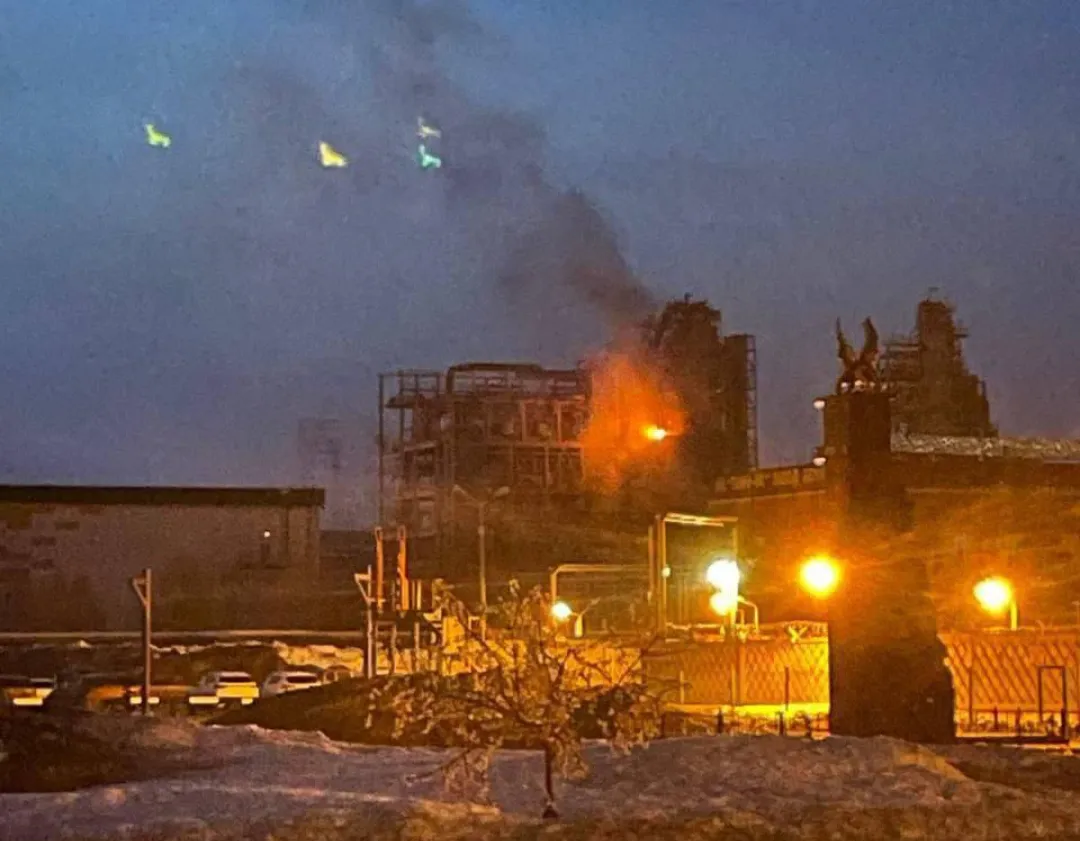
https://assets.kyivindependent.com/content/images/2024/04/Polish_20240402_111355744-1.webp
Attack on the oil refinery In Russia's Nizhnekamsk. (local Telegram channels)

One of Russia's largest oil refineries and a drone factory located in the Russian province of Tatarstan were attacked by Ukrainian drones in what seems to be the deepest strike yet by Kyiv within Russian territory. The facilities are located near the cities of Yelabuga and Nizhnekamsk, some 1,200 kilometres east of Ukraine. Russian regional authorities reported that a dozen people were injured.

Russian refineries and oil terminals have become priority targets in recent months of Ukrainian drone attacks. Reflecting stepped-up assaults on Russian territory. Which seems a fair balance of events. Given that Moscow feels entirely entitled to attack and occupy Ukrainian sovereign territory, declaring them henceforth to be part of the Russian Federation. At the same time Vladimir Putin seems to feel that Russian territory is sacrosanct, and Kyiv is engaging in forbidden moves attacking inside Russian territory.

Drone developers in Ukraine have been extending the range of their weapons' productions. Resulting in Kyiv compensating for its battlefield disadvantage in troops and weapons supplies. The unmanned vehicles represent for the weapons-strapped Ukraine military an affordable option, while awaiting promised  additional U.S. military aid which has created a critical shortage in its delay.

The 1,000-km front line has seen relatively little activity from either side, as both Russia and Ukraine find themselves at a stalemate; both are short on troop replacement. While Moscow has trumpeted that it has gained new conscripts as a result of public outrage over what it claims is Ukraine's deadly terrorist assault last month on a Moscow concert hall that killed 140  people, President Zelenskyy has signed a bill lowering the conscription age from 27 to 25, in the hope of filling at least part of the military's request for 500,000 new recruits.

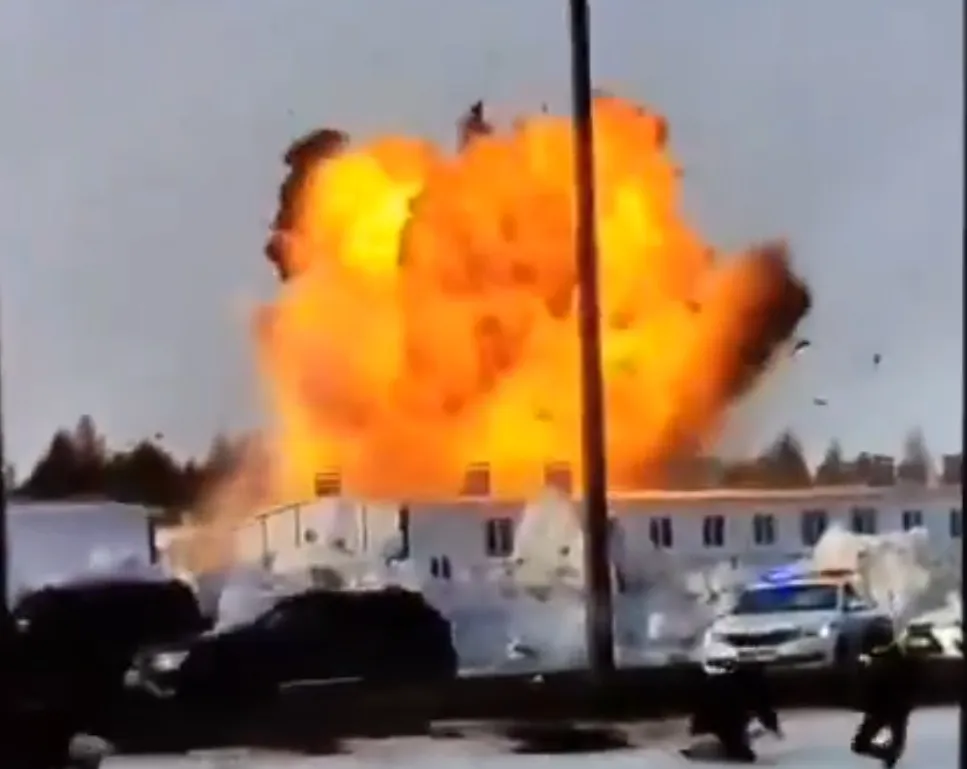
According to Ukrainian security and intelligence officials a "drone-production site" in Yelabuga was targeted with the use of Ukrainian-produced long-range drones. Near Yelabuga a factory engaged in building Iranian-designed Shahed exploding drones was the surprise recipient of Ukraine's very effective calling cards. An overnight attack on the Nizhnekamsk oil factory was also in the cards, according to Ukrainian officials.
 
https://assets.kyivindependent.com/content/images/2024/04/Polish_20240402_095738461.webp
UAV attack in Tatarstan, Russia on April 2, 2024. (screenshot from a video on social media)


Labels: , , ,

Thursday, May 18, 2023

The Plans of Mice and Men Gang aft a-gley


"The enemy's mission is to sow panic and create chaos."
"However, in the northern operational zone [including Kyiv], everything is under complete control."
General Serhiy Naev, Commander, Joint Forces of the Ukraine Armed Forces

"It is worth noting that Russia's designation for the Kinzhal as a 'hypersonic' missile is somewhat misleading, as nearly all ballistic missiles reach hypersonic speeds [i.e., above Mach 5] at some point during their flight."
Center for Strategic and International Studies (CSIS)
 
"A year ago, we were not able to shoot down most of the terrorists' missiles, especially ballistic ones."
"And I am asking one thing now. If we are able to do this, is there anything we can't do?" 
Ukrainian President Volodymyr Zelenskyy
A large flash of light in the sky and a vapor trail appear over a city at night.
The night sky lights up in Kyiv, Ukraine, early on Tuesday. Air raid sirens blared across nearly all of Ukraine early on Tuesday and were heard over the capital and its region for more than three hours during the Russian missile attack. (Gleb Garanich/The Associated Press)

According to news out of Kyivm Ukrainian forces shot down six Russian Kinzhal missiles on Tuesday night, thus thwarting a weapon held by Moscow boasting weapons upsmanship as the next-generation hypersonic missile, all but unstoppable, a weapon so powerful that NATO had reason to shiver in its collective boots. Ukraine appears to have demonstrated that nothing is impossible.

An entire volley of Kinzhal missiles has for the first time been struck by Ukrainian defence; a demonstration of Kyiv's newly deployed Western air defence effectiveness. All of Ukraine heard air-raid sirens blaring for over three hours early Tuesday, warning the population of incoming missiles in Moscow's all-out war against Ukraine -- President Vladimir Putin's bitter project of subjugation of a defiant nation.

A volley of 18 missiles had been flung overnight into Ukraine, the six Kinzhals among them, and as they were struck by Ukraine defences, the sky lit up with their shattering and their detritus rained down on the landscape. Which Western-supplied defensive weapon Ukraine had relied upon to stop the Kinzhals was not released by Kyiv.

On Russia's part a different story, as usual, is heard with the defence ministry claiming to have destroyed a U.S.-built Patriot surface-to-air missile-defence system struck by a Kinzhal missile, according to a report by the Zvezda military news outlet. Yet, Valeriy Zaluzbnyi, commander-in-chief of Ukraine's armed forces affirmed that all of the missiles had been intercepted successfully. 
 
"It was exceptional in its density -- the maximum number of attack missiles in the shortest period of time", stated Serhiy Popko, head of Kyiv's city military administration.The Russian military was quoted by Zvezda as describing the attacks aimed at Ukrainian fighting units and ammunition storage sites. 
 
Contradicting Russian news sources, Commander-in-chief Valeriy Zaluzhni stated his forces intercepted the six Kinzhals launched from aircraft, along with nine Kalibr cruise missiles from ships in the Black Sea, and three Iskanders fired from land. Which must surely leave the targets wondering how many of these deadly projectiles are left in Russia's stockpile?

With the use of a newly deployed U.S. Patriot air-defence system, earlier in the month Ukraine had announced it shot down a single Kinzhal missile over Kyiv for the first time. While the U.S. military confirmed this, whether the Russian missile was flying at hypersonic speed at the time was not mentioned. According to U.S.-based CSIS, the Kinzhal rapidly accelerates to Mach 4 (4,900 km/h) after launch and speeds of up to Mach 10 -- ten times the speed of sound -- may be reached.

Kinzhal -- which means 'dagger' in Russkij -- is capable of carrying conventional or nuclear warheads up to 2,000 km. The weapons were used by Russia for the first time in Ukraine last year. It costs a whopping $10 million to produce each Kinzhal missile. The question might be how many does Moscow have of these to spare? If they're being shot down and destroyed by Ukrainian defences how many more is Putin willing to lose in his waning conflict with Ukraine?

Vladimir Putin has repeatedly spoken proudly of the Kinzhal as proof of Russia's capacity to produce technically outstanding weapons of a superior type that would outclass anything produced by the West. If Mr. Putin believed that by deploying the hypersonic missiles in his Ukraine conflict which has become a debacle for him and for Russia, that he would prove the exceptionality of Russia's fighting force and weaponry, he appears to have calculated poorly.

It is obvious that in anticipation of Ukraine's intention to launch its spring counteroffensive, the first such operation in six months, Mr. Putin chose to make the move hoping to overwhelm Ukrainian forces with the size, velocity and anticipated success of launching powerful long-rage airstrikes at such high frequency. Matters have not proceeded in this bid for hegemonic conquest the neat and formalized way that Mr. Putin designed them to.

In the past week alone Ukraine has foiled Russian expectations as Ukrainian forces made large gains on the battlefield on the northern and southern outskirts of Bakhmut, the region and the city that Vladimir Putin was determined would mark a great victory for Russia on the eve of its annually-celebrated Victory Day. A sour outcome for a Russian leader who bit off more than he could chew.

Firefighters hose down a fire, at night, in front of the burning remains of two buses.
Firefighters work at a site damaged by Russian missiles in Kyiv on Tuesday. (State Emergency Service of Ukraine in Kyiv/Reuters)


Labels: , , , ,

Monday, April 10, 2023

Overworked Propaganda or the Real Thing?

"Since the USSR's collapse, Russian intelligence has degraded to the extent that the only way to redeem itself after "Salisbury" and 'three-day plans' is to photoshop and fake leaks."
"[The documents represent yet another Kremlin disinformation effort, and the Russian army will see the real plans on the ground soon."
Mikhailo Podolyak, adviser to Volodymyr Zelenskyy

"[The five documents, marked [top secret] gave away valuable intelligence ahead of Ukraine's spring counteroffensive.]"
"[Representing a] first breakthrough for Russian intelligence."
"In particular, there were graphs of the expected supply of weapons, the number of troops and the consumption of ammunition."
Telegram channel with links to FSB security services
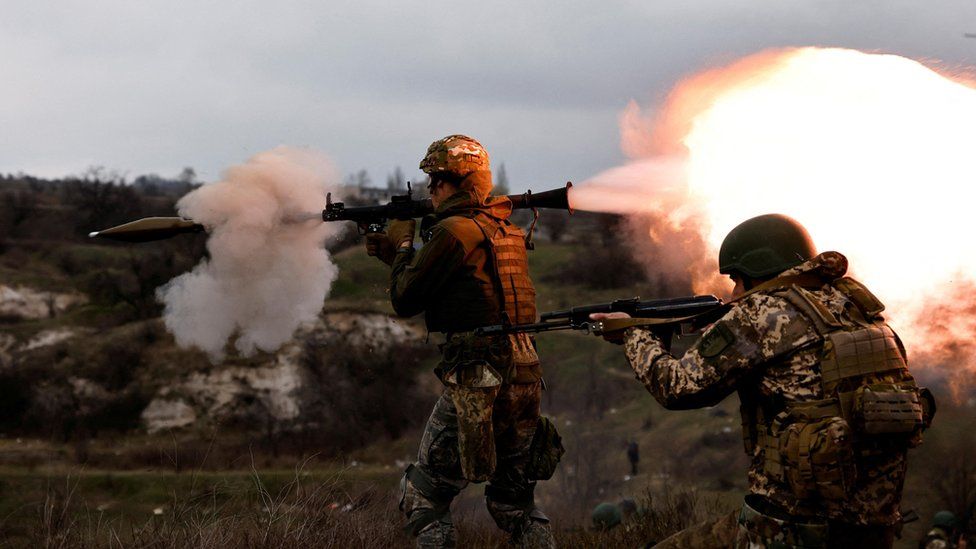
New Ukrainian army brigade recruits take part in a military exercise conducted by a foreign instructor
The documents include detailed accounts of the training being provided to Ukraine by foreign powers  Reuters

That "top secret" American battlefield intelligence was leaked and appeared on Russian social media has caused the Pentagon to open an investigation. Clearly the U.S. is less than pleased that Russian propagandists are gloating over a trove of documents that fell into their hands, detailing Western assistance meant for Ukraine. Kyiv, on the other hand, insists the information is entirely fake.
 
In Mikhailo Podolyak's opinion referring to the 2018 poisoning of a Kremlin critic in Salisbury England along with his daughter, and the Kremlin's failed aspiration to complete its capture of Ukraine within three days, their bark is bigger than their bite. He was responding to a Telegram channel with links to Russia's FSB boasting of a breakthrough in insider intelligence alerting Moscow to highly secure U.S.-Ukraine secret military details.
 
Dated between February 23 and March 1, the documents reflected training schedules and locations for Ukrainian and Russian military units and artillery guns along the front line. Also purportedly revealed, estimates of timelines of when muddy spring conditions in southern and eastern Ukraine would suffcently dry to enable swift tank advances on Russian positions.
 
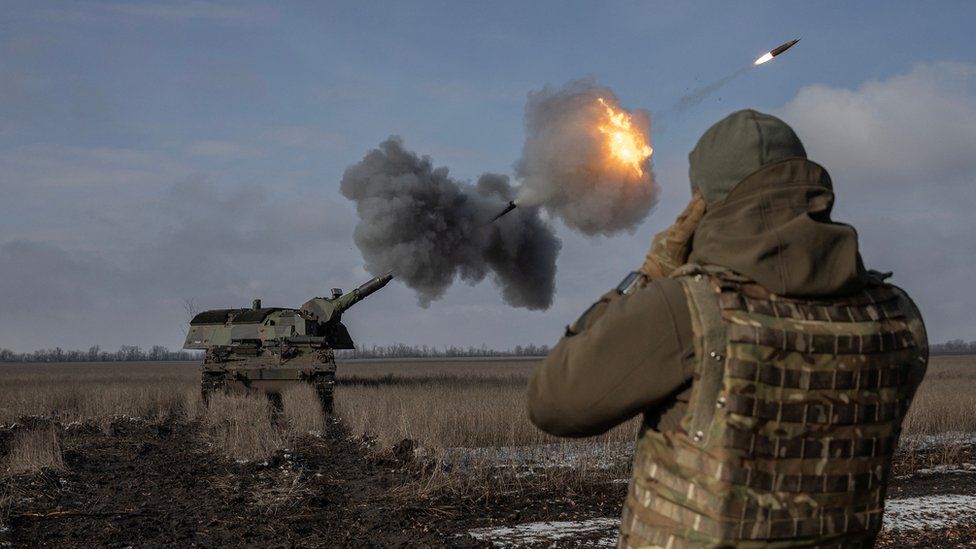
Ukrainian soldiers fire a German howitzer Panzerhaubitze 2000
Ukrainian soldiers fire a German howitzer Panzerhaubitze 2000   Reuters
 
Twitter users were quick to notice that the photos of the documents published by Russian Telegram channels seem to have been altered. The original social media posts showed the documents listing 43,500 Russian soldiers and 17,500 Ukrainian soldiers had died in the 13 months since the start of the invasion. It was noted that later the statistics were altered to show 17,500 Russian troop losses compared to 71,500 Ukrainians.

The documents, according to Podolyak, were more Kremlin disinformation efforts. The Russian army, he said, "will see the real plans on the ground soon", although the Pentagon stated it was taking the leaks seriously. Deputy press secretary Sabrina Singh at the Pentagon, said "We are aware of the reports of social media posts and the department is reviewing the matter.".

Along the front line, Ukraine has been building up forces all year, not disclosing where or when it plans to begin its counteroffensive. German media was informd by the U.S. secretary of state Antony Blinken that he expected the counteroffensive to begin in "coming weeks".  Location of the counterattack has specuattion focused on the occupied town of Melitopol, south of the Dnipro river, the southern front line.

https://i.ytimg.com/vi_webp/h1foRGZhwZo/maxresdefault.webp
Following disclosure of the leak, Reuters has reviewed more than 50 documents labelled "Secret" and "Top Secret" that first appeared last month on social media websites, beginning with Discord and 4Chan. While some of the documents were posted weeks ago, their existence was first reported Friday by the New York Times.

Labels: , , , ,

Follow @rheytah Tweet