Wednesday, July 15, 2026

Ukraine Unsettling Russia in Crimea

"There's no place to hide in Crimea."
"The Ukrainians have the ability to touch every single place where there's an air defense weapon or a logistics hub or an airfield."
Lieutenant General Ben Hodges, retired commanding general of U.S. Army Europe 
 
"To achieve the final objective, this blockade must be intensified."
"This situation must be maintained for a sufficiently long period of time."
Kostiantyn Mashovetz, Ukrainian military analyst
 
"According to announcements by Ukraine’s drone forces, the USF (Unmanned Systems Forces), dozens of electrical substations or other power infrastructure have been hit by Ukrainian robot aircraft across Crimea in recent weeks, with 38+ strikes claimed in the first week of July and 45+ in the second week of July. Besides power transmission and generation infrastructure, attacks have hit gas distribution stations and compressor stations."
"Most of the strikes have been carried out by Ukraine’s workhorse FP-2 push propeller drone, a slow-flying plane roughly the size of a large sofa. USF commanders have said attacks against the Russia-run power grid in Crimea are succeeding because of months of preliminary attacks that hit and destroyed Russian air defenses. The top Ukrainian target in those preparatory drone attacks has been Russia’s Pantsir gun/missile system, an air defense weapon designed to shoot down drones."
Stefan Korshak, Kyiv Post Senior Defense Correspondent 
Temporarily occupied Crimea (Photo: Reuters)
 
Crimea, annexed by Vladimir Putin in 2014 is being given very special attention at this point in time, a dozen  years later by the Ukraine military, where attacks in recent weeks have been increased substantially for the dual purpose of returning the critical geography to its rightful owner, as well as depriving the Russian military of its supply lines. The Kerch Strait Bridge is in Ukraine's crosshairs, the sole direct link to Russia. Ukraine has targeted bridges and roads in its bid to transform the peninsula from its current status as a Russian-occupied fortress into a military nightmare for the Kremlin.
 
This most recent wave of attacks saw Ukraine targeting air defense and radar systems across the peninsula. The energy grid and fuel reserves have also received attention from the Ukrainian military, battered to the extent that blackouts occur, shaking life in Crimea. Causing Russian forces along the southern front to shift into defensive mode. 
 
In the last week alone, Russia bombarded Kyiv, killing 30 people, in its own show of retaliatory force; its usual tactics, targeting civilian enclaves claiming they were aiming at military targets. A stark contrast in military priorities, where Kyiv focuses on military installations or fuel depots to deprive Russia of its critical fuel lines, and Moscow's response is to hit civilian areas.
 
Moscow's special attention toward its prize restoration of Crimea as part of Russia saw to it that years were spent fortifying the geography with advanced air defenses and coastal batteries, fighter jets and bomber-packed airfields -- while on land, missile launch systems abounded. Russia gave itself direct access to Crimea when it built the $3.7 billion Kerch Strait Bridge. 
 
Even in the conflict's first years, Ukraine had targeted Russia's naval headquarters in Sevastopol, driving Russian warships from Crimean ports. They were limited however, by the weapons in Ukraine's possession at that time. According to Ukrainian officials now, their arsenal is capable of inflicting more pain, in essence sufficiently so, to convince Moscow it needed to return to the negotiating table. 

A black and white image shows a tanker at sea at night.
The view from a Ukrainian drone during what the military says was a strike against Russian tankers in the Sea of Azov. (Commander of Unmanned Aerial Systems Force/Reuters)
 
Videos were posted by Ukrainian military units in June of their Crimean strikes. The clips are a vital part of Ukraine's wartime propaganda, illustrating battlefield successes against Russia. Russian forces were increasingly attempting to counteract Ukrainian drone strikes by patrolling critical southern routes with drones and interceptor units, according to Kateryna Stepanenko, analyst at the Institute for the Study of War. "But they need more mobile air defense to blunt the impact of Ukrainian strikes" she noted. 
 
Ukrainian commanders anticipate that Russian troops would adapt, to shift their tactics in turn: "Adaptation can take days, weeks or months, but we consistently find new ways to strike in any direction, at any depth, with whatever assets we have", stated Artem Bielienkov, chief of staff of Ukraine's 412th Unmanned Systems Brigade. 
 
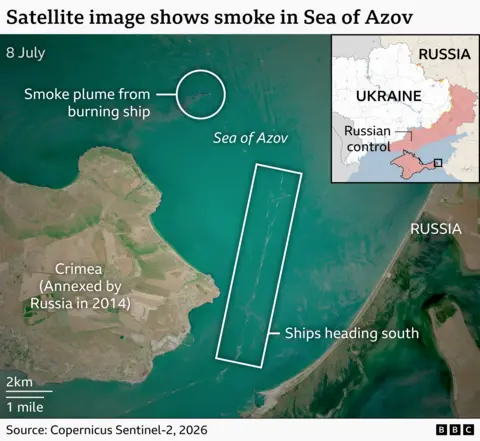
Widespread blackouts in Crimea have resulted from strikes on fuel facilities. Local authorities have declared a state of emergency, gas stations have run out of fuel, and thousands fled the peninsula since the latest strikes began by Ukraine. There were Ukrainian strikes on oil and gas storage facilities, compression stations and power plants.  
Map showing part of Crimea and the Sea of Azov
 
"The occupiers' attempts to fix the  damage to key facilities -- like the Tavria and Balaklava thermal power plants, major substations and fuel terminals -- are running into complex technical and logistical problems."
Hennadii Riabtsev, Ukrainian energy analyst 


Labels: , , ,

Tuesday, August 27, 2024

Aid and Comfort to Ukraine by India

"We say it very loudly and clearly that we support the respect for sovereignty and territorial integrity. It's our highest priority."
"...Problems cannot be resolved on the battlefield."
"The only way of resolving problems is through dialogue and diplomacy. It must be done without losing any time."
"We chose to stay away from war. That doesn't mean we are neutral. We are on the side of peace."
"Personally, as a friend [to Ukraine], if there is any role that I can play, I would very much like to play that role toward peace."
Indian Prime Minister Narendra Modi
https://media-cldnry.s-nbcnews.com/image/upload/t_fit-1000w,f_auto,q_auto:best/rockcms/2024-08/240823-modi-ukraine-mb-1348-8e6347.jpg
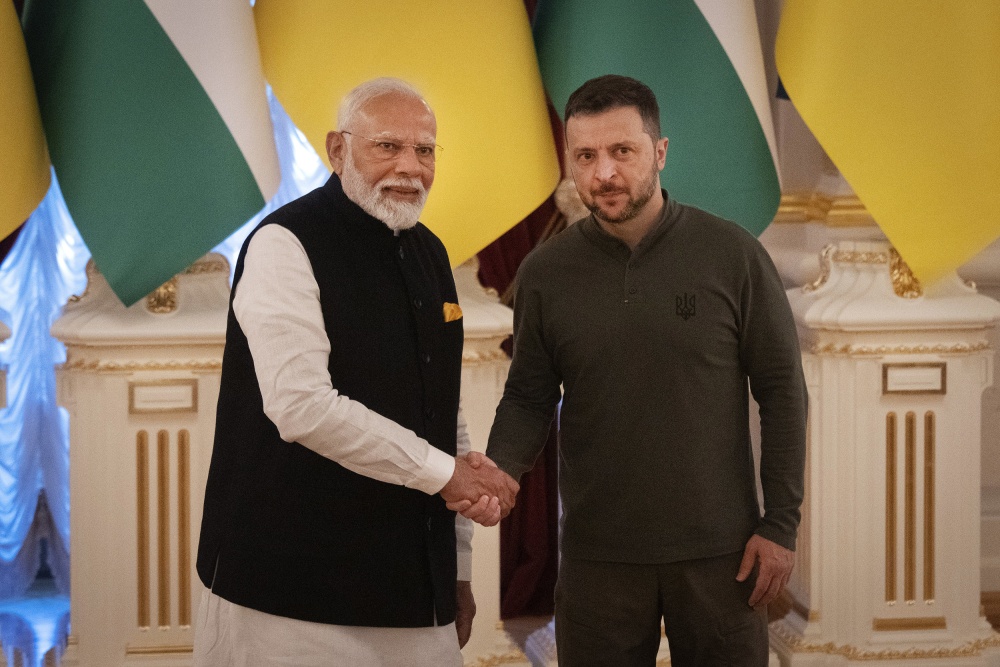
Indian Prime Minister Narendra Modi with Ukrainian President Volodymyr Zelenskyy in Kyiv on Friday.   Efrem Lukatsky / AP

And it was as a 'friend' that Mr. Modi made an unprecedented visit to Ukraine to meet with embattled President Volodymyr Zelenskyy, to offer, as a friend, to do what he could to intercede between Kyiv and Moscow in an effort to bring the two countries together to explore ways in which each might agree to the other's concessionary guidelines to reach a peace agreement. Which, on the evidence appears to be a shore too far. Since Moscow's demands are such that Kyiv in agreeing, would simply surrender to its aggressor's territorial grab. And in turn Kyiv's demands would never be met by Russia; complete military withdrawal and full restitution.
 
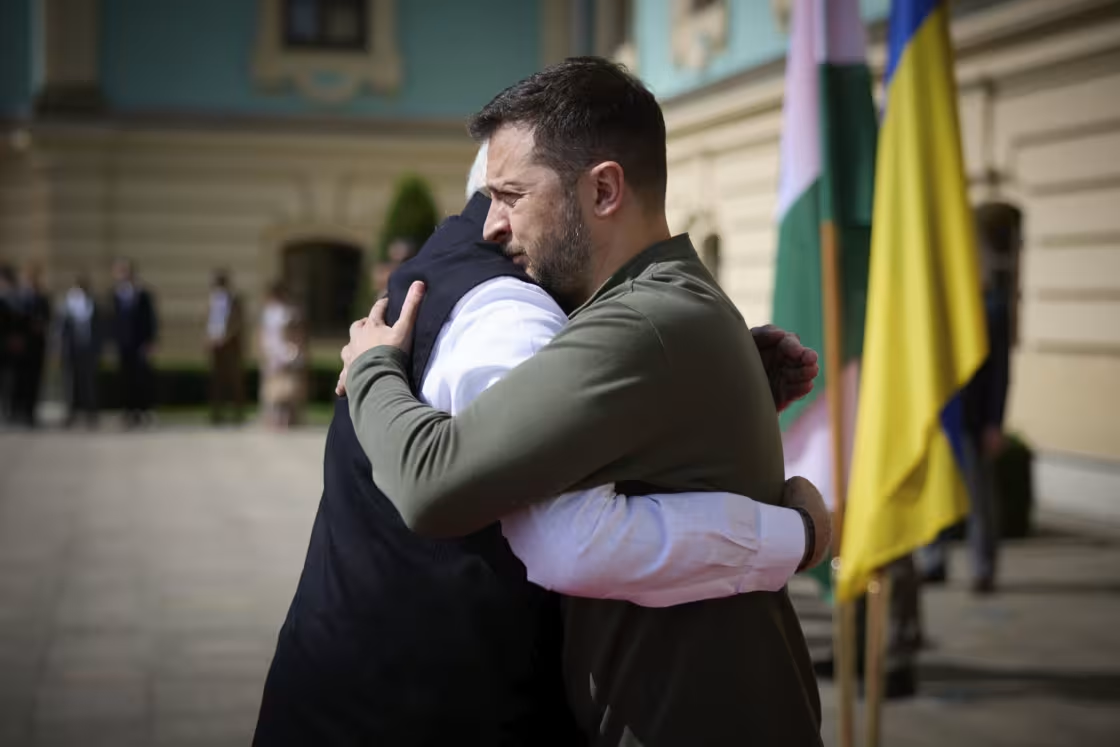
In any event, Mr. Modi's appearance in Ukraine and his friendly overtures to its president could be regarded as a gentle and reassuring hug from an important world leader. Somewhat leavened by the fact that India is inadvertently helping the war to continue by accepting Russian oil and gas, at no doubt a discounted price for a nation whose burgeoning industries are thirsty for energy sources. Mr. Modi has also met with Vladimir Putin, with whom he recounts a conversation urging the Russian President to seek peace with the country he is slowly destroying.
 
And then there are the realities of this prolonged war which the Kremlin believed would last no longer than, say a month, before the smaller, weaker, less militant and less well-equipped-militarily nation would fold before its neighbour's onslaught. With the considerable assistance of its democratic Western support along with that of its near neighbours supplying vital equipment to survive and to meet the onslaught with a counteroffensive, Ukraine is giving almost as good as it's getting.
 
https://static.euronews.com/articles/stories/08/67/15/06/1080x720_cmsv2_2af86390-a039-5fe6-9b73-9fba790279be-8671506.jpg
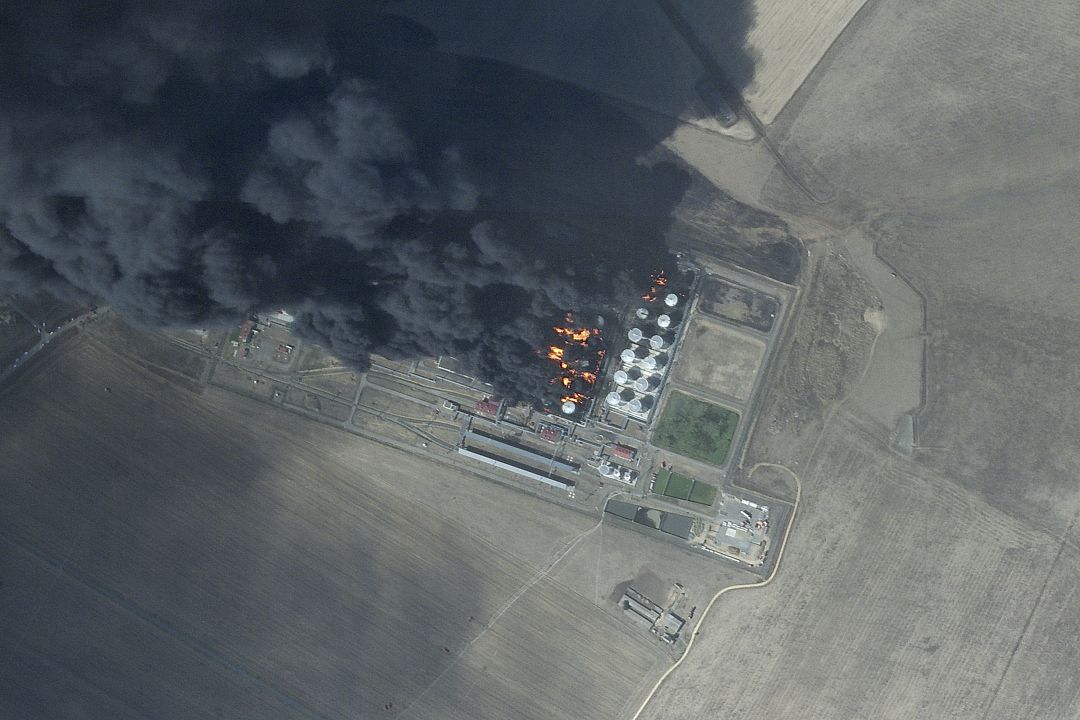
This satellite photo from Planet Labs PBC shows a fire at an oil depot earlier hit by a Ukrainian drone attack near Proletarsk, August 19, 2024    Planet Labs PBC/AP
Strikes in Russia's Kursk region are continuing, with the Ukraine military making use of high-precision glide bombs provided courtesy of the United States with their assent to carry out strikes in the region. The result being the military's having recaptured some territory in Kharkiv, where in the spring Russia launched an offensive. A video was issued Thursday by Lt. Gen. Mykola Oleschuk, Commander of the Ukraine Air Force, showing a Russian platoon base hit in the Kursk region, which led to equipment destruction by the GBU-30 bombs.

Forces of the Ukraine 3rd Separate Assault Brigade advanced some two square kilometres in the Kharkiv region. New momentum has been gained by Ukraine's forces this month, once the delayed deliveries of American weaponry were finally released. A shock offensive that began August 6 was enabled into western Kursk region, intensifying a drone war against military and fuel targets, sparking blazes this week, deep into Russian territory.

A Russian airbase in the Volgograd region was struck by a Ukrainian drone attack causing significant damage to an airfield housing glide bombs Moscow used in its war on Ukraine, At the port of Kavkaz in Russia's Krasnodar region saw a cargo ferry come under attack. Ukraine intends to continue its momentum, initially hoping to distract Russia from its Donetsk region slow but steady advance, but despite Moscow's perturbation over Ukraine's capture of towns and villages in Kursk and the mass evacuation of its citizens, no Russian platoons have been re-directed to Kursk.

Prime Minister Modi and President Zelenskyy signed co-operation agreements in agriculture, medicine and culture, releasing a joint statement that gave notice both countries agree on the necessity of close dialogue to "ensure a comprehensive, just and lasting peace"

https://media-cldnry.s-nbcnews.com/image/upload/t_fit-560w,f_avif,q_auto:eco,dpr_2/rockcms/2024-08/240823-modi-ukraine-mb-1347-ee5de6.jpg
Indian Prime Minister Narendra Modi hugs Ukrainian President Volodymyr Zelenskyy in Kyiv on Friday.  AP

Labels: , , , ,

Wednesday, October 26, 2022

Deadly Russian Malice


Ukraine's President Volodymyr Zelenskyy appears on screens as he speaks via a video link at the opening session of the International Crimea Platform Parliamentary summit, organized by Ukraine and Croatia, in Zagreb, on Tuesday. (Damir Sencar/AFP/Getty Images)
"Our countries made clear that we all reject Russia's transparently false allegations that Ukraine is preparing to use a dirty bomb on its own territory."
"The world would see through any attempt to use this allegation as a pretext for escalation."
France, Britain, United States joint statement
 
"[The aim of a] dirty bomb [attack by Ukraine would be to blame the resulting radioactive contamination on Russia by accusing Moscow of detonating a low-grade nuclear weapon]."
"The aim of the provocation would be to accuse Russia of using a weapon of mass destruction in the Ukrainian military theatre and by that means to launch a powerful anti-Russian campaign in the world."
Russian Defence Ministry
"If Russia calls and says that Ukraine is allegedly preparing something, it means one thing: Russia has already prepared all this."
"So when today the Russian Minister of Defence organizes a phone carousel and calls foreign ministers with stories about the so-called 'dirty' nuclear bomb, everyone understands who is the source of everything dirty that can be imagined in this war."
Ukrainian President Volodymyr Zelenskyy
Ukrainian National Guard soldiers fire at Russian positions with a mortar near Kharkiv, Ukraine, on Tuesday. (Andrii Marienko/The Associated Press)

Ukrainian forces are advancing toward the Dnipro River, a counteroffensive to retake Kherson the province and the city, from Russian occupation. All the more disconcerting to the Kremlin in the wake of its announcement of the annexation of the area along with three other south-eastern areas of Ukraine. Following hard on claims that those four provinces are Russian territory, Moscow advised the world and Ukraine in particular, that any action taken to recover the territory would be construed as an 'act of war' against Russia.\, with predictble consequences including nuclear.
 
A sanctimonious charge so arse-backwardly absurd it would make a good script for a theatrical comedy lampooning Russia, if it were not so obviously the work of a land-grabbing, nation-destroying, anti-human rights national government whose invasion exploits are the stuff of nightmares. A self-righteousness so deranged that the Russian Defence Minister Sergei Shoigu had the unmitigated call to  to call his counterpart ministers of France, Britain and the United States to inform them of an odious plot Ukraine was engaging in.

In fact it became almost instantly transparent that the revelation was in reverse order; that Russia is scheming to make use of a radioactive bomb of limited power and range that would be used as 'evidence' of Ukraine's willingness to begin a nuclear war between Russia and NATO, spurring Russia to self-protection, to respond in kind. Not Russia's fault, goes the plotline, if the 'neo-Nazi' government of Ukraine provoked Russia to such an extent it had little option but to reciprocate.

In a follow-up call with Russia's military Chief of General Staff Valery Gerasimov, British Chief of Defence Staff Tony Radakin made it quite clear his government rejected the Russian allegations, even while taking pains to convey the sensible message that both sides continue to maintain open channels of communication as a vital commitment.

Kremlin spokesman Dmitry Peskov, when asked to comment on Western skepticism of Russia's Ukraine accusations, responded "their disbelief doesn't mean there's no threat. The threat is evident." In ostensible response to which Moscow has ordered civilian evacuation of the territory in advance of the Ukrainian forces' advance. Should Russia suffer a defeat in Kherson it would represent a massive setback of the Russian 'special military invasion' agenda.

The west bank of the Dnipro River represents Russia's sole foothold of the area. That area where the Dnipro i\bisects Ukraine is a gateway to the Crimean peninsula, annexed by Russia in 2014.  

Energoatom, Ukraine's state nuclear plant operator, said it assumes ... the Russians to be preparing a terrorist act using nuclear materials and radioactive waste stored at [the plant]. It said there were 174 containers at the plant's dry spent fuel storage facility, each of them containing 24 assemblies of spent nuclear fuel. 

"Destruction of these containers as a result of explosion will lead to a radiation accident and radiation contamination of several hundred square kilometres of the adjacent territory."

People shelter inside a subway station during a Russian missile attack in Kyiv on Tuesday. (Vladyslav Musiienko/Reuters)


Labels: , , ,

Sunday, October 23, 2022

Russian War Crimes in Ukraine

 
"We’re literally training kids how to put on tourniquets because enough people wanted the rest of their family to know how to take care of them in case they were injured, or their kid was the only one left alive in a building."
"These people feel like they’re facing an existential threat, and they want something better for their kids — they want their kids to survive."
"[Now, though], frostbite, or cold, or malnutrition, or even just GI [gastrointestinal] related illness that goes prolonged and untreated [are becoming more common, likely due to lapses in critical infrastructure," 
"Before Russia ramped up the attacks on civilian infrastructure], we would see military-aged males, injured in combat with blast and shrapnel injuries. You would occasionally see the civilian population — the usual spread, women, children, and elderly — that may have gotten hit with just a missile, or something that hit a civilian area. Or, if it was a town that was being attacked by the Russians and they were trying to obliterate everything within the town, then it was just a spread of everybody coming in with blast and shrapnel and burn injuries."
"I think we’re starting to see a much larger scale of problems from a health standpoint that may not be a direct blast, penetrating injuries, burn injuries — it’s now population-wide in terms of loss of infrastructure problems, so I think that’s the more noticeable impact of what’s been going on lately."
"[Many victims now look like] the elderly grandmother who’s sitting in her apartment, just trying to wait out the war [and] suddenly has no power for a week, or suddenly has no clean water."
Aaron Epstein, the president of the Global Surgical and Medical Support Group 
 
"The subject matter [and] technical expertise leaves [so there’s no one to repair the damaged infrastructure. Ukrainian cities have demonstrated quite a bit of resilience so far, repairing damaged facilities and restoring access to critical services as quickly as possible], but as this goes on it will be interesting to see what continuing toll is going to be on the response."
"Critical infrastructure or civilian objects should not be targeted under the law of armed conflict, under IHL [But services and facilities that civilians rely on — like a power station] can be dual-use, they can be used by the military and then they could qualify as a military objective under IHL because by their nature and location, they’re making a contribution to military action.”
"[Military actors] should not be trying to degrade critical infrastructure, unless that’s part of your war strategy, [but if that’s the case], you run afoul of the legal principles."
Sahr Muhammadally, director for MENA & South Asia at Center for Civilians in Conflict
Traces of war in Ukrainian city of Sviatohiersk
Ukrainian civilians queue for humanitarian aid provided by the Red Cross as people try to survive amid the wave of Russia’s missile strikes in Sviatohiersk, Donetsk Oblast, Ukraine on October 20, 2022.
Wolfgang Schwan/Anadolu Agency via Getty Images
 
Now that it has become clear that Vladimir Putin's military strategy to bring Ukraine to its knees -- while the Ukrainian military has been ousting Russian troops from occupied territories and is fast moving in on Kherson -- by continuing and intensifying its illegal aerial bombardments of the country's critical infrastructure; its power stations, electrical grids, potable water supply, bombing civilian targets, destroying areas right across the vast geography of Ukraine -- there are new warnings that a massive dam may be the next target.

Ukrainian President Volodymyr Zelenskyy once again is calling on the West, this time to address Russia directly about the severe inadvisability of blowing up the immense Nova Kakhovka dam holding back a reservoir dominating much of southern Ukraine. Russian forces have performed the prelininary work in planting explosives within the dam. "Now everyone in the world must act powerfully and quickly to prevent a new Russian terrorist attack. Destroying the dam would mean a large-scale disaster", Mr.Zelenskyy warned.

Russia did some counter-warning of its own, accusing Kyiv of firing rockets at the dam, planning ultimately to destroy it; a sign according to Ukrainian officials that Moscow may take the initiative to blow it  up and then place the blame with Kyiv. It's a tried-and-untrue method that finds favour with the Kremlin; accuse Ukraine of responsibility for the most brazen war crimes against its own people as well as Russians, that Russia itself has been engaged with.
 
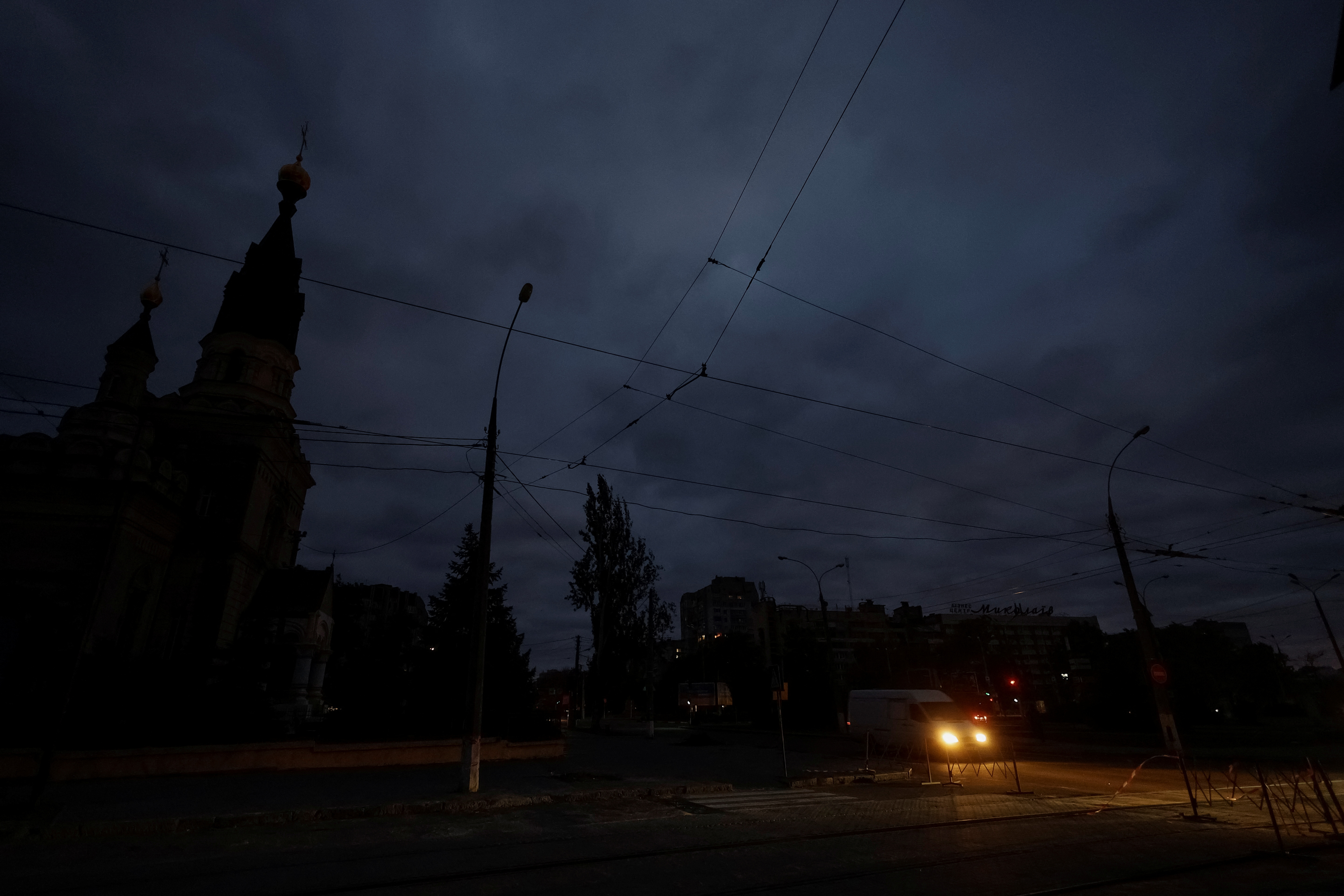
Van drives along a dark street during electricity shortage in Mykolaiv
A van moves along a dark street during electricity shortage, amid Russia's attack on Ukraine, in Mykolaiv, Ukraine October 20, 2022. REUTERS/Valentyn Ogirenko

Bursting the dam  could see a wall of water flooding settlements below, toward the city of Kherson. The Dnipro River is several kilometres wide in places. The canal system irrigating much of southern Ukraine that includes Crimea would also be ruined. Further upriver, Ukrainian historians document Soviet sappers having dynamited another huge dam with the retreat of their troops, causing floods that swept away villages and killed thousands of people, during the Second World War.

The potential of such widespread destruction, pointed out President Zelenskyy would have results "exactly the same as the use of weapons of mass destruction". Ukrainian forces are advancing along the river's west bank with the intention of regaining Kherson city and encircling thousands of Russian troops. Russia's newly appointed commander Sergei Srovikin, infamous for his command of the Russian aerial bombardment in Syria, against the regime's opponents, spoke of the situation in Kherson as "already difficult" leading Russia to "not ruling out difficult decisions".

In the area, Ukrainian troops have identified a secton of the front north of Kherson with a noticeable reduction in shellfire from Ruissian positions, about four kilometres away. Speculation among them is that the droppoff in shooting and absence of armour indicate a shortage of ammunition and equipment for Russia. "They've been shooting less starting about three weks ago. And their drones are less active", pointed out Myhailo, a soldier deployed in the area.

Vladimir Putin began a campaign of attacks with the use of cruise missiles and Iranian drones earlier in the month to destroy Ukraine's power supply before the onset of winter. Ukraine's energy infrastructure has also come under fire, but Moscow will not admit to its targeting of civilians; the aim, they claim of the "special military operation" is to degrade Ukraine's military. Calls countrywide to reduce electricity consumption alerted Ukrainians to straitened conditions ahead.

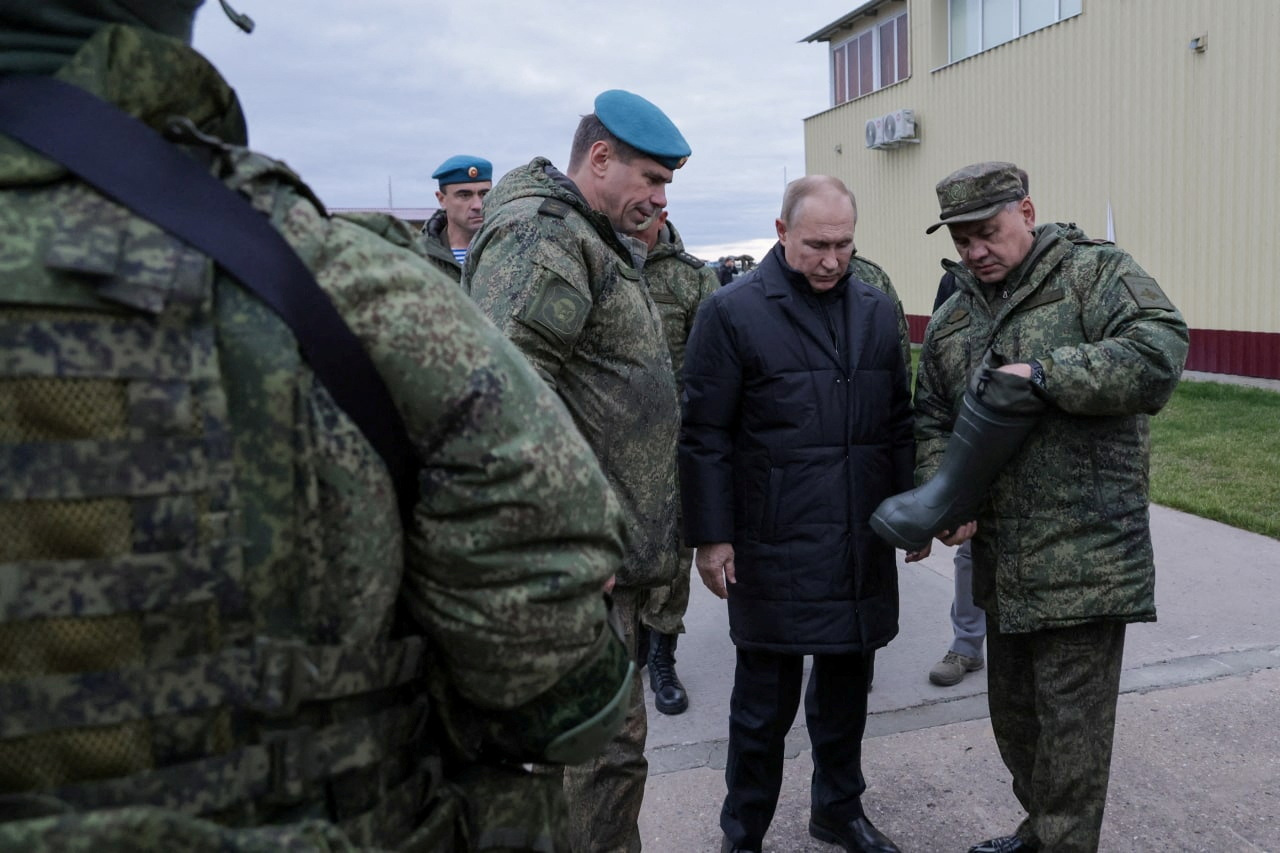
Russian President Vladimir Putin inspects preparations of mobilised reservists at a military training centre in Ryazan Region
Russian President Vladimir Putin visits a training centre of the Western Military District for mobilised reservists along with Defence Minister Sergei Shoigu and Deputy Commander of the Airborne Troops Anatoly Kontsevoy, in Ryazan Region, Russia October 20, 2022. Russian Defence Ministry/Handout via REUTERS


Labels: , , , ,

Saturday, October 15, 2022

Who's For World War III?


"Kyiv is well aware that such a step would mean a guaranteed escalation to World War III."
"The suicidal nature of such a step [NATO welcoming Ukraine into its membership] is understood by NATO members themselves."
Alexander Venediktov, deputy secretary, Russian Security Council

"[In the event of a Russian military use of nuclear weaponry]: We will not go into exactly how we will respond, but of course this will fundamentally change the nature of the conflict."
"It will mean that a very important line has been crossed."
"Even any use of a smaller nuclear weapon will be a very serious thing, fundamentally changing the nature of the war in Ukraine, and of course that would have consequences."
NATO Secretary-General Jens Stoltenberg

Russian President Vladimir Putin addresses a Sept. 30 rally in Moscow's Red Square.  ALEXANDER NEMENOV/AFP via Getty Images

A rational mind -- which under current circumstances making it clear that it excludes Russian President Vladimir Putin -- would understand that what Russia has embarked on, in a bid to swiftly and relatively without much cost, restore Ukraine to the orbit of the Russian Federation, integrating it geographically, reminiscent of the good old days of the USSR's hegemonic stranglehold on Ukraine -- would understand that a violent intrusion and annexation of its neighbour, and consequent desperate threats of nuclear dimensions is itself suicidal.

Unfortunately, the Kremlin sees the issue through its own dark lens of history, heritage and conquest, illuminating the greatness that is Russia. Ukraine, on the other hand, thinks quite rationally. It sees itself in the talons of a neighbour that plans to expunge its history, tradition and culture. A neighbour that once saw fit to bring down upon Ukraine the spectre of a managed famine that wiped out millions of people through the starvation called the Holodomor.

Moscow does not withhold its bellicose intentions, making it clear that Ukraine has no right to exist as a proudly independent, fully autonomous nation. And despite protests from those Russians most affected by the war; mothers of sons conscripted to the conflict, oligarchs made persona non grata, their assets abroad seized, and Russian Ukrainians along with human-rights personnel --- the greater Russian public is fully supportive of pounding Ukraine into the ground, and absconding with what is left.

Until, that is, more Russian troops die, over the official count of 20,000 dead and countless more wounded. Mr. Putin has called an end to the call-up, stating his goal of an additional 300,000 conscripts for the front lines has been accomplished. That would be the front line that keeps wavering and being shunted back toward the Russian border as the great, fearless, ill-trained Russian army panics under the counteroffensive of the Ukrainian military advance and flees, leaving its weapons behind.

President Volodymyr Zeleskyy announced an emergency bid for fast-tracking membership into NATO immediately his Russian counterpart announced the formal annexation of four Ukrainian provinces accounting for 18 percent of its vast territory. Mr. Putin identifies his misfortune in the campaign-gone-awry to U.S. meddling and, its encouragement of Ukraine to counter the Russian invasion, providing a massive amount of highly technical military equipment for good measure to Ukraine's advantage.

A cornered Vladimir Putin snarls a reminder now and again that he possesses a huge stockpile of nuclear weapons and his nuclear division has been placed on 'alert'. These may be desperate threats, but they are not empty ones. Now that the industrial heartland of Ukraine is purportedly in Russia's possession, any further forays by Ukrainian troops into the four provinces to regain their possession, is to be treated as an 'act of war' to be defended by any measures, including nuclear.
 
Intercontinental ballistic missiles are launched from the Sea of Okhotsk by a Russian nuclear submarine in 2020.   Russian Defense Ministry Press Service via AP
 
Which implies that Russia's 'special military invasion' was no act of war, but Ukraine's response certainly is, in Russia's regard. It is Ukraine's intransigence in prolonging the war by denying Russia's claims of history, heritage and possession, and therefore the deaths accruing from the conflict as well as the destroyed infrastructure is Ukraine's fault, fully and without equivocation. Russia is only doing what is right;  unseating a fascist government to free Ukrainians from servitude to a neo-Nazi regime.

Russia warns it would be justified in the use of nuclear devices, given the West's and NATO's interference in its near abroad and the special invasion of Ukraine. In fact, should the West consider the gift to Ukraine of more powerful missiles that could conceivably wreak damage over the border into Russia, nuclear arms could be pointed directly at NATO-member assets in the region.  Not an idle threat, Putin reiterates.
"We have a [nuclear] doctrine, which is clear."
"The dissuasion is working. But then, the less we talk about it the less we brandish the threat, the more credible we are.:"
"Too many people are talking about it."
French President Emmanuel Macron
France, stated President Macron in a television interview, would not respond with a nuclear strike. 

Ukrainian servicemen fire a mortar at their Russian counterparts on the front line in Donetsk on Oct. 5. Donetsk is one of four Ukrainian territories illegally annexed by Moscow, which has said its forces will defend the areas as if they were Russian soil.        ANTOLII STEPANOV/AFP via Getty Images

Labels: , ,

Friday, October 14, 2022

Punishing Ukraine For Attacking the Russian Occupation of Ukraine


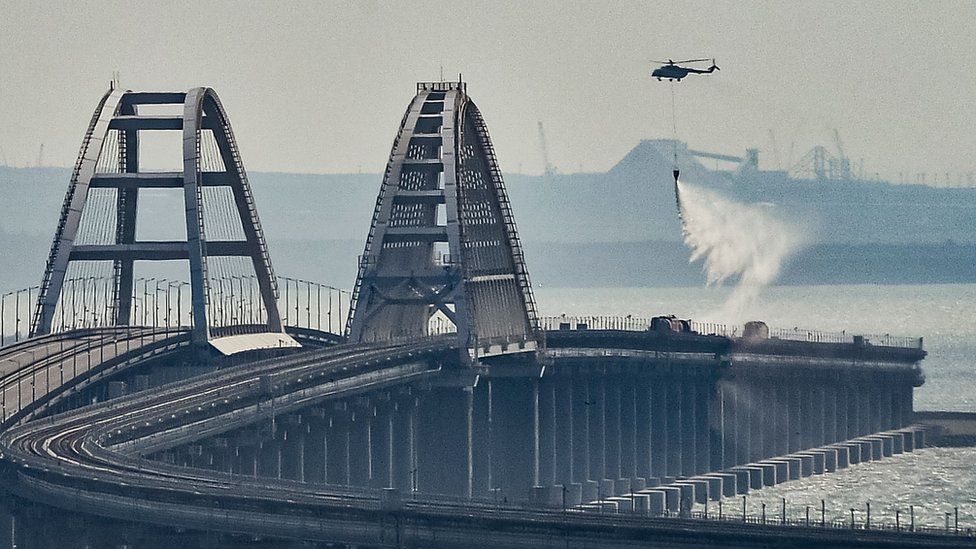
Helicopter pours water on fire on a collapsed part of a bridge that links Crimea with Russia
A firefighter helicopter pours water on fire on a collapsed part of the Kerch Strait bridge in Crimea last Saturday   AFP
 
"Basically, what we've got here is the weaponization of civil nuclear perhaps for the first time."
"And in an increasingly unstable world, it's important to understand this and what this implies for nuclear worldwide."
Paul Dorfman, nuclear expert, University of Sussex, England
 
"As the war in Ukraine persists, the NEA collects information from verifiable and reliable sources to support its members’ efforts to maintain an understanding of the state of nuclear safety and radiological protection in that country. Because our Ukrainian colleagues are faced with a highly uncertain, ever-changing and very challenging situation it is to be expected that obtaining detailed information on a regular basis may not be possible."
:In Ukraine 15 pressurised water reactors of Russian VVER design are operated by the State Enterprise National Nuclear Energy Generating Company “Energoatom” at four plants. These plants operate under nuclear safety regulations implemented by the State Nuclear Regulatory Inspectorate of Ukraine (SNRIU)."
Nuclear Energy Agency
Zaporizhzhia Ukraine
Zaporizhzhia nuclear power plant, Ukraine. Image: Ralf1969

There can no longer be differentiation between nuclear plants whose output is meant strictly for power generation, and the stockpiling of nuclear-tipped missiles. Each poses a threat; the missiles perhaps in a more visibly direct way, meant to penetrate an enemy's sovereign soil during a war operation, a civil nuclear infrastructure during an 'invasion' used as a threat with similar consequences, through maliciously deliberate sabotage; staging the disruption of its integrity for the purpose of causing a nuclear explosion on an enemy's soil.

All external power was lost at the crippled nuclear plant in Ukraine for the second time in five days. The risk of a radiation disaster resulting from critical safety systems being closed off to electricity to operate its safety regimen has been increased as a result of continued fighting in the area. The United Nations' Atomic Energy watchdog reported that the final remaining outside connection to the Russia-occupied Zaporizhzha Nuclear Power Plant had been restored some eight hours on.

Despite which, the interruption highlighted "how precarious the situation is", at the largest nuclear plant in Europe, emphasized International Atomic Energy Agency Director Rafael Grossi. Energoatom, Ukraine's nuclear power operator, explained that the Zaporizhzhia plant had undergone a "blackout" on Wednesday when a missile damaged an electrical substation causing the emergency shutdown of the last external power source to the plant.

Much earlier in the invasion and occupation of the plant, all six of its reactors had been shut down, but they require electricity to prevent overheatng to the point of meltdown. Such an event could cause radiation to leak from the plant. Diesel generators were supplying the plant, but Russian troops blocked a convoy bringing additional fuel for the backup equipment.

A way was later found by Ukrainian plant workers to repair the line and re-connect the plant to the Ukrainian power grid. Petro Kotin, chief of Energoatom, last month explained that typically the plant had sufficient diesel on hand to operate the generators -- "the station's last defence before a radiation accident", for a ten-day period.

In the wake of the horrendous missile and drone strikes carried out by Russia across Ukraine this week in retaliation for the explosions on the Crimean bridge linking the Russian mainland to the peninsula, Western governments have re-pledged to ship new weapons systems to Ukraine. Russia's Federal Security Service (FSB), revealed the arrest of five Russians and three citizens of Ukraine and Armenia as suspects in the attack on the Kerch Bridge, a span covering 12 miles.

The massive bridge serves as a symbol of Moscow's regional dominance, erected four years after Russia had declared annexation of the Crimean peninsula. It is a crucial route for military supplies trucked from Russia through to Ukraine in Moscow's 'special military invasion'. The explosive blast at the Crimean bridge saw Russian President Vladimir Putin responding through ordering missile strikes across Ukraine.

A bombardment which deliberately targeted power plants and civilian buildings across the cuntry. About a third of Ukraine's energy ifrastructure has been damaged, Eight regions of southeast Ukraine were victims of hundreds of Russian attacks in a 24-hour period. Punishing strikes on central and western Ukraine were concluded.
 
Rafael M. Grossi, director general of the International Atomic Energy Agency, said firing on a nuclear power plant “violates the fundamental principle” that a nuclear site’s physical integrity must be maintained at all times.
  Credit...Christian Bruna/EPA, via Shutterstock

Labels: ,

Follow @rheytah Tweet