Catastrophic Explosions in Daka, Equtorial Guinea
"There are many children without parents. In the long [term] what do we do with those children?"
"[The first explosion] was so big that all of us and the people around us were shouting: 'This is a bomb, this is a bomb!"
"People were crying, shouting, running, trying to stay somewhere, but it was panic."
"We started to see police cars and firemen and people bleeding."
Teacher (name withheld), Bata, Equatorial Guinea
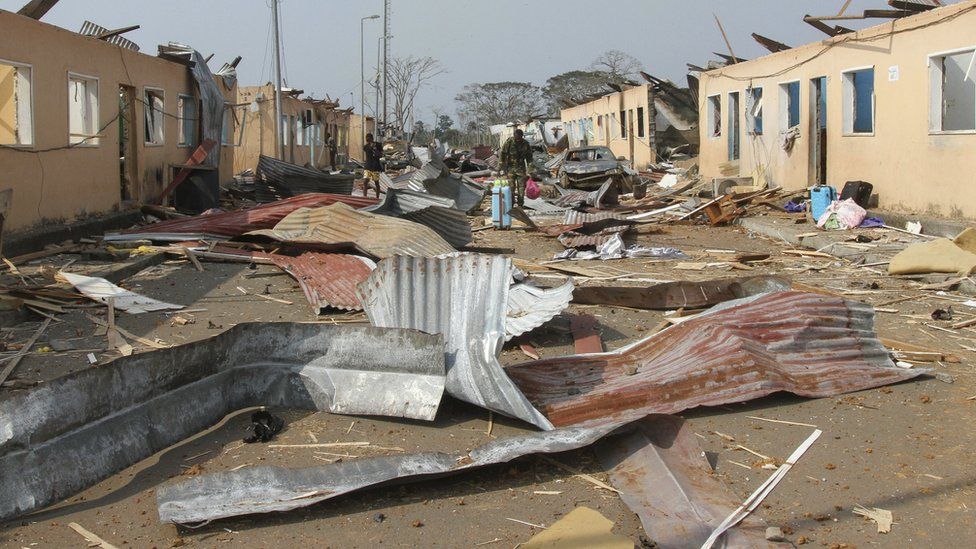
In Dakar, Equatorial Guinea's largest city a series of explosions flattened the city earlier int h e week. Residents of Bata are unable to cope with the scale of the tragedy. At least 105 people were killed, with over 600 other people injured. Children frantically searched for t heir parents, missing since the explosions levelled the city.
 |
Volunteers searched the rubble for bodies EPA
|
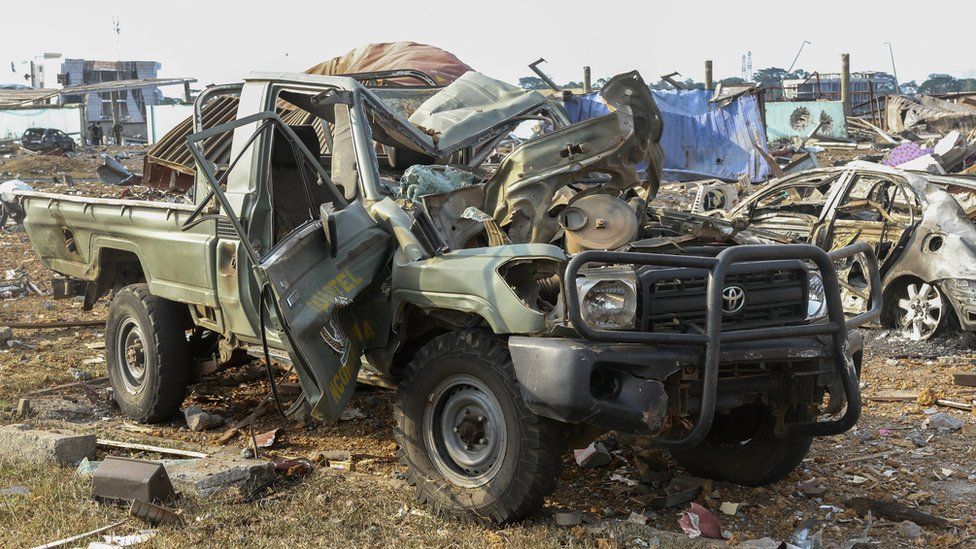
Block after block of public housing in the coastal city were completely destroyed or close to collapse. Roofs and walls, the remnants of once-teeming homes for residents were scattered along the dirt roads in the neighbourhood. The explosions, states government authorities, were the result of fires farmers living near a military base set to burn their fields. It also places blame on the military for its careless handling of dynamite stocks guarded by the military.
Bata was declared a catastrophe zone leading the government to release millions for the response in clearing away the mountains of debris and begin building new shelters. Authorities in Daka have appealed to the international community for aid. A five-year-old girl was discovered in the rubble of a house in the military camp; a rare rescue.
 |
| EPA |
Firefighters continue their efforts, combing rubble searching for bodies. Onlookers stand nearby weeping. Appeals have gone out for donations of blood and basic goods. Refrigerated containers have been repurposed as morgues to store bodies until they can be buried. According to Alfredo Okenve, a human-rights activist living in European exile, he was informed the number of deaths to be between 150 and 200, quite a larger number than the official count of 105.
At the information ministry, Virgilio Seriche denied bodies were being stored in containers. Authorities, he said, were providing up-to-date numbers of confirmed deaths. The explosions which lasted for hours on Sunday traumatized Bata residents who remain fearful of additional blasts to occur at any time. Psychiatrists and psychologists were being deployed by the health ministry.
Spain forwarded a first batch of emergency aid, while the United Nations announced that the World Health Organization and UNICEF had mobilized teams for infection control and logistical support.
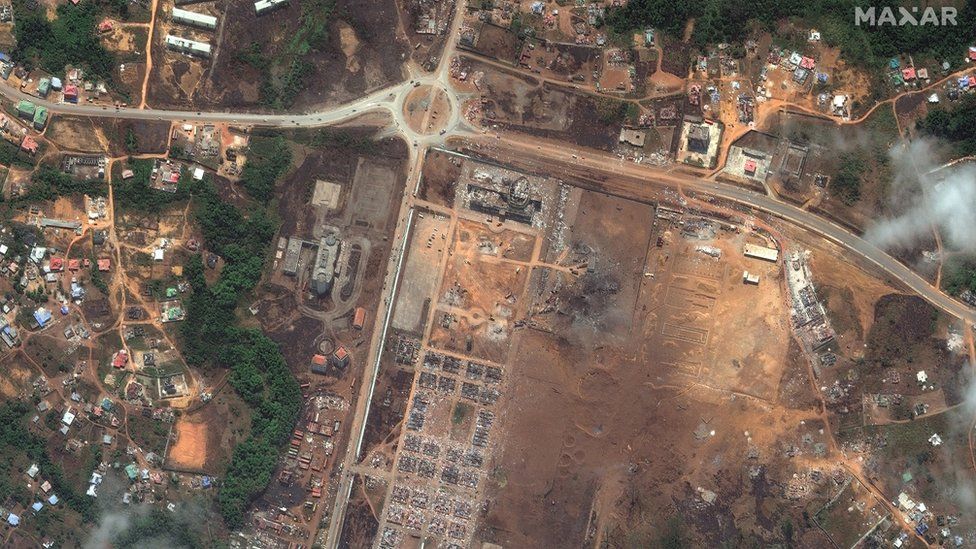 |
| New satellite images reveal
the extent of destruction in Equatorial Guinea's main city Bata
following explosions at a munitions depot on Sunday. |
Labels: Aid, Daka, Destruction, Equatorial Guinea, Explosions
Political Diplomacy Answers To Italy's Agony
"We don't want to get over enthusiastic or overestimate a trend, but compared to yesterday there is a slight drop in the figures."
"We must not lower our guard, we must continue with the measures taken and respect the government's instructions."
Franco Locatelli, head, Italian Health Council
"The closure of production activity is devastating. Our companies will lose market share and won't be able to reopen for lack of liquidity."
"This is the end of Italy's industrial system."
Alberto Forchielli, head, Mandarin Capital Partners
"We are all afraid but we have a revolutionary duty to fulfill, so we take out fear and put it to one side."
"He who says he is not afraid is a superhero, but we are not superheroes, we are revolutionary doctors."
Leonardo Fernandez, 68, intensive care specialist, Cuban medical brigade
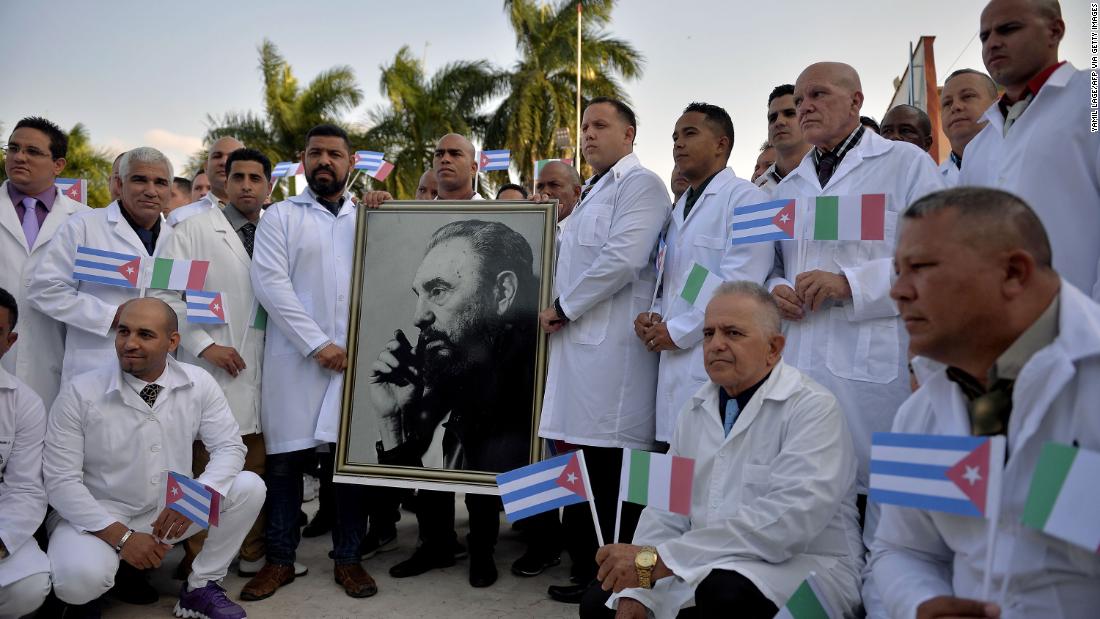 |
| Doctors and nurses of Cuba's Henry Reeve International Medical Brigade
pose with a portrait of Cuban late leader Fidel Castro before travelling
to Italy, at the Central Unit of Medical Cooperation in Havana, on
March 21, 2020. |
Italy is desperately trying to slow the spread of the novel coronavirus as people continue to die from the disease at an alarming rate. All business activity has been frozen that is considered to be non-essential, purposing to keep people off the streets and in their homes. The car, clothing and furniture industries have been targeted in particular to wind down operations and remain shut down until the first week of April.
People were informed in no uncertain terms by both the interior and the health ministries that they must remain where they are, other than being called away on urgent business or if they are forced for health reasons to move elsewhere. No other nation on Earth has registered more deaths as a result of the respiratory disease caused by the novel coronavirus. Its confirmed cases of COVID-19 are second only to China's, with a total of over 60,000 cases and 10,000 deaths, according to the Civil Protection Agency.
/cdn.vox-cdn.com/uploads/chorus_image/image/66572025/GettyImages_1208426042.0.jpg) |
The disastrous Covid-19 outbreak in Italy offers warnings — and lessons — for the US.
Antonio Masiello/Getty Images
|
Prime Minister Giuseppe Conte has been pressured for days, as infection rates have continued to spiral upward, to put harsher measures in place in an effort to control the viral stampede. Italian business leaders and financiers are as alarmed about the state of the Italian economy and the decision to shut down more companies, as the government and the public is over the vulnerability of the population to increased infection, causing the horrendous growing death rate among Italy's aged demographic.
Union leaders, on the other hand, have taken to accusing the prime minister of hesitating to go far enough to meet the crisis head on. Dozens of sectors had been given special exemptions, leading the unions to threaten a general strike should too many workers continue to be exposed to health risks. Prime Minister Conte spoke to the public in a video posted on Facebook, declaring Italy to be facing its most serious crisis since the Second World War.
China has forwarded medical equipment and doctors to aid Italy. Over 50 Cuban doctors arrived in Milan to provide assistance to the hospitals whose overstretched capacity has left the medical community exhausted from overwork and devastated by the extent of the loss of human life, much less fears for their own health safety by the rampaging viral threat.
President Vladimir Putin has ordered the Russian military to begin sending aid to Italy.
"All wars are won in two ways, with one's own army and with the help of one's own allies", stated head of the government's coronavirus relief effort, when Domenico Arcuri said through the country's state broadcaster RAI, that Italy was 'at war'. It is telling, in this situation, that Italy has seen no aid of any substance emanating from the European Union.
"Armies of white robes" have been sent by Cuba to disaster sites around the world; for the most part to poor countries, as a revolutionary commitment. Cuba's doctors fought on the front lines against cholera in Haiti and Ebola in West Africa in 2010. Now, the 52-srong brigade of Cuban doctors for the first time has been tasked with a mission to one of the world's wealthiest countries, in a move of medical diplomacy.
Other medical brigades have been sent by Cuba to halt the spread of the new virus elsewhere; contingents have arrived in socialist countries like Venezuela and Nicaragua, along with Jamaica, Suriname and Grenada. Steeped in politics as it is, it is also a noble enterprise that speaks to humanity's need at a time of great global upheaval. All medical personnel who respond, are heroes.
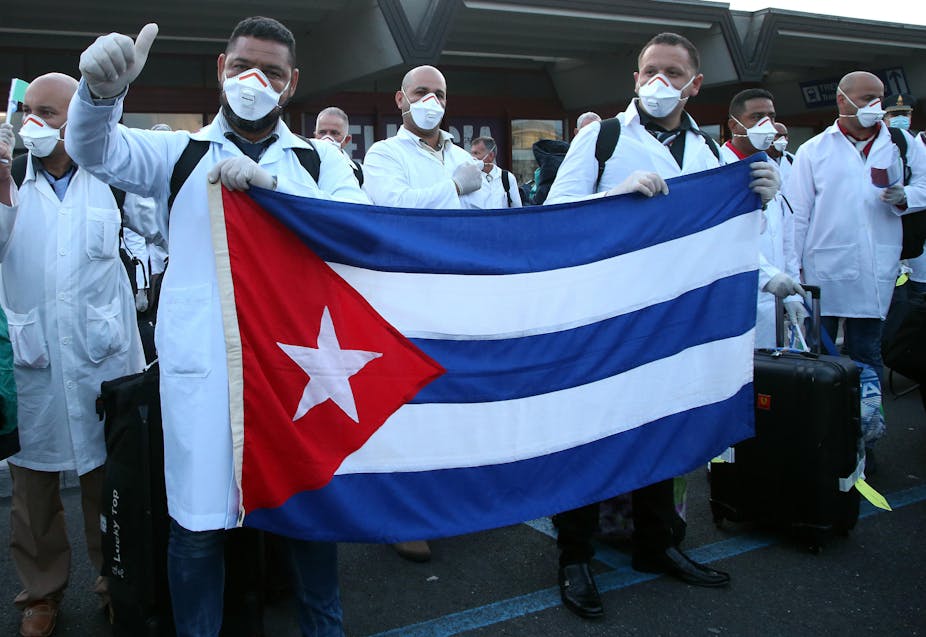 |
| Cuban doctors arrive in Italy to help fight COVID-19.
Matteo Bazzi/EPA |
Labels: Aid, Crisis Management, Italy, Medical Personnel, Novel Coronavirus, Political Crises


