Saturday, December 31, 2016

Betrayed? By Islamist Terror!

"I was betrayed."
"All the security improvement and welfare information we were told we would find here turned out to be false."
"We got many promises, but it was a deception meant to make us leave [the Dadaab refugee camp in Kenya]."
Madino Dhurow, Daryeel refugee camp, Mogadishu, Somalia
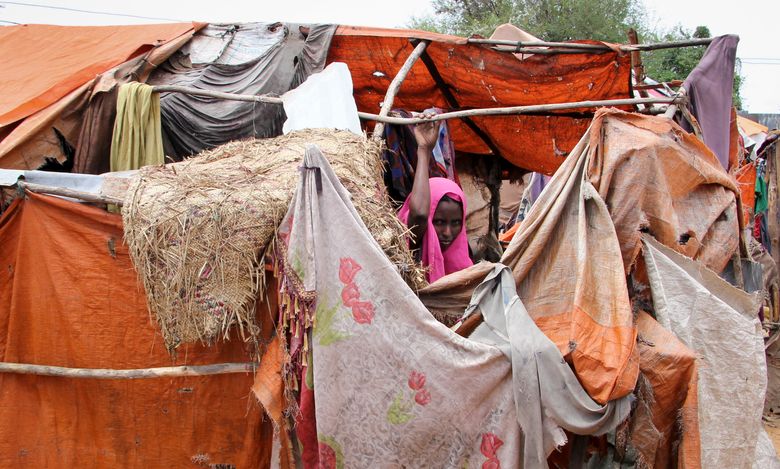
In this photo taken Wednesday, Nov. 16, 2016, Somali refugee and mother of six Madino Dhurow, who was repatriated to Somalia from Kenya’s Dadaab camp, stands by her makeshift shelter in the Daryeel camp for the displaced, where she now lives in Mogadishu, Somalia. (AP Photo/Farah Abdi Warsameh)
Somali refugee and mother of six Madino Dhurow, who was repatriated to Somalia from Kenya’s Dadaab camp, stands by her makeshift shelter in the Daryeel camp for the... (AP Photo/Farah Abdi Warsameh)

"As opposed to what we were told, what we found here is all about insecurity incidents during the day and gangs preying into our camps to rob us of the little things we were given before."
"Whoever ventures to go outside will be killed."
Ali Haji, Somalian returnee from Dadaab refugee camp, Kenya

Just as refugees have been and are continuing to be created throughout the Middle East by terrorism imposed upon Muslims through ethnic, tribal and mostly sectarian animus, where the sacred writings of the Koran impose jihad on its faithful, to transform the world into one great Sharia-inspired caliphate, North Africa continues to go through its prolonged destination toward the Islamification of every aspect of life; no casual iteration of Islam is to be tolerated, it must sweep backward toward the purity of its initiation.

And in its initiation it represented a wide and ever-growing arc -- like a stone thrown into a pond's inexorable spread to its outer reaches, of world-absorption through violent conquest -- at which time the fulfillment of Islam's destiny will have been achieved. Only then may the faithful rest in the assurance that their mortal obligation to Islam will have reached its conclusion, when no other religions are left to which people will cleave; a time when those who spurned the imperative of Islam will all have been slaughtered.

The upheaval in Somalia has been ongoing  for decades, leaving some Somalian refugees considering the Dadaab refugee camp in eastern Kenya, their homes, for there they might have been born, 20 years earlier. The camp contained 260,000 Somalis who fled the 1991 civil war and the conflict and destabilization that has been the hallmark of Islamist strife ever since. al-Shabab took the initiative of a continuation of the murder and plundering.

The Nairobi government's announcement that it would close the sprawling refugee camp paired with its efforts to persuade Somali refugees to leave, to return to their country of origin, where normalization under a struggling government is proceeding at a snail's pace under great difficulties. The threat that al-Shabab continues to pose to the weak government has stalled its progress. So the Daryeel camp outside the capital is anything but a secure environment.

Families live there in homes made of sticks and plastic sheeting, little comfort in the monsoon rains, or protection from the armed gangs that roam about with impunity during the night-time hours. Each refugee family in the Kenyan refugee camp was informed that they would be safe and well looked after on their return to Somalia, and each was given a one-time United Nations cash support of $400 for anticipated expenses; funding that it was soon discovered, that melted quickly away.

 To the present, about 35,000 refugees have returned to Somalia voluntarily since 2014. To find the situation prevailing there no resemblance whatever to the promises that had convinced them  to return. There are reports of harassment and intimidation at the hands of the very Kenyan security agents that persuaded them to leave voluntarily. Obviously the process of emptying the Kenyan camp is a high priority and repatriation the essence of eventual success.

When the refugees return to Somalia, they are inevitably exposed to violence, amid risks to their very existence. Apart from the fact that they become susceptible to forcible recruitment into al-Shabab.
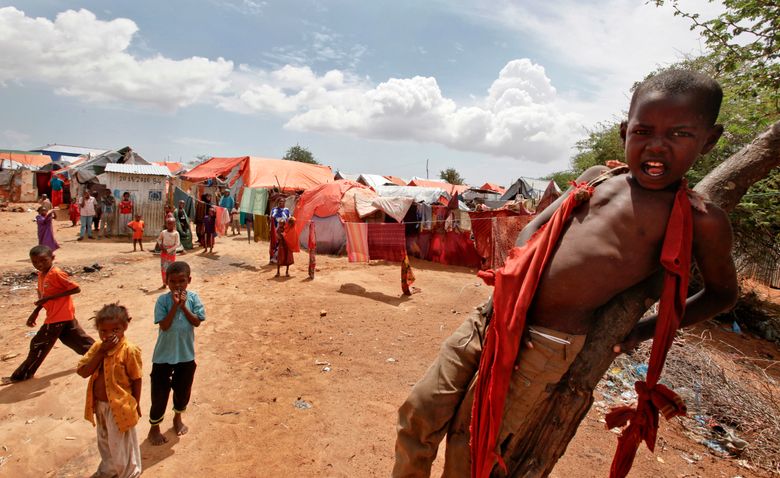
In this photo taken Wednesday, Nov. 16, 2016, Somali children who were repatriated to Somalia from Kenya’s Dadaab camp, play in front of makeshift shelters in the Daryeel camp for the displaced, in Mogadishu, Somalia. (AP Photo/Farah Abdi Warsameh)
In this photo taken Wednesday, Nov. 16, 2016, Somali children who were repatriated to Somalia from Kenya’s Dadaab camp, play in front of makeshift shelters in the Daryeel camp for the displaced, in Mogadishu,... (AP Photo/Farah Abdi Warsameh)

Labels: , , , ,

Saturday, April 04, 2015

The "Operation Against The Infidels"

"All I could hear were footsteps and gunshots. Nobody was screaming because they thought this would lead the gunmen to know where they are."
"The gunmen were saying, 'Sisi ni Al Shabab' -- Swahili for 'We are Al Shabab'."
"If you were a Christian, you were shot on the spot. With each blast of the gun, I thought I was going to die."
"The next thing, we saw people in military uniform through the window of the back of our rooms who identified themselves as the Kenyan military."
Collins Wetangula, student, Garissa University, , Garissa, Kenya

"I am saddened to inform the nation that early today, terrorists attacked Garissa University College, killed and wounded several people, and have taken others hostage."
Kenya President Uhuru Kenyatta
Kenya
A Kenya Defense Force soldier runs for cover near the perimeter wall where attackers are holding up at a campus in Garissa

Actually, 147 people were shot dead on Thursday on the Al Shabab attack on the university, mostly students, but as well two security guards, a policeman and a soldier. Another 79 people were wounded. The campus is located 145 kilometres from the border with Somalia. There are six dorms on the campus, holding about 887 students.

The attack began at 5:30 a.m. when morning prayers at the university mosque had begun, and there, at the mosque no worshippers were threatened, let alone attacked. Three dorms had been evacuated, where the gunmen, masked, strapped with explosives and armed with AK-47s, carefully sought non-Muslim students at the college, gunned them down, while those who could ran for their lives.

The dozens of hostages that the gunmen took with them in a fourth dorm must have felt they were in a terrifying journey to hell as the terrorists exchanged fire with troops and police, the deadly standoff ending only after thirteen hours of violence. Interior Minister Joseph Nkaissery described the terrorists exploding "like bombs" when gunfire from security forces struck them.

A $220,000 bounty has been posted by Kenyan authorities for Mohammed Mohamud, felt to have been the leader masterminding this attack. He had been a teacher at an Islamic religious school, a Wahhabi madrassa. One of the attackers appears to have survived and has been taken into custody. An audio message surfaced soon enough with Ali Mohamoud Raghe, an al-Shabab spokesman claiming the attack resulted because "the Christian government of Kenya has invaded our country".

Kenya had dispatched its military in a 2011 incursion into Somalia in an attempt to drive the terrorist group from its strongholds. The university had been chosen as a venue for attack in response to its educating Christian students in "a Muslim land under colony", referring to the large Somali population in an area of Kenya that Somalis had once claimed. The university, he went on, was partner in Kenya's "plan to spread their Christianity and infidelity".

"When I looked back, I saw them. There were five or six of them. They were masked. And they were shooting live rounds", said Augustine Alanga, 21, an economics student, who had been asleep when the shooting started. He left his room on the run, shoeless, sprinting across the campus and into a nearby forest.

Kenya Defence Forces soldiers move behind a thicket in Garissa town Kenya Defence Forces soldiers move behind a thicket in Garissa town

Labels: , , ,

Follow @rheytah Tweet