"We
are only able to reach those who are really on the verge of, if you
don't give them something now, they will not be there tomorrow."
"[In some areas, children are still getting food, but not pregnant mothers]. Literally, it's who dies first, and who dies next."
Hameed Nuru, Somalia director, World Food Program
"The situation has become unbearable."
"The American regime is led by a person who really doesn't care about anything happening outside his gates."
"The Americans are not honoring their commitment to the world."
Adan Bare Ali, deputy mayor, Dollow, Somalia
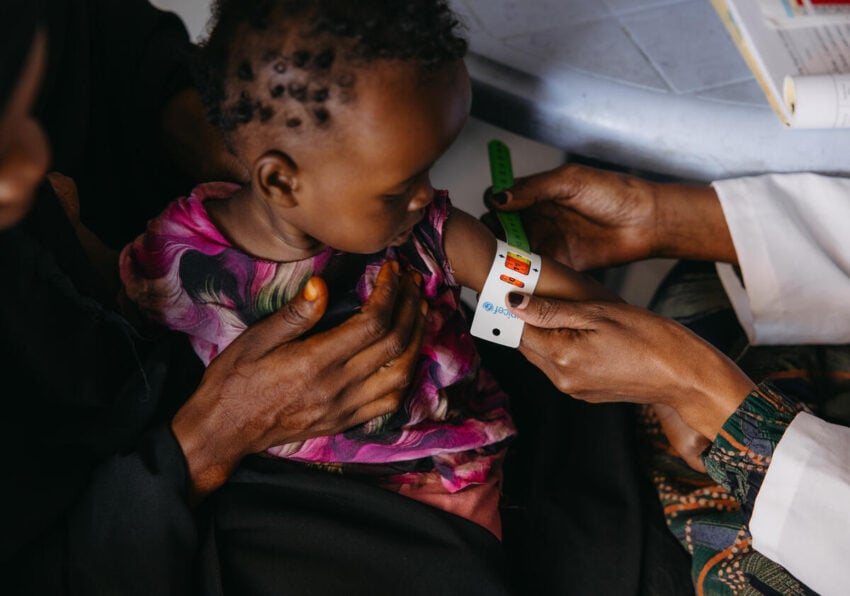
In northeastern Somalia, the Jeexdin Health Center is a critical medical
and nutrition clinic serving children and adults near Garowe and
Galkayo. Photo by Abigajla Conway)
In
Somalia, one of the world's poorest and least stable countries, acute
hunger is set to increase beyond its current state. When Russia invaded
Ukraine four years ago the global supply of fertilizers and cereal
grains was disrupted leading to fears of hunger, from Africa to South
Asia. A $43 billion humanitarian assistance drive led by governments and
multilateral institutions limited the human damage of primary
scarcities of the substances of life-sustaining provisions. Food aid,
water and medical care was delivered o the desperately needy, with $17
billion of that total supplied by the United States.
Currently,
humanitarian funding saw a disastrous drop to $28 billion, with the
share provided by the United States diminished to $4 billion. "The system has been eviscerated", stated the head of global advocacy at Mercy Corps, Kate Phillips-Barrasso. "This is the era of indifference", she concluded.
For
decades, Somalians have suffered through a brutal civil war, through
famine and the attacks of the fundamentalist Islamic group Al Shabab.
The country's most recent harvest was ravaged by drought. Approximately
one-third of the Somali population -- 6.5 million people -- encountered
hunger at levels described as an emergency, with the U.N. Food and
Agriculture Organization warning that over 1.8 million children under 5
were facing acute malnutrition. That was back in February, with the
situation since exacerbated due to the war in Iran.
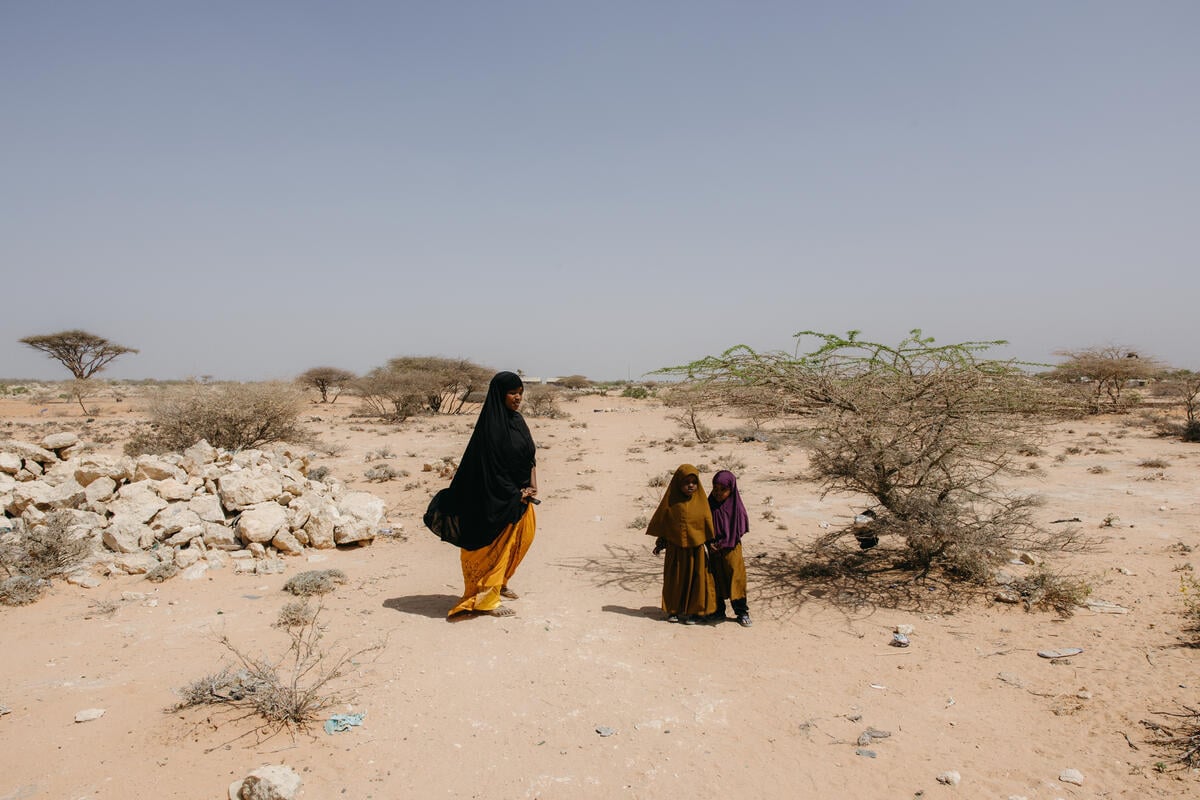
An increasing number of displaced families in Somalia are experiencing
severe hunger. Near Garowe, Somalia. 2025 Photo by Abigajla Conway
A
mere 2 percent of all relief from international donors for Somalia was
derived from the United States. From providing humanitarian assistance
to Somalia in 2024 of $467 million, last year the U.S. administration
slashed that aid to $70 million. Dependent on oil from the United Arab
Emirates, Iranian strikes on production facilities in the Persian gulf
affected transport cessation, leading to the price of gasoline and
diesel over-doubling in price.
The
predictable response was trucking companies doubling and tripling costs
for trucking sacks of corn from Ethiopia over the border to Somalia.
Rice shipped into Somalian ports rose similarly. The price of water at
public wells tripled since many of the pumps use diesel for energy. One
third of fertilizers for Somalia's farming sector is derived from the
Persian Gulf so with stocks marooned at the Strait of Hormuz, farmers
face steeply higher operating costs.
Unaffordable
food in combination with fewer medical clinics in operation resulted in
children likelier to suffer malnutrition. Infants and toddlers with
severe cases of malnutrition were given therapeutic milk formula and
antibiotics, while those in greatest danger went to a stabilization unit
operated by UNICEF within a local hospital. Children on cots with
feeding tubes and some attached to oxygen, fought for their lives and
their futures.
The
largest source of aid in Somalia, the World Food Program, has
sufficient funding to support 300,000 people monthly through to July,
representing a fraction of the close to two million people a month it
was serving in early 2025. Somalia depends on imports for 70 percent of
its food, at a time when staple goods like rice and wheat have doubled
in price.
Three years ago, Tahliil Abdulahi Cali had 250
goats. Today he has 100. The rest died as the rains failed, season
after season, across his community in the Mudug region. Mohamed Said Barkhadle
"Pirates will not be eliminated as long as there is illegal fishing, because those people who are doing piracy consider themselves heroes defending their resources." Hassan Warsame, Fisheries Minister, Galmudug State, Somalia
"Now it's in the original home of piracy, in an area they thought they cleaned up. It's very disappointing." "That's the thousand-dollar question. People keep talking about the Galmudug Coast Guard, but that doesn't exist." "It's quite often pirates fining people, finding a fishing boat, and saying they're illegally fishing. It's not actually a coast guard. It's more former pirates." John Steed, senior maritime expert, UN Office of Drugs and Crime
Just when the world breathed a sigh of relief that modern-day piracy off the Horn of Africa was stilled, the last month has brought a succession of piracy incidents back to the Somalian coast. Off the coast of Somalia's Galmudug state, to be precise. An area where illegal fishing vessels were convinced they must pay the "fines" exacted upon them to reflect their illegal status which would be relieved once the fines were received.
The international shipping industry views the sea lane routes that take them into that area, critical to the movement of transports valued at $700-billion in cargo every year. Now, hijacking episodes that bedevilled the industry several years back have returned, men commandeering cargo ships off the Somali coast, and re-assigning the journeys to a charted course toward the coastal town of Hobyo, known as a former pirate stronghold. From March of 2017 to April pirates have been busy in the Puntland region of Somalia.
Oil tankers, merchant vessels, fishing vessels, they are all game for the ambitious, looting Somalian pirates who feel justified in their new, remunerative mission in life. The busy transport corridors of international shipping had seen a lull in the business, however, leading the international anti-piracy forces and the shipping companies to drop their protective guard. In December a NATO naval force left the Horn due to the decline in pirate attacks.
Cargo ships halted basic precautionary measures no longer hiring armed guards, sailing further from shore at higher speeds. Now there are voices being raised in a chorus of charges that opposing through military means the proliferation of pirates to put them out of business was merely a temporary solution. Awaiting a final solution that would ensure that illegal fishing by foreign vessels, destroying Somali fishermen's legal fishing rights, is the only way to restore the coast to stability.
In Puntland the small boats used by the special maritime police force are no match
for some of the vessels used by illegal fishermen and criminal pirate
gangs. TRT World
According to Somali federal law, foreign ships are forbidden from fishing inside 15 miles of the coast, in a measure meant to preserve fisheries for small-scale fishermen out of Somalia. Destructive bottom trawling is also banned by Somali law. In Puntland, where the federal government in Mogadishu has little control, however, those laws have failed to alt the practices they're meant to address.
Somali authorities should be engaged in intercepting illegal fishing vessels to bring them to justice, but areas like Galmudug have settled on accepting rampant illegal fishing in the absence of maritime authorities. Local armed groups have taken to extracting "fines", instead, where the Galmudug Coast Guard extracts those fines and allows the illegal foreign fishing vessels to go on their way. The reality is that Galmudug has no official coast guard.
And fishing permits are improperly doled out to foreign fishing vessels, with trawlers buying their permits from the Puntland state government which hasn't hesitated to violate Somali law where only the federal government is permitted to issue commercial fishing licenses. Ten million in value of fishing licenses were sold by Puntland's government to China last year, as well as to South Korean and Djibouti flagged trawlers.
Illegal fishermen took advantage of porous security in recent years to
pillage Somali waters, compelling impoverished fishermen to turn to
kidnapping and ransom. TRT World
"I was betrayed." "All the security improvement and welfare information we were told we would find here turned out to be false." "We got many promises, but it was a deception meant to make us leave [the Dadaab refugee camp in Kenya]." Madino Dhurow, Daryeel refugee camp, Mogadishu, Somalia
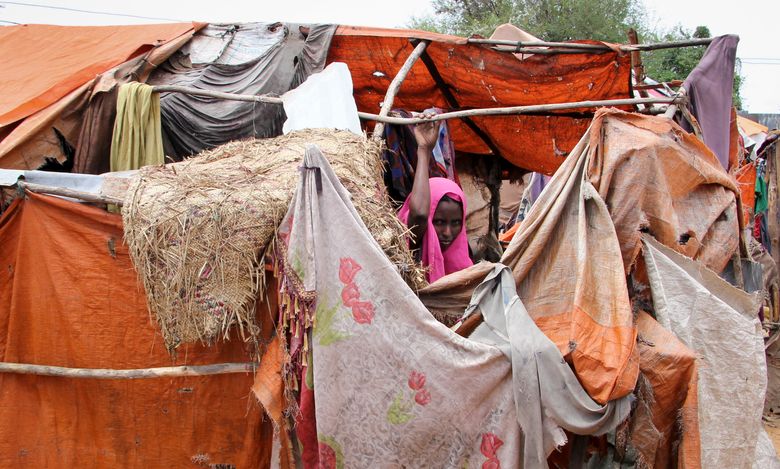
Somali refugee and mother of six Madino Dhurow, who was
repatriated to Somalia from Kenya’s Dadaab camp, stands by her makeshift
shelter in the Daryeel camp for the... (AP Photo/Farah Abdi Warsameh)
"As opposed to what we were told, what we found here is all about insecurity incidents during the day and gangs preying into our camps to rob us of the little things we were given before." "Whoever ventures to go outside will be killed." Ali Haji, Somalian returnee from Dadaab refugee camp, Kenya
Just as refugees have been and are continuing to be created throughout the Middle East by terrorism imposed upon Muslims through ethnic, tribal and mostly sectarian animus, where the sacred writings of the Koran impose jihad on its faithful, to transform the world into one great Sharia-inspired caliphate, North Africa continues to go through its prolonged destination toward the Islamification of every aspect of life; no casual iteration of Islam is to be tolerated, it must sweep backward toward the purity of its initiation.
And in its initiation it represented a wide and ever-growing arc -- like a stone thrown into a pond's inexorable spread to its outer reaches, of world-absorption through violent conquest -- at which time the fulfillment of Islam's destiny will have been achieved. Only then may the faithful rest in the assurance that their mortal obligation to Islam will have reached its conclusion, when no other religions are left to which people will cleave; a time when those who spurned the imperative of Islam will all have been slaughtered.
The upheaval in Somalia has been ongoing for decades, leaving some Somalian refugees considering the Dadaab refugee camp in eastern Kenya, their homes, for there they might have been born, 20 years earlier. The camp contained 260,000 Somalis who fled the 1991 civil war and the conflict and destabilization that has been the hallmark of Islamist strife ever since. al-Shabab took the initiative of a continuation of the murder and plundering.
The Nairobi government's announcement that it would close the sprawling refugee camp paired with its efforts to persuade Somali refugees to leave, to return to their country of origin, where normalization under a struggling government is proceeding at a snail's pace under great difficulties. The threat that al-Shabab continues to pose to the weak government has stalled its progress. So the Daryeel camp outside the capital is anything but a secure environment.
Families live there in homes made of sticks and plastic sheeting, little comfort in the monsoon rains, or protection from the armed gangs that roam about with impunity during the night-time hours. Each refugee family in the Kenyan refugee camp was informed that they would be safe and well looked after on their return to Somalia, and each was given a one-time United Nations cash support of $400 for anticipated expenses; funding that it was soon discovered, that melted quickly away.
To the present, about 35,000 refugees have returned to Somalia voluntarily since 2014. To find the situation prevailing there no resemblance whatever to the promises that had convinced them to return. There are reports of harassment and intimidation at the hands of the very Kenyan security agents that persuaded them to leave voluntarily. Obviously the process of emptying the Kenyan camp is a high priority and repatriation the essence of eventual success.
When the refugees return to Somalia, they are inevitably exposed to violence, amid risks to their very existence. Apart from the fact that they become susceptible to forcible recruitment into al-Shabab.
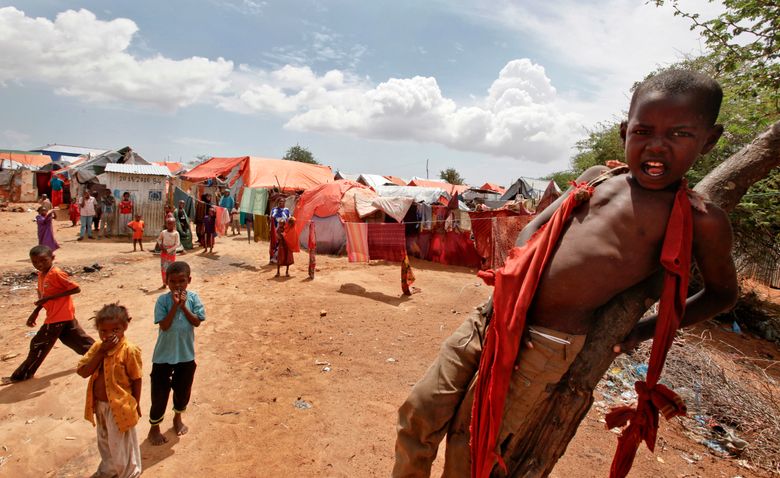
In this photo taken Wednesday, Nov. 16, 2016,
Somali children who were repatriated to Somalia from Kenya’s Dadaab
camp, play in front of makeshift shelters in the Daryeel camp for the
displaced, in Mogadishu,... (AP Photo/Farah Abdi Warsameh)
"I
felt that throughout my time in Canada, I felt lot of discrimination
whether because I'm black or I'm Muslim. I felt that if I lived in a
Muslim country I probably would not experience Islamophobia." "I
never told him to join al-Shabab but I basically told him ways to evade
capture, if you will, because I didn't want to see a good friend go to
jail." "I
probably should have called [to report the undercover officer], but he
wasn't saying he wanted to do anything in Canada. I was like, out of
sight, out of mind." "Yeah, I always pictured myself as a type of, ah you know, like a silent assassin, you know what I mean." "If you ever insult the Prophet Allah, peace and blessings be upon him, you deserve a certain outcome, you know?" Mohamed Hersi, convicted Canadian-Somali jihadi
Mohamed Hersi, 25, outside Brampton court in April. (Stan Behal/Toronto Sun files)If the
seasoned, experienced reporter quoted Mr. Hersi correctly, does that
mean that this devout Muslim is ignorant of the name of the Prophet
Mohammed, confusing him with the Almighty? That aside, he's
contradicting fairly serious evidence pin-pointing him as precisely what
he claims not to be. The advice he gave to the undercover police
officer posing as a sympathetic figure to Mr. Hersi's own oft-stated
intention to travel to Somalia to join al-Shabab was replete with
usefulness.
Say, for example, handing over for the undercover officer's edification a U.S. sniper training manual and a copy of The Anarchist Cookbook. Telling his friend the undercover officer not to "burn any bridges in Canada" before leaving for his overseas destination in case al-Shabab might decide to dispatch him on a mission back to Canada to "take care of" anyone there who might be foolish enough to insult the Prophet Mohammad.
Two
of Mohamed Hersi's Canadian school chums had already departed for
Somalia, much earlier, to join al-Shabab in defence of fanatical
Islamism; one of them died a martyr to the cause. Mr. Hersi had contact
with the other through Facebook. He had gone online, a survey of his
computer contents revealed to the RCMP, to search such innocuous terms
as "shotgun Somalia", "Somalia AK-47 cost", and "gun market in Mogadishu Somalia". Just curious, see?
Mr.
Hersi would never have come to the attention of police had not a
drycleaner in Toronto discovered a USB memory device in the man's
security guard uniform. When it developed that the device contained a
book on bomb-making the drycleaners called in Toronto police, and an
undercover investigation was launched. The undercover agent dispatched
to make contact with Mr. Hersi gained his confidence.
And
their relationship followed from there. At trial Mohamed Hersi insisted
that his undercover friend was the instigator, who continually
expressed interest in al-Shabab. "I said, 'I don't want to join al-Shabab",
insisted Mr. Hersi. But testimony and recordings played for the jury
revealed that Mr. Hersi never hesitated in giving advice about how to
make up a cover story for a trip to Somalia, how much money to take
along, and how to make "connections" in Kenya.
Bribing his way across the border into Somalia would be a cake-walk. Buy weapons in Africa. Read the Al-Qaeda magazine Inspire. Listen to the online lectures of idealogue Anwar Al-Awlaki. And just don't fear anything about the venture. "The verdict here is not the end of things",
warned Paul Slansky, lawyer for the convicted, planning an argument
that his client was entrapped. And facing up to ten years' imprisonment.
"You shouldn't fear them. They're stupid as a rock, you know?", Hersi had said convincingly to the undercover officer. "They
don't know too much. They're not very intelligent themselves, you know?
When you think about it they are very stupid, you know?" So stupid that he pretty well convicted himself. "It's not fair. Where is the justice in the world. He didn't do anything",
a woman dressed in traditional Somali garb sobbed outside the
courtroom. For their part, the stupid RCMP spoke of the verdict as a
"significant milestone", that
"underscores the reality of the threats that exist in Canada, as well
as abroad, including Canadians participating in violent extremism."
Kenya's National Intelligence Service had produced an internal report predating the September 21 Al-Shabab attack on the Westgate Mall in Nairobi, warning that it was aware of Al-Shabab members being in Nairobi "and are planning to mount suicide attacks on undisclosed date, targeting Westgate Mall and Holy Family Basilica." It warned also of "Mumbai-style attacks", so Kenya's intelligence community was in possession of hard facts.
Kenya perhaps, isn't aware that it is incumbent on their intelligence services not only to know these things, but to plan their response should they, as suspected on the evidence at hand, actually occur. Yet they were obviously taken by complete surprise, and had the unmitigated gall to criticize their intelligence partners in the U.S. and Israel for not sufficiently alerting them to the imminence of the attack.
That outside intelligence agencies are expected to be alert to the potential of attack and to have information on their actual occurrence, while the home agency feels justified in letting down their guard and simply resting on the possibility that others will do their work for them, is rather mind-boggling. That, in their defence against charges of incompetence they point a finger of blame elsewhere says volumes.
Belatedly, Interpol was asked to issue an arrest notice for Samantha Lewthwaite, a woman of British origin, as one of the "key actors" in the Nairobi mall attack. Acknowledged in retrospect as the lead planner of the attack, giving orders instantly obeyed by her Al-Shabab cohorts, she was not apprehended. Although perhaps she could have been, pre-attack, if Kenyan intelligence had been sufficiently alert.
The U.S., whom they excoriated for its lack of intelligence and response to a purely Kenyan-Somalia episode of terrorism, made an effort to capture a Kenyan in Somalia, known to have plotted an attack on his country's parliament buildings and the UN Nairobi Headquarters. Kenyan intelligence knows all about him. Did they ever make an effort to collect this Kenyan, in full awareness of his intentions?
The U.S. Navy SEALs' attempt to capture Abdulkadir Mohamed Abdulkadir (Ikrima) through a pre-dawn raid in Somalia failed because, unlike Kenyan intelligence and its military, Al-Shabab was alert and conscious of the potential of such an attack which happened to have been carried out by the very unit that raided the bin Laden compound in Pakistan, successfully.
Kenya's National Intelligence Service identifies Mr. Abdulkadir as the lead planner of a plot to carry out multiple attacks in East Africa in late 2011 and early 2012, in collaboration with Al-Qaeda's top henchmen in Pakistan. They have the information but it would appear, sadly enough, not the intelligence in the sense of using the intelligence on hand to act appropriately.
The undisclosed date for the planned suicide attack on the Westgate Mall was just too nebulous for them to grasp, one supposes. Two of the suspects involved were thought to have been wearing suicide vests, making good use of grenades and AK-47 assault rifles. Perhaps the Al-Shabab terrorists grasp the idea that gives them the courage to act in the knowledge that the Kenyan military is incapable of so doing.
Finding looting the premises of the mall far more appealing than confronting the terrorists of Al-Shabab. One of whom may have been Mr. Abdulkadir, or may not have been. In any event, he's still on the loose, and doubtless chortling at the expeditious response of his own terror group in confronting the SEALs in a hail of fire, sufficient to put them off the target.
For fear, they said, that innocents might be injured in the resulting melee.
US commando raids target Islamist leaders in Africa
BBC News online -- 6 October 2013
Al-Libi was on the FBI's most wanted list
US special forces have carried out two separate raids in Africa targeting senior Islamist militants, American officials say.
In Libya, US commandos captured an al-Qaeda leader accused of the 1998 bombings of the US embassies in Kenya and Tanzania.
Anas al-Libi was seized in the capital Tripoli.
And a leader of the al-Shabab group was targeted in southern Somalia, but that raid appears to have failed.
The al-Shabab leader - who has not been identified - is
suspected of involvement in last month's attack in the Westgate shopping
centre in Kenya's capital Nairobi, which left at least 67 people dead. $5m bounty
Anas al-Libi's relatives and US officials said he had been seized in the Libyan capital early on Saturday.
He was parking outside his house when three vehicles
encircled him, his car's window was smashed and his gun was seized
before he was taken away, his brother Nabih was quoted as saying by AP.
He added that Libi's wife wife also saw the attack, describing the abductors as foreign-looking "commandos".
The raid was conducted with the knowledge of the Libyan government, a US official was quoted as saying by CNN.
More than 220 people died in the 1998 embassy attack in Kenya and Tanzania
Libi "is currently lawfully detained by the US military in a
secure location outside of Libya", Pentagon spokesman George Little
said.
The 49-year-old is believed to have been one of the
masterminds behind the 1998 US embassy attacks, which killed more than
220 people in Kenya and Tanzania. US commandos hit Islamists in Africa
He has been indicted in a New York court in connection with the attacks.
Libi - whose real name is Nazih Abdul-Hamed al-Ruqai - has
been on the FBI's most wanted list for more than a decade with a $5m
(£3.1m) bounty on his head.
Al-Qaeda's leadership has been consistently targeted since
the killing of Osama Bin Laden by US special forces in 2011 in Pakistan.
Meanwhile, the US defence department confirmed that special
forces had carried out a seaborne operation in the Somalia's coastal
town of Barawe.
Mr Little said the forces "were involved in a
counter-terrorism operation against a known al-Shabab terrorist". He
declined to provide any further details.
Initial reports in the US media quoted unnamed US officials
as saying that the suspect had been captured or killed by US Navy Seals
in the pre-dawn raid on a villa.
However, the officials later said that the Seals failed to find the intended target, who was not identified.
The raid was carried out by members of Seal Team Six - the same unit that killed bin Laden, a US military official told AP.
The official added that in Barawe the commandos had decided
to abort the mission after encountering fierce resistance from al-Shabab
fighters.
"The Barawe raid was planned a week and a half ago," a US security official told the New York Times.
"It was prompted by the Westgate attack," added the official, who was speaking on the condition of anonymity.
Al-Shabab earlier told the BBC that "white soldiers" had
arrived by boat in Barawe and rebels had repulsed them, losing a
fighter.
Local group commander Mohamed Abu Suleiman said the raid had failed and the group remained in control of Barawe.
Both Britain and Turkey deny al-Shabab claims that their forces were involved in the operation.
Barawe residents said say they were woken up by heavy fighting before dawn.
"Gunfire broke out for about 10-15 minutes," an eyewitness told AFP news agency.
Al-Shabab has said it carried out the attack in the Westgate shopping centre in Nairobi on 21 September.
"The man handed himself in and is in custody now. I think he is not mentally fit but we are questioning him." Col. Isak Ali Abdulle, Somalian Police Force
"He had some health problems, but he had no mental problems. "They were born in Kenya, but they were Canadian because the father was Canadian." Qadro Addawe, Mogadishu
In Somalia, police have arrested 60-year-old Omar Hassan. He is the father of 11, 9, 7 and 6-year-old children. Their mother is 29-year-old Qadro Addawe. Their children, explained Ms. Addae, had never been to Canada. Their father had emigrated to Canada 30 years before. And presumably visited from time to time, explaining the birth of the four children.
The four boys, according to their mother, were beheaded by their father. She has no idea why. As far as she is concerned, no motive for the father of their four boys existed for him to destroy their lives. Let alone so gruesomely. Their bodies were found near a village, according to a regional police commissioner, and were buried.
The killings were said to have taken place in the central town of Beledweyne, about 330 kilometres north of Somalia's capital Mogadishu. Her husband Hassan, said Ms. Addawe, was a taxi driver in Calgary. He had returned home to Somalia a few months earlier. "The community is very sad about it. It's unheard of", said Mohamed Jama, president of the Somali Canadian Society of Calgary, who pointed out that neither he nor others in their group knew Hassan.
Beheadings are certainly not unknown in Somalia. They are particularly favoured by Islamists. It is the way that the American journalist Daniel Pearl met his death.
The viciously Islamist group al-Shabab, associated with al-Qaeda, practise beheading those they are particularly not fond of. So it is not 'unknown' in Somalia. What is unknown is why a father would do such a horrible thing to his four young children.
"What he's got left is a sort of meaner, leaner al-Shabab. He has consolidated a much-diminished al-Shabab. So on the one hand it is a weaker al-Shabab, but on the other, it is more cohesive, tightly knit, more secretive and more violent. "Everybody is very much loyal to him. He has set up an organization that is highly disciplined, and well organized. "He is popular amongst a certain group of people who believe in his values and the value that al-Shabab is holding" Cedric Barnes, regional director, International Crisis Group
Al-Shabaab
fighters conduct military exercises in northern Mogadishu, Somalia in
October 2010. (AP Photo/Farah Abdi Warsameh, File) - See more at:
http://cnsnews.com/news/article/patrick-goodenough/2-or-3-americans-among-islamist-terrorists-kenyan-mall-siege#sthash.8lpjI2n6.dpuf
Al-Shabaab
fighters conduct military exercises in northern Mogadishu, Somalia in
October 2010. (AP Photo/Farah Abdi Warsameh, File) - See more at:
http://cnsnews.com/image/al-shabab#sthash.oeftf0ut.dpuf
Under leader Ahmed Abdi Godane, heavily armed al-Shabab fighters have become more disciplined and committed to a global Islamic caliphate. Farah Abdi Warsameh/The Associated Press Files
Al-Shabaab fighters conduct military exercises in northern Mogadishu,
Somalia in October 2010. (AP Photo/Farah Abdi Warsameh, File) - See
more at: http://cnsnews.com/image/al-shabab#sthash.oeftf0ut.dpuf
And those values? So odiously murderous that Osama bin Laden himself was reputed once to have chided him for his psychopathic dedication to slaughter. When Ahmed Abdi Godane, the now-secretive leader of Al-Shabab proposed linking with al-Qaeda, he was rejected by the former leader of al-Qaeda. Once Ayman al-Zawahri took the leadership role with the death of bin Laden, however, al-Shabab was welcomed into the organization.
"We will fight and the wars will not end until Islamic Sharia is implemented in all continents in the world", he vowed. His leadership led al-Shabab to specialize in suicide bombings and large scale terrorist attacks. "Godane is completely uncompromising. He is not a pragmatist. He is not interested in negotiating. It is not even clear that al-Shabab has a vision of national leadership, or that they aspire to become leaders", explained director of Sahan Research, Matt Bryden.
The al-Shabab leader's agenda, said Mr. Bryden, is "a very vague sort of nebulous commitment" to jihad, the caliphate, global Islamism. "The expression of that agenda is nihilistic violence." He is not often seen in public and uses audio-recorded messages to communicate with his troops. Emulating, perhaps, Osama bin Laden. He made his home in Sharjah, United Arab Emirates -- living there since 2008, with his wife and children.
He belongs to a tribe from the northern regions of Somaliland. He won a scholarship from a Saudi Arabian religious foundation to study economics in Pakistan. The perfect country to be introduced to violent jihad. And to be trained in the execution of his duties as a pious Islamist jihadist. He received additional military training in Afghanistan.
"Jihad is to fight your enemy on the battlefield ... but to kill innocent people doing shopping for their wives and children and spouses and family members, that is far away from jihad. "That's not Islam. No human being can justify that. "All these young people that are planning to join these people should know this is definitely not dignified. If they think they're doing service to Islam, they are far from that. There's no righteousness in killing children and defenceless women." Said Rageah, formerly imam at Abu Huraira Mosque, Toronto
"It is a place where tourists from across the world come to shop, where diplomats gather. It is a place where Kenya's decision-makers go to relax and enjoy themselves. Westgate is a place where there are Jewish and American shops. So we have to attack them." Sheik Abdulazia Abu Muscab, al-Shabab military spokesman
Tyler Hicks/The New York Times
The Kenyan administration did not exactly cover themselves with glory in this violent situation. Their constant updates assuring Kenyans and the watching world that they had everything under control, along with their condemnations of the terrorist attack portrayed them as inefficient in their response and somewhat less than capable of bringing the carnage to an end. Their statements that there were no more hostages to be rescued, later to be retracted, left the impression of awkward ineptitude.
On the other hand, it's questionable whether the response in Mumbai to the 2008 attack which also took days to resolve and even greater numbers of victims, was handled much better. It seems clear enough that the kind of asymmetrical warfare that jihadis practise is difficult to handle. All the more that the soft targets that they select lend themselves to the success of large numbers of obliterated lives in brutal bloodshed.
The attackers are immune from empathy, they are psychotic, high on the illusion of being favoured by Islam for advancing its agenda of conquest. Their reward dangles before them, visions of ascending -- like the Prophet Mohammad whose legacy of violence they are, after all, emulating but with high-powered rifles and grenades, not scimitars -- heavenward, and on to Paradise where all those compliant virgins await them.
Kenyan authorities announced the death of three of the attackers, that several more were wounded and that they had, before the entire catastrophe had come to a conclusion, arrested ten people for 'questioning'. "We're in control of Westgate", announced Kenya's Interior Ministry on Twitter, well before they were, in actual fact. It's still unknown whether there were a dozen or 20 al-Shebab jihadis involved in he attack.
For a relative handful of people a lot of damage can be inflicted upon unarmed, vulnerable people, the last thing on their minds being that they lethally endangered their lives and those of their children by embarking on a pleasant day of shopping, dining and entertainment. A number of security officials in Nairobi claim that several women may have been included among the terrorists -- escaping after the initial attack stage.
Later that statement was elaborated upon by Kenya's Chief of Defence Forces, General Julius Karangi who stated all the attackers were male, though some of them were camouflaged in women's clothing. Burqas may not be attractive but they do conceal much and have been used in the past, elsewhere, to portray impressions that will allow those using them to evade security.
The impression that al-Shabab has been struggling as a result of infighting and battlefield losses to African Union troops may yet prevail. This may represent a last-gasp spectacular by the terrorist group. On the other hand, its success in the number of lives taken, the wide circle of the injured, the impact on foreigners, diplomats, the social elite of Kenya may have wider repercussions, perhaps not yet fully understood.
A success in wreaking havoc, huge destruction, and even larger international coverage may be the most useful enterprise that al-Shabab may yet have undertaken, in bringing universal notoriety to its presence and purposeful cunning, its masterly capability in having a relative handful of armed jihadis hold off all the police, security and military responses that the government of Kenya was capable of throwing at the situation, only to be met with a stand-off lasting four days.
The fact that there were present at the event, aiding the Kenyan authorities, military experts from other countries, like Israel and the United States, will only add lustre to the increased reputation of al- Shebab. Victorious in large measure, against such seemingly insurmountable odds. More heroes, more martyrs, come one, come all.
The end effect may just be a successful recruiting situation -- where previously a trickle of European and North American Somali immigrant youth flowed through to Somalia to join al-Shabab, perhaps now a veritable flood of eager recruits may result, anxious to join a successfully adventurous militant group that has proven its jihadi mettle.
Kenyan troops continue attempts to secure Nairobi mall
Kenyan
forces are securing the Nairobi shopping centre attacked by suspected
al-Shabab militants, as the stand-off enters its fourth day.
A senior police source said early on Tuesday the operation
was "over", however journalists at the scene have reported sporadic
gunfire at the mall.
There has been no official confirmation the siege is over. Kenya's president is expected to make a statement shortly.
At least 65 people have been killed, including three soldiers.
The Kenyan Red Cross says 51 people are still missing, and
the BBC's Gabriel Gatehouse says mortuaries in the capital are expecting
to receive more bodies.
Al-Shabab militia
Name means "The Youth" in Arabic
Controls large areas of Somalia
Formed as a radical offshoot of the Union of Islamic Courts in 2006
Include foreign jihadists
Has launched cross-border raids into Kenya, Uganda
Estimated to have 7,000 to 9,000 fighters
Announced merger with al-Qaeda in 2012
There are reports that part of the roof at the Westgate shopping centre has collapsed, following a fierce blaze on Monday.
The Somali Islamist al-Shabab movement said it had carried
out the attack in retaliation for Kenyan military operations in Somalia.
Somali Prime Minister Abdi Farah Shirdon has said that those behind the attacks "must be held accountable."
Meanwhile, Kenya's foreign minister said "two or three" Americans and a British woman were among the attackers.
In an interview with the US TV programme PBS Newshour, Amina
Mohamed said the Americans were 18 or 19 years old, of Somali or Arab
origin, and lived "in Minnesota and one other place".
She said the Briton was a woman who had "done this many times before".
Ms Mohamed appeared to contradict earlier comments from
Kenya's interior minister, who suggested that all the attackers were men
- though some may have been dressed as women.
Ms Mohamed's remarks have fuelled media speculation about the
possible involvement of Samantha Lewthwaite, the widow of one of the
men who carried out attacks on London's transport system on 7 July 2005.
British officials said they would not be drawn on the identity of the attackers while investigations continued.
The Kenyan security forces are continuing to comb the shopping centre to flush out the last of the militants.
The interior ministry said security officials were in "mop-up
operations" and that "we're very near the end", while the police said
they were defusing explosives planted in the area.
The BBC understands from official sources that six of the attackers have been killed - three on Monday and three since midnight.
The government said there were 10 to 15 militants involved in
Saturday's attack, and it is not yet clear how the rest are accounted
for.
Al-Shabab has made counter-claims on social media that it is
still in contact with fighters in the shopping mall, and they still have
hostages.
The government has said it has no indication that there are any captives.
Officials said earlier that 10 people had been arrested in connection with the attack.
Al-Shabab say this picture, which circulated on social media on Monday, shows their fighters in the shopping centre
Militants stormed the Westgate centre on Saturday, throwing grenades and firing on shoppers and staff.
At least 18 foreigners are among the dead, including six
Britons, as well as citizens from France, Canada, the Netherlands,
Australia, Peru, India, Ghana, South Africa and China.
The interior ministry said on Tuesday that three soldiers had
succumbed to their injuries, and eight were still being treated. "We've
lost three heroes," the ministry said on its Twitter account.
Nearly 200 people were wounded.
President Barack Obama called the attack a "terrible outrage"
and said the US was providing all the co-operation it could to Kenya.
Thousands of Kenyans have been responding to appeals for blood donations.
Al-Shabab, which is linked to al-Qaeda, has repeatedly
threatened attacks on Kenyan soil if Nairobi did not pull its troops out
of Somalia.
There are about 4,000 Kenyan troops in the south of Somalia
as part of an African Union force supporting Somali government forces.
Al-Shabab is fighting to create an Islamic state in Somalia.
Despite being pushed out of key cities in the past two years,
it remains in control of smaller towns and large swathes of the
countryside.
UN special representative for Somalia Nicholas Kay called on
Tuesday for a fresh surge in African troops to Somalia to counter an
estimated 5,000 al-Shabab fighters, Reuters news agency reported.
Of any one single humanitarian group operating in conflict zones and places of the world where people live desperate lives of mass poverty, endemic illness and no hope for the future of their children, surely Doctors Without Borders/Medecines sans Frontieres(MSF) stands out as the most effective, self-sacrificing group whose volunteers are committed to their life-saving tasks like none other.
Their dedicated volunteers in the health-care field see nature, failing health and human relations at their utter direst. They pass no judgement, but enter situations which most people would turn away from with fear and revulsion.
They use their professional medical skills to bring new life to suffering people, to give hope to those without it, to improve health outcomes and life aspirations for as many people as they possibly can. Unlike most humanitarian groups they put forward a humble face of dedication to the duty of healing, expecting nothing in return but the relief of having succeeded where they can.
When they establish themselves in an area of endemic poverty, political oppression, social upheaval and religious strife, they know they must present as personally indifferent to the events around them with their focus solely on who it is that requires their medical assistance, and how they may best solve dangerous, sometimes intractable health conditions to enable peoples' lives to be prolonged.
Somali women and children wait to get
medicine in July 2008, from a clinic run by Doctors Without Borders
about 20 miles south of Mogadishu. AFP/AFP/Getty Images
MSF has suffered, over its long years of selfless service to the needy, the ill and the afflicted, losses of its own. There are places and times when their workers have been attacked, injured, abducted, and sometimes killed while going about their normal life-saving activities, as they too become imperilled by the forces that inflict pain, fear and oppression upon the weak, the fearful, the powerless in societies disrupted by internal conflict.
One such failed nation is that of Somalia. Where the weak government in Mogadishu is truly a central government, incapable of exerting influence and governing control in great swathes of its territory taken over by Muslim jihadists like Al-Shabab, the terrorist group that slaughters innocent people without the slightest provocation other than to exert their impulse to destroy and to wreak havoc wherever they can.
When Somalia was suffering yet another dreadful famine as a result of a prolonged drought a year ago Al-Shabab which controlled the south and central parts of the country, refused to permit aid groups, including the UN Food Agency, to enter those areas to give food relief to desperate Somalians; during that time almost a quarter-million Somalians died of starvation.
But Doctors Without Borders is now prepared to leave Somalia after 22 years where it provided emergency aid.
It is leaving simply because it can no longer in conscience permit its vulnerable workers to be endangered; abducted, attacked, slaughtered. It is not only aid workers whose lives are imperilled in that lawless, brutal area of a country whose government seems powerless to bring order and security to its people. Two dozen local journalist have been killed since 2012.
A truck bomb and gunfire attack on the main UN compound in Mogadishu killed eight UN employees along with five Somali civilians.
MSF is well aware that their leaving the country will leave hundreds of thousands of people to suffer unaided by any outside medical-relief agency. MSF operates the country's only pediatric intensive care unit, and women requiring emergency caesarean sections will be bereft of the medical care they were up until the pullout able to rely upon.
The deciding factor in leaving the country was the government's release from prison of a killer of two MSF staff.
A former Somali employee of MSF took revenge for his contract not being renewed by shooting and killing a Belgian and an Indonesian worker at an MSF compound. The killer was convicted and sentenced to 30 years' imprisonment, but authorities chose to release him after his having served a mere three months.
Dozens of violent attacks have resulted in the deaths of sixteen Doctors Without Borders staff in Somalia since 1991.
Dr. Unni Karunakara, MSF's international president said bluntly what cause-and-effect was represented by: "Extreme attacks on its staff in an environment where armed groups and civilian leaders increasingly support, tolerate, or condone the killing, assaulting and abducting of humanitarian aid workers. In choosing to kill, attack and abduct humanitarian aid workers, these armed groups, and the civilian authorities who tolerate their actions, have sealed the fate of countless lives in Somalia".
The final straw for the humanitarian group, emphasized Mr. Karunakara, was the clear understanding that the country's political and security authorities were obviously supporting or giving tacit approval to attacks against MSF, irrespective of the fact that access to hard-to-reach communities had been negotiated between government and MSF.
"We are pleased to see the huge reduction in piracy and yet equally concerned by the reports of increased criminality. We have much work to do to create legitimate livelihoods and deter Somalis from crime ... despite numerous inaccuracies, contradictions and factual gaps" in the 500-page UN tome accusing Somalia's government of wide-ranging corruption. Abdirahman Omar Osman, Somali presidential spokesman
No government is particularly pleased to have the United Nations focus on their administration to reach the determination that they have been found wanting. Somalia, in particular, with the reach of government rather narrow in scope, retained within a relatively manageable area, nowhere near encompassing the width and breadth of the country. A country that seems to revel in opportunities, sans government oversight, to involve in illegal, violent, but financially fruitful activities.
Not that long ago Somali pirates represented a huge international shipping headache. Shipping insurance rates were set to explode. Enterprising Somalis, linked to equally enterprising foreign Arab bureaucrat-business types became skilled in the operation of small, swift craft equipped with serious artillery. A mother ship was capable of launching these little craft manned by swaggering young Somalis eager to cash in on a motherlode of blackmail treasure.
Surrounding and outgunning usually unarmed cargo ships they would take the crew prisoner, haul the ships off to guarded ports and make demands for hefty ransom, which made them all wonderfully wealthy in a country where poverty represents normalcy. When charged indignantly by the international community with endangering global shipping revenues, Somalis simply responded that illegal fishing by international crews had left them unable to find catches in their own waters.
A coalition of countries began to patrol the waters off Somalia to hinder the pirates' activities, and then the pirates found new resources for livelihood opportunities. Becoming ex-pirates they rented out their experience and expertise with small arms as guards on cargo ships. Illegal Iranian and Yemeni fishing vessels still fish the waters off Puntland, along with Chinese, Taiwanese, Korean and European-owned vessels; some of the same countries that cried foul over piratical activities.
Now, private security teams on vessels represent pools of demobilized Somali pirates, and the same businessmen from the United Arab Emirates, Oman, Yemen and Iran who funded their emerging piratical activities are lucratively gathering in windfalls from this new enterprise, along with the Somalis. The hijacking trade was lucrative while it lasted; 149 ships in seven years yielding almost $400-million in ransom.
Isn't it marvellous how flexible and accommodating to needful alterations in plans enterprising minds can be?
Tens of thousands of people in Somalia fled the famine in search of food
Nearly 260,000 people died during the famine that hit Somalia from 2010 to 2012, a study shows.
Half of them were children under the age of five, says the
report by the UN food agency and the US-funded Famine Early Warning
Systems Network.
The number of deaths was higher than the estimated 220,000 people who died during the 1992 famine.
The crisis was caused by a severe drought, worsened by conflict between rival groups fighting for power.
UN Food and Agriculture Organisation (FAO) senior economist
Mark Smulders said the "true enormity of this human tragedy" had emerged
for the first time from the study, done jointly with the Famine Early
Warning Systems Network (Fews Net).
"By nature, estimating mortality in emergencies is an
imprecise science, but given the quantity and quality of data that were
available, we are confident in the strength of the study," said Fews Net
official Chris Hillbruner.
Major African Hunger Crises
Somalia, 2010-2012: Nearly 260,000 die of hunger caused by drought and conflict
Niger, 2010: Food shortages affect more than 7 million people after crops fail; 2005 - thousands die following drought and locust invasion
Sudan, 2008: Localised famine in some areas of southern Sudan due to war and drought
Ethiopia, 2000: Three consecutive years of drought leave millions at risk, with famine declared in Gode, the Somali region
Democratic Republic of Congo, 1998-2004: Severe food crisis caused by conflict, millions affected by hunger
Somalia, 1991-1992: Drought and war contribute to famine across the country; about 250,000 famine-related deaths reported in 1992
Ethiopia, 1984-1985: Up to one million people die in famine caused by conflict, drought and economic mismanagement
Nigeria, 1967-1970: One million die in civil war and famine in the breakaway Biafran republic
Uganda, 1970s: Localised famine in Karamoja leaves thousands dead
"It suggests that what occurred in Somalia was one of the worst famines in the last 25 years," he added.
The UN first declared a famine in July 2011 in Somalia's
Southern Bakool and Lower Shabelle regions, which were controlled by
the militant Islamist group al-Shabab, which is aligned to al-Qaeda.
It denied there was a famine and banned several Western aid agencies from operating in its areas.
The famine later spread to other areas, including Middle
Shabelle, Afgoye and at camps for displaced people in the
government-controlled capital, Mogadishu.
An estimated 4.6% of the total population and 10% of children
under five died in southern and central Somalia, the report says.
"The report confirms we should have done more before the
famine was declared," said Philippe Lazzarini, UN humanitarian
co-ordinator for Somalia.
"Warnings that began as far back as the drought in 2010 did
not trigger sufficient early action," he said in a statement, AFP news
agency reports.
In Lower Shabelle, 18% of children under five died and in Mogadishu 17%, the report said.
Somalia was worst hit by extreme drought in 2011 that affected more than 13 million people across the Horn of Africa.
Tens of thousands of people fled their homes in search of food.
The UN declared the famine over in February 2012.
"While conditions in Somalia have improved in recent months,
the country still has one of the highest rates of child malnutrition and
infant mortality in the world," Ben Foot, from the charity Save the
Children, said in a statement.
The UK government has said that at a conference it is hosting
on Somalia's future next week it will set out how to tackle the root
cause of famine and ensure Somalis are better prepared to stop bad
droughts turning into famines.
"This is a sobering reminder that Somalia's famine was one of
the worst disasters of recent times," the UK's International
Development Secretary Justine Greening said in a statement.
During more than 20 years of civil war, Somalia has seen
clan-based warlords, rival politicians and Islamist militants battle for
control - a situation that has allowed lawlessness to flourish.
Last September, a UN-backed government came to power, after
eight years of transitional rule, bringing some stability to some areas.
This represents a general opinion site for its author. It also offers a space for the author to record her experiences and perceptions,both personal and public. This is rendered obvious by the content contained in the blog, but the space is here inviting me to write. And so I do.