The Failed Arab Political Revolution
"...Given the Arab spring’s uneven progress, many say the answer is authoritarian modernisation: an Augusto Pinochet, Lee Kuan Yew or Deng Xiaoping to keep order and make the economy grow. Unlike South-East Asians, the Arabs can boast no philosopher-king who has willingly nurtured democracy as his economy has flourished. Instead, the dictator’s brothers and the first lady’s cousins get all the best businesses. And the despots—always wary of stirring up the masses—have tended to duck the big challenges of reform, such as gradually removing the energy subsidies that in Egypt alone swallow 8% of GDP. Even now the oil-rich monarchies are trying to buy peace; but as an educated and disenfranchised youth sniffs freedom, the old way of doing things looks ever more impossible, unless, as in Syria, the ruler is prepared to shed vast amounts of blood to stay in charge. Some of the more go-ahead Arab monarchies, for example in Morocco, Jordan and Kuwait, are groping towards constitutional systems that give their subjects a bigger say."
The Economist, 2013
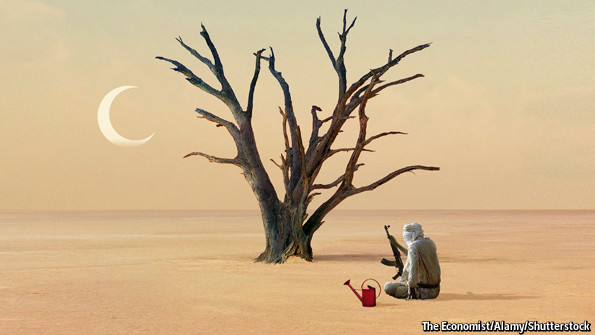
The Western imagination was stirred by the very thought of a revolution taking place in the Middle East, that the common man and woman on the street would gather despite their repressive and oppressive tyrannies and demand their human rights be recognized, that the kinds of of corruption-soaked governments they were long accustomed to finally give way to a semblance of democratic rule paying homage to human rights.
The Arab Spring was, in their opinion, a noble uprising whose time had at long last, been hastened by the resolve of an oppressed people. The despairing act of self-immolation of a street vendor harassed by petty officialdom trampling on his rights in Tunisia stirred the conscience of a nation. That nation was viewed as an autocratic dictatorship but one whose citizens were civilized not by Islamism, but by a penchant for Western values.
 |
A protester at a demonstration in Cairo's Tahrir Square in April, 2011, two months after President Mubarak was ousted ... Credit AFP |
The upheavals that followed elsewhere were far less successful in their outcomes, however. In nations where tribalism, sectarian animosities, Islamist ideologies and corruption were endemic to the region. Egypt's revolution to remove President Hosni Mubarak succeeded on the surface; he was arrested amid the turmoil of dissent and protest, while the repressed Muslim Brotherhood took advantage of the chaos to unleash prisoners from among whom would come the first elected Egyptian president.
Mohammad Morsi's Muslim Brotherhood's vast support among Egypt's poor, among university students and Islamists brought him to the power of the presidency and the Brotherhood to greater prominence, but their allegiance was to the Brotherhood movement, not to Egypt and their arrogance alienated the greater Egyptian population who demanded their ouster after a year's trial. Bringing the 360-degree return to military rule for 80 million Arabs.
A military dictatorship of necessity to confront the growing challenge of Islamist entitlement and the violent backlash of jihadist militias where the Sinai peninsula, lawless and threatening to the stability of the country plotted to destroy the new dictatorship just as it had the old one, making accommodation with the one in between, now disrupted.

Shaimaa al-Sabbagh is carried by a friend after she was shot in Cairo on January 24, 2015. She'd marked the anniversary of the Arab Spring in Tahrir Square. She died of her wounds. Reuters
The world has since looked on, aghast, as Syrian tyrant Bashar al Assad has responded in his own inimitable way to his Sunni majority's plea for equality with Syrian Alawites, opening the gates of Hell within Syria through his merciless attacks on his civilian population, and the introduction of foreign jihadis on the crumbling geographic region. Which was soon introduced to the epitome of Islamist barbarity in the form of Islamic State.
 |
| Reuters: Government forces shoot dead five protesters in southern city of Deraa, marking the beginning of an uprising across the country against President Bashar al-Assad. By October, 2011, 3,000 people lie dead and fears of a civil war mount but Assad clings on amid divisions in the international community. |
As the civil rights and socialist elements of those countries look with disappointed dismay at their hopes shattered that their societies might be altered and some vestiges of real democratic rule enter to transform what have been traditionally corrupt and dictatorial administrations, the situation of those countries remains mired in a kind of social dysfunction where the civilian population is preyed upon and kept in a state of endemic servitude to their masters.
It might be questioned where human decency is in all of this, where the powerful grip their status with deadly resolve prepared to destroy any vestige of confrontation or challenge to their authority. The region is stuck in a religious, cultural, heritage time-warp hearking back to the 7th Century and reflecting tribalism and suspicion of the sects, each insistent that the other represents a foul assault on Islam.
The Middle East is peopled with men and women capable of demonstrating great kindness and courtesy, but just as often great cruelty and lack of compassion. They are too divided as a culture, too steeped in tribal entitlements and resentments, too corrupt, too quick to violence, too sexually repressed in a patriarchal heritage of control, and far, far too removed from civility toward one another.
Resentment of the success of the West permeates the Middle East, as does the belief that the West conspires to keep Islam in thrall to its own needs.
Labels: Arab Spring, Heritage, Islamism, Middle East, Tradition, Violence
posted by Pieface @ Tuesday, May 24, 2016