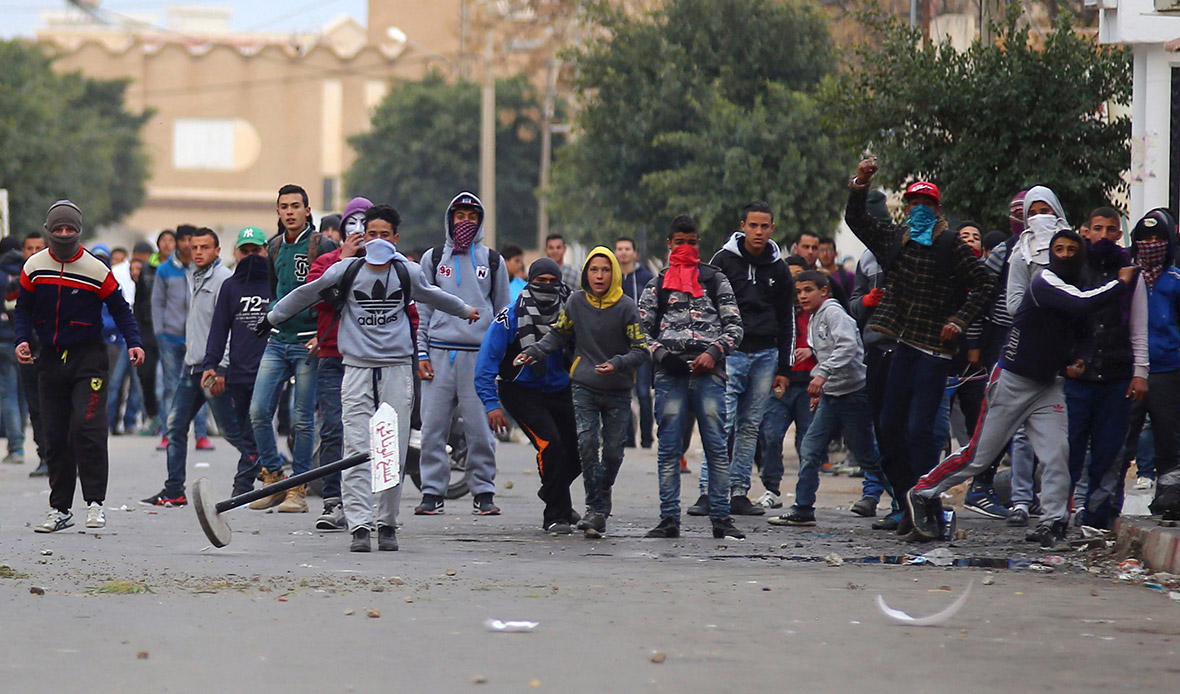
"Sometimes the women who come here ran away from a desperate situation with no luggage whatsoever, so we provide everything." Sonia Mhamdi, office of the Ministry of Women, Family and Children, Gafsa, Tunisia
"The new law is innovative because before, when the woman was abused and forgave the abuser, he would not be punished by law." "Now even if the woman forgives him, he will face the law and he will be accountable." Amor Yahyaoui, general inspector, Ministry of Justice
"The women in the center provided me with legal assistance and also psychological support." "I know my rights, but I need support to be sure that my children will remain safe in the process and benefit from at least some help." "[She withdrew her battery complaints] because I didn't want my children to be without their father." "[After her husband began beating their oldest child] I just could not take it any more." Sihem Ben Romdhane, Gafsa, Tunisia
"Women and men come every day to the court for marriage issues and to ask for child support and women do not hesitate to complain about their violent husbands." "It's not taboo anymore." Mohamed Khlefi, Gafsa court public prosecutor
The Tunisian government is taking substantial measures against anti-women violence. [AFP]
Date of publication:
25 February,
2018
According to 2016 statistics, 60 percent of Tunisian women were exposed to domestic violence, a figure released by the Ministry of Women, Family and children, supported by studies from NGOs suggesting the actual number of women victimized by family violence to be even higher. Fifty percent of Tunisian women have stated that at least once in their lives they had experienced violent aggression in a public space.
Tunisia has been regarded as representing the most socially advanced of Arab countries for women's rights being upheld. Polygamy was altogether abolished in 1956, the year after independence. Women have long been able to gain custody of their children, along with the right to divorce. Despite which violence in domestic settings victimizes a large proportion of Tunisian women. They are discriminated against within society as they are in most Muslim societies.
Because these are Muslim societies where the Koran instructs men how they may treat women who are recalcitrant and urges men to beat such women with discretion, and at the same time warns that women are not independent of their husbands, must accede to them in all matters, and may not at any time deny their husbands sexual relations, else face due punishment. Multiple wives are not uncommon in Muslim countries.
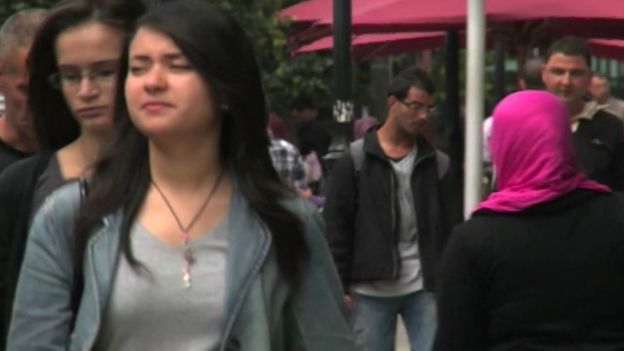
The view on Avenue Habib Bourguiba of women wearing a variety of styles is a rare sight in the Arab world
In Tunisia, however, a law passed a year ago that outlaws violent acts against women, and recommended that new shelters and other facilities whose purpose is to protect women be opened. Funded by the European Union, seven shelters operate throughout Tunisia, not an excess of havens in a nation where an estimated 60 percent of women are victims of domestic violence. Domestic rape is now outlawed. Moreover a rapist is now barred from the expedient of marrying his victim to minimize his sentence.
Should police fail to receive a woman's abuse complaint with the seriousness it calls for, he could himself face jail time. Under the new legislation, if the victim drops the charges, the investigation must continue. Many women, after lodging an official complaint, withdraw it when they are informed their husband will go to jail, and the abuse simply carries on, the wife loathe to carry through. If a police officer now makes an effort to have a woman change her mind about bringing charges, he will himself be charged.
Any witness of violence against women who fails to report it may be prosecuted, as well. Two years in prison is the punishment for sexual harassment. Domestic-violence-specific courts and judges dedicated to sitting in judgement in cases of domestic violence, along with special police units, led mostly by women all represent new initiatives in an effort to reduce the numbers of women who face violence in their lives.
They won't take inspiration on women's liberation from Wonder Woman, though; it's been banned in Tunisia.
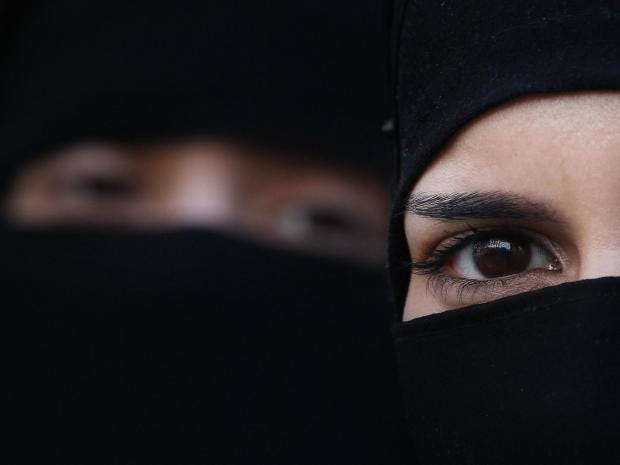
Tunisia's new law could lead to a cultural revolution for Muslim women across the Arab world, human rights organisations hope Getty
"How can we accept those people who are professionals in war, in the use of arms and have a culture of being terrorists?" "It is a nightmare for Tunisia. We are not ready for that." Badra Gaaloul, International Center of Strategic, Security and Military Studies
"The terrorist current was one of the main beneficiaries of the Tunisian revolution." "From the first months it quickly profited from the release of its detained members and from the climate of freedom to rebuild itself." Tunisian report on terrorism
"Their aim [Islamists] is still to destabilize the state." "They [Tunisian police and military] have dismantled the logistics and recruitment networks, and there is no longer this support system that there was in 2012 and 2013." Colonel Mokhtar Ben Nasr, head, military analysis, Tunisian Center for Global Security Studies
Tunisian forces in Ben Gardane, near the Libyan border, during clashes with jihadists a year ago.Credit
Fathi Nasri/Agence France-Presse — Getty Images
There is no longer any government-sponsored programs for the purpose of de-radicalizing Tunisians returning to their country of birth from fighting in Syria, Iraq and Libya; no programs, no efforts to reintegrate them back into society, according to Ridha Raddaoui, lawyer and co-author of a new report on terrorism in the country, authorized by the Tunisian Forum for Economic and Social Rights. Which points out that instead of supporting families of suspects and returning fighters they face persecution. "The methods are pushing people to terrorism", claims Mr. Raddaoui, of the thousands whose family members long since departed to become fighters for Islamic State or al-Qaeda. Greater numbers of Tunisians joined rank with the Islamic State than from any other country in the region. Facing defeat on the battlefields of Syria and Iraq, Tunisia is girding itself for the return of its Islamist citizen-fighters, without having any idea of how best to handle their presence.
Of the 5,5000 Tunisians who chose to go abroad to fight as jihadists -- responding to a clarion call to the faithful they found irresistible -- many, according to estimates out of the United Nations, are planning new targets to be found at home and throughout Europe. Tunisians have been known for their implication in a number of recent terrorist attacks taking place in France and Germany. Tunisia is contemplating with dread their return to Tunisia.
Associated Press
The nation's new Constitution does not permit their being barred entry, as Tunisians. They can be incarcerated as punishment for becoming part of a terrorist group or for the commission of crimes abroad, but evidence is elusive to support such cases. Instead, Tunisia has settled for a possibly illegal system of monitoring, viewed by government opponents and human rights groups as being counter-productive. Since the threat of imprisonment and torture is seen as a deterrence to those planning to return.
Instead some of those committed jihadists have decided to remain illegally in Turkey and Europe, as literally ticking time bombs. Threatened with punishment on return to Tunisia, they have been rendered stateless and may perceive they have nothing to lose by continuing their commitment to jihad right where they find themselves. Those Tunisians choosing to remain in Libya affiliated with al-Qaeda in the Islamic Maghreb are every bit as much a threat since that group plans to bring Islamic rule to Tunisia, extending it to all of North Africa.
Tunisia, the poster-nation for the only 'success' realized by the unfolding of the Arab Spring. As the first country to experience the phenomenon and the only one to be recognized as having transitioned from a dictatorship to a well-functioning hybrid secular government with an Islamist back-up, it has been hailed as a success. The moderates among the political parties made accommodation with the fundamentalists, but insurgents crossed into Algeria.
And those terrorists initiated a campaign of assassinations, ambushes on police and military, and also affected suicide attacks, the hallmark of Islamic State action-central. Tunisia, since 2013 has been struck by numerous episodes of terrorist attacks, many of which were planned by groups whose bases are in Libya. A suicide attacker killed a dozen members of the Tunisian presidential guard in 2015. The Tunisian border town of Ben Gardane last year came under attack by hundreds of Tunisian fighters.
Tunisian Islamist leaders, previously finding sympathy with young jihadists have now joined President Beji Caid Essebsi to agree that all returning fighters must go before the courts. "They killed people, and they have to pay", stated Abdelfattah Mourou, deputy speaker of Parliament. Human rights activists insist that the cycle of radicalization will continue as long as the jihadists see no way out of their dilemma of returning only to face imprisonment.
Mr. Raddaoui of the Tunisian Forum for Economic and Social Rights points out that the justice system will discover that "There are no autopsies, no police reports", since the crimes took place elsewhere, making it difficult to prove that any punishable crimes were committed, leaving the government in a quandary once again on how to proceed, to protect the Tunisian public from the presence of hard-core fighters bringing their grievances back home with them.
As though to give the government authorities further fuel for thought, Mr. Raddaoui helpfully pointed out that in his reading of the court papers relating to 500 returned Tunisians, there was no detectable signal of remorse to be seen: "What they admit to, they do not regret at all", was his less-than-comforting observation.
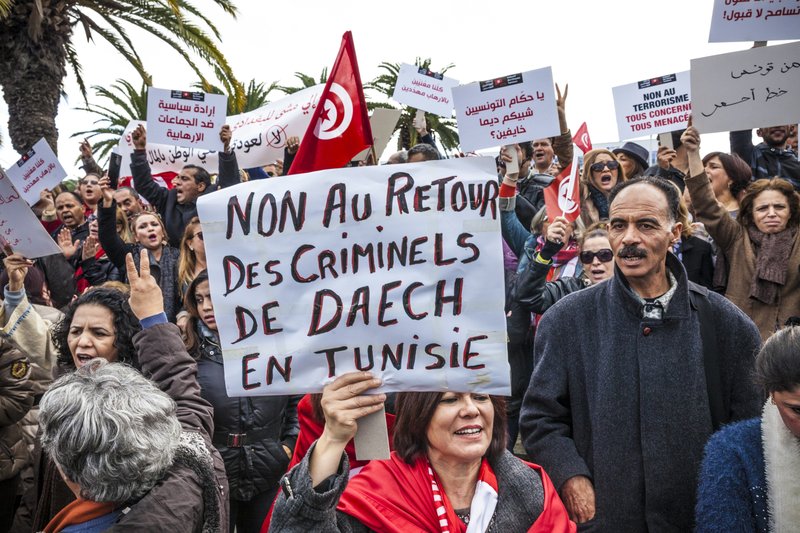
A January protest in Tunis against returning jihadists, as seen from inside a bus.Credit
Amine Landoulsi/Anadolu Agency, via Getty Images
"He was the most wanted man in Europe. There is absolutely no doubt that the person killed is Anis Amri." Italian Interior Minister Marco Miniti
"It was a regular patrol. They had no perception that it could be him, otherwise they'd have been more careful." Milan police chief Antonion de Iesu
"We can be relieved at the end of this week that one acute danger has been ended." "But the danger of terrorism as a whole remains, as it has for many years -- we all know that." German Chancellor Angela Merkel
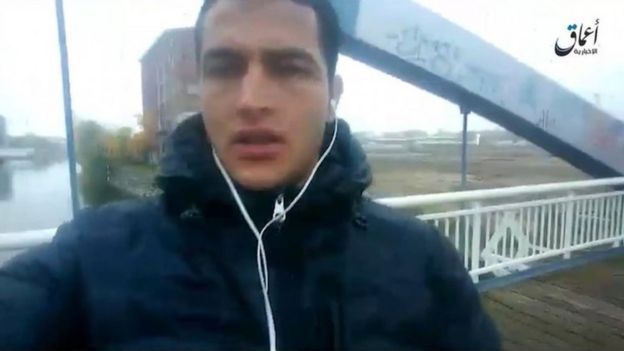
"God willing, we will slaughter you like pigs." "To my brothers everywhere, fight for the sake of Allah. Protect our religion. Everyone can do this in their own way. People who can fight should fight, even in Europe." "Fear is a reaction, courage is a decision." Anis Amri, 24, Tunisian Jihadist
Image caption
IS released a video showing Amri pledging allegiance == AFP
Just as Islamic culture equates honour with the subjugation of women, jihadists equate courage with the decision to mount terrorist attacks upon vulnerable civilian populations with an aim to murder as many as conceivably possible, in honour of Allah. Islam demands of its faithful that they be willingly instrumental in spreading their sacred word of surrender to Islam. Jihad will not be complete until the world turns as one five times daily in Islamic prayer certifying that conquest is achieved.
On the other hand, perhaps it can be conceived that Anis Amri, once his bloody carnage was completed, failed the complete test of heroic courage. To martyr oneself in the course of jihadist action is to complete the process. Since there is honour in the slaughter of non-Muslims to please Allah, self-martyrdom is a requirement, upon which the martyr's ascent to Paradise is assured, when he can reap his promised reward for all eternity with submissive nubile virgins.
Perhaps Islamic clerics will now concern themselves with the scholarly discussions that must now ensue to determine whether this courageous man's actions, culminating in a desperate bid to escape unIslamic justice truly equates with martyrdom, since the concept of the ideological belief in jihad is to sacrifice one's life since, as jihadists are so often fond of claiming, they love death as others love life. Having no fear of death, prepared to clasp it to their bosom, has this man betrayed Islam?
And then other questions arise. Why cannot European intelligence agencies confer with one another and exchange vital information that could protect themselves against such bloody assaults? Authorities admit one time after another that jihadists had come under their surveillance as suspects long before the actual violence ensued. Finding themselves hamstrung with insufficient evidence reflective of Western judicial guidelines to remove the threat.
And this: despite a widespread European threat assessment and warning from various sources then the subsequent alerting of policing and intelligence agencies after the fact, the man who had left more than adequate evidence in his personal papers, his fingerprints, his blood sample at the scene of the crime, was still able to evade authorities in a string of countries including Austria or France or Switzerland. The murderer evaded German authorities, travelled through that country, then Austria and Switzerland, to arrive in Italy.
He was permitted entry to Italy, even though he had a criminal record in both Italy and Tunisia. It was only by chance that a two-man Italian police patrol on the lookout for a robbery suspect, stopped this unkempt-appearing man in the early morning hours at a train station popular with such as he. He had been identified as the prime suspect in the Berlin Christmas market truck ramming, yet Germany couldn't hold him and three other countries couldn't identify him.
This man represented one of the multi-thousand economic migrants who had entered the Italian coast through Lampedusa in 2011 before moving on to Milan; considered a "youth" to whom all opportunities as a Muslim migrant should be extended. He repaid that concern by burning down the refugee holding building he and countless others were sheltered in, over a complaint that the food was not to their liking. His subsequent years in a Milan prison were said to have exposed him to 'radicalization'.
This reflects the circumstances whereby Europe is slowly and steadily being undone.
"We have one demand: employment." "People don't have money. We are sick with worry about food and electricity." Shamseddine Tlilli, 30, computer science master's degree
"The government asks us to submit projects, but then there are a whole lot of obstacles. You have to know someone or have money to bribe. If I had money, I would not be here." "We asked the government to negotiate with us because we have ideas and solutions." Ibrahim Omri, textile engineer
Protesters shout slogans across from government offices in Kasserine, Tunisia, Amina ben Aziza, Reuters
The inspiration for the Arab Spring that flooded the Middle East after the protest self-immolation of a fruit street vendor harassed over a license in 2011 did have the effect of unseating the-then government of Tunisia, but Mohamed Bouazizi's self-sacrifice has not, five years later, resulted in relief from unemployment and distress for other young Tunisians.
Like Bouazizi who was a representative of the poor who could aspire only to vending fruit as an itinerant peddler, the highly educated youth of Tunisia find themselves just as frustrated by an employment market shut to their professions, skills and wish to work. In Kasserine, a provincial capital with a population of 400,000 jobless youth are desperate.
Some declare hunger strikes, several hundred among them lay siege to a governor's office for weeks. Unemployed young people with degrees have heard more than enough promises that the revolution would make a meaningful change in their lives. But the impoverished town, whose residents are anxious to see investment to help their economy, aren't likely to any time soon, given the military operations and clashes with an Islamic insurgency set up in camps in mountains outside the town.
The young protesters in the town are disappointed and frustrated that their advanced academic and professional degrees have done little to advance their interests. Jobs are scarce, and thoughts of moving to larger cities are non-starters, given the expense. They see a solution of some kind in government relaxing conditions for loans given to young entrepreneurs willing to begin their own businesses.
Pervasive corruption, they claim, impedes those few programs designed by government to generate jobs. "People are sick of the governments words", said Ahmed Rahall 24, with his master's degree in business management, jobless nonetheless. Some among his group of protesters have had training courses for entrepreneurs. Their biggest complaint is that banks are unprepared to fund them with startup money insisting on down payments that are unaffordable.
President Beji Caid Essebsi characterizes the far left representing the students with their demands as being as dangerous as Islamist extremists who commit terrorist attacks. /The mayor of Kasserine, Ridha Abbassi who had, as an academic supported the 2011 revolution, speaks of his position as one of crisis management: "I feel all the time I am walking on fire. The town is boiling and bubbling."
And Tunisia is considered to be the sole exception to the failures, some of them as spectacular as the massive breakdown of Syria, of the Arab Spring revolt against traditional Middle East and North African government authority.
"There was a great hole in his head. I felt his body slip onto mine. We were all crammed together on top of each other and there were lots of wounded. My friend had two people on top of him who were seriously injured and losing a lot of blood. So what we did, as we were scared the terrorists would come back, was to smear victims' blood over our bodies." "As we were still alive, we thought it would be best to play dead and smear blood all over ourselves in case they returned." "[The terrorists] came from nowhere, shooting in all directions." Maryline, Parisian tourist, Tunisia, Bardo Museum
"We saw a man come running in chased by the shots of a terrorist. We hid in a small room and that's where we stayed. We spent all night there and we thought the terrorists were still outside. But it was simply the police who were searching for people. We thought they were terrorists out there and that's why we didn't venture out." Juan Carlos Sanchez, Cristina Rubio, Spanish couple
Gunfire: Glass shattered by bullets at the scene of the massacre Marwen Farhani/ Transterra Medi
Cristine Rubio, four months' pregnant and her husband spent a full day shuttered within a tiny room used to stock cleaning supplies at the Bardo museum, next to the Tunis Parliament buildings. And there they stayed, terrified, long after the attack had concluded, an attack that left twenty tourists and two Tunisians dead. "It was terrible. Every time I think about it I start crying", a South African tourist said. His wife had been shot and critically injured.
And then there were the people who took shelter behind a pillar. Nothing seemed to deter the gunmen, they fired indiscriminately as was their intention, to kill as many people as possible. Nine people have been arrested by Tunisian police. But the country's tourism has been left in a state of shambles, an industry that Tunisia is heavily dependent on. The two gunmen who were killed by police were praised by Islamic State in an audio recording which proudly described them in Arabic as "knights of the Islamic State".
Unsurprisingly, the Islamic State connection has been made, given that Tunisians, coming from the crucible of the Arab Spring -- the only Arab Muslim and North African country for whom the protests that resulted in the removal of an autocratic government manoeuvred its way toward a true democracy -- has unwillingly donated roughly three thousand jihadis to Syria, Iraq and Libya to fight for the Islamic State caliphate.
Avoidance of stops in Tunis for cruise ship companies will become routine from Italian Costa Cruises and MSC Cruises, along with two German tour companies which had decided to halt all further trips to Tunis from beach resorts nearby. "If you use the analogy of a needle in a haystack, the haystack gets a lot bigger in the summer months and this is a very, very difficult time for the Turkish authorities", commented Chris Phillips, former head of the U.K. National Counter Terrorism Security Office, noting that vacationers travelling to Turkey will make it difficult to track would-be jihadists passing through.
Four of the people arrested by police, according to authories, had links that led directly to the assault. The remaining arrested five had indirect connections. As people gathered outside the now-locked gates of the Bardo Museum to protest the attack, they voiced sympathy for the victims and concern for their country's future was not far from their minds. "We've never had a problem with terrorists. They are animals and when they are caught the government should strip them of their citizenship" Radhia Loveti, 49 recommended.
Stripping such monsters of citizenship will be of scant comfort to the tourists from France, Belgium, Italy, Spain, Poland, Australia, Columbia and Tunisia itself who had made a trip of a lifetime on the MSC Splendida cruise ship, to dock at the Port of Tunis hours before the attack took place.
"I want the people of Tunisia to understand firstly and lastly that we are in a war with terror, and these savage minority groups will not frighten us." "The fight against them will continue until they are exterminated." President Beji Caid Essebsi, Tunis
"After they entered the museum, I saw their faces: They were about ten metres away from me, shooting at anything that moved." Josep Lluis Cusido, tourist, mayor of Spanish town of Vallmoll
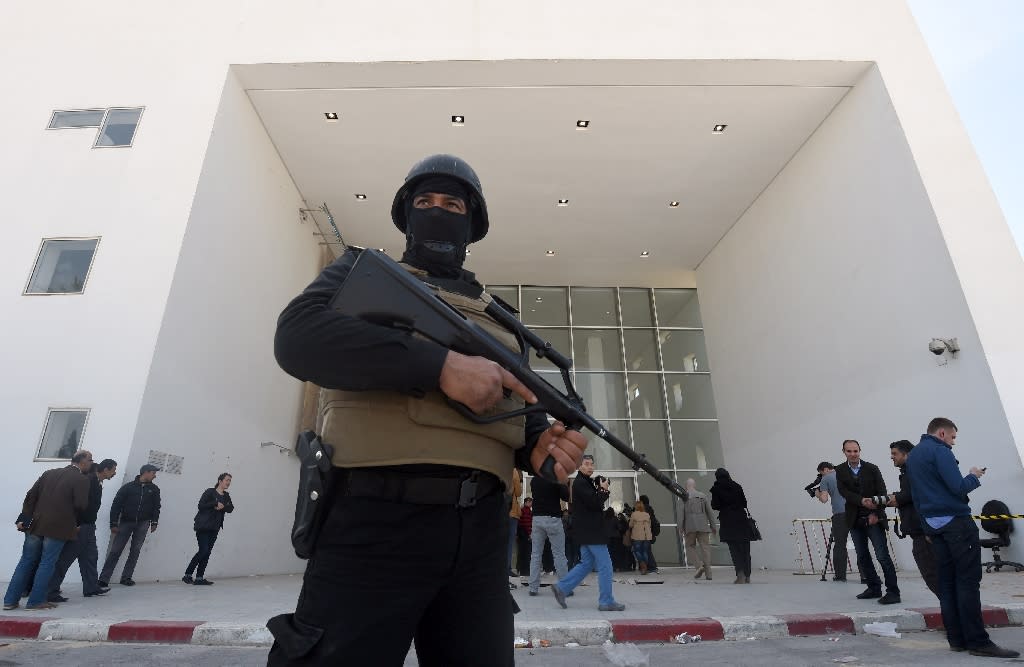
Tunisian security forces stand guard as
journalists gather at the visitors entrance of the National Bardo Museum
in Tunis on March 19, 2015, in the aftermath of an attack on foreign
tourists (AFP Photo/Fethi Belaid)
Foreign tourists exiting a bus at the National Bardo Museum, on an onshore trip off their cruise liner were met by militants wearing military-style uniforms and with assault rifles gunning them down. After shooting eighteen of the tourists and two local Tunisians dead, the attackers charged the interior of the museum to take hostages. Eventually two of the terrorists were killed in a firefight with security forces but not before 50 innocent people were injured.
A hunt was immediately begun for the two or three accomplices who had managed to escape after the attack. The tourists who lost their lives in a country hugely dependent on its income from tourism, were from Poland, Italy, Spain, Germany and Colombia. The cruise ship, with an estimated three thousand tourists aboard, left Tunisian waters and is unlikely to return any time soon.
Islamic State Twitter accounts were rife with congratulatory messages. And urgings that Tunisians take steps to "follow their brothers" in organizing additional such attacks. The Islamic State of Iraq and al-Sham, in fact, is taking full credit for the deadly attack at the country's largest museum. Tunisia has appeared as the sole country in the North Africa/Middle East continuum to have emerged from its Arab Spring as an intact democracy.
After unseating its dictatorial ruler, Zine El Abidine Ben Ali, a country that had always looked to the West to emulate its democratic, civil style in a cosmopolitan atmosphere of tolerance, struggled to find its new place in the world of reformed democratic action. As the harbinger of the Arab Spring phenomenon that trickled through to the Middle East with disastrous outcomes, it is the only country that persevered with the outcome of freeing itself from the shackles of authoritarian rule.
The original protesters who empathized with the self-immolating despair of a fruit vendor harassed over a trade permit were affluent and sophisticated, hoping for their country to fully pattern the Western tradition of liberty and democracy and the tradition of human rights practised in Europe. The country's Islamist parties at all levels of the spectrum from moderate to fanatical made their own visions for the country's future known.
Parliament divided between secularists and Islamists, and each made an effort to get along. But radical Islamism gained the momentum to the extent that secular politicians were harassed and sometimes assassinated, calling for an end to the tolerance from radical religious parties whose aspirations represented a threat to the well-being of the country.
The slums of Tunis saw the rise of the radical Ansar al-Sharia group who saw much in common with al-Qaeda and now Islamic State, with their Libyan counterparts. Banned several years ago when the country cracked down on extremists when two leftist political leaders were killed, the government remains in a struggle to stamp it out altogether, difficult with its contiguous border with Libya now home to Islamic State militants.
Tunisian Islamists, however, have swollen the fighting force of Islamic State to an extent few other countries in the region have. Of eleven million inhabitants, Tunisia has gained the distinction of having contributed a larger number of jihadist fighters to Syria and Iraq, dedicated to the caliphate of Islamic State, than any other country in the region.
"What are we celebrating today?" "We are celebrating freedom! We are celebrating Tunisia! We are celebrating democracy!" Rachid Ghannouchi, 63, leader of Islamist Party
Supporters
of Tunisian presidential candidate Beji Caid Essebsi shout slogans and
wave flags on Bourguiba avenue in the capital, Tunis. Photo: Fadel Senna
/ AFP
The Islamist party's supporters hardly needed the cheerleading of Mr. Ghannouchi, they were celebrating anyway. They were celebrating the fact that their country had just undergone a peaceful election, and they waved their little red-and-white Tunisian flags in celebration of that event. That they happened to have lost the election appeared almost incidental.
In a way it's odd that North Africa's most civil, secular-ruled and societally-secular country, the first among all its nation-cadres to explode into the protests to unseat the then-government of their dictator Zine el-Abidine Ben Ali, incited by the self-immolation of a fruit vendor who was protesting a matter of licensing and ill treatment by authorities, remains the sole Arab (Muslim) country to have found their way to the balance of political moderation and social peace.
The Islamist government that ruled was accused perpetually of surrendering its authority to the more radical Islamist parties within a society that is more Western in cultural and social practise than its other 21 Arab-member countries. But the transition through a democratic vote that removed them from power to make way for a successor has been civilized and peaceful.
Unlike Egypt's turn at their Arab Spring, vastly dissimilar to the basket case that Libya swiftly degenerated into with competing Islamist militias, armed and dangerous to the public weal, defiant of central government. And certainly bearing no resemblance whatever to the horrors that befell Syria when its majority Sunni population campaigned for equal treatment as citizens of Syria ruled by the Baathist Alawite Shiite regime of Bashar al Assad who preferred to bomb his critics rather than negotiate with them.
Not that all is sweetness and light in Tunisia. While the Islamists on the moderate scale of the ledger had surged to power (just as the Muslim Brotherhood did in Egypt with the downfall of Hosni Mubarak and then went on to demonstrate their inability to lead the country responsibly as its economy collapsed and crime skyrocketed along with unemployment) Tunisians have decided after all, that they would return to some semblance of the sectarian rule they had dismissed three years earlier.
The fly in their ointment appears to be the likely election of Beji Caid Essebsi, now 87, who had served the previous authoritarian government, pre-revolution. But it is his secular party that won the parliamentary elections. This time the secularists view Mr. Essebsi as a moderate, giving Islamists reason for alarm in a return to the 'the old regime controlling everything'.
"Today I have the means to bring back 107 people, but I'll lose 3,000 Tunisian dinars ($1,922)." Tomorrow I might not be able to. I have people who work with me. If I interrupt work once, twice, three times, it becomes a heavy burden on my shoulders." "The other day, with my boat, I brought back 107 people, three or four died before my eyes; they fell in the water and they didn't know how to swim. My stability (of the boat) didn't allow me to act. One hundred and seven people represents a great danger for my crew." Chamseddine Bourassine, Tunisian fisherman, Zarzis, Tunisia
"We find them dead, but we don't declare it. [If] there is a body on the water and we are six or seven hours from the land, we can't get them on board." Mansour Ben Chouikha, Tunisian fisherman
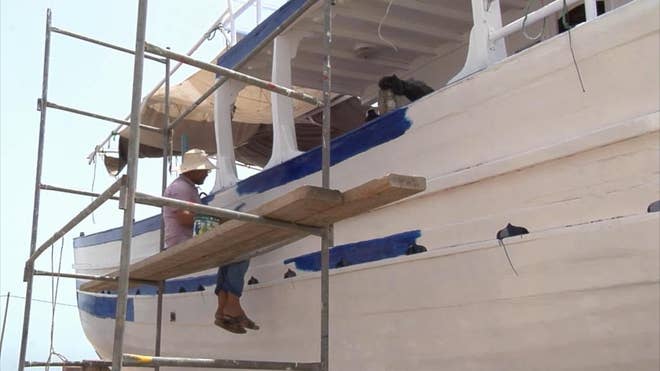
In
this image taken from TV Tunisian fisherman Chamseddine Bourrassine
paints his boat in Zarzis Tunisia Monday Aug. 5, 2014. Zarzis is like
many other costal towns in Tunisia, it relies heavily on its fishing
industry, which employs many of the local men.The fishermen are netting a
catch of a different kind too - migrants who attempt to cross the
waters, trying to get in to Europe by sea. Many of these migrants have
their sights set on a better life, fleeing conflicts in their home
countries. (AP Photo/Associated Press Television) (The Associated Press)
Tunisian men in their 50s, owners and operators of Tunisian fishing boats out of the small North African port of Zarzis have been witnessing tragedy on an immense scale on the seas they have long been accustomed to fishing for their living, but which have latterly been the graveyard of desperate migrants trying to escape conflict, starvation, death. They are witness to waves of migration from the coast of Africa to the presumed safety of Italian shores, and beckoning European salvation.
Floods of the desperate, escaping the conflict maelstrom of the Middle East and Africa, seeking life in Europe, hoping to leave the deadly insecurity of their homelands far behind them, like finally waking from a nightmare of impossibly bleak proportions, helpless to aid oneself but to turn one's back on all that was once their heritage. The Tunisian fishermen respond as they can, attempting to save as many lives as possible, but their good intentions are being swamped in the impossible-to-cope-with numbers.
Mr. Bourassine himself estimates he has helped to save over one thousand migrants while out on his fishing boat; on two occasions alone since the 2011 Libyan uprising. There are no rewards for the aid they give the desperate, other than their knowledge that they have obeyed their humanitarian instinct. Even so, they feel they've been placed in an impossible situation; their government has done little to ameliorate the situation, to organize rescue missions, leaving such things to good-hearted civilians, wanting no details.
Speaking volumes of the vast differences in institutionalized social, humanitarian values between an Islamic and a Western, democratic sensibility expressed by national government.
Mansour Ben Chouikha has seen more horrific scenes on the calm waters around Zarzis than he cares to mention; floating bodies decomposing in the Mediterranean, some headless. They don't maintain numbers of recovered migrants, dead or alive, but they insist the numbers are on the rise. And they complain that their government does nothing useful. While disasters such as Lampedusa off the southern Italian coast where 400 migrants died in the capsizing of their vessel in 2013, are well reported in the West, such episodes are given no newsplay in Tunisia.
The Tunisian men report seeing 30 boats of migrants each day leaving for Italy, each with a capacity between 50 and 250 people. While the Red Crescent is attempting to aid some of the migrants the Tunisian Coast Guard picks up, they are a minuscule number, at an estimated 400, of the actual numbers of people desperately fleeing to what they hope will be haven and safety.
The Italian navy, on the other hand, has ramped up[ its rescue efforts since that calamitous mass drowning at the island of Lampedusa. It announced recently its rescue of over 93,000 migrants since the turn of the year.
Tunisian Political Deal Brings an End to Islamist Government
Tunisia's
political rivals have agreed on a timetable for the Islamist coalition
to quit and be replaced by a government of independents.
By Elad Benari -- ArutzSheva 7
First Publish: 10/6/2013, 6:31 AM
Tunisian leaders on October 5, 2013
Reuters
Tunisia's political rivals agreed on Saturday
on a timetable for the unpopular Islamist-led ruling coalition to quit
and be replaced by a government of independents, aiming to end a
festering political crisis, reports AFP.
The Islamist Ennahda party and opposition groups in the country that gave birth to the Arab Spring signed a roadmap aimed at creating a new government within three weeks, said the report.
Saturday's deal, signed in the presence of politicians and media, was brokered to end a simmering two-month crisis sparked by the assassination in July of opposition MP Mohamed Brahmi.
The document, drawn up by four mediators,
foresees the nomination of an independent prime minister by the end of
next week, who would then have two weeks to form a cabinet.
It says that after the first day of national dialogue, "the government will resign with a delay not exceeding three weeks."
One of the leaders of Ennahda, Abdelhamid Jlassi, told AFP the national dialogue proper is not expected to start on Monday, however.
"First there will be preparatory meetings,
and the date of the government's resignation will not be determined
until the start of the real national dialogue," he told the news agency.
"Ennahda's signature today is a major concession made in the interests of the country," he added.
Saturday's ceremony got under way after a delay of several hours that underscored the mutual distrust between the rival camps.
By signing the roadmap, the Ennahda-led
coalition, which has been rocked by the murder of two political
opponents, economic woes and prolonged political disputes, has agreed to
step down two years after winning a general election.
Its victory at the polls on October 23, 2011, was the first free vote in Tunisian history, and followed the overthrow of long-ruling strongman Zine El Abidine Ben Ali in the first revolt of the Arab Spring.
Ennahda has been more moderate than the Muslim Brotherhood in
agreeing to a power-sharing agreement, and not mentioning Sharia
(Islamic law) in the constitution, but opposition groups have accused it
of turning a blind eye to the activities of more radical Islamist
groups.
Mohamed Brahmi's daughter, Belkis, was joined by angry protesters outside the hospital where the politician died
Tunisian opposition politician Mohamed Brahmi has been shot dead outside his home in the capital, Tunis, officials say.
Mr Brahmi, 58, led the nationalist Movement of the People party.
It is the second time an opposition party leader has been killed this year.
Protesters have gathered in Tunis and in Mr Brahmi's
hometown, Sidi Bouzid, calling for the government to resign. Tunisia
largest labour union has announced a general strike for Friday.
In February, prominent secular politician Chokri Belaid was also shot outside his house in Tunis.
His murder sparked nationwide mass protests and forced Prime Minister Hamadi Jebali to resign.
An uprising in Tunisia in late 2010 kick-started a series of
revolutions that spread through the Middle East and became known as the
Arab Spring.
But there has been deep division between Islamists and
secular opponents since the revolution, the BBC's diplomatic
correspondent James Robbins reports.
The opposition leader was gunned down in his car outside his home in Tunis
Many Tunisians, particularly the young, complain that their
quest for secular democracy has been hijacked by intolerant Islamists,
including the Muslim Brotherhood which forms part of the current
government, our correspondent says.
Gunmen on a motorbike shot Mr Brahmi in his car in front of
his wife and daughter on Thursday morning, Movement of the People party
officials said.
Local media reported the assailants fired 11 bullets at the politician. It is not known yet who was behind the attack.
The family of Mr Brahmi has accused the governing Islamist Ennahda party of being behind the killing.
The party has not responded to the claim, but released a statement expressing "sadness and shock" at the "cowardly and despicable crime".
Mr Brahmi's wife, Mbarka, and her daughter Belkis were joined
by angry Tunisians outside the hospital in Tunis where the politician
died.
Large crowds also gathered in front of the Ministry of Interior in the capital in protest at the killing.
There were also reports of demonstrators converging in the city of Sidi Bouzid, the birthplace of the Arab Spring.
Large crowds also gathered outside the Ministry of Interior in Tunis in protest at the killing
"People have blocked roads and set tyres alight," a local resident told the Reuters news agency.
The killing came as Tunisia celebrated the 56th anniversary of becoming a republic after gaining independence from France.
French President Francois Hollande condemned Mr Brahmi's
murder and called on Tunisians to unite behind the democratic
transition.
Human rights organisation Amnesty International said the killing was a "blow to the rule of law in Tunisia", which was experiencing a "worrying tide of political violence".
Mr Brahmi was a vocal critic of the governing Islamist Ennahda party
Mr Brahmi founded the Movement of the People party after the 2011 revolution.
He was also a member of the National Constituent Assembly, which is drafting a new constitution.
The assembly announced Friday would be a day of mourning.
Mr Brahmi was not as big a political figure as Mr Belaid, but he too was a leftist critical of Ennahda.
Ennahda came to power following the overthrow of long-term ruler Zine al-Abidine Ben Ali in January 201.
The party has faced growing popular unrest over a faltering economy and a rising extremist Islamist movement.
After Mr Belaid's assassination in February, many Tunisians
accused Ennahda of not doing enough to stamp out a rise in Islamist
violence, with some critics saying the party was actively fomenting it,
correspondents say.
The El Ghriba synagogue in Tunisia. Photo: Wikimedia Commons.
The oldest synagogue in Tunisia opened its doors Sunday to visitors
for the first time since protests broke out in the country in 2011.
Jewish pilgrims visited Ghriba, Africa’s oldest synagogue on the
Tunisian island of Djerba, where security was high to prevent any
violence.
The protests in 2011 eventually led to the ouster of the country’s
leader, Zine El Abidine Ben Ali, and inspired similar movements in
countries throughout the region. But it also proved problematic for the
Jewish community in Tunisia, and security concerns prevented the use of
Ghriba.
This year the pilgrimage, which started Friday, took place in a
festival-like atmosphere with a final procession attended by Tourism
Minister Jamel Ghamra and Tunisia’s Grand Rabbi Haim Bitan.
According to legend, the synagogue was founded in 586 BC by Jews fleeing the destruction of the Temple of Solomon in Jerusalem.
“There’s an impressive security presence which is a positive step
that sends a message to the Jews in the world and says Tunisia protects
them, although the county’s leadership is Muslim,” Perez Trabelsi,
head of the Jewish community in Djerba, was quoted by Israel’s Channel 2
as saying. “Jews in the world should see the effort of the government
and understand that they can come back here now and in the coming
years.”
Authorities had reinforced security around the ancient mosque and the
Jewish quarter of Djerba for the pilgrimage to prevent any attacks by
radical Muslim groups, the AFP reported.
Beginning 33 days after the start of the Jewish Passover festival,
the Ghriba pilgrimage used to attract thousands of pilgrims and
tourists but their number fell dramatically after an April 2002 bombing
that killed 21 people.
Tunisia sparks fears from seculars over growing Islamist insurgency
Al Arabiya
Secular and western societies are becoming increasingly concerned
over developments in Tunisia following the noticeable post-revolution
surge in the number of citizens participating in Islamist movements, the
Financial Times reported on Monday.
The developed
situation is raising concerns from counter-terrorism organizations as
more Tunisian militants are seen to take the frontlines fighting in
Iraq, Syria, Afghanistan and Mali.
Tunisia had been viewed as a secular state prior to the 2010 revolution.
In January, Tunisians formed the biggest group among the militants who participated in the attack
on the In Amenas natural gas plant in Algeria, and in February,
suspected Islamist militants shot dead a leading secular politician in
Tunis, triggering further political instability.
Tunisia has
recently been embroiled in controversy following reports that members of
Islamist Tunisian parties are involved in the fighting in Syria. The
country said the presence of insurgents abroad and the increased access
to weapons has left the government concerned about its foreign and
domestic policies, the newspaper reported.
Tunisian Prime
Minister Ali Larayedh said last week in a statement made to the press
that his country cannot legally prevent its citizens from travelling to
Syria to fight.
Larayedh revealed that Tunisians travel to Libya and Turkey under the pretext of tourism or work and later go to Syria.
Tunisian
security forces said late March that there are a number of disbanded
networks that were working on recruiting young Tunisians to send them to
Syria.
Government officials reported to have on many occasions
caught weapons being smuggled into the country. Earlier in February,
Tunisian security forces were reported to have clashed with militants
smuggling weapons into the country and killed three.
Experts say
the Tunisian uprising resulted in a sizable number of young Tunisian
civilians recruited by extremists to participate in violent battles
inside and outside the country.
What is disturbing is that many Arab and Islamic human rights organizations
have remained silent about the crimes committed against Muslim women throughout
the Arab and Muslim world. By contrast, these organizations are often quick to
denounce Westerners for "insulting" Islam by depicting the Prophet Mohammed. If
anyone is really insulting Islam, it is the Muslim fundamentalists and jihadis
who show no respect for Muslim girls and treat them as sex
slaves.
What are the Muslim jihadis in Syria doing when they are not fighting against
Bashar Assad's army?
According to reports
in a number of Arab media outlets, the jihadis are importing Muslim girls to
satisfy their sexual needs.
The sexual exploitation of girls was revealed after several Tunisian families
reported that their teenage daughters had gone missing in recent months.
It later transpired that the girls had been dispatched to serve to Syria on
"jihad marriages." In other words, the girls had been sent to Syria to satisfy
the sexual needs of the anti-Assad jihadis.
The jihadis, some of whom are affiliated with Al-Qaeda, are probably not
getting enough weapons from Arabs and Westerners to fight against Assad's
forces. But what is evident is that they are in the meantime getting enough
supplies of young girls to satisfy their sexual needs.
The phenomenon apparently began after a Saudi religious scholar, Mohamed
al-Arifi, reportedly issued a fatwa [religious decree] allowing Muslim
girls to go on "jihad marriages" in Syria. Al-Arifi has since denied issuing the
fatwa.
The fatwa purportedly allows the jihadis, who abandoned their wives to
fight against Assad's regime, to marry girls for a few hours to satisfy their
sexual needs.
But even if there never were such a fatwa, as the Saudi scholar says, what is
evident is that Tunisian girls are being sexually exploited by the jihadis in
Syria.
Tunisian Minister for Religious Affairs, Noor Eddin al-Khadimi, said that
Tunisians should not abide by the fatwa.
Salma al-Raqiq, a Tunisian opposition figure, said that the "jihad marriages"
were a disgrace for the Tunisians.
She also called on the authorities to start dealing with the increasing
phenomenon of Tunisian jihadis heading to Syria to join radical Islamist
groups.
Al-Raqiq told United Press International that the phenomenon was a dangerous
one. She said that young girls, including minors, have been sent to Syria to
"marry" jihadis for a few hours.
The reports about "jihad marriages" follow charges that Muslim men have been
exploiting the plight of Syrian refugees by "marrying" their young
daughters.
Reports in the Jordanian media revealed that Muslim men from various
countries have been converging on Jordan to pick young Syrian girls residing in
a temporary refugee camp near the border with Syria. Nearly one million Syrians
have fled to Jordan since the beginning of the crisis in their country two years
ago.
A report on Channel 4 revealed this week that Syrian girls in Jordan were
being kidnapped, sexually harassed and raped.
What is disturbing is that many Arab and Islamic human rights organizations
have remained silent about the crimes committed against Muslim women throughout
the Arab and Muslim world. By contrast, these organizations are often quick to
denounce Westerners for "insulting" Islam by publishing photos depicting the
Prophet Mohamed.
If anyone is really insulting Islam, it those the Muslim fundamentalists and
jihadis who show no respect for Muslim girls and treat them as sex slaves.
Islamist militancy quietly makes inroads in post-revolution Tunisia
Tunisia has been spared most violence since ousting its longtime
dictator. But Islamist extremism is growing, and young Tunisian men are
heading overseas to fight.
A
supporter of the ruling Islamic party Ennahda protests against another
march during ceremonies marking the second anniversary of the
Revolution, in Tunis, in January. Long before Tunisia ousted its
dictator and inspired the North African pro-democracy movement, the
small, relatively prosperous country had the more dubious distinction of
exporting Islamic militants. Now experts say the flow of fighters is
getting worse.
Amine Landoulsi/AP/File
Ain Drahem, Tunisia
One night last December, national guardsmen burst into the hospital
emergency room in this mountain town leading a young man, handcuffed
and shot through the right buttock.
“I am a mujahid on the path of God,” he proclaimed, but
disclosed no more, according to a hospital worker who asked not to be
named because he wasn’t allowed to speak to media.
The young man,
Saifeddine Chagroun, was shot and arrested while trying to sneak into
Algeria en route to Syrian battlefields, says his lawyer. He is one of
many would-be fighters signaling Islamist militancy that is increasingly
spanning borders.
The Arab Spring has brought new freedoms, but
also instability. Libya is swamped with weapons, which fueled an
Islamist takeover of northern Mali last year. In Tunisia, revolution has
weakened security and allowed a hardline conservative Salafi current to
emerge.
For North Africa’s militants, that makes Tunisia a good place to
traffic arms and recruit fighters. Authorities want to crack down
harder, but lack resources. Lawyers warn that what they describe as
scapegoating and alleged abuse of Salafi suspects could inflame an
already tense situation.
US and Tunisian authorities are
increasingly worried. This week Gen. Carter Ham, who heads the US Army’s
Africa Command, said Al Qaeda was trying to get a foothold in Tunisia,
while Tunisia’s interior ministry said it was creating “crisis cells” to
watch for terrorist activity.
On March 17, North Africa’s premier militant group, Al Qaeda in the Islamic Maghreb, called
on supporters to work against local secularists or fight government
forces in Algeria and a French-led intervention in Mali.
Meanwhile, the families of young men like Mr. Chagroun are still groping for an explanation.
Chagroun grew up in the city of El Kef, in hilly country near the Algerian border. His family remember a lively, personable boy.
“He was especially close to his father – sometimes I’d get jealous!” says his aunt, Samira Ben Rejeb.
The
family members were nibbling cake at home after the recent funeral of a
relative. Chagroun’s mother, Latifa Ben Rejeb, got out a photograph of
him and Samira kissed it.
“And in Tunis, anything new?” Samira said. Chagroun is under investigation by a Tunis court.
“No.”
Until
his arrest, Chagroun studied sports education at university. He prayed
with Salafi friends at a nearby mosque but was moderate himself, says
his family. However, local Slim Ghrissi, who prays at the mosque, says
Chagroun shared the Salafi goal of strictly Islamic governance.
Salafis
have pushed that agenda since revolt ended persecution of conservative
Muslims by former president Zine El ABidine Ben Ali. A few have also
gotten violent, often over art they call blasphemous.
Last May
a middle-school drama teacher named Rejeb Magri was walking through El
Kef when he felt a fist smash into his head, he says. Instantly, men he describes as Salafis were showering him with blows and kicks. Then a hand yanked him up by the hair.
“It was Saifeddine Chagroun,” he says. “He looked into my eyes and said, ‘We’ll kill you one by one’.”
Mr.
Magri was hospitalized with a broken jaw and clavicle, and
four fewer teeth. His wife filed a complaint with police accusing
Chagroun. Chagroun’s family insist he’s innocent, and have
procured a statement from his university that says he was taking an exam
on the day of the assault.
Authorities didn’t act on the
complaint, but guilty or not, Chagroun became convinced that police were
after him. His family think fear of arrest prompted his departure. Mr.
Ghrissi says Chagroun also developed a mantra: “I’m a mujahid on the path of God.”
Leading
Tunisian Salafis have declared the country off-limits for armed
struggle. Many Salafis say they reject violence on principle. For
others, foreign conflicts offer a chance to fulfill what they call a
religious duty to aid fellow Muslims.
"We see one Muslim country,” says Ghrissi. “And we support our brothers in Syria against Bashar al Assad.”
It’s
unknown how many Tunisians have joined the revolt against Mr. Assad’s
regime, which is increasingly dominated by Islamist militias.
But earlier this week, a Tunis court said it would investigate
networks suspected of funneling would-be fighters abroad.
For
Tunisia, the fear is those fighters will return “more experienced and
more fanatical,” says a Western official who spoke on condition of
anonymity. The country’s porous border also makes it a channel for
moving arms from Libya.
A December shootout between security
forces and militants near the Algerian border uncovered a cache of
explosives and ammunition, authorities said. Even larger caches of
Ak-47’s, RPG’s, and munitions have since been found.
So far,
trafficked weapons are destined for other countries, says the official.
But they suggest cooperation among North African militants. So do the
trajectories of men like Laroussi Derbali, a Tunisian laborer who ended
up fighting in Algeria, apparently by way of neighboring Libya.
Mr.
Derbali went to Libya for work in 2010 and broke contact with his
family last August, says his brother, Said. In January, Laroussi was
among 11 Tunisians accused of taking part in an attack on a gas plant
near Algeria’s Libyan border that killed 29 attackers and 38 hostages.
Derbali is now jailed in Algeria. His brother speculates that he met people in Libya “who got inside his head.”
Meanwhile,
Tunisian police forces that bolstered Mr. Ben Ali’s regime are still
recovering from its collapse, while the army is overstretched – problems
compounded by “a kind of distrust between the police and the army,”
says the official.
Still, security has tightenedsince a
mob that included Salafis sacked the US embassy last September over a
film lampooning the prophet Muhammed. Police got clear permission to use
force against attacks and began arresting people for allegedly inciting
violence, says a February report by the International Crisis Group.
Some
lawyers, however, say authorities risk aggravating Salafis by targeting
them disproportionately and veering into abuses such as beating
suspects and bending procedures.
“It’s extremism against
extremism,” says lawyer Jilani Lammouchi, who is defending suspects in
the US embassy attack. “And for every action, there’s a reaction.”
Tunisia’s interior ministry and national guard didn’t reply to requests for comment on any aspect of this article.
Chagroun
isn’t saying exactly why he headed for Syria. He hoped to avoid police
at Tunis’ airport by going through Algeria. But national guardsmen
stopped his car on a forest road near Ain Drahem, on the Algerian
border.
Chagroun says he surrendered but was shot anyway by a
panicky guardsman, according to his lawyer, Mehdi Zagrouba. National
Guardsmen in Ain Drahem said they weren’t allowed to comment. The state
newswire described guardsmen opening fire on a fleeing suspect who was
carrying bullets, which Chagroun denies.
Today Chagroun is in El
Kef’s prison, down the hill from his house. His mother visits him each
Wednesday. He talks more to her now than to his father, she says.
“I
think he wants to spare me the strain,” is how Mohamed Chagroun
explains it. For now, he and his family are waiting and hoping “that his
rights will be respected, and that families will look after their
children and not let them stray.”
Tunisia’s PM unveils new government led by Islamists
Tunisia’s Prime Minister-designate Ali Larayedh speaks during a
news conference after his meeting with Tunisia’s President Moncef
Marzouki (not seen) in Tunis March 7, 2013. (Reuters)
Al Arabiya With Agencies
Tunisia’s Prime Minister-designate Ali Larayedh unveiled a proposed
new coalition government on Friday, just hours ahead of his deadline,
composed of people from the parties of the outgoing alliance and
independents.
“I presented to the president the dossier
containing the list of the new government and a summary of the
government program,” Larayedh announced on television, just hours before
a midnight deadline. The new government is led by the Islamist
Ennahda party, backed by two secular parties, the centre-left Ettakatol
and thesecular Congress for the Republic led by President Moncef
Marzouki - the same parties that were in the previous cabinet.
Ennahda’s
coalition partners - the centre-left Ettakatol and President Moncef
Marzouki’s secular Congress for the Republic(CPR) - are the same parties
as in the previous government.
“Our country needs national
unity,” Larayedh told a news conference, saying his government would not
last beyond this year, with elections likely to be held in October or
November.
“You must be patient. The road to democracy is long,”
said Larayedh, interior minister in the outgoing cabinet, which had
struggled with Islamist-secular tensions as well as frequent popular
unrest over unemployment and rising living costs.
Ennahda has
ceded control of several key ministries to independents in the new
cabinet, with career diplomat Othman Jarandi named as foreign minister,
Lotfi Ben Jedou interior minister and Rachid Sabbagh defense minister.
Elyess Fakhfakh of Ettakatol, an economist, keeps the finance portfolio.
Jarandi, a former ambassador to the United Nations, has strong ties with international bodies and the West.
Ben Jedou and Sabbagh are both judges. Ben Jedou took part in an
investigation into the killing of dozens of young men during the
“Jasmine Revolution” that toppled Ben Ali and inspired revolts against
autocrats around the Arab world.
Twelve members of Jebali’s
Cabinet stay on, including Agriculture Minister Mohamed Ben Salem and
Human Rights Minister Samir Dilou, who are both members of Ennahda, as
well as Culture Minister Mehdi Mabrouk, an independent.
Larayedh tried but failed to induce other secular parties to join the
coalition, one of whose main tasks will be to oversee polls in a
transition process jolted by Belaid’s assassination.
His
killing, which the authorities blame on strict Salafi Muslim militants,
provoked three days of sometimes violent protests and exposed deep rifts
between ruling Islamists elected to power and liberals who fear the
loss of hard-won freedoms.
Ennahda’s leader Rached Ghannouchi told Reuters last month that any
stable government in Tunisia must be a coalition between moderate
Islamists and moderate secularists.
Ennahda, Ettakatol and CPR
have governed in coalition since December 2011, following Tunisia’s
first free election for a217-seat National Constituent Assembly, which
is supposed to draft a new constitution for the post-Ben Ali era.
Disputes over the role of Islam in politics and society have delayed a document which must be approved before the election.
Political turmoil in recent weeks has set back talks with the
International Monetary Fund on a $1.78 billion loan and has prompted
Standard and Poor’s lower its long-term foreign and local currency
sovereign credit rating of Tunisia.
The government raised most
fuel prices this week as part of a drive to cut subsidies and reduce a
forecast 2013 budget deficit of 6 percent of Gross Domestic Product.
The central bank warned last week that continuing political crisis would harm the economy, which relies heavily on tourism.
Tunisia’s transition has been calmer than those in Egypt and Libya, but
the struggle over Islam’s place in government and society has emerged
as a particularly divisive political issue.
Salafis, not all of
whom espouse violence, want a broader role for religion in Tunisia,
alarming secular elites who fear they will seek to impose their strict
views at the expense of individual freedoms, women’s rights and
democracy.
Salafis prevented several concerts and plays from
taking place in Tunisian cities last year, saying they violated Islamic
principles. Salafis also ransacked the U.S. Embassy in September during
worldwide Muslim protests over an Internet video.
Secular groups have accused the Ennahda-led government of a lax response to such attacks.
After Belaid’s death, Jebali tried to restore calm by proposing an
apolitical cabinet of technocrats to organize parliamentary election,
but resigned after opposition from within his own Ennahda party
scuppered the plan.
Popular protests across the Arab world in early 2011, which led to the
overthrow of deeply entrenched authoritarian dictatorships, were warmly
welcomed around the world. The term 'Arab Spring' was coined, in homage
to the 'Prague Spring', and many spoke excitedly of a fourth wave of
democratisation.
In hindsight, Prague Spring comparisons were very apt since
Czechoslovakia's brief period of liberalisation and reform in early 1969
was abruptly bought to an end by the Soviet Union and members of the
Warsaw Pact later that year. The Prague Spring became a harsh winter,
and the Arab Spring seems to be heading the same way.
The overthrow of Saddam's regime in 2003, by a US-led coalition, led to
an outbreak of chaos, criminality, sectarian strife and political
in-fighting that has yet to subside. It was easy to blame it all on the
US-led intervention and a lack of workable post-war plans, and to an
extent that was true.
But the removal of a brutal dictator in Iraq was always going to
unleash tensions that had been simmering under the surface for decades
and open up new fractures in a society that was once termed 'a prison
camp above ground and a mass grave below it'.
The mistake many made was to view events in Iraq as an exception rather
than a harbinger of what was yet to come. The removal of dictatorships
in Tunisia, Libya and Egypt seems to be having the same effect it did in
Iraq, except it is much harder to blame the US this time, though many
will try.
Talk of an Arab Spring is starting to sound increasingly absurd.
Well-armed militias still control parts of Libya; leading liberal
opposition politicians are being assassinated in Tunisia; al-Qaeda
remains an existential threat in Yemen; and Egypt faces fresh protests
every week. Beyond political stability, very little has improved in
these countries and many things have got a lot worse. Onlookers are
waking up to the realisation that dictatorships were never the root
cause of the malaise affecting the Arab world.
In truth, this idea was being discussed long before the recent wave of
revolutions in the Arab world. Back in 2002, for example, a team of Arab
scholars, led by the Egyptian Nader Fergany, compiled a report entitled
the 'Arab Human Development Report 2002'. This report, which was
published by the United Nations Development Program (UNDP), and caused a
huge stir, identified attitudes towards three key things that were
holding Arab societies back: freedom, knowledge, and women's status.
I can remember giving a speech in Cairo back in 2010 and being struck
by just how restricted and narrow the scope for self-expression was.
Intellectual and artistic freedom is simply not able to thrive. Freedom
as we know it simply does not exist. Tribal patriarchy, religious
obscurantism, and political authoritarianism often combine to create an
intolerant and suffocating social atmosphere that can only lead to
sudden outbursts of misdirected anger and rage.
As for knowledge, in the last 1000 years, Arabs have translated as many
books as Spain translates in a single year. Education systems are
woefully inadequate, spending on research and development is a fraction
of the world average, and adult illiteracy rates are still very high.
Knowledge is simply not valued and certainly not disseminated en mass.
Finally, societies in which half of the citizens are treated as second
class citizens can never hope to prosper. The participation of women in
political and economic life in Arab societies is the lowest in the
world. At the same time sexual harassment rates, certainly in Egypt, are
amongst the highest in the world.
There is little reason to believe that progress has been made on these
three key issues since the report’s publication in 2002. In fact, the
opposite case can be made.
Now that nationalist and secular dictatorships have been overthrown,
Saudi-funded Salafist groups roam the streets of Tunisia and Egypt
trying to enforce their own twisted interpretation of morality.
Post-revolution, life for women has been made that little bit worse.
Personal freedoms seem as distant as ever.
Democracy has never been simply about holding a set of elections. A
democratic political culture needs to be matched by appropriate social,
cultural and economic changes too. Eastern European states had their
western counterparts to look up to and imitate; Arab states lack such
role models and instead are at the receiving end of Saudi and
Qatari-funded initiatives that favour more regressive forces.
What was termed the 'Arab Spring' was simply the start of a long period
of chaos and uncertainty in which anything could happen. The region is
being pulled in different directions with very little consensus on the
best way to move forward. Western powers have not come out in support of
liberal and secular forces in the region, instead preferring to watch
from the side-lines and focus on realpolitik.
There was no Arab Spring; there was a harsh winter that could be
followed by a spring. Whether it will or not remains to be seen. If the
past two years are anything to go by, the winter will last for quite a
while yet.
Ghaffar Hussain is a counter terrorism expert and Contributing Editor to The Commentator. Follow him on Twitter @GhaffarH
This represents a general opinion site for its author. It also offers a space for the author to record her experiences and perceptions,both personal and public. This is rendered obvious by the content contained in the blog, but the space is here inviting me to write. And so I do.