Wednesday, January 29, 2025

Auschwitz, "The Largest Hungarian Mass Grave"

"I must not forget."
"In my subconscious, I can never get over the possibility that a six-pointed star could be placed on my gate again at any moment."
"It is always in my mind."
"[Hungarian society] refuses to face its part; [collaboration with the Nazis remains within the country's consciousness]."
"It's just a matter of time before we get to a moment where people think the time has come to hate someone again."
Tamas Lederer, Budapest artist

"We carry in our genes what our grandparents' or our parents' generation went through."
"I think that in order for us to happily observe Jewish holidays or to have Jewishness in our homes, what they experienced must remain a fresh memory and that memory has to be part of our lives."
"[For Jews, preserving the memory of the Holocaust is a way to] commit ourselves to showing the world that learning from the events of the past, we will not allow anything similar to happen to anyone else."
Tamas Vero, Budapest rabbi
https://english.news.cn/20250128/b4d0f85b4d52452288a6eca56f2881f8/f7d41cd54c5a4d0cb8bd07e589fb4bcc.jpg
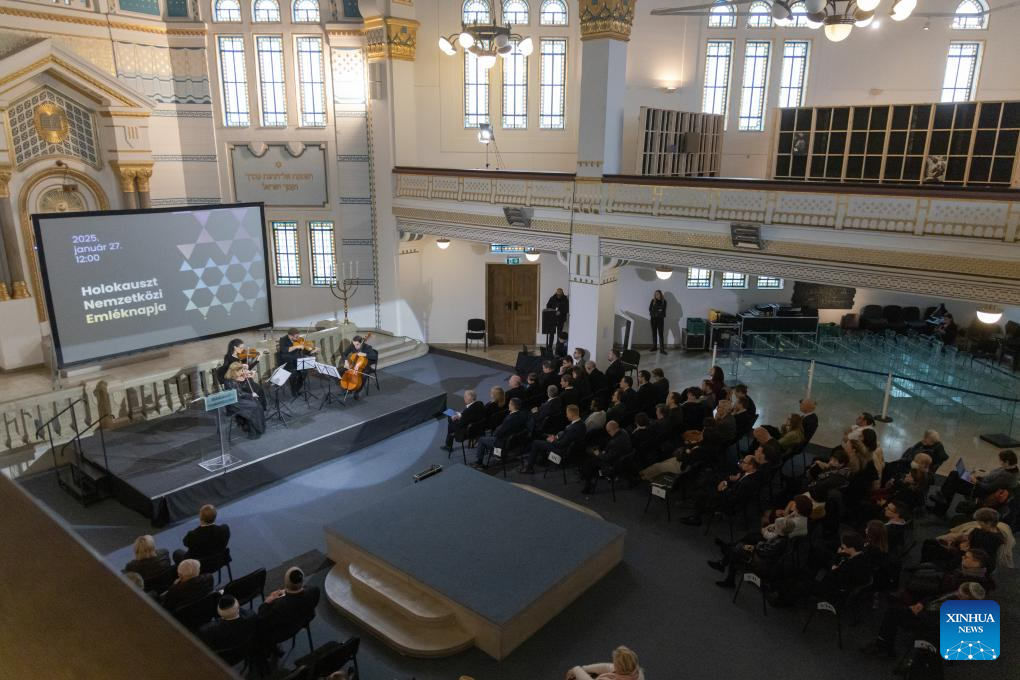
People commemorate the International Holocaust Remembrance Day at the Holocaust Memorial Center in Budapest, Hungary on Jan. 27, 2025.
 
In Auschwitz-Birkenau -- both a slave labour and a death camp complex -- close to a half-million Hungarian Jews were systematically murdered. And Tamas Lederer, born in Budapest in 1938, is haunted by the inner conviction that the horrors of the 20th century committed by Nazi Germany may yet be repeated; he feels that the world has failed to respond to that signal lesson in genocidal intent. His experience is one of survival; he evaded deportation to German camps hidden in Budapest basements after his parents tore the Jew-mandatory symbol from his clothing, of a yellow star.
 
After Auschwitz was liberated by the Soviet Red Army 80 years ago, on January 27, 1945, the 87-year-old's thoughts turn to the risks inherent in growing hate-full violence against Jews, completely unsettling him. Close to ten percent of the 6 million Jews killed by the Nazis were Hungarian Jews. Of the 1.1 million people who died at Auschwitz-Birkenau, over 90 percent of whom were Jews, roughly 435,000 of them were of Hungarian origin, a toll of Hungarian Jews that exceeded those of any other nationality.

Although Hungary made common cause with Germany, becoming part of the German Axis, and Hungary was also the first country in Europe to pass anti-Jewish laws in 1920, the government under its then-leader, Regent Miklos Horthy, while cooperating with Adolf Hitler throughout the war, also resisted German demands to deport the large Jewish population of Hungary. Hitler ordered the invasion of Hungary in March 1944, fearing that Horthy might defect from the Axis to join the Allies.

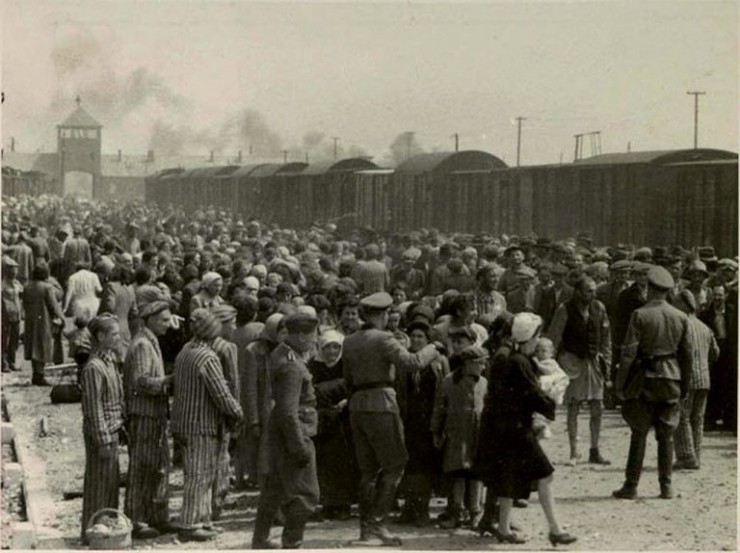
With the invasion, mass deportations swiftly took place. Between March and May of 1944, in less than two months, 435,000 Hungarian Jews, mostly rounded up from countryside cities and villages, were deported to Poland where they were incarcerated at Auschwitz. On arrival, most of the Hungarian Jews were ordered directly to the gas chambers. As war's end approached, thousands of other Jews still in Hungary were murdered by the Hungarian fascist Arrow Cross Party death squads, shot en masse in Budapest, into the Danube River.

Rabbi Vero on Monday and others gathered in Budapest at the Holocaust Memorial Centre for International Holocaust Remembrance Day for prayers, where a handful among the attendees were  Holocaust survivors. Dr. Andras Zima, director of the centre, spoke of Auschwitz as "the largest Hungarian mass grave".
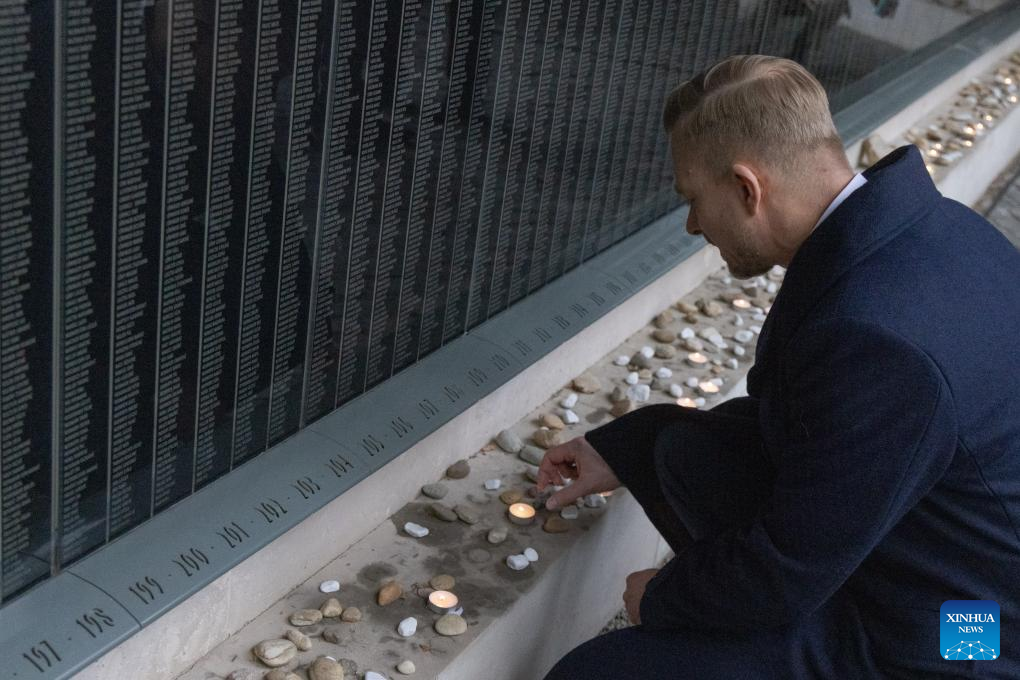
https://english.news.cn/20250128/b4d0f85b4d52452288a6eca56f2881f8/2d10f966d41348d49a7ff02d55cd3368.jpg
A man lays a candle in commemoration of Holocaust victims at the Holocaust Memorial Center in Budapest, Hungary on Jan. 27, 2025. Hungarian Minister of Regional Development Tibor Navracsics described the Holocaust as the "indefensible, inexplicable low point of European civilization" during a commemoration in Budapest on Monday. The event at the Holocaust Memorial Center marked International Holocaust Remembrance Day and the 80th anniversary of Auschwitz's liberation. (Xinhua/Attila Volgyi)

Labels: , , , , ,

Sunday, October 10, 2021

Grim Memorial to a Living Sentiment

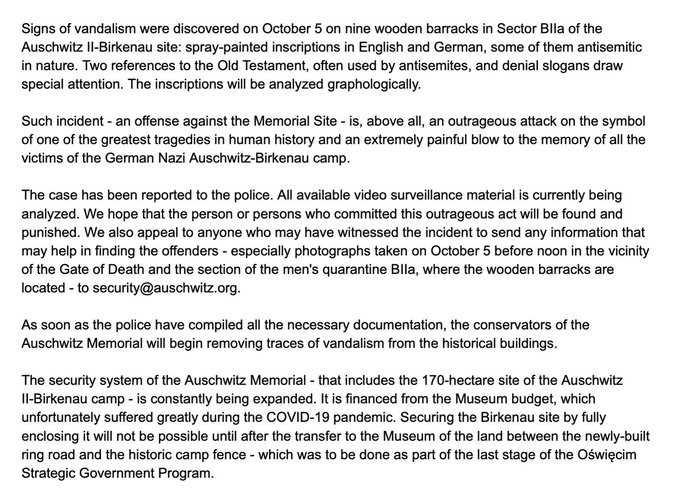
"An offense against the Memorial Site – is above all, an outrageous attack on the symbol of one of the greatest tragedies in human history and an extremely painful blow to the memory of all the victims of the German Nazi Auschwitz-Birkenau camp."
Auschwitz death camp memorial site statementImage
"[Security at the 420-acre site, which is] constantly being expanded [has become difficult as of late. The security is financed through the museum’s budget, which has been impacted by the reduced number of paying visitors during the pandemic]."
"[The graffiti is to remain on the barracks until police] have compiled all the necessary documentation."
"We hope that the person or people who committed this outrageous act will be found and punished."
Auschwitz Museum statement
Auschwitz-Birkenau Memorial and Museum, in Oswiecim, Poland. Photo credit: Oscar Gonzalez/WENN.com

During the Holocaust years of organized national institutional genocide against Europe's Jews, no one ostensibly was aware of the lethal menace facing Jewish lives. Despite the very public campaign of de-humanization of Jews, their disenfranchisement, their public humiliations, public beatings and killings, the mass round-ups, incarcerations and public proclamations, the truck and freight-train transports to slave labour camps and death camps, no one knew what was happening. 

Those relative few that did take notice, under threat of lethal punishment themselves, tried to shield a few Jews as their commitment to human dignity and the right of existence. So long after the liberation of Auschwitz by the Soviets freeing the paltry few political prisoners, military prisoners of war, conscientious objectors, Roma, homosexuals and Jews -- mostly Jews -- left alive in skeletal condition, there is no one on this Earth who could not know what happened in the barracks and the crematoria. 

Yet there remain and there always will be those who continue to thoroughly approve of the Final Solution to rid the world of the presence of Jews. Among them those who stigmatize world Jewry further by claiming the Holocaust was a pretext, that Jews themselves were involved in its management, that it is used as a crutch to manipulate world opinion. But those who vandalized the Auschwitz barracks knew the Holocaust was real and they would repeat it, if they could.

The world is no friendlier to Jews today than it was in 1939-45; a renaissance of Jew-hatred has once again blossomed into full view, and now that the world Jewish community has a country and a military of its own for legitimacy and protection the diaspora breathes more freely, but it too is a symbol of universal hatred toward Jews: still Jews albeit Israelis. The extermination site's barracks wee spray-painted in a sign of despicable lethality. The message that the unspeakable can be repeated.

Anti-Semitism -- responded 81 percent of young Jewish Europeans to a survey conducted by Europe's Agency for Fundamental Rights -- is an issue in their respective countries. Of that number of respondents, 44 percent claimed to have been targets of anti-Semitic harassment in the 12 months leading up to the survey. The time of the global pandemic has seen an inexplicable rise in anti-Semitism, linking a Jewish conspiracy to SARS-CoV-2, loosed on the world by reprehensible Jews.

Controversially, the yellow Star-of-David forced on European Jews as a demeaning symbol to set them apart from all others during World War 11 under Nazi occupation, was co-opted by anti-vaccination conspirators protesting protective-mask wearing during COVID-19 and societal closures as victimization by health agencies, equating public measures to control the virus with Nazi fascism. Mocking the hell-on-earth for Jews as commensurate with public unease over health measures.

Holocaust museums and memorials during the last two years have been defaced in many American states, as with other areas in Europe. A surge of online activity with hateful content was found and reported by the European Commission, particularly in France and Germany, on Facebook, Twitter and Telegram, with a sevenfold increase in French and 13-fold in German. Resulting in the EU announcement it plans to unfold a new strategy in combatting anti-Semitism.

The Auschwitz 11-Burkenau vandalism marked the barracks with phrases in both German and English, with "two references to the Old Testament, often used by anti-Semites, and denial slogans", stated museum representatives of the nine barracks used to house male prisoners that were defaced.

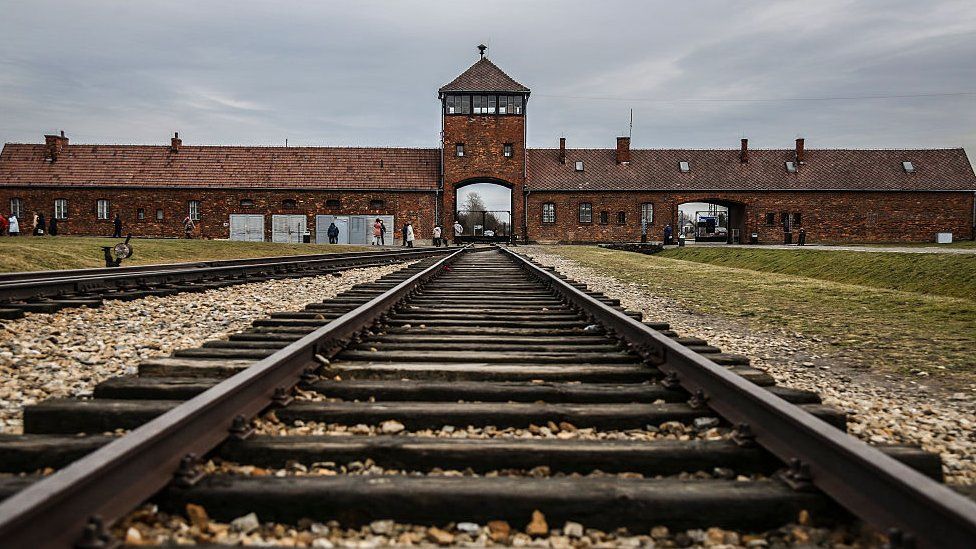
Entrance to the Auschwitz concentration camp
Most of those who died in the complex of camps at Auschwitz died at the Birkenau extermination camp   Getty Images


Labels: , ,

Tuesday, January 28, 2020

Auschwitz-Birkenau ... Horror Tourism

"The realities of mass tourism that is destroying Venice and Amsterdam are destroying Auschwitz."
"Where do you put the public toilets at Auschwitz? People always complain about Auschwitz as a tourist site and, of course, with so many people wanting to visit, it cannot be anything but a tourist site. This is the reality of mass tourism."
"We are entering the last decade of having survivors with us who are able to testify as eyewitnesses. Along with losing the eyewitnesses, the site itself, in its present, sprawling form, cannot be maintained forever. We are losing another touchstone of authenticity."
"One of the problems with the success of Auschwitz is that other places of the Holocaust are suffering. Dachau, for example, has too few visitors and Auschwitz has too many. It would be good if the wealth could be spread."
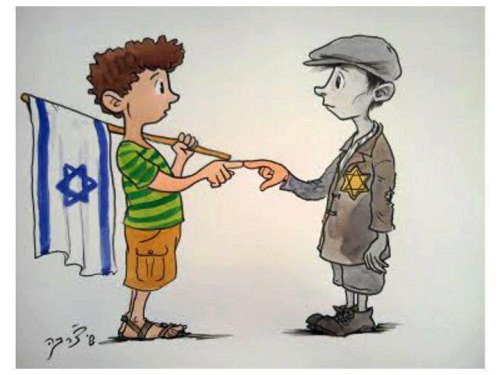
There are buildings that are really fragile ruins and you really don't want anyone to step on those ruins and there are always people who will ignore it. You see from time to time groups of Israeli students climb on the roof of the crematorium to wave a flag. It really is problematic from the point of view of preserving those ruins."
"We have no other comparable catastrophe, if there is any comparable catastrophe, that we have so many artifacts with personal stories attached to them. The Holocaust is, in general, still the best-documented genocide in world history."
Robert Jan van Pelt, architecture professor, University of Waterloo
Image
"In a few years there won't be a single survivor of the camps left, there is no getting away from that."
"While we remain alive, as eyewitnesses, we have to testify to what has happened and to the importance of it."
"Everybody comes out of there [Auschwitz] a changed person. History is the greatest teacher. We need to remember history. We cannot hide history."
"It's not for the past. It's for the sake of the future."
Auschwitz survivor Paul Herczeg, 90, Montreal resident

"Auschwitz has been a relatively manageable symbol for Germany after the Second World War, significantly reducing the actual scale of the evil done."
"The gates and walls of Auschwitz can seem to contain an evil that, in fact, extended from Paris to Smolensk."
"Yet while Auschwitz has been remembered, most of the Holocaust has been largely forgotten."
Timothy Snyder, historian, Black Earth
Auschwitz gateway
A focal point for visitors today, the gateway sign says "Work Will Set You Free," a monstrous lie told to the men, women and children imprisoned there. (Maciek Nabrdalik)
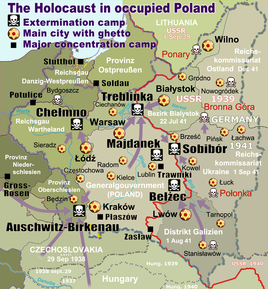
 Unlike Auschwitz, points out Mr. Snyder, in the death camps at Treblinka, Sobibor, Belzec and Chelmno no Jews survived. Those were camps dedicated to total annihilation. Whereas at Auschwitz there was also slave labour, enabling some Jews to survive. And he writes as well of other realities; Jews throughout eastern Europe forced to kneel in front of an open pit while mobile killing squads machine-gunned them, positioning them just so that the impact would throw them into the pits, ridding entire villages of their Jewish populations.

WW2-Holocaust-Poland.PNG


This survival of Auschwitz inmates went beyond piecing together the carefully contrived mechanism of state murder of millions. Most of the Holocaust-era destruction of European Jewry, points out Mr. Snyder took place even before Auschwitz-Birkenau set out to systematically, methodically and swiftly finish that Final Solution genocide meant to spare none whatever. Forced labour and death camp, both, the complex camps that are part of Auschwitz are less than an hour's drive from Poland's second largest city, Krakow, once home to 68 thousand Jews.

According to the Auschwitz-Birkenau State Museum, over 2,320,000 visitors came to the world-renowned site in 2019. The guard towers, gates and crematoria serve as testament to the agony and anguish of the inmates and the fierce determination of the Third Reich to destroy their presence for posterity. Among the inmates, Roma, gays, political prisoners, dissenters, Russians and Poles but mostly Jews marked for destruction. It is where an estimated 1.1 million people were gassed and incinerated; almost a million of them Jews. It is the survivors who bring to agonizing life the trials of those who perished. They, in their aged sorrow, stand witness to history.
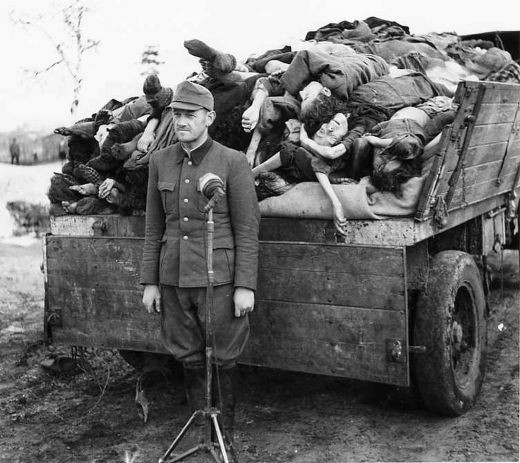
 auschiwtz-photos-bodies
Bodies of victims

In 1944 when the camp was operating at peak efficiency it covered 40 square kilometres with sub-camps extended beyond that acreage. Private hands today hold much of the property, outside the state museum. Some of the old barracks that once held starving prisoners being worked to death are now in people's gardens. "There is enormous pressure of development all around the site. Private business is very much exploiting the economic opportunity that comes from 2.3 million visitors", explained Mr. van Pelt.

"It is a very important historical site and for the last five or six years there has been construction around it. People are developing their property. Now you are in a neighbourhood. Inside Birkenau, there is only a barbed-wire fence. There is incredible transparency You can see what is happening on the other side. You can see the parking lot, you can see the reception centre, the businesses."

Auschwitz Birkenau, a tourist site, a business opportunity, a Polish 'world heritage' site.

 auschwitz-photos-transport
Arriving at Auschwitz

Labels: , , ,

Follow @rheytah Tweet