Wednesday, January 29, 2025

Auschwitz, "The Largest Hungarian Mass Grave"

"I must not forget."
"In my subconscious, I can never get over the possibility that a six-pointed star could be placed on my gate again at any moment."
"It is always in my mind."
"[Hungarian society] refuses to face its part; [collaboration with the Nazis remains within the country's consciousness]."
"It's just a matter of time before we get to a moment where people think the time has come to hate someone again."
Tamas Lederer, Budapest artist

"We carry in our genes what our grandparents' or our parents' generation went through."
"I think that in order for us to happily observe Jewish holidays or to have Jewishness in our homes, what they experienced must remain a fresh memory and that memory has to be part of our lives."
"[For Jews, preserving the memory of the Holocaust is a way to] commit ourselves to showing the world that learning from the events of the past, we will not allow anything similar to happen to anyone else."
Tamas Vero, Budapest rabbi
https://english.news.cn/20250128/b4d0f85b4d52452288a6eca56f2881f8/f7d41cd54c5a4d0cb8bd07e589fb4bcc.jpg
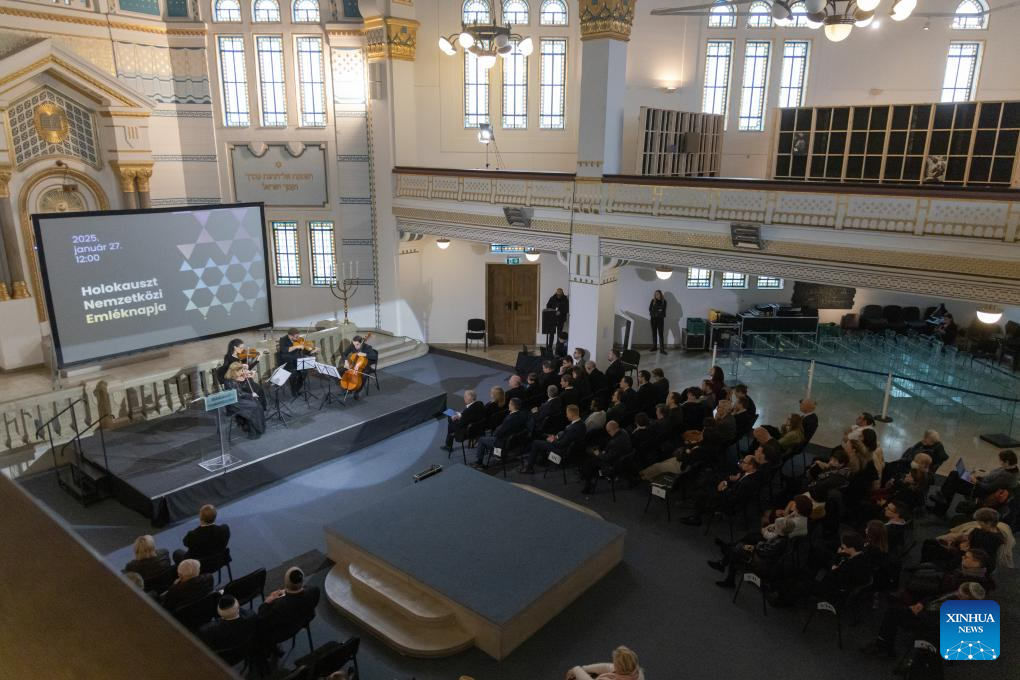
People commemorate the International Holocaust Remembrance Day at the Holocaust Memorial Center in Budapest, Hungary on Jan. 27, 2025.
 
In Auschwitz-Birkenau -- both a slave labour and a death camp complex -- close to a half-million Hungarian Jews were systematically murdered. And Tamas Lederer, born in Budapest in 1938, is haunted by the inner conviction that the horrors of the 20th century committed by Nazi Germany may yet be repeated; he feels that the world has failed to respond to that signal lesson in genocidal intent. His experience is one of survival; he evaded deportation to German camps hidden in Budapest basements after his parents tore the Jew-mandatory symbol from his clothing, of a yellow star.
 
After Auschwitz was liberated by the Soviet Red Army 80 years ago, on January 27, 1945, the 87-year-old's thoughts turn to the risks inherent in growing hate-full violence against Jews, completely unsettling him. Close to ten percent of the 6 million Jews killed by the Nazis were Hungarian Jews. Of the 1.1 million people who died at Auschwitz-Birkenau, over 90 percent of whom were Jews, roughly 435,000 of them were of Hungarian origin, a toll of Hungarian Jews that exceeded those of any other nationality.

Although Hungary made common cause with Germany, becoming part of the German Axis, and Hungary was also the first country in Europe to pass anti-Jewish laws in 1920, the government under its then-leader, Regent Miklos Horthy, while cooperating with Adolf Hitler throughout the war, also resisted German demands to deport the large Jewish population of Hungary. Hitler ordered the invasion of Hungary in March 1944, fearing that Horthy might defect from the Axis to join the Allies.

With the invasion, mass deportations swiftly took place. Between March and May of 1944, in less than two months, 435,000 Hungarian Jews, mostly rounded up from countryside cities and villages, were deported to Poland where they were incarcerated at Auschwitz. On arrival, most of the Hungarian Jews were ordered directly to the gas chambers. As war's end approached, thousands of other Jews still in Hungary were murdered by the Hungarian fascist Arrow Cross Party death squads, shot en masse in Budapest, into the Danube River.

Rabbi Vero on Monday and others gathered in Budapest at the Holocaust Memorial Centre for International Holocaust Remembrance Day for prayers, where a handful among the attendees were  Holocaust survivors. Dr. Andras Zima, director of the centre, spoke of Auschwitz as "the largest Hungarian mass grave".
https://english.news.cn/20250128/b4d0f85b4d52452288a6eca56f2881f8/2d10f966d41348d49a7ff02d55cd3368.jpg
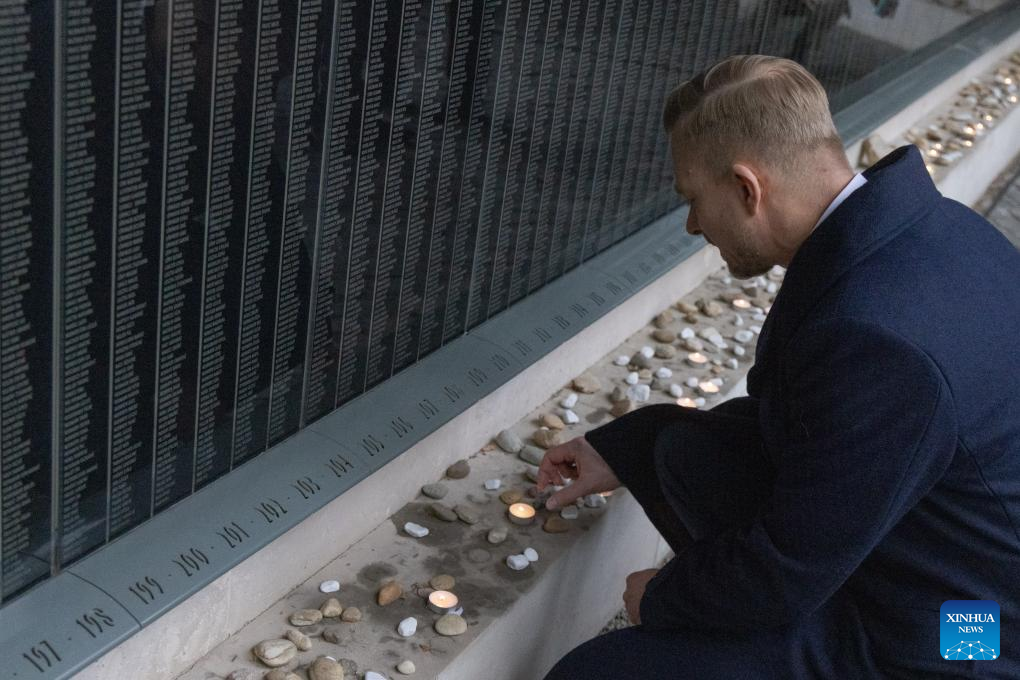
A man lays a candle in commemoration of Holocaust victims at the Holocaust Memorial Center in Budapest, Hungary on Jan. 27, 2025. Hungarian Minister of Regional Development Tibor Navracsics described the Holocaust as the "indefensible, inexplicable low point of European civilization" during a commemoration in Budapest on Monday. The event at the Holocaust Memorial Center marked International Holocaust Remembrance Day and the 80th anniversary of Auschwitz's liberation. (Xinhua/Attila Volgyi)

Labels: , , , , ,

Monday, January 27, 2020

Project Final Solution

"It is obvious that the war which Hitler and his accomplices waged was a war not only against Jewish men, women, and children, but also against Jewish religion, Jewish culture, Jewish tradition, therefore Jewish memory."
"Never shall I forget those moments that murdered my god and my soul and turned my dreams to ashes."
"After Auschwitz, the human condition is not the same, nothing will be the same."
Nobel Laureate Elie Wiesel, Night
Soviet soldiers arriving at main gate of Auschwitz during liberation (REUTERS:HO AUSCHWITZ MUSEUM REUTERS).JPG
Soviet soldiers arriving at the gates of Auschwitz in 1945.
REUTERS:HO AUSCHWITZ MUSEUM REUTERS

It is now 75 years since Soviet soldiers liberated Auschwitz, opened the gates and met the sight of gaunt, starved prisoners who had managed to survive their years in the concentration and death camp, while others, of a total count of 1,100,000 were sent to the gas chambers, their bodies then incinerated in giant furnaces whose smoke stacks belched black ashes over Poland. It is fitting that liberation of the camp came at the hands of Russian soldiers, since Auschwitz originally functioned as a prisoner-of-war camp for Soviet prisoners of war whom the Germans captured.

Most of those Russian prisoners did not survive their internment in Auschwitz. The camp was later transformed to an extermination camp for Jews. Auschwitz itself was a number of 'camps' linked together, and it also had a slave-labour component camp as well, where relatively healthy and still-strong prisoners (forced laborers) worked in mines and rock quarries or road building until they died of overwork, starvation or disease; in other concentration camps, there were factories producing armaments for the Nazi war effort.
Children who survived
Children who have lived to be liberated by the Red Army from the Auschwitz concentration camp on January 27, 1945.
TASS via Getty Images

At Auschwitz at the present time, maintained as a museum, there are pavilions housed on site; one primary exhibition details the Shoah. Others curated by a number of countries; a Polish pavilion, and a Russian pavilion among them. Poland, during the Second World War, was occupied by Nazi Germany. The Soviet Union, which first signed a non-aggression pact with Germany, was later invaded by Germany, the two consumed in a massive conflict which Russians endured at the loss of millions of the Soviet Red Army, and millions of citizens. The Soviet victory over the Nazis on the Eastern Front effectively broke the back of the Third Reich, and the Allied victories in the West finished the job.

Nazi death camp of Auschwitz I, in Oswiecim, Poland   AP

But not before close to a million Jewish corpses were fed into the giant maws of the ovens, the greatest number of Jews exterminated in any of the countless death camps strewn all over Europe which succeeded in demolishing the lives of six million European Jews. The Auschwitz site has been preserved as a memorial ground despite calls for its destruction as a 'cursed' place, after the end of the Second World War. It was the demand of the survivors that led to its preservation as a place of remembrance.

Under communist rule, Poland lacked the financial resources to maintain the camp, though the Polish government in 1947 had declared the site would be preserved forever, by law. Lack of resources made it difficult to preserve barracks, barbed-wire fences, watchtowers and gas chambers fallen into ruin. Prisoner artefacts seen to be critical in showing visitors the scale and dehumanization of the atrocities carried out in the Auschwitz-Birkenau camp were difficult to maintain without resources.
Jewish children at Auschwitz
Jewish children, survivors of Auschwitz, with a nurse behind a barbed wire fence, Poland, February 1945.
Galerie Bilderwelt/Getty Images

The inventory of personal remnants of the millions who passed through those infamous gates declaring "Arbeit Macht Frei" has among its sad treasures of the past, 110,000 shoes, 3,800 suitcases, 12,000 pots and pans, 40 kilograms of eyeglasses, 470 prostheses, 570 pieces of camp clothing, and several tons of women's hair, sheared from the heads of prisoners by the Nazis. These are what is left of the millions of personal effects the Nazis took from helpless prisoners, along with more valuable items including gold pried from teeth, marriage bands, jewellery, to help the Nazi war effort.

The Auschwitz Museum regularly consults with conservationists, historians and heritage experts on preservation and reconstruction with a view to preserving the site as it was at the time. The risk being that alteration of the site might support claims of Holocaust deniers that the reality of the Holocaust has been embellished beyond its actual occurrence, supporting their denials and their claims that the program of genocidal extermination had never taken place.

Poland is where Auschwitz was established and where the Polish pavilion was organized as The Struggle and Martyrdom of the Polish Nation 1939 - 1945. Claiming for itself the place of first victim of the Nazis, emphasizing Polish resistance in occupied Poland. Its focus is on Polish losses, not on the number of Polish and other European Jews who were gassed, their ashes fertilizing the countryside. The Russian pavilion too emphasizes its role, with the theme of Tragedy, Valour, Liberation.
soviet soldiers with liberated prisons in 1945 (REUTERS:HO AUSCHWITZ MUSEUM).JPG
Soviet soldiers with survivors of Auschwitz in 1945.
REUTERS:HO AUSCHWITZ MUSEUM

The world now views Auschwitz as the symbol of Nazi depravity in its vicious extermination of Jewish lives. Before Poland liberated itself from the stranglehold of the USSR, visitors to Auschwitz came mostly through representatives of Soviet satellite countries, with 400,000 annual visits. The turn of the century has seen an increase in the number of yearly visitors to 1.3 million by 2009 and over two million by 2017. The largest number of visitors at the present, come from the United Kingdom, United States, Italy, Spain, Germany, Israel and France.

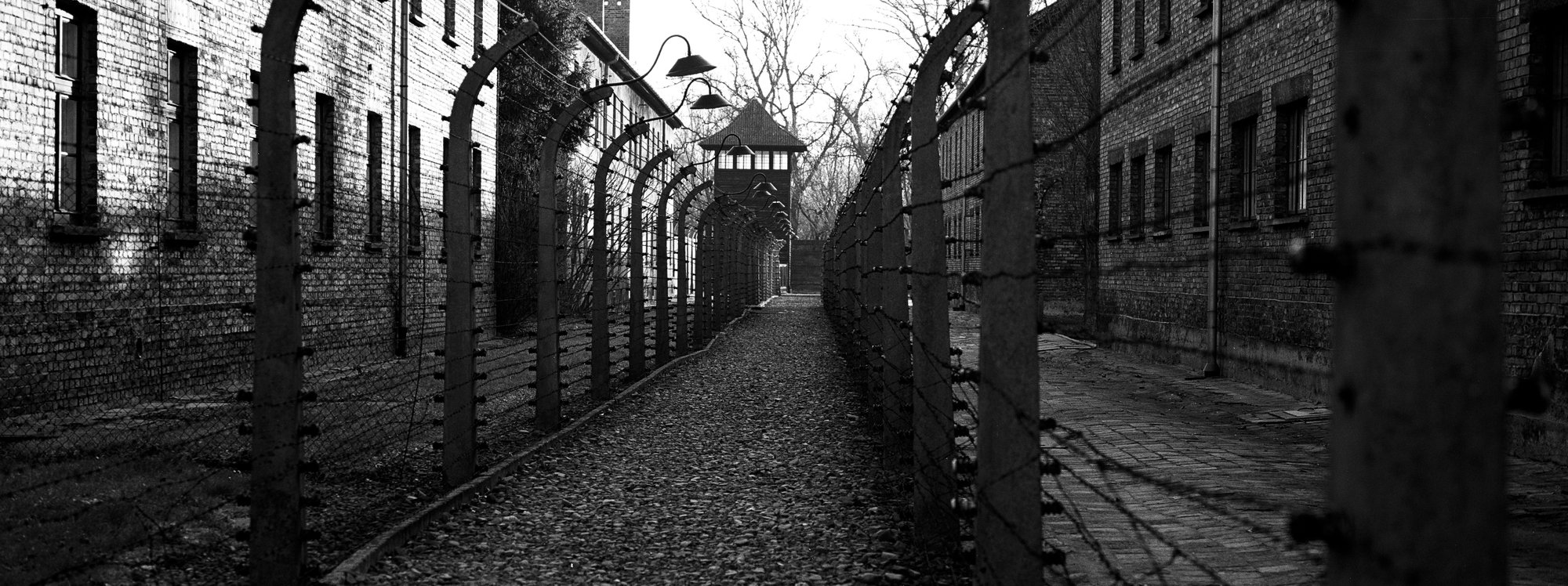
A pathway leading to an observation and security tower between what were electric barbed wire fences inside the former Nazi death camp of Auschwitz I in Oswiecim, Poland, Sunday, Dec. 8, 2019. (AP Photo/Markus Schreiber)

Labels: , , , ,

Monday, November 28, 2016

Re-Arranging History

"It's a part of the present government's attempt to rewrite history."
"It's one of the pillars of every authoritarian or totalitarian regime that they want to reorder the past to their own fantasies."
Norman Davies, British historian of Poland

"The museum is the only attempt in Europe or really in the world to actually present the war as international history."
"Poland is over-represented in this international museum, which is not surprising, given that the museum is in Poland."
Timothy Snyder, historian, Yale University

"[The Museum of the Second World War does not emphasize] enough stress on the Polish point of view."
"Our obligation is to maintain a conversation about our sacrifice."
"Poland is associated mainly with the Holocaust. The world knows about the Warsaw Ghetto uprising on April 19, 1943, but it doesn't recognize the Warsaw Rising that took a much bigger toll."
"It [the Museum] has enough [funding] for opening and for at least for six months. After that period, we'll see."
Piotr Glinski, Polish Culture Minister
The Museum of the Second World War

The new, right-leaning government of Poland has had thoughts about the soon-to-be-opened Museum of the Second World War. It plans to alter its orientation. To align it with the Battle of Westerplatte, the 1939 battle that pitted Poland's military against that of the Nazi regime's and which Poland lost, leading to German invasion and occupation. There is no actual Battle of Westerplatte Museum, but there is the name of the Battle of Westerplatte Museum, and the new Polish culture ministry has plans to combine them, giving the focus to the battle at the almost-completed Museum, re-focusing it away from a more generalized, international-flavoured museum, which it was meant to be.

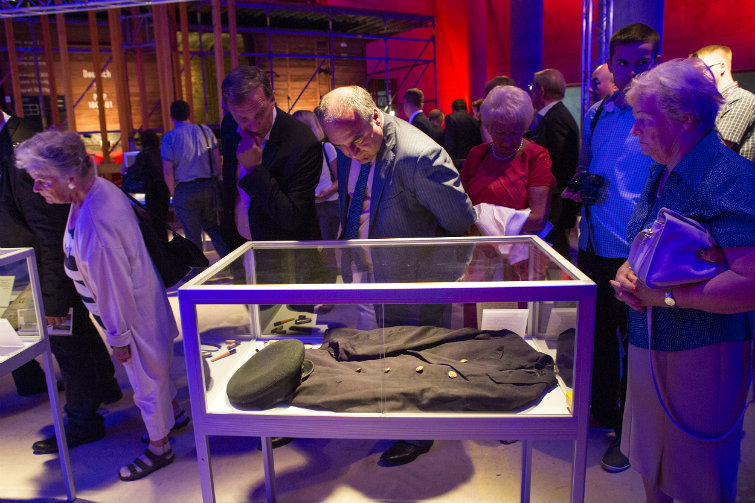
The museum has been a decade in the making, when during a period of optimism the design and dedication of the museum was all mapped out. It was to have described a devastated world that Europe had become, achieving a focus transcending mere national boundaries. The museum's collection is inclusive of Soviet and American tanks, it includes keys to the homes of Jews who were murdered by their Polish neighbours, it has flags in its possession identifying the Polish Home Army which courageously fought the Nazis, and it also features an Enigma encoding machine.

The state-financed institution is undergoing a second-thought for its focus, taking away the global, international perspective and the details that emphasized the scope of the destruction in human life along with poignant mementos which describe the utter devastation that had overtaken the human spirit under the black miasma of the belching chimneys of the crematoria meant to solve the "Jewish problem" for all time, as an enduring symbol of proud Nazi Aryan values and ideology. Poland is now ensnared anew in political and cultural conflict.

2016-05-09-1462785370-2877348-budowarjochermuseum.jpg
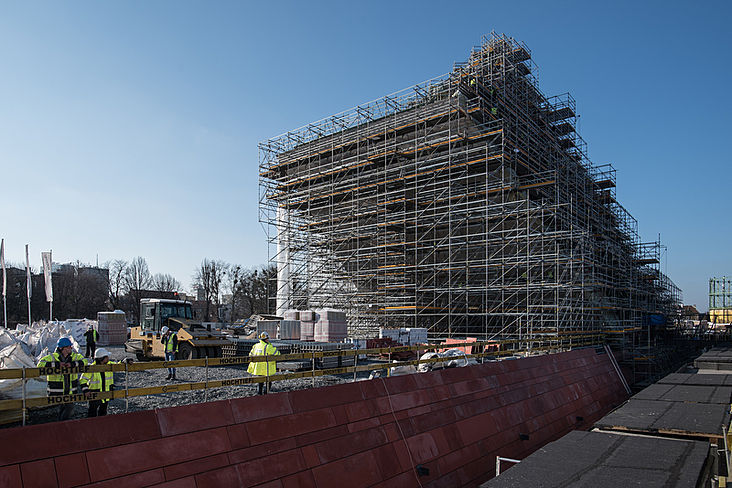
The building of the museum is almost finished. Photo: WWII museum/Roman Jocher

At a cost of around $114-million to date, and five years of construction, the January opening spectacular may be delayed. And the museum can look forward as well to the prospect of the government cutting off its funding, if it presents to the public and the international community as it was originally meant to. The culture minister feels strongly that a focus on the first battle of the war must be front and centre, more reflective of heroic Polish self-defense, mowed down by an indestructible behemoth of a monstrous juggernaut.

2016-05-09-1462785460-165885-czolgjpinkas.JPG
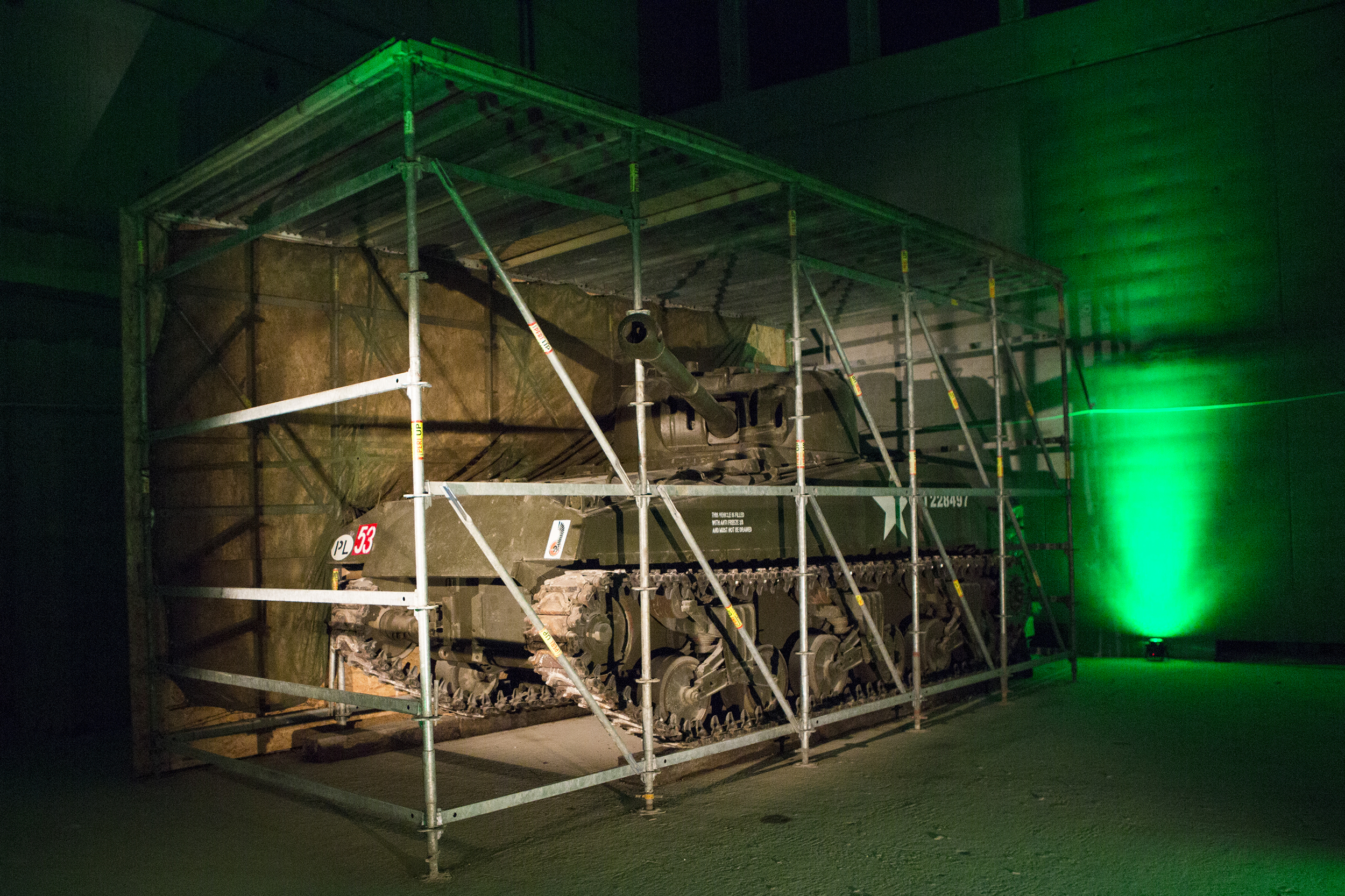
The exhibition has already been contracted, many exhibits ready, like the tank who was installed in an underground part of the museum. Photo: Jerzy Pinkas
Designed by a Polish firm, the building was constructed with five thousand square meters of exhibition space. A staff of sixty has been hired to do its exhibits justice and welcome visitors. Its original emphasis was on the civilian toll of the war with sections dedicated to the Holocaust, and the Battle of Westerplatte as well.There are 41,000 objects for display, two thousand of which are meant to be featured in the permanent exhibition. Coat buttons from Poles who were executed by Soviet agents during the Katyn massacre of 1940, when thousands of Poland's military elite met their end are also to be on featured display.

2016-05-09-1462785555-258045-dzienotwartyjpinkas.JPG
There was an open day on the construction site in September 2015. Today the project is much more advanced. Photo: Jerzy Pinkas

Sections are meant to be devoted to the French and Danish Resistance. Should the proposed merger become reality, Pawel Machcewicz, director of the Museum of the Second World War, hopes the opening could take place in late January. He feels that the government has only committed to providing half of the museum expenses meant to cover costs for the coming year of 2017. The culture ministry assures that the contents of the museum will be preserved and the planned opening will take place on time. As for financial support, it may or may not be forthcoming.

The reaction to this new direction -- emanating from a source that cannot be denied its control and insistence --from some families who had donated heirlooms was that they would be withdrawn, should the merger proceed. So reaction to the government's plans are perhaps predictable, and obviously hostile to those plans. "They thought they could do a blitzkrieg, but now we have the Battle of Stalingrad", wryly observed the museum director, Mr. Machcewicz.

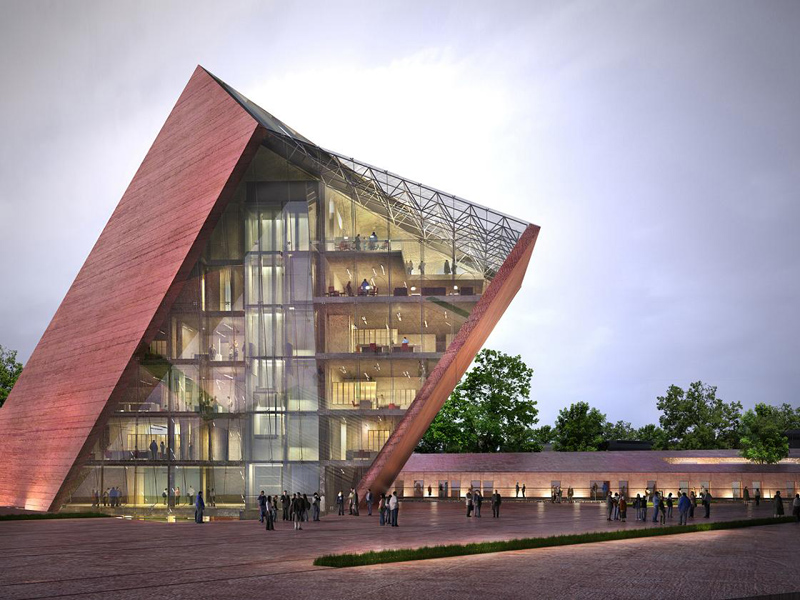
2016-05-09-1462785677-9451636-wizualizacja.jpg
How the museum will look like within months.

Labels: , , , ,

Wednesday, November 11, 2015

MAIN IMAGE: Mary Wattenberg (Mary Berg), left, walks down a street of the Warsaw Ghetto with her boyfriend in this undated photo slide. Berg s published
Mary Wattenberg (Mary Berg), left, walks down a street of the Warsaw Ghetto with her boyfriend in this undated photo slide. Berg s published account of surviving the Holocaust was widely read. But only after a man discovered this photo and others in an album won at a Red Lion auction earlier this year did it become clear that Berg lived and worked here in York County for years. INSET: The cover image of The Diary of Mary Berg: Growing up in the Warsaw Ghetto, published by Oneworld Press. (Main photo courtesy of the U.S. Holocaust Memorial Museum)


Lodz, November 3, 1939
Almost every day our apartment is visited by German soldiers who, under various pretexts, rob us of our possessions I feel as if I were in prison. Yet I cannot console myself by looking out of the window, for when I peer from behind the curtain I witness hideous incidents like that which I saw yesterday:
A man with markedly Semitic features was standing quietly on the sidewalk near the curb. A uniformed German approached him and apparently gave him an unreasonable order, for I could see that the poor fellow tried to explain something with an embarrassed expression Then a few other uniformed Germans came upon the scene and began to beat their victim with rubber truncheons. They called a cab and tried to push him into it, but he resisted vigorously. The Germans then tied his legs together with a rope, attached the end of the rope to the cab from behind, and ordered the driver to start. The unfortunate man's face struck the sharp stones of the pavement, dyeing them red with blood. Then the cab vanished down the street.

Lodz, November 12, 1939
Percy, my mother's younger brother, has returned from Nazi captivity. Only a miracle saved him from death. On the battlefield, seeing the approaching Nazis, and realizing that his unit had surrendered, he decided to commit suicide. As he was in a medical unit he had all sorts of drugs on his person; he swallowed thirty tablets of Veronal and fell asleep. He lay thus on the open field when suddenly a pouring rain began to fall. This awakened him. "I don't know how it happened", he told us, "but I suddenly began to vomit, and spat up almost all of the poison". He was too weak to move, and soon the Germans picked him up and placed him in a prison camp Next day, with a comrade, he managed to get through the barbed-wire fence and after wandering for a week in the so-called Kampinowska forest, made his way to Lodz.

November 15, 1940
Today the Jewish ghetto was officially established. Jews are forbidden to move outside the boundaries formed by certain streets. There is considerable commotion Our people are hurrying about nervously in the streets, whispering various rumours, one more fantastic than the other.
Work on the walls -- which will be three yards high -- has already begun. Jewish masons, supervised by Nazi soldiers, are laying bricks upon bricks. Those who do not work fast enough are lashed by the overseers. It makes me think of the Biblical description of our slavery in Egypt. But where is the Moses who will release us from our new bondage?
At the end of those streets in which the traffic has not been stopped completely there are German sentries. Germans and Poles are allowed to enter the isolated quarter, but they must not carry any parcels. The specter of starvation looms up before us all.

January 4, 1941
The ghetto is covered with deep snow. The cold is terrible and none of the apartments are heated. Wherever I go  find people wrapped up in blankets or huddling under feather beds. That is, if the Germans have not yet taken all these warm things for their own soldiers. The bitter cold makes the Nazi beasts who stand guard near the ghetto entrances even more savage than usual. Just to warm up as they lurch back and forth in the deep snow, they open fire every so often and there are many victims among the passers-by. Other guards who are bored with their duty at the gates arrange entertainments for themselves. For instance, they choose a victim from among the people who chance to go by, order him to throw himself in the snow with his face down, and if he is a Jew who wears a beard, they tear it off together with the skin until the snow is red with blood. When such a Nazi is in a bad mood, his victim may be a Jewish policeman who stands guard with him.
Yesterday I myself saw a Nazi gendarme "exercise" a Jewish policeman near the passage from the Little to the Big Ghetto on Chlodna Street. The young man finally lost his breath, but the Nazi still forced him to fall and rise until he collapsed in a pol of blood. Then someone called for an ambulance and the Jewish policeman was put on a stretcher and carried away on a hand truck. There are only three ambulance cars for the whole ghetto, and for that reason hand trucks are mostly used. We call them rickshas.
Snow is falling slowly, and the frost draws marvelous flower patterns on the windowpanes. I dream of a sled gliding over the ice, of freedom. Shall I ever be free again? I have become really selfish. For the time being I am still warm and have food, but all around me there is so much misery and starvation that I am beginning to be very unhappy.

July 10, 1941
I am full of dire forebodings. During the last few nights, I have had terrible nightmares. I saw Warsaw drowning in blood; together with my sister and my parents, I walked over prostrate corpses. I wanted to flee, but could not, and awoke in a cold sweat, terrified and exhausted. The golden sun and the blue sky only irritate my shaken nerves.

July 29, 1941
The typhus epidemic is raging. Yesterday the number of deaths from this disease exceeded two hundred The doctors are simply throwing up their hands in despair. There are no medicines, and all the hospitals are overcrowded. New beds are constantly being added in the wards and corridors, but this does not solve the problem, and the number of victims is growing daily.

September 20, 1941
The Nazis are victorious. Kiev has fallen. Soon Himmler will be in Moscow. London is suffering severe bombardments. Will the Germans win this war? No, a thousand times no! Why do not the Allies bomb German cities? Why is Berlin still intact? Germany must be wiped off the face of the earth. Such a people should not be allowed to exist. Not only are the uniformed Nazis criminals, but all the Germans, the whole civilian population, which enjoys the fruits of the looting and murders committed by their husbands and fathers.

December 9, 1941
America's entry into the war has inspired the hundreds of thousands of dejected Jews in the ghetto with a new breath of hope. The Nazi guards at the gates have long faces Some are considerably less insolent, but on others the effect has been exactly opposite and they are more unbearable than ever. Most people believe that the war will not last long now and that the Allies' victory is certain.

February 27, 1942
Shootings have now become very frequent at the ghetto exits. Usually they are perpetrated by some guard who wants to amuse himself. Every day morning and afternoon, when I go to school, I am not sure whether I will return alive. I have to go past two of the most dangerous German sentry posts: at the corner of Zelazna and Chlodna Streets near the bridge, and at the corner of Krochmalna and Grzybowska Streets. At the latter place there is usually a guard who has been nicknamed "Frankenstein", because of his notorious cruelty. Apparently this soldier cannot go to sleep unless he has a few victims to his credit; he is a real sadist. When I see him from a distance I shudder He looks like an ape: small and stocky, with swarthy grimacing face. This morning on my way to school as I was approaching the corner of Krochmalna and Grzybowska Streets, I saw his familiar figure, torturing some ricksha driver whose vehicle had passed an inch closer to the exit than the regulations permitted. The unfortunate man lay on the curb in a puddle of blood. A yellowish liquid dripped from his mouth to the pavement. Soon I realized that he was dead, another victim of the German sadist. The blood was so horribly red the sight of it completely shattered me.

July 5, 1942
Fewer and fewer students come to our school; now they are afraid to walk in the streets The Nazi guard Frankenstein is raging through the ghetto, one day he kills ten persons, another day five ... everyone expects to be his next victim. A few days ago, I too, ceased completely attending school. Today I boldly removed my arm band. After all, officially I am now an American citizen.
The inhabitants of the street looked at me with curiosity: 'That's the girl who is going to America'. In this street everyone knows everyone else. Every few minutes people approached me and asked me to note the addresses of their American relatives, and to tell them to do everything possible for their unfortunate kin.

December 17, 1942
Dita W., one of yesterdays arrivals, told us last night what she had heard about the camp at Treblinki. During her frequent visits to Gestapo headquarters at Aleja Szucha she became acquainted with a German who was an official in this death camp. He did not realize that she was Jewish, and told her with great satisfaction how the deported Jews were being murdered there, assuring her that the Germans would finally "finish off" all the Jews.
At the Umschlagplatz the cattle cars are loaded with one hundred and fifty people each, after their floors have been covered with a thick layer of lime. The cars have no windows or other openings. The people lie on top of each other without sufficient air to breathe, and without food or water. The cars are often left for two or three days at the Stawki station. The locked-up people must perform their natural functions in the closed cars and, as a result, the lime dissolves, filling the cars with poisonous fumes The survivors are unloaded at Treblinki station and divided according to  their trades. Shoemakers, tailors, etc., are grouped separately in order to make the victims believe that they are going to be employed in workshops. The real purpose is to make them go to their deaths more obediently The women are separated from the men.
Mary Berg (pseudonym) Poland, 15 years old
Header

Children in the Holocaust and World War II, their secret diaries -- compiled by Laurel Holliday  c. 1995

Labels: ,

Sunday, September 06, 2015

The Peace Initiative...?


"War is like a mirror. Looking at it helps us better appreciate the value of peace. Today, peace and development have become the prevailing trend, but the world is far from tranquil. War is the sword of Damocles that still hangs over mankind. We must learn the lessons of history and dedicate ourselves to peace."
"In the interest of peace, we need to foster a keen sense of a global community of shared future. Prejudice, discrimination, hatred and war can only cause disaster and suffering, while mutual respect, equality, peaceful development and common prosperity represent the right path to take. All countries should jointly uphold the international order and system underpinned by the purposes and principles of the UN Charter, build a new type of international relations featuring win-win cooperation and advance the noble cause of global peace and development."
"In the interest of peace, China will remain committed to peaceful development. We Chinese love peace. No matter how much stronger it may become, China will never seek hegemony or expansion. It will never inflict its past suffering on any other nation. The Chinese people are resolved to pursue friendly relations with all other countries, uphold the outcomes of the Chinese People's War of Resistance Against Japanese Aggression and the World Anti-Fascist War, and make greater contribution to mankind."
Chinese President Xi Jinping, Beijing, 3 September 2015 
President Xi Jinping with President Putin And South Korea's Park Geun-hye -- Reuters
"For the last 30 years or more, China has been searching for an ideology that will bind the nation together after the failure of the Cultural Revolution. This is about the war as part of a binding national identity."
Rana Mitter, professor of Chinese history, Oxford University

"They are saying, Look, the U.S. may have delivered the coup de grace -- but ..."
"The war gets recast as the beginning of the wealth and power era for China, as a moment of transition from humiliation to rejuvenation."
John Delury, scholar of China and Korea, Yonsei University, Seoul

"In the experience of the Chinese Communist Party, the regime's power comes from guns. To hold on to the regime and his personal power and position, it is very important for [Xi] to have control over the armed forces."
Zhang Lifan, Chinese historian

"It's all about [the] Second World War, but it's also not about [the] Second World War at all."
"The military is going to love this, because they are going to feel how far they've come -- from the baggy-suited peasant army of 40 years ago to a very capable modern military today."
Susan Shirk, chair, 21st Century China Program, University of California, San Diego
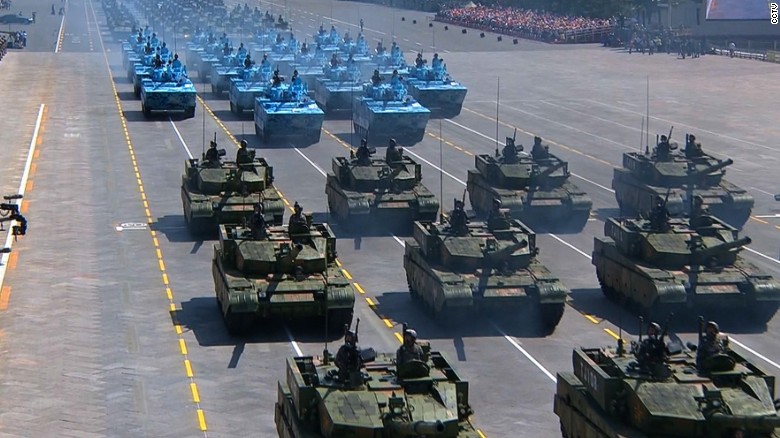
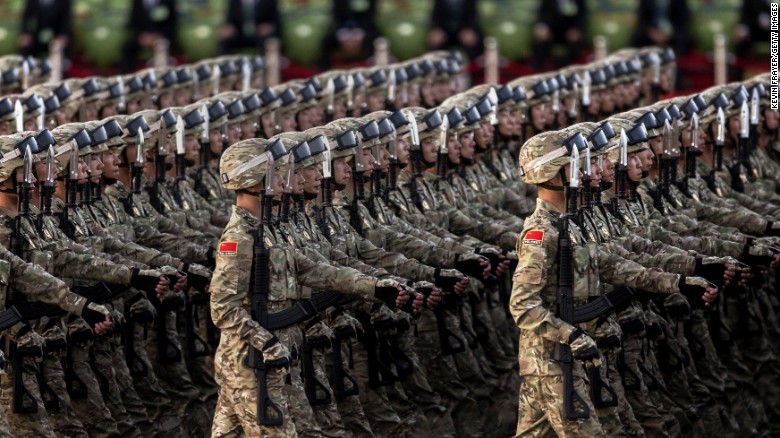
Tanks promenade through the parade route on September 3.
CNN
President Xi's comforting words of peace will come as a huge relief to his neighbours. His declaration of universality of humankind, of China's peaceful intentions, of his nation's disinterest in hegemonic order, and of territorial expansion will certainly come as a welcome revelation to those who have witnessed the exercises in creating 'sand' reclamation islands and the posting of military bases in the East and West China Seas.

China's presumed sabre-rattling over its hugely expanded sovereign air space and its warning to its neighbours, the nervous leaders in the Philippines, South Korea, Vietnam, Australia, can rest easy. The release of thousands of doves in a touching demonstration of China's intentions should come as a great relief that all is well, and China's intentions have been hugely misunderstood. Tibet too can breathe a sigh of relief that it hasn't, as it has assumed, been an occupied nation since the turn of the last Century.

The symbolic message in the release of 70,000 doves seen in flight against a broad, blue sky is testament to China's sincerity. And who is prepared to question that? If the general secretary of the Communist Party of China, chairman of the Central Military Commission and President of the People's Republic of China cannot be trusted, then who can be? The twelve thousand troops standing by certainly trust him and were doubtless thrilled to be inspected by their leader during the "victory in the Chinese People's War Against Japanese Aggression".

Chinese soldiers march past Tiananmen Square on September 3.
CNN

Patriotism is a potent medicine in knitting public opinion toward its leader, none too subtly directng it to vent its rage against its one-time occupier whose armies insulted, degraded and massacred millions of Chinese unable to shake loose the fetters of imperialistic brutality until the People's Liberation Army [definitely not the Nationalist Army of Chiang Kai-shek] cast off the shackles and freed China from Japanese occupation. It is a time to forget China's new economic fragility, a time to celebrate China's greatness.

Russian President Vladimir Putin and South Korean President Park Geun-hye were present along with dignitaries from 30 countries. Missing were the Allied powers' current leadership. Present also was unsavoury Sudanese President Omar Hassan al-Bashir, whose murderous exploits in Darfur earned him an accusation of war crimes by the International Criminal Court.

Labels: , , , , ,

Follow @rheytah Tweet