Thursday, April 23, 2026

Fired for Cause, not Discriminatory

"When he used his title in a letter supporting a friend's, client's, or potential client's immigration application, [Kalisa] did so in an effort to increase the chances that it would be approved."
"If it was approved, and the client or potential client became able to travel to Canada to view properties, [Kalisa] could gain a personal and business advantage, whether in the short or long term."
It seems unlikely to me that that trend would continue for 13 years ... if the grievor was merely confirming to those concerned that their applications were  being processed."
"I find that it is more likely than not that he shared additional information not available to the public about the status of the applications in question."
Labour Tribunal
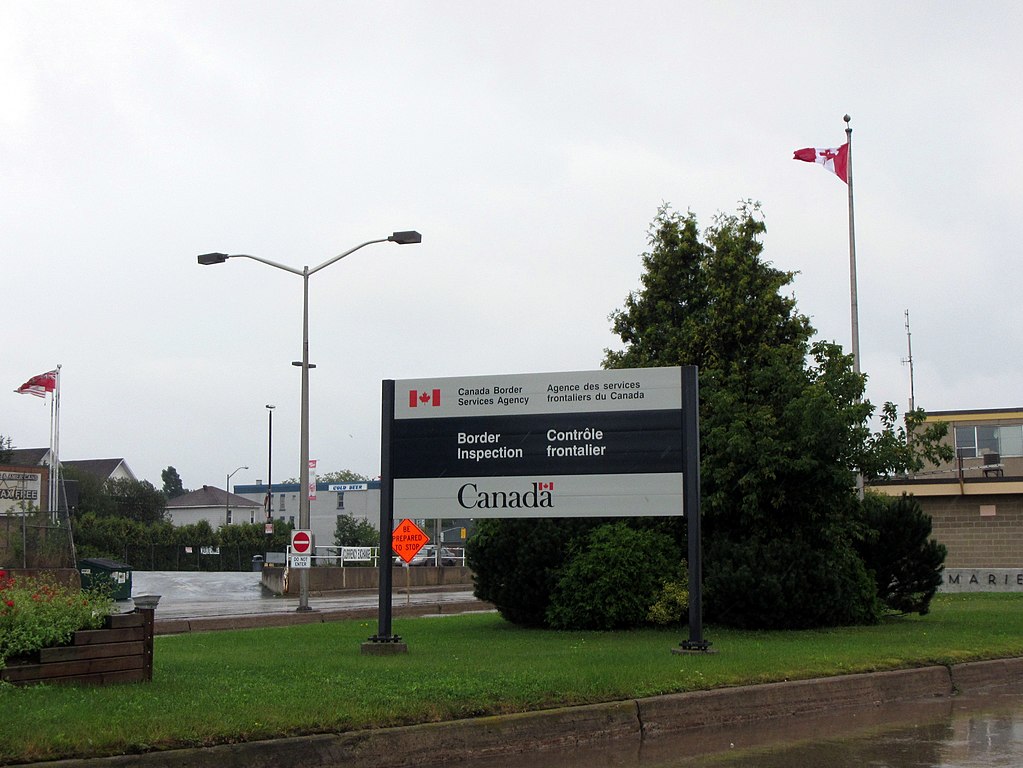
https://hrlawcanada.com/wp-content/uploads/2025/10/Canadian_Border_Inspection_-_Controle_frontalier_du_Canada_-_panoramio.jpg
Photo: Bohao Zhao

 A recently published online February decision of the federal labour tribunal confirmed the firing in 2017 of a longtime Canada Border Services Agency employee, while Placide Kalisa, who was contesting  his dismissal, characterized it as discriminatory, given his ethnicity. He plans to contest his firing confirmation by filing discrimination lawsuits against the CBSA and  his former union which had refused to represent his grievance against his firing.

Placide Kalisa was found, for 13 years of his employment with the federal border services, to have accessed government databases improperly, passing confidential information on to immigration applicants, among them some who would become his clients as an after-work real estate agent. Kalisa was a senior program officer, his job was to recommend whether the agency could safely remove inadmissible foreign nationals to certain countries. 
 
Deeply connected to the Rwandan community in Canada, Kalisa had emigrated decades earlier from Rwanda, and worked as a part-time real estate agent and manager. The tribunal had found that Kalisa had committed dozens pf "worrisome" unauthorized searches of  sensitive CBSA and Immigration, Refugees and Citizenship Canada databases from 2003 to his suspension in 2016. Some of those who benefited from his illegal intervention later became his real estate clients.
 
https://smartcdn.gprod.postmedia.digital/nationalpost/wp-content/uploads/2026/04/cp175172277_302620209.jpg?quality=90&strip=all&w=564&h=423&type=webp&sig=R99xHb-AG3LliVSGwtzEhA
Canada Border Services Agency patch
In the space of two months, Kalisa had searched an IRCC database on 32 occasions after a Rwandan identified in the decision as "A.K." contacted him to ask why it was that his visa application had been denied.  Once he confirmed that A.K.'s background cleared any suspicion of having been involved in the 1994 genocide in Rwanda, Kalisa undertook an invitation letter for the man and his spouse, asking a colleague to sign in his stead. 
 
Kalisa was aware that A.K.'s purpose in coming to Canada was to acquire a condominium, and his invitation letter would support the visa applicant persuasively. Indeed, Kalisa had admitted he had written invitation letters and had conducted database searches for some seven individuals at the very least; each letter identified him as a CBSA employee which his agency title made clear.
 
While Kalisa denied wrongdoing throughout the grievance process, the tribunal dismissed his explanations for his actions, terming his testimony "implausible or unpersuasive". Kalisa, who required a top-secret security clearance for his CBSA work, had somehow forgotten to inform his employer that one of his friends happened to be a suspected criminal. The Rwandan embassy had given Kalisa a list of suspected war criminals with his friend's name on it.

 
https://cdn.realtor.ca/individuals/TS638824002600000000/highres/1364665.jpg
Placide Kalisa, Realtor
Because Kalisa said he was certain his friend was not a war criminal, he failed to disclose his relationship, he explained to an unimpressed tribunal. "It was not for [Kalisa] to decide whether the embassy was right or wrong to include D.N.'s name on a list of suspected war criminals ... He was obligated to inform his manager of his association with D.N. He did not", the tribunal wrote. 
 
A series of trips that Kalisa took to Rwanda booked by D.N. led the Canadian Security Intelligence Service to begin an investigation that motivated CBSA to look into the work activities of its employee, in 2014. Two years on, CBSA reviewed Kalisa's security clearance, and his unauthorized searches in CBSA and IRCC databases were revealed, leading to his suspension and finally, his firing. 
"Since 2015, database usage -- including all adds/moves/changes/deletes -- are captured, logged, and stored to a repository which is accessible for internal auditing functions."
"Any new or updated systems are required to record to this system for auditing purposes."
Canada Border Services Agency spokesperson Rebecca Purdy 


Labels: , , , , , , , , ,

Saturday, November 22, 2025

Entering Canada? No Problem!

A patch on a uniform
Canada Border Services Agency
"Our goal at the border is to build the file to be able to identify non-genuine claims, and right now we're kind of relying on people to self-declare that they're a non-genuine claim."
"Claimants spend significantly less time meaningfully interacting with officers, with the result of reduced security for the sake of expediency."
"That was our opportunity to ask follow-up questions, make sure that the claim is genuine. We could look for things like indications of coaching, human smuggling, that kind of thing."
"We're not verifying anyone's story at all. The ability for us to confirm whether or not their story is genuine has really been removed." 
"To speed things up, because we are short-staffed, we are allowing people into the country without first doing ... security screening."
"It's exactly the people with the greatest motivation to not self-declare who are going to be the ones who don't self-declare and don't report back."
"They essentially disappear into Canada." 
Mark Weber, president, Customs and Immigration Union  

Find out if you're inadmissible to Canada

Find out why you could be denied a visa or refused entry to Canada.

Security screening

Learn why border services officers may perform security screenings to help them determine if you can enter Canada.

Enforcing immigration laws in Canada

Get information on when and why border services officers arrest, detain and remove citizens of other countries.

Airport arrival kiosks and eGates

Verify your identity and make an on-screen customs declaration at Canada's major international airports using primary inspection kiosks and eGates.

Canadian customs: Secondary inspections

Border officers may need more details about yourself, your children, your pets or belongings.

So, above on the Canada.ca webpage the very basics of the entry-security-screening process is outlined. What to expect when entering Canada. Only that isn't exactly what happens any longer. A landslide of people declaring themselves refugees seeking haven, irregular migrants and others in like position have overwhelmed the screening capacity of border agents. It has become standard practice of late for border officials to make use of an 'honour system', a self-declaration on the part of a would-be entrant to Canada that they have no ulterior motives to come to the country, none at all, nossir!

The required number of personnel, the time it would take to conduct a proper security screening, entirely absent the process. Making a public statement to the Standing Committee on Citizenship and Immigration,  Mark Weber, president of the Customs and Immigration Union, frankly admitted that lack of personnel and a constricted time-schedule have mitigated against the basic necessity of screening entrants to the country and this, at a time of internal social and political turmoil in a background of external conflict. Both news reportage and word-of-mouth narratives of virtually unrestricted access to Canada will most certainly exacerbate an already troubling situation.
 
Where it is known that members of the Islamic Revolutionary Guard Corps, of Hezbollah and Hamas, both listed terrorist groups in Canada, have located themselves within the country diligently working to defray the social contract, upturning Canadian values and customs, flouting the laws, dividing society in a rampage of intimidation and threats with those in authority barely blinking an eye, preferring to spout assurances, without supporting them with any level of actual control over a deteriorating social contract.


Any foreign national from whatever corner of the world can now appear at the border, declare themselves refugees, swear no illegal, criminal background, and no intention to wreak havoc in Canada, and be allowed entry. Filling out a security questionnaire can be accomplished through a smartphone app. Once in Canada as a refugee claimant, they are entitled to free health care, access to public schools, and work permits. Many among them receive further benefits, including housing and a daily living allowance. As though Canada doesn't have enough homeless and indigent Canadian-born demographics.
 
The federal government's Interim Housing Assistance Program released numbers last year indicating that some claimants receive free meals and hotel rooms costing $224 for each claimant, daily. While awaiting the processing of their claims, even those whose applications may be rejected, can spend several years waiting for their case to be  reviewed by immigration authorities. Yet the Canadian pubic should take heart; heading off hostile intentions to abuse the system is the assurance that entrants will "self-declare that they're here for no good".
 
Border guards no longer have the time to look for "patterns and flags" indicating an individual may pose a potential security threat. Because of the workload, the protocol is reduced to collecting basic personal and biometric data (fingerprints), then releasing refugee claimants to their own recognizance. Canada's backlog of refugees and refugee claimants is at an all-time high with the most recent Statistics Canada figure of 497,443. Back in 2015, when the Liberals under Justin Trudeau took power that number stood at 16,058.
 
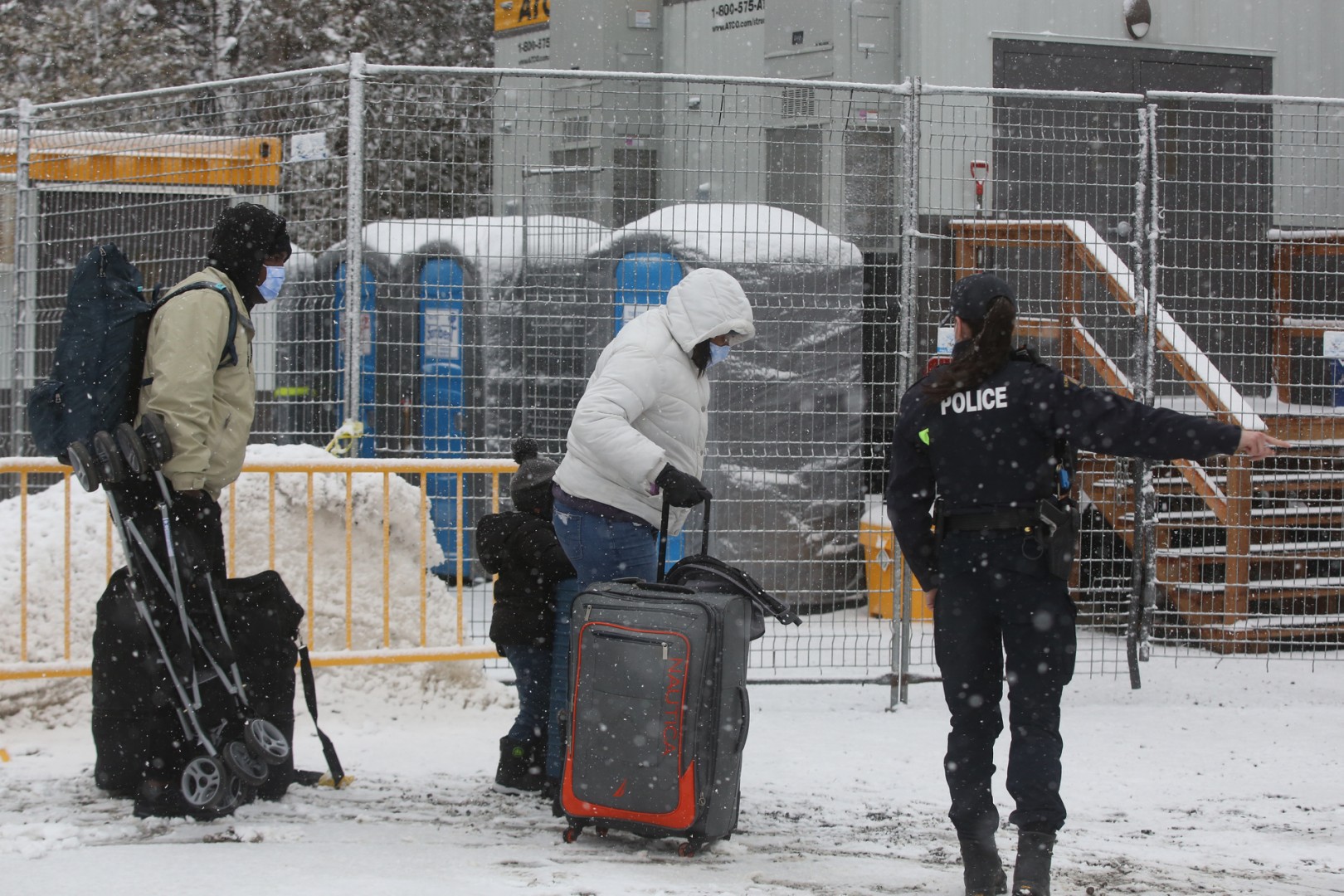
Royal Canadian Mounted Police officers greet refugees as they arrive on March 25, 2023 at the Roxham Road border crossing in Champlain, New York following the closing of the crossing the previous day (AFP / Lars Hagberg)
 
Over 100,000 'irregular' border crossers comprised of foreign nationals crossing illegally into Canada to declare asylum since 2017 have gained entry to await a final ruling of their application claims. A record number of foreign students claimed asylum last year timed as their study visa lapsed, amounting to 20,245 international students claiming asylum; an even higher number is anticipated for this year. 
 
There are approximately 8,500 frontline employees with the Canada Border Services Agency, a number that has not risen since 2012, back when a public service cut took place and CBSA lost 1,000 employees. That number of CBSA frontline workers have exponentially more work to do in carrying out their duties, at this time, given the spike in refugee claimants and irregular (illegal) border crossings.  
"The technology that we see the CBSA putting in place is all about self-declaration -- the refugee  claimant doing everything on their own because we simply don't have the staff to do the proper interviews and do what we did previously."
"[Canada's borders are increasingly being stripped of the] human element."
Mark Weber 


Labels: , , , , , ,

Sunday, December 01, 2024

Contemplating A Flood Tide of Migrants From the United States Into Canada

"I understand Trump is already talking about building -- basically concentration camps and huge detention centres. And people are just going to run. They're just going to run. They come to either Mexico or Canada."
"[Ten thousand illegals showing up at our borders] would throw our system completely off kilter."
"So this immigration minister is saying not everybody's welcome but you know we've clearly got a reputation as being soft, and different than the United States. We have a reputation for being very generous. Very, very generous, and that's going to be a problem."
"I mean, some of them have come all the way from Africa from Central America, walked into the States, all the way to Canada."
Richard Huntley, retired senior Canadian Border Services Agency official
https://i.cbc.ca/1.7330282.1726874127!/fileImage/httpImage/image.jpg_gen/derivatives/original_1180/migrants-crossing-security-camera-2.jpg
A family crosses a wooded area at Canada-U.S. border, as recorded on Oliver's security camera. (Submitted by Chris Oliver)

As the United States, Canada's neighbour, anticipates the resumption of Donald Trump's presidency in the New Year, illegal migrants have been placed on notice that they will be the subject of a new executive order of mass deportation. The expectation is that millions of illegal immigrants will be ordered deported. As re-elected president, Mr. Trump will get on with the preoccupation of his first term; completion of a border wall between Mexico and the U.S. and cleansing America of millions of illegals.
 
Canada is trembling at the prospect of a hugely enlarged resurgence of people fleeing deportation, and arriving in Canada to declare refugee status. Richard Huntley, 68, had 33 years at the Canadian Border Service Agency, enforcing Canadian border security and immigration rules. He spent two decades as chief of CBSA's inland immigration enforcement in southern Alberta, so he knows the file intimately as the longest undefended border in the world.

With his experience added to the current almost-dysfunctionally overwhelmed state of the Service, he  has little confidence that the joint apparatus of the RCMP and the federal border security service even with the support of Immigration Refugees and Citizenship along with the Canadian Security Intelligence Service, will find Canada fully prepared for a deluge of asylum seekers entering from the United States into Canada in a desperate search for asylum.
 
https://smartcdn.gprod.postmedia.digital/montrealgazette/wp-content/uploads/2024/11/2023102016104-6532dd97b0ea431cb90530a9jpeg.jpg?quality=90&strip=all&w=1128&h=846&type=webp&sig=4To0N0NBmjKY6je9S3tVqQ
CBSA, he points out, is still trying to cope with the 492 Sri Lankan Tamils who arrived in 2010 to British Columbia on a Thai cargo ship. The Liberal government of Justin Trudeau recently scaled back its projected absorption numbers for immigrants from 500,000 yearly as an intake from 2025 onward. This was a forced decision given the disruption and heavy calls on an already understaffed and inadequate medical system, as well as the realization that Canada's housing requirements for additional population numbers could not be met.
"Coyotes or smugglers, are going to be in big demand. All organized crime knows that there's big money to be made -- even with less chance of being caught than doing drugs or smuggling diamonds or pornography or whatever. There's big money in it and it's very seldom  you catch the coyote. Because they're just coming up to the border and pointing the people in the direction of Canada and saying 'That's where you're going'."
The American border patrol is equipped with drones and armed vehicles. In Canada, "we've got one or two Mounties roaming around every so often, especially out West here. they're totally ineffective to stop something like this." There was a time, Mr. Huntley said, when the provinces would hold immigration detainees while they pursued the refugee process. At the present time given the numbers of refugee declarants, there just is nowhere to hold them, and so they're released into the population.

Immigration detention centres exist only in Vancouver Toronto and Montreal. Refugee declarants in other cities by their thousands are maintained in temporary improvised lodgings; social services meant to serve the Canadian homeless, stretching the capacity of various agencies to their limits. When people coming in as migrants are not found to be legitimate refugees Canada has the option of sending them back, obligated to return them to their country of origin. "Very occasionally, we'd have to charter a plane because somebody would be too dangerous to fly on a commercial flight."

https://i.cbc.ca/ais/9a188f1c-e639-4310-9a9f-6fafc87df012,1726881804179/full/max/0/default.jpg?im=Crop%2Crect%3D%280%2C0%2C1919%2C1079%29%3BResize%3D%28620%29
Human smuggling on the Canada-U.S. border    CBC
 
"A refugee system where you can't deal with someone's claim in an expeditious manner just leads to problems down the road."
"Huge problems, because they become your neighbours, they have kids, they get married, do you know what I mean?"
"It's impossible to deal with people that have been here for five  years or more."
Richard Huntley 


Labels: , ,

Thursday, July 13, 2023

Proportionate, Reasonable Accommodation to Perceived Security Threats

https://i.cbc.ca/1.5437024.1579737004!/fileImage/httpImage/image.jpg_gen/derivatives/16x9_780/cbsa.jpg
(Canada Border Services Agency)
"Detention is a tool that we use. It is the tool of last resort, but it is a tool that we need."
"There is a hardcore, a very small number, but a significant number of people that represent high risk. In exercising our responsibility to protect Canadians, we need to find a home for them."
"Our planning is to address that very issue [the potential for the agency to run out of short term space for current and future detainees]. It's to make sure that we can appropriately manage all the detainees that come our way, including the high-risk ones."
"The team here is working diligently to find the alternate solutions to build that capacity."
"I think the system and why we do [detention] is poorly understood."
"I think there's a misunderstanding around how broad is the scope of people that are subjected to detention. And I don't think there's a clear understanding of ... the care [for immigrants that] more often than not, we're asking [them] to leave the country because they're inadmissible."
"I'm not sure people are giving us the recognition for the great work that we've done."
Aaron McCrorie, vice-president, intelligence and enforcement, Canada Border Services Agency
 
"We have to find a different and better path forward in my view to deal with individuals who may be detained for violations of immigration law when there's some kind of an alternative."
"My own view is that immigration detention should be a last resort, absolutely, for somebody who did not commit a criminal offence."
Federal Immigration Minister Sean Fraser
barbed wire fence at jail
The Ottawa-Carleton Detention Centre, seen here, is one of the provincial jails that accepts migrants detained by the Canada Border Services Agency. (Radio-Canada)

The Canada Border Agency finds itself in a bind, with a backlash resulting from controversy over the practice of detaining high-risk migrants. Uncertainty, claims of human rights abuses by rights group, have led the provinces over the last year to cancel agreements that had permitted the Canada Border Services Agency to use provincial prisons in housing migrants detained over the matter of security concerns, during the time their cases are being officially considered. 

There will always -- emphasized Aaron McCrorie of the CBSA -- be certain immigration candidates to Canada who pose a security risk, for which the temporary solution is to detain them until such time as their application for asylum has been decided one way or another. British Columbia, Nova Scotia, Alberta, Manitoba, Saskatchewan, New Brunswick and Quebec cancelled prison agreements a year ago with CBSA. A one-year sunset clause gave the border agency time to find replacements.

The question remains whether the federal government will overhaul the system significantly, and whether new centres to relocate current detainees and place new arrivals by the CBSA can be established, before access to provincial prisons is lost entirely. The agency does have the alternative of building more of its own administered immigration holding centres, over the three it currently has to serve the entire country.

There were 931 immigration detainees in provincial prisons at the end of 2022-23, reduced from 2,043 seven years previously, and as of June 2022 that number fell further, to 70. Another 221 are held in CBSA's three immigration holding centres. Detainment represents a small portion of the agency security framework for immigration candidates considered a risk, with 97 percent of the 12,000 currently enrolled under surveillance in detention alternatives such as ankle-bracelet monitoring or regular reporting with CBSA agents.
 
Removals from Canada:
"If you receive a Removal Order you cannot legally remain in Canada and must leave the country. Depending on your situation, your removal order may be effective immediately, or after a negative decision if you had made an appeal. If you have questions about your Removal Order you are encouraged to call 1-833-995-0002, Monday to Friday between 8:00 am to 4:00 pm AST, to speak to an officer who can answer your case-specific questions."
"There are three types of Removal Orders issued by Immigration, Refugees and Citizenship Canada (IRCC) or the Canada Border Services Agency (CBSA). These are Departure Orders, Exclusion Orders and Deportation Orders. The form number on the Removal Order indicates what type of order you received."
Failure to Leave
"Once a Removal Order takes effect, you must leave Canada immediately."
"If you fail to appear for a removal interview or a scheduled removal date, the CBSA will issue a Canada-wide warrant for your arrest. Once arrested, the CBSA may detain you in a holding facility before removal."
"In order to ensure you leave Canada, the CBSA may assign an escort officer to accompany you on your departure."
Canada Border Services Agency
Human rights groups in recent years have accused CBSA of locking up some immigrants, children among them, for months at a time in "abusive" prison conditions, no date set for release. Mr. McCrorie notes significant changes have been implemented to the manner in which CBSA manages its immigration detainee stream since the launch in 2016 of the National Immigration Detention Framework, with its expanded alternatives to detention. Holding centres in British Columbia and Quebec, he points out, have implemented improved medical and mental health services for detainees.
 
Moreover, detention is reserved for acutely "high-risk" cases, most of whom have been convicted of crimes or are suspected of serious criminal activity in Canada or abroad. Individuals set to be deported will also be incarcerated should they be considered to represent a flight risk. 
 
Amnesty International and Human Rights Watch published a report in June of 2021 calling for the end of Canada's immigration detention system. The CBSA was accused in the report of incarcerating thousands of people in "often abusive conditions" for months or years with no clear date of release. A campaign was launched by the two organizations urging provinces to end their agreements with CBSA for provincial prisons to take in immigrant detainees.
 
Some 2,000 of the approximately 8,000 migrants detained by CBSA on average each year from 2015 to 2020 were sent to provincial jails. (Radio-Canada)


Labels: , , ,

Follow @rheytah Tweet