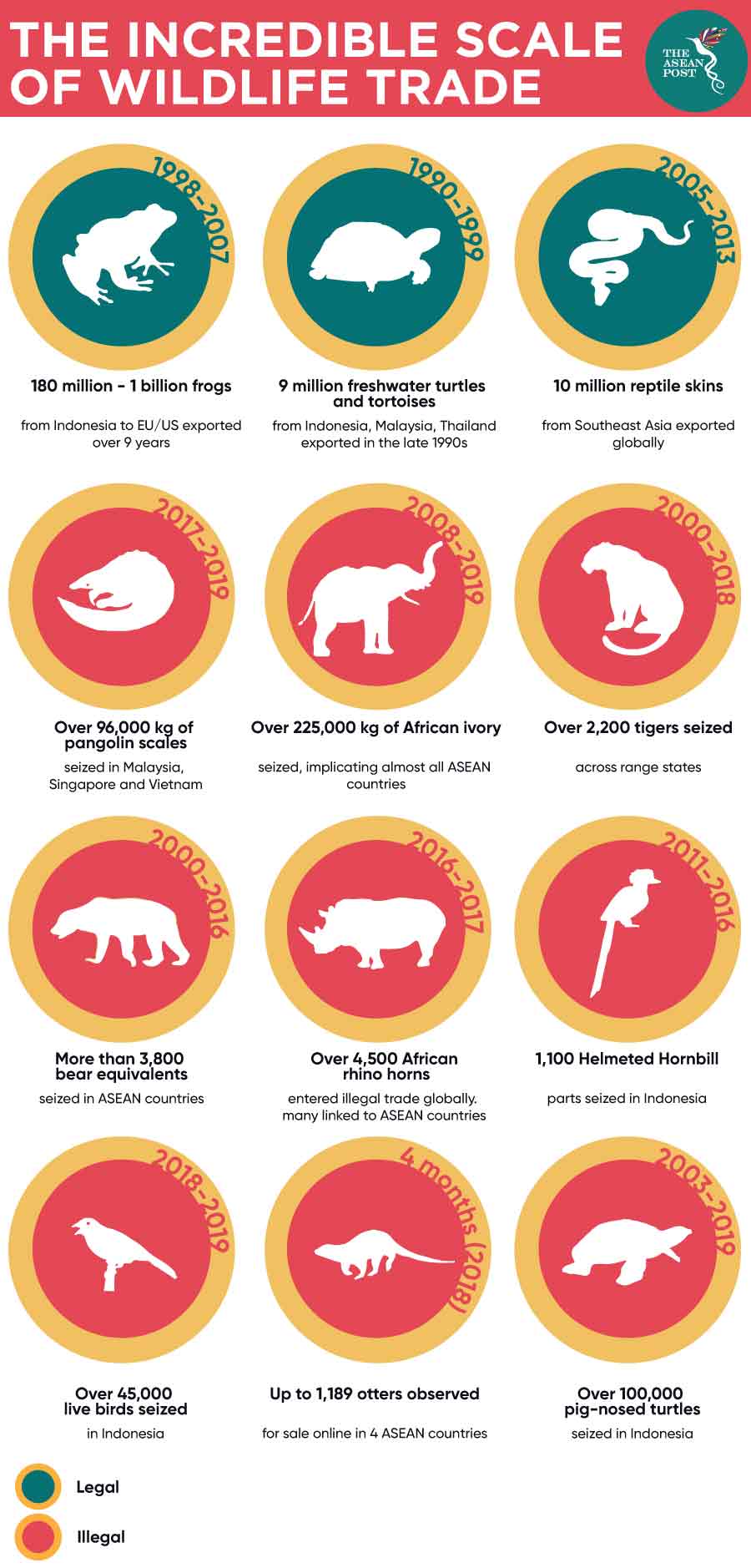
"Hard-core believers in 'jinbu' seem to buy into the notion: 'Like-shapes eaten strengthen like-shapes', with the word 'shapes' sometimes referring to human organs and their functions. Adherents count as favourites a long list of exotic foods -- whose methods of procurement or preparation can be outright cruel, with some simply too revolting to describe here." "I have seen snakes and the penises of bulls or horses -- great for men, the theory goes -- on offer at restaurants in many cities in southern China. Bats, which are thought to be the original source of both the current coronavirus and the SARS virus, are said to be good for restoring eyesight -- especially the animals' granular feces, called 'sands of nocturnal shine'." "Gallbladders and bile harvested from live bears are good for treating jaundice; tiger bone is for erections." Yizheng Lian, The New York Times
A security guard stands outside the Huanan Seafood Wholesale Market where the coronavirus was detected in Wuhan on January 24.
It was initially called Wuhan Virus, Chinese Virus, Novel Coronavirus, and now it is COVID-19, named so by the World Health Organization, sensitive to Beijing's bristling outrage that a virus should be identified with China. WHO empathetically sought to discourage giving emerging diseases the names of locations where they emanated from, as unfair, to avoid"unintended negative impacts by stigmatizing certain communities". So,what has finally been declared a 'global pandemic' is CO(corona)VI(virus)D(disease)-19(2019.
On the other hand, realistically, the zoonotic that is the COVID-19 virus has a cultural, distinctly Chinese origin and there is little that soft-peddling a name can do to change that reality. China's infamous sensitivity to be linked to anything deleterious, threatening, leaving a bad odour to its name has led it repeatedly to downplay and ignore all such events. Its leaders have a tendency to hide dangerous events and it was no different this time, when doctors who detected something wrong arising, sought to alert their counterparts.
Picture taken in May 2003 shows a policeman watching over a civet cat
captured in the wild by a farmer in Wuhan, central China's Hubei
province.
Warnings were issued by Chinese authorities, threats that the targets were well aware might imperil them should they persist in warning the wider public of an emerging danger. Somehow, the Chinese public sooner or later discovers the perfidy of their government and expresses its outrage at threat of danger to itself. As occurred this time when one of the physicians who warned his colleagues of a strange new pneumonia, was threatened by authorities, himself contracted the virus, and died of it.
And then there is the issue of Chinese cultural preferences in cuisine and pharmaceuticals; its use of exotic and rare plant and animal species for their supposed powers of healing. A culture that is doing its part in reducing the numbers and species of wild animals and plants to the detriment of risking species' survival. "Jinbu" in Chinese food culture describes the use of food to cure a disease, part of a holistic theory holding that disease and illness results when the body is depleted of blood and energy.
A vendor sells three peacocks at a wildlife animals market in Guangzhou
Jinbu for men relates to a mystical exhausted energy that can be rectified and virility restored along with sexual prowess; for women replacing blood to improve beauty and fertility, and in those interests rare plants and animals are thought to replenish 'blood' and 'energy', all the more so when wild animals and plants are eaten fresh or raw. Winter is the season when the body cries out for more "jinbu" foods.
A
pangolin in Kuala Lumpur, Malaysia, in 2002. Prized in China as a
delicacy and for the purported medicinal virtues of their scales,
pangolins are said to be the most trafficked mammal in the world. Credit...Jimin Lai/Agence France-Presse — Getty Images
The palm civet, a small, wild quadruped is suspected of having been the source of the SARS virus in humans; stewed with snake meat, it is relied upon as a cure for insomnia. The ordinary population feels that dog meat, preferentially a dog that has been chased before slaughter to ensure more "jinbu" benefits accrue from eating an animal whose blood and energy has been exercised to high mode, suffices. Animals slaughtered before serving are believed to be more "jinbu" potent.
And this is where the wet markets comes in, where live, wild exotic animals are obtainable; sold live as more potent "jinbu" sources before they end up on the dinner table. Unbeknownst to the diner, their potency comes strengthened with the presence of viruses which are passed from animal to human on occasion. The Chinese culture is deeply permeated with the belief that exotic wildlife translate to healthful foods.
"The celebration surrounding the annual Pacific bluefin auction hides how deeply in trouble this species really is." "Its population has fallen to less than 3.5 percent of its historic size and overfishing still continues today." "It's time for countries, including Japan, to support Pacific bluefin recovery, fund the necessary science, and commit to enforcing fishing limits, to ensure that there will still be bluefin left to auction." Jamie Gibbon, associate manager, global tuna conservation, The Pew Charitable Trusts
Kiyomura Co. President Kiyoshi Kimura (C) cuts
a fresh bluefin tuna at one of the company’s Sushi Zanmai sushi
restaurants after the year’s first auction at Tsukiji Market on January
05, 2019 in Tokyo, Japan. Kiyomura Co. bid for the highest priced tuna
weighing 278 kilogram (612lbs) for 336 million yen ($3.1m) at the year’s
first auction.Takashi Aoyama/Getty Images
Japan hasn't got a sterling reputation as a steward of the aquatic creatures of the sea, given its unrestrained appetite for endangered species and its challenges to those who express a need to conserve the worldwide whale population. The Japanese public's appetite for various types of fish is understandable to a point as a maritime nation, a sequence of three islands in the Pacific. In its refusal to reign in its enthusiasm for wholesale capture of fish species it rivals China.
The immense population of China is wedded to exotic cuisine dependent on exotic animal parts, a threat to the existence of large-game animals throughout Africa, indeed everywhere in the world. Chinese traditional medicinal formulae as well, dependent on body parts of various animals take their toll on the existence of species known to be teetering close to extinction. At a time when much of the world is becoming aware of responsibility to the welfare of other species on Earth, persuading nations to preserve their native animal species is hampered by poaching and illegal gathering.
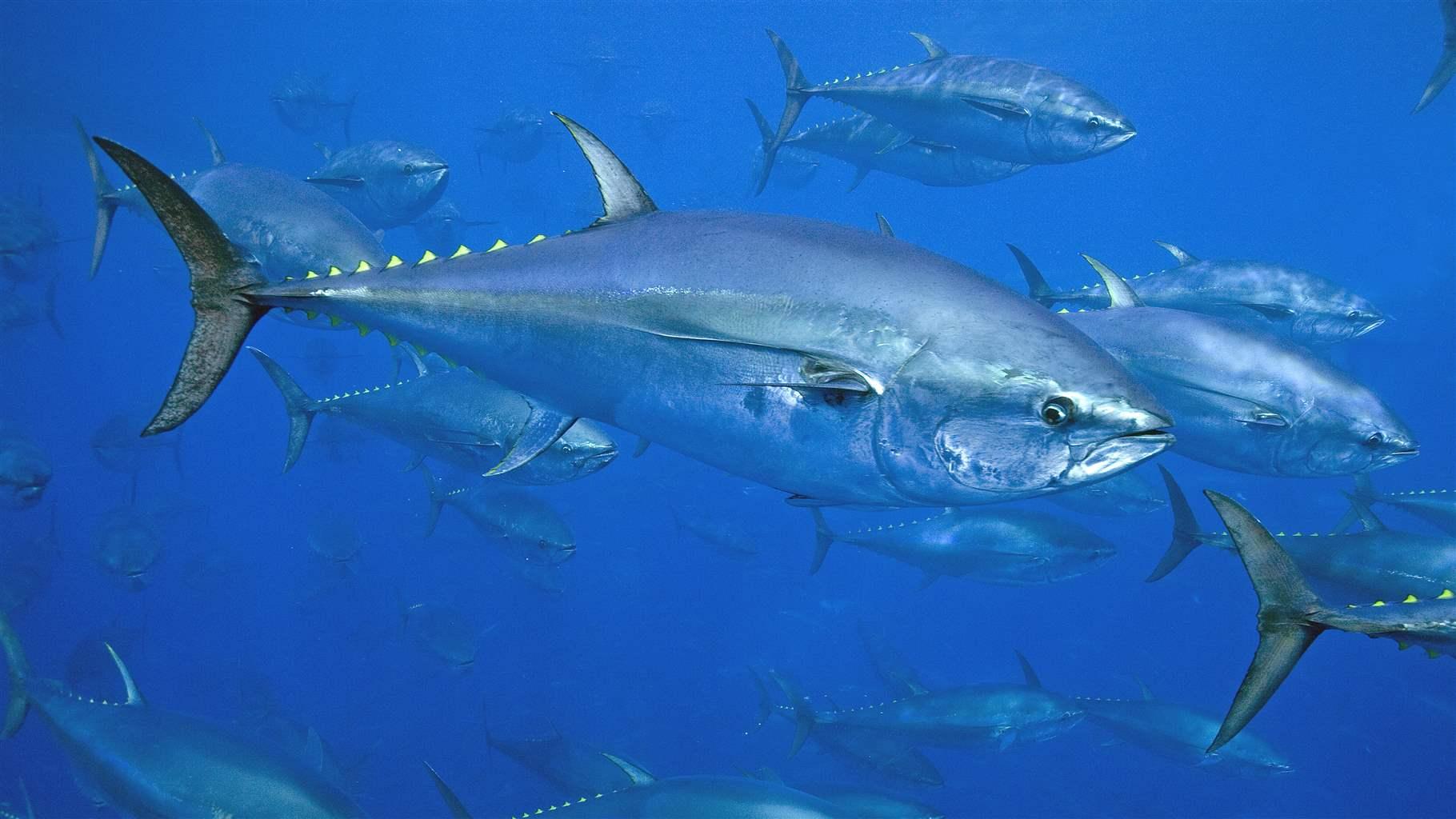
Bluefin tuna is valued in sushi restaurants worldwide, but of course in particular in the country where sushi is a national dish. Bluefin tuna stocks are plummeting, however, the result of unrestrained fishing for the valuable fish. The Pacific Bluefin tuna (Thunnus orientalis) is listed as "vulnerable" according to the British-based International Union of Conservation of Nature, in their Red List of Threatened Species, in recognition of its decreasing population.
Atlantic bluefin tuna is worth nearly US$1 billion per year,
but illegal and unreported fishing could jeopardize recent efforts to
help bluefin fisheries reach sustainability. Richard Herrmann
Japan and other governments had agreed in 2017 to observe strict quotas and restrictions on fishing for the purpose of attempting to rebuild stocks from twenty percent of historic levels by 2034. Fishing methods in Japan's Aomori prefecture in the small town of Oma with its national reputation for the quality of its tuna catch eschew trawling for traditional manual fishing.
Those fishermen found tuna harder to find than previously, and their catches were on the low end leading to fears the Oma tuna might disappear from Japan's sushi bars. Japanese fishermen protested the new quotas, leading Japan and other countries lobbying for higher catch quotas for the coming year of 2019, only one year into the new, agreed 16-year recovery plan.
There were reports of Japanese fishermen discarding and failing to report dead Bluefin in avoidance of exceeding their quotas. Pacific Bluefin tuna's maximum length of close to three meters at maturity, with a weight topping 550 kilograms identify it as a very large fish. As an ocean predator they have been spoken of as "twice the size of a lion and faster than a gazelle", built with a torpedo-like hydrodynamic shape, according to the World Wildlife Fund.
Their two main breeding grounds off the coast of Japan leave most of the tuna in the western Pacific their entire lives, from Sakhalin Island in Russia in the north to New Zealand in the south. Other tuna reaching one to two years of age undertake a 11,000-kilometre migration to waters off California and Mexico's Baja Peninsula, rich with food for the tuna. After two to four years they return to spawn where they began their life, in the western Pacific.
Before reaching maturity, fishermen mostly from Japan, South Korea and Mexico often take those fish resulting in undermining the population. These fish are so valued in Japan that a huge bluefin sold for a record $3.1 million at Tokyo's fish market this week -- the buyer Kiyoshi Kimura, owner of the Sushi Zanmai restaurant chain -- at the firs auction of the year; a price ten times higher than the price paid at last year's auction.
Kiyoshi Kimura, president of Kiyomura
Corp., give a thumbs up to a vendor as he walks with a newly-purchased
tuna towards a Sushizanmai restaurant in Tokyo, Japan, on Saturday Jan.
5, 2019. Kiyomura, operator of the Sushizanmai restaurant chain across
Japan, made the winning bid of 333.6 million yen (about $3.1 million)
for a 278-kilogram bluefin tuna at Toyosu Market on Saturday. Bloomberg photo by Keith Bedford
This represents a general opinion site for its author. It also offers a space for the author to record her experiences and perceptions,both personal and public. This is rendered obvious by the content contained in the blog, but the space is here inviting me to write. And so I do.