"The more preparations we make, the less likely there will be rash attempts of aggression."
"The more united we are, the stronger and safer Taiwan would become."
Taiwan President Tsai Ing-won
"We
[United States] will continue to assist Taiwan in maintaining a
sufficient self defence capability in line with our long-standing
commitments and consistent with our one China policy."
White House National Security Council
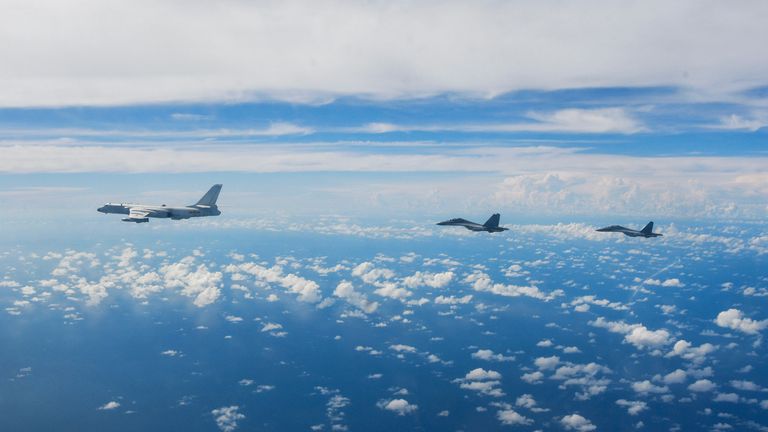
Aircraft of the Eastern Theater Command during a prior drill near Taiwan in August. Pic: Xinhua /AP
The
entire region of East Asia shows indication of an uneasy peace slowly
unravelling. North Korea sent drones across its heavily fortified
border with South Korea, with the South responding by scrambling fighter
jets, flying surveillance and firing warning shots in deterrence. For
the first time in five years a fresh escalation of tensions has erupted
of an intensity that strikes concern, according to South Korea's Joint
Chiefs of Staff.
Attack
helicopters were dispatched along with fighter jets to shoot down the
drones. Several days earlier two short-range ballistic missiles were
fired at the South. This is North Korea's method of protesting its
displeasure at joint air drills carried out betwen South Korea and the
United States; a rehearsal for an invasion, interpreted by North Korea. "Our military will thoroughly and resolutely respond to this kind of North Korea provation", director of operations Major General Lee Seung-o of the South Korean Joint Chiefs of Staff stated emphatically.
"[U.S.
officials are] consulting closely with the [Republic of Korea] about
the nature of this incursion. We recoggnize the need of the ROK to
protect its territorial integrity", noted an unnamed
White House National Security official. Taiwan, South Korea nervous of
the intentions of China and North Korea. Joining them is Japan, edgily
watching what is happening in its neighbourhood and fearing that it too
is in North Korea's and China's crosshairs.
Tokyo
is considering the possibility of a nuclear attack to match the growing
fears of a potentially full-on conflict with either North Korea or
China. Japan, the only nation on Earth that has ever suffered a nuclear
attack, saw its cities of Hiroshima and Nagasaki both devastated in the
wake of the Second World War when nuclear devices were unleashed on an
unsuspecting, still war-defiant nation. Suddenly a soaring business has
taken off of nuclear shelter sales in Japan.
In
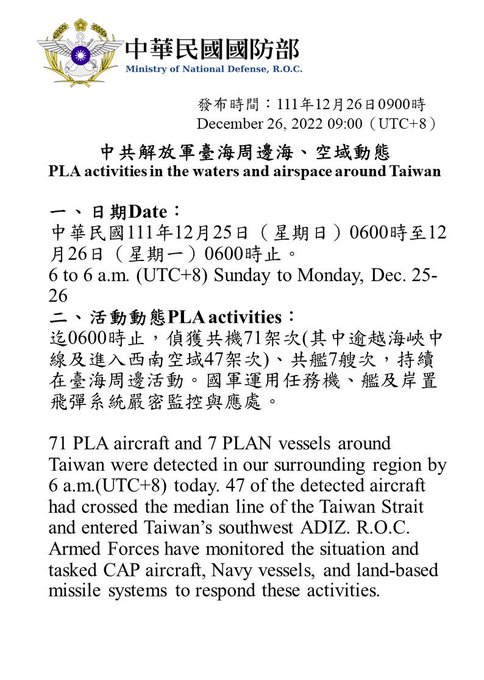
Taiwan, in a 24-hour-period, 71 Chinese military aircraft. among them
fighter jets and drones, entered Taiwan's air defence zone, to date the
largest reported incursion. The Taiwan Straits saw 43 aircraft cross the
median line, the unofficial buffer separating the two sides. Throughout
the steady increase of aggressive intimidation that Beijing tqrgets
Taipei with, this is yet the most emphatic. According to Beijing these
were 'strike drills'.
Beijing
was merely responding to 'provocations' from Taiwan and the United
States. The latter intervening in territory not its own, the former
spurning Beijing's wish for reunifiction, to take independent sovereign
Taiwan back under its wing. The drills saw the Chinese air force
dispatch warplanes from several locales across the country for simulated
attacks on Taiwanese and U.S. warships.
The
situation has compelled Taiwan to change the service tenure of its
compulsory military service from the current four months to a year, to
deal with rising tensions linked to Beijing's military pressure.
Taiwan's southern air defence identification zone saw Chinese
electronic-warfare and antisubmarine aircraft incursions along with
drones. Repeated missions by the Chinese air force of the last two years
has given Taipei reason for vigilance. In response to the latest
incursion, Taiwan sent combat aircraft to warn off the Chinese planes,
with missile systems monitoring their flight.
"We
will promote our values, including by calling on China to respect human
rights and fundamental freedoms, especially in relation to Xinjiang and
those rights, freedoms and high degree of autonomy for Hong Kong
enshrined in the Sino-British joint Declaration."
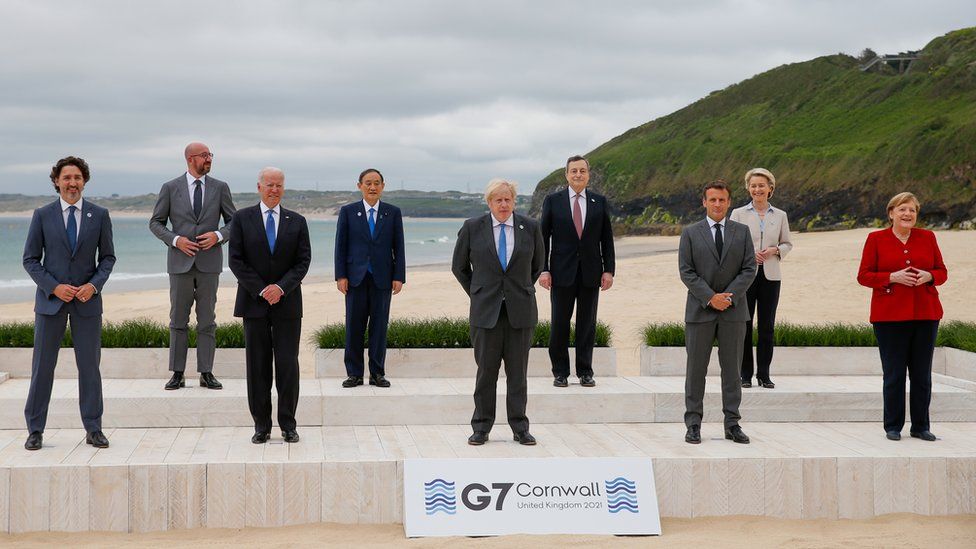
"[We
stress] the importance of peace and stability across the Taiwan Strait,
and encourage the peaceful resolution of cross-Strait Issues."
"We
remain seriously concerned about the situation in the East- and
South-China Seas and strongly oppose any unilateral attempts to change
the status quo and increase tensions."
G7 Closing statement of joint agreements
"We're
in a contest, not with China per se ... with autocrats, autocratic
governments around the world, as to whether or not democracies can
compare with them in a rapidly changing 21st Century."
"As
I've told [Chinese President] Xi Jinping myself, I'm not looking for
conflict. Where we cooperation, we'll cooperate; where we disagree I'm
going to state this frankly, and we are going to respond to actions that
are inconsistent."
U.S. President Joe Biden
The
group of economically advanced Western democracies that comprise the
G7; the United States, Japan, Germany, France, Britain, Italy and Canada
expressed its concern over the issue of forced labour in global supply
chains inclusive of the agricultural, solar and garment sectors. All of
which issues Beijing has repeatedly and forcefully rejected. From its
perspective, efforts by Western powers to contain China are doomed to
failure.
As
far as Beijing is concerned -- and its concern was conveyed by China's
mission in the United Kingdom -- responding to Western assertions over
China's growing influence, in efforts to counteract that influence and
to contain China, it charges that Western powers remain gripped by an
outdated imperial mindset, expressed by humiliating China.
Clearly
one gross humiliation represents the G7 demanding a complete and
thorough investigation of the origins of the coronavirus that appeared
in Wuhan and that has gone on to devastate populations worldwide, along
with the global economy. The final agreed-upon G7 communique, highly
critical of Beijing, delved into areas that China insists are off limits
to any outside interference of its sovereignty. The call for a
transparent Phase 2 COVID-19 Origins study to be convened by the World Health Organization is anathema to Beijing.
Again
and again China has responded to allegations citing its treatment of
the Uyghurs, Hong Kong independence, and Taiwan's status as a free
independent state, that these are internal issues; matters of no
interest to any other country. Such efforts by Western powers to rein in
China's ambitions have been characterized by Beijing as doomed to fail.
Western powers' attempts to contain China reflect major powers still in
the grip of an outdated imperial mindset following years of humiliating
China.
That
United Nations experts in human rights issues claim that over a million
people, mostly Uyghurs and other Muslim minorities have had their
freedom and liberty dramatically curtailed as they have been detained in
vast camps n Xinjiang in northwest China. Accusations that China
characterizes as preposterous, nothing but slander. That all accusations
of forced labour or abuse is without substance.
The
camps, Beijing stresses, are in reality vocational centres, designed to
eradicate extremism and having nothing whatever to do with forced
labour. They are no longer even in operation, counters China. Since
late 2019, all those in the camps had "graduated". "Stop slandering China, stop interfering in China's internal affairs, and stop harming China's interests", protested a spokesman from the Chinese Embassy in London.
"[China is a peace-loving country that advocates cooperation, but also has its bottom lines]."
"China's
internal affairs must not be interfered in, China's reputation must not
be slandered, and China's interests must not be violated,"
"We
will resolutely defend our national sovereignty, security, and
development interests, and resolutely fight back against all kinds of
injustices and infringements imposed on China."
China's U.K. Embassy
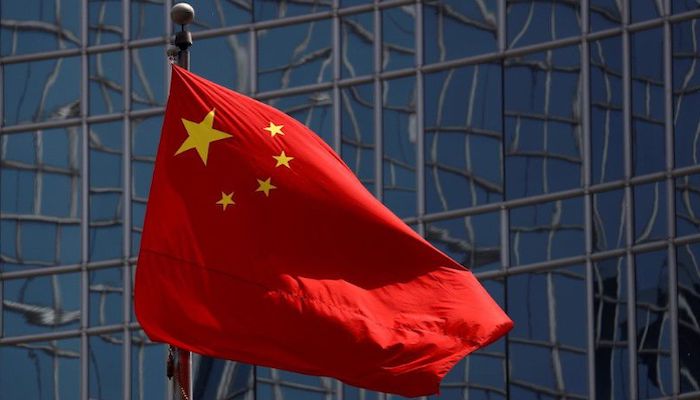
The Chinese national flag is seen in Beijing, China. Photo: Reuters
"When you see something that is technically sweet, you go ahead and do it." “Now I am become Death, the destroyer of worlds." "We knew the world would not be the same. A few people laughed, a few people cried, most people were silent."J.Robert Oppenheimer, head, Los Alamos Laboratory, the Manhattan Project
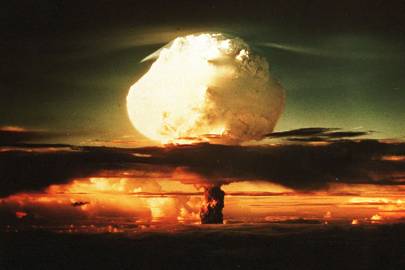
A photograph on display at The Bradbury Science Museum shows the first thermonuclear test on October 31, 1952 Bradbury Science Museum / Getty Images
"There's
just no comparison [between the first atomic bombs and present-day
nuclear weapons]; the shift in our nuclear arsenal is
astounding." "When you have the leaders of countries
issuing nuclear threats on [Twitter], that's a serious
development."
"The world is sleepwalking its way through a newly unstable nuclear
landscape." "Any belief that the threat of nuclear war has been
vanquished is a mirage.""[The trend for] tactical [weapons doesn't make us safer."Sharon Squassoni, global security expert, Bulletin of the Atomic Scientists
"The
overall trend has been away from mass destruction to prevision,
reducing collateral
damage."
"However, the argument goes that precision actually makes it more
likely that we might use them."Seth Baum, executive director, Global Catastrophic Risk Institute
"The
idea was to explode the damned
thing," "We
weren't terribly concerned with the radiation."Hymer Friedell, Manhattan Project
"[In
Hiroshima many survivors were brought to the Hiroshima Communications
Hospital, to the care of Dr.Michihiko
Hachiya." "They began
vomiting, leading the doctor to wonder whether] the new weapon [threw]
off a poison gas or perhaps some deadly germ?"
"Unconsciously, I grabbed some of my hair and pulled ... The amount
that came out made me feel sick."Dr.Michihiko Hachiya, Hiroshima Communications Hospital
Dr.Hachiya
had just completed his air raid duty, noting in his logbook that there
was nothing to report. The residents of Hiroshima were accustomed to
hearing the American bombers overhead, but for some reason unknown to
them the bombs never rained down on Hiroshima, as they did elsewhere in
Japan. Hearing the planes pass overhead, the residents felt no tense
expectation, just a casual acceptance that this was what U.S. B-29
bombers did.
Dr.Hachiya noted that "The hour was early; the morning still, warm and beautiful."
Overhead flew a plane called the Enola Gay, and it carried a new device
named Little Boy. Mere hours earlier in the New Mexico desert the
first ever produced atom bomb had been detonated. "The whole country was lighted by a searing light with the intensity many times that of the midday sun", observed General Thomas Farrell, deputy commander of the Manhattan Project, Los Alamos.
The
"Trinity" test completed, Little Boy headed toward the Southwest
Pacific in a ship. The crew of the Enola Gay discover their mission and
are informed that the bomb they are set to release over a Japanese city
is powerful enough to crack the Earth's crust. That night a clear night
sparkling with shooting stars lay over Hiroshima. The crew of the Enola
Gay is given four cyanide capsules, one for each member of the crew,
should they be captured.
WWII veterans recall the tough missions leading up to Hiroshima and the
efforts to hide the Enola Gay, seen here returning from dropping the
atomic bomb on that city 75 years ago today. (AP Photo/Max Desfor)
Early
morning, their flight close to their destination, the 4,400 kg warhead
is armed. Two hours later, a tone alerts the crew to prepare for the
explosion. At 8:15 a.m. the bomb bay doors release Big Boy on a
beautiful sunny morning, and a fireball hotter than the sun appears,
vaporizing everything within a mile, instantly killing a quarter of the
350,000 residents of Hiroshima. Those who survive the initial blast are
naked, their clothing seared into their backs, wandering about within
the inferno.
The
sky that was so clear and the sun that shone its warmth and light down
onto the city have been eclipsed, and black rain envelopes the city.
Survivors have no memory of the great boom the explosion caused;
recalling only the flare. And the silence. "That beautiful cloud! I have never seen anything so magnificent in my life!", enthused one mystified survivor. The Enola Gay returned to its base.
Peace Memorial Park cenotaph atomic bombing
in Hiroshima, (Eugene Hoshiko/AP)
Since
the atom bombs dropped on Hiroshima and Nagasaki, weapons whose power
have been exponentially magnified have emerged. Spurring bans and
treaties. In 1986 there were 70,000 nuclear weapons globally; that
number now stands at 14,000. How many such weapons of dreadful killing
magnitude would it take to turn the globe into a burnt ember?
Technology
never looks back, only forward. Hypersonic delivery systems have been
designed to evade missile shields to high-altitude strikes, disabling
communication networks. The creation of the atomic bomb took much
furiously intensive creative thinking and careful experimentation.
Refining the bomb, making it infinitely more destructive was a
relatively relaxed task in comparison to the deep experimentation
required to build the first nuclear device.
A minute of silence for the victims of the
atomic bombing. (Eugene Hoshiko/AP)
Now,
miniaturized and still powerful nuclear devices are on the cusp of the
future, where terrorist groups dream of arming themselves with the
world's most destructive weaponry. Back in time, 70 years ago, the navy
secretary informed Harry Truman that Japanese survivors held open to
them "a unique opportunity for the study of the medical biological effects of radiation". Scientists arrived in Japan to study the survivors.
Five
years later, 130,000 survivors had been 'enrolled' in the Life Span
Study, its results forming the world's larget bank of data on the
effects of radiation, helping to develop safe medical uses, like CAT
scans and X-rays. The Survey remains active; now studying the effects of
the nuclear detonation on the next generation of children. "Some people didn't want to go naer them because they were 'infected'", Takuo Takigawa, director of the Hiroshima Peace Memorial Museum notes.
Hibakusha,
as survivors and their offspring were called, were not permitted use of
public baths fearing contamination. They were unable to find
employment, rejected as survivors contaminated by radiation, viewed as
societal castoffs. There was a reason that U.S. bombers refrained from
bombing Hiroshima and Nagasaki. The purpose was to be able to study the
total annihilation and material effects of the atom bomb from a clean
slate.
Valuable
scientific and medical information was derived from studying the effect
on human habitation and human life, destroyed by a nuclear blast.
Resembling nothing so much as Nazi medical experimentation on slave
labourers and concentration camp inmates. The most infamous of these
experiments were carried out under the precise instructions and
directions of SS physician Dr.Josef Mengele, at Auschwitz.
Two women and a
child, subjected to medical experiments—--
United States Holocaust Memorial Museum
Out
of his experiments where living human beings == many of them children,
and infamously twins, were routinely tortured, experimented on, most
frequently perishing from the rigours they suffered -- came data on the
conditions under which human life would be forfeit. Sterilization,
artificial insemination, extreme temperatures, poison and wound
experiments and many others on an ad hoc basis were carried out on
helpless prisoners. Their results formed the basis of an entire range of
data compiled into medical texts.
These
'research' results made their way into reputable medical journals as
data that could never have been assembled under universal
medical/scientific rules of research. Yet these data have been used as
valuable insights compiled on living human beings by meticulous
note-taking on the part of cold-blooded medical professionals whose oath
of conduct would have included the ancient, revered code of 'do no
harm'.
"There's no trust right now." "Nobody is going to buy this idea anymore that greater economic engagement is going to alleviate political strains [between India and China]." Tanvi Madan, director, India Project, Brookings Institution, Washington "If you consider the division of labour, then China is certainly on the winning side [of the two countries' trade imbalance]." "[Particularly in two key areas -- telecoms and pharmaceuticals -- the government] must put in place a medium-term strategy to get out of this kind of dependence [on China. It is] absolutely imperative." Biswajit Dhar, former Indian trade negotiator "[China is] trying to change the status quo unilaterally in the Est China Sea, the South China Sea, at the Indian border and in Hong Kong." "Our fighter jets scramble against Chinese airplanes almost every day. ...Their armed ships are trying to violate our territorial waters." Taro Kono, Japanese Minister of Defence
A Japanese military plane flies over the Senakuku/Diaoyu islands
China has named 50 underwater geographic features located in close proximity to islands whose sovereignty has long been disputed between Japan and China in the East China Sea. China obviously is in the mood to prove the old adage that 'possession is nine-tenths of the law'. Tokyo has interpreted Beijing's move as an "alarming" leap in advancing Chinese territorial claims; recognized as but one of a number of provocative events in flashpoints in the Asia-Pacific region based on fears of military escalation.
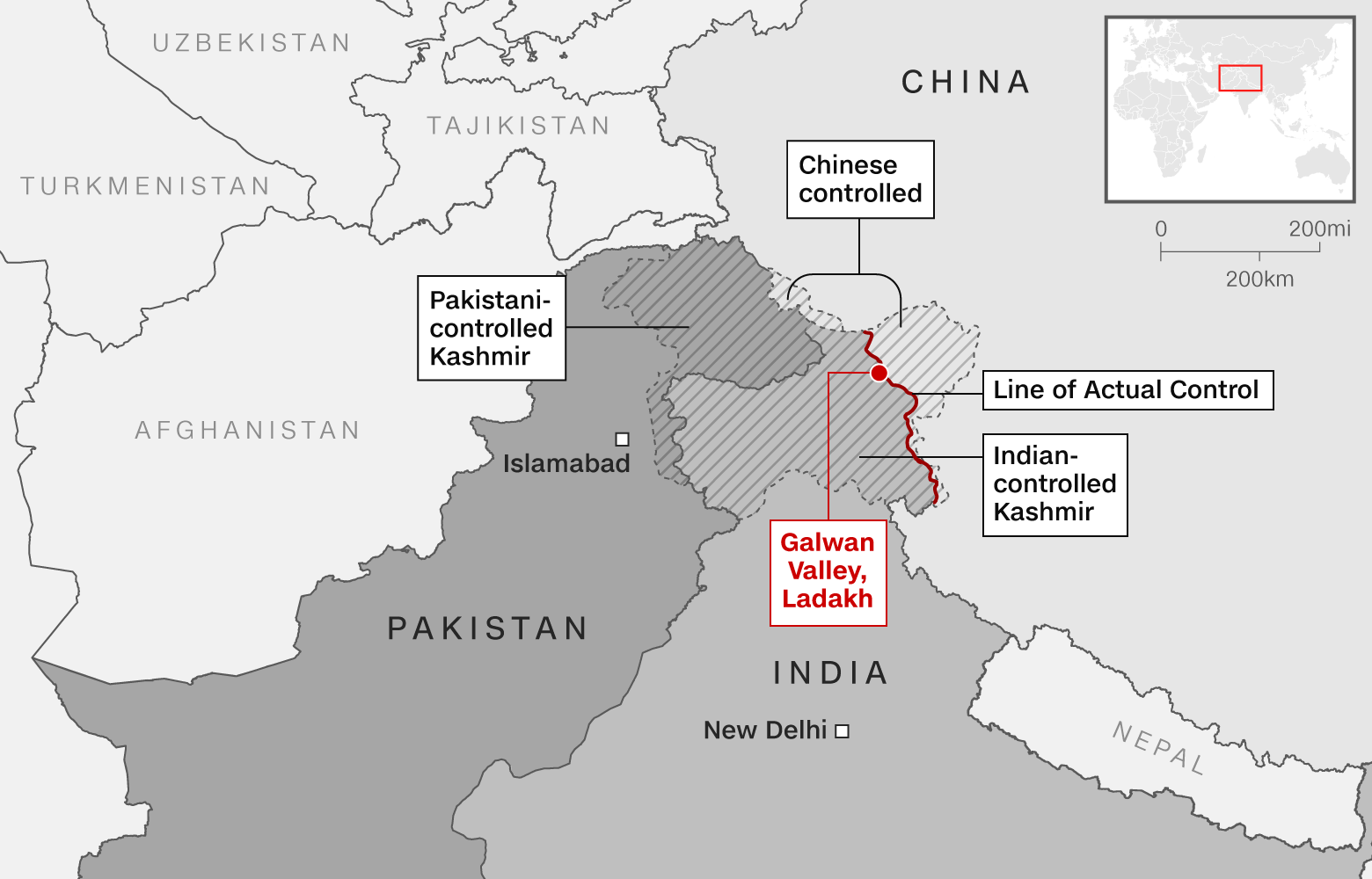
Events between China and India have become even more obviously fraught where disputed territory between the two giant nuclear nations in the Himalaya has seen Beijing's departure from the cold diplomacy its neighbours rely upon to blatant military violence in claiming geographical points within India's boundaries. In a May 15 physical altercation between unarmed Indian and Chinese troops, over 20 Indian soldiers were beaten to death in a violent melee. China has not divulged the numbers of its own losses.
Beijing has given orders for its military to move forward beyond China's territorial borders and into India's. It has surreptitiously erected army posts where no Chinese should venture, within the borders of India's sovereign territory high in the Himalaya. There has been a troop buildup on both sides; China belligerently prepared to advance its interests, and India just as prepared to protect its own from a predatory neighbour. And though both sides had long ago agreed that their military would not carry arms to prevent bloodshed in case of a skirmish, both resorted to improvised weaponry.
An Indian Army convoy moves along a highway leading to Ladakh, at
Gagangeer in Kashmir's Ganderbal district June 18, 2020. REUTERS/Danish
Ismail
China's latest move is to send martial art trainers to their outposts on the Tibetan Plateau -- itself representing a geographical territory torn from Tibetan sovereignty over Chinese claims that Tibet is part of China which it appropriated a century ago, formally annexing it in 1951 with the claim that Tibet formed part of China 800 years ago. Chinese soldiers stationed in their mountain redoubts will now become proficient in the martial arts, though even without them they had hurled an Indian commander to his death off the side of the mountain.
Analysts of satellite imagery confirmed that despite its diplomatic "mutual consensus to disengage" with India over the disputed territory, it had taken no action to remove the posts it had constructed inside Indian territory, nor had it withdrawn its troops stationed there in the Galwan valley. Indeed it has fortified the area in dispute. "India will reduce its dependence on imports", stated Prime Minister Modi. "We [will] become [the] biggest exporters of the commodities that we now import", he declared.
The treacherous terrain of the Ladakh region.Credit:AP
Unfortunately, just like all other nations within the international community, India too has over the years become a nation dependent on Chinese trade, intertwined with its own, a huge trade imbalance in China's favour the result of acquiring cheaper goods, ranging from household items to high-tech communications and personal protection equipment during a time of global economic breakdown caused by a ferociously infectious virus out of China.
Most nations including those whose natural resources China is steadily depleting, and who will never be able to repay the immense infrastructure loans made by Beijing to emerging economies, to bring them into China's "one road, one belt" orbit to capture an even greater share of the world market already mortgaged to China, seek to ingratiate themselves with the power that is behind Beijing, fearful of enduring its wrath should they be seen to defy Chinese directives.
The irony is that the country that gifted the global community with an economy-wrecking, social disaster-wreacking, death-delivering zoonotic, is the very same country that produces a huge proportion of the world's disinfectant chemicals, respirators, medical masks and gowns, ensuring that the stricken world remains dependent on China and in the process, semi-vassals of Beijing. India, with its uneasy political and trade relations with China, finds itself in a bind.
India exports raw materials and imports intermediate and final products of higher economic value; the traditional short-end-of-the-stick in trade. It accesses raw material that China produces; high performance polyethylene, to produce its bulletproof vests for Indian paramilitary and police forces. Bulletproof jackets for the Indian army relies on materials imported from China. India will henceforth make a strenuous effort to wean itself away from Chinese products.
As a worldwide pharmaceutical producer in the global generic drug industry, India is deeply dependent on China, since around 70 percent of the active ingredients required by drugmakers emanate from china, according to Ashok Kumar Madan, executive director of the Indian Drug Manufacturers' Association. Decreasing that reliance on China is a goal that India has long eyed and found frustratingly difficult to attain.
Taking a leaf, as it were, over China's preferred method of punishing nations that dare to defy the advances of the Chinese Communist Party in Beijing India will nonetheless begin the process of withdrawal. Where China bullies other nations when they run afoul of Beijing's wishes, by punishing them through imposing high tariffs on their products or finding reason to discontinue accessing their products for Chinese consumption, as it has done with Canada and Australia. A trade war is less destructive than a military war.
"Japan touts a low-emissions Olympics, but in the very same year, it will start operating five new coal-fired power plants that will emit many times more carbon dioxide than anything the Olympics can offset." Kimiko Hirata, director, Kiko Network, climate action
"They say temperatures are rising. We've known that for a long time." "It's time to do something about that." Tetsuya Komatsubara, 77, resident, Yokosuka, Tokyo Bay
Coal awaits transport at a Japanese port. Almost all of the nation's supply is imported.
BLOOMBERG/GETTY IMAGES
Japan speaks of its plans to transition to a more climate-resilient economy, with innovations such as roads to reflect heat. Organizers of Japan's upcoming summer Olympics have stated that electricity for the Games will be sourced from renewables in energy. The underlying reality appears somewhat at odds with this, however, with its decision to re-invest in coal. To the extent that the country has made plans to build up to 22 new coal-burning power plants over the next five years, known to be one of the dirtiest sources of electricity.
There are 17 identified sites where -- in the following five years while the world is focused on carbon dioxide emissions in the fight against global warming -- those 22 coal-burning plants are meant to be situated. This return to a disputed and rejected old energy source, tried, true and reliable, but horribly polluting, comes as a result of the alarm raised over the Fukushima nuclear disaster of a decade ago, following an earthquake and tsunami. Where a design flaw in the reactor was the cause of the nuclear plant collapse. "Why coal, why now? It's the worst possible thing they could build", commented a homemaker in Yokosuka, the identified site where two of the coal-burning units are to be erected. Altogether, the 22 power plants would result in emissions producing close to the annual carbon dioxide of all passenger cars sold in the United States. And how this situation reflects on Japan's efforts to portray its Tokyo Olympic Games as one of the greenest ever, is a mystery.
Kobe Steel power plant from an apartment balcony in Kobe. (Photo:Ken Kobayashi)
Environmental groups in Japan are accustomed to focusing their ire on nuclear power. With news of the coal-fired plants' impending construction, local residents have turned to taking the government to court over its approval of the new coal-burning plants, arguing that the plants' effect will serve to degrade local air quality, endangering communities through contributing to climate change.
Scientists in Japan attribute a heat wave that occurred in 2018, killing over a thousand people, to climate change. Heat concerns have led the International Olympic Committee to move the Tokyo Olympics' marathon events to a city that experiences cooler temperatures, about 1,100 kilometers north of Tokyo. In a Tokyo summer, residents strive to leave the city's hot, humid environment for temporary cooler environs. A Tokyo summer is hardly an appropriate venue for strenuous athletic events to take place.
Coal produces over a third of Japan's power generating requirements. Even while older coal plants will begin being retired to eventually reduce overall coal dependency, Japan still has expectations that it can meet more than a quarter of its electricity needs into 2030 from coal. Coal consumption has been on the rise for decades in the energy-deficient country, reliant on imports for most of its energy needs, and attempting to wean itself away from foreign oil imports ever since the 1970s oil shock.
Add caption
Japan's government feels the country's utilities must continue to invest in fossil fuels to ensure a diversification of energy sources and lessen dependency on any one type. About four-fifths of Japan's electricity needs are met with natural gas and oil. Renewal sources of energy led by hydropower produce about 16 percent. Up to a third of Japan's power generation was once provided by nuclear energy which has since plummeted in 2017 to 3 percent.
Scientists registered an increase in the temperature of waters off Tokyo representing over one degree Celsius over the past decade. The result of which is dwindling fish stocks. Local fisherman Tetsuya Komatsuhara, who operates a duo of small fishing boats diving for giant clams, can feel the rise in water temperature on his skin. He is concerned that the new plants would strike yet another blow to a fishing business already declining.
A coal depot at
Sakata Kyodo Coal Power Plant in Sakata, Yamagata Prefecture: Coal could
make up more than half of Japan's energy mix by 2030. (Photo by Ken
Kobayashi)
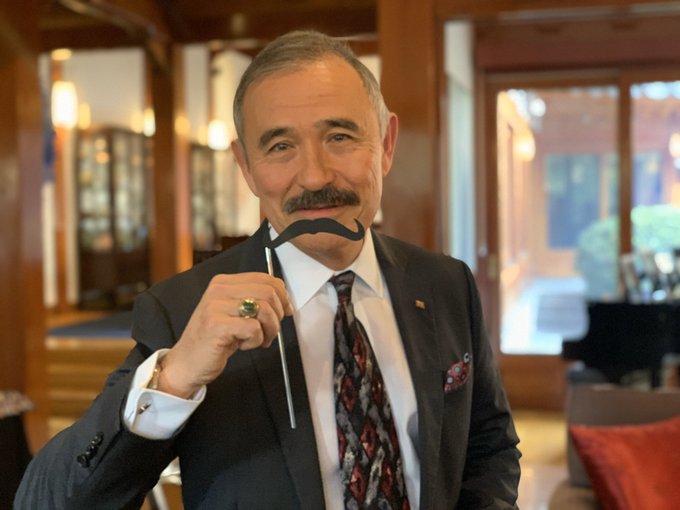
"My moustache, for some reason, has become a point of some fascination here." "I have been criticized in the media here, especially in social media, because of my ethnic background, because I am a Japanese-American." U.S. Ambassador to South Korea, Harry Harris Jr.
"Harris's mother is Japanese." "It feels like that alone is enough for us to dislike him." "Which side will he choose if he is asked to choose between South Korea and Japan?" (America)
Internet blogger, South Korea
"The moustache has become associated with the latest U.S. image of being disrespectful and even coersive toward Korea." "Harris often has been ridiculed for not being an ambassador but a governor-general." Korea Times
Resentment and prejudice go both ways. The Japanese, an outwardly courteous and kind people, consider Koreans inferior to the Japanese. Which is in and of itself not all that unusual, from the ancient Greeks who considered themselves superior to all others, to Nazi Germany, to Americans themselves preoccupied with themselves to the exclusion of interest in other countries, it is human nature to elevate one's own and think unkindly of others.
In Japan, generations of Koreans hide their origins by posing as Japanese, changing their names and becoming loyal Japanese citizens, hoping to be viewed as equals. Japan is obsessed with its racial purity and favours no square pegs for its round-holed citizenry. Like China, it deplores restlessness and appreciates calm and serenity. Conformity is culturally obligatory; no one is meant to make a fuss. The more people resemble one another, the better.
The history of Japanese invasion and occupation and brutal behaviour in Korea and China has left both countries embittered and resentful against Japan for its unforgivable atrocities and the suffering of the Chinese and Koreans under its iron fist. The issue of Korean 'comfort women', of occupation, enslavement and violence in both countries is not easily forgotten nor forgiven. Japan's role in the Second World War condemned it to a purely 'defensive' military up to the last few years.
Japanese suffering during World War II after Japan bombed Pearl Harbour forcing the United States to enter the conflict saw its citizens after the nuclear bombing of Nagasaki and Hiroshima, so averse to conflict that members of its military never wear military uniforms in public; they would travel to work at defence headquarters in civilian clothing, and change into their uniforms once arrived at their place of work, and do the reverse to return home.
The U.S. Ambassador is a retired navy admiral who was born in Japan in a union between a Japanese woman and an American naval officer. South Koreans view his moustache as an assault on their sensibilities, reminiscent of Japanese governors-general who ruled Korea from 1910 to 1945 who wore facial hair. Ambassador Harris was named ambassador to Seoul in 2018 and grew his moustache in reaction to having been clean-shaven for most of his naval career.
Despite the close diplomatic and government ties between the U.S. and South Korea linked to the separation between it and the aggressive communist North Korea, with the U.S. presence guaranteeing South Korean protection against the North's sabre-rattling threats, there has been a rift of late. With Ambassador Harris's appointment considered a slight imposed by President Trump in view of strained relations between Japan and South Korea, another issue of wealthy South Korea assuming responsibility in financing the U.S. troop presence has become another irritant.
One that Ambassador Harris has continually put forward as long overdue. South Korea's decision to abandon a military intelligence-sharing agreement with Japan considered important by the U.S. in guarding against China and North Korea has also become a point of irritation, with the ambassador zealously pushing for a reversal of that decision. These are issued that led to the impression of an overbearing American ambassador, whose presence is doubly offensive to the Koreans.
For his part, Mr. Harris responds that growing a moustache was not only popular in the West but in the early 20th Century even among Korean leaders who fought for liberation from Japan, wearing a moustache had become common. He has no plans for the immediate future to remove the facial hair that celebrated his retirement from the U.S. navy. Which realistically dramatically reduces his effectiveness as a diplomat in the nation to which he has been assigned. South Korean reaction is, on the other hand, rather disgraceful.
In this Dec. 13, 2019 photo, a protester plucks face mustache from a
picture of U.S. Ambassador to South Korea Harry Harris during a rally to
denounce the United States' policies against North Korea near the U.S.
embassy in Seoul, South Korea. Harris has some unusual explanations for
the harsh criticism he's faced in his host country. His mustache, maybe?
Or a Japanese ancestry that raises unpleasant reminders of Japan's
former colonial domination of Korea? (Lee Yong-hwan/Newsis via AP)
"The Japanese government compiled a report on the South Pacific on May
17, affirming its targets of "maintaining and promoting environments
for realizing a free and open Indo-Pacific" and "ensuring the stability
and safety of the region." "Free and open Indo-Pacific," an
expression frequently used by Japanese Prime Minister Shinzo Abe,
generally means the security of ocean routes from the Indian Ocean to
the Pacific through Southeast Asia. Stressing the importance of the rule
of law and freedom of navigation, the expression is aimed to check
China which is expanding its presence in the area." "China
is sparking conflicts with countries around the South China Sea as it
builds artificial islands there as military outposts. The Japanese
government's report adopts the same expression out of concern that China
may resort to the same strategy in the South Pacific." "China
envisions a line of defense from Japan's southern Ogasawara Islands to
Papua New Guinea via Guam and Saipan as its "second island chain"
strategy. An advisory organ to the U.S. Congress said in a report last
year that China is capable of rivaling the U.S. in air, sea and ground
forces in the island chain. In fact, China is expanding its military
influence to the South Pacific." SUSUMU KURONUMA, Nikkei Asian Review
Japan Prime
Minister Shinzo Abe, center, poses with the leaders of Pacific island
countries in a photo session during their meeting in Iwaki, Fukushima
Prefecture, in May 2018.
"Establishing a base in our neighbourhood would be a low-cost,
low-risk way for China to show off its growing military and diplomatic
reach and clout. Moreover, by ignoring the noisy complaints that would
surely emanate from Washington, Beijing would show that it is willing to
defy the United States." "And it would send an unambiguous message to us here in Australia,
signalling Beijing’s rejection of our claims to our own sphere of
influence in the South Pacific, and sending a stark warning of China’s
reach and its capacity to punish us if we side too vociferously with the
US or Japan against it." Hugh White, The Guardian
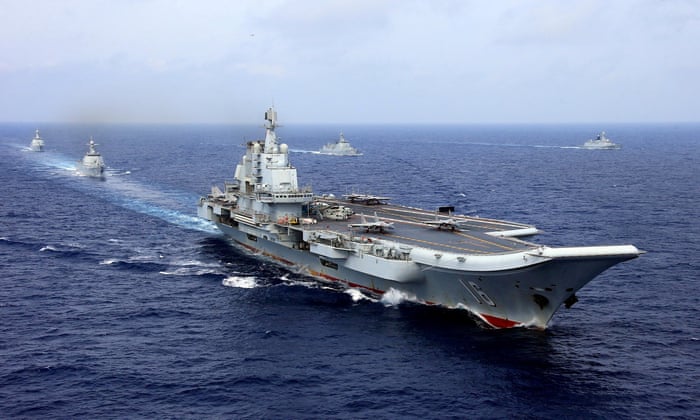
China’s aircraft carrier Liaoning takes part in a military drill of
Chinese People’s Liberation Army navy in the western Pacific Ocean in
2018. Photograph: China Stringer Network/Reuters
Australia and Japan, once bitter enemies, now recognize in one another partners in a quiet offensive against a rising China's ambitions to dominate the western Pacific. China's economic clout has bought it alliances in the Pacific through investments and loans and the gratitude of Pacific island nations. China's steadily growing fleet is next in size only to that of the United States, lacking but the power of the U.S. major fleet units. China's dominance is already on view; its ambitions clear, leaving its neighbours in a state of high anxiety.
Japan and Australia have a robust trading relationship through the 2015 Japan-Australia Partnership, Australia is now Japan's fourth-largest trading partner, Japan Australia's second-largest trading partner. And they both, of necessity and of geography, have a large trading relationship with China. But then, which country globally does not?
Now the two countries are looking at another area of cooperation, examining a formal partnership in building an architecture of security through military cooperation, hoping in the process to invite other Asian countries, perhaps even European nations to join them. In the absence of a U.S. ongoing commitment to counter the growth of China's military, its intentions and influence among Pacific Island nations, the two countries see the vital utility of working together purposefully.
The historic agreement whereby the U.S. has its protective alliance with New Zealand and Australia, and that which Japan has so long relied upon with the U.S. commitment to Japanese security have both been tipped slightly askew with statements emanating from the White House in the last few years. The U.S. pulled its surprise removal from the Trans-Pacific Partnership. And seemingly snap decisions upending generations of treaties and long-held security suppositions have grown an aura of uncertainty.
Both Japan and Australia are trying to prepare themselves psychologically as well as practically for the potential of a post-U.S. Pacific, an absence of balance against the rising power of China. Geopolitical rivalry, particularly that between Japan and China recalls the turn of the 20th Century when an aggressive Japan invaded Korea and China, neither able to withstand the onslaught of a militarily assertive nation hungry for power.
Now it is Japan that has been long quiescent, and China in the ascendancy. The Chinese Peoples Liberation Army Navy, the largest in the world in numbers of seagoing ships still does not compare to striking power of the U.S. Navy with its carrier battle groups and large nuclear submarine fleets, but it is inexorably catching up, to the concern of its neighbours, in particular Australia and Japan.
Their concern is that should the U.S. withdraw from the far Pacific not only Australia and Japan but South Korea, Vietnam, Singapore, the Philippines and other island nations will be challenged to push back against China, or simply resign themselves to the inevitable. Both Australia and Japan have their own considerable naval power; Australia with 31 major fleet units -- submarines, assault landing ships, frigates, destroyers. While Japan has the third largest navy in the world with 65 frigates, destroyers, submarines and other ships.
But a challenge to China's ambitions of total conquest? Doubtful.
Australia's then-Prime Minister Malcolm Turnbull, talks with his Japanese
counterpart Shinzo Abe during a meeting of Japan's National Security
Council at Abe's official residence in Tokyo. 2018. Picture: AP
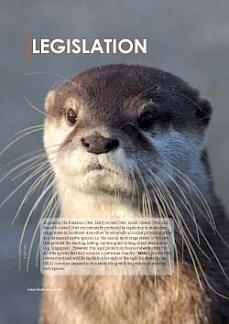
"Young otters are often taken from the wild while their mother is killed trying to defend her litter." "The fact that there are so many newborns available also suggests that traders have no concern as to whether the animals survive or not." Paul Yoxon, head of operations, International Otter Survival Fund
"[The Internet has largely driven the] logarithmic increase [in the popularity of otters as pets]." "Sellers advertise online, and pet owners post endless cute pictures of their little otter, which spreads the news that otters make wonderful pets, which they don't." Nichole Duplaix, conservation biologist, Oregon State University
"There's no way we can completely get rid of pet trade." "In a country like Vietnam, it's much better that people are keeping otters rather than eating them." "Some of these people really care about their animals, and if we can find a way to engage with them to show them why keeping otters is wrong, they can become advocates for wildlife conservation." Daniel Willcox, science adviser, Save Vietnam's Wildlife
Photo: Peter Hess
People make the most peculiar choices all too often when choosing pets. Endangered species, animals clearly unsuitable to be held out of their natural environment in a building; from constrictor snakes to tigers and lions. Yet people think that animals meant to be in the wild to live out their natural lifespan as nature intended them to be within a biology-appropriate environment specific to their species, will somehow respond positively to being placed in an entirely inappropriate setting, to please their own acquisitive egos.
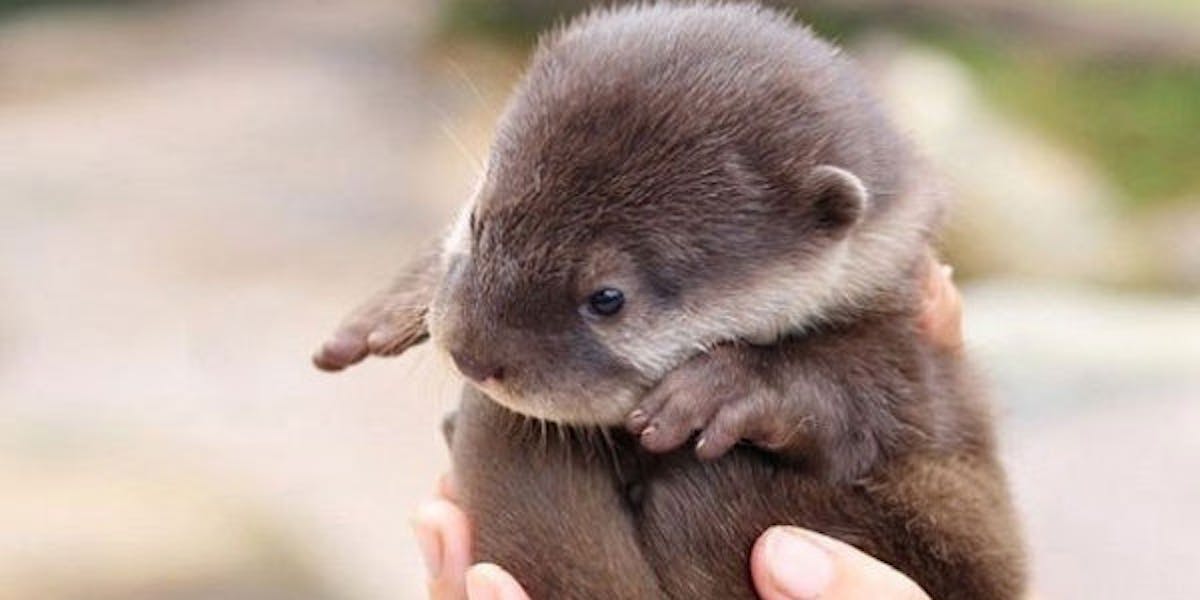
When it comes to abuse of other species, this predilection for raising animals meant to be in the wild in urban settings, comes a close second to the trapping of wild and endangered species for medicinal or dinner table purposes and for ornamental uses. The lack of sensitivity to the existential rights and needs of animals by people fixated on their own needs is beyond unreasonable. Otters have now become a new pet-ownership status symbol. They are 'cute' and that alone is enough to make people of certain cultures who are given to admiring 'cuteness' line up to own them.
Otters are continually on the move, restless and active, high-wired and inquisitive, unwilling to be in any one place for any measure of time. They are smelly, they are explosively loud, are equipped with very sharp teeth and their jaws are strong enough to crack bones. And they're hugely popular as pets in Japan where animal cafes feature the presence of otters -- and people want them as the latest in exotic pets. People are disillusioned with their owls, slow lorises, sugar gliders and star tortoises; not as cute as otters. But equally inappropriate as pets.
People in Indonesia, Thailand, Vietnam and Malaysia all clamour for otters, and where can they be found, as animals difficult to breed in captivity? Captured in the wild, of course. Smooth-coated otters are on the threatened list, and hairy-nosed otters are on the endangered list, both are native to Southeast Asia. However, it is the Asian small-clawed otters, "terminally cute" that focus the attention of would-be pet owners and they've become primary targets for poachers.
Pollution and development have destroyed their habitats and fishermen and aquaculture farmers kill them because they are regarded as competition. In China, otter skins represent a market, so poachers hunt them for their skin as well as live young for the pet trade. Although it is illegal to trap, sell or export otters in Thailand, online trading is brisk. Doctoral candidate Penthai Siriwat at Oxford Brookes University, monitored seven Thai-language Facebook pages and found 572 otters listed for sale in a two-year period.
Half the otters listed for sale in Thailand represent newborn litters, their eyes not yet opened, the rest are juveniles for the most part, weaned on cat food, and more expensive to purchase since the sellers claim they are guaranteed to live, Siriwat reported in the Journal of Asia-Pacific Biodiversity. The trade in otters has spread from Thailand outward. In Japan a popular television series kicked off the trend, featuring a pet otter, and typically social media stars posted videos of visits to otter cafes, earning millions of views.
Traffic Japan, which monitors illegal wildlife trade, conducted research showing that 70 percent of otters from Southeast Asia were meant for the Japanese market. Police were given a tip that two men were smuggling five baby otters into Tokyo from Thailand and they were arrested and prosecuted. The man who tipped the police is himself the owner of a popular otter cafe with branches in Tokyo, Nagoya and Fukuoka. In the Tokyo location walls hold autographed photos of Japanese YouTube and television celebrities.
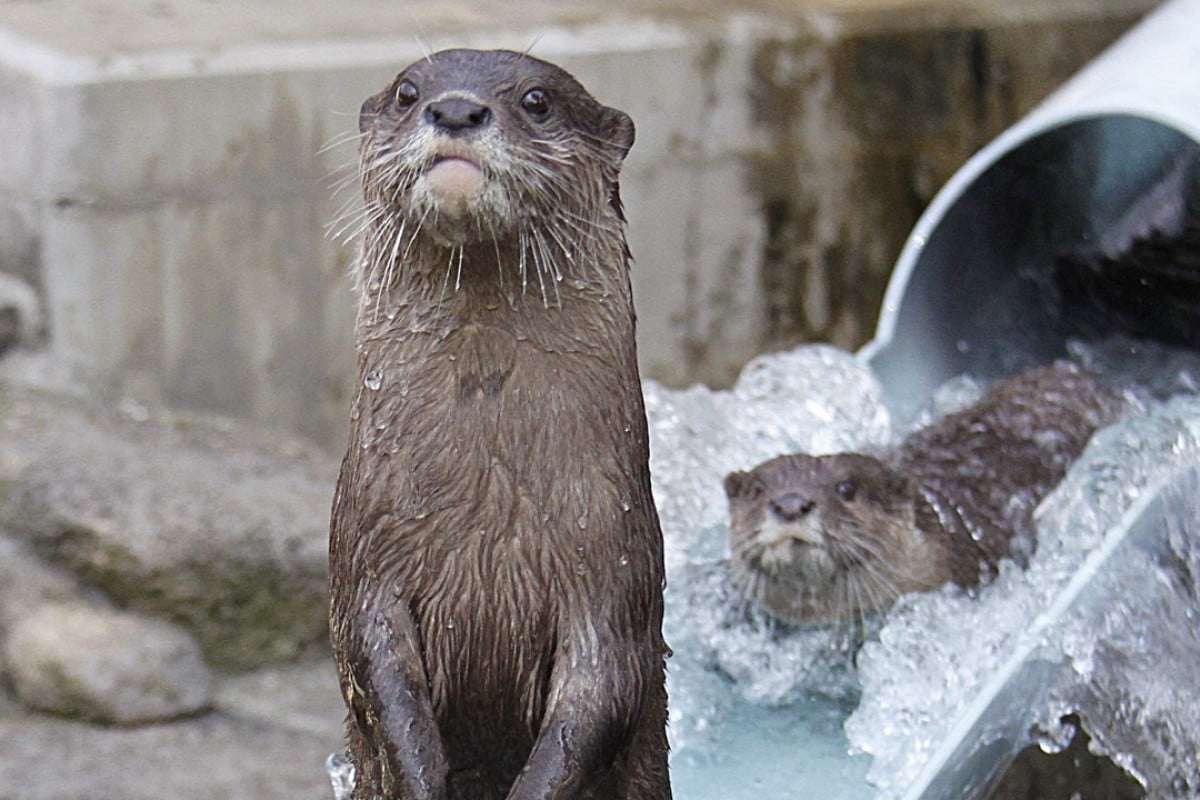
A river otter stands up after a go on the waterslide at Ichikawa
Zoological and Botanical Garden in Ichikawa, east of Tokyo. Photo: AP
The cafe otters are sourced from a breeding facility founded by cafe owner Yoshiaki Nagayasu himself, in Malang, Indonesia where otters rescued from the illegal trade are bred. When they reach Japan, Mr. Nagayasu prices them at around $10,000 each -- with profits, he claims, returned to Indonesia for maintenance of the facility, along with wild otter conservation. "If we didn't do this business, all the otters you see here right now would probably be dead", he states.
However, at the breeding facility in Indonesia little evidence exists of conservation, according to the Scorpion Wildlife Trade Monitoring Group based in Medan, Indonesia. "One of the workers at the facility told me they got otters from around the area, from the wild", executive director Gumung Gea of Scorpion reported. At a meeting in May of the Convention on International Trade in Endangered Species of Wild Fauna and Flora (CITES), international representatives are slated to vote on whether to give short-clawed and smooth-coated otters the highest level of protection.
If the international commercial trade of wild otters is banned, the increased protection would be helpful for otter protection, but would not end the illegal trade, according to Daniel Wilcox. Obstacles would be created by endemic corruption and challenges to enforcement, so that many species fully protected by CITES still are sold illegally.
"The celebration surrounding the annual Pacific bluefin auction hides how deeply in trouble this species really is." "Its population has fallen to less than 3.5 percent of its historic size and overfishing still continues today." "It's time for countries, including Japan, to support Pacific bluefin recovery, fund the necessary science, and commit to enforcing fishing limits, to ensure that there will still be bluefin left to auction." Jamie Gibbon, associate manager, global tuna conservation, The Pew Charitable Trusts
Kiyomura Co. President Kiyoshi Kimura (C) cuts
a fresh bluefin tuna at one of the company’s Sushi Zanmai sushi
restaurants after the year’s first auction at Tsukiji Market on January
05, 2019 in Tokyo, Japan. Kiyomura Co. bid for the highest priced tuna
weighing 278 kilogram (612lbs) for 336 million yen ($3.1m) at the year’s
first auction.Takashi Aoyama/Getty Images
Japan hasn't got a sterling reputation as a steward of the aquatic creatures of the sea, given its unrestrained appetite for endangered species and its challenges to those who express a need to conserve the worldwide whale population. The Japanese public's appetite for various types of fish is understandable to a point as a maritime nation, a sequence of three islands in the Pacific. In its refusal to reign in its enthusiasm for wholesale capture of fish species it rivals China.
The immense population of China is wedded to exotic cuisine dependent on exotic animal parts, a threat to the existence of large-game animals throughout Africa, indeed everywhere in the world. Chinese traditional medicinal formulae as well, dependent on body parts of various animals take their toll on the existence of species known to be teetering close to extinction. At a time when much of the world is becoming aware of responsibility to the welfare of other species on Earth, persuading nations to preserve their native animal species is hampered by poaching and illegal gathering.
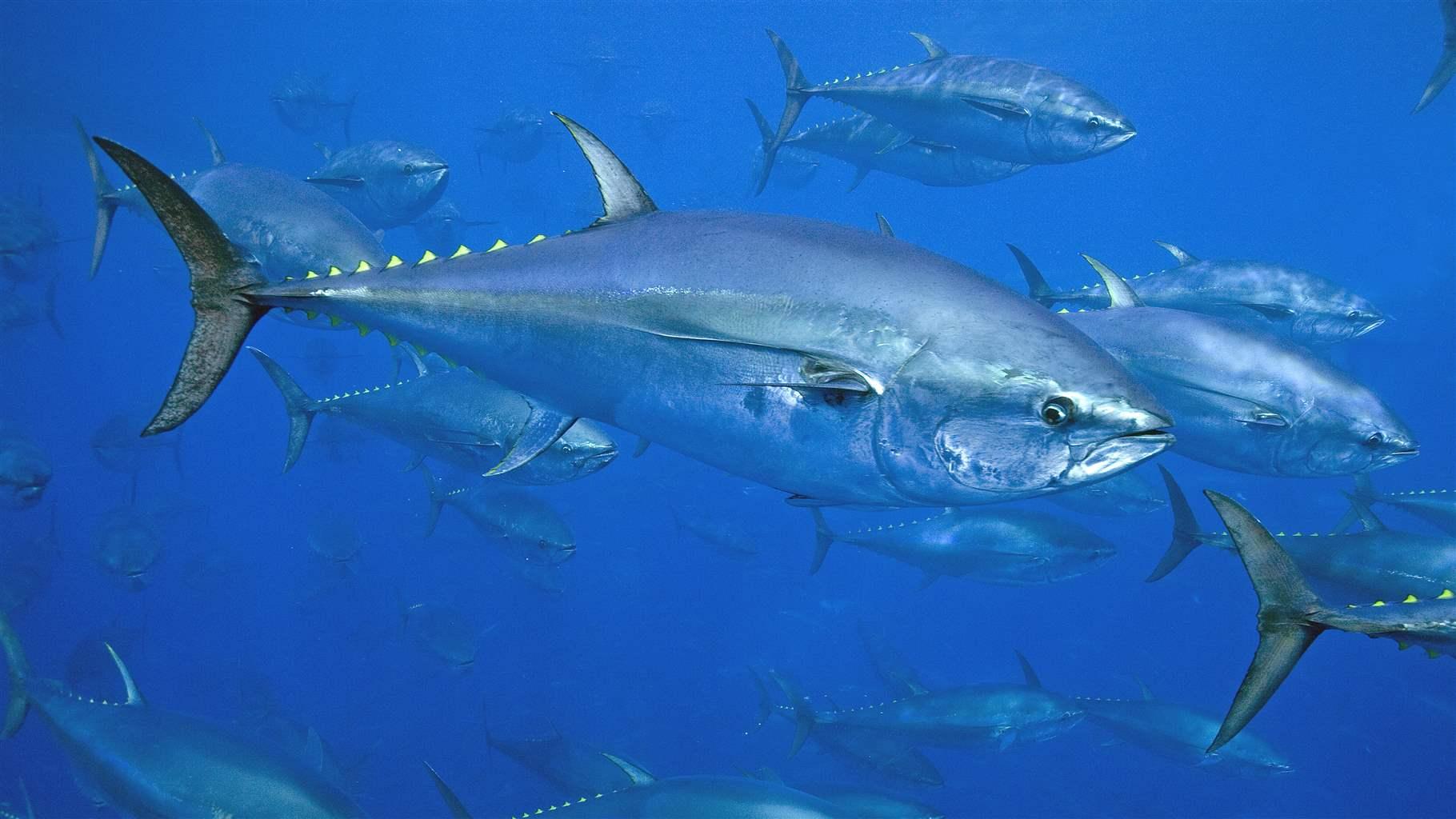
Bluefin tuna is valued in sushi restaurants worldwide, but of course in particular in the country where sushi is a national dish. Bluefin tuna stocks are plummeting, however, the result of unrestrained fishing for the valuable fish. The Pacific Bluefin tuna (Thunnus orientalis) is listed as "vulnerable" according to the British-based International Union of Conservation of Nature, in their Red List of Threatened Species, in recognition of its decreasing population.
Atlantic bluefin tuna is worth nearly US$1 billion per year,
but illegal and unreported fishing could jeopardize recent efforts to
help bluefin fisheries reach sustainability. Richard Herrmann
Japan and other governments had agreed in 2017 to observe strict quotas and restrictions on fishing for the purpose of attempting to rebuild stocks from twenty percent of historic levels by 2034. Fishing methods in Japan's Aomori prefecture in the small town of Oma with its national reputation for the quality of its tuna catch eschew trawling for traditional manual fishing.
Those fishermen found tuna harder to find than previously, and their catches were on the low end leading to fears the Oma tuna might disappear from Japan's sushi bars. Japanese fishermen protested the new quotas, leading Japan and other countries lobbying for higher catch quotas for the coming year of 2019, only one year into the new, agreed 16-year recovery plan.
There were reports of Japanese fishermen discarding and failing to report dead Bluefin in avoidance of exceeding their quotas. Pacific Bluefin tuna's maximum length of close to three meters at maturity, with a weight topping 550 kilograms identify it as a very large fish. As an ocean predator they have been spoken of as "twice the size of a lion and faster than a gazelle", built with a torpedo-like hydrodynamic shape, according to the World Wildlife Fund.
Their two main breeding grounds off the coast of Japan leave most of the tuna in the western Pacific their entire lives, from Sakhalin Island in Russia in the north to New Zealand in the south. Other tuna reaching one to two years of age undertake a 11,000-kilometre migration to waters off California and Mexico's Baja Peninsula, rich with food for the tuna. After two to four years they return to spawn where they began their life, in the western Pacific.
Before reaching maturity, fishermen mostly from Japan, South Korea and Mexico often take those fish resulting in undermining the population. These fish are so valued in Japan that a huge bluefin sold for a record $3.1 million at Tokyo's fish market this week -- the buyer Kiyoshi Kimura, owner of the Sushi Zanmai restaurant chain -- at the firs auction of the year; a price ten times higher than the price paid at last year's auction.
Kiyoshi Kimura, president of Kiyomura
Corp., give a thumbs up to a vendor as he walks with a newly-purchased
tuna towards a Sushizanmai restaurant in Tokyo, Japan, on Saturday Jan.
5, 2019. Kiyomura, operator of the Sushizanmai restaurant chain across
Japan, made the winning bid of 333.6 million yen (about $3.1 million)
for a 278-kilogram bluefin tuna at Toyosu Market on Saturday. Bloomberg photo by Keith Bedford
ARTICLE 9. (1) Aspiring sincerely to an international peace based on
justice and order, the Japanese people forever renounce war as a
sovereign right of the nation and the threat or use of force as means of
settling international disputes. (2) In order to accomplish
the aim of the preceding paragraph, land, sea, and air forces, as well
as other war potential, will never be maintained. The right of belligerency of the state will not be recognized. Japanese Constitution
A mushroom cloud over the city of Hiroshima, taken on a reconnaissance
plane that flew with US air force bomber Enola Gay that dropped the
atomic bomb.Source:News Corp Australia
The very thought of Japan militarizing their country again, after the colossal suffering caused by its entry into World War II by bombing Pearl Harbour and aligning itself with the Axis covenant of Nazi Germany, would have been unthinkable a decade ago. At that time the presence of military installations in Tokyo were unacknowledged. Military personnel serving at the headquarters of Japan's Defence Department couldn't show themselves in military uniform in public. Travelling from their homes to the military bases they would wear civilian garb, changing into their military uniforms once arrived at base.
Japanese civilians had suffered so intensely, the U.S. atomic attacks on Hiroshima and Nagasaki had been so horrific in the vast scope of their destruction, let alone the constant aerial fire bombings carried out by the Allies against Japanese cities and towns so complete in their unsparing ruination of the country the very thought of a Japanese military for offensive purposes was utterly unacceptable to the Japanese. The presence of a preventive, defensive military was conceivable but nothing more.
That has changed. Japan has no deficit in military hardware and highly advanced technical equipment, all labelled defensive, despite their clearly offensive capabilities. The Constitution of Japan, however, is clear, that Japan will refrain from ever maintaining an offensive capability. So the ideal writ in law and the reality seen in actual practise fail to align. And the reason for that is hardly a surprise. North Korea having sent medium-range ballistic missiles into the Sea of Japan could have resulted in a response.
That is, had it not been for one monumental deterrence. That North Korea is under the protective aegis of China. Relations between Japan and China are strained and at times volatile. Militant Japan's occupation of an unprepared and docile China in 1937 and Japanese brutalities and mass atrocities will never be forgiven by the Chinese. That Japan no longer exists, and nor does that China. The China now dominating the global scene is a confident, strong and influential China dominating the east militarily and the west financially.
Chinese nationalism is alive and well and continues to grow with each bellicose claim of ownership of the South and East China Seas. China has created artificial islands to host airbases, anti-aircraft missiles and the Chinese "coast guard" vessels patrolling areas China claims are its own, despite that they are areas disputed with its neighbours. China's declaration that even airspace is theirs and that permission is required to fly over said airspace has been challenged by U.S. fighter jets overflying "China's airspace".
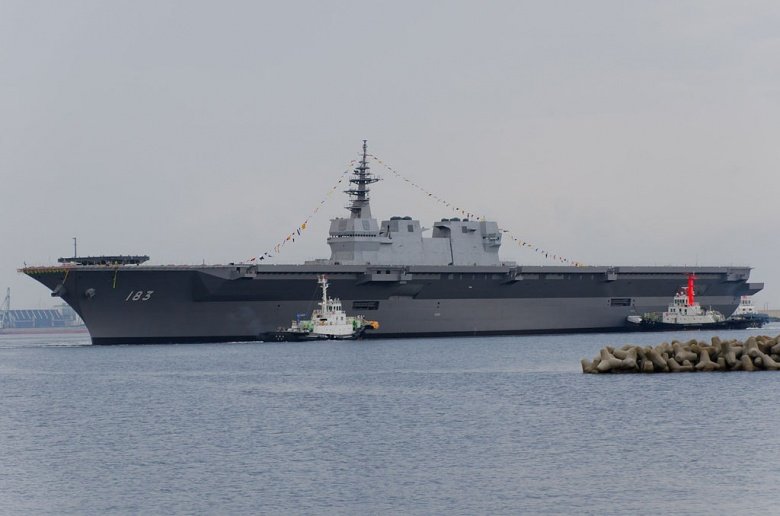
Japan has built itself a responsive military machine. It has 18 diesel electric submarines, four helicopter destroyers (aircraft carriers), 43 destroyers and destroyer escorts, 25 minesweepers and training ships, fleet oilers, submarine rescue ships and its navy, the Maritime Self-Defence Force is the second-largest in Asia, one of the largest in the world, highly advanced technologically, growing continually. Japan is adding to its two 27,000-ton Izumo-class helicopter destroyers along with advanced U.S.-style Aegis class destroyers able to shoot down medium-range ballistic missiles.
The 8,200-ton, 170-meter--long destroyers
are equipped with the Aegis Baseline J7 combat system. (Courtesy of the
Japan Maritime Self-Defense Force)
These are all defensive, of course, because Japan's post-Second World War Constitution's Article 9 prohibits it from any offensive military capacity. Japan had the wherewithal to build what it has thanks to its economic status as the world's second-largest economy. A status it has fairly recently surrendered to China. But Japan's remains a highly technically advanced economy as the world well knows, where quality control in production is king.
Heavily dependent on sea transport, as a maritime nation Japan relies on the incoming transport of fuel oil and natural gas from the Middle East through the Strait of Malacca and the Formosa Strait. As a former protectorate-in-practise of the powerful United States of America, Japan could always depend on the back-up of the U.S. to protect its interests. Much has changed in that relationship since the Obama and Trump administrations, though the bonds remain firm.
The Trump White House, however, no longer guarantees its Sheriff role to its collegial nation-partners. With China clearly in the ascendancy in the region, South Korea, Japan, Australia and others dependent on the constancy of the United States to ride to their rescue has diminished and those nations must now look to themselves being fully responsible for their own defence. As the world turns.
This represents a general opinion site for its author. It also offers a space for the author to record her experiences and perceptions,both personal and public. This is rendered obvious by the content contained in the blog, but the space is here inviting me to write. And so I do.


/cloudfront-us-east-1.images.arcpublishing.com/mco/EJWUHIRT2BHSPPLUPYFJFK4FQE.jpg)








 Illegal otter trade in Southeast Asia


/arc-anglerfish-arc2-prod-mco.s3.amazonaws.com/public/DNBQ4JGPCRHNBDPKZTYVWBU54Q.jpg)