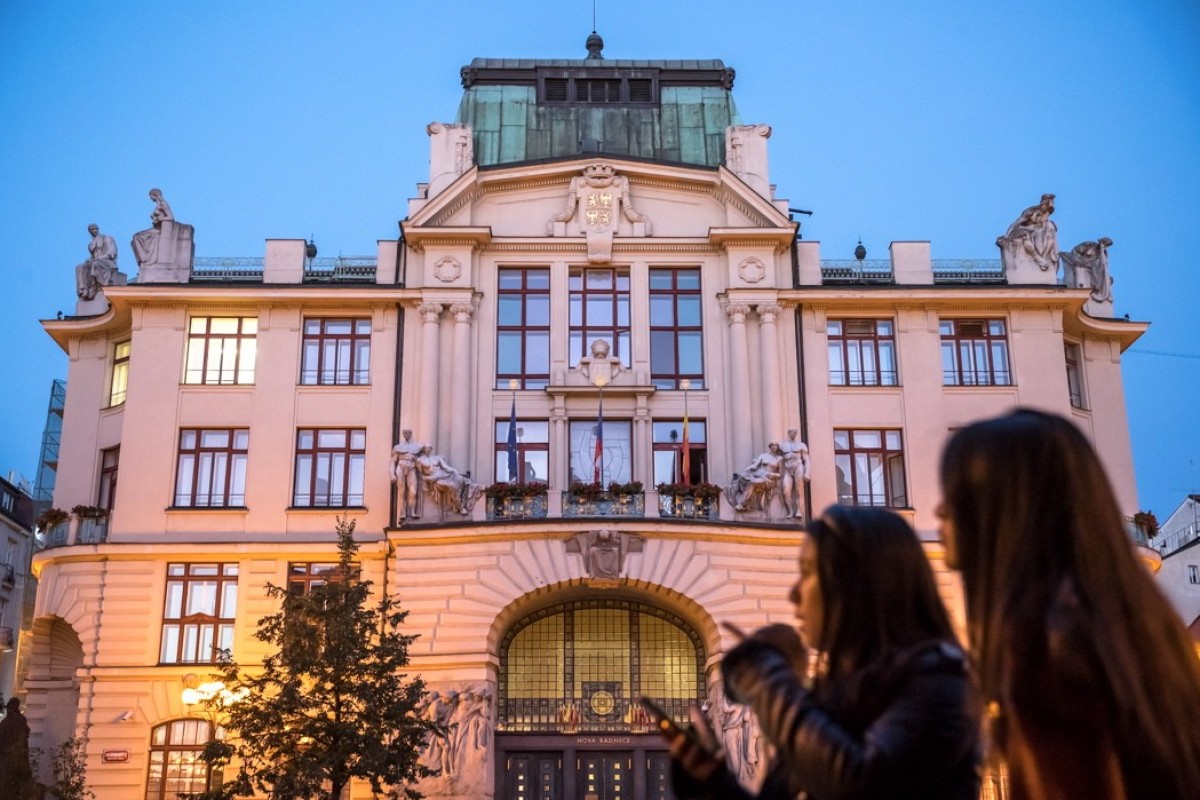
"He [Chinese ambassador] demanded that I kick out the representative of Taiwan. I said, 'We do not kick out our guests'." "Some people say that we should not be involved in foreign affairs. But what we have done is get rid of this 'One China' declaration, which dragged Prague into foreign affairs." "When I was little, I had this book with very nice black-and-white photos. And the coolest animal there [in the Prague Zoo] was the pangolin." Prague, Mayor Zdenek Hrib, Czech Republic
"The cancellation of the tour [Autumn China tour] meant for the orchestra [Prague Philharmonic Orchestra] an economic loss of several million Czech crowns." "However, we consider as much more damaging the fact that culture has been subject to political pressure." Radim Otepka, director, Prague Philharmonic Orchestra
Chanji
and Ding Cha, Shanghai natives who are studying in Europe, visited
Prague for a wedding photo session and a few days in the city last
month. China has threatened to reduce tourism to the city.Credit...Kasia Strek for The New York Times
At the Prague Zoo, the planned panda pavilion will not proceed, after all. What national zoo after all, would not celebrate the loan of a panda from China? Crowds of people anywhere in the world turn up to view those lovable and rare animals. As a special concession to its special friends and in the interests of gaining closer cooperation in trade and the political sphere, China is pleased on occasion to extend the courtesy of such a loan. Prague was in line for such an honour. But 'was' is the operative here.
Taiwan is known to have played a key role in saving the endangered pangolin. A creature most fascinating that resembles a scaly anteater. Taiwan is home now to what is classified as the largest population of captive pangolins. The mayor of Taipei has been optimistic that his city can see its way clear to loaning out one of the animals that has been brought back from the edge of extinction, to a country that has defied China's demands of it that it refrain from recognizing Taiwan as a separate political entity from China.
Solidarity with the Hong Kong protests in Prague.The New York Times
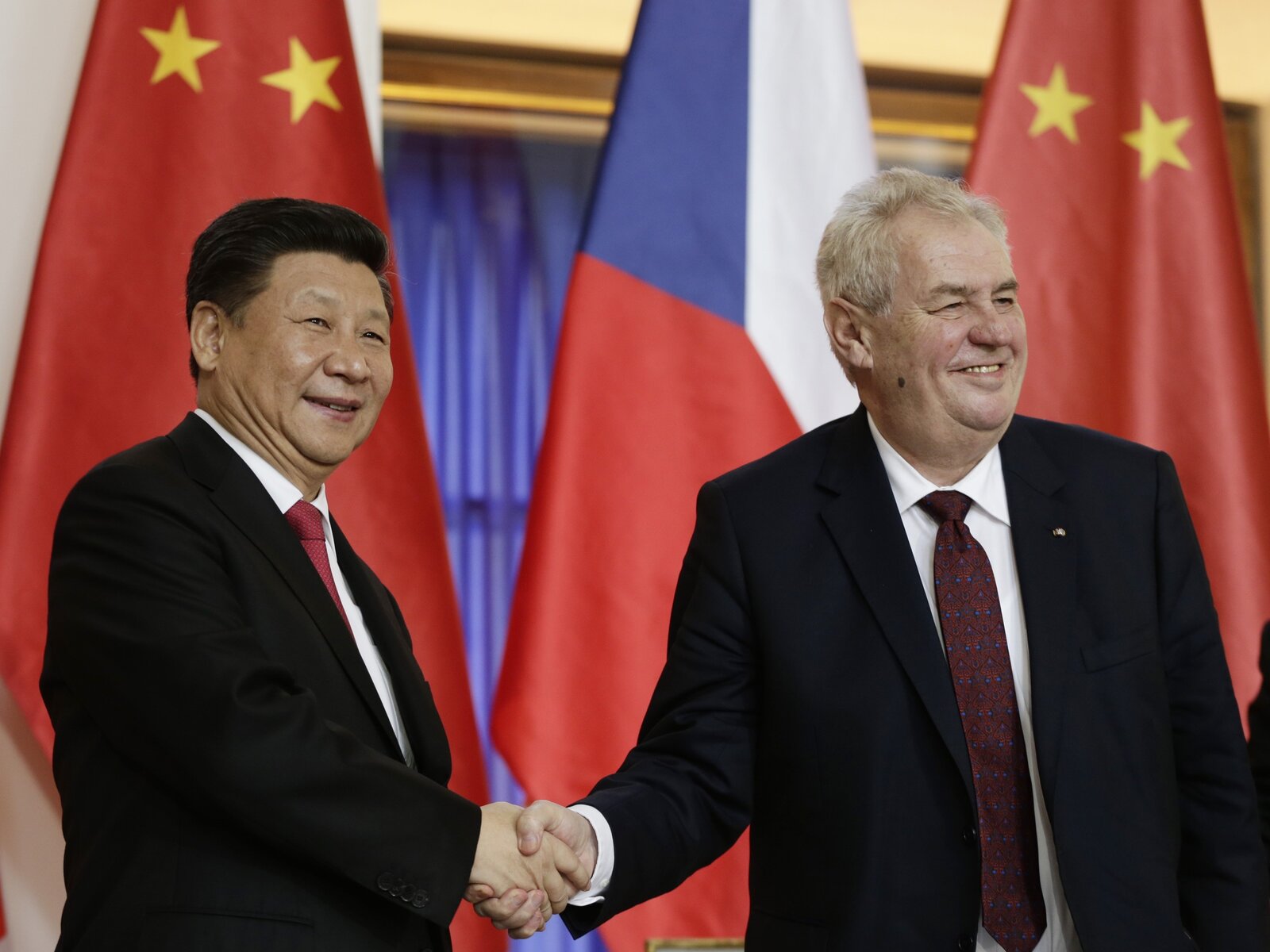
Prague and Beijing were "sister cities"; the Czech Republic gambling that ties with China might promise increased trade and investment. In 2016 Xi Jinping was welcomed to the Czech Republic on a state visit to meet with President Milos Zeman whose declaration that his country would become China's "gateway to Europe", no doubt endeared him to President Xi. Prior to the visit a sister-city agreement was signed between Prague and Beijing. That commitment included support for the "One China" policy.
Chinese leader Xi Jinping and Czech Republic President
Milos Zeman, Pragu, 2016.
Petr David Josek/AP
Prague had visions of an increase of tourism from China, of cultural exchanges. And perhaps even the loan of a panda for its Zoo. The years passed, and not much in investment materialized. On the other hand, concern has arisen relating to espionage. Mr.Hrib's Pirate Party became the third-largest Parliamentary force with its anti-establishment agenda, challenging the foreign policy of Mr. Zeman and the transactional point of view of Prime Minister Andrej Babis.
The wording of the city's agreement with Beijing was in Mr. Hrib's sights. He traveled to Taiwan in March, having spent time there as a student. Months later Mayor Hrib made his intention to bring the language in the agreement of the "One China" policy to a vote in the City Council. Threats were issued by Chinese officials: The Prague Philharmonic would have to reject the mayor's intentions if it wanted to perform in China, despite the two years it had spent in preparation.
Czechs, according to Mayor Hrib, were reminded of their former Communist rulers, by China's political pressure and they liked it not one whit. Czech cybersecurity warned that Chinese tech and communications giant Huawei represented a potential national security threat, amidst concerns that China was attempting to influence Czech academic institutions.
This was worrying to the Czech President Zeman who write in a letter to Mr. Xi "that the Czech Republic, its government, fully respects the policy of One China". In response China growled that it would limit Chinese tourists permitted to visit the country. And it all began when Mayor Hrib's principled refusal to support the "One China" policy insisting Taiwan to be a part of China.
Sister cities no longer. Political strains beyond the point of resuscitation. One China support dissolved. Dissonance and Irreparable relations. Tch!
The Prague city council decision “is just one aspect of a much larger trend”, according to one analyst. Photo: EPA-EFE
"We can't find enough humans. We're trying to replace people with machines wherever we can [to remain productive]." "We'll still need people. But robots are more reliable." Zbynek Frolik, CEO Linet, Prague Czech Republic
"A labour shortage will continue for years." "We must be prepared to find more human employees, or find a way to substitute for them." Bohdan Dovhanic, business director, Schneider Electric, Prague
"It's becoming [inability to expand for lack of workers] a brake on growth." "If businesses don't increase robotization and artificial intelligence, they'll disappear." Jaroslav Hanak, president, Czech Confederation of Industry "Unless business leaders, politicians and trade unions react well in advance and responsibly to the upcoming industrial revolution, even more jobs may be under threat [resulting from lack of available human labour]." Josef Stredula, president, Czech-Moravian Confederation of Trade Unions
At
Linet, most welding, cutting, painting and molding functions were
automated a decade ago. Thirty industrial robots do the work of up to
200 people. But that doesn’t offset the need for humans. CreditMilan Bures for The New York Times
Although China is dedicated to its vision of a world monopoly on manufacturing consumer items to control global trade as well as natural resources, and apply its intelligence to conquering new frontiers in technology, it is, it seems, not the only country capable of applying itself to taking a greater share of the commerce that keeps the world humming along. There are nations in eastern Europe, once part of the Soviet bloc, whose manufacturing capabilities were constrained by the ideology of Communism, who now focus on excellence in manufacturing techniques to challenge China's superiority in producing cheap, inexpensive consumer products.
At Linet, manufacturers of state-of-the-art hospital beds which over 100 countries import for their hospitals, the discovery that new employees, badly needed to enable them to produce and expand the company, are nowhere to be found. Their factories in central Bohemia advertise for new employees right across the Czech Republic, but even though raising wages to tempt new workers were tried, as well as offers to subsidize worker housing, there were few responses.
Now, at the Linet manufacturing plants there are 30 industrial robots hard at work, performing work normally done by up to two hundred human employees. Still, the company is on the lookout for humans to program machines and perform custom work whose complex nature cannot yet be undertaken by robotic help.
The
labor shortage has been so stark in the Czech Republic that even the
trams in Prague have run less frequently this year for want of drivers. CreditMilan Bures for The New York Times
The Czech Republic and its neighbours recognize the imperative to adopt robots to confront their labour shortages. And as well for the obvious purpose of increasing manufacturing flexibility and output. Although inviting foreign workers to enter would represent another solution to the problem to acquire human labour where it is needed, the government has pledged that it will limit immigration in response to the general rejection in eastern Europe of the flow of migrant labour from Africa and the Middle East.
Natural population growth in Europe as in all Western countries is low, and the realization is that more people are dying than are being replaced by new births to stabilize national population levels. Which succeeds in ensuring high employment but fails to produce sufficient workers to satisfy the needs of employers. Robots are recognized as a solution in eastern Europe for worker shortages. Businesses in the Czech Republic, Hungary, Slovakia and Poland are aware of the imperative to remain agile to compete.
They became low-cost manufacturing hubs for Europe when the USSR fell, and have since then averaged a production growth of five percent in more recent years, helped along by the global recovery from the broad-based 2008 recession. Companies experiment now in replacement of factory workers and truck drivers with artificial intelligence. Workers, though well employed, fear the rise of automation as heralding a potential mass job displacement.
In eastern Europe, however, the lowest jobless rate in the European Union, comes in at 2.4 percent; it would be the envy of workers in North America. Between 2010 and 2015, new robot installations rose 40 percent in the Czech Republic, the result being that at present, roughly101 robots are at work for every 10,000 workers, and more on the way as companies gear toward improving productivity. In Germany, there are 300 robots per 10,000 workers, the greatest such ratio in all of Europe.
Buyers
crowded around “smart” machines that tested car headlights or
interacted with humans in shared work spaces at the Amper trade fair, in
the Czech city of Brno. CreditMilan Bures for The New York Times
At Elko Co., producing industrial timers for companies such as General Electric, 70 percent of production is fully automated, with the company planning to be close to full robotization in a few years' time. Factory floor workers were moved by Jiri Konecny, the company's chief executive, to perform more complex roles, while hundreds of other employees were to focus on research and development. "If we didn't invest early in automation, we'd be dead by now", he stated.
The Czech Republic can boast that it was they who coined the word robot, derived from "rabota", the Slavonic term describing arduous work. The word itself appeared for the first time in a Czech play dating from 1920 focusing on machines created to perform repetitive factory tasks. In the play, the robots do their work competently, then manage over time to take over; a nightmare scenario repeated in many science fiction works, since then. "You won't switch off the robots and bring back people", warns Michal Pechoucek, head of the Artificial Intelligence Center at the Czech Technical University in Prague.
Linet is one of the world’s biggest
hospital bed makers, with 900 employees making 500 beds a day. Its
devices monitor and collect data on patient health, and can cost as much
as a BMW.CreditMilan Bures for The New York Time
"When it comes to Russia's diplomatic mission in 2013 the number of intelligence officers working undercover as diplomats was extremely high." "They are complemented by intelligence officers who travel to the Czech Republic as individuals, posing as tourists, experts, academics and entrepreneurs." "The Cold War and he Soviet Union may have passed, but same is not true for Russia's passion for trying to gain influence and taking active measures (such as the use of agents) to achieve this." Czech Republic Security Information Service "In Poland's neighbourhood there is a risk of conflict, of a regional or local characteristic, that may involve us directly or indirectly. [War is] unlikely but possible." Polish security strategy
"The geopolitical situation has changed. We have the biggest crisis of security since the Cold War and we must draw conclusions from that." Tomaz Siemoniak, Polish Defence Minister
Poland is to purchase 40 medium-range missiles from the US as the Ukraine
crisis sees eastern European countries double-down on military spendingPolish President Bronislaw Komorowski, right, with US President Barack Obama in Warsaw last JunePhoto: Janek Skarzynski/AFP
Even while Russian President Vladimir Putin rails hysterically about the United States' actions in the Middle East and around the world interfering in the affairs of other states and destabilizing world order, he complacently insists that Moscow has had no hand in Ukraine's affairs, has not incited Russian-speakers in Ukraine's east to defy the Lyvov authority, and engage in violent conflict with Ukraine's military, and makes no mention of Russia's annexation of the Crimean Peninsula.
But Russia's near neighbours are beyond uneasy. That Russia is said to have deployed an "extremely high" number of intelligence officers at its Czech embassy last year, revealed by a secret service report, serves to further strain diplomacy in eastern and northern Europe. Moscow's ambitions and its temperamental president's goads and interferences in the affairs of his neighbours have made for some extremely uneasy conversations among adjoining nations.
On the eastern flank of the European Union and NATO are those vital pipelines with Russian energy crossing European soil and central and eastern European states gazing nervously at one another worrying about the increasing attention they have been subjected to covertly from spies reporting to the Kremlin. Poland arrested two people, one a high-ranking army officer on suspicion of working for a foreign power; Russia.
The new Polish security strategy just released stated the belief that conflict could be afflicting Poland for the first time since 1989 and the collapse of the Soviet bloc. Polish security had previously felt there was a risk of regional conflicts, but none that would involve Poland. It has now altered its perceptions, planning to move thousands of troops to the east in response to the continuing conflict in Ukraine.
This represents a general opinion site for its author. It also offers a space for the author to record her experiences and perceptions,both personal and public. This is rendered obvious by the content contained in the blog, but the space is here inviting me to write. And so I do.