"China has become older before it has become rich."
"[China's population has been in decline since 2018; the population crisis is] much more severe [than previously thought]."
"[China's]
real demographic crisis is beyond imagination and that [means] all of
China's past economic, social, defence and foreign policies were based
on faulty demographic data."
Yi Puxian, demographer, expert on Chinese population trends University of Wisconsin-Madison
"For policies to reverse the fertility decline itself is very
challenging. In recent years China has already been coming
up with lots of new measures, including getting rid of the one-child
policy, some kinds of subsidies at different levels. But they haven't
really been working well, fertility has not reversed. I do think this
decline will continue."
"But what's really causing concerns socially is what that means in terms
of the structure. Because things are changing really fast… societies
may not have time to adapt,"
Shuang Chen, assistant professor, department of social policy, London School of Economics
"The Chinese economy is entering a critical transition phase, no
longer able to rely on an abundant, cost-competitive labor force to
drive industrialization and growth."
"As the supply of workers begins to shrink, productivity growth
will need to pick up to sustain the economy’s heady pace of expansion."
HSBC chief Asia economist
Frederic Neumann.
"[We will] improve the population development strategy [and ease economic pressure on families]."
“[We will] establish a policy system to boost birth rates, and
bring down the costs of pregnancy and childbirth, child rearing, and
schooling."
"We will pursue a proactive national strategy in
response to population aging, develop elderly care programs and
services, and provide better services for elderly people who live
alone."
Chinese President Xi Jinping
Children playing in the village square after school in Xiasha Village in Shenzhen, China, in November.Credit...Qilai Shen for The New York Times
Wherever,
whenever the Chinese Communist Party creates solutions to problems that
confront it, Beijing somehow manages to make the problems more severe
than ever imagined. Its interference through measures that tend to be
draconian in nature solving nothing and complicating everything. Just as
its zero-COVID measures served only to stave off the inevitable. Just
as it ignored the welfare of the elderly by failing to inoculate them
adequately against the SARS-CoV-2 virus. Just as it refused to import
mRNA vaccines that were immeasurably more effective than Chinese
vaccines.
Its
policy of one-child per family, meant to slow down population growth,
deprived families of the choice of the number of children they would
ideally prefer to have, and in the long term began a stealth campaign
against female children. Since in Chinese culture (practised elsewhere as well)
male babies were preferred, abortions of female foetuses were common,
and neglect of female babies including infanticide was not unknown.
Which
has now given way to a paucity of females of marriageable,
child-bearing age in China and an embarrassment of young Chinese men who
cannot find brides. Women of marriageable age are now more educated and
many refuse to be child-bearers, much like their counterparts elsewhere
in the developed world where population replacement levels are on the
decrease. Women prefer careers over child-rearing. There are now more
elderly Chinese dying than children being born in the space of a year.
Over
the past three years while China and the rest of the world have been
coping with economic downturns resulting from the pandemic, workplaces
shuttered and people became unemployed. In straitened economic times
people are not inclined to grow their families. All these issues have
left China with a diminishing population. Granted, with 1.4 billion
people, China has been celebrated as the most populous country on Earth (many now claim India has overtaken China in population growth and numbers), with an ample and cheap labour force.
That
labour force is now compromised and the growth engine of world
production is stalling. China has established itself as a production
colossus, the manufacturing and export hub of the world community. In
the past few years manufacturing has slowed considerably thanks to
COVID-19's impact, and supply lines have stalled. A situation not
guaranteed to improve much any time soon. In fact, with China now facing
the likelihood of an ongoing and even accelerated drop in its
population base, the entire world's production and distribution
capabilities will be affected.
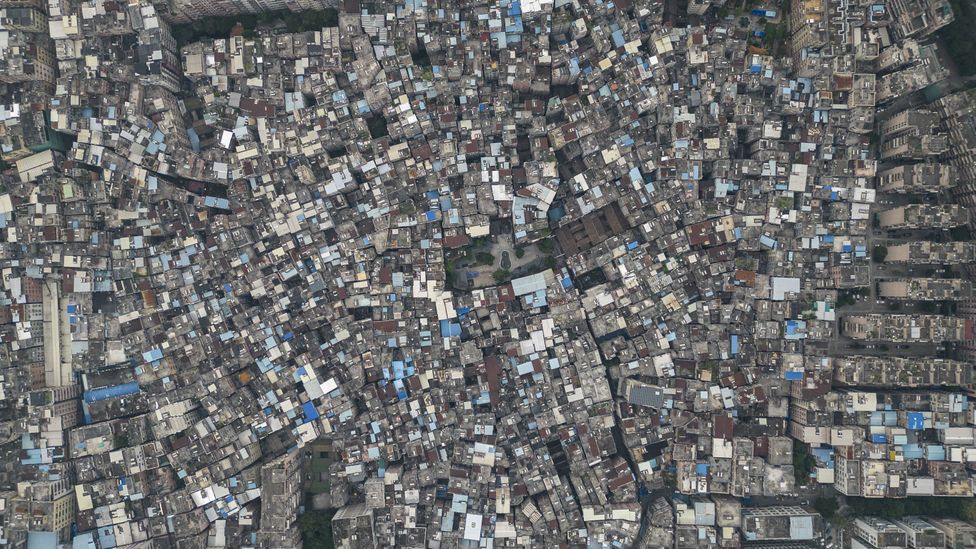
China is home to several of the most populous cities on Earth (Credit: Getty Images)
The
country whose government was set on controlling the world's commercial
resources has failed its own population which lacks the resources to
care for its aging population. At a time when inflation is running high
through the global community there is no rescue from a situation which
suddenly appears even more bleak, with the official news out of China of
its shrinking population and a crisis of demographic proportions.
According
to a report released by the National Bureau of Statistics, China had
850,000 fewer people at the turn of the year than the previous year.
This number refers to the population of mainland China only, not
inclusive of Hong Kong and Macau. Fewer babies were born in China to the
tune of over a million, than the year before. China's newly-sclerotic
economy due to incessant lockdowns bodes ill for the future. It was
reported by the Bureau that 9.56 million births took place in 2022,
while deaths numbered 10,41 million.
The
situation rivals the time of the Great Leap Forward when collective
farming and industrialization propelled by Mao Zedong in the 1950s
resulted in a massive famine where millions of people starved to death. A
decline in population had been officially recognized, but this decline
is at least a decade faster and steeper than authorities anticipated.
The working age population between 15 and 59 years of age totalled
875.56 million, accounting for 62 percent of the national population,
according to the statistics bureau. Those aged 65 and over totalled
209.78 million , relative to 14.9 percent of the total.
China's overall population has not declined for decades. (Andy Wong/The Associated Press)
The Mystery of Disappearing Chinese Manufacturing Ethics
"The stuff was at the airport ready to be shipped. We had it on the tarmac. I was hearing on the news about companies bringing in 10,000 masks, 5,000 masks -- and we have five million masks coming." "Then the craziest thing happened." "To this day I have no idea where that shipment went. It's like somebody pulled up with a truck, picked up our pallets and put them on a different plane and it disappeared and nobody will know because it was just cash changing hands." "It was like the Wild West at the airport." Manny Kapur, Xthetica, wellness supply
"We never got the shipment onto the airplane. It turns out we were suddenly outbid. [It sounded like] modern day pirates." "We started with looking for masks but it is all about protecting each other from COVID-19."
Dr.Elaine Chin, medical director, Executive Health Centre, Toronto
Medical masks being Shanghaied, FR24 News
Dr.Elaine Chin, a Toronto doctor, arranged with a business colleague to have five million medical masks shipped from a manufacturer in China directly to Canada to help in the fight against COVID-19. That was away back in early March. Having contacted a manufacturer who agreed to sell the duo the masks, requiring a $500,000 down payment to secure the shipment, Dr.Chin and Mr. Kapur closed the deal, and made shipping arrangements.
It all started when Dr.Chin, recalling her and her husband's involvement during the epidemic of SARS in 2003, found herself trepidatious for public health in Canada given her previous involvement in the SARS epidemic. So she decided to source medical masks, beginning with making them available to a cancer patient of hers with an obviously compromised immune system. She asked Mr. Kapur if he could procure a box of masks for her patient.
He did some homework and through calls to contacts realized masks were in short supply. He called a contact in Europe who informed him masks were being ordered from China and that was where he should focus for the supply he wanted, as long as he could meet the minimum order requirement. "I can't get you one mask, but I think I can get you two million", he informed Dr.Chin. And so both together decided to give it a try.
Friends of influence and clients donated some of the needed funding and then they were left to tap into their personal lines of credit to make certain they could gather the $500,000 down payment for the five million N95-equivalent masks they decided to obtain. March 18 their order was confirmed, set to arrive March 23. In the interim, Canadian government ministers and health officials, hearing of the order, called to express interest and offer assistance.
Dr.Chin and Mr. Kapur lined up private donors for mask purchase to turn around and donate them to hospitals. "It was all working out just fine. Then it all blew up in the ether", explained Dr.Chin. Their assured shipment had gone to a higher bidder. They were at the airport in Shanghai to supervise the transfer of their ordered shipment to Canada, directly from the Chinese manufacturer. The 'crazy thing' that happened is that the Chinese manufacturer found the offer from a shipment-competitor too alluring to pass up.
So much for business ethics and the morality of doing business with manufacturers whose reliability can be handily turned at the whiff of greater profit. They were informed while at the airport that a sudden offer four times the price they had agreed upon simply short-circuited their contract. Then, out of their disappointment they created a campaign to raise funds for the COVID-19 fight in Canada.
Through the Faculty of Medicine at University of Toronto, Dr.Chin initiated the Masking Together Challenge, to work to provide personal protective equipment to medical personnel across Canada. Securing the PPE from sources other than China and as well funding accommodations for medical trainees required to isolate, and for COVID-19 research.
"We need to make sure there is a safe sanctuary for residents and
interns and fellows who are on the front line and still making student
wages." "The pandemic is an unprecedented event on a
global scale. We need to dig deep and think about solutions, and how we
can each do our part." "We started with looking for masks, but it is all about protecting each other from COVID-19." Dr.Elaine Chin
A sample of the five million medical masks Dr.
Elaine Chin and Manny Kapur were buying from China for Canadian doctors
and patients in the COVID-19 fight.Supplied
"We can't find enough humans. We're trying to replace people with machines wherever we can [to remain productive]." "We'll still need people. But robots are more reliable." Zbynek Frolik, CEO Linet, Prague Czech Republic
"A labour shortage will continue for years." "We must be prepared to find more human employees, or find a way to substitute for them." Bohdan Dovhanic, business director, Schneider Electric, Prague
"It's becoming [inability to expand for lack of workers] a brake on growth." "If businesses don't increase robotization and artificial intelligence, they'll disappear." Jaroslav Hanak, president, Czech Confederation of Industry "Unless business leaders, politicians and trade unions react well in advance and responsibly to the upcoming industrial revolution, even more jobs may be under threat [resulting from lack of available human labour]." Josef Stredula, president, Czech-Moravian Confederation of Trade Unions
At
Linet, most welding, cutting, painting and molding functions were
automated a decade ago. Thirty industrial robots do the work of up to
200 people. But that doesn’t offset the need for humans. CreditMilan Bures for The New York Times
Although China is dedicated to its vision of a world monopoly on manufacturing consumer items to control global trade as well as natural resources, and apply its intelligence to conquering new frontiers in technology, it is, it seems, not the only country capable of applying itself to taking a greater share of the commerce that keeps the world humming along. There are nations in eastern Europe, once part of the Soviet bloc, whose manufacturing capabilities were constrained by the ideology of Communism, who now focus on excellence in manufacturing techniques to challenge China's superiority in producing cheap, inexpensive consumer products.
At Linet, manufacturers of state-of-the-art hospital beds which over 100 countries import for their hospitals, the discovery that new employees, badly needed to enable them to produce and expand the company, are nowhere to be found. Their factories in central Bohemia advertise for new employees right across the Czech Republic, but even though raising wages to tempt new workers were tried, as well as offers to subsidize worker housing, there were few responses.
Now, at the Linet manufacturing plants there are 30 industrial robots hard at work, performing work normally done by up to two hundred human employees. Still, the company is on the lookout for humans to program machines and perform custom work whose complex nature cannot yet be undertaken by robotic help.
The
labor shortage has been so stark in the Czech Republic that even the
trams in Prague have run less frequently this year for want of drivers. CreditMilan Bures for The New York Times
The Czech Republic and its neighbours recognize the imperative to adopt robots to confront their labour shortages. And as well for the obvious purpose of increasing manufacturing flexibility and output. Although inviting foreign workers to enter would represent another solution to the problem to acquire human labour where it is needed, the government has pledged that it will limit immigration in response to the general rejection in eastern Europe of the flow of migrant labour from Africa and the Middle East.
Natural population growth in Europe as in all Western countries is low, and the realization is that more people are dying than are being replaced by new births to stabilize national population levels. Which succeeds in ensuring high employment but fails to produce sufficient workers to satisfy the needs of employers. Robots are recognized as a solution in eastern Europe for worker shortages. Businesses in the Czech Republic, Hungary, Slovakia and Poland are aware of the imperative to remain agile to compete.
They became low-cost manufacturing hubs for Europe when the USSR fell, and have since then averaged a production growth of five percent in more recent years, helped along by the global recovery from the broad-based 2008 recession. Companies experiment now in replacement of factory workers and truck drivers with artificial intelligence. Workers, though well employed, fear the rise of automation as heralding a potential mass job displacement.
In eastern Europe, however, the lowest jobless rate in the European Union, comes in at 2.4 percent; it would be the envy of workers in North America. Between 2010 and 2015, new robot installations rose 40 percent in the Czech Republic, the result being that at present, roughly101 robots are at work for every 10,000 workers, and more on the way as companies gear toward improving productivity. In Germany, there are 300 robots per 10,000 workers, the greatest such ratio in all of Europe.
Buyers
crowded around “smart” machines that tested car headlights or
interacted with humans in shared work spaces at the Amper trade fair, in
the Czech city of Brno. CreditMilan Bures for The New York Times
At Elko Co., producing industrial timers for companies such as General Electric, 70 percent of production is fully automated, with the company planning to be close to full robotization in a few years' time. Factory floor workers were moved by Jiri Konecny, the company's chief executive, to perform more complex roles, while hundreds of other employees were to focus on research and development. "If we didn't invest early in automation, we'd be dead by now", he stated.
The Czech Republic can boast that it was they who coined the word robot, derived from "rabota", the Slavonic term describing arduous work. The word itself appeared for the first time in a Czech play dating from 1920 focusing on machines created to perform repetitive factory tasks. In the play, the robots do their work competently, then manage over time to take over; a nightmare scenario repeated in many science fiction works, since then. "You won't switch off the robots and bring back people", warns Michal Pechoucek, head of the Artificial Intelligence Center at the Czech Technical University in Prague.
Linet is one of the world’s biggest
hospital bed makers, with 900 employees making 500 beds a day. Its
devices monitor and collect data on patient health, and can cost as much
as a BMW.CreditMilan Bures for The New York Time
"I think it’s an insult to democracy and
human rights to take them into negotiations [on trade agreements[. If so, people will ask how
much democracy and human rights cost. [Including 'non-trade factors' in a free trade agreement would be] unfair." "Advancing talks [on the
free trade agreement is a major priority to] create more favourable conditions to expand our trade." "We shouldn’t refuse judiciary and law enforcement [returning Chinese nationals to face punishment], even though we have different judicial systems." '[The complexities of] managing affairs [in
a country as big as China] demands wisdom. Based on the
national conditions of China, it doesn’t work if we just follow foreign
examples." "The signing of the [free-trade agreement] is to provide a stable and
anticipated institutional arrangement for mutual investment, so that
investors won’t worry [that] their investments may encounter some
difficulties or problems."
"We are also not in a rush — it is totally up
to the Canadian side. The earlier the Canadian side signs the FTA, the earlier you get the benefits."
"I have stated many times that we’re not afraid of discussing the
issues, such as democracy and human rights. FTA is FTA itself
— we just don’t want to add too many non-economic or nontrade factors
into it."
Chinese Ambassador to Canada Lu Shaye
China's Ambassador to Canada Lu Shaye
participates in an interview at the Embassy of the People's Republic of
China in Canada, in Ottawa on Thursday, June 29, 2017. Shaye told The
Canadian Press he doesn't think Chinese investors will want to endure
what he described as lengthy regulatory processes required for Canadian
infrastructure. THE CANADIAN PRESS/Justin Tang
Many Canadians, including the official opposition in Parliament, have no wish for Canada to sign a free trade deal with the Peoples Republic of China unless the ruling Communist Party turns around its abysmal record on human rights. As much as trade is of primary importance to any country, the issue of human rights is too important to set aside for the sake of national profitability. And this was most certainly the view of former Prime Minister Stephen Harper. Current Prime Minister Justin Trudeau, however, has opposite feelings on the issue. He has in the past stated his admiration for left-wing dictators; he was a familiar with Cuba's Fidel Castro. And he once expressed his opinion that it was just fantastic how China transformed itself from a vast poverty-strewn nation to the place where it is today, having lifted its immense population of 1.3-billion people into the 20th Century with impressive speed. Of course, on the way to that material and economic success there was the Cultural Revolution that in its paroxysms of 'change' took millions of lives through tyranny, conflict and privation. As far as Justin Trudeau is concerned, his focus is on the amazing swiftness with which a massive country like Japan can turn itself around, from indigent to prosperous. And Trudeau feels that a free trade deal with China can only be a good thing; the old canard that former Prime Minister Jean Chretien, also obsessed with China and trade used, was that there was no need to press China on its human rights record; simply doing business with the nation would have the effect of subtly turning it in the right direction. The spillover effect of virtuous Canada exerting its influence on massive China. The new Chinese ambassador, who reflecting the official Chinese stance on human rights and linking it with trade, expressed his rejection of any link whatever; the classic example of apples and oranges not resulting in bananas. Evidently Ambassador Lu had the post of Director General of the Policy Research Bureau of the Foreign Affairs Department of the Central Committee of the Chinese Communist Party. So he is an insider's insider; intimate with the priorities and values of the Party and its immutable direction. "Why do you think China can make so many great achievements with so high effience? It's because the Communist Party of China and the Chinese government are good at listening to the public opinion and mobilizing and guiding the public for common cause", he explains, chastising any interlocutor foolish enough to attempt to link trade and human rights. China's major news networks were informed that henceforth any news produced must express "total loyalty" to the Communist Party. If complaints arose they were swift to disappear. Beijing's censors have been busy looking out for published articles not in compliance with that three-month-old directive. Editorial news managers with online media platforms such as websites, web logs, discussion forums, search engines, messaging applications and news distribution, must seek Beijing's approval. Training is put on by central government authorities for editorial staff. On the anniversary of the Tienanmen Square massacre public discussion was absent. The 1989 slaughter simply never happened.
And Weibo, the microblogging site, was separated for three days from the world outside China. Weibo hosts 340 million users. It had been ordered shut down; all their video and audio streaming platforms entirely cut off by order of the State Administration of Press Publication, Radio, Film and Television in Beijing. Other virtual private networks used to access news and information globally now face Beijing's "Great Firewall"; The New York Times and Facebook verboten.
An analysis released last week by Reporters Without Borders asserted that media freedom in Hong Kong "has never been so low" since mainland Chinese interests placed eight of the 25 major media organizations in Hong Kong under Beijing ownership and control, thus succeeding in a bid to "muzzle dissenting voices". In reality China is a miracle in its current Communism-with-capitalism-on-the-side presentation. It has succeeded in an impressive makeover, becoming the world's producer of all manner of goods, in the process managing to effectively shutter manufacturing worldwide, incapable of matching China's vast and inexpensive labour market. It has scooped up basic resources worldwide in metals, concrete, energy to mobilize its manufacturing resources. And it has also mastered advanced technologies to an extent that few other countries have managed. While lifting its broad population into the middle class. It all comes at a cost, not only in the area of human rights, but environmentally, where clear air safe to breathe is at a premium, and lakes and rivers have been polluted by industrial chemicals. Production at all costs? Not really. So its population is conflicted, satisfied that their economic well-being is immensely improved; stricken that health is dreadfully impacted by the emphasis on production over respect for the environment. It's a case history in success and failure. Lump into that the appetite to claim as China's geographic areas that are not its heritage, but which are forced to accept it as such for the sake of harmony, while Han Chinese are moved to those areas in huge numbers to weight down the advantage of population bias in complete defiance of human rights.
"When I started my business, I recognized where my strengths were and knew that I didn't have any experience in production and manufacturing." "I am not a designer. I am an entrepreneur." Ivanka Trump, entrepreneur extraordinaire
U.S. President-elect (that is sooo wince-inducing) Donald Trump has stated that he intends to bring back to the United States and to the unemployed factory workers in the United States all the jobs that have gone elsewhere. His task will be to convince, bully, entreat, threaten and boost all the manufacturing that once made America a powerhouse. It's still a powerhouse, but not as a result of manufacturing. Basically, American consumers like paying as little as they can get away with for consumer items.
And Donald Trump's daughter is a chick off the old bloke. She talks as good a line as does her father. And then goes about doing whatever it takes to satisfy that American craving for inexpensive products that will turn a nice profit for her. Items made in the United States reflect a higher wage than do items produced say, in Bangladesh, Pakistan or China. China became the world leader in manufacturing because of its low wages. Which served American consumers very nicely.
When Donald Trump wanted something manufactured that would have his iconic name all over it, he turned to the cheapest mode of manufacturing he could find. And this is precisely what his daughter does, as well. Yet the Trump administration will castigate, fine and tax producers that don't take America First seriously enough. He is prepared to belligerently throw his considerable weight around to intimidate, shame and force American manufacturers to stop exporting their labour costs, and to try the same with those who have already done so.
Ideally, American manufacturers, loyal to their nation, should keep their costs down by paying their workers less, giving them fewer benefits, and selling their finished products for a lesser profit. Like, for example, Donald Trump does. Oh, he doesn't do that himself? Well, consider that expectation an opportunity to prove loyalty, then, it'll warm the cockles of one's heart. The Donald's heart warms only to profit. And he sees profit in extolling his non-existent virtues while demanding others be virtuous.
The kind of efficiencies that he approves of for his own businesses require finessing cheap labour to extract top profit. But that's just his nature, his way of doing business, rather inimitable, he feels, since he also feels that he can do no wrong, but everyone else is always wrong, because they're not Donald Trump. And nor are they Ivanka Trump who enjoys the opportunity to be a public figure dressed in her private label, so she can tweet where they're available at a die-for price.
A white polyester blouse made in Indonesia, a steal at $34.99, for example, and you can look like Ivanka Trump. You can get it at Saks Off Fifth in New York. Or a jacket made in Vietnam at Macy's. Hey, at the Trump Tower blue cotton caps embellished with "Trump National Golf Club" made in Bangladesh can be had for $35.00! Cheap apparel with name-recognition, branding cheap offshore products. That's business acumen; no design talents, no manufacturing infrastructure commitment, a middleman course labelled entrepreneurial.
High tariffs are in the cards for those found guilty of moving their production outside the United States. Those who do so, who have done so, are economic slags, pariahs in the American world of patriotism, just ask Donald J. Trump. American citizens who love their bargains, embrace the fact that they plan never, ever to pay full price for anything, would see their expenses rise, rise and continue to rise should he ever succeed in his moral extortion.
According to the American Apparel and Footwear Association, most clothing purchased at Walmart, Macy's and Target are produced out-of-country; 97 percent of apparel, 98 percent of shoes. Away back in the 1980s most American garment manufacturers made the move to China. That was then; now Chinese shoemakers build their own factories where wages are much, much lower than in China: Africa, please move to the front of the line.
B.J. Nickol, president of the All American Clothing Company in Ohio estimates it costs his company $10 to $15 in the manufacture of a polo shirt which he sells for $28 to $38 while employing 15 people, along with subcontractors to cut, sew and ship out his shirts, jeans and sweaters. That same polo shirt, manufactured in Bangladesh for Trump enterprises is double the price at Trump Tower. If Mr. Trump would like to put his money where his mouth is, Mr. Nickol would be glad to accommodate him.
"I don't think Uralvagonzavod will vote for Putin again -- we saw what that led to. This is the opinion of a lot of workers, but a lot of them are afraid to say it. We just don't understand why they are firing people." "They say they have orders, but they also cut our salaries." Yevgeny M. Shukhin, labour protester, Nizhny Tagil, Russia
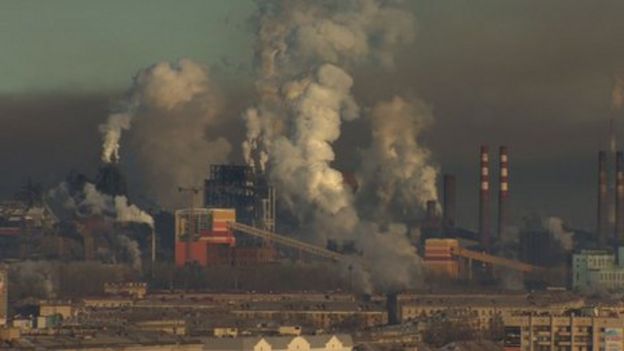
Industrial pollution in Nizhby Tagil, BBC News
In Nizhby Tagil there are two industrial plants, one of which produces steel and the other, Uralvagonzavod which turns out train cars and tanks. Both are pivotal industries. Both have announced worker layoffs. Since that initial announcement, however, Uralvagonzavod has stated that within its workforce of about 30,000, "optimization" will be of a voluntary nature.
The agony of these Russian workers is inextricably wound up with Russian President Vladimir Putin's extravagance in military spending, given the parlous nature of the Russian economy, stuttering since the fall in oil prices and struggling under the sanctions regime. But his dedication appears to be heavily in favour of continuing that military spending; there remains prestige and the promise of power in that direction.
The workers will have to fend for themselves. And they're doing that by angry protests. Uralvagonzavod is not yet fully feeling the pain, however. Workers on the train-car portion of the factory are now on two-thirds salary amounting to about $260 monthly, while the tank assembly lines are going full blast, and those workers are paid in full measure.
Russia's economic slump has seen real wages, adjusted for inflation, drop 6.3 percent in January. New car sales are down 50 percent. Labour unrest is stirring throughout Russia. The days of flush $100-a-barrel oil prices fuelling the economy are past. Once viewed as the champion of factory towns, the troubled industrial centers no longer view Mr. Putin as their knight carrying bailout funding.
As many workers as are out protesting, their presence is overwhelmed by more numerous police officers on Machinists Square. Those workers who did turn out were extremely aware of the presence of the uniformed and plain-clothes police. A local activist pulled a red banner printed with "For Workers' Rights!" across the pedestal holding a statue of Lenin.
Back in 2012 during the presidency campaign, Vladimir Putin showed up in Nizhny Tagil in the northern Ural Mountains where a shift foreman at the factory had boasted on television that his "boys" from the factory were prepared to travel to Moscow to beat up the urban protesters. "You showed who the Russian people are, who the Russian working man is", Mr. Putin said to the foreman, Igor R. Kholmanskikh. "For more than a year, people go to work but do nothing", said Ilya Korovin. He grumbled that the assembly lines were idled while workers' pay was cut and grocery prices were going through the roof. And the factory management had no response, no direction, not the merest bit of alternative action, let alone response to the workers' crisis of confidence.
While back in Moscow, Ilya V. Yashin, a leader of the opposition movement that Mr. Kholmanskikh had threatened with his "boys" from the factory, empathized with the workers: "Dear Workers of Uralvagonzavod! In the end, the workers who not so long ago threatened to scatter the protesters were themselves forced to go to protest against layoffs and violations of their labour rights. Time put everything in its place."
A retired shift boss at Uralvagonzavod, Mikhail G. Scherbakov, has a pension of $175 monthly, after 43 years of his working life on the assembly line. "They either have no conscience, or they have no money", he noted glumly, prepared to give them the benefit of the doubt.
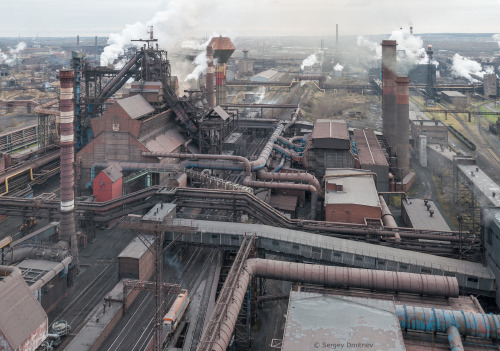
Overviews of EVRAZ NTMK plant in Nizhniy Tagil - one of the biggest
Russian steel mills. Together with UVZ (machine building plant which
produces railroad carriages and tanks) and some smaller factories, this
huge combine covers almost half of the town’s territory. Currently only two blast furnaces are running at the site and two more
are under demolition. Also there are two coking plants, BOF shop,
numerous rolling mills, continuous casters and mechanical shops. steelphoto.net
"It
is unfortunate that Apple
continues to refuse to assist the department in obtaining access to the
phone of one of the terrorists involved in a major terror attack on U.S.
soil."
U.S. Justice Department
"The same engineers who built strong encryption into the iPhone to
protect our users would, ironically, be ordered to weaken those
protections and make our users less safe."
Timothy D. Cook, Chief executive, Apple Incorporated
In their investigation of the Islamist terrorist murder that took place in San Bernardino, California, last December, the F.B.I. has asked Apple for their assistance in "unlocking" an iPhone used by one of the two attackers. Apple has rejected that request. "The worst-case scenario has come true. As more of these devices come to market, this touches all aspects of the cases that we're working on", stated Reynaldi Tariche, an F.B.I. agent, of the problems inherent in scrutinizing the contents of the phone used by Syed Rizwan Farook.
The problem is a four-letter code. The problem is if the F.B.I. tries a number of combinations and none work, the cellphone will automatically go into a state of permanent lock-down, ostensibly to protect the security of someone who is now dead, but whose violent act of multiple murders gave him a place of notoriety in the pantheon of Islamist jihadists for his success in annihilating the lives of innocent people. Any potential connections to others in jihad that could be obtained by the cellphone's contents are vital in the investigation.
Apple, however, has dug in its sanctimonious heels, insisting its first duty is the protection of its clients. Besides which, it insists they do not have the technology yet developed that would satisfy the demands of investigators. Inconveniently, it was pointed out by technology experts in design and security that this particular piece of technology is quite within the capacity of Apple to create for the use of this particular purpose and none other.
Oddly enough, when it does suit Apple's purpose, when something affects their bottom line, they can invent security reasons why it is required of them to develop a system whereby they are enabled to completely disengage a cellphone, making it entirely worthless. As when for example, an iPhone owner takes his own cellphone apart to make a slight adjustment, or when that owner takes the cellphone in for servicing somewhere other than an approved Apple dealer.
In those circumstances, bypassing an accredited, and more-expensive-to-pay-for, dealer who is authorized by the company for a technician to make adjustments to a device they have sold and is in the possession of an individual who believes that as the owner he has the right to do with his device what best suits his plans and his wallet, Apple has designed an operation to destroy the usefulness of the iPhone.
"We believe Apple may be intentionally forcing users to use their
repair services, which cost much more than most third-party repair
shops." "There is incentive for Apple to keep end users from
finding alternative methods to fix their products." PCVA law firm, Seattle, Washington
"It is hard to see how something which ceases to work in this way
could be said to be of reasonable quality, one of the determinants of
which is durability." "The law states: 'A person who without lawful excuse destroys or
damages any property belonging to another, intending to destroy or
damage any such property or being reckless as to whether any such
property would be destroyed or damaged shall be guilty of an offence.'" London-based barrister Richard Colbey: Error 53
could be viewed as an offence under the Criminal Damage Act 1971
"We cannot leave all those victims. We really hope that they would come forth and really collectively recognize the need to compensate the people, though they may not be legally responsible." Gilbert Houngbo, deputy director-general, International Labour Organization
"Brands are failing Rana Plaza victims, and they need to pay up now." Jyrki Raina, general secretary, IndustriaALL Global Union
"I have no money, and I need it badly. I've heard many promises from the government but haven't received anything from them." Bulbuli Akter, 23, former Rana Plaza factory worker
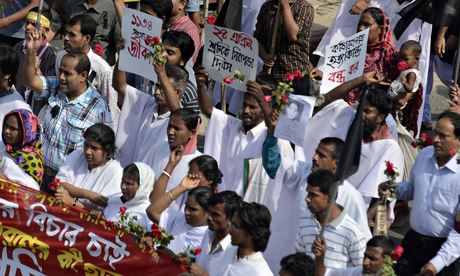
Campaigners and
relatives of the victims of the Rana Plaza building collapse donned
funeral shrouds as they took part in a protest to mark the first
anniversary of the disaster. Photograph: Munir Uz Zaman/AFP/Getty Images
There were 2,400 survivors of the eight-storey collapse of the Rana factory complex in Savar, close to the capital of Bangladesh, Dhaka. The horrendous collapse of the building resulted in the deaths of 1,135 people. A local government investigation discovered that safety rules had been flouted including the decision to place heavy-duty generators on the building's roof.
Over 1,500 of the surviving workers were injured in the collapse, and of that number roughly one thousand surveyed by the aid group Action-Aid Bangladesh are unable to hold jobs as a result of physical failings, trauma, or through employers unwilling to hire them. The government of Prime Minister Sheikh Hasina called for donations to a a victim relief fund.
Fatema holds a picture of her son Nurul Karim in front of her slum house
in Savar. Fatema lost her son and her daughter Arifa, who were working
on the fifth floor of Rana Plaza when it collapsed. (ANDREW BIRAJ/REUTERS)
Most families of dead workers received funds; however, 173 received no financial help from the government. "We're trying to sort out the problem", said Labour Secretary Mikail Shipar. The government plans to pay $644 each to about 3,000 victims including families of those who died. But it has as yet distributed less than one-fifth of the $16-million in the relief fund.
The International Labour Organization has raised less than half of its $40-million goal to help the victims. That $40-million represents a minuscule fraction of profits earned by leading retailers whose products result from factories such as Rana. The U.S. and other countries have demanded Bangladesh employ stricter safety standards in a country known as having the world's second-largest garment industry.
Worker wages remain among the world's lowest for garment workers supplying retailers like Hennes & Mauritz and Walmart. The government of Bangladesh raised the minimum monthly wage by a whopping 77% to result in a final minimum monthly wage of about $70. The ILO trust fund has received $15-million to date representing less than 0.1 percent of an estimated $22-billion annual profit enjoyed by 29 brands sourcing garments from such low-cost producers.
Fifteen brands have not yet contributed funds. Those brands include the Benetton Group and Carefour, according to the website of Switzerland-based UNI Global Union. Three groups have started factory inspections since Rana Plaza collapsed, backed by companies including Walmart and H&M, along with the Bangladeshi government and the ILO.
Across greater Dhaka alone there are almost 5,000 factories to be inspected.
"We have been living with the factory for fourteen years, and we live in dust almost every day and can't sell our rice and other farm products. "We need to live." Nong Dinting, Huang Liangzheng, Baha, Yunnan province
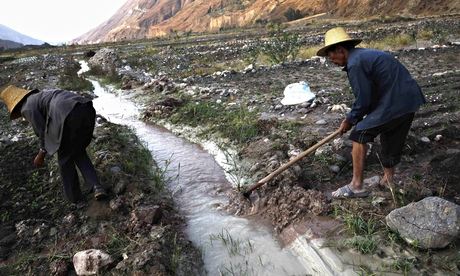
The Chinese public are
becoming increasingly critical of the fouling of the country’s air,
soil and waterways by decades of development. Photograph: Reuters/China
Chinese police have been busy arresting people at the local police station in Baha, a village in Yunnan province. Their crime was 'vigorously' protesting against the polluted waste water from a local metalwork factory. The factory guilty of discharging black smoke and and despoiling the environment. They wanted to speak with the factory authority, but were met with refusal.
Which was when the villagers smashed the factory's offices and equipment, and when police arrived, clashing with them as well. Sending a message, already forwarded to Beijing by hundreds of other such incidents with townspeople protesting against the corruption of their environment by factory owners oblivious of the poisoning effect of their factories' effluent, untreated and discharged into rural areas.
The villagers went on a furious rampage, smashing cars, equipment offices and dormitories. Police ordered all villagers who were involved in the clashes to surrender. And Mr. Huang, who said, "Yes, I am one of those people they are looking for and I have nothing to fear", was prepared to surrender himself to the police. The very obverse of the country's vaunted "harmony".
People in China are becoming increasingly aware of the power of bad publicity, shaming their government on the international scene. They are also becoming increasingly wedded to the euphoric power of mass protests to draw attention to their human rights grievances and demands that ameliorating action be taken in recognition of their demands.
In the past, protests have taken place along China's coastal region in reflection of the area's heavy industrial pollution. That people are feeling more empowered results as well from their elevated economic security in the emerging middle-class. Many of whom have travelled abroad and have been able to see for themselves in foreign countries that those citizens will not accept such raw conditions placing their collective health in peril.
This incident took place further inland. Last year the provincial capital, Kunming, was the site of large protests against a petroleum refinery planned for the area. The stepping-up of such vociferous and increasingly activist-violent protests has Beijing paying attention, concerned at the spread of civil activism in a country that values placid acceptance of encroaching factory pollution in the country's steady march toward capturing the world's marketplace of consumer products.
This represents a general opinion site for its author. It also offers a space for the author to record her experiences and perceptions,both personal and public. This is rendered obvious by the content contained in the blog, but the space is here inviting me to write. And so I do.



 Donald J. Trump