Havana Syndrome
"I was a zombie, basically. They sent me back with a damaged brain. They exposed me twice. I should not have been sent back there.""People who were normal came back abnormal. I am not the same person.""It seems almost certain that we were the victims of targeted attacks. There is no other plausible explanation.""The fact that they can sit in a big meeting and blatantly tell us that everything is fine and they have a great system at hand for dealing with people, it is a brazen denial of our experience."Unnamed 35-year Canadian diplomat"[It's hard to say why the diplomats] aren't getting the respect they deserve from their government."Lawyer Paul Miller
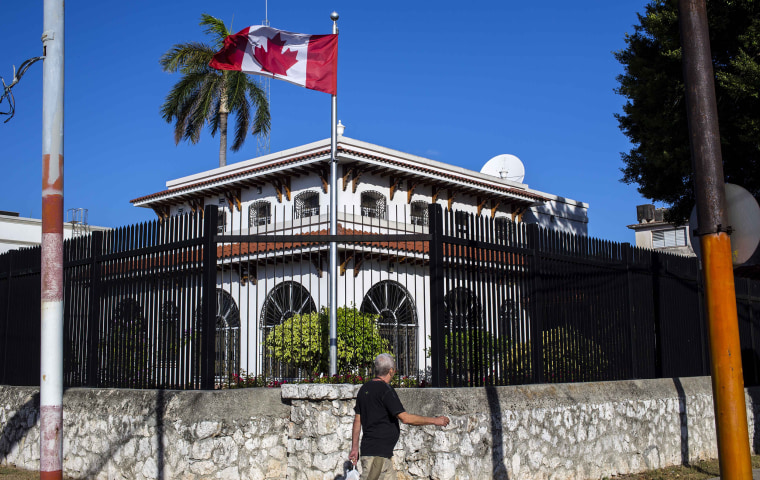 |
| Canada's embassy in Havana, Cuba Desmond Boylan / AP file |
Eight
Canadian diplomats who were posted to Cuba with their families and who
experienced sudden, strange inexplicable 'attacks' of unknown origin
that left them in a state of psychological and brain-physically
imbalance have decided to take the Department of Foreign Affairs to
court, joining a $28-million lawsuit against the Government of Canada.
For neglect, among other issues, for lack of concern, lack of action,
lack of full disclosure, lack of practical support when they were left
vulnerable and ill, unable to live their normal lives because of
exposure to a peculiar and unknown 'weapon' aimed strategically at
American and Canadian diplomats posted to Cuba.
Dalhousie
University in Halifax took the lead in examining the diplomats'
symptoms in an effort to understand and discover what it might have been
that attacked them and affected their brains in the process. The
government itself through its Department of Foreign Affairs (renamed Global Affairs by this government) did
nothing to investigate the issue and even seemed to doubt the
credibility of the sufferers, and nor did they arrange for medical
treatment and follow-up for any of the diplomats or their dependants.
Leaving
the diplomats and their families that accompanied them to Havana and
shared the horrible experience, to fend for themselves, to seek out
medical treatment in an effort to identify the problem and find a
solution to their illness. In the experience of the diplomat quoted
above who had requested anonymity, he was re-posted to Havana after
being tested at Dalhousie University's Brain Repair Centre. A report was
sent to Foreign Affairs on his condition, but it was never divulged by
Foreign Affairs to him personally.
Instead,
he was re-posted to Cuba. His formerly mild symptoms worsened
considerably while he was in Cuba until he reached the point where he
could no longer function at the Canadian Embassy in Havana due to the
severity of the illness he finally succumbed to; memory loss, cognitive
difficulties, dizziness. When he contacted the Canadian government for
medical assistance he was returned to Canada and sent back to Dalhousie
for urgent testing. A letter confirming him to be case No.15 in the
Havana syndrome file of the government reached him.
 |
| Stellar IAS Academy |
His
neurological and other medical symptoms were originally reported back
in 2016, when the syndrome first appeared, targeting American and
Canadian Embassy staff. Diplomats concerned sent a letter to the
Minister of Foreign Affairs last month, which pointed out that the
department's actions worked "to diminish and distort what happened to Canadian diplomats for an agenda unconnected to their or their families' well-being". A meeting they had was "a disheartening reminder of the delays, mismanagement, half-truths and empty promises we have faced since 2017".
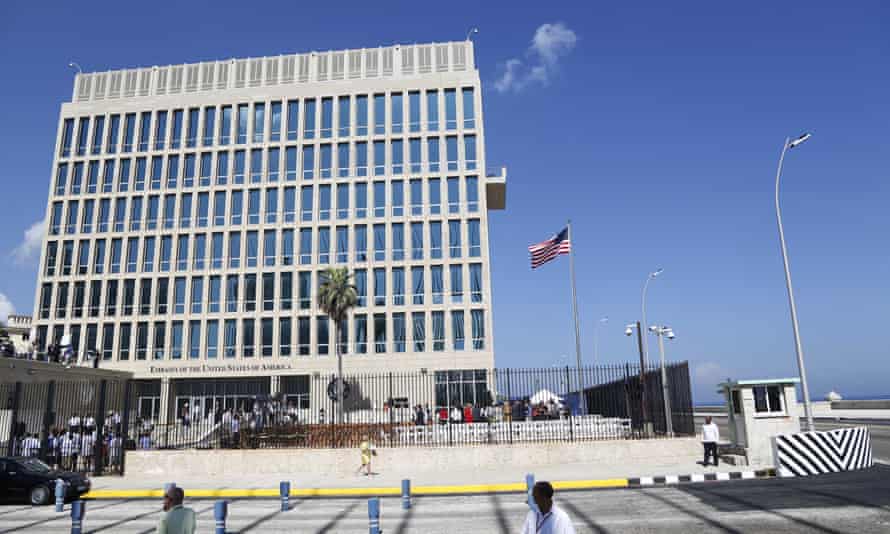 |
| A US flag flies at the embassy in Cuba, where cases of Havana syndrome were first reported. Photograph: Desmond Boylan/AP |
In
the United States, authorities have aggressively investigated their
cases of Havana syndrome among U.S. diplomats and other staff, including
the CIA. U.S. numbers affected were put at 130, which included cases
out of Europe, Asia and Cuba, according to a recent New York Times
report. One American report concluded that the mysterious neurological
and hearing symptoms were likely targeted microwave attacks, a find not
shared by the Government of Canada.
A
Dalhousie University study from 2019 suggested neurotoxins might have
been involved, used to fumigate diplomats' housing, a suggestion
rejected by the diplomats, that there is no research to support the
theory and nor does it clarify why other nationals were not affected.
Pesticides was rejected by the National Academy of Science in the U.S.,
as a possible cause. Another theories is that of mass hysteria, none of
them having the credibility of microwave attacks being the source of the
inexplicable illness with its neurological symptoms.
The
unnamed diplomat continues to struggle with cognitive and memory
issues, along with tinnitus and sleep problems, taking medication for
cognitive impairment. His cognitive deficit is between 25 to 30 percent,
he explains, and his career has been "put on a shelf",
while he now prepares to retire. As far as he and other diplomats are
concerned, the only explanation that makes sense is that put forward by
the U.S. National Academy of Science report, that directed energy is the
likely cause of Havana syndrome.
The
group action lawyer, Paul Miller, points out as well that children
posted with their parents to Cuba who suffer similar symptoms have
received no substantial testing or treatment, their families left
largely to fend for themselves; that despite being employees along with
their families of the Department of Foreign Affairs -- which
incidentally recently posted notice of its intention to expand in Cuba,
despite not yet solving the dilemma causing brain injuries suffered by
diplomats and their families -- the situation has left them in a
quandary and feeling "abandoned"..
"Since the beginning of the health incidents, the health, safety and security of our diplomatic staff and their families remains a priority.""Global Affairs Canada maintains a strict security protocol to respond immediately to any unusual events affecting Canadian diplomats or their families posted to a mission abroad."Global Affairs Canada spokesperson Christelle Chartrand
Labels: American Embassy in Cuba, Canadian Embassy in Cuba, Diplomats, Microwave Attacks, Neurological Symptoms
posted by Pieface @ Tuesday, May 18, 2021