"We, from our side, must do everything so that next year this war ends by diplomatic means. This is very important."
"This
is their approach [the United States], their promise to their society
[quick deal between Kyiv and Moscow], it is also very important to them.
He [Trump] is on the side of supporting Ukraine, he appreciates our
strength, integrity and courage."
"[Ukraine
should not be] left alone with the Russian Federation [to craft a
solution to the conflict]. For us, the victory means a strong Ukraine.
Whether that's in diplomacy or on the battlefield is another question."
"But
we have already proved that 'sit and listen' rhetoric does not work
with us. Sitting, talking and agreeing on nothing -- this is what is
beneficial for Putin."
Ukrainian President Volodymyr Zelenskyy
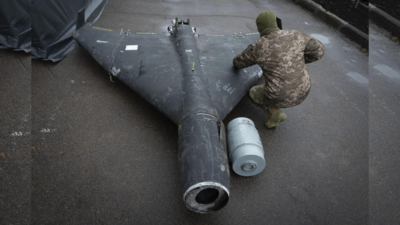
A Ukrainian soldier examines a thermobaric drone launched by Russia AP
A
small number of highly destructive thermobaric drones have been created
by a high-tech factory in central Russia. The same factory also
produces huge swarms of inexpensive decoys. The use of the drones --
both the destructive models, relatively few in number due to the expense
of production and the decoys produced in much greater number are an
expression of a new tactic devised by Moscow to overwhelm Kyiv, forcing
it to respond to all the drones in fear of one of the thermobaric types
wreaking chaos and greater deaths. In the process of responding, the
plan is for Ukraine to unnecessarily, out of caution, use its dwindling
stock of defensive weaponry to shoot down the drones, expending in the
process defensive funding.
Vladimir
Putin's mission to destroy Ukraine and reap the benefits of acquiring
more Ukrainian territory to be folded into Greater Russia doesn't leave
much hope for Russia to become a willing partner for peace until its
objectives have been achieved. At which time Ukraine will be
geographically eviscerated at the cost of more lives and ruined civic
infrastructure. And while Kyiv is anxious to protect the lives of its
citizens, the Kremlin seems disposed to consider its fighting men
expendable, including the new contingents of North Korean fighters now
under Russian command.
Russia
calls its drone scheme Operation False Target, its intention is to
force Ukraine to needlessly use its scarce resources to save lives and
hope to spare further destruction of critical infrastructure. As for
distinguishing the relatively harmless drones from their look-alike
thermobaric drones, it cannot be done by radar and even electronics
experts cannot distinguish which drones fleeting through the skies are
the deadly ones. Russia's is a devilish plan to continue on its path of
destruction in Ukraine. The first weekend of November saw 20 hours in
the Kyiv region under air alert. In October some 1,889 drones were
launched by Moscow.
Over
50% of the drones that target Ukraine are unarmed decoys with up to 75%
being produced out of a factory in the Alabuga Special Economic Zone in
Russia; a highly sensitive industry. A deadly variant of the Shahed
unmanned aircraft is also produced at the same factory, armed with
thermobaric warheads. These vacuum bombs create a vortex of high
pressure and heat capable of penetrating the thickest walls while
sucking out all the oxygen encountered in their path. When they strike
buildings Alabuga's thermobaric drones are particularly deadly since
they are loaded as well with ball bearings to cause massive damage
beyond the superheated blast.
These
deadly drones are estimated to make up between 3 and 5 percent of all
drones. Their physical effects on people even outside the initial blast
site, are grotesquely lethal; collapsed lungs, crushed eyeballs, brain
damage included. The human toll is of little interest to Russia,
however. They see great conflict benefits in the drones' use. An unarmed
drone costs much less than the $50,000 to produce an armed Shahed
drone. Decoys with live-feed cameras also have their special functions,
allowing geolocation of Ukraine's air defences, relaying the information
to Russia just before they crash.
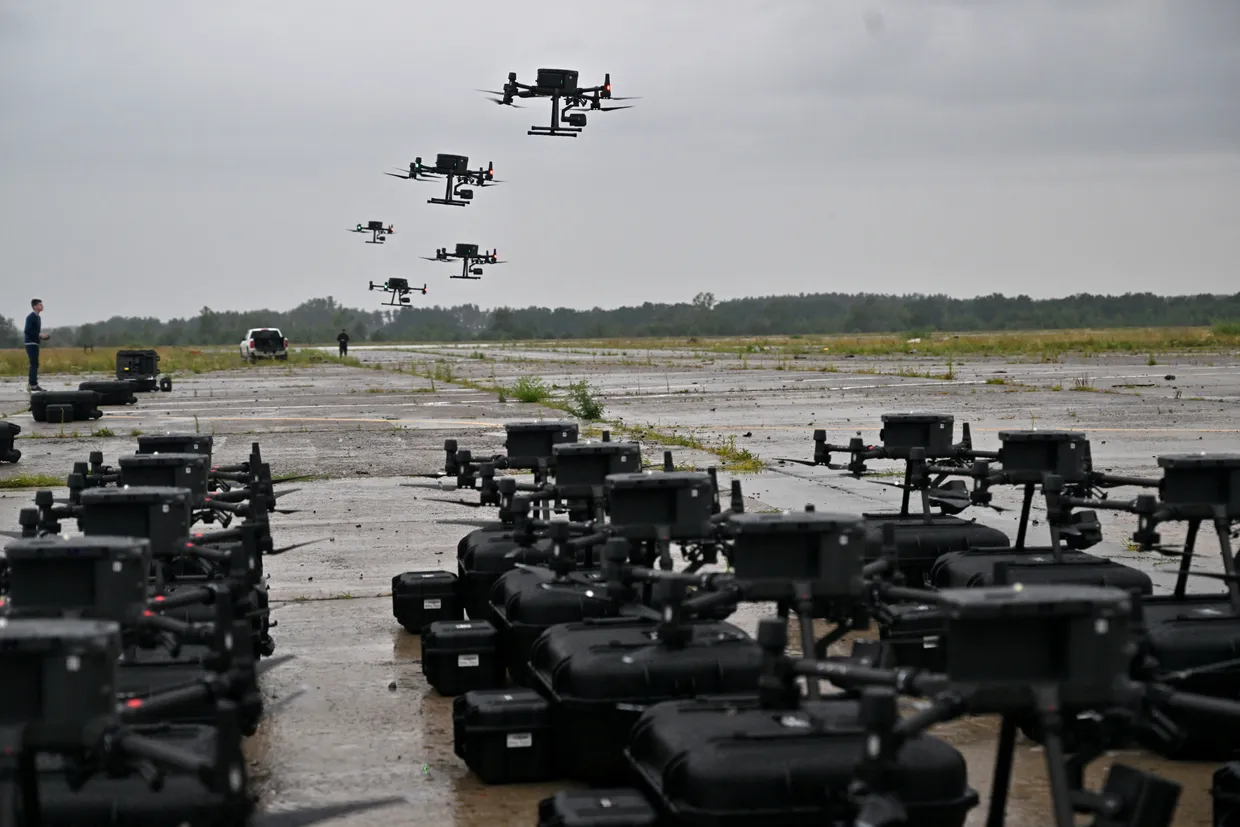
DJI Matrice reconnaissance drones, bought during 'The
Army of Drones' program, are set up ready for test flights in the Kyiv
region, Ukraine. (Sergei Supinsky / AFP via Getty
Images)
"If
you look at the explosions in the attacks, they are quite small. I
suspect that these [rudimentary drones made in Ukraine] are homemade
drones, which have had
explosives strapped to them."
"If you wanted to seek out enemy positions in the past, you would have
had to send out special forces units... and you might lose some troops. Now, all you're risking is a drone."
"They were shown attacking targets such as ammunition dumps, and played a part in the sinking of the Moskva [warship],"
"Ukraine doesn't have as much ammunition as Russia. Having 'eyes in the sky' to spot targets and direct artillery fire
means they can make better use of what they have."
"Russian forces have the Stupor rifle, which shoots electromagnetic
pulses, [This stops commercial drones from being able to
navigate using GPS]."
Dr Marina Miron, researcher in defence studies, King's College London
A damaged building after a Russian drone attack on Wednesday in Kyiv, Ukraine.Credit...Laura Boushnak for The New York Times
Faced with a violent adversary that has demonstrated its willingness to
exercise a scorched earth policy on its neighbour, marching in to
invade and to intimidate by force of arms with the intention of
unseating the legally installed government, in the process never
hesitating to bomb civilian structures; apartment buildings, schools,
markets, hospitals; Ukraine has had to jump-start itself on brilliant
strategic moves, improvising munitions, quickly training its servicemen
in the use of internationally-supplied advanced weaponry and has, by
sheer grit and determination defended itself.
To
the astonishment of the global community, most of which has rallied to
aid Ukraine in its plight, pledging military and non-military support,
enacting sanctions on Russia, fulfilling commitments to upgrade
Ukraine's weapons arsenals and to continue training for its military,
the government of Ukraine and its military has exacted a steep price on
Russia for its arrogant assumption that the country would easily fall to
its neighbour's predations.
Ill-trained
Russian troops, unprepared conscripts, faulty weaponry have all
illustrated just how ill-prepared Moscow was to pounce on its neighbour
with the expectation that it could withdraw after looting Ukrainian
territory in an expansion of Russia's. Ukraine's counteroffensive has
aptly demonstrated the expertise and versatility of Ukraine's strategic
capacity, from sinking Russian warships to bombing weapons depots and
returning to Russia within its borders compliments in the form of
missiles and improvised drones in response to Russia's raging drones as
pay-back for Ukraine's attack on a supply bridge in Crimea.
Russia
saw fit to annex Donetsk, Kherson, Luhansk and Zaporizhzhia oblasts as
an entitlement project, but spits fire in rage over Ukraine defending
itself and effectively demonstrating that those provinces will be
returned to Ukraine by the same kind of force that the Kremlin ordered
to divide them from their proper sovereign ownership. Yet again, Ukraine
is able to state having thwarted Russian drone attacks, this time on
Kyiv and its regional surrounds. The Ukraine air defence system on
Wednesday destroyed a baker's dozen of explosive-laden drones.
Their
falling wreckage did cause damage to buildings but no human casualties.
As opposed to those thirteen drones hitting their targets unchallenged.
Russia has had to rely on distance aerial attacks in the face of its
troops' inability to counter Ukrainian troops on the battlefield without
ignominiously retreating, leaving behind all their munitions as a gift
for the victorious Ukrainian troops. No doubt leaving Mr. Putin both
fuming in rage and cringing in despair.
Once
again Ukrainian President Volodymyr Zelensky announced that
"terrorists" had fired Iranian-produced drones, all of which were
successfully intercepted. Drones alongside rockets, missiles, mortars
and artillery have all been used by Moscow to target power stations,
water facilities and various other public utility apparatus. In the wake
of the latest attacks on Wednesday, clean-up crews were dispatched to
shovel off rubble and roll out sheeting to cover windows.
According
to some Kyiv residents, fragments from a drone bore the words "For
Ryazan", a military base in the Ryazan region of western Russia hit by a
cross-border attack the week before. In areas close to the front lines
Odesa has seen drone strikes shut off power completely. Air defence
systems on December 5 responding to a round of Russian volleys,
intercepted over 60 of 70 strikes, nine of 10 targeting the capital.
Patriot surface-to-air missile batteries are next on the agenda from the
U.S. to Ukraine.
.
In Washington, the Russian Embassy warned that a Patriot missile delivery would be viewed by Moscow as "another provocative step by the administration, which could lead to unpredictable consequences" which in turn would be likely to cause "colossal
damage not only to Russian-American relations but would create
additional global security risks".
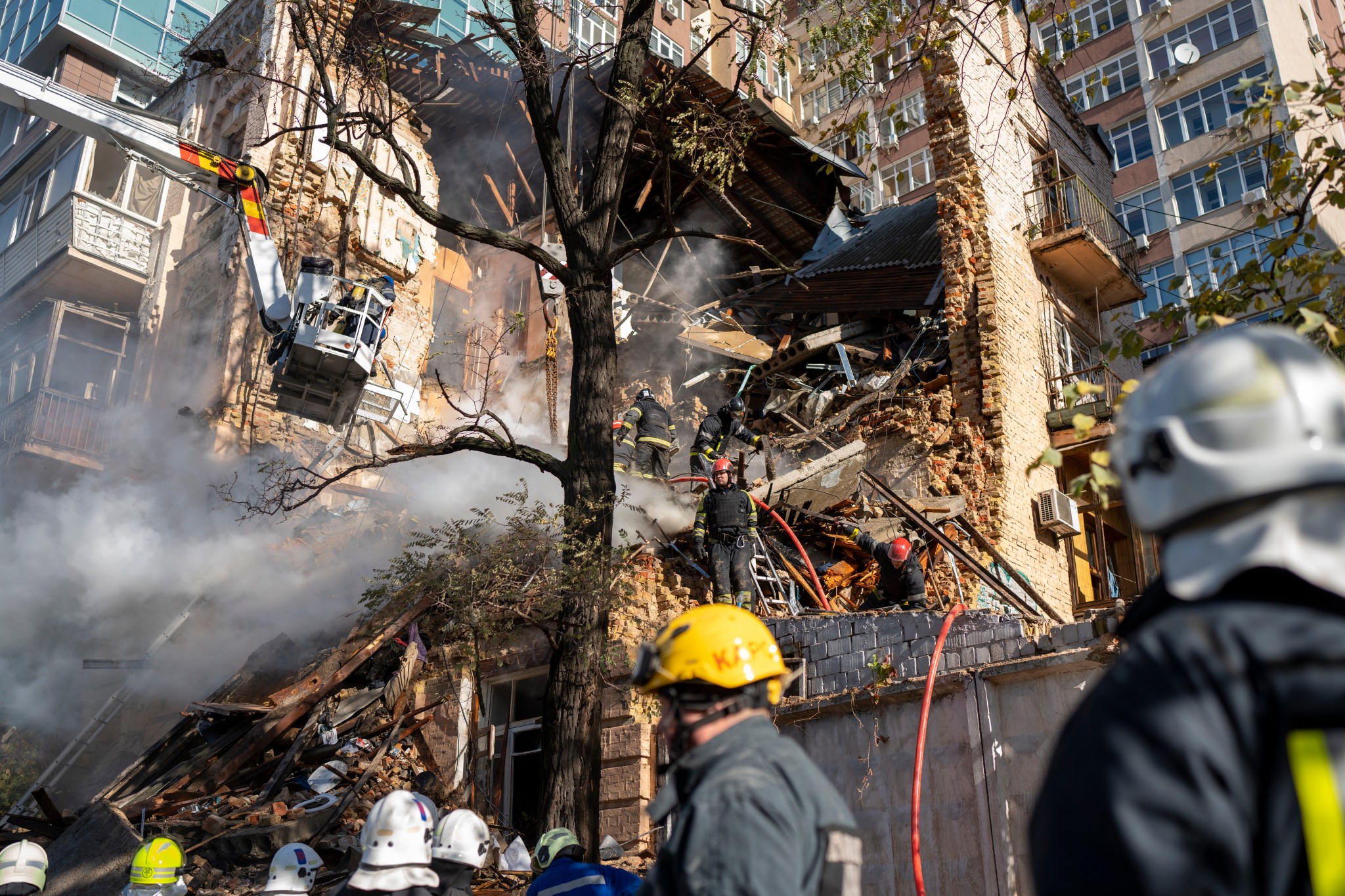
Firefighters work after a drone fired on
buildings in Kyiv, Ukraine, on Oct. 17. Waves of explosive-laden suicide
drones struck Ukraine’s capital as families were preparing to start
their week early Monday, the blasts echoing across Kyiv, setting
buildings ablaze and sending people scurrying to shelters.
Roman Hrytsyna/AP
This represents a general opinion site for its author. It also offers a space for the author to record her experiences and perceptions,both personal and public. This is rendered obvious by the content contained in the blog, but the space is here inviting me to write. And so I do.