Minority Protection in the New Syrian Government
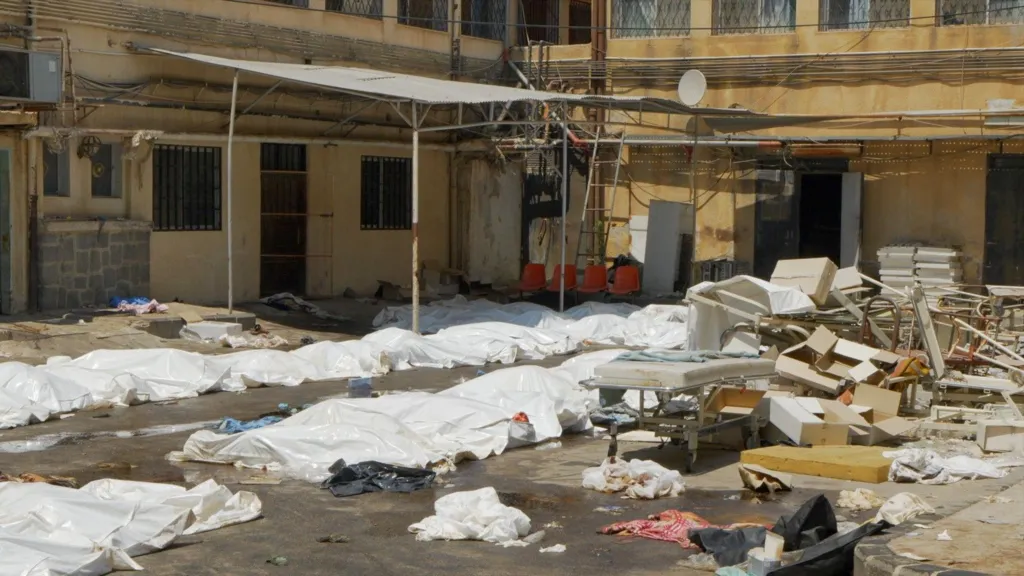
"There isn’t a single home in the whole province that isn’t grieving someone.""The youngest victim was 3 months old, killed by shrapnel that hit her stomach. This one was 14. She was slaughtered [young girl, her head turned to the side a scarlet line across her throat].""These are only the people we know about and who could reach us [many victims were buried in makeshift graves near people’s homes because the hospital had been surrounded during much of the battles].""The final tally will be much worse."Randa Mihrez, one of the coroners at Sweida National Hospital"They were screaming, and I tried to move them, to help them somehow. But I kept slipping on the blood.""One relative was bleeding out and barely alive. He was begging, ‘Shoot me.’ But I had no weapons on me. I would have done it otherwise.""[He heard the gunmen say] 'Kill them all. We don’t want them identifying us'."Hatem Radhwan, 71, Druze Blacksmith"Initially, we wanted to bury them in the hospital’s backyard, but administrators worried we’d contaminate the water reservoir.""The bodies were decomposing too much in the sun, they were becoming unrecognizable. We just couldn’t wait anymore [the man who bulldozed a mass grave for 149 people from the hospital either unidentified or whose families were unable to bury them]."Basel Abu Saab, on a bare mountain outside Sweida's outskirts
 |
A group of Druze factions move displaced families
from the city to the mountains in response to the battles with the
Bedouins, Sweida, Syria. (Hasan Belal/For The Times) |
"On July 13th, a Bedouin group kidnapped a man and took his car. In retaliation, an armed group linked to the owner detained Bedouins in Swaida’s suburbs. The situation escalated: retaliatory kidnappings, property seizures, then shelling from Bedouin groups, which killed eight people, including a child. Druze fighters mobilized. Mediation led to the release of the hostages by July 14.""Despite that resolution, on July 15, the ministries of interior and defense announced plans to forcibly enter Swaida to “restore peace.” Many interpreted this as a signal of Israeli approval, believing the Syrian government would not risk a direct retaliatory strike by Israel otherwise. The government’s offensive began from Daraa, targeting western Swaida. Resistance followed—not only from al-Hajari’s groups but also from Rejal El Karama, who supported integration with the state but were not consulted and opposed the incursion.""A video showing Druze fighters humiliating government forces—including handcuffing and verbally abusing them—prompted further army mobilization. Later videos appeared to show the government forces being executed. The incident intensified the government fighters’ resolve, and the Druze’s basic defenses were quickly overrun. Government forces entered al-Mazra’a, a key village, without resistance. Still, reports of looting and burning houses emerged.""As the offensive pushed forward, shelling hit residential areas, with reports of significant casualties and destruction of properties. To minimize casualties, identical statements from al-Hajari and Jarbouh welcomed state forces; however, violence continued. Videos surfaced showing fighters without uniforms, foreign accents, homes ablaze, and the public humiliation of elderly civilians. Al-Hajari said the government coerced him into the statement to prevent further bloodshed, but after continued attacks, he called for mass mobilization.""Numerous Facebook videos showed killings, looting, and shelling. Druze ambushes intensified, and al-Hajari again called for international protection. Israeli airstrikes soon followed, targeting heavy weaponry and demanding a full army withdrawal. The violence triggered a broader popular uprising beyond organized armed groups, forcing many regime forces to retreat."
 |
One of the Druze injured from the city of Sweida receiving
treatment at the National Hospital following the battles that took place
between the Bedouins and the Druze factions in Sweida, Syria. (Hasan Belal/For The Times) |
Ahmed
al-Sharaa, once named Abu Mohammad al-Juliani when he led a terrorist
group allied with al-Qaeda, has won the support of Western leaders, most
notably U.S. President Donald Trump who was charmed by the young man
wearing immaculately designed Western suits, bearded and smiling,
claiming "He's a young, attractive guy. He's got a real shot at holding it together",
as interim president of a new Syria. A Syria that the new president,
after the ouster of Bashar al-Assad with a 14-year civil war of vicious
attrition behind him, promised would respect the human rights of Syria's
minorities.
Minorities
in Syria -- Alawites, Christians, Druze, Kurds, weren't so sure. Nor
was Israel, that al-Sharaa/al-Juliano could be trusted to maintain a
firm hold over the Islamist groups that comprised part of the new
government's military from the temptation to shoot rockets over the
Golan Heights again, at Israeli towns and villages. The Syrian
minorities had little option but to wait and see whether the new
government's vow to preserve the rights of Syria's minority sects and
clans would eventuate, even while the West was persuaded that this was
an entirely new Syria.
And
then, in March and April the coalition of extremists that comprised the
new Syrian military went on a rampage within the Alawite community when
some 1,500 Alawites were slaughtered. Giving due cause for the other
minorities to wonder when their turn would be next. Al-Sharaa/Al-Juliano
was shocked, shocked at the carnage, denying his military was involved,
claiming that these were outlier Islamist groups -- nothing to do with
him and his government. Then the Christians became targets.
And
finally a week ago, government troops joined local Bedouin tribes to
enter the Druze town of Sweida near the Syrian border with Jordan.
Long-standing sectarian and ethnic antagonism was on full display as
soldiers and Bedouin fighters entered the Sweida hospital to murder
patients in their beds. The city of 75,000 was treated to widespread
brutality. Reports of rape and Druze women taken hostage. reports of a
man tied to a chair and set on fire, his wife and children forced to
watch. Young Druze men were bound and forced to jump at gunpoint from
balconies.
 |
| The outbreak of violence in southern Syria's Druze-majority Suweida province has caused alarm in recent days. Jon Donnison, BBC |
Syrian
soldiers, in one video clip, were shown to rip the moustache from a
man's face, along with the skin, to great laughter. Druze men were
humiliated, forcefully having their moustaches shaved off, where in
Druze culture the moustache is a sign of respect and manhood. Hundreds
of Druze from Majdal Shams in the Golan Heights crossed into Syria to
fight with their Syrian Druze brethren. The IDF warned them to return to
Israel. And in response to appeals from Israeli Druze who are loyal
Israeli citizens, the IDF took to the skies to bomb government troops in
defense of the Syrian Druze.
Tensions
between the Bedouin and Druze in the area periodically erupted into
violence since the fall of the Assad government, but the attack on
Sweida was wholesale slaughter, the Druze overwhelmed by the numbers of
Sunni Islamist groups joining the Bedouin clans and government soldiers
in their murderous rampage. Israel's protective response against Syrian
government forces did not win favour in the Trump White house. President
Trump's boasts of easily turning swords into ploughshares have not gone
well in Ukraine and Gaza.
 |
Around 1,500 people from Bedouin tribal families
who had been held in Sweida governorate were evacuated earlier this week
under a ceasefire agreement, following fierce clashes between tribal
forces and Druze gunmen loyal to religious leader Hikmat al-Hijri. (Rami Alsayed / NurPhoto via Getty Images) |
Labels: Abu Mohammad al-Julani/Islamist Terrorist, Alawites, Christians, Druze, Kurds, President Ahmed al-Sharaa, Syrian Government, Syrian Minorities, Violent Druze/Bedouin Clash
posted by Pieface @ Tuesday, July 29, 2025


