EU's Funding of Forced Labour in Eritrea
"The European Union does not pay for labour under this project."
"The project only covers the procurement of material and equipment to support the rehabilitation of roads [in Eritrea]."
European Commission
"Despite the peace agreement with Ethiopia, the human rights situation in Eritrea remains dire."
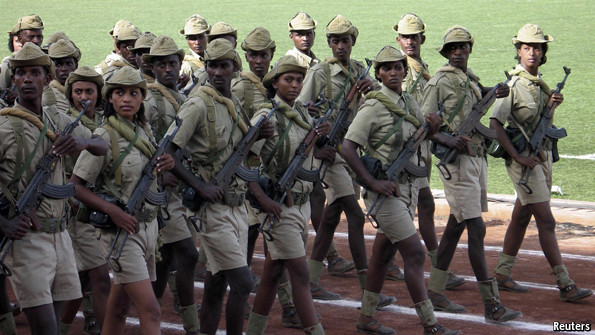
"The government [of Eritrea] continues to conscript much of its population into indefinite national service and [to] hold scores of political detainees in inhumane conditions."
"For the EU to rely on the government to do its monitoring, I think it is incredibly problematic, especially when obviously some of the issues the EU will be discussing with the government are around labour force."
"And as we know the government has quite bluntly said that it will continue to rely on national service conscripts."
Laetitia Bader, regional member, Human Rights Watch
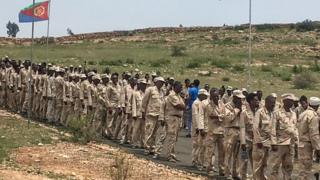 |
| National service in Eritrea is supposed to last 18 months but it can continue indefinitely, rights groups say Getty Images |
"The EU has made support for democracy a more prominent objective in its relations with African countries since the early 2000s, I would say."
"And the EU has put more emphasis on developing its instruments to support democratic reforms."" But the context now for democracy support in Africa and globally is a very different one because there is more of a competition of political models with China and other actors."
Christine Hackenesch, German Development Institute

The European Union has provided roughly $22 million to Eritrea, the source of most of the asylum seekers headed to Europe for the past several years. Equipment and materials were funded to build a road in the country, a practical and useful initiative, but one that is more complicated than might seem on the surface. Since many of the workers tasked to build the road are forced conscripts. And since the EU provides a no-strings-attached funding for the road-building, it is unable to monitor the project.
Human-rights groups, examining the situation, have been clear in their condemnation of the EU's initiative to use the funding as a prod to the Eritrean government to make a better effort to keep its citizens at home and out of Europe. Even though the situation became known months ago, the EU gave Eritrea an additional tens of millions to fund what has been labelled a system of forced labour described by the UN as "tantamount to enslavement".
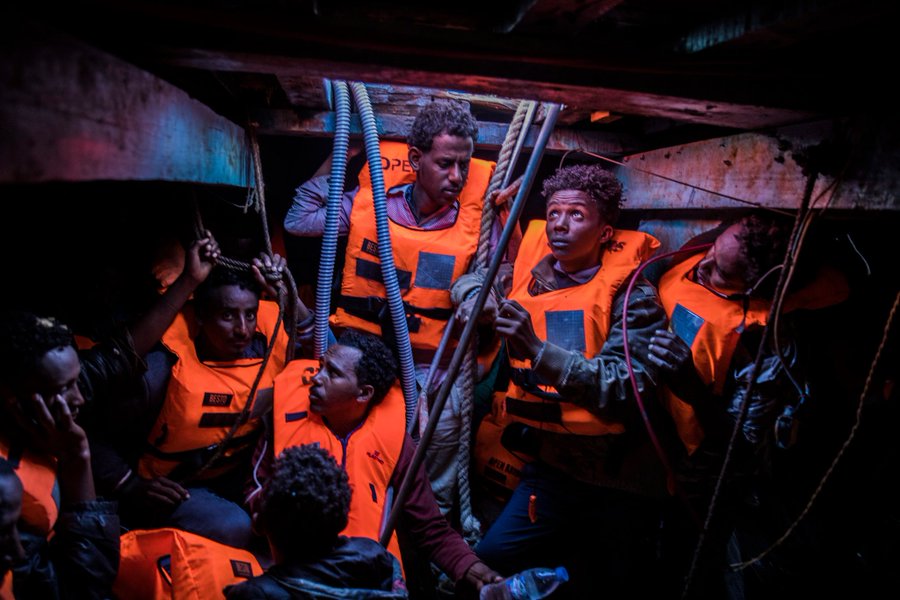 |
The additional funding represents an example of desperation to extract itself from the quandary of Eritreans choosing to leave their cloistered nation of around five million in he Horn of Africa. Since the EU decided to make its aid unconditional with no guarantees of democratic reforms it is left now with no avenue to address the situation. Part of a $6 billion European Union Trust Fund for Africa, created when the refugee crisis was at its 2015 peak, it was meant to "address the root causes of migration".
Yet asylum seekers flooding out of Eritrea remain high, with at least 5,000 people seeking asylum in Europe yearly for the past decade An exception occurred in 2015-16, when the number rose to over 30,000 and last year more than 10,000. Since up to 80 percent of asylum requests ended up being successful according to Eurostat, the funding by the EU to Eritrea has been fundamentally purposeless.
From the total emergency fund, $300 million has been earmarked for Eritrea in the hope that it would aid the local economy to create jobs to ensure Eritreans remained at home, and helping to contribute to the peace agreement with its neighbour Ethiopia, reached in 2018. None of which changes the reality of Eritrea's reputation as one of the world's worst human rights abusers.
 |
Labels: Africa, Eritrea, European Union, Forced Labour, Funding, Migrants
posted by Pieface @ Saturday, January 25, 2020