"[Traditional race relations in Bolivia is similar to] the apartheid system in South Africa, with Indigenous people being second-class citizens." "The significance of Evo [Morales] was he rose up and achieved a lot of positive things for Indigenous people." "He rallied his Indigenous base through the rhetoric of racial distinctions, which has now polarized much of the country." Diego von Vacano, Bolivian political scientist, Texas A&M University
"Racism exists in Bolivia: it existed before Evo, and it will never disappear." "While Evo started an important discussion, he also manipulated the race issue, and that has caused disunity. And now people of different races look at each other with suspicion." Michelle Kieffer, insurance broker, La Paz, Bolivia
"They have burned our flag. They have laughed at our culture." "This is racism; this is discrimination. We will give our lives for our rights." Alfonso Coque, cocoa grower, Bolivia
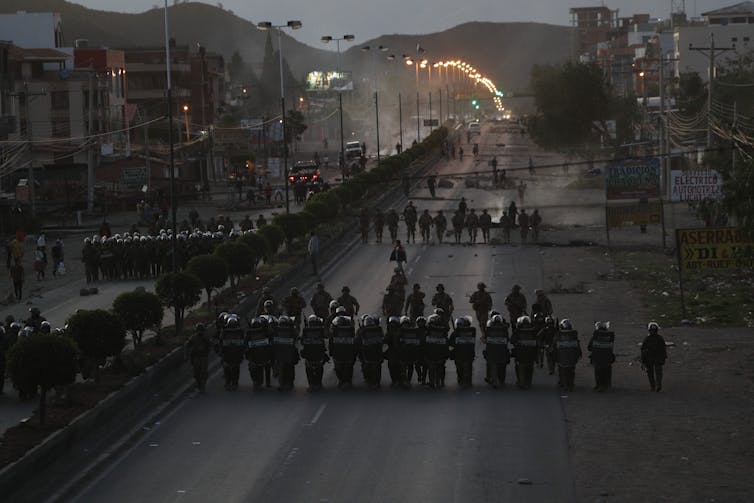
Police fired tear gas and live rounds of ammunition on November 15 at Indigenous supporters of former Bolivian President Evo Morales. The protesters attempted to march into Cochambamba, about 400 kilometres east of La Paz. Nine people were killed, dozens others were injured. In Mr. Morales's time in office Indigenous representatives grew in number as he redistributed the country's natural gas wealth, sharing it with native communities.
His time in office led to a renaissance of traditional Bolivian cuisine, music and cultural dress. A multicoloured flag representing the country's diverse Indigenous groups was introduced to give pride to those who had been too long neglected and marginalized. This became an official flag to fly alongside the traditional Independence-era banner of red, green and yellow. All of this and much, much more saw him idolized in many of Bolivia's Indigenous communities.
On the other hand, the major Quechua and Aymara Indigenous tribes comprising roughly a third of the country's adult population were given primary status, leaving many other Bolivians of mixed or European descent, along with smaller Indigenous groups resentful, accusing Mr. Morales of ethnic favoritism. Oddly enough there was a drop in the numbers of Bolivians identifying as members of Indigenous groups, falling to 41 percent in the last census, from 62 percent a decade earlier.
In former President Morales' absence an acting president of European descent has installed herself, even as police have removed insignia representing Indigenous symbols from their uniforms. The Indigenous flag has been burned by protesters, while the acting president appointed an initial cabinet lacking any Indigenous members. "We feel threatened. They don't represent us, they reject us, the Indigenous", stated Juan Acume, a farmer of the Quechua Indigenous group.
Jeanine Afiez Chavez, an opposition senator, proclaimed herself interim president, promising to unite the nation, and that new elections would take place in January. Divisive action began almost immediately when of eleven ministers not one was identified as a member of an Indigenous group until sensing the antagonism directed toward her moves, she relented, appointing an Indigenous minister of culture. The new president revived Catholic rituals in public events despite the Constitution defining Bolivia as a secular state.
Security forces block supporters of former President Evo Morales outside Cochabamba, Bolivia, Nov. 18, 2019.AP Photo/Juan Karita
The presence of European descendants of the original Spanish from colonial times amounted to a type of apartheid, with the European Bolivians in elite positions and the Indigenous population considered lower class citizens. Relations won't be helped by Ms.Afiez having published Twitter posts mocking the Indigenous culture, branding religious rites of their faith as "satanic".
"[Asylum was granted due to] humanitarian reasons. Morales'] life and integrity are under risk." Mexican foreign affairs minister Marcelo Ebrard
"If I have the support of those who carried out this movement for freedom and democracy, I will take on the challenge, only to do what's necessary to call transparent elections." "Evo Morales does not qualify to run for a fourth term. It's
because [he did] that we've had all this convulsion, and because of this
that so many Bolivians have been demonstrating in the streets." Senate second vice-president Jeanine Afiez, La Paz, Bolivia
Bolivia's interim president Jeanine Añez talks to the media outside the
Presidential Palace in La Paz on Thursday. She has appointed a new
military chief and cabinet members to help support her interim
leadership. (Marco Bello/Reuters)
The man of the people, Bolivia's Indigenous President Evo Morales who fourteen years ago enthralled the world and elevated the hopes and aspirations of Bolivians to ecstatic proportions of expectation, lived up to his promises of rescuing his country's fortunes and future and giving it back to his people to be proud of their identity and the future awaiting them. The country, once destitute, saw its GDP boosted as a result of good government empowering ingenuity and hard work. Socialists around the world applauded his example. The World Bank and the International Monetary Fund found the country's turnabout at Morales' hand admirable.
Poverty in the country was halved. Natural resources were managed well finally and profited the country with an even distribution of benefits nationally as the financial situation became robust, the GDP growing at 5% annually. Education became a priority, and literacy assumed its rightful place among the people. Evo Morales' Movimiento al Socialismo rebuilt the nation. Amazingly, he took his pledge seriously and for years governed as he had promised.
Was it his close association and admiration for Hugo Chavez in Venezuela who boasted of his own 'Bolivarian' Revolution whom he emulated as Chavez became a tyrant, that led Morales astray?
And astray he went, becoming as corrupt as any dictator. In the wake of a rigged election that was illegal to begin with, flouting the nation's constitutional limits of the presidency, limiting it to two terms, Evo Morales had already served out three terms and was intent on a fourth. Protests and unrest resulted and finally Bolivia was convulsed with the spectre of civil war. Like the other leftists who took power in Latin America, weeks of violent protests from disaffected Bolivians against the abuse of power and corruption brought the country to a standstill.
The champion of the poor and downtrodden whose capacity for governing well -- appears to have transitioned in the last few years to an autocrat who felt entitled to permanent rule of a country to which he had brought steady economic growth. His defiance of presidential term limits signed his fate as his government collapsed when the Organization of American States' damning report into serious irregularities during the October vote was released.
Party allies resigned. The military recommended he step away from office. When Morales' deputy and other allies in government and parliament deserted him, it was time for opposition politician, Senate second vice-president Jeanine Afiez to step forward, as constitutionally the next in line to assume the presidency. Mexico acceded to Evo Morales petition for asylum, stating fear for his life motivating him to leave his country. "The world and our Bolivian patriots repudiate the coup", Morales said, accusing his election rival of a conspiracy.
A supporter of former Bolivian president Evo Morales reacts during a protest in La Paz on Wednesday. (Henry Romero/Reuters)
This represents a general opinion site for its author. It also offers a space for the author to record her experiences and perceptions,both personal and public. This is rendered obvious by the content contained in the blog, but the space is here inviting me to write. And so I do.