"[Traditional race relations in Bolivia is similar to] the apartheid system in South Africa, with Indigenous people being second-class citizens." "The significance of Evo [Morales] was he rose up and achieved a lot of positive things for Indigenous people." "He rallied his Indigenous base through the rhetoric of racial distinctions, which has now polarized much of the country." Diego von Vacano, Bolivian political scientist, Texas A&M University
"Racism exists in Bolivia: it existed before Evo, and it will never disappear." "While Evo started an important discussion, he also manipulated the race issue, and that has caused disunity. And now people of different races look at each other with suspicion." Michelle Kieffer, insurance broker, La Paz, Bolivia
"They have burned our flag. They have laughed at our culture." "This is racism; this is discrimination. We will give our lives for our rights." Alfonso Coque, cocoa grower, Bolivia
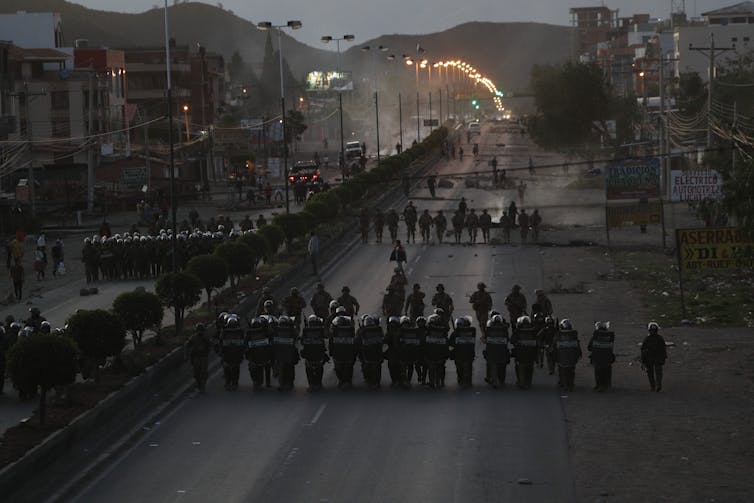
Police fired tear gas and live rounds of ammunition on November 15 at Indigenous supporters of former Bolivian President Evo Morales. The protesters attempted to march into Cochambamba, about 400 kilometres east of La Paz. Nine people were killed, dozens others were injured. In Mr. Morales's time in office Indigenous representatives grew in number as he redistributed the country's natural gas wealth, sharing it with native communities.
His time in office led to a renaissance of traditional Bolivian cuisine, music and cultural dress. A multicoloured flag representing the country's diverse Indigenous groups was introduced to give pride to those who had been too long neglected and marginalized. This became an official flag to fly alongside the traditional Independence-era banner of red, green and yellow. All of this and much, much more saw him idolized in many of Bolivia's Indigenous communities.
On the other hand, the major Quechua and Aymara Indigenous tribes comprising roughly a third of the country's adult population were given primary status, leaving many other Bolivians of mixed or European descent, along with smaller Indigenous groups resentful, accusing Mr. Morales of ethnic favoritism. Oddly enough there was a drop in the numbers of Bolivians identifying as members of Indigenous groups, falling to 41 percent in the last census, from 62 percent a decade earlier.
In former President Morales' absence an acting president of European descent has installed herself, even as police have removed insignia representing Indigenous symbols from their uniforms. The Indigenous flag has been burned by protesters, while the acting president appointed an initial cabinet lacking any Indigenous members. "We feel threatened. They don't represent us, they reject us, the Indigenous", stated Juan Acume, a farmer of the Quechua Indigenous group.
Jeanine Afiez Chavez, an opposition senator, proclaimed herself interim president, promising to unite the nation, and that new elections would take place in January. Divisive action began almost immediately when of eleven ministers not one was identified as a member of an Indigenous group until sensing the antagonism directed toward her moves, she relented, appointing an Indigenous minister of culture. The new president revived Catholic rituals in public events despite the Constitution defining Bolivia as a secular state.
Security forces block supporters of former President Evo Morales outside Cochabamba, Bolivia, Nov. 18, 2019.AP Photo/Juan Karita
The presence of European descendants of the original Spanish from colonial times amounted to a type of apartheid, with the European Bolivians in elite positions and the Indigenous population considered lower class citizens. Relations won't be helped by Ms.Afiez having published Twitter posts mocking the Indigenous culture, branding religious rites of their faith as "satanic".
"I want you to know where I come from so you can tell where I am headed. I'm like thousands of women in South Africa who lost their men to cities and prisons ... I stand defiant, tall and strong." "We had our textbooks, naturally written by white men, and they had their interpretation. Then [her father] would put the textbook aside and say: 'Now, this is what the book says, but the truth is: these white people invaded our country and stole the land from our grandfathers." "There is an anger that wakes up in you when you are a child and it builds up and determines the political consciousness of the black man." "We have no guns -- we have only stones, boxes of matches and petrol." "Together, hand in hand, with our boxes of matches and our necklaces, we shall liberate this country."
Nomzamo Winifred Zanyiwe Madikizela, Soweto, South Africa
"Without condoning her misdemeanours, we must acknowledge that she is a victim, she is damaged and hurt." "When someone is subjected to the kind of consistent persecution and harassment she suffered from the apartheid system, something is bound to snap. We understand that and will always be there for her." Kgalema Motlanthe, then-ANC Secretary General
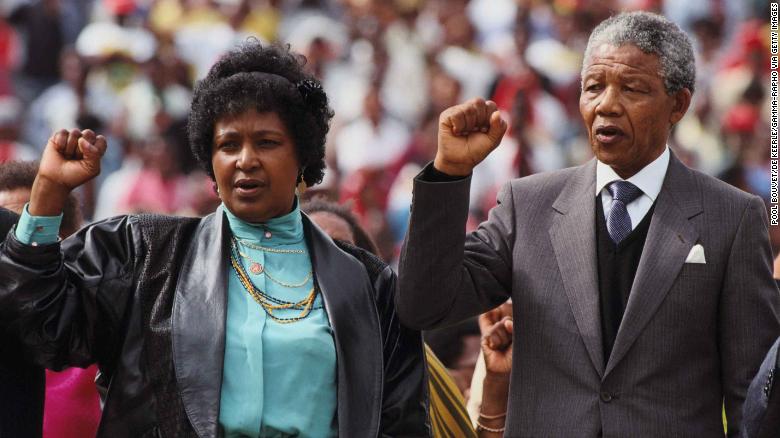
Winnie and Nelson Mandela in Soweto, South Africa in February 1990.
Winnie Mandela lived in 'interesting times', reflecting that old Chinese curse. She had no wish to live in 'interesting times', but they were imposed upon her, her family, her village, her people of South Africa by white-settler rule. She was born with a genetic inheritance of resilience, intelligence, determination and physical beauty. She was also married to one of the world's most renowned Black Africans who rebelled against apartheid in his country, suffered 27 years of imprisonment, and eventually became the country's first elected indigenous president.
Her name became synonymous with the black ghetto of Soweto during the years of resistance against white rule in a black nation. She returned to the black township located southwest of Johannesburg, but it was in Johannesburg that she died at age 81, a celebrated member of the African National Congress which had once disowned her as having disgraced them with her violent rhetoric and her involvement in a violent football group of thugs. The death of a 14-year-old boy was said to have been instigated by her.
For her part, she criticized the political party she once characterized as her "family". She was a fighter, and a fighter not only for black equality, but equality among blacks, railing against fraud, corruption and that after the fall of apartheid and the rule of the ANC in power, black South African poverty was never solved, housing was inadequate, and the elite looked after themselves exceedingly well. She chose never to herself live in the privileged enclaves, choosing instead to remain in Soweto.
She had worked toward a social-work degree from the Jan Hofmeyr School in Johannesburg, soon afterward meeting Nelson Mandela, and became part of the resistance movement that eventually led to present-day South Africa. In 1960 the attention of the world focused on the police killing of dozens of unarmed protesters, the Sharpeville Massacre. Nelson Mandela became a defendant in the Treason Trial of people involved in the evolution of the Freedom Charter, a blueprint for a future South African democracy.
Nelson Mandela had organized the group's defence, denying it had plotted a violent overthrow of the white government, was taken into custody and though found not guilty, was forced to go into hiding. During that time his wife Winnie was arrested, harassed and banned, unable to perform social contacts to keep herself involved a a time when she became the target of police informers. In 1969 she spent 18 months in solitary confinement, interrogated endlessly, forced to sit upright night and day without breaks.
"The whole experience is so terrible, because I had left little children at home in bed and I had no idea what had happened to them", she later explained. The food she was given was in unrinsed sanitary pail lids, covered often in bird droppings while she lived in a five-by-ten-foot concrete cell, sleeping on the floor. Eventually she was exiled to a shack in a remote town. In lock-step with her enforced isolation she became an international figure of interest.
Winnie Mandela and her two daughters, Zenara left, and Zindzi, at Cape Town airport in 1985.
At the same time, she began a daycare in Brandfort, the little town she was exiled to near Johannesburg, and she taught women there to plant vegetable gardens to feed their families. She also began drinking and had numerous extramarital relationships. And there was curiosity rising over international donations to her social welfare programs in the town; what happened to the money?
Returning to Soweto in 1984 she found gangs and police brutality, and she promoted "necklacing".
Suspected police informants were killed by placing a gasoline-soakjed tire around their body and lighting it afire. She was an ardent proponent of "necklacing". On New Year's, 1989, 14-year-old James Moeketsi Seipei (Stompie) suddenly disappeared. He had been living in Mandela's house and rumour had it that she had set her football gang to kill him. She was charged in connection with the boy's murder, and convicted of kidnapping and being an accessory to assault. Her sentence was suspended.
When her husband was finally freed after 27 years of imprisonment, Nelson Mandela, suing his wife for divorce said "I was the loneliest man during the time I stayed with her". The divorce was granted. The Truth and Reconciliation Commission condemned her in 1998 for human rights violations when 30 witnesses gave evidence against her. Her followers remained faithful to the woman they called the "Mother of the Nation".
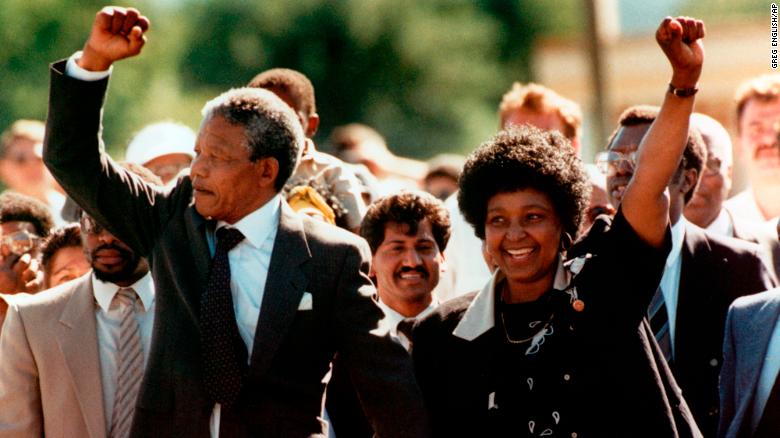
Nelson and Winnie Mandela raise clenched fists to supporters upon Nelson's release from jail in February 1990.
This represents a general opinion site for its author. It also offers a space for the author to record her experiences and perceptions,both personal and public. This is rendered obvious by the content contained in the blog, but the space is here inviting me to write. And so I do.