The Messy Divorce Proceedings Between Ottawa and Beijing
One legislation can change your life. Tomorrow when you get up, your life will be different. Nothing belongs to you anymore."
"This
could affect thousands of Canadians with benign links to China because
of their familial, commercial, educational, or civil society
relationships in the mainland [China]."
"It
seems very likely to me that these individuals will be seen in an
unfavourable light. In the current context of extreme suspicion about
all things Chinese, the risk of stigmatization is real."
"Your
name goes on a list, whether you are guilty or whether you are in fact
a foreign agent. Once your name goes on the list, you will have a mark
on your head and you will be stigmatized and that can affect your career
and your life prospects."
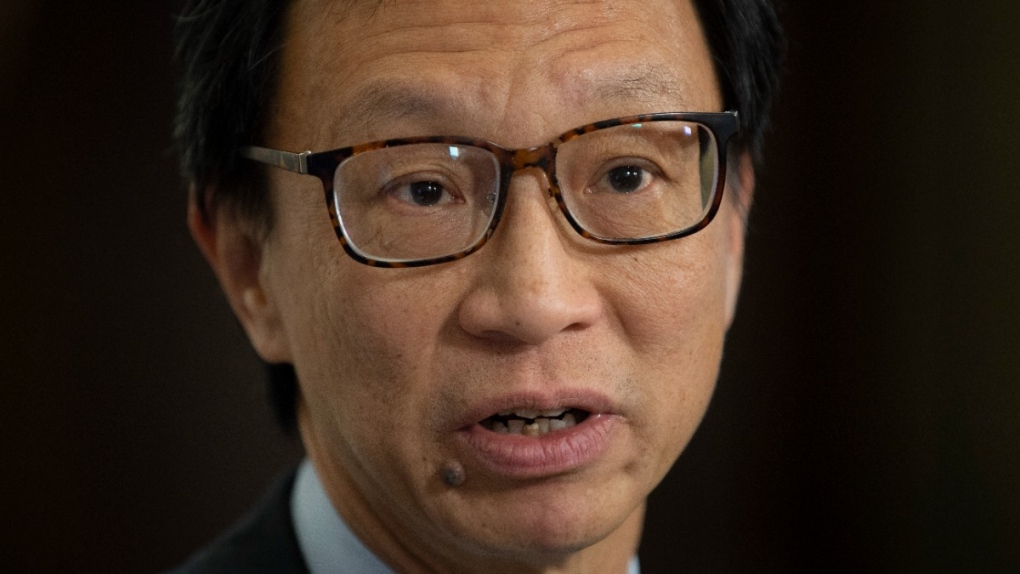
Canadian Senator Victor Oh
"This
is straight out of the CCP's [Chinese Communist Party] playbook, using
racism as a deflection from the proper issue at hand."
"It's downright offensive."
Cheuk Kwan, Toronto Association for Democracy in China
"[The anti-registry push is similar to the disinformation campaign that targeted me in the 2021 election]."
"They are using the fear of newer immigrants."
"It's fertile ground for misinformation and they're exploiting the opportunity."
Former Conservative MP Kenny Chiu
Marco Mendicini, Minister of Public Safety: "Today, we launched consultations on the creation of a Canadian Foreign Influence Transparency Registry.
We invite Canadians to share their views on this important tool to protect our institutions." Twitter
That
Beijing has been infiltrating Canada at every conceivable level for
years is well known. Agents loyal to the People's Republic of China have
inserted themselves in academia, science, business and politics; their
purpose to gain influence for China. During the mainland takeover of
Hong Kong and the persecution of democracy activists those same
activists cojoining forces with the Chinese missions in Canada and
enlisting the support of Chinese students on study visas championed
Beijing.
At
the opposite end of the spectrum, Chinese Canadians of Hong Kong
background deplored Beijing's dashing of Hong Kong's freedom to lean
into democracy, imposing on the city Beijing's heavy hand of
communist-style justice. The Confucius Institute chapters that were
opened in many universities to foster friendship with China, to feature
its heritage and promote its language was recognized as a propaganda
tool and lost favour in Canada.
Above
all, the harassment of Chinese-Canadians by Chinese agents working out
of Canada, some in the confines of shadowy Chinese police stations that
threatened those who rebelled against Beijing's line finally received
attention by investigative reporters who revealed the role that Beijing
played in the last federal elections, spreading false information and
attempting to influence the outcome of elections, which in fact resulted
in two anti-Beijing Members of Parliament losing their seats, and led
to a proposal for a foreign agent registry.
Canada
has an ugly past with respect to its white European heritage that
wanted to keep its citizens of European derivation and white. In 1923,
the Chinese Immigration Act barred Chinese from migrating to Canada and
installed a head tax of $500, an unheard-of-sum. At the same time Jewish
Canadians faced discrimination as did Indigenous Canadians. Today,
Canada welcomes Chinese immigrants that represent one of two top sources
of new Canadians. But this Liberal government denied any knowledge of
Beijing's interference despite being informed years ago by its own
intelligence services.
Now,
in the face of real and proven interference on many levels from
industrial espionage to cybersecurity, and proven political
interference, controversy has arisen over the pending legislation for a
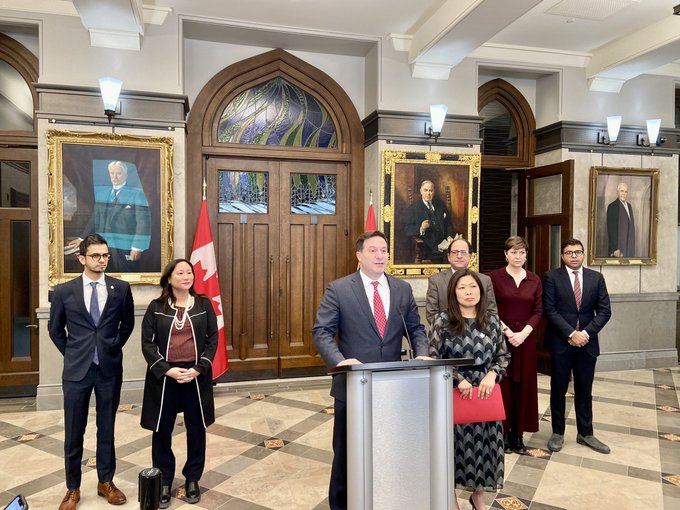
foreign agent registry. Senator Yuen Pau Woo of British Columbia
conflated the installation of a registry with the former immigration
act, that a registry could become "a modern form of Chinese exclusion". Both he and Senator Victor Oh often speak in the senate in support of Beijing.
Cheuk Kwan and lawyer Dora Nipp argue a registry would be welcomed by Chinese-Canadians since it would "prevent an entire community from being singularly labelled as a threat"
as well as its function acting as a reminder to other nations to
refrain from intimidating diaspora members. Activist Bill Chiu of
Vancouver dismissed any link between legislation for a foreign agent
registry and the former Chinese head tax: "If
they are so gung-ho about modern forms of Chines exclusion, shouldn't
they be jumping up and down when the PRC's draconian policies exclude
equal participation of countless [people] in China?"
The
bill, if passed would require anyone acting for a foreign government or
related entity to register if planning to communicate with a member of
Parliament or a senior official on government business. To prevent
"malign" influence as Public Safety Canada calls it, where someone acts
for a foreign power without disclosing their connection. Senator Woo
opposed a Senate motion calling China's treatment of its Uyghur minority
genocide; he advised government to release Huawei executive Meng
Wanzhou and co-authored a report that Chinese-Canadians were largely
impervious to foreign interference, while recommending closer ties with
China.
Debate
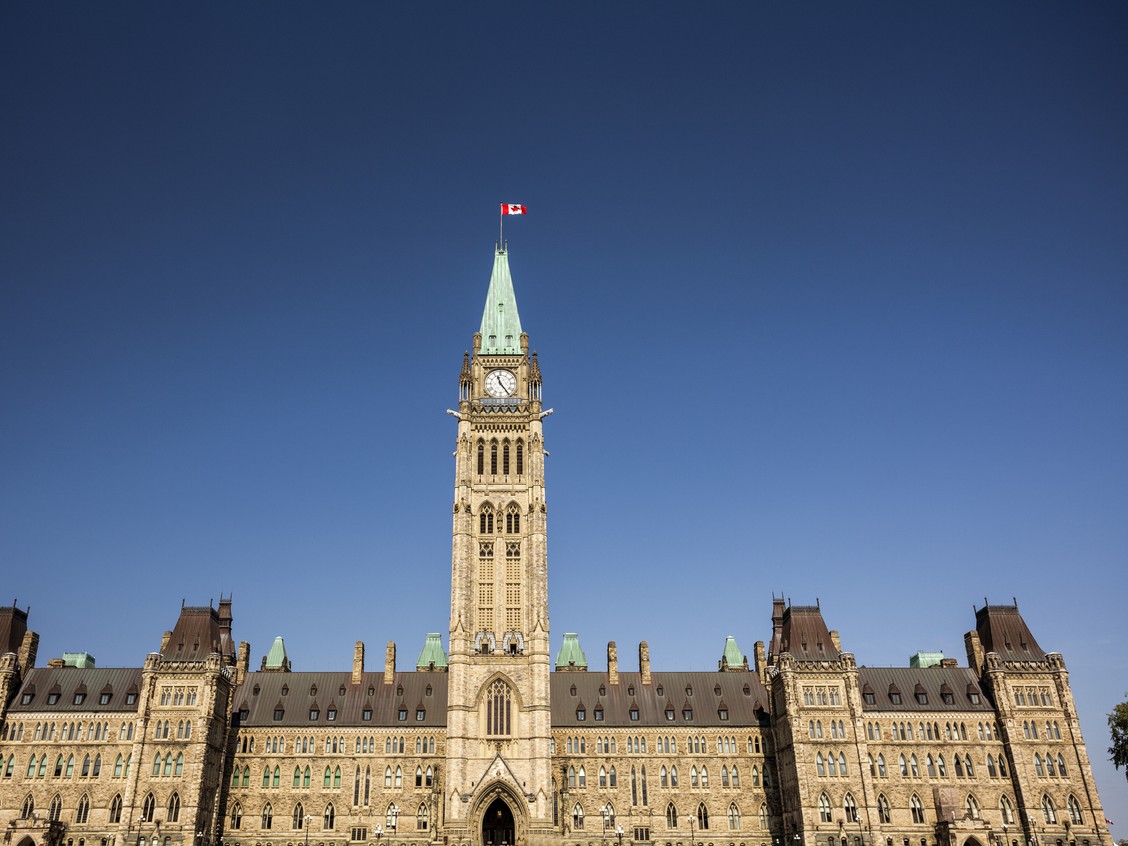
on a bill that would identify foreign agents lobbying those in public
office was opened in the Senate.Photo by iStock /GETTY IMAGES
Senator Pau Woo
Yuen Pau Woo
@yuenpauwoo
100 years ago, as part of the #ChineseExclusionAct,
Canada forced all Chinese people in the country to register or face
deportation. How can we prevent this registry from becoming a modern
form of Chinese exclusion? S-237 & the former C-282 are not the
answer. Time to speak out
"If you ask the American people to choose between public health and the economy, then it's no contest." "No American is going to say accelerate the economy at the cost of human life." New York Governor Andrew Cuomo
“We cannot let the cure be worse than the problem itself. At the end of the 15-day period, we will make a decision as to which way we want to go!" "We’ll get a pretty good idea what we’re doing [at the end of his 15
Days to Slow the Spread [campaign on March 31]." “You
know there will be a point at which we say: ‘We’re back in business,
let’s go'." U.S. President Donald Trump
"My message: let’s get back to work, let’s get back to living, let’s
be smart about it, and those of us who are 70-plus, we’ll take care of
ourselves." "Don’t sacrifice the country.Don’t do that.” "You know, Tucker, no one reached out to me and said, ‘As a senior
citizen, are you willing to take a chance on your survival in exchange
for keeping the America that all America loves for your children and
grandchildren'," And if that’s the exchange, I’m all in." "That doesn’t make me noble or brave or anything like that. I just think there are lots of grandparents out there in this
country like me." "I don’t want the whole country to be sacrificed. I’ve talked to hundreds of people … and everyone says pretty much the
same thing: We can’t lose our whole country. We’re having an economic
collapse." "We’re going to be in a total collapse, recession, depression,
collapse in our society if this goes on for another several months. As the president said, the mortality rate is so low. Do
we have to shut down the entire country for this? I think we can get
back to work." "Look, I’m going to do everything I can do to live. But
if you said, are you willing to take a chance … If I get sick, I’ll go
and try to get better, but if I don’t, I don’t." Texas Lieutenant Governor Dan Patrick
The passion of histrionics, the dedication of believers. All hail the business ethnic, the free enterprise system. As the World Health Organization projected their considered opinion that the United States may very well emerge as the epicentre of the global pandemic striking out on all rounded corners of the world, the reality is fast sinking in and in corporate America -- much like the rest of the world, witnessing their GDP shrinking disastrously, burgeoning unemployment and the need to invoke national security to lend heavily and guarantee support to banks, corporations, employers -- panic is setting in.
Exemplified in that a one-track American president is pressing a case for the reopening of the nation's economy in a few weeks' time; a welcome Easter gift, as he puts it longingly. The Governor of New York State isn't so convinced at all, that the limits on travel, socializing and working would be the wise course for a country to take while its population is being battered by the wild rampage of a bedeviling virus running amok. Governor Cuomo's response dampening President Trump's enthusiasm is obviously not universally shared, witness Texas Lt.Gen. Patrick's sacrificial message.
Perspective can be everything; Patrick's majority of one as opposed to a governor whose state has been the worst hit by the novel coronavirus where over 50,000 people have been infected across the nation, with 660 dead, and in New York the death toll from COVID-19 reached 157, and the shortage of hospital beds is beyond worrying. In New York alone the rate of infection doubles every three days with the apex anticipated in 14 to 21 days.
State officials and financial investors in New York are united in warning against easing up on restrictions too precipitately. But for the president the focus is on winning re-election in November and a collapse of the economy will not win him plaudits. He is considering how to restart business after the 14-day lockdown ends in a week's time, the contagious viral spread aside, poorly equipped hospitals notwithstanding. "I would love to have the country opened up and just raring to go by Easter."
Anthony Fauci, director of the National
Institute of Allergy and Infectious Diseases, listens during a
Coronavirus Task Force news conference in the briefing room of the White
House in Washington, D.C., U.S., on Saturday, March 21, 2020.Stefani Reynolds/CNP/Bloomberg
With Neighbourly Pakistan's Help, Afghanistan Will Look After Its Own
Security Alongside the Taliban, al-Qaeda and Islamic State -- Oh, Does
That Seem Delusionally Disingenuous?
"We've
been there for twenty years and we've been protecting the country but
we can't be there for the next -- eventually they're going to have to
protect themselves." "[What
if a U.S. withdrawal enables the Taliban to overrun the government?] I
can't answer that question. It's not supposed to happen that way but it
possibly will." "Eventually, countries have to take care of themselves." U.S. President Donald Trump "[Taliban
fighters] were actively attacking an Afghan National Security Forces
checkpoint. This [the U.S. air strike on Taliban fighters post-troop
withdrawal agreement] was a defensive strike to disrupt the attack." "Taliban leadership promised the [international] community they would reduce violence and not increase attacks." "We call on the Taliban to stop needless attacks and uphold their commitments." Col.Sonny Leggett, spokesman, U.S.Forces, Afghanistan
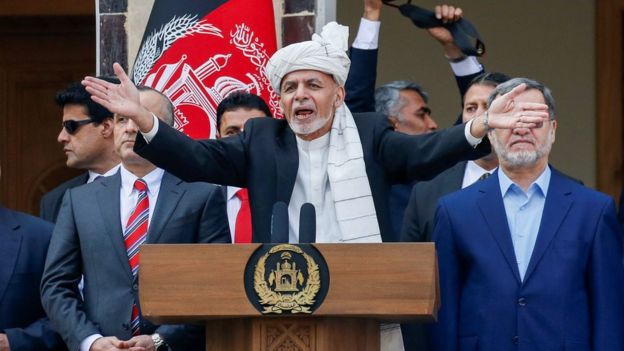
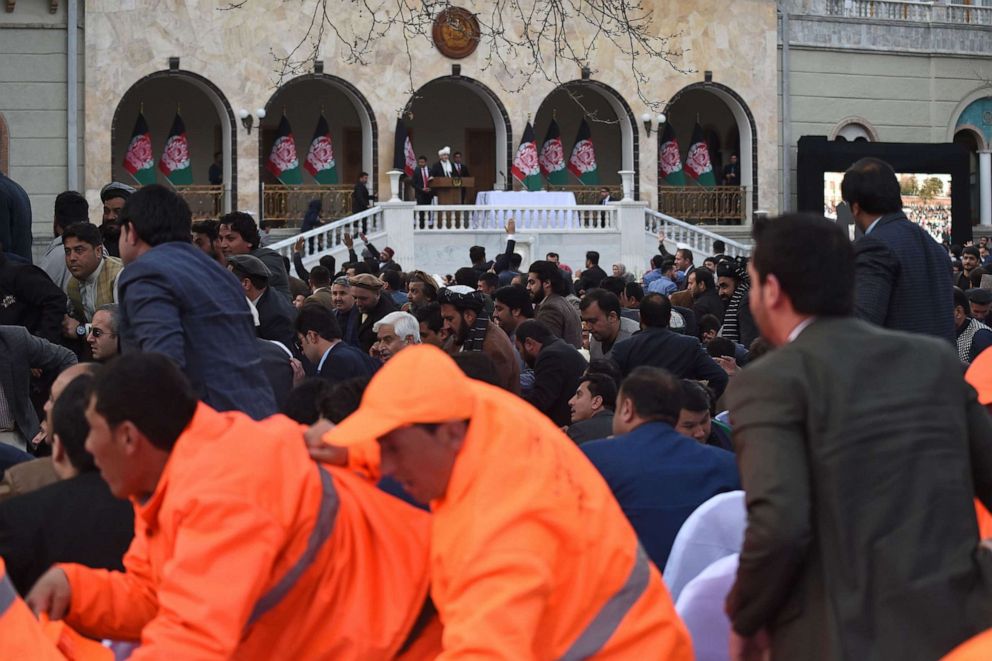
Ashraf Ghani was sworn in as president as his rival attended his own ceremony nearby Reuters
True, countries must take responsibility for themselves. Executive
administrative stewards have an obligation to the people they serve to
ensure that security and stability to enable the population to thrive
and to prosper. And this is what is seen in Europe, in North America, in
Oceania and Asia, but rarely in Africa, Southeast Asia and the Middle
East. Where Islam rules, sectarian and ideological differences,
tribalism, rampant corruption and war reign. Islam has taken the place
of Marxism and Fascism in social engineering and political control of
peoples' lives.
And there, chaos reigns, producing inter-tribal conflict, suffering and
poverty and where human rights abuses represent the order of the day,
every day, everywhere for there is no escape. Rebellion, civil war,
terrorism haunt the populations that flee the persecution and brutality
they suffer. Islam has created a vast tide of displaced populations
through bloodshed and human wreckage, with millions of people becoming
refugees, hoping to be absorbed by Europe and North America.
Officials
and guests react after hearing loud blasts during Afghan President
Ashraf Ghani's swearing in inauguration ceremony, at the Presidential
Palace in Kabul on March 9, 2020.Wakil Kohsar/AFP via Getty Images
The most powerful country on the globe would soon beggar its resources,
both financial and military, through the effort it would take to police
these dysfunctional countries in an attempt to bring order, to protect
the lives of the targeted and the vulnerable, and to bring warring
factions to a table to bargain for peace. Reason would have it that the
powerful would feel the need to put a stop to bloodshed and forge a way
toward attaining a country where people would be safe and society could
prosper.
But where the religion of political Islam is concerned with its power
base in convincing the oppressed that Islam rewards the faithful who are
expected to surrender their lives to the dictates of the clerics and
the warlords who espouse the conquest of Islam and strict adherence to
its sacred principles of surrender and jihad there is no goal but Sharia
and control of all elements of civic life. Shrewdly Islamists play the
reasonableness of Western democratic thought.
The goal of the Taliban is to show Western foreign interests the way to
the exit from Islamist concerns and once Afghanistan is free of their
presence the Taliban can then set about re-establishing its strict,
imperious rule, impervious to civility, reflective of Islamic
dictatorship. In leaving Afghanistan, which the Trump administration and
other foreign entities plan to do, the elected government of
Afghanistan will be left to defy the dedication of the Taliban to
resuming its former role in governing the country.
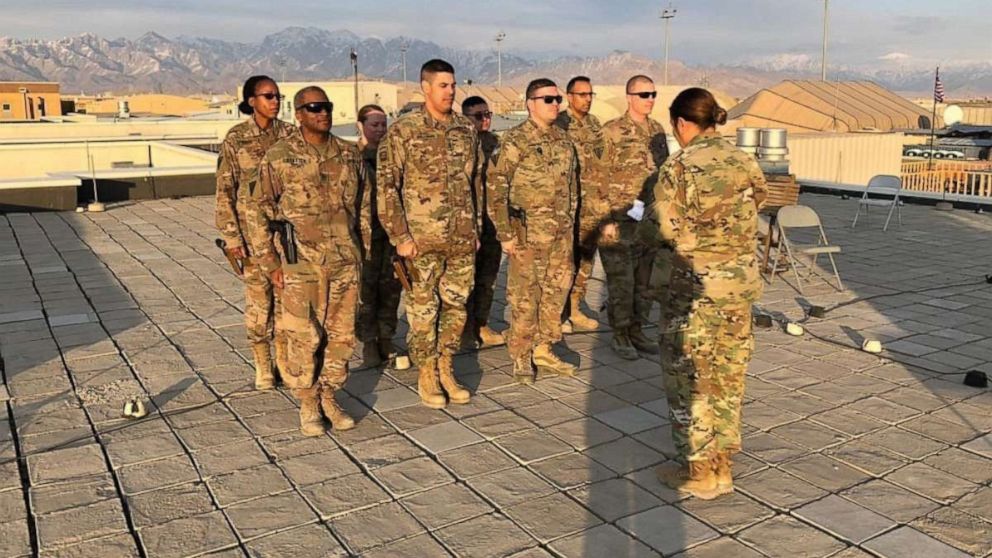
Soldiers
from the 3rd Medical Command - Deployment Support stand in formation
prior to a patching ceremony at Bagram Airfield, Afghanistan, Feb. 20,
2020.US Army
The Taliban has possession of the remote provinces, the government of
President Ashraf Ghani the cities. President Ghani refuses to honour the
U.S. agreement on their behalf to release thousands of Taliban
prisoners from Afghanistan jails. After all, the government of
Afghanistan was denied the opportunity to join the U.S. in talks with
the Taliban because Taliban leaders recognize the government as tools of
the West refusing to speak directly with them. No possible opportunity
will arise where reason can prevail to result in a shared government in
Afghanistan.
That is a Western concept, one that is feasible among civilized people
determined to bring peace to a turbulent geography, and in Islam it is
only the strong that prevail, the weak are those who are prepared to
discuss matters in the hopes of resolving differences. For its part, the
U.S. plan is to ensure there is reduced violence against Afghan forces
and civilians. This, to be achieved through a pullout of U.S. troops.
Whereupon the Taliban and Afghan government officials will set to work
amicably settling their differences, but not in this lifetime.
"USFOR-A maintains all the military means and authorities to accomplish
our objectives -- including conducting counterterrorism operations
against al-Qaida and ISIS-K and providing support to the Afghan National
Defense and Security Forces." "USFOR-A is on track to meet directed force
levels while retaining the necessary capabilities." Gen. Austin Miller, head, U.S. Forces Afghanistan
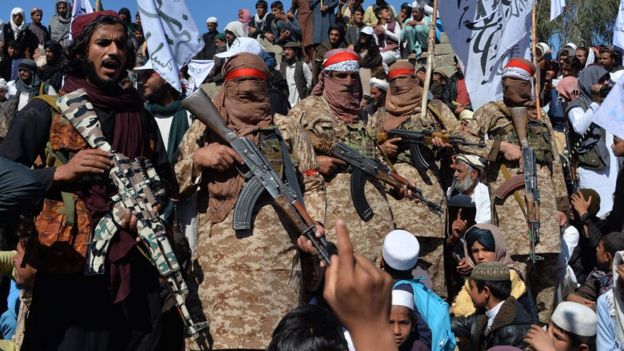
Taliban fighters were celebrating the US deal earlier this week AFP
"Talking with jihadists and fighting terrorism is not contradictory. I have a duty and a mission today to create all possible
spaces and to do everything possible so that, by one means or another,
some kind of appeasement can be achieved. It's time certain avenues were
explored." "We're going to try and do what the people want, like with the jirga in
Afghanistan, to put it into practice, and we're trying to do it without
being naive, we're not gullible." "We'll continue with our work, with our
duty, but we want to make sure that we will no longer be stubborn about
things, stuck, or obtuse." Malian President Ibrahim Boubacar Keita
"People think that Shariah is more rapid, less corrupt and delivered in a manner that people can understand." "It is also less costly." Drissa Traore, head, Bamako office, International Federation for Human Rights
"The jihadists have gained the hearts and minds of many people." "But what people are asking for are basic social services; they are not asking for jihadist services. They want things like roads and education." "The battle will never be won through military means." Riccardo Maia, MINUSMA head office, Timbuktu
"In all countries in the region you can see economic and social progress in capitals and other cities, but not when you leave the cities." "If you go to more remote areas, nothing has changed for 20 or 30 y6ears. You don't have leaders in the region who seem genuinely to appreciate the stakes." Gilles Yabi, director, Wathi, West African think tank
The Western effort -- mostly through French military intervention followed by diplomacy in a former French colony -- to curtail Islamist insurgencies spreading with alarming rapidity through the Sahel region of Africa, sees the minds of ordinary Malians appear to have accepted the message delivered by jihadists even though they recall the Islamist brutality they reeled under eight years earlier when a jihadist seizure of Timbuktu destroyed heritage sites and irreplaceable ancient documents and slaughtered the unconvinced.
Back then it was forbidden to smoke, for a woman or girl to be seen in the presence of men or boys at risk of flogging. Even so, the jihadists earned a reputation of stern anti-corruption and in their presence there was no crime being committed, given that Shariah actively engaged with the chopping off of hands as a deterrent against theft. "Now there are bandits everywhere", one disgruntled man stated, using a chopping down motion to indicate the effectiveness of Shariah.
The 2013 French-led military force drove the al-Qaeda affiliates from Timbuktu and other Malian towns, but seven years on, jihadists are still about in northern Mali, expanding their reach into other regions the while, despite the presence of 5,000 French troops and a 15,000-strong separate UN peacekeeping force named MINUSMA. The Sahel, a vast region on the southern fringe of the Sahara, now hosts the jihadist insurgency in other states.
Militants have convinced many northern Malians that they should be trusted to represent the people's interests far more than the government in Bamako, the capital of the country. Successive governments in Bamako have neglected the communities in northern Mali for decades. Government is equated with police, soldiers, judges and officials accused with being invested in what they can loot from northern Mali, not in benefiting locals.
Bribery and extortion, and/or involvement in Saharan drugs, weapons and people-smuggling networks cross the region and to the people living there, this is what they think of how the government manifests its interest in their welfare. Even while the jihadists have their hand in drug running as well as smuggling, they have been seen to use their profits to build Koranic schools and Shariah courts to aid in entrenching their extreme ideology, presenting themselves as the legitimate alternatives to the ineffective, disinterested state.
MINUSMA has been heartened by the arrival of 250 British soldiers to aid them in fending off repeated attacks on bases, and mounting dangerous operations to protect civilians. The group has performed whatever it could manage to replace the vacuum left by the state; repairing the road from the Niger to Timbuktu, and in Gao, a former jihadist town, helping to fund women's agricultural collectives, and build police stations, important moves to help win support among the populace.
Mali's president, Ibrahim Boubacar Keita is recognized among other Sahelian leaders as making no serious effort to address the frustration that exists in ignored and marginalized parts of their states, according to analysts. Possibly, in reaching an accord with the Islamist fanatics, the government can dispense with the nuisance pretense of fairly administering a portion of the country that is of little interest to them, voluntarily offering a firm foothold to jihad which will inevitably begin to make further inroads.
The futile West hoping to save Muslims from the greater and graver human rights abuses of Shariah-led Islam. And while France invests itself in trying to save its former colonies from collapse into the hands of Islamist terrorism, it nurtures at home in its banlieues transposed Islamists hostile to French values and ideology and determined to transform France into a bastion of Islamist Shariah using whatever means and patience required to achieve their goal.
"It's the Chernobyl of the Islamic Republic." "The establishment has three major problems: corruption, inefficiency and inconsistency, and the plane crash once again laid bare the inefficiency and inconsistency in the system." Saeed Leylaz, economist, former adviser to Iran reformist president Ali Mohammad Khatami
"The Iranian regime's inadvertent murder of 176 people -- most of them Iranian -- in the tragic plane accident may limit their ability to further avenge Soleimani's death." "Iranians are tired of the cycle of violence and retribution, and are brutally aware that it is Iranian civilians who invariably pay the highest price, not the regime and not the United States." Karim Sadjadpour, senior fellow, Middle East program, Carnegie Endowment for International Peace, Washington
Iranians held hands during a demonstration in front of Tehran's Amir Kabir University on January 11, 2020.
Backlash from the Iranian regime's insistence that it had no part in the downing of the Ukrainian Airlines flight that killed 176 passengers and crew just minutes after take-off from Tehran International Airport on Wednesday morning has brought Iranians back to the streets of cities in the country, despite months of protests late in 2019 that cost the lives of an estimated 1,500 protesters in the ferocity of the regime's response. Iranians are simply so enraged at their government that they've set aside personal safety once again to have their voices heard.
Crowds of people assembled outside both Sharif University and Amir Kabir University of Technology where many of the victims studied; Iranian students headed for Canada on student visas. Video emerged on the Internet of students deliberately bypassing the opportunity to walk over painted American and Israeli flags on the entrances to their universities; insults that the government encourages and hoped would deflect attention from them to the nation's purported enemies.
A woman attending a candlelight vigil scolds police at Amirkabir University, Tehran.
The crowds chanted anti-government slogans as protests re-emerged in Tehran, calling for the Supreme Leader Ayatollah Khamenei's ultimate sacrifice of martyrdom: "Death to the dictator!" Police dispersed protesters, leading to violent clashes. The U.K. ambassador to Iran present at the vigil outside Amir Kabir in mourning of students who lost their lives in the fiery crash of the shattered plane, was arrested as the tribute turned violent.
Security forces were out blocking entrances to city squares and landmarks where demonstrators intended to gather in their anti-regime force. Over 230 civilians have been killed since Iran threatened to retaliate for the death of Al Quds Force Commander Qassem Soleimani, Iran's terrorist mastermind. Any sympathy evoked among Iranians by his dispatch appears to have evaporated in the public rage over the deaths of so many other Iranians; 56 at a stampede during Soleimani's funeral, and the rest on the passenger jet.
That number, added to the 1,500 killed during late 2019 months of protests throughout Iran, puts into perspective just how much this regime cares about its citizens. Iranian media had claimed for days that up to 80 U.S. troops had died when the IRGC air defence units fired missiles at two bases in Iraq and Syria ... and then fired those same missiles at the Ukrainian airliner. The Guardian Council saw itself under intense scrutiny and pressure from public outbreaks of furious denunciation.
More reformist and competent electoral candidates for parliamentary elections set for February 21 were demanded by the public for the legislature to attain some balance between moderates and hardline conservatives. According to local media reports, however, the Council's announcement that it has completed vetting candidates, finds that the result has been the exclusion of dozens of current MPs, mostly moderates, shut out of running again.
Supreme Leader Ayatollah Ali Khamenei and President Hassan Rouhani have attempted to distance themselves from the coverup of the air crash, insisting they had discovered the true cycle of events late Friday. "With all of my being I hang my head", Foreign Minister Javad Zarif said in a condolence message on Sunday, while a posting by an aide to President Rouhani warning domestic media not to report accusations by Australia, Canada and the U.K. that the airliner had been shot down shortly after takeoff, stated regrets in Koranic verse.
Everyone appears eager to proffer public apologies of remorse, having trustingly repeated lies the government pressed on them to exonerate themselves from responsibility over the shooting down of the passenger liner. Accidents, of course, can happen. And so can repercussions of unimagined ferocity when those in charge make deliberate decisions they think they can live with, then discover the difficulty of living with them after the fact.
Demonstrators chant during a vigil for the victims of the Ukraine airliner crash in Tehran on January 11.
"At
a time when Canada needs strong relationships more than ever, Justin
Trudeau's poor judgement, lack of professionalism and love of drama
continues to weaken Canada's position on the world stage." "We saw this just yesterday at the NATO summit." Conservative Leader Andrew Scheer, Parliamentary Opposition
"He's
not paying two percent and he should be paying two percent. It's
Canada. They have money and they should be paying two percent [in
military preparedness]. So I called him out on that and I'm sure he
wasn't happy about that, but that's the way it is." "And
honestly, with Trudeau he's a nice guy, I find him to be a very nice
guy but you know the truth is, that I called him out on the fact that
he's not paying two percent and I guess he's not very happy about it.
[Canada is] slightly delinquent." "Trudeau is two-faced." U.S. President Donald J. Trump
"I
think he hit a nerve. If you look a the tape and you look at the
reaction, it was hard not to think about high school where you have the
two good-looking rich guys gossiping about the big powerful other guy." "The
relationship is deeper and has guardrails around it, in a sense, that
doesn't allow that sort of stuff to happen easily [actual damaging
fall-out or related consequences]." Eric Miller, global fellow, Canada Institute, Wilson Centre, Washington, D.C.
President Donald Trump meets with Canadian Prime Minister Justin Trudeau at Winfield House, Tuesday, Dec. 3, 2019, in London. (The Associated Press)
As a judge of good character it's hard to credit President Trump with a
keen objective sense of what even constitutes good character. He is not
himself an example by any means. And he's cut Justin Trudeau a lot of
slack; generous to a fault. But it is a faulty conclusion. He's not a
nice guy by any means, but rather a pretentious, egotistical, vain,
entitled charlatan. Oops, that is Trudeau, but those traits also echo
Trump, so little wonder he approves of the former's persona.
There were serious issues to be discussed at the NATO conference, even
if it purported to be a celebration and consolidation of its 70 years of
international cooperation among NATO allies. One issue that failed to
pass the test of serious consideration was the appropriateness of
Turkey's half-century of membership that might have been countenanced
when it was an Ataturkian-secularist-reform-governed proto-democracy, an
entirely different administration than the current Islamist autocracy
headed by Recep Tayyip Erdogan.
Turkey now shares none of the concerns of NATO. Its ruling Justice and
Development Party, which proves more than adequately that words have
lost their intrinsic meaning to be manipulated by tyrants and autocrats
to serve their personal purposes, has an agenda that is abhorrent for
many reasons to other NATO members. With the sad exception of the U.S.
whose president gravitates happily to strongmen since he models himself
as one. Turkey's membership in NATO, an unspoken grievance by many
members, should be under discussion.
Emmanuel Macron was a little precipitate in declaring NATO 'brain dead'
on the basis of having been abandoned by Trump, whose volatile, puzzling
and intemperate statements and choices have suddenly resurrected U.S.
interest in NATO. Donald Trump imagines himself the elder statesman of
NATO by virtue of his powerful country's having created the union as a
bulwark against the-then Cold War with the Soviet Union and its powerful
Eastern European bloc. As the most influential, wealthiest country on
the globe, he is conferred with exceptional status.
His pique is spontaneous, his decision-making lacking deep knowledge to
guide him, his arrogance is monumental, and defying the man when for a
change he has a legitimate point to make in holding other NATO members
to the agreed-upon pact all made to spend 2 percent of GDP to acquiring
and sustaining a robust national military complete with military
hardware in the interests of unity and a reliable military capacity both
singly and collectively in an increasingly unsettled world order, can
be given the respect it deserves.
When President Trump chastised Prime Minister Trudeau for Canada's lack
of commitment to acquiring adequate military hardware, and for failing
to live up to its troop-number commitment to NATO, he had a legitimate
point to make in urging Canada to follow the example of less-wealthy
NATO members who do take their commitment seriously. That Justin Trudeau
was incapable of responding like a mature adult and chose instead to
mock the president of the United States speaks to a monumental failure
on Trudeau's part in representing the best interests of the country he
governs.
Choosing to behave like an adolescent rather than an adult to anticipate
the frisson of pleasure he would experience in making himself yet again
the centre of amused attention by his political international peers, he
once more disgraced himself, pandering to his theatrical,
drama-princeling aptitude and greed to be the centre of notice, while
enjoying the opportunity to laugh at someone he grovels before in
face-to-face contact.
On the other hand, Trudeau happened to be in the company of heads of
government who chose themselves to behave like adolescent clowns. It is
most unfortunate, but Trump seems to have this effect on people who
consider themselves to be superior to a man whose manners and values are
deplorable and in their distaste for him and choosing to demean the man
who holds the position of the most powerful man on Earth, however
temporarily, they more or less reflect some of his unsavoury
attributes....
PM
Justin Trudeau, France's Emmanuel Macron, UK PM Boris Johnson and other
VIPs shared a few words at a Buckingham Palace reception Tuesday - and
seemed to be talking about U.S. President Donald Trump's lengthy
impromptu press conferences earlier in the day. CBC
"The public hospital system has collapsed. Citizens are dying like flies. The power blackouts are now permanent. Hyperinflation has spiralled out of control." "But they sat and named roads after themselves." Tendai Biti, vice-president, opposition Movement for Democratic Change, Zimbabwe
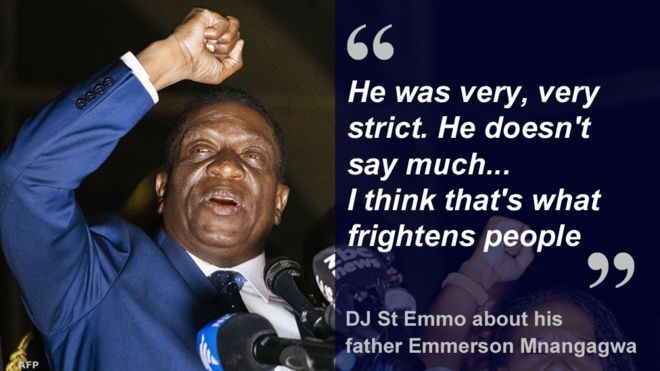
President Emmerson Mnangagwa rose to power in 2017 Getty Images
Zimbabwe, once the regional breadbasket that produced agricultural crops to feed its population and ample excess to sell to less productive countries, now imports a huge proportion of the food its population needs for survival. Under Robert Mugabe who ruled like a typical African tyrant belying the belief that he would lead his country forward in development when he was viewed as a saviour in the first years of his rule after independence, took the country down the path of total ruin.
The Rhodesian-era white settler-farmers who had farmed the land for generations, employing hundreds of thousands of farm labourers, feeding the nation, sending food crops abroad, loyal to the country, received a shock when their family farms were peremptorily expropriated by the state. They were forced from the farms, often violently, and some lost their lives in the process. The reason was to reclaim Zimbabwe's agricultural land and return it to its indigenous population.
Those who fought for independence monopolize power. AFP
Black Zimbabwean farm workers lost their employment. The farms were given over to Mugabe's fellow 'freedom fighters' who had no idea how agrarian methods of raising crops would maintain a working farm. But they did relish the idea of land ownership. Even while the once-working farms lay fallow, no crops were grown because no one cared and no one knew how to proceed nor was interested in finding out how to restore the functionality of farms that once fed the nation.
patrick mpandawana
@patrick_mpa
Replying to
@larry_moyo
Breaking News: Prices Set To Fall And Exchange Rates Stabalise After Govt Announces New Street Names
2:12 AM · Nov 22, 2019, Twitter
Zimbabwe suffered sky-high inflation, unemployment soared, food and medicine became scarce, but President Mugabe saw nothing amiss and was disinterested in useful criticism while his people suffered. He is dead now; he almost ruled for life, but was eventually deposed and in his place is President Emmerson Mnangagwa whose administration has done very little to raise the hopes and expectations of Zimbabweans that their long-suffering travails are over.
He is too busy renaming streets whose names reflect the colonial era. In ten of the country's largest cities and towns, Harare included, thoroughfares are being renamed to reflect the name of the president, Emmerson Dambudzo Mnangagwa. Hughes Street, Etherton Road, and other British-type names are the past and are now consigned to the past. In their place will be Emmerson Dambudzo Mnangagwa Road, Emmerson Dambudzo Mnangagwa Street, and so on.
And nor are members of the Zanu-PF leading party to be ignored; streets are slated to be named after them as well, including that of Solomon Mujuru a party kingpin whose collection of confiscated farms when white farmers were purged, runs to 16. But Soviet leader Leonid Brezhnev will be memorialized by an Avenue and so will Fidel Castro and Chairman Mao. These are vitally important cultural, political and social steps forward for the country.
"All the other name changes are to cover up this wicked ambition", said Arthur Mutambara, veteran opposition figure, accusing the Zimbabwean president of striving to "immortalize himself." Like Robert Mugabe before him the current president is busy ensuring that he has the 'respect' of his fellow Zimbabweans, for whom he has done scant to ensure that their lives will see any kind of improvement any time soon.
He has other, more important things to take his time and notice and energy. As for example, the unveiling of a statue of himself in southern Zimbabwe, at Masvingo Airport. And no doubt many more in the planning stages.
"[Asylum was granted due to] humanitarian reasons. Morales'] life and integrity are under risk." Mexican foreign affairs minister Marcelo Ebrard
"If I have the support of those who carried out this movement for freedom and democracy, I will take on the challenge, only to do what's necessary to call transparent elections." "Evo Morales does not qualify to run for a fourth term. It's
because [he did] that we've had all this convulsion, and because of this
that so many Bolivians have been demonstrating in the streets." Senate second vice-president Jeanine Afiez, La Paz, Bolivia
Bolivia's interim president Jeanine Añez talks to the media outside the
Presidential Palace in La Paz on Thursday. She has appointed a new
military chief and cabinet members to help support her interim
leadership. (Marco Bello/Reuters)
The man of the people, Bolivia's Indigenous President Evo Morales who fourteen years ago enthralled the world and elevated the hopes and aspirations of Bolivians to ecstatic proportions of expectation, lived up to his promises of rescuing his country's fortunes and future and giving it back to his people to be proud of their identity and the future awaiting them. The country, once destitute, saw its GDP boosted as a result of good government empowering ingenuity and hard work. Socialists around the world applauded his example. The World Bank and the International Monetary Fund found the country's turnabout at Morales' hand admirable.
Poverty in the country was halved. Natural resources were managed well finally and profited the country with an even distribution of benefits nationally as the financial situation became robust, the GDP growing at 5% annually. Education became a priority, and literacy assumed its rightful place among the people. Evo Morales' Movimiento al Socialismo rebuilt the nation. Amazingly, he took his pledge seriously and for years governed as he had promised.
Was it his close association and admiration for Hugo Chavez in Venezuela who boasted of his own 'Bolivarian' Revolution whom he emulated as Chavez became a tyrant, that led Morales astray?
And astray he went, becoming as corrupt as any dictator. In the wake of a rigged election that was illegal to begin with, flouting the nation's constitutional limits of the presidency, limiting it to two terms, Evo Morales had already served out three terms and was intent on a fourth. Protests and unrest resulted and finally Bolivia was convulsed with the spectre of civil war. Like the other leftists who took power in Latin America, weeks of violent protests from disaffected Bolivians against the abuse of power and corruption brought the country to a standstill.
The champion of the poor and downtrodden whose capacity for governing well -- appears to have transitioned in the last few years to an autocrat who felt entitled to permanent rule of a country to which he had brought steady economic growth. His defiance of presidential term limits signed his fate as his government collapsed when the Organization of American States' damning report into serious irregularities during the October vote was released.
Party allies resigned. The military recommended he step away from office. When Morales' deputy and other allies in government and parliament deserted him, it was time for opposition politician, Senate second vice-president Jeanine Afiez to step forward, as constitutionally the next in line to assume the presidency. Mexico acceded to Evo Morales petition for asylum, stating fear for his life motivating him to leave his country. "The world and our Bolivian patriots repudiate the coup", Morales said, accusing his election rival of a conspiracy.
A supporter of former Bolivian president Evo Morales reacts during a protest in La Paz on Wednesday. (Henry Romero/Reuters)
Chinese President Xi Jinping poses with
Canadian anthropologist Isabel Crook after awarding her a Friendship
Medal during a ceremony on occasion of the 70th anniversary of the
founding of the People’s Republic of China at the Great Hall of the
People in Beijing, China September 29, 2019.
"China
does not have a legal system in any meaningful sense. It is a
completely bogus system ... introduced in 1979 for reasons having little
... to do with any desire to implement Rule of Law ... China is a
brutal police state ..." Clive Ansley, former Shanghai lawyer
"Over
two decades, the [Chinese Communist] regime has been directing a vast
network organ-harvesting from prisoners of conscience -- primarily Falun
Gong -- since 2001, but also from Tibetans, Christians and Muslim
Uyghurs. By some estimates, two million Uyghurs confined to camps have
all been blood-tested, as is necessary for organ transplant purposes." David Kilgour, former Canadian Parliamentarian, Human Rights activist
China Tribunal, Final Judgement and Report, 17 June 2019
"[This tribunal is] certain that Falun Gong was ... probably the
principal source ... of organs for forced organ harvesting ... very many
people have died indescribably hideous deaths for no reason ... " Sir Geoffrey Nice, former prosecutor, chair, International China Tribunal
China has made it well known that Canada is not its favourite partner in
diplomacy and trade. When the RCMP made an airport arrest in December
of Huawei executive Meng Wanzhou in response to an extradition treaty
request by the U.S. Justice Department, the response from Beijing was
fierce and swift. The arrests of two Canadians, Michael Kovrig and
Michael Spavor, former businessman and diplomat respectively, under an
arbitrary shield of spying on China, while two other Canadians charged
with drug trafficking were given death sentences.
Ms. Wanzhou lives in bail luxury in one of her two Vancouver mansions,
free to move about as she wishes, while two Canadians are on death row,
and Kovrig and Spavor are kept in squalid jail cells, unmercifully
subjected to 'soft' torture techniques and endless interrogations.
China, in its fury with Canada moved on to inhibit trade in Canadian
agricultural products, targeting canola, soybeans and pork imports on
specious accusations of contamination. At the same time, China warns
Canada that should it fail to include Huawei in its emerging 5G upgrade,
there will be 'consequences'.
China detests 'splitists', and argues unceasingly for 'harmony'. Hong
Kong as an example struggles against falling under the Communist China
government's political control and has been fighting to regain
assurances that their island state with special political and economic
status will not be interfered with, as guaranteed in the 1997 handover
from British oversight to Beijing, under the agreed-upon "one country, two systems" model that had a supposed shelf-life of 80 years.
Military vehicles carrying DF-41
intercontinental ballistic missiles drive past Tiananmen Square during
the military parade marking the 70th founding anniversary of People's
Republic of China, on its National Day in Beijing, China October 1,
2019.Thomas Peter / Reuters
Now, China celebrated on October 1st, the grand 70-year anniversary of
Communist party rule. It paraded the latest weaponry through the streets
of Beijing, as President Xi Jinping officiated at the ceremonies in
great, colourful style. In obeisance to the economic and political and
technological powerhouse that modern China under the rule of the CCP has
become, there have been ceremonies celebrating that event everywhere
China has a diplomatic presence. And there has been one in Vancouver
through the auspices of the Chinese Benevolent Association,
unsurprisingly, given Canada's huge expatriate Chinese population.
"During
the event, Mr. Sajjan delivered brief remarks where he spoke of the
long-standing focus of the organization on promoting diversity and their
efforts to grant Chinese-Canadians the right to vote. Mr. Sajjan took
the opportunity to state that the Chinese government needed to address
the consular cases of the two arbitrarily-detained Canadians." "...Shortly following the remarks, Mr. Sajjan departed. ... Mr. Sajjan did not stay for dinner." Todd Lane, spokesman, Canadian Minister of Defence
Photos of Harjit Sajjan at a recent
reception celebrating the 70th anniversary of the founding of the
People's Republic of China are drawing criticism. cbavancouver.com
"I
don't think our politicians should attend the PRC [Peoples Republic of
China] 70th anniversary at this moment while PRC retains our Canadians
with no reason for over nine months." "Canada should, with other leaders of the world, stand up against ever-encroaching authoritarianism from the PRC." Mabel Tung, chair, Vancouver Society in Support of Democratic Movement
"[It
seems extremely odd [that Defence Minister Harjit Sajjan would attend
an event celebrating the founding of the Chinese Communist Party] at a
time [when] China is holding two Canadians hostage in retaliation for a
perceived slight against a state-championed company." Stephanie Carvin, professor of international affairs, Carleton University
"Interactions
as such are part of the 'unnecessary evil' that comes with having
formal ties. But we can apply a 'harm reduction' strategy to actively
manage the interaction, and attending their functions doesn't mean our
officials have to do everything on their terms." Fenella Sung, Canadian Friends of Hong Kong
"The
Mayor [John Tory, Toronto] is hopeful that in the very near future a
resolution will be found to a number of issues between Canada and China
which are of great concern to him and to all of the people of Toronto
who strongly believe in addressing issues at home and abroad
respectfully and with due process." "The
only way democracy prevails is by allowing free speech and free
expression in our society. While the Chinese consulate is permitted to
raise its flag on its national day, people are also free to object to
that and to protest it." Don Peat, spokesman, Mayor John Tory, Toronto
Photos of Harjit Sajjan at a recent reception
celebrating the 70th anniversary of the founding of the People’s
Republic of China are drawing criticism.cbavancouver.com
Chinese authorities at the highest level have refused to take telephone
calls, refused to meet in person with their Canadian counterparts who
are striving to convince the Chinese government that diplomacy is the
art of compromise and patience, of hearing out the perceptions and point
of view of a counterpart and respecting their position, even if it
fails to find favour with the one being addressed. It is not possible to
compare the position of Huawei's CFO with that of the two Canadians
arrested on trumped-up charges of espionage.
It is far from diplomatic to take such dramatic and diplomatically
violent steps as to arrest another nation's nationals and expose them to
harshly oppressive treatment as a sign of China's displeasure with
their home country. It is gratuitously uncivilized in a global economy
to shut down another nation's entry to a familiar market, throwing its
agricultural economy into depression, while China emphasizes its
contempt for Canadian rule of law.
And for a Canadian Minister of the Crown to distinguish himself by
attending a celebration of China's People's Republic founding 70 years
ago, as though little has occurred in the past year to disrupt
diplomatic and trade relations between the two countries seems peculiar
indeed. As though ingratiating himself to the Chinese consul-general
will somehow register with Premier Xi, and help him relent in the
persecution of Canadians and be politically useful to reestablish normal
relations.
Michael Kovrig, left, and Michael Spavor AFP/Getty Images; AP
There is no dignity in this situation. Where Canada should be firm and
unobliging to a a government that is caustically undiplomatic in
charging Canada with 'racism', and vengeful in its abduction of
Canadians doing business in China, unaware that their presence there
makes them vulnerable to sudden 'disappearance', such that China visits
upon its own dissenters, it cowers with trepidation.
To our great shame over this Canadian government's lack of political-diplomatic spine
The Fruits of Israeli Proportional Representation's Competing, Complex Issues
"These are early days indeed to try to make sense of what government
may emerge from the migraine-inducing complexity of Israel’s elections." " But the outcome everybody professes to want to avoid is already starting to loom in the distance." "If Netanyahu sees it as his last hope, and Gantz thinks he’ll emerge
from it stronger, we may yet have to go through this all again." David Horovitz, founding editor, Times of Israel
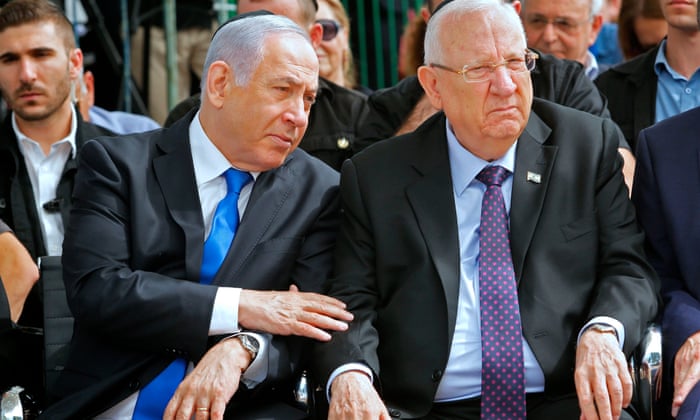
Israeli Prime Minister Benjamin Netanyahu, left, and President Reuven Rivlin.
Photograph: Gil Cohen-Magen/AFP/Getty Images
Prime Minister Benjamin Netanyahu has had two stints as his country's prime minister, the second one lasting a decade. He has always been hounded by scandal of one kind or another, charged with inappropriate behaviour, fairly unspectacular in their illicit nature, of a kind that wouldn't raise a murmur of reaction in most countries, but does in Israel. He has also achieved an enviable reputation as a man whose political skills have become legendary in his ability to manipulate events to his advantage.
That legendary skill, it might now appear, is no longer sufficient to keep him at the helm of government. His rivals feel it's time for him to move on. And those who had formerly supported his ambitions to continue as head of government can no longer be relied upon. He gambled with this second election and he lost. His manic campaigning, his promises, his international alliances that he touted would advantage Israel, his hard line against surrendering territory though popular simply failed to impress the electorate to the extent he anticipated.
Israel, originally conceived and governed as a secular Democratic liberal state under a left-leaning Labour government has become increasingly split between the push and pull of secularism and orthodox Judaism. Mr. Netanyahu's party's reliance on the support of the religious parties has failed to endear him to the greater public in Israel.
Proportional representation in a nation of fractious political parties reflecting Jewish, Arab, Druze, Bedouin, Christian and other elements of the population and their diverse and often opposing values eludes majority governments with all the public confidence and authority available to them throughout their mandate. Israel's is a complex society with nettlesome issues.
No clear election victory for Benjamin Netanyahu the second time around, and this time Likud lost three seats. And the centrist Blue and White party has no interest in propping up a Likud government. The very fact that Blue and White and its leader Benny Ganz gained over Likud's 31 seats, with 33 of the Knesset's 120 seats translates to a new government waiting in the wings. Former military chief Benny Ganz has the support of the Knesset's Arab bloc, another advantage.
"Benny Gantz is not our cup of tea." "But
we promised our constituents that we would do everything to topple
Netanyahu, and the default here is recommending Benny Gantz." Arab lawmaker Ahmad Tibi
During the first election in April the Prime Minister was seen to be denigrating the Arab bloc and the voting record of Israeli Palestinians, much less their loyalty to Israel. With good reason in many instances, given both the propensity of some Arab Knesset members to dialogue with Hamas and appear to support their agenda of violence, much less the incidences of Israeli Arab citizens continuing violence against Israeli Jews.
"As we warned, the Arab parties that oppose Israel as a Jewish and
democratic state and glorify terrorists recommended Gantz for prime
minister", stated Mr. Netanyahu in response.
"If the center-left parties of Israel believe that Arab Palestinian
citizens have a place in this country, they must accept that we have a
place in its politics." "There is no shared future without the
full and equal participation of Arab Palestinian citizens." Ayman Odeh, leader, Joint List
This too is a complicated issue. The State of Israel represents a return to Zion, the heritage geography of Biblical-era-and-beyond Judaism. It was a state meant for a Jewish nation in the realization that nowhere else on Earth could Jews feel free to be themselves. Diaspora Jews have suffered the agony of discrimination and oppression, of violence and of genocide. The re-creation of the State of Israel was meant as a remedy, a place of refuge.
Despite which, of its nine million population, almost two million are Arab. There is a sizeable African refugee population. There are Copts, Bedouin, Arameans, Circassians, Assyrians, a hodge-podge of ethnic and religious groups. All are citizens, all have the rights of citizenship. As a large minority group, Arabs hold prominent positions of authority in various levels of government, including those elected to parliament. The Jewish state, in other words, is all-inclusive.
Whereas in Arab countries they are excluded. Should a new Palestinian state ever see the light of reality, its leaders have stated unequivocally that no Jews would ever be permitted to live among them. This is the reality of the region that Israel and its Jewish population live with. Walking a fine line, playing a light tune of conciliation and acceptance.
Defending its existence and that of its Jewish population as its reason for existence. Governing such a nation is an uneasy task.
It will be left to Israeli President Reuven Rivlin to determine his choice for prime minister.
This represents a general opinion site for its author. It also offers a space for the author to record her experiences and perceptions,both personal and public. This is rendered obvious by the content contained in the blog, but the space is here inviting me to write. And so I do.