The Allure of 'Their' Future
"This is something completely new for us. And it has absolutely exploded."
"The risks are extremely high [with strong currents in the Channel, and the water so cold] you would survive for less than an hour."
"It’s been an unusually good spell for winter – very light winds, no swell."
"That seems to have encouraged the criminals. These crossings are not
being made by individuals using whatever they can find, they are
organized by criminal networks. That’s new. It’s shockingly dangerous:
this is the busiest sea lane in the world, more than 400 ships a day.
The water is at 13C. Survival time, if you fall in, is an hour."
Marc Bonnafous, search and rescue operations, Cap Gris-Nez, France
"It was cold, very cold. The sea was calm, flat, but it was frightening.
A dark night and, of course, no lights. Dangerous. We all knew it was
dangerous. We could die. Instead, we’re back here [northern outskirts of Calais]."
"The man picks us up in his van, takes us somewhere, we don’t know
where, we get in a boat. I don’t even know if he bought it or stole it."
"But I will keep trying as long as I can. I have to, of course. It is my future."
Wahid, 22, Iranian, twice-failed attempt to cross the English Channel
“They forced the window on my boat in an effort to break in."
"We
could repair it. But others, they ripped open the control panels to try
and jump-start them … They couldn’t go to sea. People have lost two,
three days’ fishing, just before New Year’s Eve."
Anthony Cuvillier, captain, fishing boat Surcouf
"[The engine
on one Boulogne boat was] completely wrecked [after intruders failed to
open its valves]."
"Someone will get killed. And these boats
can’t leave the port without appearing on the authority’s radar screen
anyway. It’s crazy."
Alain Brulin, relief crewman, the Geoffrey Laurent
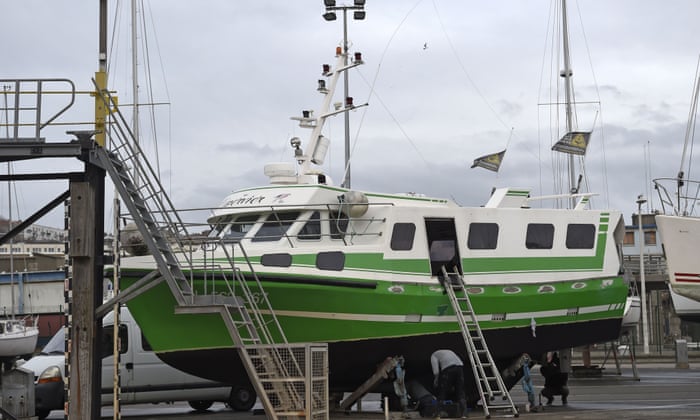 |
| Workers repair L’Epervier, a boat that was stolen and damaged by
migrants who tried to cross the Channel, in Wissant, northern France.
Photograph: François Lo Presti/AFP/Getty Images
|
A surge of migrant crossings the last three months of 2018 has been reported in Boulogne-sur-Mer, the largest fishing port in France. Those crossings are attempted in small inflatable boats setting off in the dark from beaches on the French coast. Often, however, the ships are fishing boats that have been stolen. And many of them become wrecked in the process. The owners of the fishing boats are frantic; this is their livelihood that is being threatened.
Smugglers and their migrant clients intent to reach Britain are on the lookout for any vessels they can find to allow them to cross the English Channel, despite the dangers inherent in that challenge which has always been viewed as unbreachable for its shifting currents and volatile weather making it an extremely dangerous option. The result is that fishing boat captains returning to Boulogne-sur-Mer with the day's catch tell a similar story of their boats being broken into.
Around 500 migrants, ten times the number as in 2017 made the attempt to voyage across the channel, about 30 kilometers at its narrowest point, with over half of those attempts succeeding; these crossings of huge concern to Britain, politicians hostile to immigration calling it a crisis. This is hardly immigration; it is the stealth, unwanted entrance of illegals determined to forge their way into Europe to escape a country that has failed to convince them their futures lie where they were born.
"This boat is my business; it's my only enterprise" Jean-Marie Baheu stated, working to fix a lock on his 13-meter boat,
Murex, where someone had made the attempt to smash into the captain's cabin. Deck hands busy hoisting crates of crab as the captain worked to repair the damage on the Quai Gambette, the favoured docking spot where skippers can unload their catch directly to the stalls lining the waterfront, selling their newly-caught sea treasures.
There alone, twelve attempted break-ins were logged in recent weeks
"We've never seen anything like this", Valerie Arnout, at her stand selling fish her brother's boat brought in that morning, worried. As the largest fish-processing center in Europe the town depends on its fleet for its very survival, leading some of the fishermen to claim they're prepared to sit up all night in their boats, with guns to respond to would-be break-ins.
Iranians have been identified as representing most of those making the crossing attempt, according to officials who reason they possess the funds to pay smugglers' hefty fees. Migrants were known to have paid their smuggler around $115,000 each, in one recent case, according to officials. One of the most trafficked waterways in the world, where giant container ships leave wakes threatening to tip inflatable skiffs, makes the option of stolen fishing boats irresistible.
Labels: Boats, Crimes, English Channel, Fishing, France, Migrants
The Gratitude of Atlantic Canada to EI
"In our hypothesis, we kind of assumed we'd have a negative spillover effect. But we got a positive effect and we don't know what explains this, so that's why, because of the special cultural economy in the Atlantic, it made me think about maybe it is a good idea to do some sensitivity tests."
"The question here is why the higher regional unemployment rate is associated with higher life satisfaction among workers in Atlantic Canada."
"We don't really have the answer for this, so we kind of put forward some possible explanations. One is that in Atlantic Canada you have a higher share of seasonal workers in that region, and many of them do have higher recall expectations."
Wen-Hao Chen, senior economist, Statistics Canada
"Because of the seasonal nature of the structure of the economy, people generally have been socialized into cyclical industries."
"When you lose a job it's devastating, but if you know that you're going to lose your job by the nature of the industry, it's not that you got fired, so it's not a shock to you. You know that the fishing industry ends by a certain time of the year, then you know the government steps in. So it reduces the shock itself."
"This is evidence pointing to the fact that government social programs actually lessen the negative impact of job loss."
"Public policy and social programs not only reduce the financial burden, but it also relieves your mental anguish, so your well-being ... and from that perspective you actually save on health care costs."
Ed Ng, business professor, Dalhousie University, Halifax, Nova Scotia
/https://www.thestar.com/content/dam/thestar/halifax/2018/08/01/atlantic-canadians-report-a-surprising-level-of-happiness-despite-unemployment-rate-study-shows/a_hal_unemploymentsatisfaction01.jpg) |
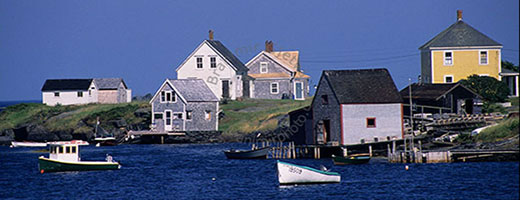
| The authors of a new study suggest that the prevalence of seasonal
employment in the Atlantic provinces is a likely cause for the positive
correlation between unemployment and satisfaction. (Andrew Vaughan / The Canadian Press) |
The high rates of unemployment in Atlantic Canada seasonally are legendary. Those receiving unemployment benefits speak of it fondly as 'the Pogy', and without embarrassment. In fact, it is well enough known -- certainly not an urban legend born of resentment in the rest of the country -- that employers and employees have established a routine of counting up work hours to qualify for unemployment funds so that others can take up the slack and be included in the qualifying work hours and resultant EI pay-outs.
A new study was undertaken looking at Canada, the United States, United Kingdom and Germany to determine the state of mind of people living congenitally with high unemployment. Invariably outside of Canada people feel unhappy and unsettled when they are unemployed and must rely on government handouts to make financial ends meet. In Canada, despite high rates of unemployment during the winter months, Atlantic Canadians alone rate their personal contentment high.
Elsewhere, the life-satisfaction gap between those who are gainfully employed and those who are in the unemployed ranks find life satisfaction steeply declining with lower well-being expressed in regions with high unemployment. Even within Canada, elsewhere than in the Atlantic provinces being unemployed and reliant on unemployment insurance leaves people heavily dissatisfied with their situation.
The positive correlation between unemployment and life satisfaction is absent for Canada as a whole, but present in Nova Scotia, New Brunswick Prince Edward Island and Newfoundland and Labrador where unemployment insurance cheques during the winter months has become a longstanding perquisite of those engaged in the fishing industry. The researchers' conclusion is that a greater number of seasonal workers in Atlantic Canada have expectations of recall.
In that they haven't faced the reality of a job loss; with the arrival of another fishing season they will be once again employed and the unemployment insurance cheques will be suspended, and all's right with their world. Knowing that this is inevitable what is considered a normal cycle of events, and one that impacts on so many others in one's community is a reassurance that all is well and normal. This transcends the dismal prospect of looking for new employment; it becomes an entitlement of expectation rewarded.
That fishing is a seasonal industry in Atlantic Canada is without dispute. The Atlantic Provinces are responsible for over 85 percent of Canada's registered fishing vessels, according to 2016 data from Fisheries and Oceans Canada. The Canadian Community Health Survey from 2009 to 2014 provided the data for the study, along with the very reality that the Atlantic Provinces were above the national average in unemployment rates for the same time frame.
Labels: Atlantic Canada, Fishing, Statistics Canada, Unemployment
Ravaging The Ocean Stock - Puntland
"Pirates will not be eliminated as long as there is illegal fishing, because those people who are doing piracy consider themselves heroes defending their resources."
Hassan Warsame, Fisheries Minister, Galmudug State, Somalia
"Now it's in the original home of piracy, in an area they thought they cleaned up. It's very disappointing."
"That's the thousand-dollar question. People keep talking about the Galmudug Coast Guard, but that doesn't exist."
"It's quite often pirates fining people, finding a fishing boat, and saying they're illegally fishing. It's not actually a coast guard. It's more former pirates."
John Steed, senior maritime expert, UN Office of Drugs and Crime

Just when the world breathed a sigh of relief that modern-day piracy off the Horn of Africa was stilled, the last month has brought a succession of piracy incidents back to the Somalian coast. Off the coast of Somalia's Galmudug state, to be precise. An area where illegal fishing vessels were convinced they must pay the "fines" exacted upon them to reflect their illegal status which would be relieved once the fines were received.
The international shipping industry views the sea lane routes that take them into that area, critical to the movement of transports valued at $700-billion in cargo every year. Now, hijacking episodes that bedevilled the industry several years back have returned, men commandeering cargo ships off the Somali coast, and re-assigning the journeys to a charted course toward the coastal town of Hobyo, known as a former pirate stronghold. From March of 2017 to April pirates have been busy in the Puntland region of Somalia.
Oil tankers, merchant vessels, fishing vessels, they are all game for the ambitious, looting Somalian pirates who feel justified in their new, remunerative mission in life. The busy transport corridors of international shipping had seen a lull in the business, however, leading the international anti-piracy forces and the shipping companies to drop their protective guard. In December a NATO naval force left the Horn due to the decline in pirate attacks.
Cargo ships halted basic precautionary measures no longer hiring armed guards, sailing further from shore at higher speeds. Now there are voices being raised in a chorus of charges that opposing through military means the proliferation of pirates to put them out of business was merely a temporary solution. Awaiting a final solution that would ensure that illegal fishing by foreign vessels, destroying Somali fishermen's legal fishing rights, is the only way to restore the coast to stability.
 |
| In Puntland the small boats used by the special maritime police force are no match
for some of the vessels used by illegal fishermen and criminal pirate
gangs. TRT World |
According to Somali federal law, foreign ships are forbidden from fishing inside 15 miles of the coast, in a measure meant to preserve fisheries for small-scale fishermen out of Somalia. Destructive bottom trawling is also banned by Somali law. In Puntland, where the federal government in Mogadishu has little control, however, those laws have failed to alt the practices they're meant to address.
Somali authorities should be engaged in intercepting illegal fishing vessels to bring them to justice, but areas like Galmudug have settled on accepting rampant illegal fishing in the absence of maritime authorities. Local armed groups have taken to extracting "fines", instead, where the Galmudug Coast Guard extracts those fines and allows the illegal foreign fishing vessels to go on their way. The reality is that Galmudug has no official coast guard.
And fishing permits are improperly doled out to foreign fishing vessels, with trawlers buying their permits from the Puntland state government which hasn't hesitated to violate Somali law where only the federal government is permitted to issue commercial fishing licenses. Ten million in value of fishing licenses were sold by Puntland's government to China last year, as well as to South Korean and Djibouti flagged trawlers.
 |
| Illegal fishermen took advantage of porous security in recent years to
pillage Somali waters, compelling impoverished fishermen to turn to
kidnapping and ransom. TRT World |
Labels: Fishing, Pirates, Somalia


