Sunday, August 28, 2022

Russia Happy to Let Europe Freeze in the Dark This Coming Winter

"[The Russian move] tells Europe that Russia is willing to flare gas instead of sending it to European countries."
"It's a reminder about how dependent Europe has been and is on Russian gas."
"We either must find new supply sources of gas or find new alternative energy sources."
Zongqiang Luo, senior analyst, Rystad energy consultancy
 
"It's been continuous for 75 days."
"Gazprom could have stopped flaring if they wanted to. It's likely they're making a deliberate choice to continue to flare."
Mark Davis, chief executive, Capterio

"The flaring is an environment disaster."
"The flaring flame is highly visible, perhaps indicating that gas is ready and waiting to flow to Europe if friendly political relations resume."
Rystad energy consultancy, Norway
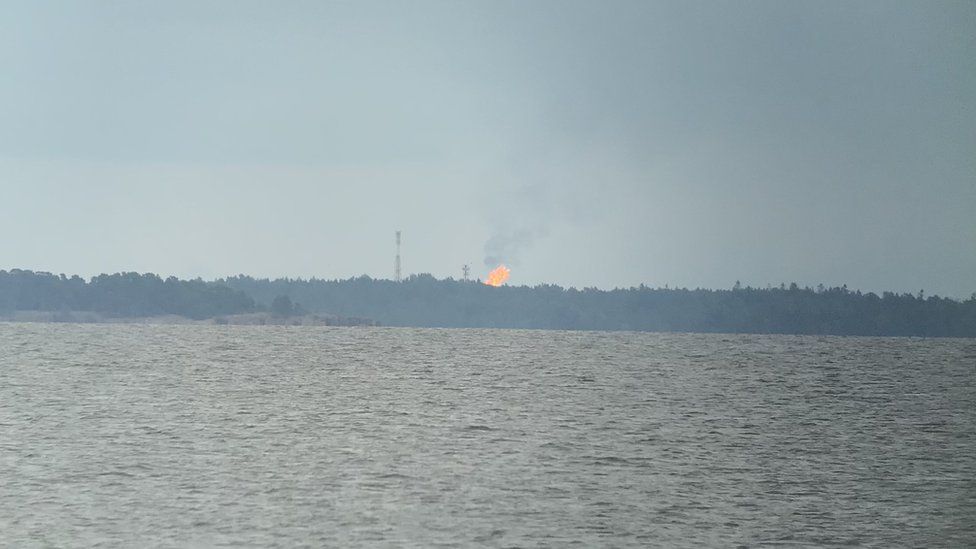
Gas flare
This photo was taken by Finnish citizen Ari Laine on 24 July at a distance of around 23 miles (38km) from the Portovaya facility   Ari Laine
 
Having dramatically reduced the amount of gas flow that the Kremlin is permitting to go to Europe as pay-back for the sanctions against the Russian Federation for sending its military on a mission to destroy Ukraine, the speculation is that all that gas going nowhere must be stored, but that there is limited storage capacity and so the gas must be burnt, effectively destroyed. 
 
Moscow made quite a fanfare over its agreement to supply China and India with gas.These are the two most populous countries on the planet, and their need for energy is manifest, and increasing. So given that contracts have been signed to supply gas for their energy needs, surely that new consumer base more than compensates for the gas being withheld from energy-dependent Europe...? 
 
Is then, the exercise strictly one of poking Europe in the eye, wasting the gas in preference to supplying it where it is desperately needed?

So there is the reality, the choice has been made by the Kremlin to flare off gas on a daily basis at a plant located near the Nord Stream 1 pipeline. This is an unprecedented situation, with experts estimating that the gas being burned reflects a lack of storage to contain the backlog, leading to the huge flare at the new liquefied natural gas plant at Portoaya since June.

Its location adjacent the compressor station at the head of the Nord Stream 1 pipeline used to transport gas undersea to Germany, is a potent message to a country desperate to find alternate sources of energy and dreading the onset of winter and a distracting situation looming in the close future. Analysts from Rystad decribe the situation in environmental disaster terms, estimating the gas being burned off into the atmosphere to be equivalent to around 0.5 percent of daily EU needs.
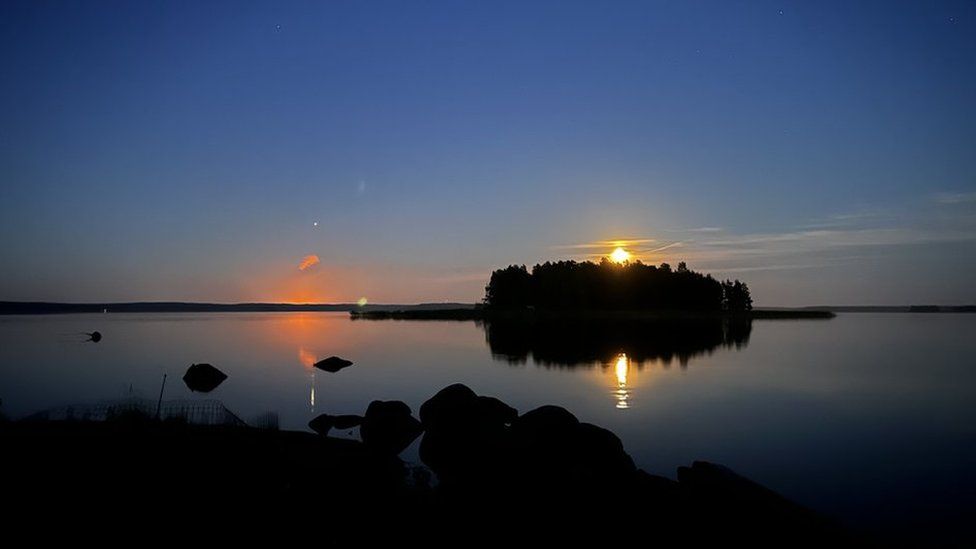
 
Gas flare
The smoke and orange light from the gas flare at Portovaya is seen on the left of this image captured by holidaymaker Elmeri Rasi
 
Satellite images of Portovaya reveal the spectacular flare. Since mid-June Moscow has curtailed supplies through Nord Stream 1 as a telling political move despite Russian claims of technical problems hampering production and delivery. Finnish citizens first caught sight of flames from beyond their border, raising awareness of the situation. It is the sheer scale of the burning that puzzles experts, not the flare offs which are not themselves unusual.

Capterio which provides gas flaring solutions for energy companies, believes the flaring could reflect technical faults caused by the trade embargo in Europe leaving Russia incapable of procuring equipment necessary to contain the gas. But they also believe that it's conceivable that the flaring is a deliberate snub at Europe's needs in response to its sanctions of Russia.

What the flare is doing is releasing 9,000 tonnes of C02 equivalent every day including the release of black carbon. Soaring energy prices since the end of COVID lockdowns and international economic recoveries have been complicated by repeat increased costs related to the invasion of Ukraine.  
"Of particular concern with flaring at Arctic latitudes is the transport of emitted black carbon northward where it deposits on snow and ice and significantly accelerates melting."
"Some highly cited estimates already put flaring as the dominant source of black carbon deposition in the Arctic and any increases in flaring in this region are especially unwelcome."
Professor Matthew Johnson, Carleton University, Canada
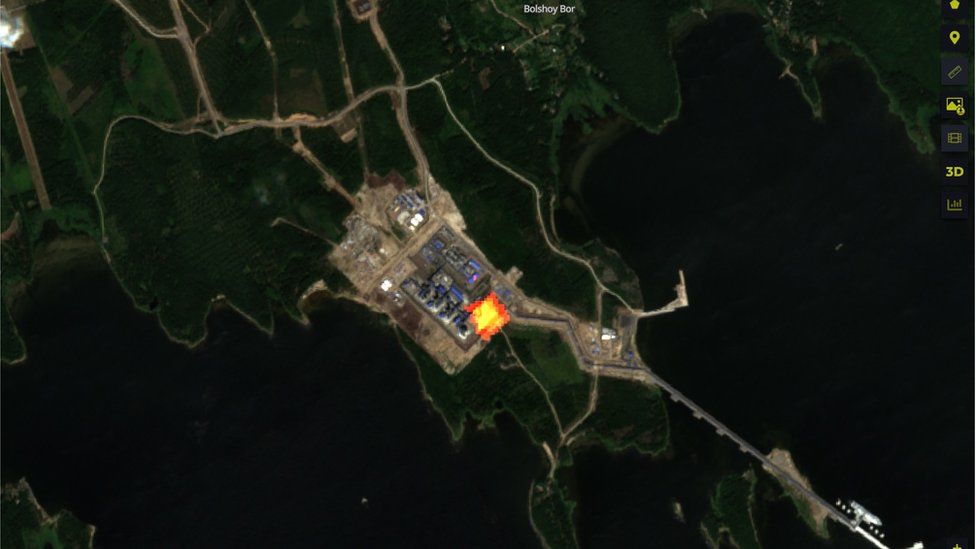
gas flare
A colourised version of this satellite image captures infrared radiation from the burning of gas at the Portovaya plant   Copernicus Sentinel/Sentinel Hub/Pierre Markuse

Labels: , , , , ,

Friday, December 24, 2021

Vladimir Putin's Ongoing Hardball Power Plays

Vladimir Putin's Ongoing Power Plays

"Everything is under a lot of stress and a lot of pressure."
"That is why we are seeing these astronomical gas prices."
Nathan Piper, head of oil and gas, Investec

"Whether they are doing it to put pressure on Europe, or simply because it is commercially advantageous, is still not clear."
"They now appear to be deliberately withholding volumes to the European spot market."
Dr.Jack Sharples, Oxford Institute for Energy Studies
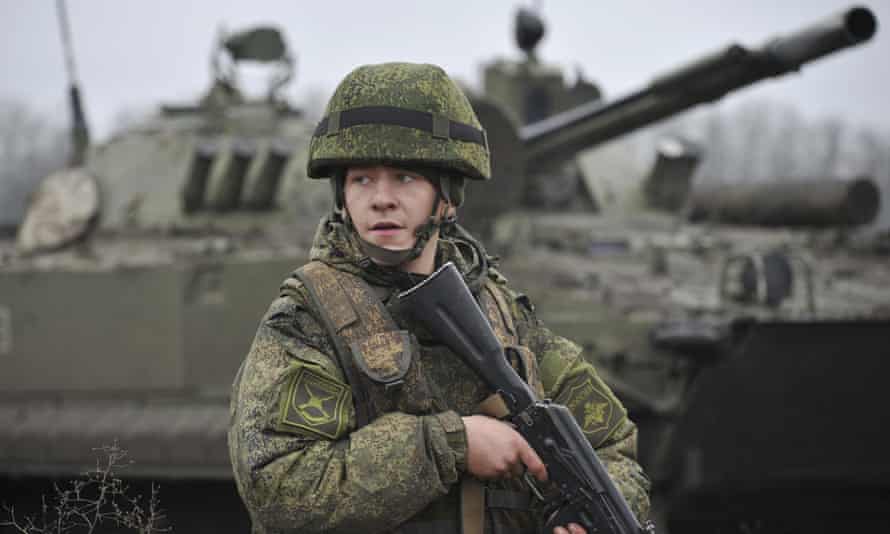
Russian soldier and tank
A Russian soldier takes part in drills at the Kadamovskiy firing range in the Rostov region in southern Russia. Russian troop concentration near Ukraine has raised concerns of a possible invasion. Photograph: AP
 
In 2019 Russia's Gazprom saw a record year in sales to Europe. The following year demand crashed when the pandemic shut down countries, until the rebound of 2021 as economies began reopening. For whatever reason that European governments and industry experts can only speculate on, Russian supplies failed to bounce back when the economies began refreshing.

The mystery is why exactly more gas is not forthcoming from Russia. Russia's state energy giant, Gazprom, has been fulfilling its contractual obligations to the letter, but has failed to respond as one might suppose a business anxious to make gains, normally would. On the other hand, this could conceivably be a game that Moscow has played before during energy-starved European winters when the Kremlin saw fit to innocently hold back gas supplies.

The supply crunch in Europe is building to crisis proportions. Demand for Russian natural gas and liquefied natural gas in Asia rose when an extremely cold season late last year extending to early 2021 along with an unexpectedly low renewable sources performance had Europe turning expectantly to Russia.

Europe was left with depleted reserves when demand saw prices pushed higher and European energy companies decided to place less into storage. Poor wind power performance in 2021 and nuclear power plants in Germany and France closing down forced energy suppliers to focus their reliance increasingly on gas. This winter sees all of these conditions come to a head.
 
The CF Industries fertilizer manufacturing complex, which is being forced to be shut down due to high natural gas prices, in Ince, U.K. Photographer: Anthony Devlin/Bloomberg
CF Industries fertilizer manufacturing complex, forced to shut down due to high natural gas prices in Ince, U.K.  Photographer Anthony Devlin/Bloomberg
 
Russia is thought to be in possession of spare production capacity, with investors on the European spot market waiting for signs Russia may decide to open the taps. But the amount that Russia is prepared to sell on the European spot market has plunged. In response to which a Gazprom spokesman said the company "supplies gas in accordance with the customers' requests in full compliance with the current contractual obligations". Full stop.

Leaving Dr.Sharples and his team to speculate that Russia, like Europe, was struggling to replenish storage levels on the vague supposition that enough gas to go around was simply not there. That was relegated to the wastebasket of hope once Gazprom announced it had no need to continue topping up its facilities after November 8. And so, the plot thickens.
 
Leaving some experts to suggest a geopolitical pressure tactic by Vladimir Putin since gas flows across the Ukrainian border also appear heavily down. Pressure by Moscow for EU regulators to approve the Nord Stream 2 pipeline to Germany, where Western leaders foresee Russia diverting flows away from Ukraine at the very time Putin is amassing troops at the border.
 
The potential exists for Gazprom testing European patience to the point of backfiring. Investment could be driven to alternative sources of energy and in the process break Europe of its gas addiction. In the meanwhile European power prices hit a new record while France faces a winter supply shortage of huge proportions. Its heavy industries forced to curb production across the region.
 
Electricity delivery for the coming year leaped to an all-time high for both Germany and France, two of the largest economies in the European Union. France will no longer think of exporting power to other countries, facing outages at nuclear plants, and needing all the energy it can source for itself. France, in the face of this severe situation is forcing factories to cut output or altogether shutter. 
"If we have a very, very cold day, it could be problematic, especially if we have to import and our neighbours have problems, as well."
"This is the domino effect we need to fear. But electricity will be expensive, there's going to be a cost to pay."
Anne-Sophie Corbeau, research scholar, Center on Global Energy Policy, Columbia University, Paris
And in Germany, power for next year leaped in megawatt-hour cost after a 25 percent rally. "The strength in the French market has been the main engine -- aside from gas prices -- of strength in neighbouring markets, including Germany, in recent days", commented the head of European power analysis at S&P Global Platts. 

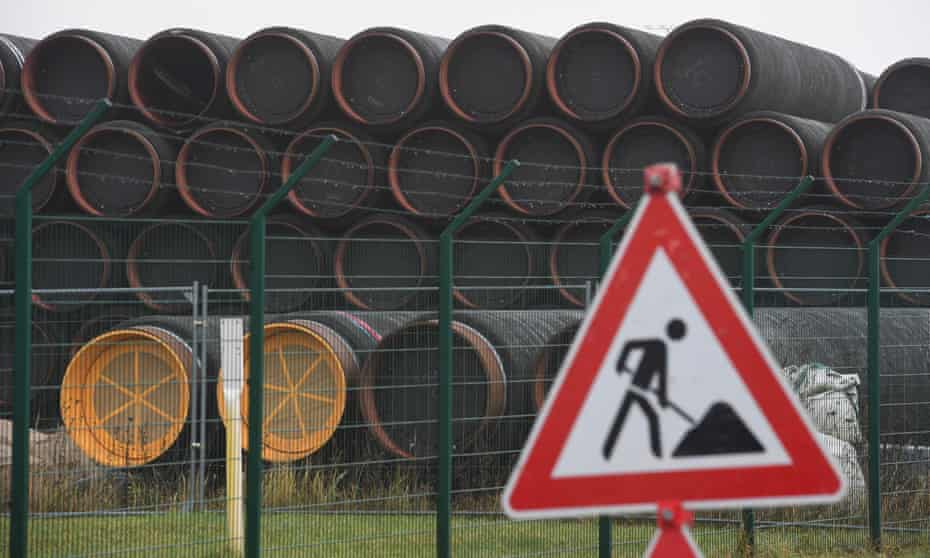
Piles of tubes for Nord Stream 2 pipeline
Tubes for the construction of the Nord Stream 2 pipeline are piled on the Baltic Sea island of Ruegen in north-eastern Germany in December 2019. Photograph: Stefan Sauer/DPA/AFP/Getty Images


Labels: , , , , , ,

Follow @rheytah Tweet