Healthcare for Jews in Australia Under Siege
"A wide-ranging investigation
published by The Australian has highlighted a series of troubling
allegations concerning a rise in antisemitism within Australia’s
healthcare system since the attacks of October 7, 2023."
"More
than 30 doctors, nurses, midwives and other healthcare professionals
described an increasingly politicized workplace, alleged discrimination
against Jewish patients and staff, and incidents that have caused
growing concern within the country’s Jewish community."
"According to the testimonies
gathered by the newspaper, pro-Palestinian activism that emerged on
Australian streets after October 7 gradually spread into hospitals and
other medical institutions."
"Staff
members at several hospitals in Melbourne and Sydney were reportedly
seen wearing badges or displaying posters bearing the slogan “From the
river to the sea.” Political stickers were also allegedly placed in
hospital departments, including one depicting a Star of David crossed
out with a red line."
i24NEWS
"Anti-Israel
activism began almost immediately after the October 76 massacre when
the protests that unfolded in Australian cities spilled into the wards
and staff rooms of hospitals in Melbourne, Sydney and other capital
cities."
"At
the Alfred Hospital in Melbourne, which has received tens of millions
of dollars from Jewish philanthropists, such stickers [Star of David
with red line through it] were stuck to the bedside wall of an elderly
Jewish patient in the hours before he died."
Megan Goldin article in The Australian
"Doctors
and nurses were posting Nazi symbols and little caricatures of Jewish
people but using the word 'Zionist' instead of 'Jews'."
Jewish pediatric neurologist Carly Debinski
 |
| Sydney, Australia Mark Baker/AP |
A report published by The Australian
following an investigation into a seeming pandemic of antisemitic acts
by Australian health-care workers against Jewish patients, caught the
attention of the Israeli Foreign Ministry, characterizing it as a "deeply
troubling picture and should serve as a wakeup call. We call upon the
Australian government to confront antisemitism forcefully. No Jew should
ever feel compelled to hide their identity to receive medical care in
an Australian hospital", wrote Israel's Foreign Ministry.
A link to The Wentworth Report quoting large sections of an article written by Megan Goldin in The Australian was
included in the ministry's statement. The article detailed a number of
egregious antisemitic behavioral examples by hospital staff toward
Jewish patients in medical facilities in Australia. The article revealed
statements by 30 doctors, nurses, midwives and health professionals who
were interviewed describing their experiences since the October 7, 2023
massacre, where anti-Israel activist health-care workers were "turning hospitals and medical clinics into ideological war zones instead of safe spaces".
The
case of Elon Glassberg, former surgeon general of the Israel Defense
Forces was cited by interviewees, whose scheduled appearance at a
medical conference in Perth was cancelled last year when anti-Israel
doctors and nurses threatened to protest. Immediately following October
7, anti-Israel medical staff wore protest symbols at work. Bathroom
stalls and hallways were covered with stickers, one of which represented
a Star of David with a red line struck through it.
Facebook
group Jewish members have been vilified or ejected should they speak of
Israeli hostages, much less the horrendous atrocities perpetrated by
Palestinian terrorists and ordinary Palestinian civilians, led by Hamas
on October 7. A Jewish intensive care unit nurse at a Melbourne hospital
was cited, (who requested anonymity), resigned her position of
over ten years in response to management's having refused to address
hateful speech online, by hospital staff. "If these people are willing to share these things on social media, imagine how they treat a patient face-to-face."
A doctor who described Jews as "loathed slime" online
and posted a Hitler quote faced no consequences. Complaints of any
number of other doctors who posted antisemitic, pro-Hamas positions also
faced no consequences. "That
pattern was repeated across the country as hospitals and healthcare
regulators tolerated conduct against Jews that would have triggered
disciplinary action if the conduct had targeted any other minority
group, say numerous medical professionals who experienced this double
standard" reported The Australian.
 |
| Anti-Israel protesters in Sydney, Australia ASSOCIATED PRESS |
"The Australian Health Practitioner Regulation Agency (Ahpra) and the
Australia’s Special Envoy to Combat Antisemitism, Ms Jillian Segal AO,
not only condemn antisemitism in all its forms but also reaffirm their
shared commitment to eliminating antisemitism – together with all forms
of racism and discrimination – in healthcare."
"Antisemitism causes real and lasting harm. In healthcare, it erodes
trust, creates fear and exclusion, and can prevent people from seeking
or receiving care. It also undermines the safety and wellbeing of Jewish
health practitioners and staff. There is no place for antisemitism in a
system dedicated to protecting health and saving lives."
"The Special Envoy to Combat Antisemitism said:
‘Healthcare should be a safe space for the entire community –
patients, practitioners and workers alike. The antisemitism we’ve seen
recently puts everyone at risk, and it has no place in our health
system. I commend Ahpra for adopting the IHRA definition of antisemitism
and committing to putting in place further measures to help push
antisemitism to the margins.’
Ahpra is strengthening its capability to respond effectively when
antisemitism is identified through its regulatory processes. This
includes ensuring staff have the necessary training, clear guidance and
expert advice to ensure matters are handled with cultural understanding,
sensitivity and rigour."
"Ahpra CEO Justin Untersteiner said: ‘Antisemitism costs lives and has
no place in healthcare. Ahpra is committed to working with the Special
Envoy and partners to eliminate antisemitism from the health system,
because everyone should feel safe when accessing care.’
Ahpra has adopted the International Holocaust Remembrance Alliance
(IHRA) definition of antisemitism as a reference tool, supported by the
Special Envoy’s handbook to support a consistent understanding of
antisemitism in its contemporary forms in our regulatory work.
Ahpra is reviewing its Vexatious Notifications Framework in response
to concerns about weaponisation of the notifications process and is
establishing an advisory panel of practitioners – including those with
lived experience of notifications underpinned by antisemitism - to
inform improvements to systems and processes and strengthen safeguards."
The Australian Health Practitioner Regulation Agency (Ahpra)
 |
| Marie McKinerney, Croakey Health Media |
Labels: Anti-Israel Activism Impeding Health Care for Jewish Australians, Antisemitism, Australia, Hospitals, Medical Staff, Patient Care in Crisis
Protecting Canada's Medical Supplies from Punishing Tariffs
"The
announced tariffs on Canadian exports, along with retaliatory tariffs
imposed by Canada on the U.S., will likely bring significant risks to
Ontario's health care system, including the disruption of access to
vital equipment and supplies."
"The
OHA [Ontario Hospital Association] is very concerned about the impact
of this trade war on the delivery of care and is engaging with the
federal and provincial governments and other stakeholders to fully
understand and minimize the impact on hospitals."
"[Much is still unknown in the] evolving [political climate]."
Melissa Prokopy, vice-president, policy and advocacy, Ontario Hospital Association
"We do stand with the government, you know, that U.S. tariffs cannot go unanswered. However, health care must be protected."
"We are looking for exemption of health-care products from any retaliatory tariffs."
"This will be very important to protect supply chain stability and prevent any kind of cost escalations."
Christine Donaldson, chief executive, Health PRO Canada
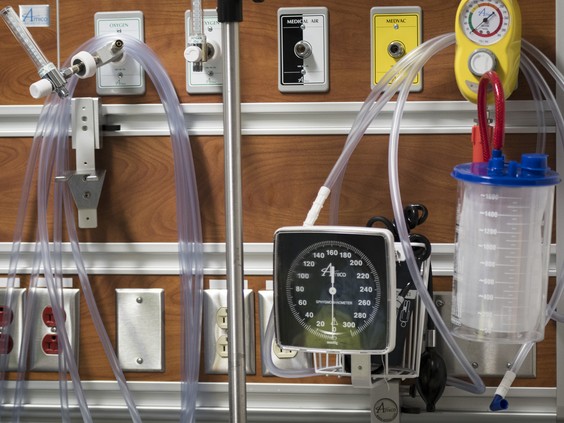 |
| In a global supply system, making pharmaceuticals
and medical devices often involves multiple countries, so it might be
difficult to pinpoint all the specific components that come through the
U.S. that might be subject to counter-tariffs. Photo by Tijana Martin/The Canadian Press files |
Federal
and provincial governments in Canada are being urged by health
associations to make certain that patients in Canada will not become
caught in the crossfire of the trade war that the new Trump
administration in the U.S. has imposed upon Canada. HealthPRO Canada, a
company which purchases medications, supplies and equipment for over
2,000 hospitals, health-care facilities and long-term care homes across
the country announced it is seeking clarity on potential future
counter-tariffs.
The
company's chief executive made a comparison to the automotive industry,
with the manufacturing process for many health-care supplies where raw
materials and components often cross borders "several times before they reach their finished production".
In other words, a fully integrated system of production shared by the
U.S. and Canada. The imposition of tariffs entirely disrupts the free
flow of materials and finished products.
While
it is not yet clear which products in particular could potentially be
affected by future counter-tariffs, some essential medications, medical
devices and diagnostic imaging equipment -- including MRI and CT
scanners, surgical tools and ventilators -- frequently are manufactured
in the United States.
Hospitals
could also be affected through counter-tariffs on food, mattresses and
other non-medical goods in the uncertainty brought about by the ongoing
trade war, when U.S. President Donald Trump decided that he was
dissatisfied with the existing U.S.-Canada-Mexico free trade agreement
that he signed on to during his first presidential term, expressing his
satisfaction at the time that negotiators representing the three North
American countries had hammered out a good free trade agreement.
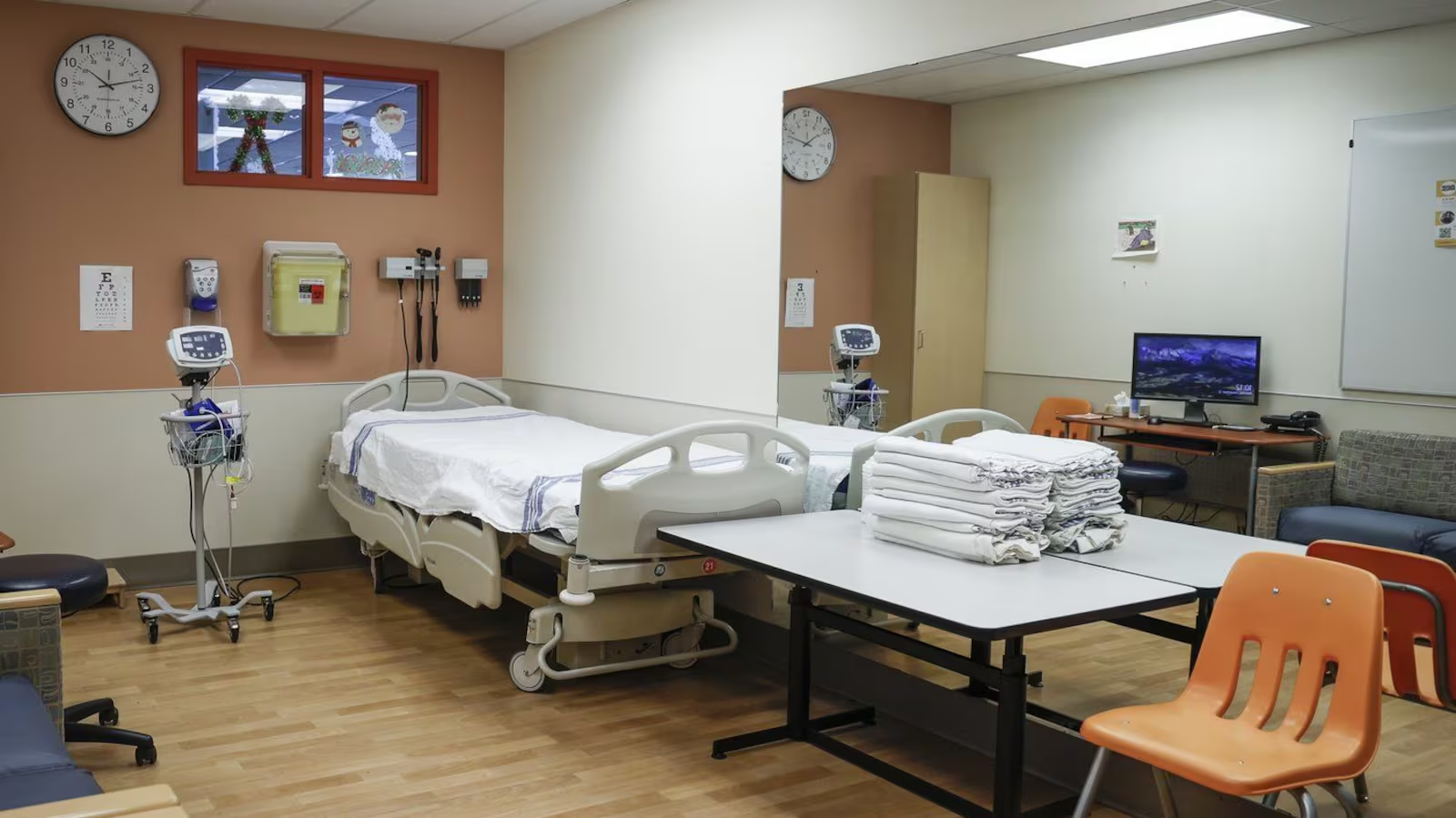 |
| A treatment room is pictured at the
Alberta Children's Hospital in Calgary, Alta.
THE CANADIAN PRESS/Jeff McIntosh |
The types of medical devices most affected by tariffs on China, Mexico, and Canada include:
- Medical Imaging Equipment: Devices such as MRI machines, CT
scanners, and X-ray machines are heavily impacted due to their reliance
on imported components.
- Surgical Instruments: Many surgical tools and instruments are imported, and tariffs can significantly increase their costs.
- Diagnostic Equipment: Devices used for diagnostics, including blood analyzers and other laboratory equipment, are also affected.
- Electronic Medical Devices: This category includes devices like
pacemakers, defibrillators, and other electronic health monitoring
equipment.
- Personal Protective Equipment (PPE): Items such as gloves, masks,
and gowns, which are crucial for healthcare workers, face increased
costs due to tariffs.
Labels: Canada-U.S. Trade War, Canada's Health Care System, Care Delivery, Health-Care Products, Hospitals, Retaliatory Tariffs
Moscow's Scorched-Earth Agenda in Ukraine
 |
Kherson in June, New York Times
|
"If
the war ended tomorrow, and I don't think it will, it would take five
years to rebuild that dam and then at least two more for the reservoir
to fill up."
"Then it would take another ten years for the fish to grow -- for some species, 20 [years]."
"I'm 50. I don't know if I'll even be around that long."
"[This was a] katastrofa."
Serhii Bezhan, patriarch, Fishing business
"If we irrigate with only what nature gives us, it will not grow. Because now there's cool
weather and rain here, but in the summer the climate is very dry, it's
very hot, and so [the harvest] won't even be here at all."
"[The word in the local business community was that] once the Russians
were kicked out [there was a plan to at least temporarily block the
river and restore the reservoir].""For now, while they [the
Russians] are here — 20 kilometres away from us — the government doesn't
want to do this because obviously they might be shelling and there will
be casualties."
"We really love this water reservoir.
It gives life. We all depend on this water."
Denys Myronenko, strawberry and grape farmer
"There's now a whole downstream catchment of the river that is not
controlled. In the wetter periods
flood waves will just come through."
"I expect those tens of thousands of people who were evacuated will have
to stay away for a while as long as those solutions are not in place.
It is difficult to see people coming back to those communities in this
situation."
Jaap Flikweert, flood and coastal management advisor, engineering consultancy Royal HaskoningDHV
 |
| The dried-up Kakhovka reservoir in Ukraine is shown after the dam was
destroyed on June 6, causing massive flooding along the lower Dnipro
River. The receding water has revealed the remains of an ancient
settlement known as the 'Cossack Meadow.' (Stephanie Jenzer/CBC) |
When the Kakhovka Reservoir in central Ukraine was still intact, kids
would play in the shallow water close to shore. Young couples would
stroll beneath the pine trees, and men would go there to fish. This
idyll was destroyed months ago when a major downriver dam was destroyed
and the lake that shimmered in the sun and was a favourite recreational
area for residents, was drained. It had once reined as one of Europe's
largest lakes. In its place now, is a 150-mile-long meadow.
Serhii
Bezhan's family business was established sixty years ago as a fishing
enterprise on the shores of the lake. Generation after generation of the
family made an enterprising living off fish. There are now no longer
any fish to be caught. The family business of buying boats, nets,
freezers and huge ice-making machinery is also now no more.
The
seismic meters hundreds of miles distant from the reservoir and the dam
on June 6 detected an explosion of enormous force taking place at the
Kakhovka dam along the Dnieper River. The dam's reinforced concrete
walls, over 60 feet in height and up to 100 feet thick, had crumbled,
resulting in a massive 4.8 trillion gallons of water escaping in huge
gushes flooding downstream communities.
The
evidence indicating scientifically that the dam was blown up from
inside has been attributed to Russia, a deliberate act of civilian
sabotage, a war crime. A war crime among many other war crimes targeting
civilian infrastructure; markets and schools and hospitals. The
rehearsal of all these war crimes that took place in Syria is continuing
to play out in Ukraine. Epic floods were created inflicting more misery
on the Ukrainian population.
First
the flood, then an ensuing drought, and wholesale environmental
destruction, to the Ukrainian economy, to the lives of people never
imagining their vast country would ever be under invasion and occupation
again by a rapacious and cruel neighbour. To the present day, homes
remain water-logged and mud-smeared. Everywhere lie the stinking
skeletons of dead fish. There is a drinking-water crisis, a crisis of
lack of irrigation for farmers. Communities bereft of work. Losses whose
depths are not yet fully understood.
It
seems there is no level of destruction and malevolent misery to be
inflicted on the invaded country that is too extreme to be contemplated
by a civilized world view. Power plants have been bombed with great
deliberation, as have grain silos, with massive food losses. At one and
the same time, Russia claims Ukrainian geography is really Russia's,
while inflicting grave wounds on the land, destroying towns and cities,
turning infrastructure into rubble, depriving people of their homes and
their livelihoods and their lives.
 |
| Local residents take boats along a flooded street in Kherson, Ukraine,
on June 8 as they evacuate from a flooded area after the Nova Kakhovka
dam was destroyed two days earlier. (Vladyslav Musiienko/Reuters) |
"At 2:35 a.m and 2:54 a.m. on June 6, seismic sensors in Ukraine and
Romania detected the telltale signs of large explosions. Witnesses in
the area heard large blasts between roughly 2:15 a.m. and 3 a.m. And
just before the dam gave way, American intelligence satellites captured
infrared heat signals that also indicated an explosion."
"The dam was designed to withstand any kind of attack from without."
"Evidence suggests Russia blew it up from within."
New York Times
Labels: Apartment Buildings, Bombed Power Plants, Destroyed Infrastructure, Environmental Destruction, Hospitals, Russian Invasion of Ukraine, War Crimes
Wuhan Novel Coronavirus
"The
public has criticised us a lot … why? It was because some of
our work was not done well." "What have we not done well? At present,
the contradiction between supply and demand of hospital beds has
remained conspicuous.""Honestly,
we are in pain and feel regrettable that a lot of the patients who have
been confirmed infected or were suspected to have contracted the
coronavirus were unable to receive proper treatment at hospitals. This problem definitely has remained unresolved." Hu Lishan, deputy secretary, Communist Party, Wuhan
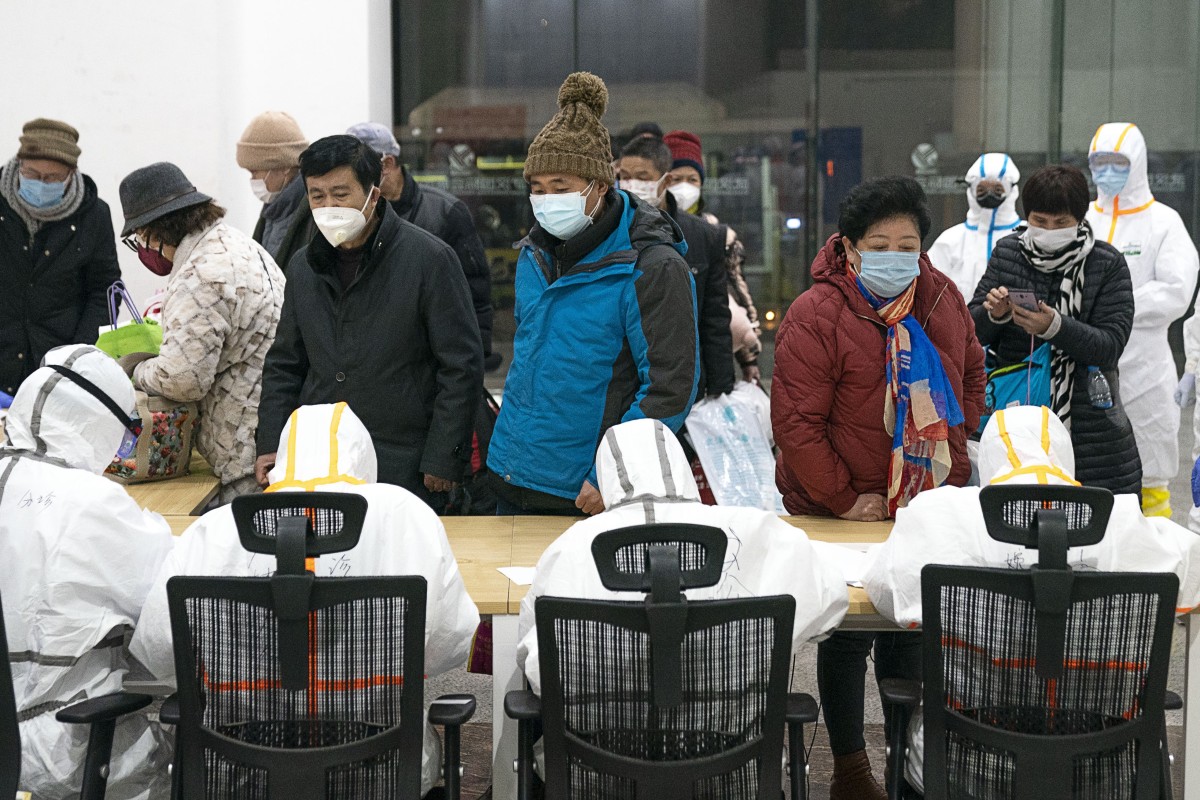 |
| Medical workers in Wuhan help patients infected with the novel
coronavirus check in at a makeshift hospital, converted from an
exhibition centre, on Wednesday. Photo: Xinhua |
Although some authorities in China are taking responsibility for not having acted early enough in response to the initial mysterious appearances of a handful of flu-like hospital admissions in the city of Wuhan in late December of 2019, it would be hard to claim now that those same authorities are not taking the situation seriously. The 1,000-bed Huoshenshan Hospital, built in a ten-day emergency construction operated by military medical personnel is now accepting patients found to be infected with the novel coronavirus that first surfaced in an open-air live-animal market in the city.
Another hurriedly-built hospital, the Leishenshan, is now close to completion and will add another 1,600 beds, while the city of Wuhan is busy converting a sports stadium and two convention halls into what they call "modular hospitals" which themselves will have capacity to house patients with mild symptoms and which are expected to add an additional 3,800 hospital beds. It doesn't end there, another eight hospitals to offer 4,600 more beds are, as well, being built in response to the fact that 550 people have died due to the infection in Hubei province.
A drug developed in the United States to treat the Ebola virus has undergone initial testing and is on the cusp of being redeployed for use as an anti-viral medication on an experimental basis to treat for coronavirus. Remdesivic is awaiting approval for treatment as a stage-three clinical drug trial. Gilead Sciences based in the U.S., which produces the drug, is collaborating with Chinese health authorities to establish a “randomised, controlled
trial” to determine whether remdesivir can safely and effectively be
used to treat the coronavirus.
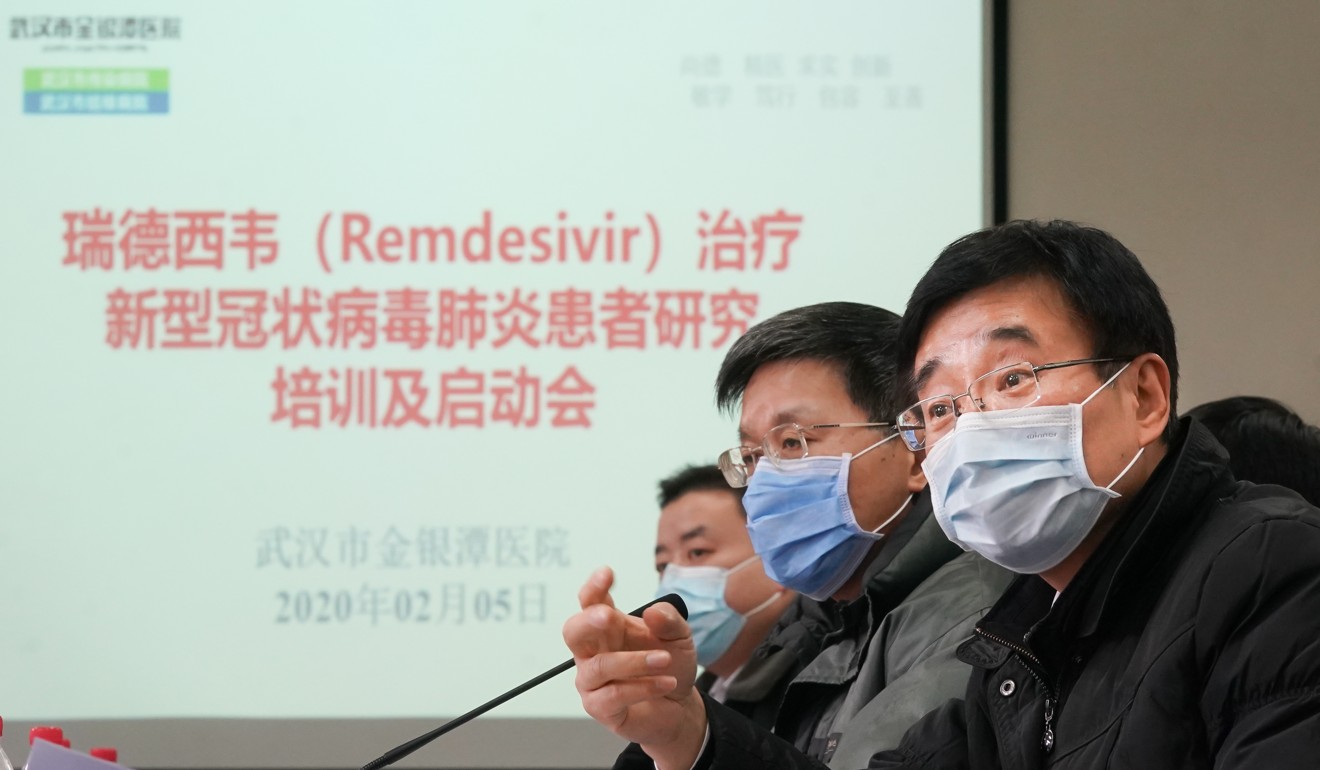 |
| Wang Chen (right) president of the Chinese Academy of Medical Sciences,
speaking Wednesday at a conference in Wuhan at which it was announced
that clinical trials using the antiviral drug remdesivir have been
approved. Photo: Xinhua |
"This could be more akin to a moderately bad flu, or even a more severe flu, which the world experiences every decade or so", according to Dr.Michael Gardam, chief of staff at Humber River Hospital in Toronto, as an infectious disease specialist. "Nobody's not worried. But none of us are worried currently that this is a problem in Canada. We're all worried about the potential of this becoming a problem in Canada."
"Because of the nature of how it's spreading and what's happening in China, we could unfortunately be dealing with this story for the next two years", he assayed. "In the most likely scenario, we're going to get more cases", stated Dr.Steven Hoffman, epidemiologist and director of the Global Strategy Lab at York University. "But also what's most likely is that they'll be quickly identified and contained, just like the first four cases [to be diagnosed in Canada] were."
A 50-something-year-old woman, resident of Metro Vancouver had been in "close contact" with Wuhan visitors to Canada. She became ill and was tested and treated in hospital, then released. Her sample was returned identified as positive, and has been sent on to the National Microbiology Laboratory in Winnipeg to determine whether the early diagnosis can be confirmed. She remains in quarantine in her home, as do her visitors.
 |
|
Although novel coronavirus may not be as fatal as first feared, the latest case is significant in that the patient hadn't travelled to China. "That's called secondary spread. That's a problem", said Dr. Isaac Bogoch, an infectious disease specialist at the University of Toronto. A viral pandemic can occur when the chains of transmission multiply and where containment efforts fail. When the virus spreads from people who were infected at the outbreak site to people they physically touched, and then went on to third or fourth-degrees of separation in various locations, is where the problem arises.
"In a week or two, we'll know which direction this is going. I still think all efforts should be on containment. But we have to prepare for the situation where that does not succeed."
"If there's a bunch of them coming in, you can run around and catch them, but if you're just getting overwhelmed, lots of t hem are going to miss you and they're going to hit the ground."
Dr.Isaac Bogoch, infectious disease speciailist, University of Toronto
Best-case scenario is that the health detection system will identify those in the community who present with symptoms and to isolate them until the danger of infection is past. But those in the community who are not symptomatic but who carry the virus have the potential to spread it widely. Attempting to catch everyone who might be infected before, or as soon as they land in the country becomes a problem of hit-and-miss.
Labels: China, Containment, Coronavirus, Experimental Drug, Hospitals, Remdesivic
"That's The Way It Is"
"We will do our utmost to learn the truth."
"This case is like a house of dark rooms. We want to bring light into the darkness."
Judge Sebastian Buehrmann, Oldenburg, Germany
"They had everything they needed [to stop him] – you don’t have to be
Sherlock Holmes."
"I didn’t expect it [the mass murderer's quick confession in court] to happen today. We now have a chance to make some real progress."
Christian Marbach, grandson of one murdered patient
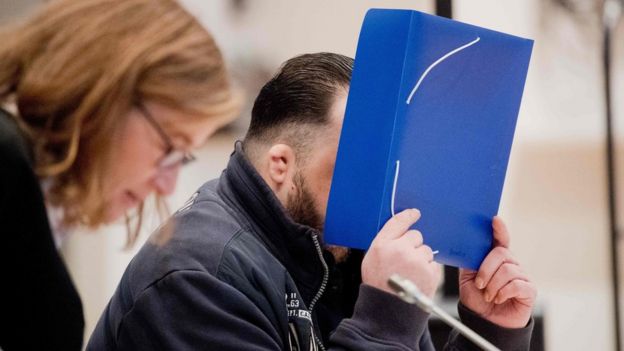 |
| Niels Högel hid his face from the cameras in court on Tuesday AFP/Getty |
He was bored. And he wanted attention. And no doubt, respect. What better way to draw the attention of his peers and his supervisors than to demonstrate such devotion to his work than when patients went into a steep and swift decline he would be there at their side, desperately attempting to resuscitate them? The patients were in serious medical condition to begin with. Occasionally he succeeded, and those who survived represented the successful staging of his two-part agenda.
He would administer deadly drugs to bring patients to the cusp of death, then rush to their assistance to make an effort to draw them away from death's embrace. Most times it wasn't possible, and so that 130 or so patients whose untimely end he was responsible for, fell victim to his sometimes-successful ploy at heroic nursing. It was the price they paid for their vulnerability, for fate that placed them in a facility where this man, 41-year-old Niels Hoegel, was employed.
As the accusations against him were read out in court in the presence of some 120 family members of some of those whom his ministrations deprived of their lives, and as he admitted the accusations were correct, he added:
"That's the way it is". And so it was. The larger pity of it was that those of his co-workers who observed the man behaving in unauthorized and clearly dangerous ways seemed not to notice.
Between the years 2000 and 2005 he was a busy man. He managed to destroy the lives of over a hundred patients at two institutions he was employed with. By administering deadly drugs like lidocaine and calcium chloride. And then coming to their aid, mostly unsuccessfully. It was, however, noted by authorities as well as co-workers that it was when he was on duty that people were losing their lives.
Prosecutors have stated that this nurse acted as he did, propelled simply by "boredom". The predictability of life? To which he inserted his own version of unpredictability; as in who would ever imagine that a nurse would make his life all that more interesting by giving the Angel of Death a helping hand? And he did, extremely generously.
The man is familiar with what awaits him; unending incarceration. Since he has already been a decade in prison, charged and convicted with six murders along with a few more attempts that failed to succeed. And receiving a life sentence for his pains. Once details emerged that Hoegel could have killed an additional hundred patients over those he was convicted of murdering, a new trial was ordered.
Grieving families agreed to allow their dead to be disinterred, to be tested for conclusive evidence. Some of his victims between the ages of 34 and 96 were cremated, so no exhumations there. More than enough were buried conventionally for the investigation to proceed, however. And he did, after all agreed that
"Yes, what I have admitted took place".
Infuriatingly, staff who shared nursing duties with Niels Hoegel knew of irregularities on his part while administering his nursing duties. They did nothing. Perhaps they too were bored. When caught injecting the deadly drug cocktail in 2005 to one of his victims, there was no immediate intervention by hospital authorities. It was only when yet another patient was killed by Hoegel with the very same method that they finally acted.
And so, hospital responsibility in the deaths through lack of integrity and action is also being examined by investigators at the two hospitals where nurse Hoegel worked as he went about acting in tandem with the devil. And four of his former colleagues now face charges of failing to report evidence that might have prevented further deaths.
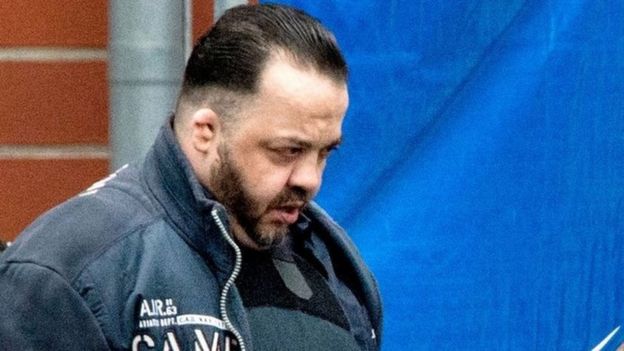 |
| He was later seen being led to a police vehicle AFP |
Labels: Germany, Hospitals, Murder, Nurse


