Seeking To Be Reunified
"Here in the town, he was like a mayor. Everyone knew him and loved him."
"My mom is destroyed. She cannot even talk."
Wilton Reynoso, Vega, Guaraguao, Dominican Republic
"[They led him to believe] it was so easy."
"There were two kilometres they [illegal entrants] had to walk [by themselves]. They [human smugglers] dropped them off and said, 'Go straight'."
"People have to know. He didn't have to die. Nobody had to die."
"He ... didn't know his left or right. He probably couldn't lift his face up anymore, and he just went down, and 30, 40 centimetres of water was enough to drown."
Andrew Burzminski, Toronto
"[Locals] consider the wooded marsh a] no man's land."
"None of us would dare even to take a chance walking through that area. It's very spongy. You get in there, it's almost like a quicksand...."
"It's obvious they didn't have a clue."
Eric Boyse, Hemmingford, Quebec
 |
| Wilson Reynoso Vega, from the Dominican
Republic, paid a smuggler to help him slip into the United States
through the Quebec border. He was found dead in marshy woods April 16,
2019.
Photo via Facebook |
He was a young man, an attractive personality, a local celebrity in the farming town of Guaraguao. A singer, the 32-year-old performed under the name Jensen Junior. He had an eleven-year-old daughter whom he missed. His wife had taken the little girl after several years living in the Dominican Republic, to the United States. But Wilson Reynoso Vega, the little girl's father, never forgot his daughter. He kept in touch, they spoke frequently, he posted her photographs on his Facebook page.
He decided he would take a trip to see her, but his application for a tourism visa to the United States had been refused. He succeeded in obtaining a tourist visa to Canada, however. He flew from Santo Domingo to Toronto and paid two smugglers $3,500 for their help in crossing the border illegally. And where they took him was to a notorious area between the province of Quebec and New York State.
It is where a thriving trade in human smuggling has been taking place with Haitians and Nigerians slipping through across the border at illegal crossings with the help of smugglers. Once these migrants cross illegally, the RCMP take them into custody, where they claim asylum as refugees. This starts a process whereby their claims will be assessed and in the meantime, the claimants are fed, housed, and given social assistance through welfare.
 |
| A
long line of asylum seekers wait to cross the Canadian-U.S. border near
Champlain, New York, on August 6, 2017, illegally. A father died trying
to make the journey across the border to see his daughter in the U.S. GEOFF ROBINS/AFP/Getty |
They can end up living in Canada for years before their claims are assessed given a backlog; most to be denied, but the claimants can then seek other avenues of consideration in appealing their rejected claims, and continue extending their stay in Canada for years, and living off social welfare. This young man, Reynoso Vega focused on accessing the U.S. border, going in the opposite direction to the 40,000 that had crossed illegally into Canada.
He ended up being part of a group of about a dozen men, driven to the border by the smugglers, and informed that they should continue on foot across the border from Canada, where someone would then pick them up on the American side. On the night of April 15, the group approached a woodland marsh on the northwestern shore of Lake Champlain. Night temperatures dropped to freezing.
The others in the group noted that Reynoso Vega appeared to become disoriented, and eventually he became separated from the group. All the others, Mexicans, later said something appeared to be awry with his balance and orientation. As the others straggled across the border into New York, they were arrested. And they then reported Reynoso as missing.
The next day his body was discovered, the cause of death determined to have been drowning. The coroner informed Reynoso's Toronto friend Burzminski who identified the body, that Reynoso had been in a hypothermic state for hours before death. He was found with rubber boots on his hands and family members speculate that he was crawling, unable to make any headway in the muck, where police said he had been moving in a circle.
An Ecuadoran man who told police that he had been offered $600 to pick up the people at Rouses Point in New York, has been arrested. Because the impoverished family cannot afford to repatriate Reynoso's body, it remains in Montreal. His mother has been hospitalized, utterly distraught by her loss. Reynoso's daughter will never see her father again.
And another tragedy has played out in a world where dislocation and the human dimension echo forlorn sorrow.
Labels: Canada-U.S. Border, Illegal Entry
Give Me Your Auspices to Advance Into a Future of Security and Opportunity...
"The Caravans are a disgrace to the Democrat party. Change the immigration laws NOW!"
"Every time you see a Caravan, or people illegally coming, or attempting to come, into our Country illegally, think of and blame the Democrats for not giving us the votes to change our pathetic Immigration Laws!"
"We will now begin cutting off, or substantially reducing, the massive foreign aid routinely given to them [Guatemala, Honduras, El Salvador]."
U.S. President Donald Trump
"[The United States, Canada and Mexico should work out a joint plan to fund development in Central America and southern Mexico]."
"In this way we confront the phenomenon of migration, because he who leaves his town does not leave for pleasure but out of necessity."
Mexican president-elect Andres Manuel Lopez Obrador
"We have had people who have ankle or shoulder injuries, from falls during the trip, and even though we have offered to take them somewhere where they can get better care, they have refused, because they fear they'll be detained and deported."
"They want to continue on their way. They are going to continue walking, and their feet won't heal as long as they keep walking."
Ulises Garcia, Red Cross official
"You have to help the next person. Today it's for them, tomorrow for us."
"From them we learn to value what they do not have."
Jesus Valdivia, Tuxtla Chico, Mexico
"There isn't a single terrorist here. We are all people from Honduras, El Salvador, Guatemala and Nicaragua."
"And as far as I know there are no terrorists in these four countries, at least beyond the corrupt government."
Denis Omar Contreras, Honduran-born caravan leader, Peubo Sin Fronteras
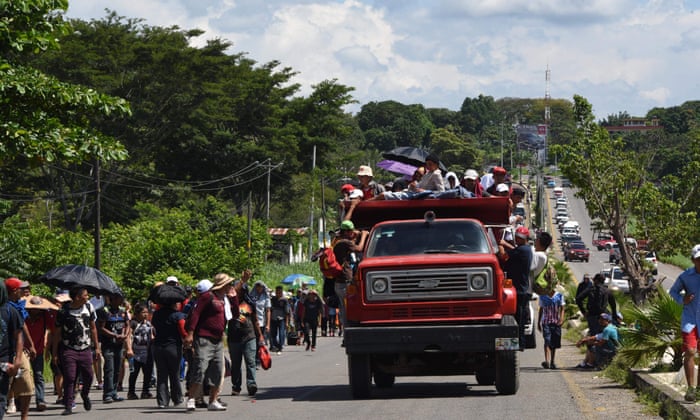 |
| Honduran migrants take part in a caravan heading to the US, in the
outskirts of Tapachula, Mexico. Photograph: Johan Ordonez/AFP/Getty
Images
|
Those with authority within the caravan movement are themselves uncertain about the exact route they will direct the thousands of participants toward, much less where they want to arrive on the U.S. Border. Central American migrants on their own have in recent years taken a direct route to Reynosa, across the border from McAllen, Texas. A much smaller caravan in the spring organized by the Contreras' organization arrived in Tijuana, about 4,000 kilometres from Tapachula, where the current four-thousand-strong caravan is resting before resuming their journey.
There they are, in their numbers, remaining together for moral strength and some assurance of safety in numbers, but with nowhere to stay other than in public, on the streets, in squares, wherever they can shoehorn their bodies into sleeping positions overnight, coping with wet ground from recent heavy downpours. They huddle together wherever they can, in the southern Mexican city of Tapachula, tired and only mildly dispirited, determined to forge forward to their final destination; the U.S. somewhere.
 |
| The caravans include families, single parents with young children, and unaccompanied minors. (Adrees Latif/Reuters) |
"We are going to sleep here in the street, because we have nothing else", 42-year-old Jose Mejia explained, having taken his wife and four children from San Pedro Sula, Honduras, to Mexico on a long, exhausting trip.
"We have to sleep on the sidewalk, and tomorrow wake up and keep walking. We'll get a piece of plastic to cover ourselves if it rains again." And it will, repeatedly, on the route the caravan is taking.
When the caravan of migrants set out a week earlier there were fewer than 200 participants; since then more people have joined the caravan along their journey. It finally swelled to an estimated 5,000 on Sunday, with migrants crossing from Guatemala into southern Mexico even as police blocked official crossing points. Another group of roughly a thousand migrants entered Mexico from Honduras. Migrants speak of widespread violence, poverty and corruption in Honduras; they flee to find a better, safer world.
Sympathetic Mexicans along the way offer the weary migrants food, water, clothing, with locals driving pickups, vans and cargo trucks stopping to give migrants a lift. Offers to take the migrants by bus to shelters set up by Mexican immigration officials, seven kilometres outside of Tapachula by civil defence officials have been refused. The migrants convinced that boarding buses would make them vulnerable to deportation.
The world, from Africa to the Middle East, Central America and Latin America is on the move as people seek alternatives to their desperate situations at home, where corrupt, inefficient, and uncaring governments oppress them, and criminals associated with drug cartels and weapons-running create atmospheres of lurking danger particularly in efforts to recruit the young into the drug trade and all the violence attendant on it. Their plight is obvious; their governments unstable and disinterested.
They look toward opportunities they know exist in the United States where once those such as they were welcome. There are legitimate channels for emigration from their countries of birth, but the question of qualifying for visas and eventual transition as immigrants is time-consuming and uncertain. Countries seen as places of haven from the threats and disorder they leave already face the reality of unregistered and illegal residents in the millions.
The wholesale movement of people willing to undertake arduous and dangerous journeys to find a new reality for themselves of promise for the future belies the facts and the needs of countries they aim for to remain in control of their borders, to be able to select whom and the numbers of those they are willing to accept. The assumption that once reaching the border they can declare themselves refugees is utterly flawed with no base in reality.
Theirs, however, is a reality of desperation. The answer to which creates a moral quandary all of its own. Accepting those thousands will do nothing if not incite many others to do the same. And the numbers will grow and the overland marches become unstoppable. The way the world now turns is wholly dysfunctional. No one is advantaged by this turmoil.
 |
| The larger caravan currently making its way north numbers in the thousands. (Ueslei Marcelino/Reuters) |
Labels: Central America, Illegal Entry, Migrants, Poverty, Security, United States, Violence


