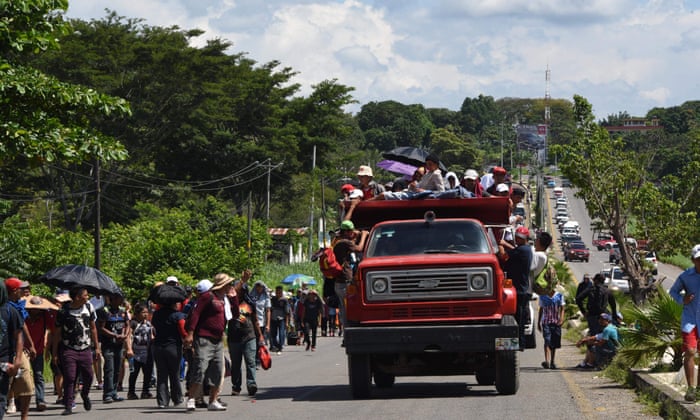
"In terms of migrants per day, December 2023 has been larger than any average we have ever seen."
"Every official who is commenting on it, on all levels, says they're near or past the breaking point."
"If
you move to a place that's super remote, there won't be a lot of agents
on staff, and that increases your chances of being released into the
U.S."
"There is nowhere to put people They can't hold you."
Adam Isacson, migration expert, Washington Office on Latin America
Women wait in a hallway Friday, Dec. 15, 2023, at a Border Patrol station in Ajo, Ariz. (AP Photo/Gregory Bull)
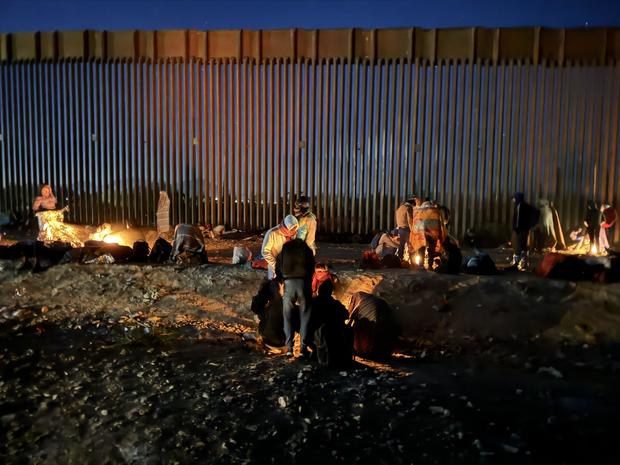
In
a remote, cold and lonely place while awaiting the arrival of border
guards, dozens of migrants huddle close to a hole in the border wall.
They have been given coffee by aid group No More Deaths. Given blankets,
food and emergency telephone calls should there be any there who
sustained life-threatening injuries on their journey. Those hailing from
Sudan have escaped another Darfur-like conflict, patiently waiting for
their search for haven to end far from their homeland.
Among
them are others, not only themselves fleeing war in Sudan, but those
escaping from Central American violent gangs and Mexican cartels. All
have crossed illegally into the United States, trekked over rugged
terrain for tiring hours, to arrive near Sasabe, Arizona exhausted,
hungry and cold. They wait to turn themselves over to authorities to be
given the opportunity to ask for asylum; stranded in the Arizona desert,
but hopeful.
Just
as night time temperatures begin dropping, a convoy of American Border
Patrol agents roll in. The men are loaded into a van where they're
briefly processed. The van continues driving in its search for more
people needing rescue. "We are not equipped to deal with this. It's a humanitarian disaster", comments Scott Carmon, a Border Patrol watch commander, of the crisis unfolding at the southern U.S. border.
A migrant walking along a road shadowed by the steel columns of the separation border between Mexico and Arizona. AP
Once
again, migrant encounters reach toward record levels, testing the
capacity of American law enforcement. Thousands of migrants arrive
daily, on their way from Africa, Asia, the Middle East or South America.
Relentless violence, desperation, fear and poverty drive them from
their places of birth where they can no longer find a future.
There
was a broad sigh of relief in the spring when crossings into the U.S.
declined after the lifting of pandemic border restrictions. The
anticipation was that the floodgates would burst, but they held. More
lately, numbers have spiked. The number of apprehensions in a recent
week soared to over 10,000 a day -- the Border Patrol found itself
stretched beyond capacity.
Small
towns on both sides of the border were overwhelmed with people funneled
through new routes by human smugglers, to evade capture.
American
officials monitored a caravan moving north through Mexico comprised of
over 2,000 migrants, heading toward the United States; unlikely to
complete their journey according to experts, but drawing significant
media notice to the migrant tide crossing the border. What has caused
the recent swell is as yet unknown.
Theories
include larger numbers of Mexicans fleeing from cartel turf battles;
rumours of a key legal pathway ending; smugglers who push desperate
people of all nationalities to attempt entry at increasingly remote
parts of the vast border. Border officials in Arizona closed a key port
of entry to legal crossings early in December to enable them to focus on
the unlawful entries.
Migrants huddle around fires for warmth along the U.S.-Mexico border near Lukeville, Arizona.Camilo Montoya-Galvez/CBS News
"We found that people had other destinations, but they were being
compelled only to come to New York City, and we are assisting in
interviewing those who seek to go somewhere else."
"Some want to go to Canada, some want to go to warmer states, and we
are there for them as they continue to move on with their pursuit of
this dream."
New York City Mayor Eric Adams
"A lot of the Americans used drugs there. I feel like Canada will be safer. It is a much quieter country than America."
"It is very difficult to get papers in America. I need to work, so I am going to Canada."
Migrant Manuel Rodon, 26, Venezuelan
"The military gave me and my family free bus tickets"
" I am going to Canada for a better quality of life for my family."
Migrant Raymond Pena, Venezuelan
"Word
has spread among the migrant community [that Canada - where Prime
Minister Justin Trudeau touted the country's] proud and longstanding
tradition of welcoming people seeking safety [is the place to go]."
“Mayor Eric Adams’s administration pays various companies that run
programs for migrants that include ‘re-ticketing’ so they can travel to
other cities, a City Hall source said."
New York Post
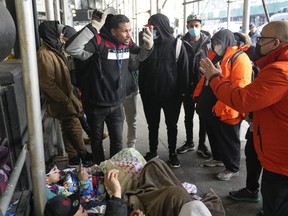
Recent
immigrants to the United States talk to city officials in front of the
Watson Hotel in New York, Monday, Jan. 30, 2023. The immigrants, mostly
from Venezuela and other Latin American countries, had been living in
the hotel until recently, when they were told to leave the temporary
shelter. Photo by Seth Wenig /AP
U.S.
States adjacent the border with Mexico developed a strategy whereby
they bus illegal migrants that enter their states, deep into the heart
of the United States, to Democratic states that have been
sanctimoniously condemnatory of their Republican brother-states
unwilling to absorb the ongoing presence of increasing numbers of
seemingly unstoppable illegal entrants to the United States. To solve
their own problems partially and to stamp 'pay-back', bus loads of
migrants have been arriving in New York City which now claims it has no
space left to house and care for the migrants.
And
while New York City is understandably enraged over the perfidy of Texas
sending illegal migrants onward to become their problem, the city has
discovered a nifty new way of alleviating their own problem. By doing
precisely what Texas has been engaged in. Only they're not sending the
migrants back to Texas, they're floating the benefits of entering Canada
to claim asylum there where they can find a new prosperous and secure
life in a country built on immigration.
Immigration,
that is, not illegal entry of unauthorized migrants. The way to enter
any country as a desired destination is and always has been legally.
Applying for visas, applying to become an immigrant. Canada invests
millions in accepting immigrants from all over the world. It has an
economy dependent on a labour force, but an aging population, one that
is not replacing itself by natural means, with a steadily falling
birthrate. Immigration to Canada has been averaging a third of a million
people annually.
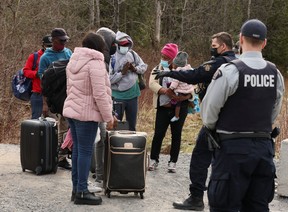
Asylum seekers talk to a police officer as they
cross into Canada from the U.S. border near a checkpoint on Roxham Road
near Hemmingford, Quebec, April 24, 2022. REUTERS/Christinne Muschi
Canada
has its own problems in absorption of such huge numbers. Settling them
in is extremely costly on the social welfare system, the universal
medicare system, and the fact that there is insufficient public housing
for people as things stand now, and housing is scarce and prohibitively
expensive. The health care system has taken a beating since the pandemic
and is having problems catching up to the level of service considered
minimal. Adding tens of thousands of unwanted people entering illegally
to declare the need for haven comes at a rather awkward time, to say the
least.
But
those buses from New York taking passengers representing illegal
migrants to the border with Canada keep coming. And only now is it being
revealed that delivering passengers by cab companies who take over as
the buses debus the passengers, to enable them to access illegal entry
border areas, bypassing official entry points continues. To the sum of
an average of 39,000 annual illegal entries to Quebec alone, in the past
several years.
Taxi drivers wait for migrants at the Plattsburgh terminus with signs indicating they will drive to Roxham Road. (Romain Schué/Radio-Canada)
Reports
have emerged that migrants resort to tearing up their American
immigration documents as they travel from Plattsburgh, New York, to the
Canadian border. Christine Frechette, Quebec's immigration minister,
"surprised" to discover the plan hatched by New York City, turns to the
federal government to reach a solution to the problem at Roxham Road,
used as an unofficial border crossing south of Montreal, enabling tens
of thousands to cross into Canada to claim asylum. These asylum-seekers
are not turned away; by Canadian law they complete documents that will
be assessed and either accepted or rejected. In the meanwhile, they are
able to live in Canada, assisted by social services.
In
cities like Toronto, temporary housing for the homeless is being
compromised as are other levels of social services by illegal migrants
requiring similar assistance. If New York City finds itself overwhelmed
by the burden of caring for tens of thousands of migrants whose human
needs cannot be ignored, it must realize that cities like Montreal and
Toronto face the same dilemma; disingenuously Mayor Adams claims to be
just 'helping' the migrants get on in life . The idea being, to pass on
the problems rather than face them and strategize a solution.
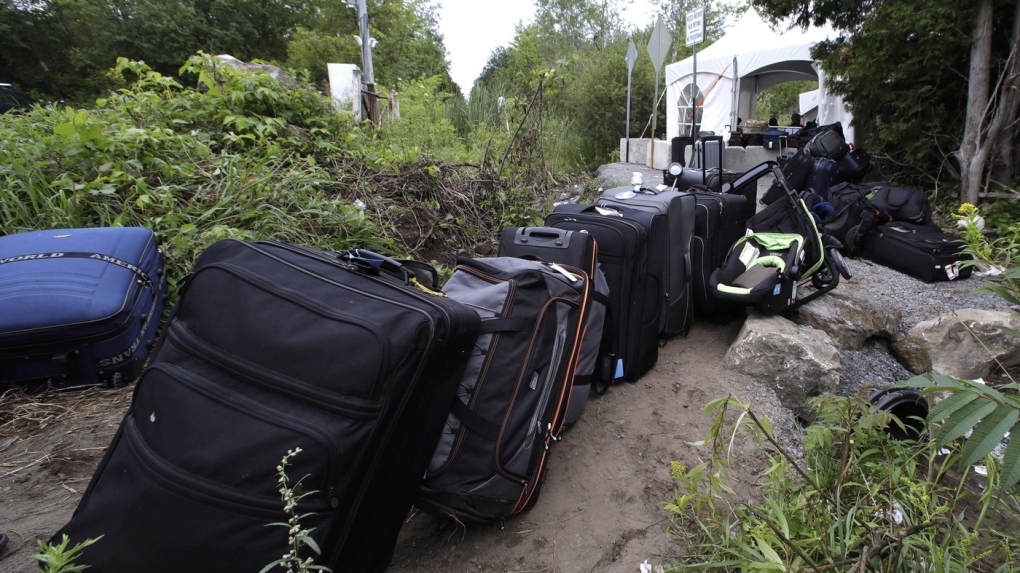
Luggage from migrants fills a pathway at an illegal crossing point from
Champlain, N.Y., to Saint-Bernard-de-Lacolle, Que.. Quebec's immigration minister says she's surprised by reports that
the City of New York is helping to provide free bus tickets to migrants
heading north to claim asylum in Canada. THE CANADIAN PRESS/AP
Photo/Charles Krupa
"It's a sperm-killer." "Thousands of individuals were knowingly put into the zone of risk of these pesticides after it was banned." Stuart H.Smith, legal team
DBCP’s Effects on health
sterility skin cancer blindness respiratory diseases precancerous legions lung, liver, kidney damage damage to the reproductive organs in the women congenital deformities in their children and many other serious diseases…
Banned in most of the United States in 1977 -- after the chemical dibromochloropropane (DBCP), an active ingredient in Nemagon -- after it was found to have caused sterility among thousands of male workers exposed to it at Dow, Shell and Occidental plants across America -- food growers based in the United States continued its use through the early 1980s at banana and pineapple plantations, according to lawsuits, in countries with lower environmental standards.
Nicaraguan plantation workers launched a wave of lawsuits in the 1990s. Those lawsuits were blocked by Dow and Shell, as well as by the growers Dole Fruit, Del Monte Fruit and Chiquita Brands, on the grounds that the U.S. was not the place to try them since the damage occurred in Central America. Nicaraguan courts awarded hundreds of millions in compensation to victims, while Dow, Shell and Doyle refused to pay, declaring that those courts lacked jurisdiction.
A Florida court denied recognition of a $97 million judgement against Dow and Dole in 2009, with the claim that the Nicaraguan proceedings were biased against the American companies. Lawsuits against Dow and Dole were thrown out by a California judge in the same year, after the judge ruled that the plaintiffs and their lawyers had made use of fraudulent tactics.
After settling claims decades ago, the chemical and banana companies argue they have no additional responsibilities. With the exception of Dole, they settled in 1997 with 26,000 former banana workers in Central America, Africa and the Philippines for a piffling $41 million. In 2014 Dole agreed to compensate over 1,700 former banana workers from Nicaragua for an undisclosed amount.
Survivors of the thousands of victims -- where the pesticide was sprayed at banana plantations around Central America, sterilizing workers -- have attempted to gain compensation ever since. They have taken to suing Dow Chemical, Shell Oil and Occidntal Chemical (now OxyChem) in France in hopes of recovering hundreds of millions in unpaid damages awarded to them by Nicaraguan courts where many of the poisonings happened.
Other countries were also harmed by the use of the pesticide Nemagon. A total of $805 million in damages was ordered by Nicaraguan courts to be paid to hundreds of victims, the companies refusing to pay, insisting the courts' lack of jurisdiction protects them and that the trials were unfair. The companies have significant assets in Europe where 1,245 former workers and their relatives are attempting to collect the compensation awards.
Now, a French judge is set to determine whether court opinions in other countries can be enforced in France and in the European Union, capping decades of legal maneuvering between the U.S. where are based, and countries in Central America and beyond where the pesticides were ultimately used despite their being banned in the United States with the knowledge of their deadly effects.
"What we have seen is that no one is getting across the border." "This forces families, with all the desperation they feel, to go illegally." Hector Silva, director, migrant center, Reynosa, Mexico "I honestly don't want to cross illegally, but I don't really have a choice." "I don't have an option, I can't be there [Honduras]. Our government is totally corrupt, and if the Mexicans or Americans deport me, I'm dead." Julian Escobar Moreno, 37, Honduran migrant
"Look, we know what the situation is in our country. We don't know what will happen when we cross [into the U.S.]" "Desperation makes you do crazy things. I don't think anything would stop me. And certainly not a wall." Osman Noe Guillen, 28, Honduran migrant, Reynosa
Rio Grande River bordering Mexico and Texas Photograph: Meredith Kohut/The New York Times
Newly married, Mr. Guillen has decided he belongs not in his country of origin, Honduras, but in the United States, where legendary opportunities to prosper lie. What drives them is what they insist is economic need, and blind faith in a future that lies ahead for them in America, convinced that Honduras is history for them and the U.S. is their future. Now they've arrived in the Mexican town of Reynosa, a border town where they planned to apply for asylum in the U.S.
They can apply for asylum, but to do so they will wait a long time since the U.S. administration has adopted a policy to admit a handful of asylum seekers daily at border crossings where migrants must now wait on the Mexican side of the border for weeks or months before given the opportunity to submit their applications. Delays that make a faster option look promising. And to take advantage of that faster option means engaging the services of a smuggler.
There's no question of desperately searching out a smuggler. Their cartels are everywhere in Reynosa, blatantly advertising their services for hire. And the price keeps rising in lock-step with the border delays. Those waiting focus on just one thing; their anxiety to cross the border separating Reynosa from McAllen, Texas near the banks of the Rio Grande. Reynosa is a border town grim with gun violence. And thousands of Central Americans wait at the border up to Tijuana, for their opportunity.
Although they know of the dangers inherent in illegal crossings, migrants who make that decision will not be dissuaded; they have calculated that they will not return to what they've left, and must by any means be enabled to enter the Paradise of opportunities that they imagine the U.S. to be. Osman Guillen and his wife Lilian Marlene Menendez took a bus from Honduras, looking upon it as a honeymoon adventure.
They chose Reynosa as the closest crossing from Honduras, the least costly to reach. They were aware of the anger expressed in the United States about illegal entrants to the country and the hordes of migrants waiting to rush the border or infiltrate it with the aid of smugglers. They know about deportations, they are aware of long waits at the border. Nothing will serve to turn them away from their destination of choice.
The risks of being smuggled in where polleros (smugglers) have been known to abandon migrants midway if payment is not given in full, who sometimes kill those they have been contracted to guide to the promised land, who will attempt to extort migrants' families to mortgage homes and pay them more than contracted for, are all stories they are aware of. They were quoted a price of $7,000 each to guide them to the bank across the river on the Texas side.
Already one of the most dangerous cities in Mexico, Renosa mayor Maki Esther Ortiz Dominguez states her concern over the situation: "This policy could at any moment detonate a new crime wave here". Smugglers are used by Mexicans as well, the price quoted them substantially less. Despite that the migration office in Reynosa recently saw a group of Mexicans waiting to be processed having been deported from the United States.
"For the migration authorities, it is a job. For Mexicans and Central Americans, immigration is a dream. We have something to live for, and that keeps us going", said18-year-old Melvin Gomez from the state of Chiapas, who had just attempted for the fourth time to cross into the U.S. and failed.
Give Me Your Auspices to Advance Into a Future of Security and Opportunity...
"The Caravans are a disgrace to the Democrat party. Change the immigration laws NOW!" "Every time you see a Caravan, or people illegally coming, or attempting to come, into our Country illegally, think of and blame the Democrats for not giving us the votes to change our pathetic Immigration Laws!" "We will now begin cutting off, or substantially reducing, the massive foreign aid routinely given to them [Guatemala, Honduras, El Salvador]." U.S. President Donald Trump "[The United States, Canada and Mexico should work out a joint plan to fund development in Central America and southern Mexico]." "In this way we confront the phenomenon of migration, because he who leaves his town does not leave for pleasure but out of necessity." Mexican president-elect Andres Manuel Lopez Obrador
"We have had people who have ankle or shoulder injuries, from falls during the trip, and even though we have offered to take them somewhere where they can get better care, they have refused, because they fear they'll be detained and deported." "They want to continue on their way. They are going to continue walking, and their feet won't heal as long as they keep walking." Ulises Garcia, Red Cross official
"You have to help the next person. Today it's for them, tomorrow for us." "From them we learn to value what they do not have." Jesus Valdivia, Tuxtla Chico, Mexico
"There isn't a single terrorist here. We are all people from Honduras, El Salvador, Guatemala and Nicaragua." "And as far as I know there are no terrorists in these four countries, at least beyond the corrupt government." Denis Omar Contreras, Honduran-born caravan leader, Peubo Sin Fronteras
Honduran migrants take part in a caravan heading to the US, in the
outskirts of Tapachula, Mexico. Photograph: Johan Ordonez/AFP/Getty
Images
Those with authority within the caravan movement are themselves uncertain about the exact route they will direct the thousands of participants toward, much less where they want to arrive on the U.S. Border. Central American migrants on their own have in recent years taken a direct route to Reynosa, across the border from McAllen, Texas. A much smaller caravan in the spring organized by the Contreras' organization arrived in Tijuana, about 4,000 kilometres from Tapachula, where the current four-thousand-strong caravan is resting before resuming their journey.
There they are, in their numbers, remaining together for moral strength and some assurance of safety in numbers, but with nowhere to stay other than in public, on the streets, in squares, wherever they can shoehorn their bodies into sleeping positions overnight, coping with wet ground from recent heavy downpours. They huddle together wherever they can, in the southern Mexican city of Tapachula, tired and only mildly dispirited, determined to forge forward to their final destination; the U.S. somewhere.
The caravans include families, single parents with young children, and unaccompanied minors. (Adrees Latif/Reuters)
"We are going to sleep here in the street, because we have nothing else", 42-year-old Jose Mejia explained, having taken his wife and four children from San Pedro Sula, Honduras, to Mexico on a long, exhausting trip. "We have to sleep on the sidewalk, and tomorrow wake up and keep walking. We'll get a piece of plastic to cover ourselves if it rains again." And it will, repeatedly, on the route the caravan is taking.
When the caravan of migrants set out a week earlier there were fewer than 200 participants; since then more people have joined the caravan along their journey. It finally swelled to an estimated 5,000 on Sunday, with migrants crossing from Guatemala into southern Mexico even as police blocked official crossing points. Another group of roughly a thousand migrants entered Mexico from Honduras. Migrants speak of widespread violence, poverty and corruption in Honduras; they flee to find a better, safer world.
Sympathetic Mexicans along the way offer the weary migrants food, water, clothing, with locals driving pickups, vans and cargo trucks stopping to give migrants a lift. Offers to take the migrants by bus to shelters set up by Mexican immigration officials, seven kilometres outside of Tapachula by civil defence officials have been refused. The migrants convinced that boarding buses would make them vulnerable to deportation.
The world, from Africa to the Middle East, Central America and Latin America is on the move as people seek alternatives to their desperate situations at home, where corrupt, inefficient, and uncaring governments oppress them, and criminals associated with drug cartels and weapons-running create atmospheres of lurking danger particularly in efforts to recruit the young into the drug trade and all the violence attendant on it. Their plight is obvious; their governments unstable and disinterested.
They look toward opportunities they know exist in the United States where once those such as they were welcome. There are legitimate channels for emigration from their countries of birth, but the question of qualifying for visas and eventual transition as immigrants is time-consuming and uncertain. Countries seen as places of haven from the threats and disorder they leave already face the reality of unregistered and illegal residents in the millions.
The wholesale movement of people willing to undertake arduous and dangerous journeys to find a new reality for themselves of promise for the future belies the facts and the needs of countries they aim for to remain in control of their borders, to be able to select whom and the numbers of those they are willing to accept. The assumption that once reaching the border they can declare themselves refugees is utterly flawed with no base in reality.
Theirs, however, is a reality of desperation. The answer to which creates a moral quandary all of its own. Accepting those thousands will do nothing if not incite many others to do the same. And the numbers will grow and the overland marches become unstoppable. The way the world now turns is wholly dysfunctional. No one is advantaged by this turmoil.
The larger caravan currently making its way north numbers in the thousands. (Ueslei Marcelino/Reuters)
This represents a general opinion site for its author. It also offers a space for the author to record her experiences and perceptions,both personal and public. This is rendered obvious by the content contained in the blog, but the space is here inviting me to write. And so I do.