Sunday, May 29, 2022

Canada's Supreme Court Bringing the Administration of Justice Into Disrepute


Canada's Supreme Court Bringing the Administration of Justice Into Disrepute

"The impugned provision, taken to its extreme, authorizes a court to order an offender to serve an ineligibility period that exceeds the life expectancy of any human being, a sentence so absurd that it would bring the administration of justice into disrepute."
"[Depriving offenders in advance of any possibility of reintegration into society, the provision] shakes the very foundations of Canadian criminal law."
Chief Justice Richard Wagner, Supreme Court of Canada

"I'll tell you what cruel and unusual punishment is."
"It's an innocent person being murdered. It's an innocent person being maimed or an innocent person having their life ripped apart."
"That is cruel and unusual punishment."
Cathy Riddell, one of 25 victims of an INCEL attack
The Supreme Court of Canada, Justin Tang, Associated Press
 
A Criminal Code provision that ruled mass murderers might have to wait 50 years or longer before they might apply for parole, has been struck down by the Supreme Court of Canada which unanimously called the provision degrading and incompatible with human dignity. This is a court that has for decades been leaning more heavily toward the rights of the accused and by extension overlooking victims' calling out for justice from great harm done them by psychopaths whose regard for the dignity and human rights of their victims have been ruthlessly absent.

The previous Conservative government of the administration of Prime Minister Stephen Harper had enacted that legislation in an effort to honour the rights of victims and to ensure that the murderous predators within society faced justice for their deadly acts of mass murder. The current Liberal government of 'progressive' Prime Minister Justin Trudeau wasted no time in overturning much of the Criminal Justice legislation of his predecessor. Now the Supreme Court stacked with progressives has followed suit.
 
Six men died in the attack on the Quebec Mosque. They are, clockwise from top left, Mamadou Tanou Barry, Azzeddine Soufiane, Abdelkrim Hassane, Ibrahima Barry, Aboubaker Thabti and Khaled Belkacemi. (CBC)
 
The case in question that the Supreme Court focused their decision on was that of Alexandre Bissonnette, who had fatally shot six people to death at a Quebec City mosque in 2017. This mass murderer will now be allowed to seek parole after having served 25 years of incarceration. The 2011 provision that allowed a judge in cases of multiple murders to impose a life sentence and parole ineligibility periods of 25 years to be served concurrently for each murder was declared unconstitutional by the Supreme Court.

According to the justices the provision serves to violate the Charter of Rights and Freedoms guarantee against cruel and unusual treatment, for as they determined, denial of a realistic possibility of being granted parole before they die offends the Charter.  Bissonette was 27 years old at the time he pleaded guilty to six charges of first-degree murder in the mosque assault that occurred following evening prayers. A previous judge had found the parole ineligibility provision unconstitutional but failed to declare it invalid, ruling that Bissonnette must wait 40 years before applying for parole.

A subsequent ruling by Quebec's Court of Appeal held the provision invalid on constitutional grounds, stating the judge had erred in the ineligibility period of 40 years. The court, it said, must revert to the law in standing prior to 2011; parole ineligibility periods to be served concurrently, resulting in a total wait period of 25 years in the case of Bissonnette's crime of mass murder.

Henceforth this ruling requires that every prisoner must be given a realistic potential of applying for parole earlier than the expiration of an ineligibility period of 40 years. The Criminal Code provision has been declared invalid immediately, retroactive to 2011 when it was enacted. Any offender who was ordered through the unconstitutional provision to serve a parole ineligibility period of 50 years or greater for multiple murders must be able to apply to the courts for a remedy.
 
Mounties pay tribute to the memorial sculptures in Moncton in honour of the three RCMP officers killed in 2014. (Matthew Bingley/CBC)
 
Mass murderers such as Justin Bourque, sentenced to 75 years in prison with no chance of parole in the killing of three RCMP officers, and the wounding of two others in Moncton, New Brunswick in 2014 will be able now to take advantage of a new 'humanitarian' prospective, giving full due to their human rights and dignity of person guaranteed under the Charter of Rights and Freedoms. Rather than relinquishing those rights on the basis of having deprived others of the dignity of life.

Then there is as well the case of Alek Minassian who was found guilty of ten counts of first-degree murder, three years after he crashed into people with a van in a busy area of Toronto on a sunny day that brought people out to a popular promenade in large numbers. Minassian was a member of the disaffected male group calling themselves involuntarily celibates, complaining that women overlook them for other males more characteristic of male traits attractive to women.

In all these cases and more, psychotic psychopaths have decided to take revenge on others whom they consider to be guilty of offences affecting their quality of life and aspirations. In the case of the mosque killings it was religious bigotry, in the case of the killing of the RCMP officers, it was hatred of policing agencies, and in the instance of the INCEL murders it was the sense of victimhood as a male unattractive to the opposite sex. All chose to murder as an expression of their hate, depriving others of life.

Yet the Supreme Court of Canada justices sitting in the high court commiserate with the plight of the murderers, held to account for their atrocities in committing mass murder, while the administration of justice, placing responsibility on the shoulders of those whose criminal acts are beyond the pale of civil society is undermined and the victims of lethal assaults and their families and greater society at large see justice fail in its fundamental purpose; to protect society from the vicious predators in their midst.
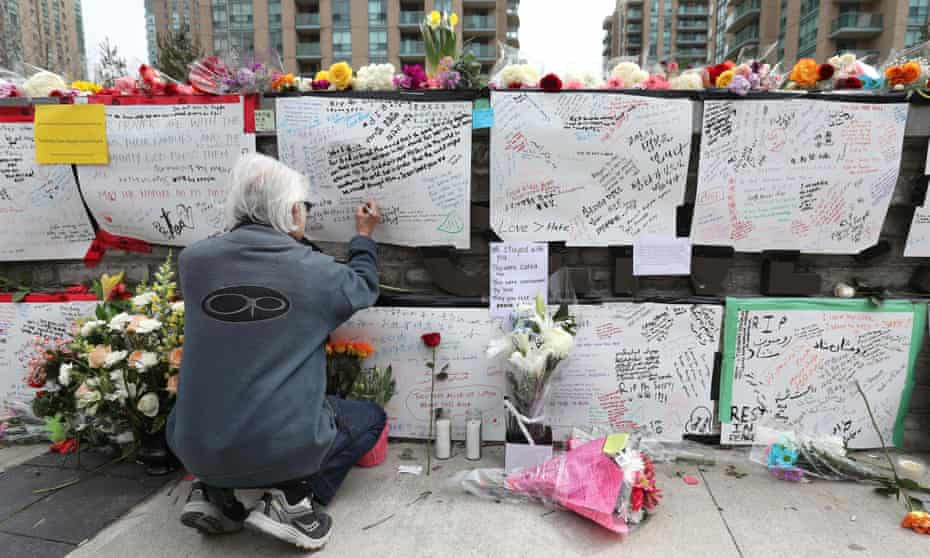
A man leaves a note at a makeshift memorial for the victims of the van attack in Toronto on 24 April 2018.
A man leaves a note at a makeshift memorial for the victims of the van attack in Toronto in April 2018. Photograph: Lars Hagberg/AFP/Getty Images

Labels: , , , , ,

Saturday, October 30, 2021

Truth and Consequences


Patrik Mathews, (RCMP Manitoba/Reuters)
"I did not hear any particular apology to our country. to me, it's galling to think someone who's not an American would know better than us what kind of country we should have here and decide that you hate America so much you're going to infiltrate our country and tear it down."
"In the letter you submitted, you didn't necessarily inspire confidence that you've changed to the point that there's no longer a threat of violence from  you."
"Nevertheless, you have stated that all you want to do is go back to Canada and live a normal life. We all hope that is something that will happen once you serve this sentence."
"[...Conversations, text exchanges and planning represented more than merely] wishes and hopes and far-flung fantasies [of a pair of] wide-eyed neophytes."
"They were specific, serious and calculating in the actions they intended to perpetrate."
District Court Judge Theodore Chuang, Greenbelt, Maryland, U.S.
Former Manitoba army reservist Patrik Mathews has been sentenced to nine years in prison for his involvement in what the FBI called a neo-Nazi plot to start a race war in the United States.CBC

Nine years in prison for former Canadian Armed Forces reservist Patrik Mathews, 28, for his role in a plot to exploit escalating U.S. social tensions in the hopes of triggering a "race war", in the assessment of the FBI. A resident of Beausejour in Manitoba, he excused himself for his ill judgement when "I got involved with the wrong people". As though the choice to connect himself with the white supremacist group The Base was an incidental error for which he was not seriously at fault. He had no idea, he claimed, of the depth and seriousness of their intended actions.

Judge Chuang, after reviewing all the evidence presented to him, and carefully reading through the letter submitted by Patrik Mathews exonerating himself and blaming a misunderstanding on his part, took due consideration of both the defence and the prosecution positions on the punishment to be meted out to the terror-by-accidental-affiliation chastened man who was, he claimed, innocent of any intent to carry out any acts of violence.

Apart from the sentence of 9 years in prison for his lapse in judgement, there is an additional penalty of three years of supervised release once his prison term is completed. And when justice has been served, he will be deported back to Canada. Both Matthews and his co-defenant, U.S. army veteran Brian Mark Lemley Jr., pleaded guilty to weapons charges associated with the plot to precipitate a clash between police and thousands of heavily armed gun control protesters, in Richmond, Virginia.. 
 
In August 2019, Brian Lemley and William Bilbrough attended a training camp for neo-Nazi group The Base. Lemley is standing second from left, holding a long gun in the air. Bilbrough is kneeling in the centre while holding a blade. (U.S. Attorney detention memo)
 
The defence had petitioned the court for location to a prison facility in Minnesota so their client would be located closer to his family in Manitoba.  Originally, he informed the court he believed The Base was committed to ideals that were less extreme, focusing on immigration controls. He characterized the work of The Base as "horrifically and disastrously wrong", though it might have been seen by him to be good, clean fun at the time.
 
He could have been given a sentence up to 25 years in prison, in reflection of the "terrorism enhancement" provision requested by the prosecution. On the other hand, the defense counsel argued a sentence of less than three years, for after all the defendants' plan ultimately was never carried out. Contrastingly, his crimes, prosecutors argued, were serious and his motives even more so.
 
During a search of the apartment Mathews shared with one of the co-accused, law enforcement agents found videos of Mathews saying violent, anti-Semitic and racist things. (U.S. Attorney detention memo)
 
Court had been presented with ample evidence of the plot unfolding, where the two spoke in terms of killing federal officials, derailing trains and poisoning water supplies; all part of a violent scheme to disrupt and exploit political and social tensions in the hopes of triggering a race war in the U.S. Another co-defendant, William Garfield Bilbrough IV, also pleaded guilty to assisting Mathews to enter the U.S. illegally, for which he was sentenced to five years in prison.

The heavily incriminating evidence that came to light was gathered through FBI wiretaps, "sneak-and-peek" warrants, and the cooperation of undercover officers. As all too often happens in cases of this nature, Patrik Mathews' father described his son as a man with a good heart but a troubled soul, who had suffered as a child from being pushed around by schoolyard bullies, resulting in an attitude of social alienation.

Mounties found this handwritten list of mass shootings when they executed a search warrant at Mathews' Beausejour, Man., residence in August 2019. The list included the year, number of people dead and whether the shooter was on medication. (U.S. prosecution sentencing memorandum)


Labels: , , , , , , ,

Wednesday, March 24, 2021

Canada's Aboriginal Justice System

"She was not a street person. She was missing, and she was murdered."
"It was horrific and I try not to dwell on it. Its like trying to get out of a dark pit."
"[Muchieiwanape is] evil [and] sadistic [he] should be locked up permanently."
"While incarcerated, he has received his education and job skills. How nice. What supports were put in place for my sister and her family after he washed my sister's blood from his hands?"
"I'm filled with anger. They should be held accountable for being lenient with these dangerous inmates. What now? Who's to blame if he harms another innocent person?"
Darlene Clarke, Aboriginal heritage, Selkirk, Manitoba
Darlene Clarke, left, is pictured with her sister Kimberley Clarke, right, in an undated family photo. The woman in the middle is their late mother, Sarah Clarke. (Submitted by Courtney Bear)
"When a person is sentenced in federal custody, a big part of that sentence is supposed to be tied to the severity of the crime, and some kind of deterrent or punishment factor. But once that person starts their sentence, another big part of what becomes part of the decision process is what is that person's needs for rehabilitation?"
"Often first-degree murderers may end up in the maximum type of prison environment, but over time ... they're continually evaluated. In some cases, that means taking down steps in their security levels at their institutions."
"...But for the majority of people that are serving federal sentences, there is a lot of value in the rehabilitation activities they do."
Mary Campbell, director, Centre for Criminal Justice Studies, University of New Brunswick
The issue in Canada of 'missing and murdered Indigenous women' is a sad and sorry statement of malfunction and dysfunction; malfunction on the part of government penal agencies and dysfunction out of the larger Aboriginal population. Indigenous, First Nations women and children have a higher degree of violence committed against them than their counterparts in the general population. The same can be said for First Nations men; who also suffer violence disproportionately.
 
More First Nations children are taken into protective custody than are non-Aboriginal children in the general population. Substantially greater numbers of First Nations men are incarcerated for all manner of crimes, and again hugely disproportionate to their numbers in society. Many First Nations people live in remote, isolated communities, but those who have left their ancestral tribal communities to live in urban centres are prone to the same behavioral frailties as their tribal cousins living on reserves. 

Addiction to drugs and alcohol run rampant through their communities, much of it driven by bio- and cultural-inheritance. Colonialism takes its fair share of responsibility for the plight and neglect of First Nations people. Tribal leaders have great influence over the course of events of their people, exerting that influence persuasively in issues such as non-integration into non-Aboriginal social streams and allegiance to their heritage and lands. Which keeps them isolated, living in remote communities where health care and social services are less accessible.
Kimberley Clarke, 36, was murdered under Winnipeg's Redwood Bridge in 1998. She had three children. (Submitted by Jade Frost)
 
The issue of violence in native communities is an ongoing failure of both First Nations and government agencies tasked to give aid, to solve. Criminal behaviour is too common but much worse is the violence enacted against one another, and most particularly toward girls and women. Missing and murdered Aboriginal women has its start right there, with the responsibility that should be laid directly at the feet of those leaders who fail to address it but point a finger of blame at 'white colonists' and issues such as residential schools whose purpose was to give Indigenous children a contemporary education to enable them to meld into the greater society.

Many Aboriginals have done just that, with and without the aid of residential schools, propelling themselves into respected positions in the professions of law, medicine, journalism, government, social services and more. Just as some tribes have succeeded in pioneering for themselves positions as leaders in commercial ventures that have been hugely successful and remunerative, while others are dismal failures, led by reserve councils that are corrupt and unaccountable.
 
Escaped prisoner Roderick Muchikekwanape.
Through all of this, the federal government and provincial governments tread a fine line between honouring Aboriginal traditions and culture and imposing the laws of the land. Unevenly, as it happens, with heavy consideration to treating First Nations law-breakers more leniently than non-First-Nations criminals. In the case of Canadian murderer Roderick Muchikekwanape, 42, freedoms of a nature ill-deserved by his murderous past. He bludgeoned an Aboriginal woman to death and sexually assaulted her.

The two met at a party in Winnipeg in 1998. They were seen walking together, when security at a nearby business called police after hearing screams and seeing someone running from the source of the tumult. When police arrived they discovered a trail of blood which led to the river. Kimberley Clarke's body was discovered after two days; she had been beaten to death. Roderick Muchikekwanape was found guilty at trial and sentenced to life imprisonment. Months ago, he walked away from a minimum-security Mission Institution in British Columbia.

These are open grounds, with few security features, where those institutionalized are on an 'honour' system to remain within the grounds. Accommodation is casual, there is no resemblance to the usual penal institutions where hardened criminals and murderers are kept in federal prisons. And these minimum-security alternatives are meant exclusively for the Aboriginal criminal class. It is thought that these places are more in keeping with First Nations cultures and systems of justice for malefactors. Several months ago Roderick Muchikekwanape walked out of Mission Institution and he is still at large.
The minimum-security Mission Institution in B.C. where Roderick Muchikekwanape was serving his life sentence has a long history of inmate escapes.
The minimum-security Mission Institution in B.C. where Roderick Muchikekwanape was serving his life sentence has a long history of inmate escapes. Photo by Francis Georgian/Postmedia/File
 
A video capture last saw him in Washington State where U.S. Marshalls feel he is likely to "claim to belong to a tribe in the U.S." Royal Canadian Mounted Police, at the time of his escape, said he has "a history of significant violence". Correctional Service of Canada issued a news release that he was unaccounted for at an evening count, leading to a warrant being issued for his arrest. His has not been the only high-profile escape from the Mission Institution which houses hundreds of medium- and minimum-security Indigenous prisoners.

Barb Van Vugt, the then-warden in 2017 described no physical barrier preventing inmates from leaving the prison. "We believe a gradual release into society is safest and best for everyone", she stated following Robert Dezwaan, serving a sentence for the sexual assault of 16-year-old Cherish Billy Oppenheim whom he had beaten to death and buried under rocks, had also decided to leave the prison. Convicted of a 2004 fire-bombing in Calgary where two young children were killed, Michael Sheets was another escapee. And there are more.

As for Muchikekwanape, the Pacific North-west Violent Offender Task Force is looking for him. Just over six feet in height, black hair, brown eyes, he has a number of aliases. He was last seen, according to the U.S. marshals, boarding a bus to Mount Vernon, another bus to Everett, on his way to Sumas, Washington -- on the Canada-U.S.border.

Labels: , , , ,

Follow @rheytah Tweet