Iranian Women Demanding Justice
 |
| Iranian Supreme Leader Ayatollah Ali Khamenei |
"[Those who foment unrest to] sabotage [the country deserve harsh prosecution and punishment. Young people who] come to the streets after excitement after watching something on the internet should be] disciplined.""[I was] heartbroken [by the death of 22-year-old Mahsa Amini in police custody; a] sad incident.""This rioting was planned. These riots and insecurities were designed by America and the Zionist regime, and their employees.""[I condemn protesters ripping off hijabs, setting fire to mosques, banks and police cars], actions that are not normal, that are unnatural."Supreme Leader Ayatollah Ali Khamenei"The regime's brute force [at Sharif University as] an expression of sheer fear at the power of education and freedom [must be condemned].""The courage of Iranians is incredible."German Foreign Minister Annalena Baerbock
 |
| The mass demonstrations over Mahsa Amini's death in Iranian police custody could create lasting change, say analysts. |
A
simple young woman from a small village in Iran's Kurdistan region,
22-year-old Mahsa Amini came to Tehran on a visit with her father and
brother. She wore her headscarf casually, as was the custom in her
village, never imagining it would be seen as a sacrilegious offence
against the rules and regulations imposed on women throughout Iran,
since in Kurdistan she had never before encountered criticism of her
attire. But loose strands of hair became a criminal offence the Tehran
morality police found serious enough to arrest her for.
Her
desperate cries to her father and brother to have her released left
them helpless and her in custody in a police van. Later, other women the
morality police had arrested, sharing prisoner space in the van with
her spoke of the guards beating the young women while she cried out in
agony and fear. For some unknown reason her fear seemed to make her a
target for their misogynistic rage. She would never see her father and
brother again, nor would they see her alive.
Her
family speak quite plainly of her death by beating in custody. While
police authirties claim the young woman died of a heart attack. Iranians
the world over are infuriated and join protests to express their anger
at the Iranian clerical regime. The theocracy in Iran is facing popular
opposition of a kind and volume rarely encountered. Leaving the regime
to order the military, the Iranian Republican Guard Corps, the
motorcycle brigade called the Basij to control the crowds chanting death
to the regime.
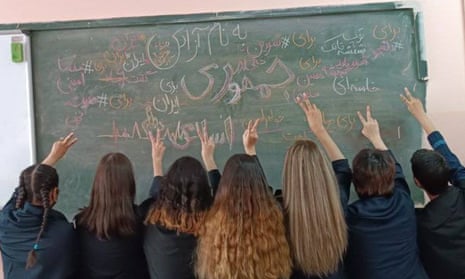 |
| An image from social media which is claimed to show Iranian schoolchildren expressing dissatisfaction towards the country's leadership. Photograph: Twitter |
Iranian
women are vociferously protesting, marching in crowds of enraged
people, chanting death to the Ayatollah, waving their headscarves in
defiance, cutting off their hair in solidarity with their cause of
liberation from the shackles of Khomeinism's Islamist regime.
Schoolgirls are defiant, heckling and taunting the Basij, while their
mothers and grandmothers clad in black chadors, the anxiety on their
faces hidden, as they attempt to herd their daughters back home from
school and away from the raging morality police.
Iran
closed its Sharif Univ4rsity of Technology in Tehran with the
announcement that only doctoral students would be permitted on campus
following the turmoil of student protests. Police kept hundreds of
students on campus, firing rounds of tear gas, while dispersing the
protests. Plainclothed police arrested and detained hundreds of
students, beating some university staff. "Suppose we beat and arrest, is this the solution?" rhetorically asked a column n a normally hard-line Iranian newspaper, the Jomhouri Eslami: "Is this productive?"
The
protests that began in Kurdistan, have spread throughout the theocratic
country. From Tehran to far-flung provinces, with authorities desperate
to bring an end to the riotous displays of anger with the regime,
disrupting internet access, blocking social media apps. Across the
Middle East and Europe, Canada and the United States, people are coming
out in drove to protest in support of those doing just that in Iran.
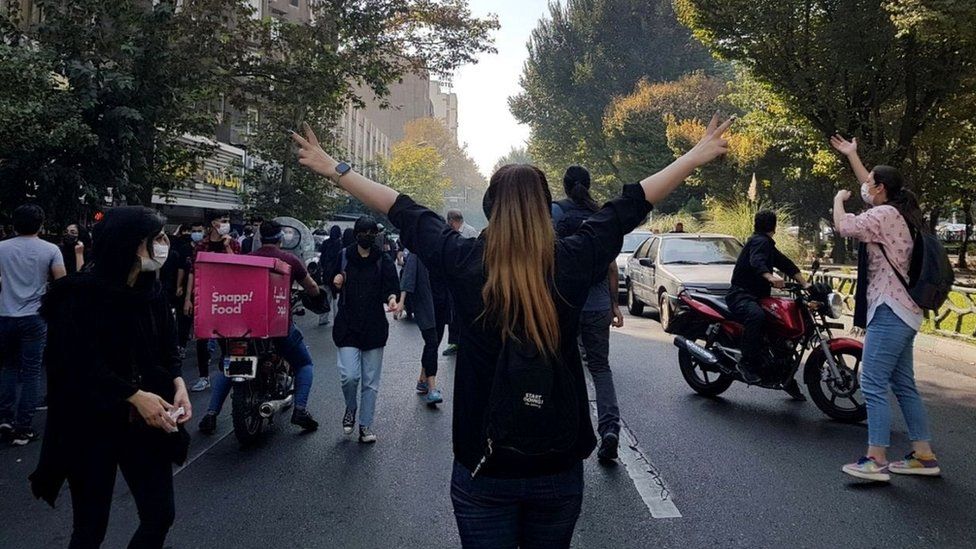 |
| Women have been at the forefront of the protests sparked by the death of Mahsa Amini EPA |
Citizens
of Germany, Poland, Italy France, Sweden, the Netherlands and other
countries have been detained by Iranian authorities. Mahsa Amini, in her
lifetime, would never have been able to imagine how important she has
become in her country of birth. At least a hundred people have been
killed while protesting her death, many more injured. Thousands have
been arrested, leaving the regime frantic with apprehension. The size of
the protests have motivated the regime to surreptitiously bring in
Arabs to help restrain the protesters; hard-liners from Syria and Iraq,
Lebanon and reportedly Palestinians.
Labels: Female Repression, Human Rights, Islamic Republic of Iran, Justice, Mahsa Amini, Morality Police, Protests
posted by Pieface @ Thursday, October 06, 2022