Monday, July 27, 2015

The Indomitable Tyrant

"If we thought we will be victorious in all the battles everywhere at the same time ... this is unrealistic and impossible. We are forced to give up areas to move those forces to the areas that we want to hold on to."
"We are in a fateful phase with no half solutions.... Are the Syrian armed forces able ... to defend the homeland? Yes, it is certainly capable. But the army in the first degree is a matter of manpower which would then utilize the weapons and ammunition. Everything is available, but there is a lack of manpower."
"[Our sister nation] Iran only gave us military expertise, and as for our loyal brothers [Hezbollah] in the Lebanese resistance, they fought with us ... their blood combined with the blood of their brethren in the army and the armed forces."
"The homeland is not for those who live in it and who carry its passport or citizenship ... but is for those who defend it and protect it."
Syrian President Bashar al-Assad
Footage shown on Al-Manar shows the Barada-Zabadani road where Hezbollah blows up militant tunnels on July 22, 2015 -- Daily Star / Al Manar (HQ)

Clearly, the 'homeland' is not for Syria's Sunni majority population. That would be the Syrians whose mild protest four years ago against inequality in citizenship the Alawite government of Bashar al-Assad responded to by arresting, imprisoning and torturing protesters, including children. The violence that the regime hurled against the Syrian Sunnis left them little option but to form themselves into rebel militias to fight back against the tyrant whose idea of citizenship obviously excluded them.

Like his father before him, al-Assad experienced no moral misgivings by using chemical weapons to punish Syrian civilians whom he believed were sympathetic to the Sunni rebels. Helicopter warships, artillery strikes, barrel bombs; no punishment too dire to deliver to the audacious Sunnis who dared contest his leadership qualities and the values inherent in an Alawite Shiite Baathist government. If the world thought that Iraq's Sunni Baathist Saddam Hussein was a barbarian, al-Assad has stepped into the breach left vacant by Saddam's departure in Iraq.

President al-Assad explained initially that those contesting his reign were thugs and terrorists and he had no option but to eradicate them. In the process he has overseen the deaths of over 200,000 people, the forced migration of millions of Syrians and the refugee status of millions more sheltering in Lebanon, Jordan and Turkey, glad to have escaped the chaos resulting from Assad's livid umbrage over Syrian Sunni challenges to his continued governance.

Those victories against the rebels and the foreign Islamists that filtered in droves into disintegrating Syria were achieved by government forces only because they had the aid of Hezbollah fighters and the battlefield strategic advice of Iran's al Quds generals and allied troops. Iran has generously shared with Syria Iraqi and Syrian Shia  tribal jihadists willing and eager to comply with Iran's orders, anxious of their own accord to diminish the number of Sunnis in the Middle East.

A video grab from Al-Manar shows smoke billowing from buildings in Zabadani after being targeted by Hezbollah and Syrian army forces, Saturday July 4, 2015 -- The Daily Star/Al Manar
And tellingly enough while the Syrian army has undergone troublesome incidents of desertion from its ranks, so too has Hezbollah. It has been rumoured that Hezbollah head Hassan Nasrallah has given warning of "dire consequences and the imposition of capital punishment" for the growing number of deserters from Hezbollah. Where some Hezbollah members resent being Iran's pawns in its wars in the Middle East. 

Syrian army shortages are to the favour of the armed opposition. The pre-conflict strength of some 300,000 troops in the Syrian military has been cut in half after four years of fighting. Casualties numbering between 80,000 to 100,000, defections and desertions have taken their inevitable toll. The Syrian military is exhausted, and Hezbollah is in little better shape. War has decimated the Alawite minority community, leaving them unable to respond as recruits for the war that their leader initiated and cannot win.

The territorial control of the Syrian government is no more than 25 percent of the country now, the bulk of the geography taken by armed groups including ISIL, other rebel groups and the best organized of all, the Kurdish militia, according to the Syrian Observatory for Human Rights, tracking the trajectory of the war that has destroyed Syria. The state-controlled areas remain home to the majority of the population, however.

Iran has sent members of its Revolutionary Guards Corps to fight in Syria, sending as well irregular forces from Iraq and Afghanistan, mobilizing Shiite populations to go to battle as a noble undertaking against the Sunni opposition. President al-Assad's government has issued an amnesty for draft dodgers and soldiers who have defected, estimating that a few thousand might take advantage of the amnesty to re-enlist in the army.

President Bashar al-Assad heads a government under siege. One so complex with so many players that he has finally understood that it will take a miracle for him to overcome the forces arrayed against his ongoing rule in a country his vicious sectarian hatred and violent atrocities has destroyed.
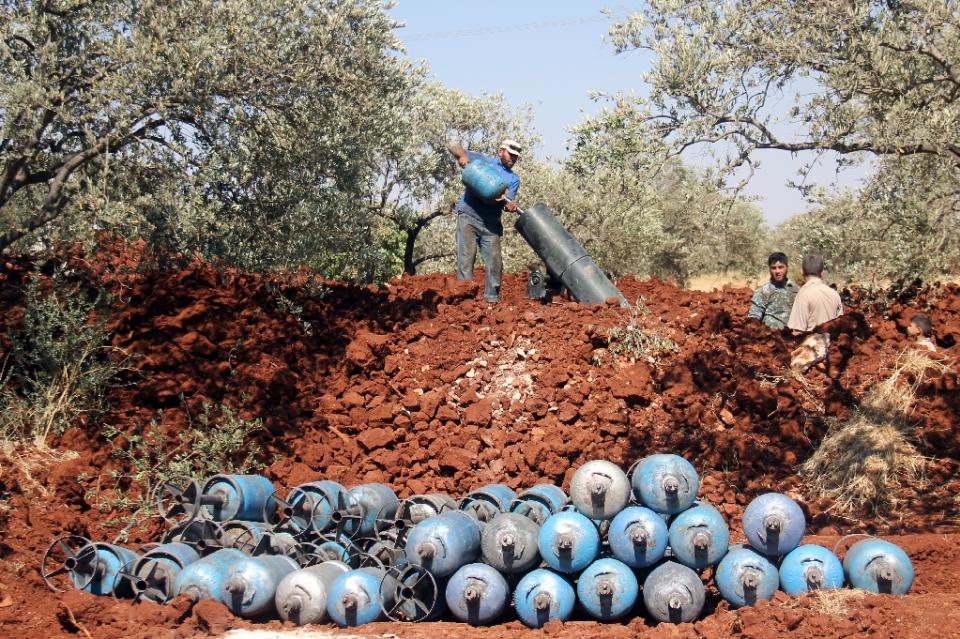
Rebel fighters fire home-made mortar rounds towards Syrian regime forces on July 20, 2015, on the outskirts of the Syrian city of Idlib (AFP Photo/Omar Haj Kadour)

Labels: , , , , ,

Thursday, May 14, 2015

Gatestone Institute


Translations of this item:
  • Pressures against non-Muslims in Turkey are actually empowered, motivated and even led by state policies.
  • There also does not seem to be any interest or pluralistic mentality in enforcing non-Islamic laws.
  • To understand the root cause of social intolerance and institutionalized violence, it is important to look more closely at how Islamic scriptures refer to non-Muslims. These labels and lies, fed to Muslims from earliest childhood, apparently do not go away easily in the minds of indoctrinated Muslims.
  • For those who oppose Islamic rule, there are only three options: They are either to be killed; made to accept their inferior status through conversion to Islam, or keep their heritage but pay the jizya, the Islamic "protection" tax."
Although there is a more or less "secular" constitution in Turkey, the anti-Semitic and anti-non-Muslim culture seems to have more influence over people even than laws. There also does not seem to be any interest or pluralistic mentality in enforcing non-Islamic laws.
A cemetery in Milas, for example, leads one question the thin, fragile line between Islam and Islamism -- or between progressive Islam and radical Islam.

Milas, whose name comes from ancient Greek "Mylasa," is a nice town in Anatolia, where there was once a powerful Jewish community.[1]

After years of neglect and disrepair, the Jewish cemetery in Milas has been turned into a place where sheep graze and garbage is thrown.

Sheep graze in the neglected Jewish cemetery in Milas, Turkey.

The historic gravestones, which should have been protected as a cultural heritage, have long since been broken into pieces.

Not only is the town now free of Jews, but now even the Jewish cemetery has been left to its fate.

"In such an unprotected environment, the cemetery is proceeding step by step to destruction," wrote Rafael Algranati, a columnist for the newspaper Salom.

In 2009, Jews from Milas talked with Muhammed Tokat, the mayor of the town, and asked him to stop the destruction of the cemetery; the mayor agreed, Algranati wrote. The mayor promised that the children's park at the entrance would be removed and the cemetery would be tidied and arranged. In 2014, he repeated the promise.
The Jewish community is still waiting.

What is intriguing about the town of Milas is that its municipality is governed by a mayor from the non-Islamist Republican People's Party (CHP). So in his case, we are not talking about the religious intolerance of Islamists.[2]

To understand the root cause of social intolerance and institutionalized violence in Muslim societies, it is important to look more closely at how Islamic scriptures refer to non-Muslims.
According to the Quran, Jews are "apes and pigs" (5:60). They are also "cursed by Allah" (5:13), they are "wicked" (4:160-162), are "fond of lies" and "devour the forbidden" (5:42). They even have "diseased hearts" (5:52).

While Muslims are continually praised in the Quran ("the best of people," 3:110), non-Muslims are described as less than human and referred to as "the vilest of animals" (8:55), "the worst of creatures" (98:6), "perverted transgressors" (3:110), "panting dogs" (7:176), "cattle" (7:179), "perverse" (2:99), "stupid" (2:171), "deceitful" (3:73) and so on.
This list can go on and on. According to Dr. Bill Warner, the director of the Center for the Study of Political Islam, 61% of the Quran is about non-Muslims.

These labels and lies about Jews and other non-Muslims that are fed to Muslims from earliest childhood, apparently do not go away easily in the indoctrinated minds of Muslims.
According to the supremacist Islamic ideology, non-believers of Islam are subordinate to Muslims.

For those who oppose Islamic rule, there are only three options: They are to be either killed; made to accept their inferior status through conversion to Islam, or allowed to keep their heritage and pay the jizya, the Islamic "protection" tax.

There is simply no other religion that condemns and dehumanizes those who merely believe in other faiths, or those who prefer no faith, to this extent.

During the Ottoman Empire, non-Muslims, including Jews, were dhimmis (tolerated, second-class citizens in an Islamic state, and required to pay the jizya "protection" tax.)
The "modern" Turkish Republic, however, established in 1923, did not provide Jews or other non-Muslims with greater rights and liberties, either.

Even though Turkey is one of the few so-called "secular" Muslim countries, its Jewish, Christian, Alevi, Yezidi and other non-Muslim communities have been exposed to persecution and systematic discrimination -- including ethnic cleansings, massacres, pogroms, forced conversions, forced assimilation and forced displacement for decades under non-Islamist governments.

In 1924, for instance, the Turkish Ministry of National Education asked all Jewish schools to choose either Turkish or Hebrew as their language of instruction. This was a smart maneuver, for very few Jews in Turkey had a command of Hebrew, because they spoke Ladino, the language brought with them from their expulsion from Spain in 1492. So the Jewish community had to choose the only suitable alternative, Turkish, as their language of instruction.[3]

Therefore, with the abolition of the Ottoman caliphate, Turkey did not actually turn into a safer and freer country for non-Muslims. Sadly, even more than 90 years after the establishment of "modern" Turkey, the strong influence of the anti-Semitic and anti-non-Muslim teachings of the Islamic ideology lives on. Moreover, pressures against non-Muslims in Turkey are actually empowered and motivated, and even led by state policies.
But no matter what some Islamic teachings contain, everyone, including Muslims, has free will -- and needs to use it justly.

Muslims could greatly benefit by seeing that the rights of human beings are not based on gender or religion; they are simply based on that we are all human beings together. At least progressive Muslims must show respect towards people of all faiths, and their cultural heritage.

If they do not, then I will tend to agree with the illustrator and writer Bosch Fawstin, who wrote that, "the only difference between 'Islamism' and Islam is three letters."
Uzay Bulut, born and raised a Muslim, is a journalist based in Ankara.

[1] Akarca, Turhan, Askidil Akarca, The Geography, History and Archeology of Milas, Istanbul Printing Press, Istanbul, 1954.
[2] Results of municipal elections in Milas from 1963 to 2014.
[3] Prof. Aron Rodrique, "The Westernization of Turkish Jews: "Alliance" Schools 1860 – 1925, Ayrac Printing House, 1997, Ankara.

Labels: , , , ,

Follow @rheytah Tweet