Tuesday, January 17, 2023

Books That Belong in Public Libraries Not School Libraries

"The book removals and also the comments create this pervasively hostile environment."
"Both send a message to the entire community that LGBTQ identities are inherently obscene, worthy of stigmatization -- and the book removals uniquely deprive LGBTQ students of the opportunity to read books that reflect their own experiences."
Chloe Kempf, lawyer, American Civil Liberties Union of Texas

"This isn't the sort of civil rights issue that requires federal intervention."
"It's a question about books in schools, not about individual rights being violated."
Will Flanders, research director, Wisconsin Institute for Law and Liberty

"I think it's gonna hold."
"I wouldn't be surprised if this ends up at the Supreme Court eventually."
John Doherty, School Liability Expert Group
The superintendent of the Granbury Independent School District, Jeremy Glenn, second from right, at a school board meeting in March. He was secretly recorded ordering librarians to remove LGBTQ-themed library books. Credit: Shelby Tauber for ProPublica/The Texas Tribune/NBC News
A Texas school district has allegedly removed books featuring LGBTQ characters from school libraries, leading the U.S. government to open an investigation. The situation marks the first test of a new legal argument that holds the failure to represent students in school books can constitute discrimination.
 
The Granbury Independent School District is now being investigated by the Education Department's Office for Civil Rights, the initiative based on a complaint of discrimination that the American Civil Liberties Union of Texas lodged last summer.
 
Should the government find in favour of the ACLU, what follows could have further implications for schools nationwide. Experts foresee that forcing libraries to stock books featuring LGBTQ individuals and requiring administrators to develop procedures ensuring student access to books some Americans feel to be unacceptable will not go down well with conservative parents. Particularly within a rising tide of book challenges and bans, expressing parental dissatisfaction with what is becoming the status quo, swiftly upturning social tradition.
 
Books focusing on themes of sexual and racial identity with all that implies in all their complexities are those books most often targeted. According to the Texas ACLU complaint, Granbury school officials directed removal of all LGBTQ books from school libraries, citing statements by superintendent Jeremy Glenn a year ago. The Texas Tribune published Mr. Glenn as having informed his staff would be "pulling out ... the transgender, LGBTQ, and the sex -- sexuality -- in books"

An estimated 130 books representing three-quarters that featured LGBTQ characters or themes were those removed from library shelves. Attorneys for the Texas ACLU argue that those actions violate Title IX -- the federal law that prohibits discrimination in public schools on the basis of sex. The law was recently interpreted by the Biden administration as forbidding discrimination based on sexual orientation and gender identity; key to the ACLU's argument.

Governmental intervention in the Granbury case, in the opinion of the Wisconsin Institute for Law and Liberty's Will Flanders, could set a worrying precedent of federal overreach. Such decisions on availability and appropiriateness in school libraries of texts should remain with local school boards reflecting the status quo of the public school system from its inception.

Photo by Shelby Tauber for ProPublica / Texas Tribune / NBC News
ProPublica
John Doherty of the School Liability Expert Group that provides expert witness testimony and legal consultations to schools predicted  it would take one to two years for the federal probe to proceed and might eventually generate penalties for the school district ranging from a reduction in federal funding to government-mandated training on inclusivity -- or nothing at all.

The Texas ACLU contends the removal of books featuring specific values may represent discrimination at a time when school book bans and challenges are surging to historic levels nationally and school officials clandestinely remove texts from shelves to avoid such controversy. The vast majority of books drawing complaints according to analyses from PEN America and the American Library Association, are written by or about people of colour and LGBTQ individuals.

John Chrastka who heads the national political action committee EveryLibrary is exultant over the scope and implications of the ACLU's argument that banning books may violate federal anti-discrimination laws. He expects, if the efforts of the ACLU prove successful. that an explosion will result in the availability of texts devoted to LGBTQ voices and subjects in school libraries.

However, as Rick Hess, director of education policy studies at the American Enterprise Institutes points out, most cases of school book challenges and removals cannot clearly be traced to animus against a particular protected class of people like LGBTQ individuals. Parents in school systems nationwide are filing complaints against books for their sexual or otherwise age-inappropriate content.

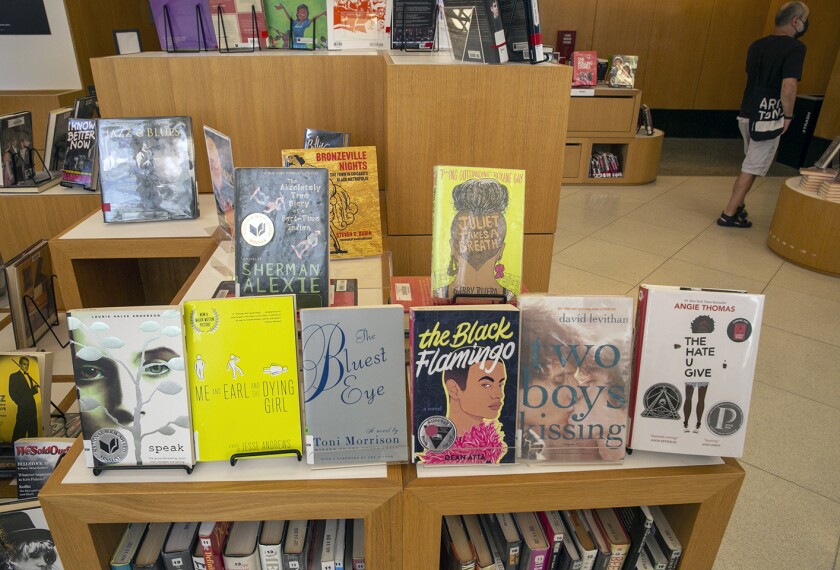
Banned books are visible at the Central Library, a branch of the Brooklyn Public Library system, in New York City on Thursday, July 7, 2022. The books are banned in several public schools and libraries in the U.S., but young people can read digital versions from anywhere through the library. The Brooklyn Public Library offers free membership to anyone in the U.S. aged 13 to 21 who wants to check out and read books digitally in response to the nationwide wave of book censorship and restrictions.
"If school districts everywhere really are systematically removing every book which contains a gay or trans character, that would be problematic, but I find that unlikely."
"But to ask whether something is appropriate for a six- or ten-year-old?"
"That strikes me as eminently reasonable."
Rick Hess, director of education policy studies, American Enterprise Institute think tank


Labels: , , ,

Saturday, February 15, 2020

Dehumanizing Gays in Indonesia

"If the psychologist declares that a candidate has a deviant sexual orientation, certainly the school will not hire that person."
Waadarrahman, official, Ministry of Education and Culture, Jakarta, Indonesia

"Psychologists cannot discriminate on the basis of sexuality."
"Every day they [homosexuals] have to hide from a society that judges them badly."
Ha H. Misbach, psychologist, Bandung
The examination question required a simple 'agree' or 'disagree'. Its wording was: "I would feel uncomfortable knowing my daughter's or son's teacher was homosexual". And another true-or-false question: "The gender composition of an orgy would be irrelevant to my decision to participate".
Indonesia
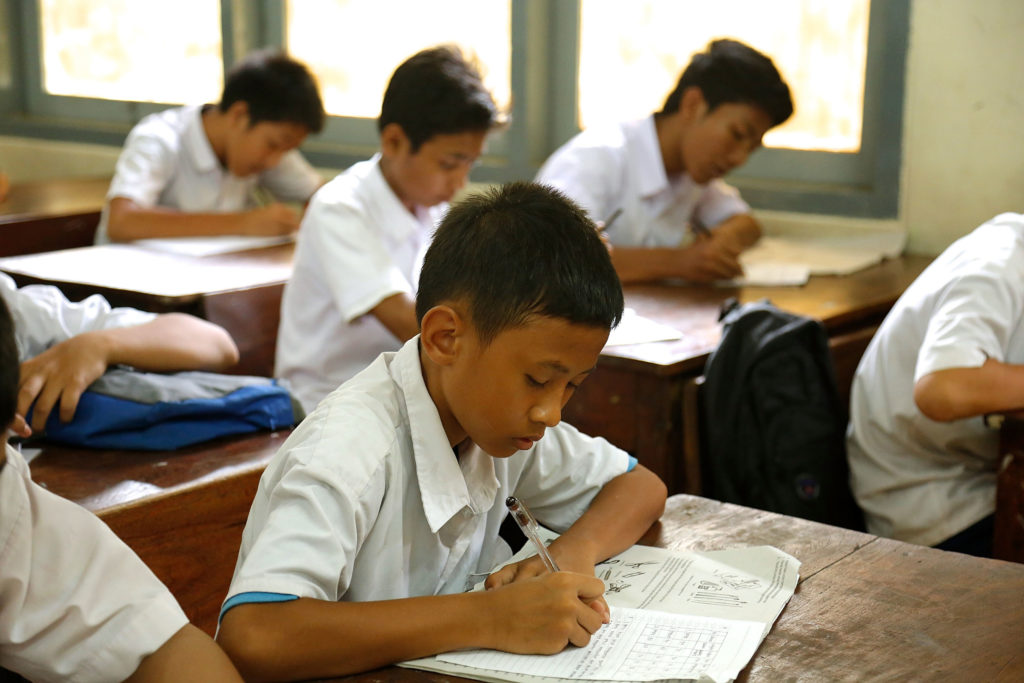
Students at an Islamic school in Jakarta, the capital of Indonesia (Ed Wray/Getty)

Some schools in Indonesia have recently confronted foreign teachers to answer questions such as those above, in what is being spoken of as a psychological test, with the goal to determine their sexual orientation and attitude toward gay rights. International schools in Muslim Indonesia are prohibited by a 2015 government regulation from hiring foreign teachers who have "an indication of abnormal sexual behaviour or orientation".

Lesbians, gays, bisexuals and transgender people are increasingly facing hostility across Indonesia, which despite being the country with the largest Muslim population in the world, once had a reputation for tolerance. Islamism, which has swept through Islamic countries globally -- with its political focus on fundamentalist Islam -- has reached Indonesia. Islam condemns homosexuality and any deviance from what is considered gender normatives.

While still officially secular, with the weight of the world's largest Muslim population, the Indonesian parliament in September wavered on passing an overhaul of the criminal code where gay and lesbian relations would be outlawed. Though it failed to pass at the time, expectations are that the proposal will be renewed in 2020.

The Child Protection Agency in Bekasi Regency, adjoining Jakarta, Indonesia's capital, identified four thousand people who suffer from the "disease" of being lesbian, gay, bisexual or transgender. Mohamad Rojak, the agency commissioner stated that "sexual disorientation" was caused by "carefree lifestyles", urging those on the list to overcome their condition through "therapy".

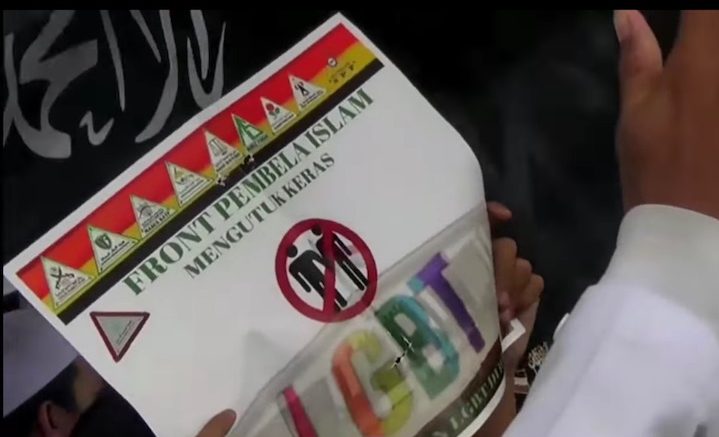
Photo: YouTube – AFP News Agency

Job applicants for the office of Indonesia's attorney general responsible for enforcing laws against discrimination, noted on its website in November that job applicants must not have "sexual orientation disorders". While not illegal in Indonesia other than in the autonomous province of Aceh, Homosexuality is now in the cross-hairs of the new vice-president who supports criminalization.

In 2014, a Canadian educator and six Indonesians were accused of sexual abuse of students at the prestigious Jakarta International School. Hugely questionable evidence was used to convict them all; even a claim that the Canadian had made use of magic so the crime scenes would be invisible. The testing regulation applies to 168 schools which are required to have a psychologist certify each teacher does not suffer from a behaviour disorder or an "above-normal sexual orientation".

No standardized exam exists, each of the schools must hire a psychologist to conduct the certification process. At one of the schools administering the required test in Jakarta, an assortment of behavioural questions required responses, at least 38 of which dealt with sexual orientation and attitudes toward gay rights. Psychologist Ha H.Misbach declined the request by a school to prepare such an exam, on the basis of unacceptable attitudes in Indonesia considering homosexuality a choice, not a characteristic determined by birth.

Foreign teachers at Indonesian private schools are being forced to take tests to determine their sexual orientations and attitudes towards LGBTQ rights in what has been described as a psychological exam.

Labels: , , ,

Tuesday, July 23, 2019

Problems in the Israel They Dreamed Of

"The concept was that they [airlifted Ethiopian Jews into Israel] would develop best as a community."
"That was a historic mistake."
Isaac Herzog, former minister of social services and welfare, Israel

"It's very difficult as someone who's black to get the same opportunities [as the rest of Israel's Jewish population]."
"People find it very hard to see you as equal."
Alamito Itzhak, Ethiopian Jew, 32, Netanya, Israel

"[Getting to Israel was] like touching the moon."
"Is this the Israel we dreamed of? It's a question I ask."
Zion Getahun, Ethiopian Jew, Netanya, Israel
Ethiopian Jewish women pray during a Sigd celebration in Jerusalem in 2014. (Wikimedia Commons)

The Ethiopian Jewish community was a minority in Ethiopia dating back 1,500 years. Theirs was a nomadic lifestyle, and ancient legends kept their Judaism alive and thriving. They call themselves the Beta Israel. In Ethiopia they were termed the Falasha, a derogatory term meaning "outsider". The Beta Israel faced discrimination over the millennia, treated as the 'other'. They lived as discrete groups in little villages, each group isolated from the others, with their own religious traditions, rabbis and houses of worship; un-unified other than in their Judaic faith.

Ethiopian rabbis (Kessim) at the ceremony of a new spiritual leader in Ashkelon, Israel, in 2012. (Wikimedia Commons)

The State of Israel 'rescued' Yemeni Jews from Yemen, flying tens of thousands to Israel to become Israeli citizens, in the late 1940s. Operation Magic Carpet brought almost 50,000 Jews of Yemenite heritage to the new Jewish State in its first two years, responding to a forced exodus of Jews out of Muslim-dominated countries when the State of Israel became a reality in 1948. Much later, in 1991, Operation Solomon was launched, when the Israeli military airlifted Beta Israel the third tranche to their new home in Israel.

The clandestine and dangerous flights took people living in traditional nomadic lifestyles that saw few advances in what we call civilized, urban life and placed them overnight into a sophisticated advanced, technological environment where everything was new and both exciting and frightening for the transferred people. But people are adaptable, and over time newer generations had no problems adjusting to the normal social life everyone else took for granted.

The religious orthodox community hesitated to consider the Ethiopian Jews as truly Jews; their exposure to the Judaic traditions and heritage was not the same as that of the Ashkenazi Jews from Europe. Moreover, they were black, backward, uneducated and viewed as decidedly second-class both in their social tradition and their religious devotion. Israelis in general may have felt happy and excited to 'rescue' Yemenite and Ethiopian Sephardic Jews, but their 'differences' set them apart.

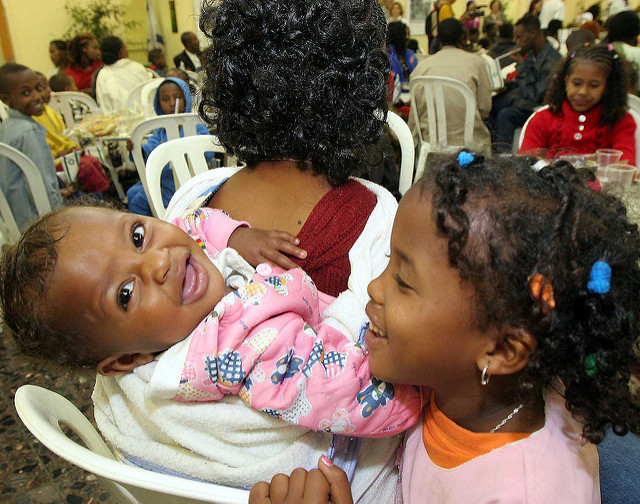
An Ethiopian Jewish family shortly after arriving in Israel in 2009. (Jewish Agency for Israel/Flickr)

There are now 150,000 Ethiopian Israelis in a greater population of 9 million Jews, Arabs, Kurds, Druze, Circassians and others. As a distinctly visible minority, Ethiopian Jews feel not fully accepted as equals in Israel, and with good reason. They are as discriminated against in Israel as blacks are everywhere else where they represent a minority group. They face discrimination in opportunities, in medical care, in education, employment, housing and social benefits.

Civil institutions fail to respond to their needs equally with that of other Israelis. Ethiopian Jews are disproportionately arrested, held in prison for minor offences, and targeted by police. "They know we don't have money for lawyers. They know we can't defend ourselves", said Izra Ayalo, 25, who tells a story of an officer raising his fist against him with no exculpatory provocation, while the police commander stood by, laughing as the young man flinched.

There is systemic racism involved, generally known and accepted, but not by the Ethiopians. Very recently an 18-year-old Ethiopian Israeli was shot and killed by a police officer who claimed he was defending himself from physical violence during an altercation. And though Israeli authorities admit to 'over-policing' being a problem where police become overly aggressive responding to minor misdemeanors, the situation remains, and the Ethiopian community has risen in protest leading to riots.
A firefighter extinguishes a car fire during a protest against the death of 18-year old Solomon Tekah, in Tel Aviv, Israel July 2, 2019. REUTERS/Corinna Kern

The original enthusiastic reception of Israelis to the 'homecoming' of the largest wave of Ethiopian Jews to arrive in 1991 hardly reflects the social climate of the present. In the general Jewish population 40 percent of Jews have achieved an academic degree while only 20 percent of Ethiopian Israelis growing up in Israel have managed to. Household income in the Ethiopian Israel community is stuck at 2/3 of that of other Israelis. Alamito Itzhak earned her teaching certificate but is unable to land a teaching position, so she works as a cashier in a supermarket.

Zion Getahun, as a teen 40 years ago, grew up hearing his grandmother's spoken dreams about living in Jerusalem. He walked hundreds of kilometers from his Ethiopian village to reach a camp in Sudan. From that camp he had been airlifted to Israel. He is still waiting to view the Israel his grandmother dreamed about, a land of recognition, equality and opportunity.
Online incitement rises massively against Ethiopian-Israelis
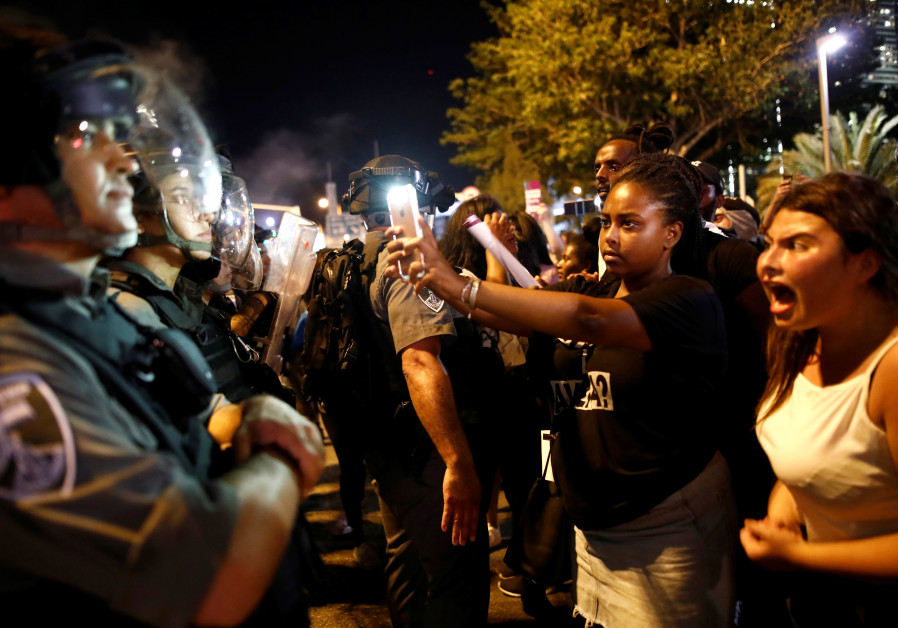
Protesters stand opposite police during a protest for the death of 18-year old Solomon Tekah of Ethiopian descent, after he was shot by police, in Tel Aviv, Israel July 2, 2019. (photo credit: CORINNA KERN/REUTERS)

"The death of Solomon Tekah is a great tragedy. Our hearts are with the family and lessons will be learned, but one thing is clear: we cannot tolerate the violence we saw yesterday, we cannot see the blocking of roads, Molotov cocktails, attacks on police and citizens and private property. This is something that cannot be tolerated, and the police are preparing accordingly to prevent it."
"[The Ethiopian-Israeli community] is dear to us [but Israel is a state of law, and demands that] everyone respect the law."
"One thing is certain, this cannot be dealt with by blocking roads, and it cannot be dealt with violently."
"We worked together and achieved important things for the Ethiopian community in Israel and we have more work to do. But the first thing I ask and expect is that you mobilize your influence to help stop this violence. It must stop immediately."
Israeli Prime Minister, Benjamin Netanyahu
An Israeli of Ethiopian origin argues with a police man during a protest outside the Knesset on July 15, 2019 in Jerusalem, Israel. The protests follow the death of a young man of Ethiopian origin who was killed by an off-duty police officer in Kiryat Haim on June 30.  Lior Mizrahi/Getty Images

Labels: , , ,

Thursday, August 27, 2015

Murder As Media Performance

"[WDBJ-TV Alison Parker is a] racist. My hollow point bullets have the victims' initials on them. Jehovah spoke to me [spurring to action]."
"Alison made racist comments ... EEOC [equal opportunities report filed] ... They hired her after that???"
"Adam went to [HR -- human resources] on me after working with me one time!!!"
"I filmed the shooting see Facebook."
"[I was a] human powder keg for a while ... just waiting to go BOOM!!!"
"What I encountered while employed at WDBJ-7 was nothing short of vile, disgusting and inexcusable. Your Honor, I am not the monster here. I get along with my current co-workers … [T]hat sure doesn’t sound like the monster I was painted to be."
Vester Flanagan, Virginia gunman

"How can this individual have robbed these families, the families of Alison and Adam, of their lives and their happiness and their love for whatever reason?"
"After many incidents of his anger coming to the fore, we dismissed him. He did not take that well."
"He quickly gathered a reputation as someone who was difficult to work with. Eventually after many incidents of his anger coming to the fore, we dismissed him. We had to call the police to escort him from the building."
Jeff Marks, general manager, WDBJ TV

"It's like showing those beheadings. I am not going to watch it. I can't watch it. I can't watch any news. All it would do is rip out my heart further than it already is."
Andy Parker, father of murdered reporter

"[Flanagan] was a good on-air performer, a pretty good reporter and then things started getting a little strange with him."
Don Shafer, former news director, KPIX-TV, Florida
Reporter, photographer shot and killed on air
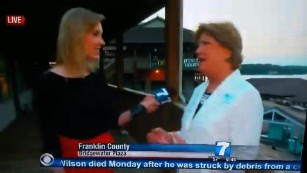
Alison Parker interviewing Vicki Gardner
When Vester Lee Flanagan, 41, worked  for WTWC television in Florida he was considered fairly good at his job. Until, in 2000 he was fired as a result of "bizarre behaviour". Mr. Flanagan, however, held that he was a victim of racial discrimination augmented by slurs and discrimination because of his gay status. Two years later he resumed his career as a reporter and producer for WNCT-TV in North Carolina.

In 2012 he was hired by WDBJ, then fired within a year. Paranoia and a persecution complex led him to the conclusion that he was meant to act against the grievous treatment that had been meted out to him, and avenge himself personally on an oppressive situation where he was victimized, incited further by the recent shooting at a historic black church in Charleston, South Carolina. He became a perfect storm, triggered by his own personality and his perceived victimhood.

And he set out to perform a ritual; to video-record his revenge, and to circulate it on social media in expectation of acclaim as a hero in the black struggle against white supremacy. To become that hero he had to select a target in a conspicuous situation where his action would be recognized as boldly audacious, proving himself a man of action and enterprising acumen, using his TV-broadcast skills in the process. His final statement to the unfair world of persecution and indignity would be self-martyrdom.
Ward was engaged to be married to a morning show producer at WDBJ, Melissa Ott, according to a journalist at the anchor desk, and Ward recently told her, "I'm going to get out of news. I think I'm going to do something else."
Adam Ward

Pointing a pistol at reporter Alison Parker as she interviewed a local official at an outdoor shopping mall he called her a "bitch" and shot her, as she reacted in shock and disbelief, attempting to flee,  filming the action as it took place, and then he shot cameraman Adam Ward, 27. He posted the ensuing video of the murders and no doubt felt satisfaction at a job well planned and executed. The interviewee, Vicki Gardner, also critically shot, underwent surgery and will survive.

The scenario he sketched out for himself works for social misfits, psychopaths, people who set out to distinguish themselves as murderers, committing atrocities for a 'cause'. The huge attention generated by videos released by Islamic State of Iraq and the Levant has acted as an obvious template for the bitterly self-conscious victim yearning to become a celebrity figure, a martyr to their own cause of self-actualization as a champion of the underdog. Leaving a legacy in the annals of self-described avengers of the wronged.

Labels: , , , , ,

Sunday, August 16, 2015

Gatestone Institute


  • The U.S. Department of State needs to analyze the Kurdish issue more closely and carefully. When they do, they will see that the problem should not be called "the Kurdish Issue;" it would be more just to call it "the Turkish Racism Problem."
  • Kurds in Turkey have always been brutally oppressed, even when there was no organization called the PKK.
  • Kurds are not the ones who started the war in Kurdistan. Kurdish leaders have openly and frequently made it clear that despite all of the state terror, mass murders and oppression they have been exposed to, they wish to live in peace with their Turkish, Arab and Persian neighbors. There is a war imposed on Kurds.
Turkey's authorities keep saying that the Turkish "security" forces do what they do -- arrest or kill Kurds -- only when Kurds carry out "terrorist" activities, or only when the Kurdistan Workers' Party (PKK) attacks targets in Turkey. Nothing, however, could be farther from the truth. Turkey's attacks against Kurds have always been intense, even when the PKK declared unilateral ceasefires.

Regarding 2014, when there were no clashes between the Turkish military and the PKK, Faysal Sariyildiz, a Kurdish MP for the Peoples' Democratic Party (HDP), said, "During the last year, regarding the Kurdish issue, 3,490 people have been taken into custody, 880 people have been arrested and 25 people have been killed with police bullets."

"These attacks," said Mark Toner, spokesman for the U.S. Department of State, "are only exacerbating the continuation and the cycle of violence here. We want to see these attacks cease. We want to see the PKK renounce violence and re-engage in talks with the government of Turkey."

What Mr. Toner fails to understand -- although of course both sides should renounce violence and try to resolve the issue through dialogue, without bloodshed -- is that the cycle of violence intensified only after the Turkish military started a recent all-out assault on Qandil in Iraqi Kurdistan.

What the AKP government refers to as "the resolution process" started in 2012, when talks were allegedly held between the Turkey's National Intelligence Organization (MIT) and the leader of the PKK, Abdullah Ocalan, who has been imprisoned in Turkey since 1999.


Abdullah Ocalan, leader of the PKK, after his capture by Turkish special forces in 1999.


But since then, in terms of liberties and rights, what has changed for Kurds?
Before that, about eight or nine talks between the PKK and the MIT were held in Oslo, Norway between 2008 to 2011, a PKK authority said. During the talks, the PKK -- through the protocols Ocalan prepared -- demanded a constitutional resolution, peace, and the establishment of a "Commission on Investigation of Truth" that would investigate murders committed in the past. "But in June 2011, after the elections, the government saw itself as powerful again, so it stopped participating in the talks and stopped taking them seriously," the PKK authority said.

Again, during this process, no legal step was taken for recognition of Kurdish national rights.
Just this May, Turkey's president, Recep Tayyip Erdogan said in a public speech:
They [the HDP party] say that "When we come to power, we will abolish the Diyanet [Presidency of Religious Affairs]." Why? Because they have nothing to do with religion. They go as far as saying that Jerusalem belongs to Jews; they [the PKK] give education on Zoroastrianism at the camps on the mountains.[1]
The TRT [state-run Turkish Radio and Television Corporation] has a Kurdish TV channel. There are Kurdish language courses at universities. Our country does not have a Kurdish issue any more. But our Kurdish citizens have some issues. Those who want to make the resolution process all about the Kurdish issue are on about something else. They say 'We are the representatives of the Kurds.' No way! If you really are their representatives, clear up the dirt in the sidestreets."
Is this the language that someone who genuinely aims to achieve peace and provide democracy would use? First of all, Erdogan and his AKP party do not see the Kurdish issue as an ethnic or national problem. They seem to think that a Kurdish TV channel and a few courses at universities should be enough to resolve the issue. This shows that the root of the problem is not the Kurds' demands or violence. The root of the problem is traditional Turkish supremacism. The Turkish government evidently expects the indigenous Kurds to settle for whatever crumbs the government offers.

It is this supremacist mentality of Turkey that started and inflamed this problem, and created countless grievances in Kurdistan. The Turkish state wants to be the one to name the issue; to start and end it; to choose the way to resolve it or make it go on forever; to determine how Kurds will live and die; what Kurds can want and when they should stop; what language they can speak, and where and when.

Then, when Kurds resist, and say they want to be free and have a say in their own affairs in Kurdistan, Turkey dismisses them or blames them for being "terrorists" or "traitors."

The Kurdish PKK is an armed organization; and just like all armed organizations or groups, it uses violence as a tactic. But it does not aim to destroy Turkey or the Turkish people. It has declared several times that it is open to dialogue, negotiation and peaceful coexistence.

The Turkish government could also embrace a similar purpose: peace based on political equality and mutual respect. Turkey could abandon its destructive militaristic ways and start an open, transparent, genuine peace process that does not aim to destroy and annihilate Kurds and their militia. Killings will only bring more killings and more hatred. It is high time that Turkey stopped attacking Kurds and used the only method it has not used in its history: respecting the indigenous peoples of Anatolia and Mesopotamia.

Turkish state authorities seem to wish to make Kurds surrender without gaining any national rights or political status, and they call this "a peace process." That is not an oversimplification: The AKP has ruled Turkey since 2002 but has done nothing to recognize Kurdish self-rule. All the AKP did was to provide a few small changes, such as permitting a Kurdish TV channel, TRT-6. But even those are not legal reforms. Turkey is still ruled with the same constitution that the Turkish military drafted after the 1980 coup d'état.

In this fight, Kurds are the "rape victims." On their own ancestral lands, they have no national rights and no political status, and they do not even have the right to be fully educated in Kurdish. They are randomly murdered and arrested. Apparently, their lives have no value in the eyes of the Turkish state.

Turkey has a huge national problem because it does not see Kurds as an equal nation. This is how many Turks see the conflict:
  • Turks are to have their own state -- a supreme one that has power over international politics -- but Kurds are not to have even autonomy.
  • Turkish is to be a rich and respected language worldwide, but Kurds are not to have a single school where they can be educated fully in Kurdish.
  • Turks are to have a powerful army; Kurds are to disarm their militia and are to just serve in the great army of Turks.
But even integration in the military does not seem to work. Many soldiers of Kurdish origin serving in the Turkish army reportedly commit "suicide" or are killed in "accidents." In 2012, for instance, out of the 42 soldiers who were officially reported to have killed themselves, 39 were Kurdish and one was Armenian, according to the lawyer Mazlum Orak.

The founders of the Turkish state also promoted Turkish nationalism to the full extent, while denying the very existence of Kurds in Turkey. They fully enforced a ban on Kurdish language, culture and geographical place names. They called Kurds "mountain Turks" and did not allow Kurds to establish legal political parties until the 1990s. Even after that, seven legal pro-Kurdish political parties were closed down by the Turkish constitutional court over 20 years. Scores of Kurdish villages were burned down by the Turkish army, and tens of thousands of Kurds were tortured or murdered wholesale.

Kurds in Turkey have therefore always been brutally oppressed even when there was no organization called the PKK.

Turkish sociologist Ismail Besikci, who was spent 17 years in prison for his writings on Kurds and Kurdistan, compared Turkey to South Africa. He concluded that Turkey's mentality "is much more racist" than South Africa's:
"What happened in South Africa in 1960s was that the white administration told the others: 'You are black; you will live separately from us. You will have separate neighborhoods, schools, hotels, and entertainment places. You will live outside of places where the white live; do not mix with whites.' And for that, they formed very large areas that were surrounded with wires. Those places had very limited infrastructure. The sewer system did not work; there were frequent electric power outages and water cuts. The schooling and health conditions were very insufficient. But the natives experienced their own identity. They lived the way they were. But Turkey tells Kurds: 'You will live with us but you will look like us. You will forget your identity. You will live with Turks but will look like Turks.' I am trying to say that this mentality is much more racist than the administration in South Africa."
Besikci noted that in the 1990s, Nelson Mandela was released from prison and was elected as the president of South Africa: "The president of the white administration that released Mandela from prison became the vice president of Mandela in the elections. South Africa is called the most racist state of the world but such a change happened there. This shows the official ideology there was flexible; it was not so strict."

Kurds are not the ones who started the war in Kurdistan. Kurdish leaders have openly and frequently made it clear that despite all of the state terror, mass murders and oppression they have been exposed to, they wish to live in peace with their Turkish, Arab and Persian neighbors. There is a war imposed on Kurds. And its results have been disastrous for Kurdistan.

The U.S. Department of State really needs to analyze the Kurdish issue more closely and carefully. When they do, they will see that the problem should actually not be called "the Kurdish Issue;" it would be more just to call it, "the Turkish Racism Problem."
Uzay Bulut, born and raised a Muslim, is a Turkish journalist based in Ankara.

[1] Selahattin Demirtas, co-President of the HDP, had said in a public statement, "Religions have their centers. Muslims go to Kaaba in Mecca; Jews go to Jerusalem."

Labels: , , , ,

Thursday, August 13, 2015

Combating Institutionalized Racism

"Mike Brown means to change the world and help other people, with the body cameras for the police. But at the end of the day, I still lost my boy."
"I feel like that's something I needed to do, something that Mike Mike would want me to do. I brought all families in to share this day with us."
"I'm angry, actually, very angry. Got to re-live this whole moment again."
"One thing I can say is he told me he's OK, [in a dream-conversation]."
"Y'all my world [to his newfound supporters]. Y'all made this happen for us."
Michael Brown, Sr., Ferguson, Missouri
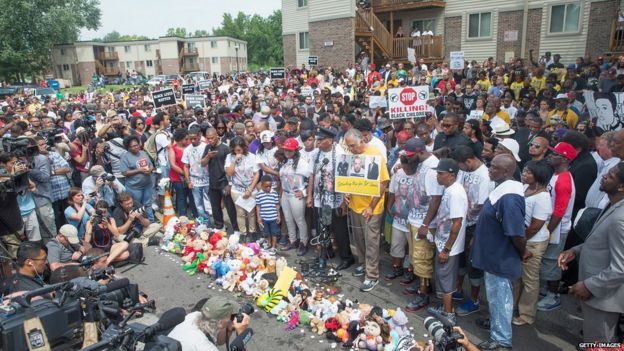
Crowds at a memorial for Brown Jr
Michael Brown's death brought thousands of protesters to Ferguson, Missouri
Blacks in American certainly have their legitimate grievances -- historically, right to the present time. There have been, and continue to be, more than ample instances of black Americans discriminated against, oppressed by a systemic, if illegal racism that continues to prevail. That distrust between whites and blacks in the United States speaks of a fundamental dysfunction is obvious. There is little reason for complacency on the part of the black population that their freedom marches gained them equality under the law.

That lawful equality may be in place, but social attitudes long ingrained as a tradition of white supremacy and black subservience to the white majority represents an underground, and sometimes not-so-covertly underground shame in a civilized society. Yet the black population has done itself few favours in cultivating an underclass of unmarried mothers raising children on their own because black men shun their parental responsibilities.

These images provided by the Ferguson Police Department show security camera footage from a convenience store in Ferguson, Mo., on Aug. 9, 2014, the day that Michael Brown was fatally shot by a police officer. A report released Friday, Aug. 15, 2014, by Ferguson Police Chief Thomas Jackson says the footage shows a confrontation between Brown and an employee at the store. The report says that Brown and his friend, Dorian Johnson, stole a box of cigars from the store shortly before Brown’s death. (AP Photo/Ferguson Police Department)

An undercurrent of unlawful and criminal activities by young black men seethes within American society, where gangs and guns and drug-dealing is all too common and celebrated in now-mainstream rap. And nor is Michael Brown who was shot to death in an altercation with a white policeman, a poster child for black innocence in the face of white supremacy. The young man was a thug and evidence points to his having given the policeman reason to fear for his own life in their face-off.

The black community mourns, as is their right and with good reason, the deaths of too many young black men. But that mourning must also take note of the irrefutable reality that young black men are over-represented in criminal activities, bringing the outcome of violent interactions with police to their behavioural doorstep. The Ferguson protests have resulted in yet another shooting of yet another young black man.

Tyrone Harris Jr., critically wounded by police returning gunfire when he fired at them, represents yet another of those fateful moments of cultural hatred and criminal deviance. The young man's father disputes the account of police, but security camera footage supports the police version of the event, showing the young man pulling a handgun from his waistband. He has been charged with ten felonies.

And nor is this the first time that this young man has been charged with criminal activities. The black community in seeking justice has fought a long, hard battle, and it is nowhere near finished. Discrimination and hardships imposed upon black Americans seem never-ending. But the disproportionate  position among the criminal classes of young black men is an indisputable reality. Reflecting the heightened vigilance of police.

There are responsibilities that must be met by both principal groups. Both of which deserve far, far better than is being dispensed at the present time. Social justice is long overdue, but so is the acknowledgement of personal responsibilities.

Labels: , , , ,

Sunday, July 26, 2015

Gatestone Institute


  • It appears as if the Turkish government is using ISIS as a pretext to attack the PKK (Kurdistan Workers' Party).
  • Turkey just announced that its air base at Incirlik will soon be open to coalition forces, presumably to fight ISIS. But the moment Turkey started bombing, it targeted Kurdish positions in Iraq, in addition to targeting ISIS positions in Syria.
  • In Turkey, millions of indigenous Kurds are continually terrorized and murdered, but ISIS terrorists can freely travel and use official border crossings to go to Syria and return to Turkey; they are even treated at Turkish hospitals.
  • If this is how the states that rule over Kurds treat them, why is there even any question as to whether the Kurds should have their own self-government?
Turkey's government seems to be waging a new war against the Kurds, now struggling to get an internationally recognized political status in Syrian Kurdistan.

On July 24, Turkish media sources reported that Turkish jet fighters bombed Kurdish PKK (Kurdistan Workers' Party) bases in Qandil, in Iraqi Kurdistan, as well as the Islamic State (ISIS) in Syria.

Turkey is evidently unsettled by the rapprochement the PKK seems to be establishing with the U.S. and Europe. Possibly alarmed by the PKK's victories against ISIS, as well as its strengthening international standing, Ankara, in addition to targeting ISIS positions in Syria, has been bombing the PKK positions in the Qandil mountains of Iraqi Kurdistan, where the PKK headquarters are located.
There is no ISIS in Qandil.

As expected, many Turkish media outlets were more enthusiastic about the Turkish air force's bombing the Kurdish militia than about bombing ISIS. "The camps of the PKK," they excitedly reported, "have been covered with fire."

It appears as if Turkey's ruling Justice and Development Party (AKP) is using ISIS as a pretext to attack the PKK. Ankara just announced that its air base at Incirlik will soon be open to coalition forces, presumably to fight ISIS, but the moment Turkey started bombing, it targeted Kurdish positions. Those attacks not only open a new era of death and destruction, but also bring an end to all possibilities of resolving Turkey's Kurdish issue non-violently.
Prime Minister Ahmet Davutoglu announced that
"a second wave operation against Daesh [ISIS] in Syria was started. Just after that, a very comprehensive operation was carried out against the camps of the terrorist organization PKK in northern Iraq. I am glad that the targets were hit with great success. We have given instructions to start a third wave operation in Syria and a second wave operation in Iraq."
The "great success" of the Turkish military has brought much damage and injury to even Kurdish civilians -- including children. The Kurdish newspaper Rudaw reported that two Kurdish villagers in Duhok's Berwari region were carried to hospital in the aftermath of a Turkish artillery bombardment in the Amediye region. One of the victims was 12 years old. The second victim lost a leg in an airstrike. Four members of the PKK were killed and several others were injured.

Shortly after military operations against the PKK started, access to the websites of pro-Kurdish newspapers and news agencies was denied "by decree of court." These websites -- including Fırat News Agency (ANF), Dicle News Agency (DIHA), Hawar News Agency (ANHA), Ozgur Gundem newspaper, Yuksekova News, Rudaw and BasNews -- are still blocked in Turkey.

ISIS, meanwhile, has not so far made any statement regarding Turkey's so-called bombings of ISIS in any of its media outlets.

Had the Turkish military attacked the PKK alone, and not in addition to attacking ISIS, it would probably have received widespread international condemnation. So to add "legitimacy" to its attacks against the Kurdish PKK -- whose affiliate Democratic Union Party (PYD) in Syria and its armed wing, the Kurdish People's Defense Units (YPG) have been resisting ISIS and other Islamist terrorist groups since 2013 -- Turkey declared that it will also attack ISIS. This would give it cover for its attacks against Kurdish fighters.

In 2014, Turkey's President Recep Tayyip Erdogan described the plan he wanted to carry out in Syria and Iraq: "The problem in Syria should be taken into account. Iraq too should be considered similarly. Moreover, there needs to be a solution that will also deal with the Syrian wing [PYD] of the separatist terrorist organization [PKK]."

The AKP government, dissatisfied with the results of last month's parliamentary elections, also seems to want to hold new elections, to push the mainly Kurdish HDP Party below the required 10% threshold, and thus force them out of parliament. Perhaps the government thinks that bombing the PKK will generate Turkish nationalist enthusiasm that will work in the AKP's favor to help it regain a majority in early elections.

Apparently, Turkey does not need Kurdish deputies in its parliament. Apparently, the state prefers to slaughter or arrest the Kurds -- as it has done for decades. Why hold talks and reach a democratic resolution when you have the power to murder people wholesale?[1]
Sadly, Turkey has preferred not to form a "Turkish-Kurdish alliance" to destroy ISIS. First, Turkey has opened its borders to ISIS, enabling the growth of the terrorist group. And now, at the first opportunity, it is bombing the Kurds again. According to this strategy, "peace" will be possible only when Kurds submit to Turkish supremacism and abandon their goal of being an equal nation.

In the meantime, Mevlut Cavusoglu, Turkish minister of foreign affairs, said that the Incirlik air base in Turkey has not yet been opened for use by the U.S. and other coalition forces, but that it will be opened in the upcoming period.

Kurdish forces, therefore, are the only forces that are truly resisting the Islamic State.
They have been repressed by Baghdad and murdered by Turkey and Iran.

If this is how the states that rule over Kurds treat them, why is there even any question as to whether the Kurds should have their own self-government?

As a result of the ISIS attacks in the region, the Kurdish PKK -- as well as its Syrian Kurdish affiliate, Democratic Union Party (PYD) and its armed wing, Kurdish People's Defense Units (YPG) -- have emerged as America's most effective battlefield partners against ISIS. Ever since ISIS became a major force in Syria, the U.S. has apparently relied heavily on YPG to stop ISIS from advancing. According to Henri Barkey, a former State Department specialist on Turkey, "The U.S. has become the YPG's air force and the YPG has become the U.S.'s ground force in Syria."

* * *

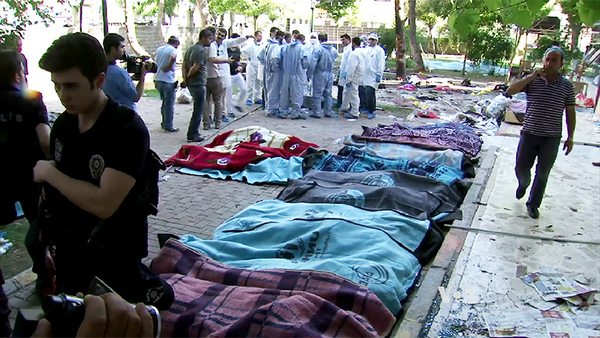
Attacks on the Kurds were already under way last week. On July 20, a bomb attack in the Kurdish town of Suruc (Pirsus) in Turkey killed 32 people during a meeting of young humanitarian activists, who were discussing the reconstruction of the neighboring Kurdish town of Kobane.

The scene of the suicide bombing in Suruc, Turkey. An ISIS suicide bomber murdered 32 people and wounded more than 100 others in a July 20 attack on Kurdish humanitarian activists. (Image source: VOA video screenshot)

The blast took place while the activists were making a statement to the press in the garden of a cultural center. At least 100 others, mostly university students, were wounded. (Graphic video of the explosion)

The suicide bomber was identified through DNA testing, according to reports in the Turkish news media. Seyh Abdurrahman Alagoz was reportedly a 20-year-old Turkish university student, recently returned from Syria, and believed to have had ties to ISIS.

Alagoz targeted a meeting of 300 secular activists, members of the Federation of Socialist Youth Associations (SGDF), who gathered at a cultural center in the province of Urfa, opposite the Kurdish town of Kobane in Syrian Kurdistan. As part of an effort to rebuild Kobane, they were preparing to provide aid, give toys to the children there and build a hospital, school, nursery, children's park, library and a memorial forest for those who had lost their lives in Kobane.

"Work on the building of hospitals and schools needs to be done," Oguz Yuzgec, the co-president of the federation, said before the explosion. "One of the things we will do is to build a children's park in Kobane. We will name it after Emre Aslan, who died fighting in Kobane. We are collecting toys. We will participate in the construction of the nursery that the canton of Kobane is planning to build. We have the responsibility of helping the nursery function. We need everybody who knows how to draw and can teach children."

Mazlum Demirtas, a survivor of the attack, said: "The main one responsible for this incident is the state of Turkey, the AKP fascism, the AKP dictatorship. ... It attacked us with its gunmen and gangs. Since yesterday, parents have been collecting the dismembered body parts of their children. They are trying to identify the dismembered bodies. This is called fascism, inhumanity and barbarity."

Pinar Gayip, another survivor of the attack, said in a telephone interview on the pro-government Haberturk TV that, "Instead of helping the wounded, the murderer-police of the murderer-AKP threw tear gas at the vehicles with which we carried the wounded." She was taken off the air.

All across Turkish Kurdistan, there were protests condemning the massacre and the government's alleged involvement in it. Police in Istanbul used plastic bullets and water cannons against people who gathered to remember those murdered in Suruc.

The Turkish authorities briefly blocked access to Twitter last Wednesday to prevent the people from viewing photos of the bombing in Suruc. Officials admitted that Turkey had asked Twitter to remove 107 URLs (web addresses) with images related to the bombing; before the ban, Twitter had already removed 50.

Selahattin Demirtas, the co-chair of the pro-Kurdish Peoples' Party (HDP), said that state surveillance activities were intensive in Suruc, and that the intelligence service was recording the identity of everyone traveling to and from Suruc.

As Demirtas's own convoy had recently not been permitted to enter Suruc, he emphasized the extent of state surveillance in the town, and said that nobody could argue that someone could have managed to infiltrate the crowd and carry out the suicide attack without state support.
"Today, we have witnessed in Suruc yet again what an army of barbarity and rape, an army that has lost human dignity, can do," Demirtas said. "Those who have been silent in the face of ISIS, who have not dared even raise their voice to it, as well as the officials in Ankara who threaten even the HDP every day but caress the head of ISIS, are the accomplices of this barbarity."

In the meantime, Mehmet Gormez, the head of the Turkish Presidency of Religious Affairs (Diyanet), announced on its Twitter account that the perpetrators of the Suruc attack do not have religion.

However, three days before the massacre in Suruc, about 100 Islamists -- alleged to be ISIS sympathizers -- had performed mass Islamic Eid prayers in Istanbul. They demanded Islamic sharia law instead of democracy. ISIS sympathizers had performed the same Eid prayers at the same place the year before, as well.

Over the border in Syrian Kurdistan, shortly after the blast in Suruc, a suicide bomber detonated a car bomb at a checkpoint in Kobane. Two Kurdish fighters were killed in the explosion, according to Rami Abdel Rahman, director of the Syrian Observatory for Human Rights.

Last month, a deadly blast hit the Kurdish province of Diyarbakir in Turkey, during an election rally of the pro-Kurdish HDP that was attended by tens of thousands of people. Just before the HDP co-chair Selahattin Demirtas was going to speak, two bombs exploded at different places. Four people were killed, and more than 100 people are estimated to have been wounded. One of the wounded, Lisa Calan, 28, a Kurdish art director from Diyarbakir, lost both legs in the explosion.

As the wounded were being carried to hospitals, police used tear gas against people trying to run from the area in panic

The bomber was reported to be a member of ISIS.

* * *
In Turkey, millions of indigenous Kurds are continually terrorized and murdered, while ISIS terrorists can freely travel and use official border crossings to go to Syria and return to Turkey; they are even treated at Turkish hospitals. Emrah Cakan, for instance, a Turkish-born ISIS commander wounded in Syria, got medical treatment at the university hospital in Turkey's Denizli province in March.

The Denizli governor's office issued a written statement on 5 March:
"The treatment of Emrah C. at the Denizli hospital was started upon his own application. The procedural acts concerning his injury were conducted by our border city during his entry to our country and they still continue. And his treatment procedures continue as a part of his right to benefit from health services just like all our other citizens have."
The "compassion" and hospitality that many Turkish institutions have for ISIS members is not even hidden. The silence of the West is mystifying and disappointing.

The U.S. government cooperates with oppressive regimes -- including the terrorist regime of Iran, under which Kurds are forced to live -- to the detriment of the Kurds, to the detriment other persecuted peoples, and to the detriment of the future of the West.

Many Middle Eastern regimes are ruled by Islamist, often genocidal governments -- so there is not much to expect from them in terms of human rights and liberties.

The Kurds need real support, real arms and real recognition. Otherwise, there does not seem to be much difference between the dictatorial, genocidal Middle Eastern regimes and the West, which used to represent democracy and freedom.
Uzay Bulut, born and raised a Muslim, is a Turkish journalist based in Ankara.

[1] The so-called "peace process" was reportedly started in 2012 and through it, Kurds and the Turkish government were to resolve the Kurdish issue through negotiations.)

Labels: , , , , , ,

Sunday, June 28, 2015

Gatestone Institute


  • If colonialism were the main problem, Muslims, too, still are, colonizers -- and not particularly "humanitarian" ones, at that.
  • Islamic jihad and Islamic violence; the sanctioning of sex slavery; dehumanization of women; hatred and persecution of non-Muslims have been commonplace in the Islamic world ever since the inception of the religion. Deny everything and blame "the infidel."
  • But is it America that tells these men to treat their wives or sisters as less than fully human? If we want to criticize the West for what is going on in the Muslim world, we should criticize it for not doing more to stop these atrocities.
  • Trying to whitewash the damage that the Islamic ideology has done to the Muslim world, while putting the blame of Islamic atrocities on the West, will never help Muslims face their own failures and come up with progressive ways to resolve them.
Every time the ISIS, Boko Haram, Iran, or any terrorist group in the Muslim world is discussed, many people tend to hold the West responsible for the devastation and murders they commit. Nothing could be farther from the truth. Blaming the failures in the Muslim world on Western nations is simply bigotry and an attempt to shift the blame and to prevent us from understanding the real root cause of the problem.

When these Islamic terrorist groups abduct women to sell them as sex-slaves or "wives;" conduct mass crucifixions and forced conversions; behead innocent people en masse; try to extinguish religious minorities and demolish irreplaceable archeological sites, the idea that this is the fault of the West is ludicrous, offensive and wrong.

Western states, like many other states, try to protect the security of their citizens. What they essentially need, therefore, are peaceful states as partners with which they can have economic, commercial and diplomatic relations. They do not need genocidal terrorist groups that destroy life, peace and stability in huge swaths across the Muslim world.

Western states also have democratic and humanitarian values, which Islamic states do not. The religious and historical experiences of the Western world and the Islamic world are so enormously different that they ended up having completely different cultures and values.
The West, established on Jewish, Christian and secular values, has created a far more humanitarian, free and democratic culture. Sadly, much of the Muslim world, under Islamic sharia law, has created a misogynistic, violent and totalitarian culture.

This does not mean that the West has been perfect and sinless. The West still commits some appalling crimes: Europe is guilty of paving the way for the slaughter of six million Jews in the Holocaust, and for still not protecting its Jewish communities. Even today, many European states contort logic to recognize Hamas, which openly states that it aims to commit genocide against Jewish people.

The West, however, accepts responsibility for the failures in its own territories: for instance, not being able to protect European women from Muslim rapists. These men have moved to Europe to benefit from the opportunities and privileges there, but instead of showing gratitude to European people and government, they have raped the women there, and tried to impose Islamic sharia law.

If we want to criticize the West for what is going on in the Muslim world, we should criticize it for not doing more to stop these atrocities.

The West, and particularly the U.S., should use all of its power to stop them -- especially the genocides committed against Jews, Christians and other non-Muslims in the Muslim world.
We should also criticize the West -- and others, such as the United Nations and its distorted Gaza War report -- for supporting those who proudly commit terrorist attacks against Israeli civilians, and we should criticize the West for not siding with the state of Israel in the face of genocidal Jew-hatred.

We should criticize the West for letting Islamic anti-Semitism grow in Europe, making lives unbearable for Jews day by day.

We should criticize the West for having accepted without a murmur the Turkish occupation of Northern Cyprus for more than 40 years.

We should also criticize the West for leaving the fate of Kurds, a persecuted and stateless people, to the tender mercies of Turkey, Iran, Iraq and Syria -- and now the Islamic State (ISIS). On June 25, ISIS carried out yet another deadly attack, killing and wounding dozens of people in the Kurdish border town of Kobani, in Syrian Kurdistan.

And we should criticize especially the current U.S. government for not being willing to take serious action to stop ISIS, Boko Haram and other extremist Islamic groups.[1]

The list could go on and on. Moreover, it would not be realistic to claim that these groups or regimes all misunderstand the teachings of their religion in exactly the same way.
It would also not be realistic to claim that the West has created all these hundreds of Islamic terror groups across the Muslim world.

The question, then, is: Who or what does create all these terrorist groups and regimes?
In almost all parts of the Muslim world, systematic discrimination, and even murder, are rampant -- especially of women and non-Muslims. Extremist Islamic organizations, however, are not the only offenders. Many Muslim civilians who have no ties with any Islamist group also commit these offenses daily. Jihad (war in the service of Islam) and the subjugation of non-Muslims are deeply rooted in the scriptures and history of Islam.

Ever since the seventh century, Muslim armies have invaded and captured Jewish, Christian, Hindu, Buddhist and Zoroastrian lands; for more than 1400 years since, they have continued their jihad, or Islamic raids, against other religions.

Many people seem to be justifiably shocked by the barbarism of ISIS, but Islamic jihad does not belong just to ISIS. Violent jihad is a centuries-long tradition of Islamic ideology. ISIS is just one jihadist army of Islam. There are many.

All of this is an Islamic issue. The free West has absolutely nothing to do with the creation and preservation of this un-free culture.

The West has, on the contrary, been the victim of Islamic military campaigns and imperialistic pursuits: Christian peoples of Europe have been exposed to Ottoman invasions and subjugation for centuries. The fall of Byzantine Empire marked the peak of Islamic Jihad in Christian lands. Many places in Europe -- including Greece, Bulgaria, Albania, Bosnia, Croatia, Hungary, Serbia, and Cyprus, among others -- were all invaded and occupied by the Ottoman armies. Other targets, including Venice, Austria, and Poland, had to fight fierce defensive wars to protect their territories.

The historical and current troubles in the Muslim world are not, therefore, problems "imported" from an outside source; they are internal cultural and political problems, which Muslim regimes and peoples have reproduced for centuries.

Some of the things that women in Saudi Arabia may not do were listed in The Week magazine: Saudi women are not allowed to "go anywhere without a male chaperone, open a bank account without their husband's permission, drive a car, vote in elections, go for a swim, compete freely in sports, try on clothes when shopping, enter a cemetery, read an uncensored fashion magazine and buy a Barbie and so on."

Of course, there is nothing specific in Islamic scriptures about cars, fashion magazines or Barbie Dolls. But there is enough there that indicates why all of these abuses, and more, are widespread across the Islamic world, and why the clerics, imams and muftis approve them.
The central issue is to see how the lines that the Islamic theology draws seed the soil in which this kind of discrimination systematically buds, why it is extolled and how it is advocated.
Saudi Arabia is not the only Muslim country where women are dehumanized. Throughout almost the almost the entire Muslim world -- including Turkey, considered one of the most "liberal" Muslim countries -- women are continually abused or killed by their husbands, ex-husbands, boyfriends, fathers, brothers or other males. [2]

Is it America that tells these men to treat their wives or sisters as less than fully human?
Is the West really what stops them from respecting human rights or resolving their political matters through diplomatic and peaceful ways? Are Muslims too stupid to make wise decisions, and act responsibly? Why should Americans or Europeans have evil wishes for the rest of the world?

Demonizing Western nations -- even after all of their cultural, scientific and rational progress -- is simply pure racism.

"The belief that the West is always guilty is among the dozen bad ideas for the 21st century," wrote the Australian pastor, Dr. Mark Durie. "This irrational and unhelpful idea is taught in many schools today and has become embedded in the world views of many. It is essentially a silencing strategy, sabotaging critical thinking."

Another term that prevents one from understanding the root causes of the conflicts in the Muslim world is "moral relativism" -- a politically correct term that really means moral cowardice.

Defending "moral relativism" and saying that "all cultures are equal" really means saying a culture that encourages child marriages, beating women and selling girls on slave markets has a value equal to a culture that respects women and recognizes their rights, and which renounces wanton violence.

Another popular target of blame for the failures in the Muslim world is historical British colonialism.

If colonialism were the main problem, however, Muslims, too, were, and still are, colonizers -- and not particularly "humanitarian" ones, at that. The Muslim colonizers do not even seem to have contributed much to the culture of the places they invaded and colonized. In fact, they have actually delayed the progress of the areas they colonized. The printing press, for instance, came to the Ottoman territories almost 200 years later than to Europe.

"Books... undermine the power of those who control oral knowledge, since they make that knowledge readily available to anyone who can master literacy," wrote Professor Daron Acemoglu and James Robinson. This threatened to undermine the existing status quo, where knowledge was controlled by elites. The Ottoman sultans and religious establishment feared the creative destruction that would result. Their solution was to forbid printing." [3]

"European Empires -- the British, French and Italians -- had a short-lived presence in North Africa and the Middle East compared with the Ottoman Empire, which ruled over that region for more than 500 years," said the historian Niall Ferguson.
"The culture that exists in the greater Middle East and North Africa today bears very, very few resemblances to the culture that Europeans tried to implement there, beginning in the late 19th century and carrying on through to the mid-20th century.
"You can't say it is the fault of imperialism and leave out the longest living empire in the Middle East, which was the Ottoman Empire, a Muslim Empire, which went back much farther than any of the European Empires mentioned in that piece."
Muslim states continue to occupy and colonize various territories -- including Kurdistan, Baluchistan and the northern part of Cyprus, an EU member state.

"One of the most tragic consequences of the 1974 Turkish invasion," according to the Ministry of Foreign Affairs of the Republic of Cyprus, "and the subsequent illegal occupation of 36.2% of the territory of the Republic of Cyprus, is the violent and systematic destruction of the cultural and religious heritage in the occupied areas.

"Hundreds of historic and religious monuments in various regions of the occupied areas have been destroyed, looted and vandalized. Illegal 'excavations' have been carried out and cultural treasures have been stolen from museums and private collections and were sold abroad."
Muslim groups and regimes continue to persecute indigenous peoples such as Assyrians, Chaldeans, Mandaeans, Shabaks, Copts, Yezidis, and Bedoon, among many others.

"A substantial segment of the Bedoon population lives with the constant threat of deportation hanging over it," according to the analyst Ben Cohen. "Around 120,000 Bedoon live without nationality and with none of the rights that flow from citizenship."
"Its members cannot obtain birth or marriage certificates, or identity cards, or driving licenses. They are banned from access to public health and education services. Their second-class status means they have no access to the law courts in order to pursue their well-documented claims of discrimination. And on those rare occasions that they summon the will to protest publicly—as they did in 2011, when demonstrators held signs bearing slogans like, 'I Have a Dream'—the security forces respond with extraordinary brutality, using such weapons as water cannons, concussion grenades, and tear gas with reckless abandon."
It is not the West or Israel committing these crimes against the Bedoon community; it is Kuwait, a wealthy Islamic state, which treats defenseless people as if they are slaves.
In Qatar, another wealthy Islamic state, Nepalese migrants building a football stadium, "[h]ave died at a rate of one every two days... This figure does not include the deaths of Indian, Sri Lankan and Bangladeshi workers.... The Nepalese foreign employment promotion board said that 157 of its workers in Qatar had died between January and mid-November" last year. In 2013, the figure for that period was 168."
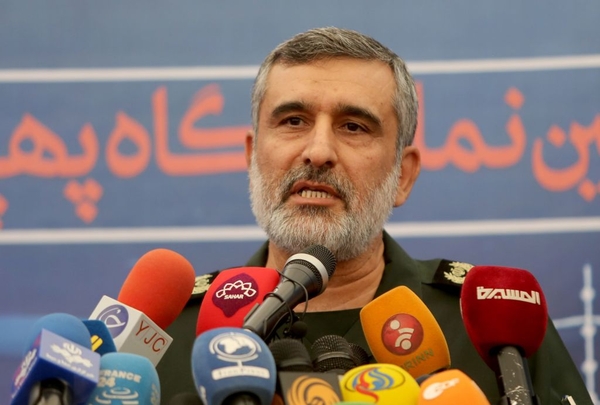
The family of a Nepalese migrant worker, who died in Qatar, prepares to bury him. Nepalese laborers in Qatar are forced to work in dangerous conditions, and die at the rate of one every two days. (Image source: Guardian video screenshot)

"In Libya, naturalisation is only open to a man if he is of Arab descent," reported the United Nations High Commissioner for Refugees (UNHCR). "And many Akhdam in Yemen, a small ethnic minority who may be descendants of African slaves, are reportedly unable to obtain citizenship."

Is that not apartheid?

In Kuwait, only Muslim applicants may seek naturalization, while Libya's nationality law allows for the withdrawal of nationality on the grounds of conversion from Islam to another religion."

Is that not apartheid? Apartheid laws seem to reign over many places in the Muslim world.
Trying to whitewash the damage the Islamic ideology has done to the Muslim world, while putting the blame of Islamic atrocities on the West, will never help Muslims face their own failures and come up with progressive ways to resolve them.

"All the world's Muslims have fewer Nobel Prizes than Trinity College, Cambridge. They did great things in the Middle Ages, though," wrote the evolutionary biologist Richard Dawkins on Twitter, after which other Twitter users piled on to criticize him.

It seems that having oil reserves, per capita, that dwarf anything available to Western countries does not create leading scientific nations.

What holds Muslims back when they have unmatched advantages of underground treasures? Why did the scientific revolution not happen in the Muslim world? Why has much of Islamic history been marked by aggressive jihad?

Islamic jihad and Islamic violence; the sanctioning of sex slavery; dehumanization of women; hatred and persecution of non-Muslims and homosexuals; suppression of free speech; and forced conversions have been commonplace in the Islamic world ever since the inception of the religion.

Many teachings in the Islamic scriptures, as well as the biographies of the founder of the religion, set up the parameters where these abuses not only occur but remain protected on a gigantic scale. These are the teachings that have become the culture of the Muslim world.
Sadly, most Muslims have wasted much time, energy and resources on killing and destruction, but -- with the exception of some civilization's most dazzling artistic splendors -- not on scientific and cultural advancement.

Recently, Sheikh Hamad bin Jassim bin Jaber al-Thani, the former Prime Minister of Qatar, said that claims that Qatar paid bribes to win the hosting rights of the 2022 World Cup were "not fair" and stemmed from the West's Islamophobia and racism towards Arabs.
Recent events indicate that he was, at best, "misinformed."

Deny everything and blame "the infidel" for your shortcomings. Nothing is more important than your honor, and nothing worse than your shame.

If Muslims wish to create a brighter future, nothing is stopping us but ourselves. We should learn to analyze critically our present and our past.

Human rights activists and academics in the West are lying to Muslims about their culture, and bashing and threatening America, Europe or "Zionism" for the problems of Muslims; this can never lead to any positive developments in the Muslim world. It is the Islamic culture and religious ideology that are responsible for these problems

If there is ever going to be an enlightenment, reform or renaissance in the Muslim world, only a hard look and hard questioning can be its starting point.
Uzay Bulut, born and raised a Muslim, is a Turkish journalist based in Ankara.

[1] Also the Muslim Brotherhood, Islamic Republic of Iran, al-Qaeda, Al-Badr, al-Gama'a al-Islamiyya, Islamic Jihad, al-Nusra Front, Hizb-ut-Tahrir, Al Ghurabaa, Al-Itihaad al-Islamiya, Al-Mourabitoun, Abdullah Azzam Brigades, Jaish al-Muhajireen wal-Ansar, Jamaat Ul-Furquan, Jamaat-ul-Ahrar, Jamaat-ul-Mujahideen Bangladesh, Jamiat al-Islah al-Idzhtimai, Great Eastern Islamic Raiders' Front, Al-Shabaab, Abu Sayyaf, Tehreek-e-Nafaz-e-Shariat-e-Mohammadi, Supreme Military Majlis ul-Shura of the United Mujahideen Forces of Caucasus, to name just a few.
[2] See: "Gender Equality Gap Greatest in Islamic Countries, Survey Shows", by Patrick Goodenough, October 29, 2014; "The Treatment of Women In Islam," by Rachel Molschky, October 7, 2013; "Women Suffer at the Hands of Radical Islam", by Raymond Ibrahim, January 9, 2014; "As Muslim women suffer, feminists avert their gaze", by Robert Fulford, National Post; Ayse Onal, a leading Turkish journalist, says in her book, Honour Killing: Stories of Men Who Killed, that in Turkey alone honour killings average about one a day -- 1,806 were reported in the period between 2000 and 2005.
[3] Daron, Acemoglu & Robinson, James (2012), Why Nations Fail: The Origins of Power, Prosperity, and Poverty, Crown Publishing Group.

Labels: , , , , , , ,

Follow @rheytah Tweet