"Russia is not the dominant power in any of the regions of the former Soviet Union."
"[The current trio of upheavals] really shed light on the situation."
"[The
Kremlin may not have stretched itself too thin with its foreign policy
agenda, but] it certainly has to pay more attention to its neighbourhood
now, more attention to its alliances."
"The
people in Belarus are very close to the people in Russia -- basically
you have the same language and very much the same culture."
"So
I think that on that score, people in the Kremlin are looking very
closely at the techniques used by the organizers of these
demonstrations."
"They're
studying it very, very closely because they believe something like that
could be used, will be used, in Russia when the situation is
appropriate."
Dmitri Trenin, director, Carnegie Moscow Center
"Russia's influence there [Central Asia] remains extremely high."
"The
new post-Soviet generation does not suffer from nostalgia for the
Soviet times and does not consider Moscow a political trendsetter."
Arkady Dubnov, political analyst, expert, Central Asia
 |
| Antigovernment demonstrators gathered in Minsk, Belarus, in August. Credit...Sergey Ponomarev for The New YorkTimes |
Vladimir
Putin is fast closing in on 70 with two more years to go, but he plans
on many more long years of active executive administration of the
Russian Federation. He has gone to great manipulative lengths to change
the constitution, forcing 'democratic' votes where he has garnered a
huge majority of assent from Russian voters to enable him to reign
undisturbed by nuisance contenders for a position that looks remarkably
like a Czarist throne. These are irritatingly contentious efforts on the
part of challengers who feel an obligation to Russia to dethrone Mr.
Putin.
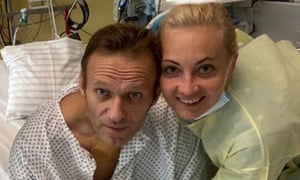 |
| Alexei and Yulia Navalny.
Photo: @navalny/Instagram |
They
have a following, but the authority to charge them with putative
offences and send them to prison sits in the Kremlin,which can choose
alternately to have them assassinated which usually puts them out of
contention. The latest such disabling adventure went badly for Mr. Putin
when political opponent Alexci Navalny failed to die of Novichok
poisoning, to be rescued by German medical science, the poison
identified by British forensic science and the wrath of additional
sanctions on Russia, Putin and other notables invoked as a lesson that
will never be learned.
President Putin yearns for the lost
days of the Soviet Union, when Russian power and influence was at its
height and neighbouring near-abroad countries were but colonies embraced
by the tentacles of the great political octopus that was the USSR. When
Soviet Russia held sway in the Middle East, and held the balance of
power that accompanies the status of a world-class superpower, a status
it shared with the United States through decades of conflicted
relationships marked by suspicion, distrust, propaganda and tension in
the competitive atmosphere of nuclear threat.
It has been a great
disappointment to the Kremlin that former satellite states in eastern
Europe, in Russia's near-abroad continue to feel so ill-done-by that
they shrink in fear at the very notion they would wish to continue a
firm alliance that would surely grip them with an iron vice. They have
turned toward the West, looking for NATO membership, an alliance that
would purchase them a guarantee of military defence against the memory
of the giant that once strode the world stage.
Still, the
consanguinity of closely-shared geography, ideology and a continuation
of totalitarian-style governance continues to link Russia with a number
of its former clients, and that a number of them are experiencing
political-social upheaval with stirrings of democratic ambition is a
worrying sign that there is an impending breakaway from the solid
footing Russia has maintained in Kyrgyzstan, Belarus, Armenia and
Azerbaijan. Following in the determined footsteps of Ukraine and
Georgia, a dreaded apparition of sovereignty and democratic choice.
Absence,
in Russia's attention turned elsewhere did not make hearts fonder of
the Russian Federation's position in eastern Europe. Where former
satellites still shudder at the prospect of military invasion and the
spectre of the Crimean Peninsula looms large as a warning. Just how thin
can a country whose petroleum and gas industry was struck a blow in the
double whammy of falling prices and a world oversupply, faltering under
sanctions and a restive population, spread itself?
Well, when
ambition to make friends and influence nations leads to entering the
fray in the mid-abroad as when Mr. Putin committed to aiding his Syrian
counterpart in destroying the lives of Sunni Syrians and airbombing
hospitals, medical clinics, schools and civilian enclaves of Sunnis in
exchange for an air base and a deep seaport in the Mediterranean,
reclaiming its former high profile position in the Middle East, it
constituted a distraction from its near-abroad.
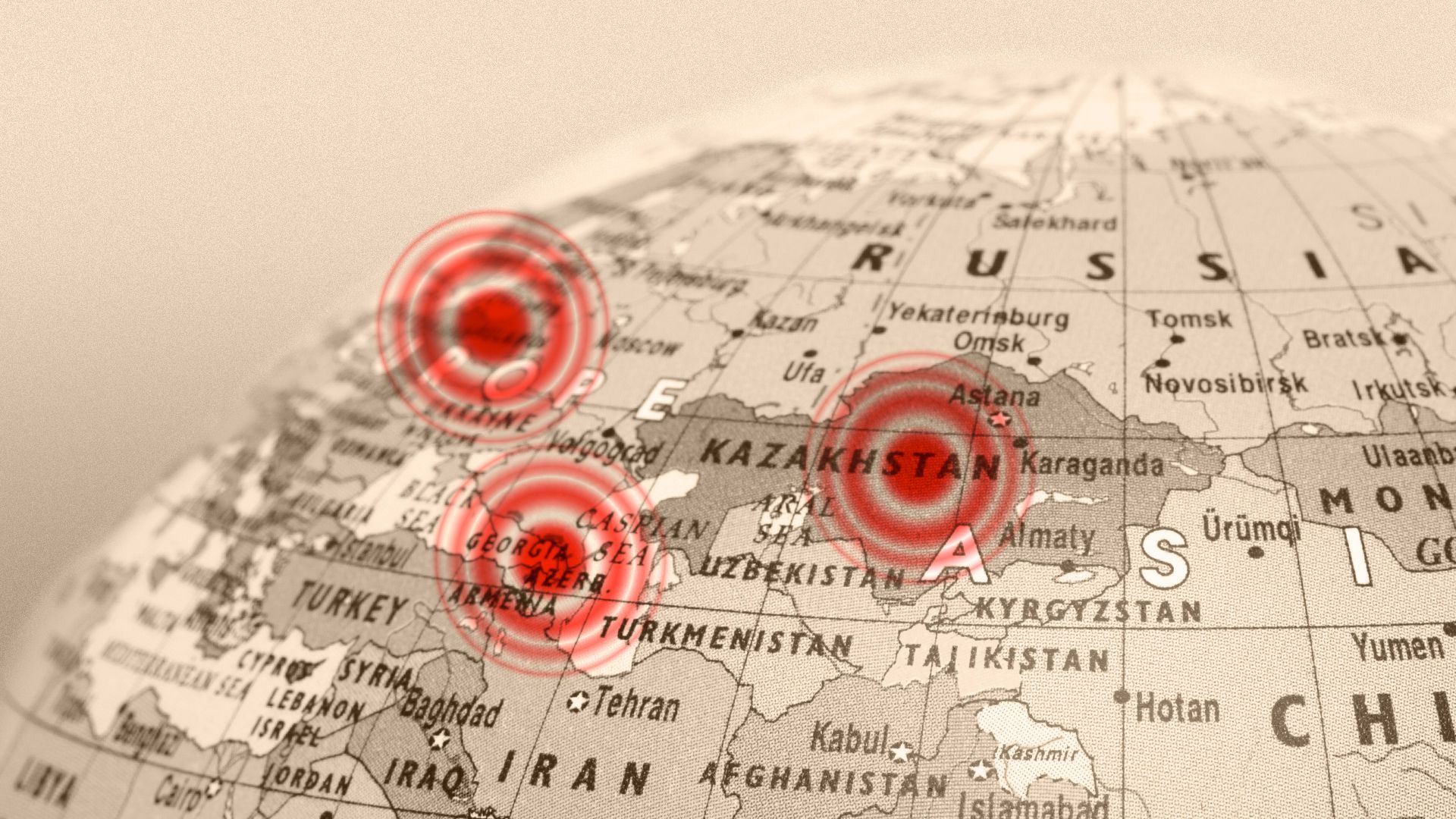
Now, the Kremlin
faces a backyard rebellion with former Soviet republics and regions from
Central Asia through the Caucasus and into Eastern Europe, in a turmoil
of mass dissent and a turn toward the West. Even as competitors, from
Turkey to China challenge the once-dominant role of the former Soviet
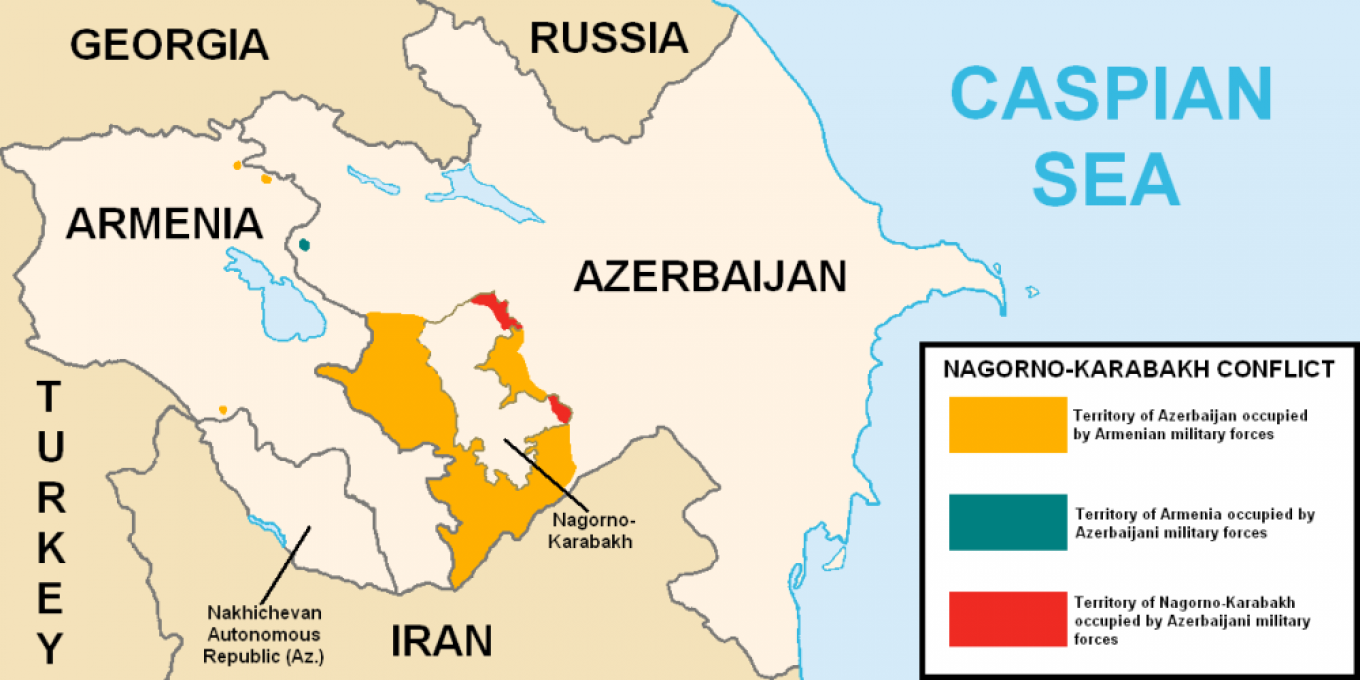
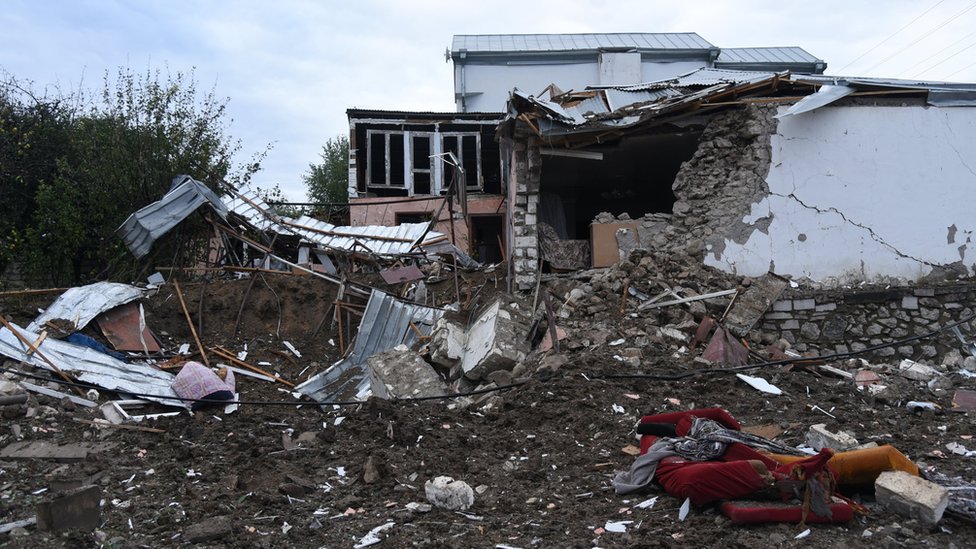
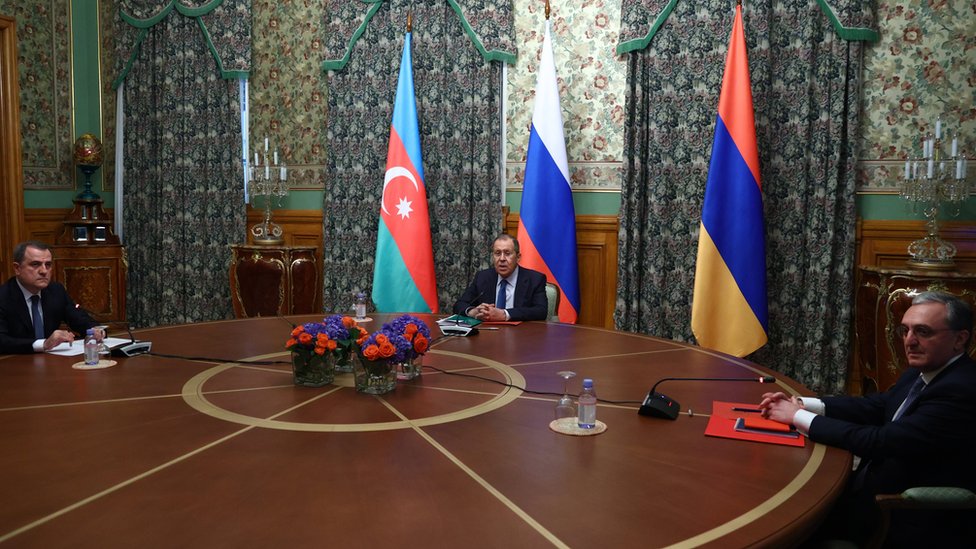
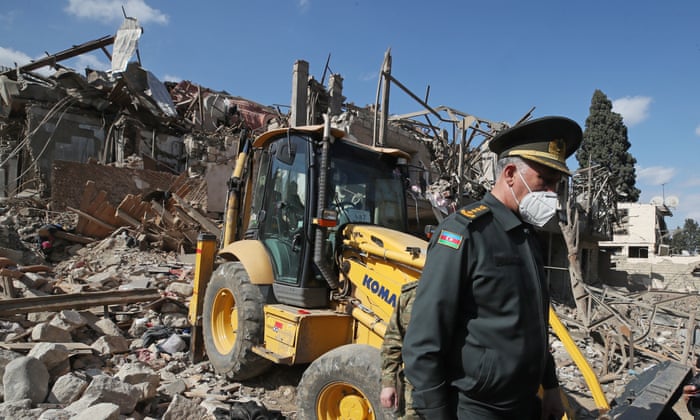
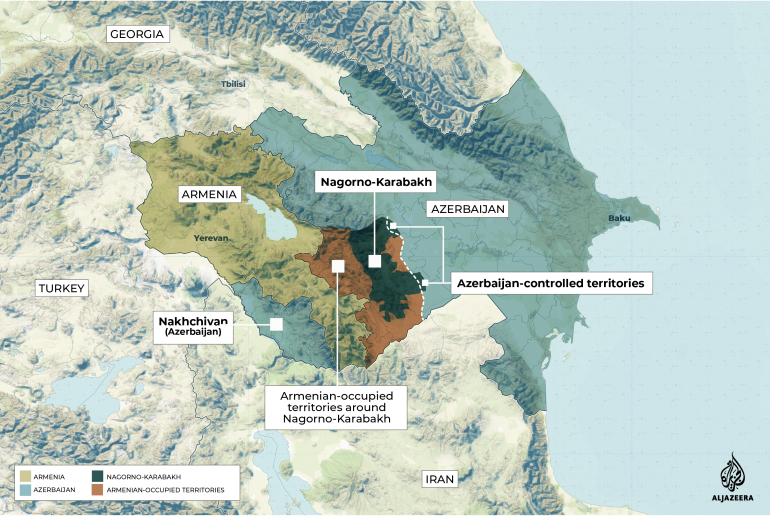
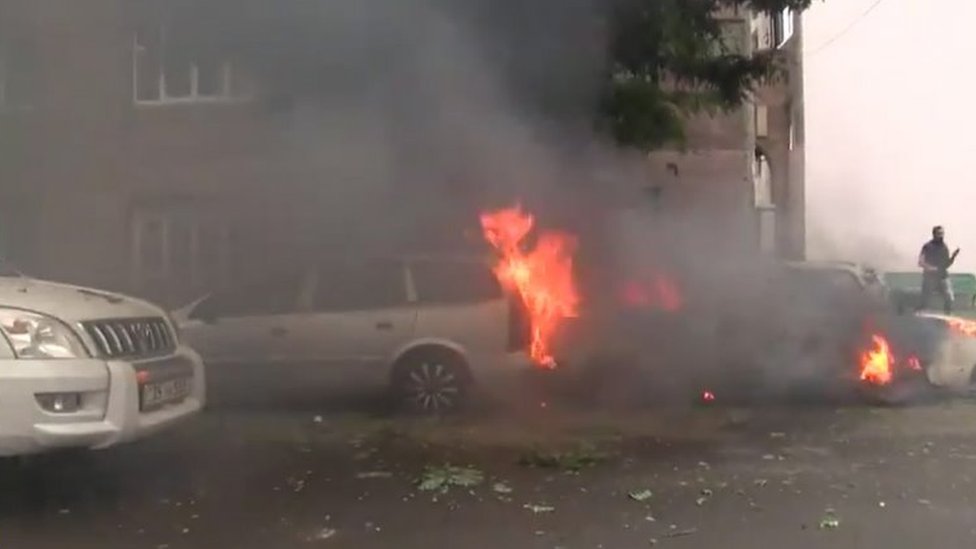
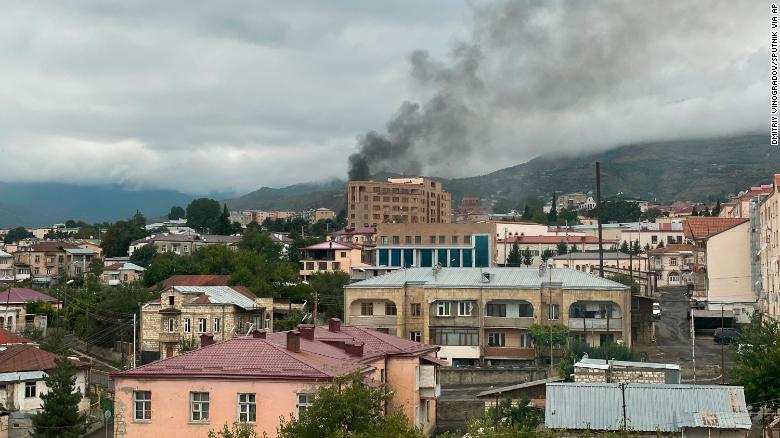
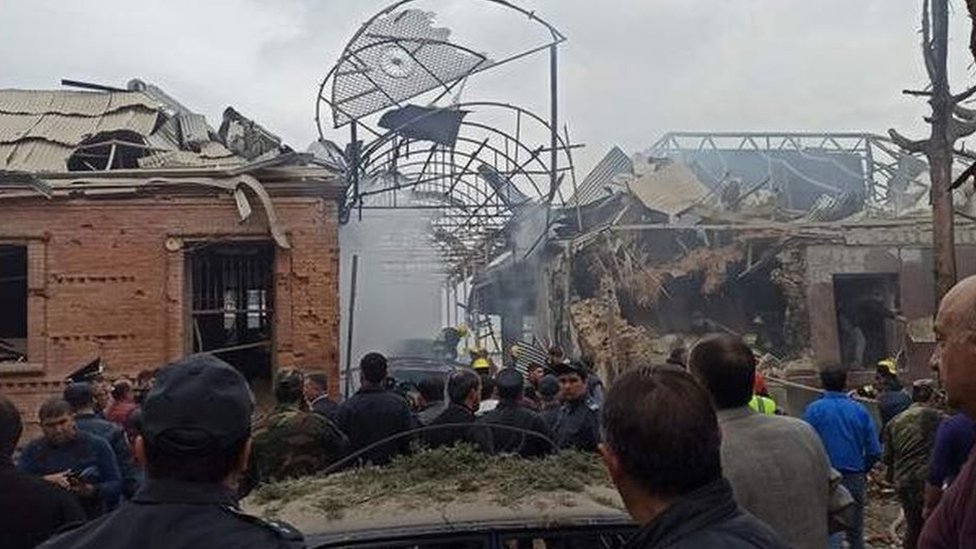
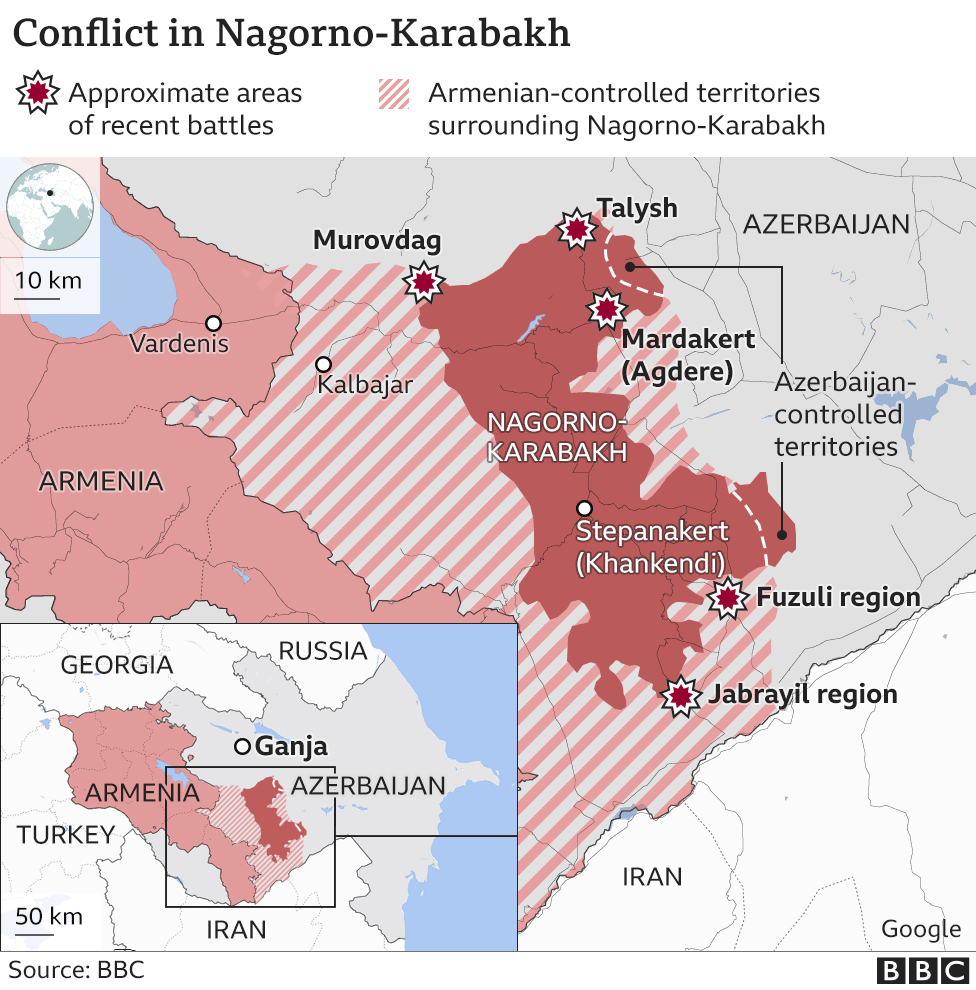
territory with their very similar ambitions. Nagorno-Karabakh presents a
dilemma for Russia between Armenia and Azerbaijan. Russia's military
treaty with Armenia, it specified, refers only to Armenia proper, not
the breakaway, majority-Armenian Nagorno-Karabakh. So it was quite
inconvenient that Azerbaijan admitted to bombing inside Armenian borders
in their violent fracas.
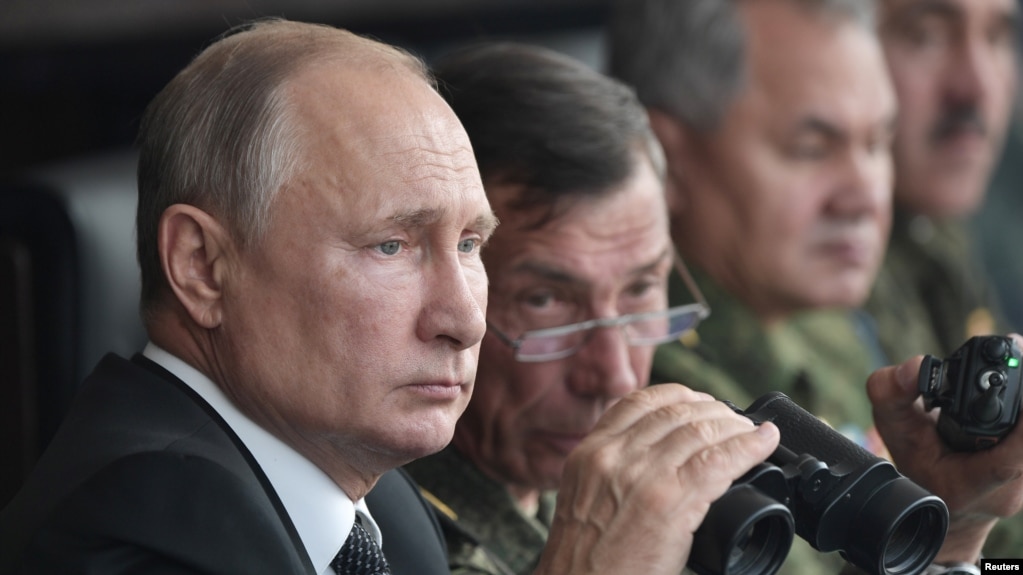 |
Keeping a watchful eye on Russia's “near abroad Reuters
|
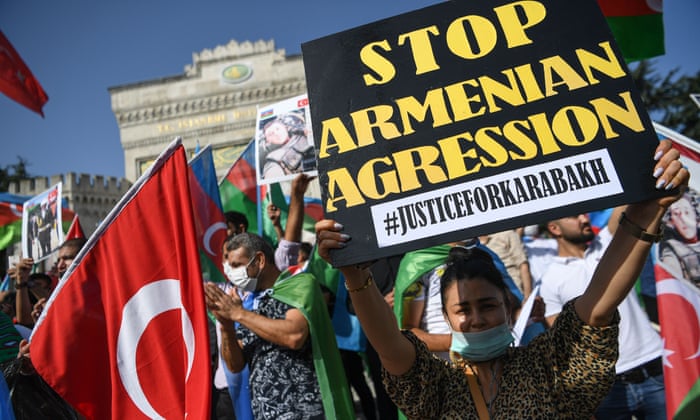
With
Turkey fully in support of Muslim Azerbaijan, a threat to Russia's
interests in the region hovers with the arrival of Syrian mercenaries to
fight for Azerbaijan, recruited by Recep Tayyip Erdogan. Russia's
foreign intelligence chief, Sergei Naryshkin warned the situation could
introduce Islamist militants entering to infiltrate Russia. After all,
Russian air power entered Syria to bomb not only Syrian Sunnis involved
in a civil war, but terrorist militias that threaten the Alawite regime
of Bashar al-Assad.
When
Turkey shot down a Russian jet it claimed had entered its airspace from
Syria, conditions were tense between the two nations, but soon enough
smoothed over, as each side saw benefits from ongoing collaboration. A
collaboration that eventually turned from lukewarm to frigid in
competing positions over Syria and Libya. In Belarus embattled
Lukashenko's rival, opposition leader Svetlana Tikhnovskaya, exiled from
Belarus, living in the haven Lithuania has provided for her is
increasingly turning to the West for help and future support.
The
2014 political uprising where Ukraine disposed of Viktor Yanukovych as a
Russian stooge, installing their own choice for president and doing so
democratically in two elections to follow, the country's firm and
growing relationship with the West is the feature of the Kremlin's worst
nightmare.
The disputed election in
Kyrgyzstan, along with that of Belarus are following in a familiar
path. As is Armenia's growing warmth with the West, fed largely by its
large and politically active diaspora.
 |
| Illustration: Aïda Amer/Axios |
Labels: Armenia, Azerbaijan, Belarus, Conflict, Kyrgyzstan, Nagorno-Karabakh, Recep Tayyip Erdogan, Russia, Turkey, Vladimir Putin