"Our main concern is that though we have seen approximately 5,000 people coming out of El-Fasher toward Tawila, we don't know where the other hundreds of thousands have gone."
"That is worrying given the ethnic nature of targetting of violence toward civilians by the RSF."
"I've never seen anything so shocking in all my 15 years of my work."
MSF President Javid Abdelmoneim
This image grab taken from handout video footage released on the paramilitary RSF's Telegram account on October 26, 2025, shows RSF fighters holding weapons and celebrating in the streets of el-Fasher in Sudan's Darfur region [AFP]
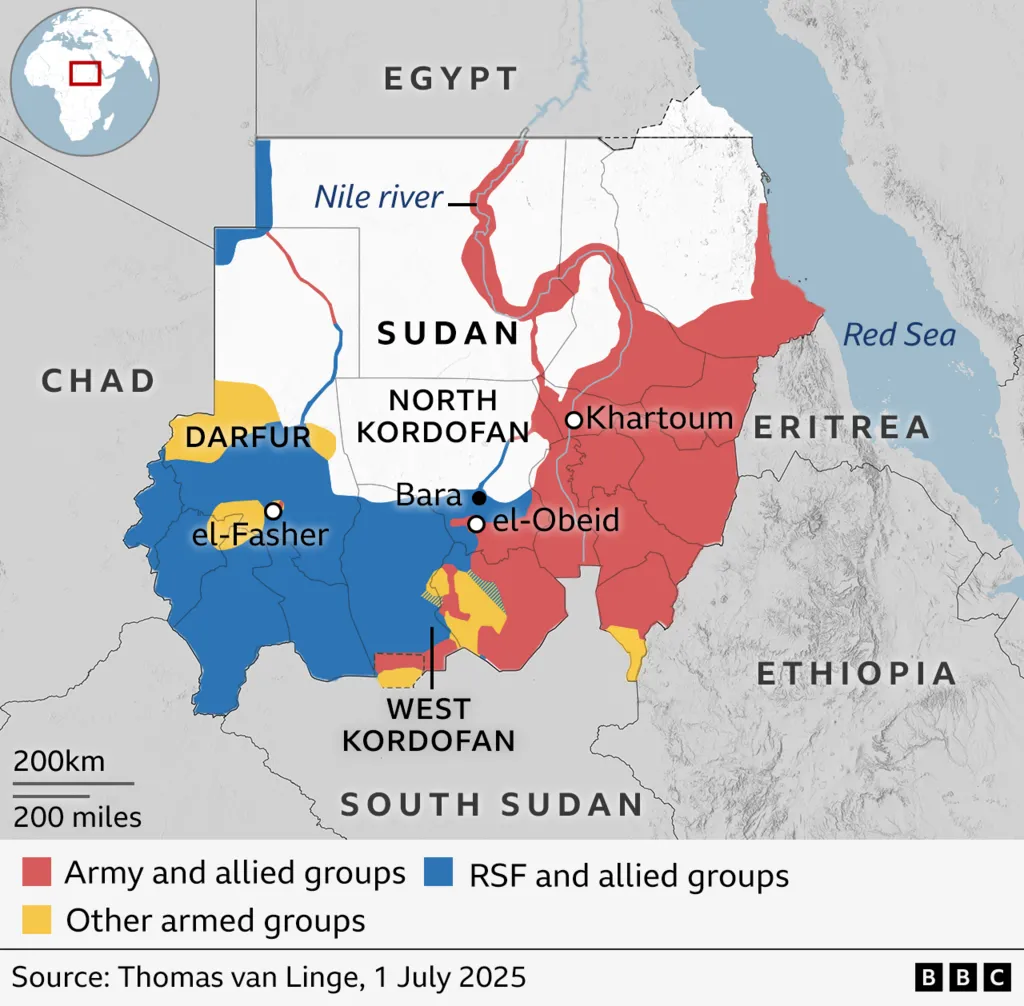
The fate of hundreds of thousands of Sudanese in flight from ethnically targetted violence in the western Sudanese city of El-Fasher remains unknown in the wake of satellite images indicating suspected mass graves. At war with the Sudanese military since 2023, with which it was once allied, the Paramilitary Rapid Support Forces (RSF) seized control of the strategic city of Al-Fasher in the Darfur region following a brutal 18-month siege.
Emerging reports of executions, sexual violence and abductions in and around El-Fasher has alarmed aid groups and the United Nations to the fate of ethnic minorities in yet another impending disaster rivalling the slaughter in Darfur when the RSF were known as the Janjaweed, Arab horsed tribesmen who attacked and raped and murdered hundreds of thousands of Fur, Masalit, and Zaghawa minorities mostly engaged in farming, as opposed to the Arab herdsmen, competing for territory.
New satellite imagery analyzed by Yale researchers suggest that mass graves are appearing in the city from which thousands have fled. Survivors in the town of Tawila, some 70 kilometres west of El-Fasher recounted to Medecines sans Frontieres 'harrowing' stories of "ethnically targeted torture, rape and summary executions", revealed a Sudanese-Iranian national.
Paramilitaries have taken full control now of all five state capitals in Darfur with the fall of El-Fasher, raising troubling concerns that Sudan could be partitioned along an east-west axis. The Humanitarian Research Lab at Yale University has revealed its finding of evidence consistent with "body disposal activities", leading to the worst fears being realized. "At least two earth disturbances consistent with mass graves - were identified -- at a mosque and at the former Children's Hospital."
Tens of thousands of people have been killed, millions have been displaced in the Sudan civil war which has also led to the largest displacement and hunger crisis in the world today, where both sides have been accused of widespread atrocities.
“It’s been almost a year since the State Department determined that the
RSF is committing genocide in Sudan. "These harrowing images from Yale
University’s Humanitarian Lab demonstrate that the genocide continues
unabated and largely ignored by the international community."
"The
testimony of refugees from el-Fasher also leaves no doubt that
ethnically targeted killings are the order of the day.” —
Clifford D. May, Founder and President, Foundation in Defense of Democracies
"People [the international community] seem to have forgotten us."
"Oh my God, it's a very painful story."
Dr. Omar Selik, El Fasher, Sudan
"Since April 2023, more than 600,000 people have been displaced from
El Fasher and its surrounding camps. Inside the city, women and girls
are enduring famine-level conditions, as classified by the IPC.
With food stocks depleted and efforts by the United Nations and its
partners to move in with supplies hampered by attacks, families are now
surviving on animal feed and tree leaves. There have been repeated attacks on humanitarian personnel and assets in North Darfur over recent months."
"More
than forty-one health and educational facilities in the state have been
destroyed, and supplies of medicine have been depleted. Pregnant women
are giving birth into the hands of unskilled attendants with no access
to emergency obstetric care. Women in need of reproductive health
services and survivors of rape have no access to any medical services."
UN Women
El Fasher has been under siege for months as RSF paramilitary forces try to take control of western Sudan
Some
40 severely malnourished children arrive daily seeking help at the last
functioning hospital in El Fasher, Sudan which has been bombed over 30
times, and there is nothing to give the children, other than animal
feed. This Sudanese settlement is the peak battleground of the brutal
civil war raging in Sudan. The city in Darfur's western region has been
under siege by the paramilitary intent on starving it into submission. A
30-kilometer earthen wall has been erected around the city's outer
boundaries, effectively locking everyone in, and keeping others out.
If
residents make the agonizing choice to remain they risk being bombed or
starved. Should they decide to leave in desperation, they risk being
killed, robbed or sexually assaulted. Over two years earlier, clashes
between Sudan's military and its paramilitary rival, the Rapid Support
Forces, broke out, a conflict that has forced some 12 million Sudanese
from their homes, killed tens of thousands, and set the stage for a
major famine which aid groups speak of as the world's largest
humanitarian crisis.
The
Rapid Support Forces were expelled from the capital, Khartoum, in March
and the group has since redoubled its campaign to capture Darfur, the
vast area where most R.S.F. fighters (once known as Janjaweed, Arab horsemen who savagely attacked Black Darfurian Muslim farmers) originated.
The focus on El Fasher is to dominate the last city standing in their
way to capture the entire Darfurian region under their command.
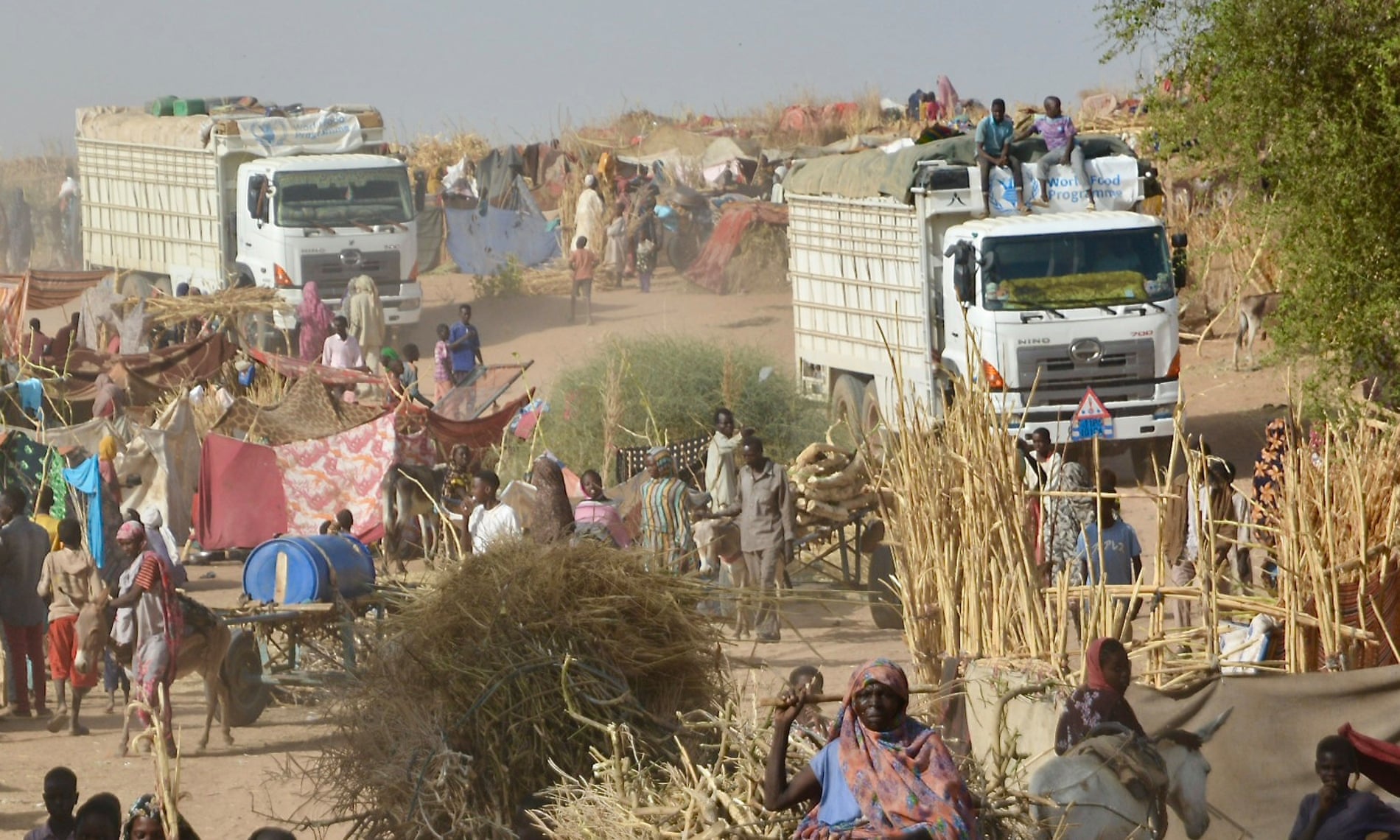
The RSF allowed food to reach displaced people in Tawila, but not El Fasher, which they kept under a tight siege, 27 April.Photograph: Jérome Tubiana
In
April the R.S.F. rampaged through the famine-stricken camp of Zamzam,
located 11 kilometers south of El Fasher, killing between 300 and 1,500
people, leading to a half-million people from El Fasher fleeing the city
in a panic of desperate survival. What followed was the erection of the
giant berm to keep people in and humanitarian groups out. Now some
260,000 residents are left in the besieged city where a kilo of pasta
costs ten times the normal price. The Emergency Response Rooms, a
humanitarian aid group, recorded the deaths of 14 children from
malnutrition over a recent two-week period, where cholera has now been
spreading.
United
Nations food convoys have been unable to deliver aid to El Fasher for
over a year, since they were attacked by drones in their approach to the
city. Five aid workers were killed when a strike in June on a 15-truck
convoy and another in August destroyed three trucks, forcing the
remainder to turn back. When young men scrambled over the berm during
the night in an attempt to flee the city, they were executed by R.S.F.
fighters.
Tawila,
a small town 65 kilometers to the west, packed with over 600,000
refugees, was able to be served by international aid groups but the
journey to reach Tawila is perilous, fighters roaming the area, robbing
or extorting fleeing civilians, raping the women, on a road lined with
shallow graves and abandoned bodies. At the Doctors Without Borders
hospital in Tawila, about 40 women, victims of rape, are treated weekly,
with evidence suggesting "that is nothing compared to the true rate".
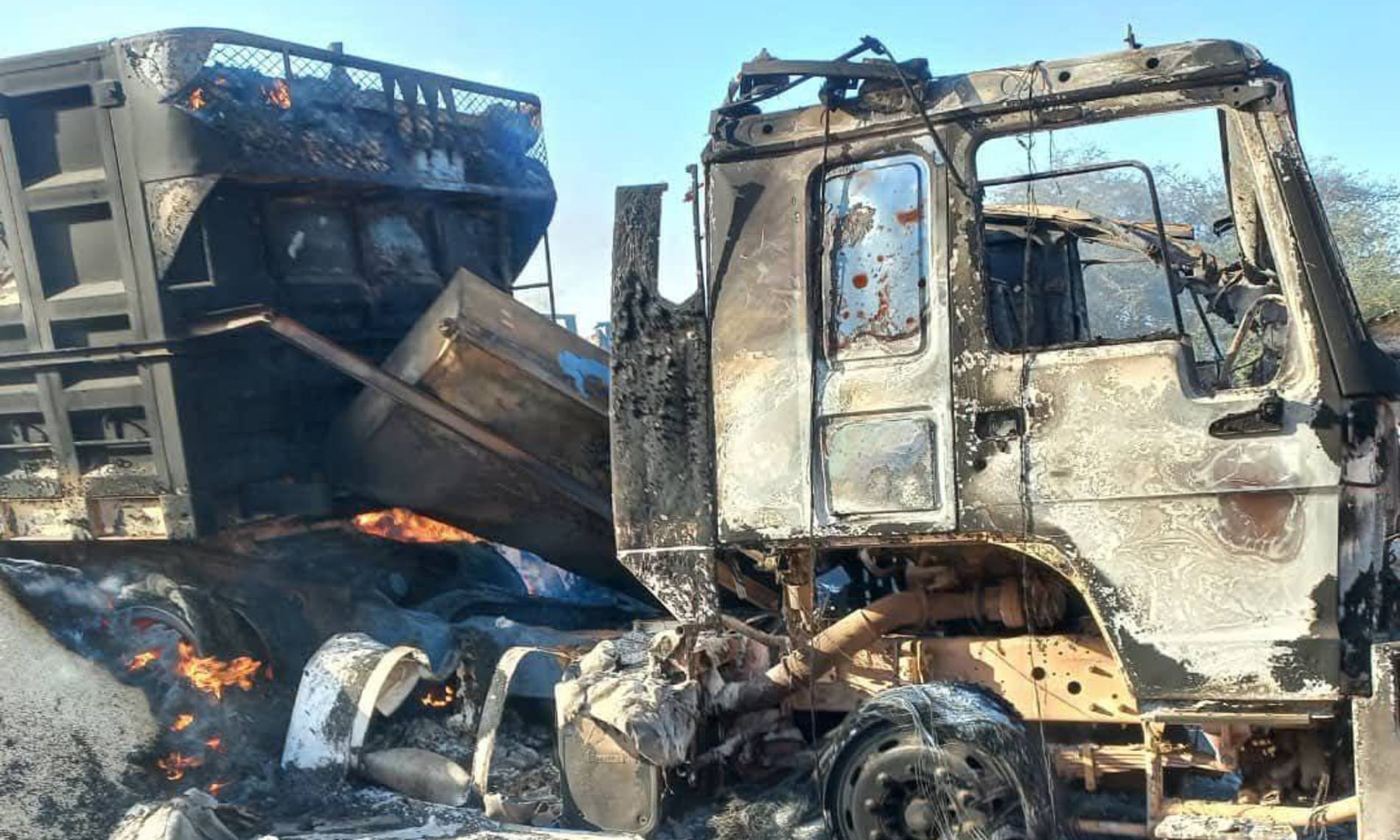
A UN truck carrying aid to El Fasher destroyed by an RSF drone attack.Photograph: X/PresstvExtra
Some
residents smuggle small amounts of food and medicine into the city,
through during the night scrambling over the earthen berm, but those the
fighters catch face beatings and threats. Of some 200 medical
facilities in El Fasher prior to the war, one only remains, the Al Saudi
hospital, where a handful of medics are hanging on, despite the
bombing, starvation and a dwindling supply of medicines. An R.S.F. drone
fired a missile into a crowded ward in January, killing 70 patients and
staff.
Doctors
at the hospital shelter in foxholes during bomb raids, while
malnourished patients are sustained with animal feed. Known locally as
ambaz, the animal feed is a dangerous alternative to human-grade food,
given that it is prone to fungal contamination. Thus far, 18 residents
have died recently after consuming ambaz. "But there is no other option", explained a senior doctor who has received death threats for his work, and chose to be quoted anonymously.
Destroying Sudan in the Name of Total Islamist Conquest
"Thousands
of people have been killed since fighting erupted just over a year ago
between the Sudanese Army and the Rapid Support Forces, a powerful
paramilitary group that is the latest iteration of the janjaweed [devils
on horseback], which was central to the ethnic cleansing in Darfur in
the 2000s. The R.S.F. helped to crack down on pro-democracy
demonstrations in 2019 and, with its general Mohamed Hamdan ... was part
of a power-sharing regime that fell apart in April."
"Now
it is at war with its former partners in government, and the Sudanese
people have become collateral damage. A report from Human Rights Watch
in May detailed the R.S.F.'s ethnic-cleansing campaign against the
Masalit and other non-Arab people in West Darfur."
"There
have been other reports of summary executions, torture and rape. Across
the country more than 11 million people have been displaced. Homes have
been occupied and looted. Museums have been targeted and their contents
probably sold, destroyed or just taken."
"And
yet the international community still stands by. Attention is rarely
paid to Sudan, and much of what I read reduces the conflict to a power
struggle between two generals or a migration problem for Europe. Perhaps
this is why R.S.F. fighters feel so free to broadcast their crimes on
social media."
Dena Ibrahim, Sudanese national in self-exile abroad
Objects are scattered in the yard of house
in Omdurman, central Sudan, May 30, 2024, that was damaged amid fighting
in the civil war that has raged for more than a year between the
regular military and the paramilitary Rapid Support Forces.AFP/Getty
In
this barbaric version of a civil war in Sudan, civilian deaths and the
aura of terrorism are not unfamiliar to those who had previously
suffered both at the hands of the military and its accomplice in violent
persecution now known as the Rapid Support Forces. Back when the black
farming community of Darfur was targeted by the Arab-led government of
Omar al-Bashir and his horsed henchmen the conflict arose from tensions
between agriculturalists and herders competing for scarce land
resources.
Now
the new war that is tearing the country apart is one of dominance by a
fundamentalist Islamism that spurns any government direction toward
democracy for its people. Across the country people have been
dispossessed of their land holdings, of their homes, of their ability to
earn a living, while scarce basic necessities of life including famine
sit heavily on the land. Homes are being pillaged, their owners moving
on hoping to survive the marauders who loot anything of value.
Hospitals
have been destroyed, millions of people are facing the threat of
dislocation and death. In the year-old war between the Sudanese military
and the transformed janjaweed, an estimated 2.5 million people are said
to be in danger of starvation. Half the population of fifty million
people are in dire need of humanitarian assistance. Non-Arab communities
are the targets of the dominant Arab half of the population, finding
common cause with the Rapid Support Forces.
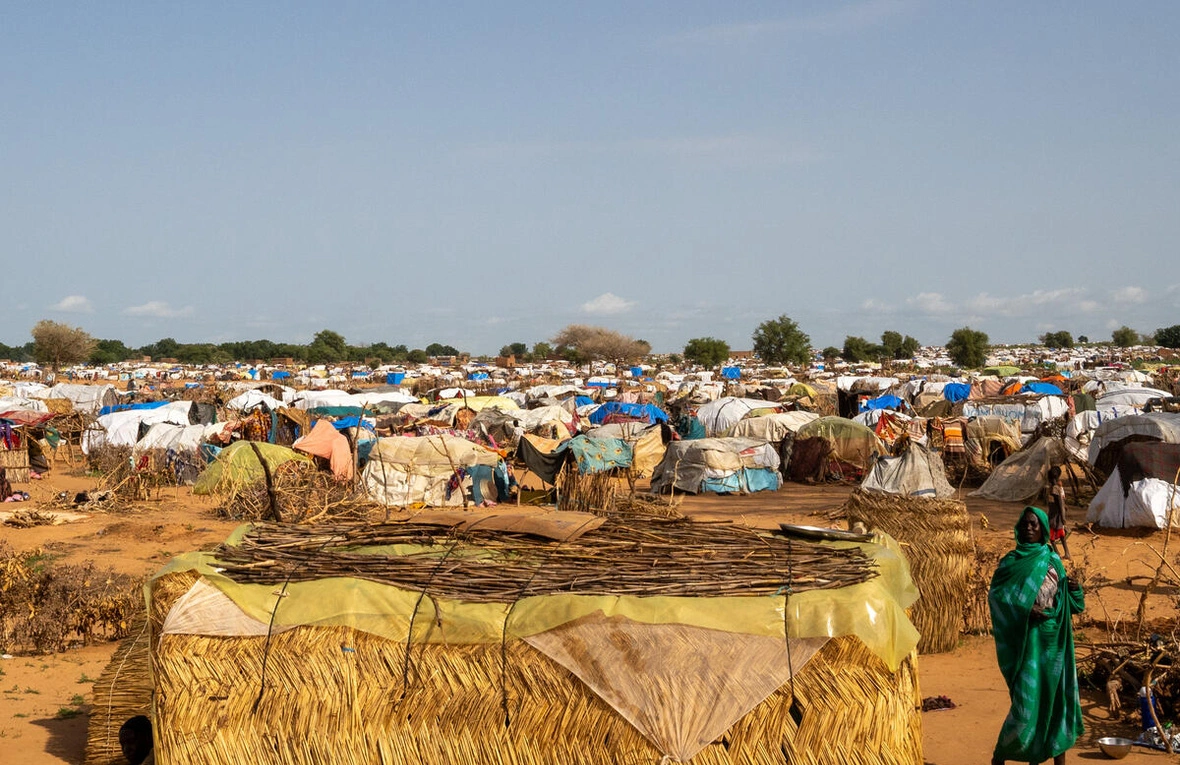
Residents displaced from a surge of violent attacks squat on blankets
and in hastily made tents in the village of Masteri in west Darfur. Paramilitary forces and their allied militias
fighting to take power in Sudan carried out widespread ethnic killings
and rapes while taking control of much of western Darfur that may amount
to war crimes and crimes against humanity. (Mustafa Younes via AP, File)
A
country that was finally on its way to achieving a measure of democracy
for its people, has been set back on its heels, its ancient heritage in
tatters as R.S.F. fighters loot the country's museums, opening ancient
caskets with their 3,000-year-old corpses, The Sudanese National Museum
rebuilt with aid by UNESCO and the National Corporation for Antiquities
and Museums, home to artifacts such as steles of ancient warrior queens
and 13th-century Christian frescoes has been looted of its historic
treasure.
University
libraries and archives have been ransacked and torched. Summary
executions complete a picture of violent chaos. Over 14,000 Sudanese
have died in this year of civil war. Its brutality has some similarities
to the still-ongoing conflict in Syria where the regime of Bashar
al-Assad continues to target his Sunni Syrian population, some 400,000
of whom have been killed. An ongoing civil war that Russian warplanes
aid the Alawite regime with in exchange for a Russian deep sea port.
Russia awaits the same opportunity with Sudan.
Over
ten million Sudanese have been internally displaced. Another two
million have fled to neighbouring countries for haven. Charges of war
crimes and crimes against humanity are once again being seen in Darfur.
Crimes of sexual violence have become an integral part of the conflict,
victimizing women and children. A main hospital in Darfur was looted,
its closure forced, according to an international humanitarian group.
According
to Doctors Without Borders, South Hospital in
al-Fasher, the capital city of North Darfur province was attacked by the
Rapid Support Forces on Sunday, which opened
fire on medical staff and patients. Local media published images showing
abandoned wards and corridors, patient beds and medical equipment
damaged, blood staining the floors. The Military fought the RSF and
forced their withdrawal from the hospital.
"Why
is the world community turning a blind eye to this conflict? At the
government level, there's geopolitics: there are few strategic
considerations or resources at stake in the region for major players
such as the United States, Russia or China. There is also the memory of
the 2003 genocide in Sudan and the protracted UN peacekeeping operation;
last week, Sudan's military government asked that the remaining
humanitarian mission be withdrawn, though it claims to remain 'committed
to constructive engagement with the UN'."
"But
at the 'civil society' level, the reason is simple: the conflict
doesn't fit the left's anti-colonial narrative. The oppressors are not
white or white-adjacent. This crisis cannot be blamed on capitalism, the
U.S. or Jews. There is nothing for the left to gain politically, by
calling out a community that is part of its own coalition. So just like
feminists stay silent when Jewish women are raped, progressives fail to
stand up for Black Africans when they are massacred."
"The
crisis in Sudan exposes 'intersectionality' for what it is: a big, fat
antisemitic lie. the hypocrisy is beyond belief. And the Masalit are the
ones to pay the price."
Tasha Kheiriddin, journalist, National Post
A Sudanese woman carrying her daughter on the outskirts of Adre, Chad, July 2023
Zohra Bensemra / Reuters
From
Democratic Republic of Congo, to Gaza, just about anywhere in the
'underdeveloped', tribal, sectarian, uncivilized reaches of the world
community, where war is prosecuted, women's lives are consumed by rape
and slaughter. Terrorists don't much mind killing babies, either. Women
are subject o mass rapes, the victimization of the most vulnerable in
any society. Perhaps it has always been that way, from ancient history
forward, but we like to believe we've progressed as humans since primal
times.
Yet, terrorists are free in some places where we are thankfully not, to shoot babies in the head, and "punish and terrorize" people, burning communities to the ground. Women and girls taken hostage, held in "slave-like conditions".
Ah, a familiar story by now, but one when repeated injudiciously risks
the careless of being identified as Islamophobic. Arab terrorists
determined to drive an ethnic group away from their ancestral
geography.
In the Darfur conflict when the government of Sudan and its military employed Arab Janjaweed (horsemen)
to attack and slaughter and disperse Black Sudanese farmers in a
regional conflict that pitted agrarians against herders, when land was
valued not for its wealth of grain-growing conditions but for pasturage,
the powerful swept down on the vulnerable to drive them off their land,
raze their villages, rape their women, and commit mass slaughter;
helicopter gunships came in handy for all of that as well.
The
scene? Sudan, once again targeting Black Africans, the Masalit. It has
been seven months and world leaders, human-rights groups and the
progressive left don't seem to have noticed. In Europe and North America
there have been no university protests, no rampaging mobs in public
arenas. Arab businesses haven't been targeted, no one has been calling
for the isolation of Muslim colonizers. They haven't been condemned as
genocidal killrs of babies. Black Lives Matter are nowhere to be seen.
That
Islamists have targeted people of colour in yet another attempt at
extermination is of little interest, it seems. If the United Nations has
been wringing its hands, has anyone noticed? In Sudan 5.6 million
people have been displaced as a result of fighting between the Arab
paramilitary Rapid Support Forces (which renamed itself from simply 'Janjaweed') and the Sudanese army. Both got along very well for a while after the government coup of 2021.
The
RSF killed over a thousand Masalit in 72 hours in the Ardamata refugee
camp. 9,000 people were killed since the summer when the conflict broke
out. In the five years 2003 to 2008, 300,000 Masalit were killed, 2.5
million displaced by the Arab militia force, Janjaweed when former
Sudanese president Omar al-Bashir used the terrorists to crush Darfur's
rebel groups revolting against the neglect suffered by the Black African
population.
Researchers
at the Centre for Information Resilience verified videos of militiamen
rounding up and whipping Masalit men in Ardamata. The uniformed men
wearing RSF insignia speak of their victims as "sons of dogs", targeting men and boys, an indigenous Darfuri group.
"They killed every man they met in my neighbourhood. I was praying when
I heard the sound of an explosion. A shell killed my friends and nearly
cut off my feet", one Ardamata resident testified.
Lip service to a distaste for the situation did come from the European Union decrying the "ethnic cleansing campaign with the aim to eradicate the non-Arab Masalit community from West Darfur".
Human rights obligation done, and done with. Oh, and in case anyone
wonders, the Black African Masalit are faithful Muslims. Just not the
right kind.
Refugees fleeing the deadly violence in Darfur are arriving to sites like this one in Adré, in Chad, in dire need. UNHCR/Ariadne Kypriadi
"There has been a loss of integrity in the Canadian immigration process."
"Most of these people have been living in Sudan for years."
"Sometimes they never really lived in Canada and don't speak English or French."
Unidentified insider source asking for anonymity
"[Statistics on the phenomenon known as] Canadians of convenience [during the Lebanon evacuation are not readily available."
"I
don't know how common it is, but it's likely not negligible. We only
tend to get a sense in cases like Lebanon and now Sudan."
Andrew Griffith, former director general, Immigration, Refugee and Citizenship Canada
Signs of a
ceasefire in Sudan are scarce as the two warring factions have returned
to fighting that has temporarily derailed rescue attempts for Canadians
still trapped in the country. CBC
Thousands
of Lebanese-Canadian citizens were evacuated at Canadian government
expense in 2006 during the war in Lebanon, to bring them back to safety
in Canada. Most of whom, after the fact, turned out to be citizens in
name only, who had acquired and maintained citizenship as a type of
'insurance' in case of emergencies. In this realm of convenience
citizenship, Chinese Hong-Kongers represent another group from abroad
who famously went to great lengths to acquire Canadian citizenship as a
future haven should their lives in Hong Kong suddenly become
'complicated'.
For
the Lebanese emergency, it cost $94 million for Canada to evacuate some
14,000 Canadians from Lebanon at war. Half that number returned to
Lebanon when hostilities ceased. Now, in Africa there are sources
suggesting there may be a repeat of this 'rescue' operation of 'citizens
of convenience' in Sudan where a civil war has been unfolding.
According to government figures, 550 people were flown out of Sudan to
Kenya on Canadian evacuation flights.
Of
that total, 175 were Canadian citizens or permanent residents. On
flights organized earlier by other countries, another 210 Canadian
citizens left. According to an individual familiar with the situation,
it has emerged while the evacuees were being processed that as many as
half of the 175 Canadian citizens and permanent residents happen to be
refugees granted status in Canada who returned to Sudan, some continuing
to claim welfare and child benefits.
A ferry transports some 1,900 evacuees across the Red Sea from Port
Sudan to the Saudi King Faisal navy base in Jeddah, Saudi Arabia. (Fayez Nureldine/AFP/Getty Images)
Some
are refugees who are in the process of becoming Canadians, which means
they should not have left the country to return to Sudan while the
process has not yet been completed. All of the evacuees in Kenya were
accommodated and cared for in hotels at Canada's expense. In the past
five years, Canada accepted 2,120 refugee claims from Sudan; individuals
who are accepted are given protection in Canada. If they return to
their country of origin, however, they effectively relinquish refugee
status.
Immigration,
Refugees and Citizenship Canada had "no response to offer" when a
spokesperson was approached for clarification on the matter. Nor could
the government provide cost estimates of an operation involving the
Canadian High Commissioner in Nairobi, the embassy in Cairo, Egypt, the
embassy in Amman, Jordan, the consulate in Djibouti and 200 Canadian
Forces on the ground in the region helping to expedite the 'rescue'.
The
Canadian portion of the relief effort has been described as "chaos" by
sources in Africa. A C-130J Hercules transport aircraft left Jordan to
head to Port Sudan on the Red Sea on a mission to retrieve stranded
Canadians after the Wadi Seidna Air Base north of Khartoum was seen as
too dangerous. According to a Forces spokesperson, Sudanese authorities
reused to permit personnel to disembark, and the flight was forced to
return to Jordan empty following a "diplomatic credentials mix-up".
After
the fiasco in Lebanon, the-then Conservative government in Canada,
instituted limitations on citizenship by descent, limiting it to one
generation born outside Canada, revoking citizenship of thousands of
Lebanese who obtained status through fraudulent means. Should it be
established that some Sudanese evacuated to Nairobi have similarly
cheated the system, they should have their citizenship invalidated.
Status can be revoked under the Canadian Citizenship Act, if it becomes clear that the person involved obtained citizenship by "false representation, fraud or knowingly concealing material circumstances".
In Canada, refugee claimants must establish they have a subjective fear
of persecution should they return to their home country. Those people
who obtained Canadian citizenship for the purpose of escaping
persecution in Sudan should not be in Sudan.
Canada
has suspended its evacuation operation at a Khartoum airfield after a
ceasefire unravelled and violence escalated, but Canadians are still
stranded in Sudan and escape options are limited. CBC
"There were power cuts, no running water, no access to cash. So I left with only $20. The city was complete mayhem when I left."
"There were women, children, families who were escaping villages along
the way. I thought at the time that only Khartoum had seen the most
destruction, but we saw villages that had clearly been devastated by the
war."
Lakshmi Parthasarathy, 32, U.S. Citizen
"There is no way to go outside of Khartoum. You can be shot, everything can
happen to you in the street."
"All the streets are captured by the militias."
"If this war continues for two or three months more, most of the
Sudanese people are going to die from poverty because the situation is
very, very difficult."
Musa Osman
El Sayeed, 55, Sudanese citizen
A
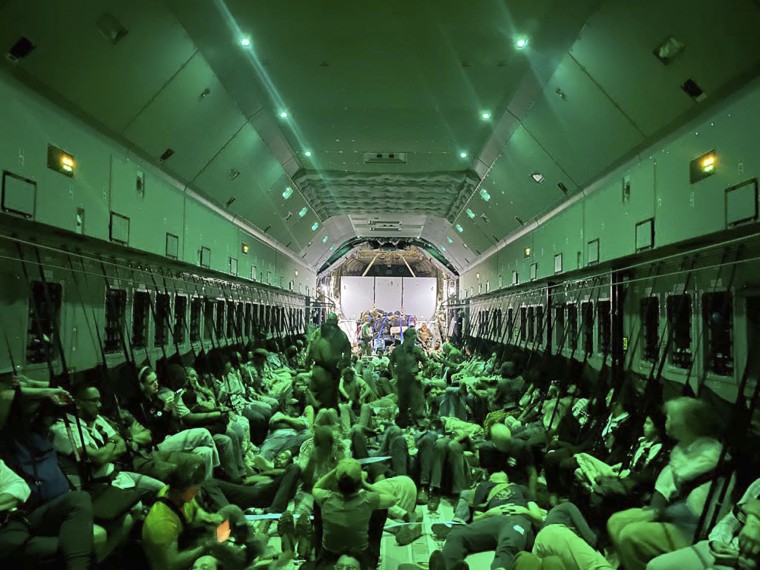
Spanish air force plane carried evacuees from Sudan to Madrid on
Monday. A European airlift has pulled out a wide variety of private
citizens from many countries. Spanish Defence Ministry via AP
For the people of Sudan, seeing the frantic international airlifts of
foreign nationals is a heart-sinking moment, indicating to them that the
international community holds out no hope that the two sides in the
conflict will reach an agreement any time soon, and the conflict of
which several ceasefires have been brokered and subsequently broken will
only escalate, leaving them in the middle of a maelstrom they will be
helpless to escape.
Foreign
governments have committed to airlifting hundreds of their diplomats
and other citizens out of the country to safety while Sudanese are left
to their own devices desperately seeking out ways they can leave the
chaos behind, believing that the two rival generals will raise their
present relatively low-level conflict to all-out civil war in their
battle for power, awaiting the completion of the foreign evacuations
before embarking on full-scale warfare.
Convoys
of foreign diplomats, civilian teachers, students, workers and families
from various countries made their way past the combatants at front
lines in Khartoum in an orderly but tense purpose to reach arranged
extraction points, while others drove to the country's east coast,
hundreds of kilometres distant.
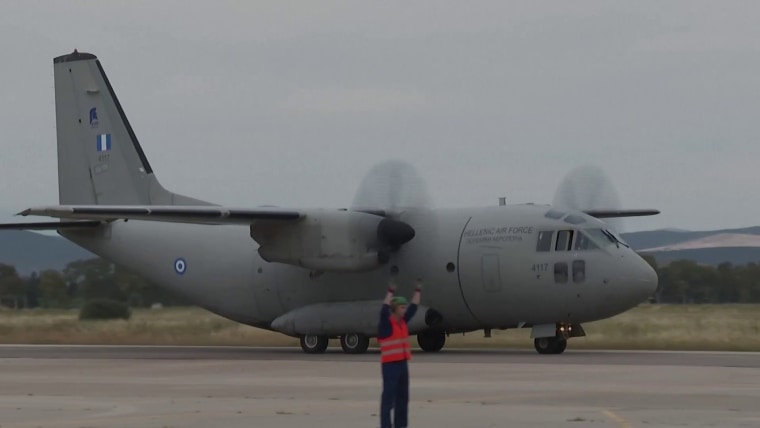
At
the airport a steady stream of European, Mideast, African and Asian
military aircraft flew in throughout the day Sunday and Monday to
collect the evacuees and fly them out to safety elsewhere; for many the
first leg of their trip back to their home countries. The last nominal
ceasefire with little reduction in fighting due to expire on Monday
evening.
Over
420 people of which total at least 273 were civilians have died, while
over 3,700 people have been wounded since the April 15 date when
fighting began. The country's military vows to fight to the end until it
accomplishes the crushing of the country's paramilitary opposition
group. Adequate reason why many Sudanese fear a dramatic escalation in
violence.
Sudan's
power-sharing negotiations with the ultimate goal of the military to
hold democratic elections and relinquish their power role to elected
civilians after the military coup, is being challenged by the
paramilitary troops with which it had a shared power agreement, but
which rejects elections and a civil, democratic government to be
returned in the East African country.
Canada
is one country that has not made plans to send in military aircraft to
evacuate the almost 1,600 Canadians formally registered in Sudan. It has
suspended consular services from the capital, noting that Canadian
diplomats would "temporarily work from a safe location outside the country", while still making an effort to aid their citizens in Sudan.
The New York Times
reported that U.S. special forces evacuated six Canadian diplomats,
along with 70 American diplomats and some as well from other countries.
Canadians were among a group evacuated by sea to Saudi Arabia. An
Egyptian expert on Africa, Amani el-Taweel, warned of "horrific
suffering" for Sudanese unable to leave. It is not possible, after all,
to evacuate an entire population of any country under military duress.
All the more so of a population of 46 million people.
This
is a country where humanitarian aid was already required by a third of
its population. And with an active conflict, aid agencies will no longer
be capable of reaching most Sudanese. "Warring parties will not heed any calls for a truce or a ceasefire"
once evacuations are complete, warned Ms. el-Taweel. Despite the
ceasefire set to expire, intensified airstrikes hit Khartoum's Nile-side
Kalakla district until the area was "razed to the ground".
Continued
fighting between the Sudanese military and their rival paramilitary
group the Rapid Support Forces saw heavy gunfire and thundering
explosions rock the city.
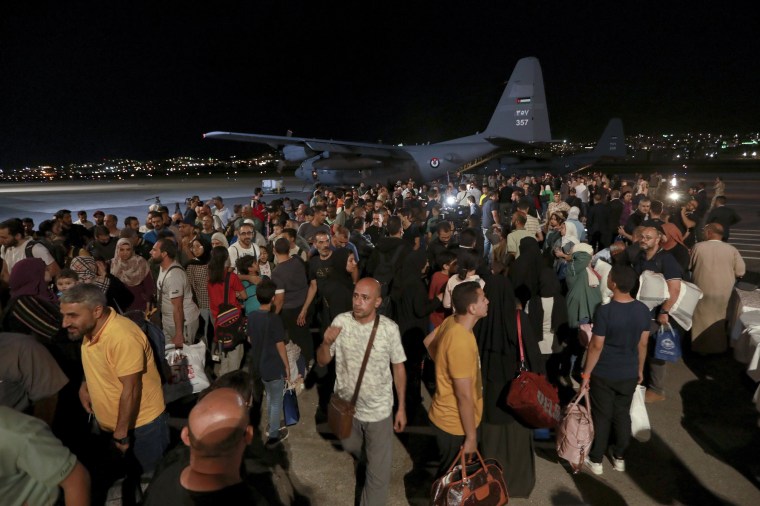
Civilians
evacuated from Sudan arrive at a military airport in Amman, Jordan, on
Monday. Foreign powers have sought to use a lull in fighting to get
citizens out.Raad Adayleh / AP
"One of the fighting parties had
seized control of the central public health laboratory in Khartoum and kicked out all of the technicians."
"That is extremely, extremely dangerous because we have polio isolates in
the lab. We have measles isolates in the lab. We have cholera isolates
in the lab."
"There is a huge biological risk associated with the occupation
of the central public health lab in Khartoum by one of the fighting
parties."
"[The expulsion of technicians and power cuts in Khartoum mean] it is not
possible to properly manage the biological materials that are stored in
the lab for medical purposes."
Dr. Nima Saeed Abid, World Health Organization representative in Sudan
"I do not know nor do I ask about the nationality of everyone I take a
photo with."
"Anyone can take a photo with me so long as they are human."
"I
never ask about his color, religion, or nationality. All of us are
human.":
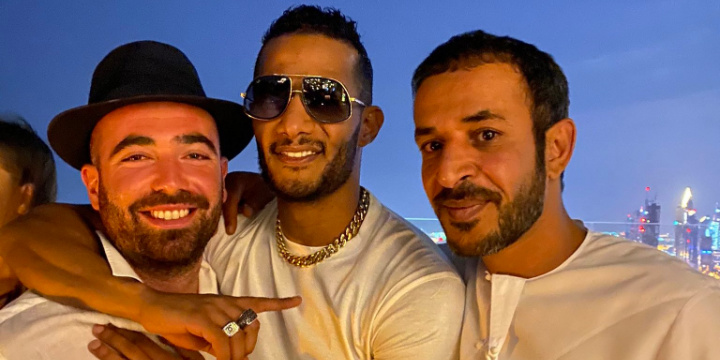
Egyptian actor and rapper Mohamed Ramadan
The picture in question of Omer Adam and Mohamed Ramadan. Photo: Twitter.
"[Pakistan]
categorically rejects baseless speculation regarding [the] possibility
of recognition of the State of Israel by Pakistan."
"The prime minister [Imran Khan] has made it clear that unless a just settlement of
the Palestine issue, satisfactory to the Palestinian people, is found,
Pakistan cannot recognize Israel."
"For just and lasting peace, it is imperative to have a two-state
solution in accordance with the relevant United Nations and Organization
of Islamic Cooperation (OIC) resolutions, with the pre-1967 borders,
and Al-Quds Al-Sharif [Jerusalem] as the capital of a viable,
independent and contiguous Palestinian State."
Where
Arab leaders of Muslim-majority countries might wish to finally lay
aside their belligerent malice at the presence of a Jewish state
returning to its Biblical-era heritage from the diaspora to which it had
been exiled only to discover that no place on Earth guaranteed Jews
equality, freedom of religion, the right to practise their distinct
culture without eventually disowning and turning on them, with blood
slanders, expulsion, pogroms, disentitlements, ghettoization, and
finally genocide, the opinion 'on the street' will always reflect the
campaigns embarked upon to delegitimize the presence of Jews on
territory Islam claims for itself.
Arab
and Muslim states in the Middle East utterly rejected the United
Nations plan for official Partition, apportioning territory to each;
Israel and Arab Palestine. Israel accepted the 1948 'permission to
proceed' by the world body, while the Palestinians obdurately refused it
and the surrounding Middle East states came to their side, swiftly
assembling a joint-Arab military invasion to oust the Jews from their
fledgling state. And failed. But the sting of failure and the insult to
Islam mandated further military assaults, all of them failing.
Eventually
the sting of failure faded at the executive government level for Egypt
and Jordan, but the propaganda lessons of Israel=enemy never did. So
while both Egypt and Jordan have long since signed peace treaties with
the 'enemy' whose presence they could never defeat, all quietened on
that front, even as hostility from their populations remained. Turkey,
the sole Islamic nation that supported the existence of Israel, did a
turnabout with the introduction of an Islamist government.
Gulf
nations that never aspired to military victory over Israel, and who
unlike Syria, Iraq, Lebanon and Egypt did not expel their Jewish
populations Arabized over the millennia of living side-by-side with
Arabs in near-fraternal order came to the final realization that the
failure of the Palestinian cause to found a nation of their own rested
with the Palestinian leadership that adamantly refused all offers at the
bargaining table with Israel that met Palestinian demands with the
exception of two; the 'right of return' and Jerusalem as a Palestinian
state capital.
Before
the advent of Islam in the 7th Century, the Arabian Peninsula and
particularly areas around the now-sacred city of Medina, was the home of
Jewish tribes. Tribes that Mohammad battled against for refusing his
offer to leave Judaism and accept Islam; exiling those he failed to kill
in combat, and restricted residence in what became Saudi Arabia to only
Muslims. In the modern era, the House of Saud contested control of
Arabia with another powerful tribe, the Hashemites; with British
mediation, the Hashemite Kingdom was given TransJordan to rule, and the
Sauds took Arabia.
Now,
the United Arab Emirates, a cosmopolitan, open society of moderate
Muslim rule, and Bahrain with similar cultural values have chosen to
normalize relations with Israel, once considered a sacrilege. Sudan
followed suit. And more Arab states are expected to follow, under the
aegis of U.S. diplomacy. Those Islamic states which have over the past
decades turned increasingly Islamist like Turkey will continue their
distance from Israel, spurning diplomatic overtures. Sadly, there is no
depth of 'normalization' between Israel, Jordan and Egypt.
The
Egyptian actor/singer who embraced Israeli entertainers at a casual
entertainment event is being sanctioned by his own Egyptian
entertainment union, and lawsuits are being brought against him for his
friendly actions toward fellow entertainers in a comradely environment
of relaxation and personal relations. His behaviour, the charges go,
insult and degrade Egyptian values. He has apologized and will perform
the necessary public penance required to redeem himself in public
opinion. Nor do Jordanian citizens bear a warmer relationship to their
Israeli counterparts.
The
normalization agreement and the process taking place now between
Israel, the UAE and Bahrain are of a different quality altogether. There
is a warm reception on either end, mutually respectful and generously
appreciative of the qualities each brings to a burgeoning new
relationship. And the most difficult of the Arab states of all to pacify
in their traditional distance with Israel, the Kingdom of Saudi Arabia
may now be warming to the concept of 'normalization' with the Jewish
State, as the Saudis turn toward moderation of their stern practice of
Islam.
These
events are taking place under the imprimatur and guidance and diplomacy
of the departing U.S. Trump White House administration, a goal and an
achievement that no other American administration has ever succeeded
with. Prime Minister Benjamin Netanyahu travelled to Saudi Arabia to
meet its crown prince to discuss between them an issue of great
importance both to Israel and to the Gulf Sunni states; the aggressively
hostile ascendance of the Islamic Republic of Iran, threatening
stability and the status quo in the Middle East.
Saudi
Arabia is officially denying that any such meeting between Crown Prince
Mohammed bin Salmon, U.S. Secretary of State Mike Pompeo and Israeli
Prime Minister Netanyahu took place. But undoubtedly, it did. A meeting
that the Saudis would like to keep under wraps, at least for the
present, but which the other two, Messrs. Pompeo and Netanyahu, would
prefer to have out in the open as a symptom and symbol that peace is
achievable and good relations between neighbours opens the way to peace.
National flags of Bahrain, UAE, Israel and the US are projected on the
walls of Jerusalem's Old City [File: L Ronen Zvulun/Reuters]
"Russia
plans to establish a military
base on Sudan’s Red Sea coast to serve as a logistics center for the
Russian navy, according to a draft agreement between Moscow and Khartoum
signed by Russian Prime Minister Mikhail Mishustin and released
publicly Nov. 11."
"The agreement states that Sudan will
provide a land plot for the Russian base free of charge for a period of
25 years. It will automatically renew for subsequent 10-year periods.
To terminate the deal, one of the parties must notify the other party of
its intention at least one year before the expiration of the next
period."
"While the base’s capacity will be
capped at four ships at a time, nuclear-powered ships are permitted to
dock, thus significantly increasing the combat capability of the Russian
navy in the Red Sea and the Indian Ocean. The number of military
personnel permanently staying at this facility should not exceed 300
people, according to the agreement. Also, Russia will have the right to
import and export through the seaports and airfields of Sudan 'any
weapons, ammunition and equipment' necessary for the operation of the
base and 'for the performance of tasks by warships'. Sudan, according to
the published document outlining the agreement, will not collect import
and export duties and taxes."
Kiril Semenov, Al-Monitor
Russian Prime Minister Mikhail Mishustin
inspects the Arktika nuclear-powered icebreaker at the port of
Murmansk, northwestern Russia, Oct. 21, 2020. (Photo by Alexander
ASTAFYEV / SPUTNIK / AFP)
Moscow
also succeeded in persuading Syria's president Bashar al-Assad in
exchange for Russian air power enabling the Alawite administration to
put down a rebellion by its Syrian Sunni population, to agree to a
Russian naval facility in Tartus as a leased military
installation of the Russian Navy located on the northern edge of the sea
port of the Syrian city of Tartus, its deep-sea base in the
Mediterranean. And then there is the little matter of seizing Ukraine's
Crimea naval base for Russia's Black Sea Fleet. Spreading itself around,
in Vladimir Putin's ambitions to restore elements of Russia's lost
status as a regional and world power.
Mr.
Putin has been a busy man, negotiating deals, and when negotiations are
inconvenient, simply stepping in, marshalling Russian military might
and imposing itself where it believes it belongs, in a position of
authority and manipulative power. No one could ever accuse Vladimir
Putin of not intimately knowing the very best chess moves. Of course
there are also clumsy and not-too-intelligent, visceral moves to rid
himself of 'enemies' of his aspirational rise for Russia to more closely
resemble the Soviet model.
Poisoning
critics is one of them, whether they take place in London or in Russia
itself. More effective has been the incidental and mysterious killing by
snipers of intrusive reporters and pestiferous political opponents.
There have been incursions in Georgia, Ukraine and Belarus, in
Nagorno-Karabakh of such an open extent that Russia's neighbours in its
near-abroad have shrunk back in fear of once again being forced into
Russia's tentacle-orbit. NATO has done its best to allay such fears, but
Mr. Putin is still smiling.
For
years, Russia has been accused of attacking hospitals and clinics as
part of a strategy to help President Bashar al-Assad of Syria secure
victory in the civil war. Credit...Meridith Kohut for The New York Times
His
expansion and military presence in Syria, Libya and even in the Arctic
have been gratifyingly useful. And should U.S.President Trump proceed
with his intention to pull American troops out of Afghanistan, Mr. Putin
will feel free to once again pop up there, too. This time perhaps not
as an occupying force where an ignominious departure has left deep scars
in the Russian psyche, but as a friend to the Taliban who are certain
to reclaim the country once again.
Belarusians
are once again becoming intimately acquainted with their neighbour
whose troops moved in conveniently to prop up its choice of
dictatorship, a ploy that failed to proceed as anticipated in Ukraine,
where the standoff between the government of Ukraine and Russia's proxy
ethnic Russian 'Ukrainian' loyalists defy Ukrainian sovereignty. Russia
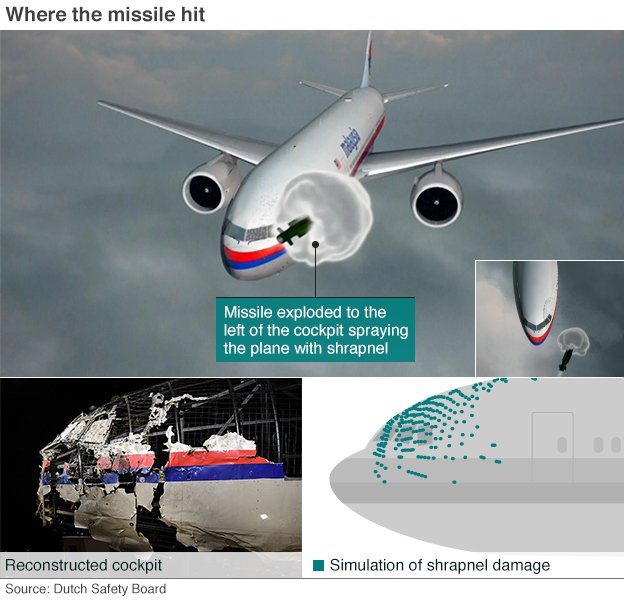
has to date escaped responsibility for the downing and murder of
passengers aboard Malaysian Airlines Flight 17 when it was downed by a
Buk missile, leaving all 283 passengers and 15 crew dead.
"Putin
appears to have achieved a significant victory in Nagorno-Karabakh that
threatens to alter the geopolitical balance throughout the former
Soviet space in his favour."
"He
has succeeded in expanding Russia's military presence in the
strategically important region ... without encountering any Western
pushback."
Anders Aslund, former economic adviser to Russia, Ukraine, Sweden, member of the Atlantic Council
In
the Republic of Moldova, an election pits a democratic, pro-European
Union candidate for president against a pro-Russian incumbent backed by
Russia. Moldova too lost part of its territory, the region of
Transnisria in 1992 to Russia. Similar to Russian troops occupying South
Ossetia in Georgia, since 2008. Vladimir Putin is having a good time
with his geographical chess game, and there's no one to interfere with
his grandiloquent plans as the new czar.
Nabad
al Hayat Surgical Hospital in southern Idlib Province served around
200,000 people before being destroyed in a Russian airstrike on May 5.
In a Russian Air Force transmission obtained by The Times, a pilot can
be heard receiving the hospital’s exact coordinates before bombing it. Credit...Orient News
"The argument by
the Russians or the regime is always that hospitals are run by
terrorists."
"Is it really possible that
all the people are terrorists?"
"The
truth is that after hospitals are hit, and in areas like this where
there is just one hospital, our houses have become hospitals."
Nabad al Hayat’s head nurse, who asked to remain
anonymous because he feared being targeted
Sudan: From Islamist Military Regime to Military Rule
"What has been just stated is for us a coup, and it is not acceptable." "Our request for a civilian transitional government has been ignored." Sara Abdelgalil, spokeswoman, Sudanese Professionals' Association
"He's like the spider at the centre of the web -- he could pick up on the smallest tremor, then deftly use his personalized political retail skills to manage the politics of the army." "Most of them [provincial leaders and tribal chiefs] became militarized and enmeshed in one of the popular defence forces. He has that extraordinary network, and it's all in his head." Alex de Waal, professor, Fletcher School of Law and Diplomacy, Tufts University
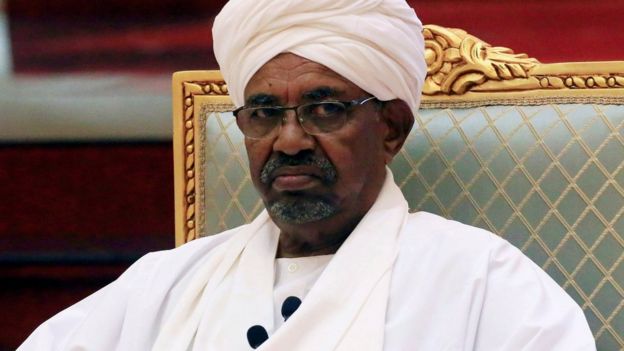
Omar al-Bashir has been in power since 1989 Reuters
It is far, far from justice, but at the very least perhaps a start in turning Sudan around from its dread ill repute as a nation whose ruler stifled dissent through a scorched earth policy. It seems, on the evidence, a very Arab response to a public outcry against a regime's ill treatment of its minority population, or a majority population ruled by a minority-representative administration -- with the previous examples of Rwanda and Syria, unrivalled in their massive butchery.
Former Sudanese President Omar al-Bashir was responsible for a horrendous slaughter in Darfur when black Darfurians protested their inferior status at the hands of its Arab rulers. Al-Bashir set out to slit the collective throats of Darfur's largely farming community beset and disadvantaged by the preferential treatment of Arab herders -- and in that revolt and its aftermath an estimated 300,000 Darfurians were killed, 2.7 made homeless, and mass rapes perpetrated.
Al-Bashir not only used helicopter gunships to unmercifully shoot down fleeing Darfurians hoping to find refuge in the forests, he bombed them, and urged and armed the mounted Arab militias known as the Janjaweed to pursue, torment and slaughter the Darfurians. When the International Criminal Court named him for genocide and declared him a fugitive from justice, no other Arab regime had the slightest interest in handing him over to the ICC.
The 75-year-old dictator prided himself on his humble beginnings born into a farming family. He had no iota of compassion for the remote villages and farming communities he destroyed in Darfur. He joined the military as a paratroop commander and in 1989 was leader of a coup to take the country from its elected prime minister, in a country accustomed to military takeovers. Leading an Islamist regime intent on embedding shariah law, international jihadis converged on Sudan, Osama bin Laden among them.
The vast country of Sudan was divided among Muslims, Animists and Christians in the south, where a war raged in a battle for independence. Sudan had become one of those wealthy, oil-rich nations enabled to fund modernization of its urban areas, and that enabled al-Bashir to cultivate a culture of one-man-rule exemplified by their president's personality cult; cue Saddam's Iraq, Moammar Gaddafi in Libya, Hosni Mubarak's Egypt and Bashir al-Assad's Syria.
Anti-government protests in Khartoum, Sudan, on April 9, 2019. AP
When Christian South Sudan gained its independence in 2011 and split off from Sudan its geographic split included most of Sudan's oil riches. Suddenly Sudan became poor again and Khartoum was under pressure. Gradually the economy of Sudan faltered and went into free-fall, an inflation rate of 72 percent, scarce fuel, and living standards collapsing, raising the ire of the urban middle classes leading to a revolt.
The initial protest against rising bread prices spread like wildfire from one town to cities across Sudan, protests led by doctors and other professionals. The protests continued and they swelled, just as they did in Egypt when Mubarak was brought down and the Muslim Brotherhood moved on their opportunity to bring an Islamist to the presidency in Mohammed Morsi. Neither the civil conflict nor the atrocities in Darfur with their enormous loss of life moved Sudanese to revolt; the price of bread did.
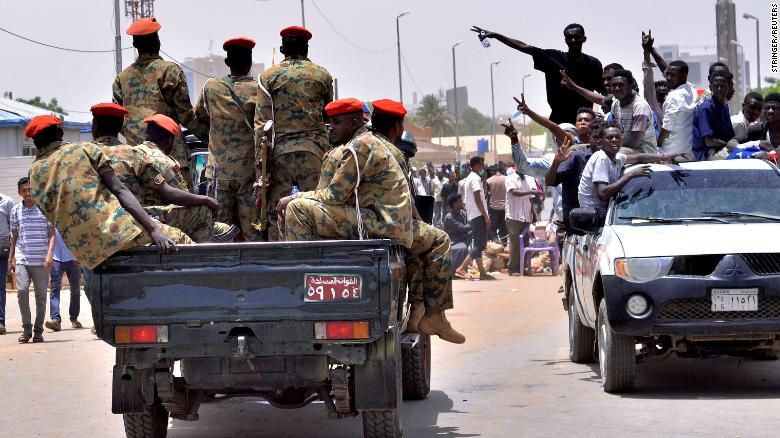
Sudanese demonstrators cheer as they drive towards a military vehicle
Sudan's top military man, General Awad ibn Ouf, named de facto leader faced the wrath of the demonstrators demanding a transition to democracy under a civilian body. He was forced to make way for another military man, one with no involvement in savage brutality; the former announcement had Sudanese celebrating, the latter had them sputtering with rage, claiming that military rule was simply extending the regime of Omar al-Bashir.
A military tribunal, it was stated, would hold al-Bashir to account for crimes he committed; no doubt the other two Sudanese military elites under al-Bashir's rule indicted by the ICC -- the interior and defence minister and the senior security chief -- will sit on that tribunal as senior military figures. It was emphasized, however, that Sudan is not prepared to hand over their former president for trial into war crimes and crimes against humanity to the ICC; it would humiliate Sudan.
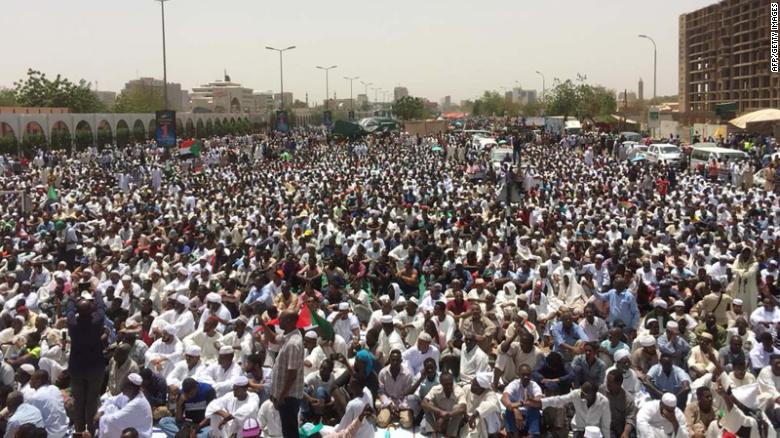
"Revolutionaries, we will continue our path", chant tens of thousands of people rallying in front of military headquarters in protest over the military power takeover, making a travesty of justice of the removal of the former president. "Just fall, that is all!" the crowds chanted, oblivious to the gunfire being exchanged by rival gangs of soldiers.
Sudanese protesters gather near the military headquarters in Khartoum as
they continue to rally demanding a civilian body to lead the transition
to democracy one day after a military council took control of the
country, on April 12, 2019.
"Families know that the only way their lives will change is if their sons join the war and bring them back money." Hager Shomo Ahmed, 16, Sudan
"The Saudis told us what to do through the telephones and devices." "They never fought with us." "Without us, the Houthis would take all of Saudi Arabia, including Mecca." Mohamed Suleiman al-Fadil, 28, Bani Hussein tribe
"The allegations that there are children among the ranks of the Sudanese forces are fictitious and unfounded." Turki al-Malki, spokesman, Saudi military coalition
Abdel-Hamid, a 14-year-old former child soldier, at a camp for displaced persons where he took shelter, in Marib, Yemen
AP/ Nariman El-Mofty
During Darfur's collapse when the government in Khartoum employed its forces including helicopter gunships and Janjaweed Arab horsemen to slaughter black Darfurian farming communities, raping women and girls, killing hundreds of thousands of people, displacing millions and creating a desperate refugee situation in 2004, the world began to take notice. That's about all the world did. Out of a total Darfurian population of 6.2 million, fully 4.7 were displaced, losing everything, their farms, their livestock, while between 200,000 to 300,000 lost their lives.
Hager Shomo Ahmed's family lived in despair after raiders stole his family's cattle leaving them destitute after a 12-year civil war. An unequal war; the Darfurians had little defence capabilities while the Khartoum government had its panoply of advanced war machines while the Janjaweed mopped up what the Sudanese military left behind. So the indigent Hager family welcomed a 2016 offer to pay up to $10,000 to have their-then 14-year-old son become a mercenary in their war with Yemeni Houthis.
The war in Yemen, according to the United Nations, represents the world's worst humanitarian crisis where an intermittent blockade by the Saudis and their coalition partners has placed 12 million Yemenites in starvation, where an estimated 85,000 children have died. The Saudis on the other hand, claim to be rescuing Yemen from a hostile group of Shiite Islamist reactionaries linked to and backed by the Islamic Republic of Iran.
Sadek, another 14 year-old former child soldier at a camp in Marib
AP/ Nariman El-Mofty
The Saudi and Gulf oil wealth enables the coalition to buy the use of mercenaries, tens of thousands of survivors of the Darfur conflict, and many of those taking up the offer are children. For close to four years, up to 14,000 Sudanese militiamen have joined the fight in Yemen alongside the local militia supported by the Saudis. Hundreds of them will never return home, casualties in a war far from their homes.
Virtually all the Sudanese mercenaries in the Yemen war represent the impoverished, battle-scarred region of Darfur, most becoming part of the paramilitary Rapid Support Forces, the tribal militia known as the Janjaweed, the very same Arab militias that preyed on black Darfurians at the behest of Khartoum. They were responsible for the systematic rape of women and girls, the indiscriminate slaughter and allied war crimes during the Darfur conflict.
The veterans among them now lead the deployment of the Sudanese mercenaries in Yemen. Many among the fighters are between the ages of 14 to 17; their parents bribed militia officers to take their sons to fight, desperate for the pay promised by Saudi Arabia. Children are estimated to represent at the very least, 20 percent of the Sudanese fighting units, a number in dispute since some returning fighters claim that children represent 40 percent of the units.
Nawaf, a 15-year-old former child soldier, in Marib
AP/ Nariman El-Mofty
Saudi and Emiratis officers involved in the command of the Sudanese fighters keep in contact by remote control, themselves remaining far from the battlefield, where they direct the units to attack or retreat remotely through radio headsets and GPS systems maintained by the Sudanese officers. "The Saudis would give us a phone call and then pull back", said Ahmed, 25, a member of the Awlad Zeid tribe. "They treat the Sudanese like their firewood."
According to now-16-year-old Hager, returned to Darfur in late 2017 from Yemen, his unit had lost 180 men in a period of six months of fighting. His Sudanese officers had allowed him to call his parents occasionally because he had been terrified constantly by his enforced military duty and the potential consequences. Now, both he and his parents are content; with his $10,000 pay he bought a house for his parents and ten cattle.
This represents a general opinion site for its author. It also offers a space for the author to record her experiences and perceptions,both personal and public. This is rendered obvious by the content contained in the blog, but the space is here inviting me to write. And so I do.







![National flags of Bahrain, UAE, Israel and the US are projected on the walls of Jerusalem's Old City [File: L Ronen Zvulun/Reuters]](/wp-content/uploads/2020/11/2020-10-20T000000Z_210160863_RC2BMJ90IV8U_RTRMADP_3_EMIRATES-ISRAEL.jpg?resize=770%2C513)



/cdn.vox-cdn.com/uploads/chorus_image/image/63396263/AP_19099493501918.0.jpg)