Saturday, October 05, 2019

The Byzantine World of the Middle East

"[Recruited at age 19 to travel to an exclusive resort in the Seycheles Islands called The Plantation Club], frequented by some of the richest private individuals in the world for whom money is no object."
"[At this] playground of the super-wealthy, it is the norm for lavish parties and events to be held [where models were flown in] to lend a sense of glamour and exclusivity."
"I have also been told that I have a very engaging personality."
Affidavit, Candice van der Merwe, South African model

How an SA bikini model got $16m from Lebanon’s prime minister
Candice van der Merwe. Picture: Twitter

Oh well, a politician. A Middle East politician. A Middle East politician in Lebanon. Comfortable to act as the troubled, sectarian-cleft prime minister of a government in which the terrorist group Hezbollah, the militia-proxy tool of the Islamic Republic of Iran, forms part of the government while at the same time governing independently within the Shiite enclaves of the country, and in the process operating a military, separate from that of the government itself.

No problem. Lebanon is accustomed to strife and disagreements and the machinations of its Sunni, Druze, Christian, Shiite blocs, all maneuvering, contending for leadership, power and control. The presence of Palestinian 'refugees' whom Lebanon will not deign to absorb as citizens somewhat complicating the situation. The domination of Syria and the emergence of 'The Party of God', martyr-loving and murder-proficient making for a rather complex society.

That Lebanese Prime Minister Saad Hariri, loved his father Rafik Hariri is perhaps not under debate. That he honours him is up to his own conscience. He may console himself with the assurance that he does, but it is a strange way to do so; to harmonize the country's affairs and its future with the very armed, dangerous, terrorist force that murdered Rafik Hariri is indisputably peculiar. What is also indisputable is that no one seems to notice, much less care (other than the Saudis).

 Since 1977, at least 12 prominent political leaders were assassinated

This is the Middle East, however, and a giant shrug of dismissal is always in order; one commits to actions that happen to be convenient or self-serving at any given time. And what is most inconvenient is to have other issues revealed that portray oneself in a morally compromising position in such a blatant manner as to be somewhat embarrassing in a geography, cult, and heritage where honour or the perception of honour is of primary importance.

What is even more disconcerting for Lebanon's prime minister is the state of affairs of his family's (collapsed) construction conglomerate, Saudi Oger, its media outlets and other business empires where employees impatiently await their promised backpay of salaries. As with private business, so to the country faces a financial crisis resulting in public anti-government protests when their prime minister warned the public in a declaration of "economic state of emergency" that austerity measures are in their future.

In 2013, this father of three had a Forbes-estimated net worth of $1.9 billion accruing from business interests inherited from Rafik Hariri, prime minister at one time like this son, until his assassination in 2005 Beirut. Recent revelations of an affair with a 20-year-old model when he was 43, and her annual income from energy-drink promotions and swimwear calendars averaged $5,400 have now complicated this poor man's life even further.

In May of 2013 the young woman's aspirations and financial assets underwent an amazingly swift transition, when a Lebanese bank transferred $15,299,965 to her personal account. A tender secret between two private individuals, although the startling amount involved caught the attention of South African financial and tax authorities. Who had the unmitigated gall to investigate and feel confident in deeming the transaction taxable income.

The young woman stood her ground with confidence, insisting this represented a gift, and as such according to South African law, not taxable. This transaction took place without conditions, she recounted in subsequent court cases where her benefactor was revealed to be Lebanon's prime minister. She had spent all of four days in 2012 at the Seychelles resort, connecting with attendees attracted to her qualities, including her "healthy lifestyle".
Prime Minister Saad Hariri of Lebanon in Beirut in August. He gave more than $16 million to a South African model who said they had a relationship.
NewYorkTimes.com   The payments were not made during the time Mr. Hariri was prime minister

After making such a favourable impression it was reasonable that other such trips followed. As to the $15 million transfer, described through a bank official as "the sender and beneficiary are boyfrield/girlfriend and are currently together in the Seychelles" -- well simply proof of a gift with which she bought a house in Cape Town's prestigious Fresnaye neighbourhood, and loaned out $2.7 million to her father's real estate company. Which left the poor woman with a mere $537,000.

When tax authorities in South Africa persisted, Candice van der MErwe's assets were frozen. Which was when her benefactor once more stepped in to send her another $1 million to ensure she had sufficient funds to assist in covering legal and living expenses. Finally, when in January she sued government officials for $65-million in damages, the documents she filed revealed the Lebanese prime minister's role in her unfortunate misery of tax harassment.

View image on Twitter

Labels: , , , , , ,

Wednesday, August 22, 2018

Pakistan's New Day Dawning

"Pakistanis are hoping against hope that somebody is going to bring about changes."
"But I do think despite all the things Imran wants to do, there is a feeling that we may be in a scenario where much of the 'Naya' [new] Pakistan may be a bit like the old Pakistan -- more of the same."
Ayesha Jalal, Pakistani historian, professor of history, Tufts University, Mass. 

"I don't know if he will be good for the country, but he adds to the confusion in the narrative."
"He is a polarizing force, like Modi and Trump."
"They do not discourage their followers from taking up divisive positions and abusing or attacking those who disagree with them."
Beena Sarwar, journalist, activist, teacher of journalism, Emerson College, Boston

"As a cricket hero, he united the country, but as a politician, he is very polarizing."
"He is a cult of personality and people are really attracted to him because of his charisma, but there are a lot of people in Pakistan who hate him. They think he has a soft spot for terror, are very much against some of his views towards women, so do not think he is very smart."
Michael Kugelman, analyst, Woodrow Wilson International Center for Scholars, Washington
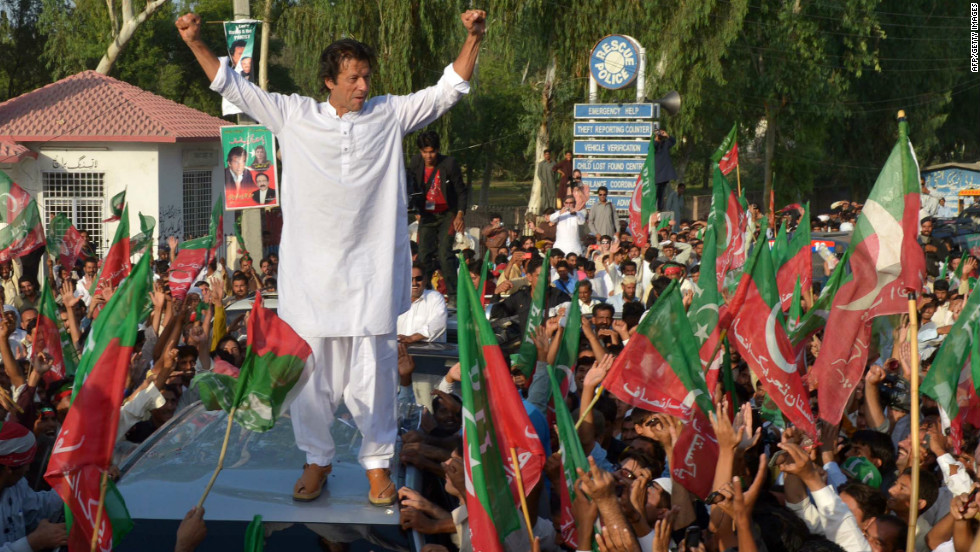
Pakistan cricket star turned politician Imran Khan gestures as he stands on a vehicle during a rally in Mianwali, northern Pakistan, on October 6, 2012.
Pakistan is a country that breeds trouble for its neighbour Afghanistan. Its hill tribes answer to no government agency. It provokes violent confrontations with India over Kashmir. It is a nuclear country with stockpiles of nuclear weapons. And it is notoriously intolerant of other religions, while also being the source of jihadist terrorists prowling about on the world stage. Even its diplomats, such as those in Canada, pose a threat to peace and security, threatening those who question the country's despicable reputation. Pakistanis who become citizens in Europe and North America are often identified as violent Islamists.

The country is undergoing hard economic times, in contrast to its neighbour India and that contrast is infuriating to Pakistan. The 207 million people of Pakistan, once part of India, expect their country to expand its middle class demographic, but its economic straits mitigate against that anytime soon. Corruption and elitism, a military and a secret service infiltrated by Islamists does not represent a formula for an encouraging future. Its newly-elected prime minister, 65-year-old Imran Khan's reputation and campaign promises brought his Tehreek-e-Insaaf party to power.

And he is promising to solve a problem of a hugely indebted country whose economy of $300 billion has faltered thanks to corrupt political regimes where basic necessities are unavailable to its citizens. The economy is in such dire straits it must look to a financial saviour and China is happy to oblige, building a China-Pakistan Economic Corridor cutting the length of Pakistan to connect China to the Indian Ocean, the $62-billion investment reflecting part of China's massive Belt and Road Initiative, in the process indebting Pakistan to China, impacting the former's sovereignty.

In view of the parlous state of affairs, Mr. Khan plans to live modestly, with his third wife, an Islamist who is also a practitioner of the occult. Mr. Khan speaks piously of the need for equality between men and women, but he has himself become fundamentally Islamist, shedding his secular celebrity persona in favour of deep devotion to Islam, favouring the burqa his ultra-religious wife affects. They plan to have two servants and live in a three-bedroom house, eschewing the palatial estate reserved for head of state, in view of an austerity drive facing up to the country's economic crisis.

Of course, the country has a moral, human rights crisis as well, in that it views conversion from Islam to Christianity a capital offence as is any opinion expressed critical of Islam. There are Christians on death row awaiting their final punishment resulting from their having been charged and found guilty of blasphemy in a justice system utterly intolerant of deviance of Sharia law in an Islamist nation that under its new prime minister is expected to become ever more unforgivingly fundamental in its religious devotion.

He muses that a prospect for transforming the prime minister's residence to a university might be useful. The 524 household staff will be let go. The fleet of 80 vehicles, 33 of which are bulletproof will be sold, two only to be maintained for his use. "I want to tell my people, I will live a simple life, I will save your money", he said. He plans to call on the wealthy to begin paying taxes. And Pakistanis living abroad should return their money to domestic banks to help the country overcome its foreign currency crisis.

Opposition parties feel disappointed that the new prime minister made no mention in his 70-minute speech to the public of how growing extremism will be dealt with. That Khan himself has been accused of emboldening those extremists through invoking his own hard-line issues on blasphemy on the campaign trail, strikes some as boding ill on that file. A bailout of $12-billion is urgent, reflecting the debt crisis. Yet Khan contemplating the country's spiral of debt balks at borrowing to pay the interest on earlier loans.

He would prefer rather than begging internationally for money for Pakistani expatriates to send their money back home: "I want you to bring your money to Pakistan. To keep your money in Pakistani banks. Right now we are short on dollars. There is a huge trade gap right now", he stated. Among his promises -- solving poverty and malnutrition, and eradicating some of the world's highest maternal and infant mortality rates. Much less the need to educate the 22.8 million Pakistani children who don't attend school.
Imran Khan
Social media exploded with jokes and memes when Pakistan Tehreek-e-Insaf (PTI) and former cricketer Imran Khan on Sunday announced his third marriage with Bushra Maneka, who was his spiritual adviser.


Labels: , , , ,

Follow @rheytah Tweet