Friday, September 06, 2019

Coping With Explosive Drug Dependencies in Scotland

"We're seeing diseases that  you would associate with old age in a lot of these middle-aged men with a long history of drug use."
"What your body tolerates at 18 it doesn't tolerate at 38 or 48."
Dr. Carole Hunter, lead pharmacist, Glasgow Addiction Services

"The jigsaw is complex."
"It's our history, it's the way we consume drugs, it's the chronic underfunding and underperforming treatment services we have."
"Underline that with austerity and welfare cuts in recent years, and you've got the perfect storm for this to happen."
"We've managed to keep a lot of the aging cohort alive through our current drug treatment services, but they get to a certain point where that blanket is not enough. They need respiratory care, they need mental health care, they need help with housing, employment, welfare and a whole host of other things."
Amdrew McAuley, senior research fellow on substance use, Glasgow Caledonian University

"I know the instinct from the U.K government is that they don't want to be seen in any way to be condoning illegal drug use."
"But people are dying. We need to do things that at first feel difficult."
Scotland Public Health Minister Joe FitzPatrick
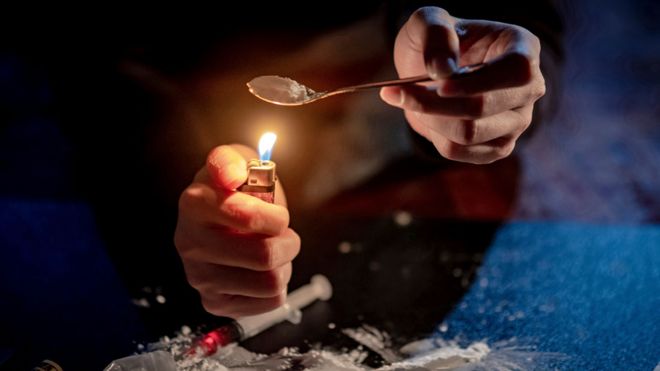
heroin

"Street Valium", or etizolam has flooded into Glasgow. "People are dying with one bad pill", said Halth Minister Joe FitzPatrick. The drug Etizolam has been discovered in close to half of all drug deaths that occurred last year in Scotland. Unlike the scourge of overdose deaths where fentanyl and carfentanil, two hugely powerful opioids -- one more deadly than the other -- have entered Canada and the United States -- mostly from China -- Scotland has not yet seen their presence.

But even without those two deadly scourges, Scotland struggles with drug dependency and its inevitable death toll. The situation has become so dire in that country it is now being referred to as the "drug-death capital of the world", a distinguishing prize the nation could well do without. There were 1,187 drug-related deaths last year, a record for Scotland, representing an increase of 27 percent from the previous year.

And what distinguishes these deaths is that it is older, long-term opioid users who are now accounting for the greater proportion of the deaths.

Over twenty years ago Edinburgh's addiction rate was infamous. The known 60,000 drug users in Scotland, routinely involved in a prolonged history of opioids or benzodiazepines keep the crisis in drug-related deaths at a high level of dramatic life expiration for no good reason. Those who fail to die of drug overdoses are experiencing disturbing health deterioration with the onset of medical conditions familiarly seen in much older people.

Drug users suffer from both physical and mental health issues. As an example, one patient who has been using drugs since age 19 and who has overdosed no fewer than four times in the past year. "I've nearly died four times", the now-43-year-old says. "It's getting harder for me to recover as I get older". He is being treated for deep-vein thrombosis, hepatitis C and skin abscesses, and lately has been urinating blood.


Life expectancy until 1950 was on a par with most of Western Europe, even better. Following the Second World War, Scotland's progress was slower than that of any other Western European country and the varied reasons behind Scotland's drug crisis can be attributed to economic policies that left regions in a deeply impoverished state where treatment services were neglected and drugs became deadlier. Needle exchanges introduced in the 1980s along with naloxone to reverse overdoses have been in widespread use since 2011.

Methadone as an opioid substitute therapy is free, available at most pharmacies. Efforts by the Edinburgh Access Practice treatment center to boost more people into treatment faster and to begin to address issues behind their drug use are positive factors in response to the epidemic of drug use, but there are few such facilities. Controlled substances like heroin fall under the British government's jurisdiction and there is resistance from conservative lawmakers to move to more progressive drug policies.


Labels: , , , , ,

Wednesday, September 17, 2014

Scottish Muslims push for independence ahead of vote

Most Scottish Muslims favor independence, with a major motivation being the ‘unlawful’ war in Iraq. (Photo courtesy: Twitter)
 
Millions in Scotland will take part on Thursday in a referendum on whether to remain part of the UK. Some 700 years after the war for a free Scotland, independence this time could be won by a simple vote.

Polls show that it is too close to call, but that most Scottish Muslims, as well as other ethnic minorities, are likely to vote yes. Out of almost 6 million people in Scotland, 1.4% are Muslim.
According to a poll by Asian radio station Awaz FM, 64% of Asians in Scotland, mostly Muslim, would vote for independence.

Tasmina Ahmed-Sheikh, a lawyer from Glasgow and national women’s officer for the pro-independence Scottish National Party, says Scotland needs to control its own foreign policy and immigration issues.

Policies imposed on Scotland by the UK government have caused a surge in popularity for far-right groups such as the UK Independence Party, she added.

“UKIP have managed to gain ground south of the border. We don’t want this in Scotland,” she said.

Scots Asians for Independence society. Picture courtesy of the Scots Asians for Independence Society

“We have a white paper called ‘Scotland’s Future: Your Guide to an Independent Scotland,’ and it outlines that people living legally in Scotland at the time of independence can remain.”

Ahmed-Sheikh says independence will lead to the closure of immigration detention centers such as Dungavel, located in Scotland.

“Scottish Muslims have a voice and it counts. For anyone still undecided, their vote should be yes,” she said.

Many Scottish Muslims say the UK government acted unlawfully in its wars in Iraq and Afghanistan.
Ahmed-Sheikh said: “I speak to Muslims all the time across Scotland, and there is a strong feeling that being independent will allow us more control over foreign policy. No longer will we be led into ‘illegal wars’.”

Nighet Riaz, the main facilitator for the Scottish Asian independence campaign, said: “Voting yes in the referendum will allow Scotland to be a beacon of hope across the globe. We will be peace-makers, as it means we can control our foreign-policy decisions and won’t be led into conflict unnecessarily.”

Riaz says this is not about being anti-English, keeping the pound is a non-issue, and this is a natural evolution for Scotland.

Tasmina Ahmed-Sheikh with Alex Salmond first Prime Minister of Scotland. Picture courtesy of Tasmina Ahmed-Sheikh

“We have contributed to the UK, and yes we should keep the pound. There are other countries that use the dollar.”

With Scotland hosting the recent Commonwealth Games, the sense of nationalism displayed during the competition appears to have heightened the desire for independence.

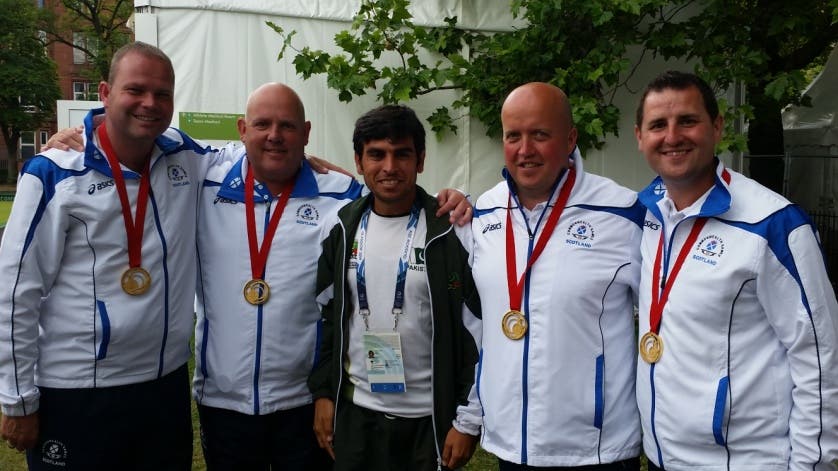
Mohammed Shahzad, who lives in Scotland and represented Pakistan in the games, plans to vote yes.
Like most Scottish Muslims, he wants the country to be able to control its own resources and wealth.
“The vast majority of my Muslim friends here in Scotland will be voting yes in the referendum. We want an independent Scotland,” he said.

“This country is so friendly to other cultures and nationalities, and a lot more accepting of the Muslim community versus the rest of the UK.”

Shahzad believes that the first few years of independence will be tough. However, his real fear is a “negative backlash” if a majority vote to remain in the UK, because of “the fact that we are even thinking about independence.”

He said he did not feel threatened by Scottish nationalism during the Commonwealth Games. “I loved every minute of the competition, and the Scottish people wore their national colours. It was great to see.”

However, some Scottish Muslims see a potential dark side to nationalism.
“We need to stick with the UK... The world is moving in such a way that nationalism could mean racism,” said Yasar Yousafzai, a PHD student from Glasgow University, adding that Scotland is the most accepting place he has ever lived.

He said separation could also lead to funding cuts in academic research within universities.
Mohammed Shahzad competing in the Commonwealth games with athletes from the Scottish team. Picture courtesy of Mohammed Shazard

Dr Imran Ahmad, a clinical lecturer at Glasgow University, also says separation could lead to a decrease in university funding as well as healthcare resources.

“It’s not been explicitly said, but it has been implied that we get better funding for research being part of the UK,” he said.

However, Ahmad disagrees that nationalism could lead to racism. “I think Scotland is very open, there will not be an increase in segregation if we become independent.”

Last Update: Wednesday, 17 September 2014 KSA 15:41 - GMT 12:41

Labels: , , ,

Wednesday, May 15, 2013

The greatest problem to tackling anti-Jewish incitement is the denial that there is any such problem. The facts, as we have seen, tell a rather different story.
A charity ball organized by the University of St. Andrew's Jewish Society, guarded by plain-clothes police officers, was held in secret last week after threats were made against staff at the original venue. The increasing security and secrecy surrounding this annual student event is an illustration of the sentiments aimed at Jewish students in Scotland.

The ball was originally supposed to be held at the Golf Hotel in St. Andrews, a small University town on the east coast of Scotland. After a campaign organized by the Scottish Palestine Solidarity Campaign, a number of threats were directed at the hotel's staff, and a number of violent comments were posted on social media, with one protester writing: "Friday we send them into hell."

The Golf Hotel cancelled the event over "safety concerns." One member of the Jewish student society said that the decision to cancel the event was "pathetic…. They [the Golf Hotel] had no right to violate their part of the contract. The Golf Hotel is scared of them. A victory does not come from bullying people into submission, it comes from engaging people and opening their minds."

Although activists from the Scottish Palestine Solidarity Campaign [SPSC] were able to pressure the hotel into cancelling the charity ball, it was held secretly at another location, and raised over three times the amount of money for its nominated charities.

The SPSC offers a free book to all new members: Shlomo Sand's The Invention of the Jewish People -- a book the central argument of which is that the Jewish people, as a single collectivity, do not exist. Last year, the group also protested in support of a student at St. Andrews, Paul Donnachie, who was charged and found guilty of racially abusing a Jewish student.

In 2006, the SPSC commemorated Holocaust Memorial Day by performing a reading of "Perdition," a play that claims the Holocaust was a joint venture between Zionists and Nazis. In 2009, the group commemorated Holocaust Memorial Day by running an event with Azzam Tamimi, a spokesperson for the terror group Hamas. And in 2010, the group reproduced the winning entry from Iran's offensive Holocaust cartoon competition of 2006.

Senior SPSC member John Wight has previously promoted a website called the "Committee for Open Debate on the Holocaust." Wight has said: "As soon as the scales fall from the eyes of international Jewry with regard to the racist and fascist ideology that is Zionism, the world will begin to emerge from the iron heel of war and brutality in the Middle East."

Similarly, Edinburgh PSC chair Mike Napier has referenced a number of neo-Nazi websites in an article that vindicated the murder of eight Jewish students at a religious school in Jerusalem, on the grounds that the school is "the main educational and training centre of the fanatical Israeli settler movement," and that the students are taught to regard Gentiles as cattle and to use Arabs for "medical experiments" and to send "Arabs to the gas chambers."

The "We are all Hana Shalabi Network" also supported the protest against the St. Andrews Jewish Society. This group campaigns in support of Hana Shalabi, a member of the Palestinian terror group Islamic Jihad. In 2012, Shalabi visited Tehran as part of a delegation from the Islamic Jihad movement. In front of the Iranian leader Ayatollah Khamenei, Shalabi spoke of her commitment to "jihad and resistance" and praised the Iranian revolution in 1979 as the "beginning of a new era."

Across Scotland, Jewish students regard the line between anti-Israel activism and anti-Jewish incitement as wearing dangerously thin. Several months ago, a number of Jewish students the University of Edinburgh abandoned their courses because of the "toxic atmosphere" on campus.

Moreover, the University of Glasgow is a participant in a European Union-funded program, "Lifelong Learning in Palestine," in which the Islamic University of Gaza is one of the main beneficiaries. The Islamic University of Gaza is the "the brain trust and engine room of Hamas," the Palestinian terror group that rules Gaza. In 2008, Hamas was using the University to build explosives and rockets for use against Israeli civilians.

In 2011, security guards had to step in to protect Arab-Israeli diplomat Ishmael Khaldi at the University of Edinburgh, after a student mob surrounded him while screaming "Viva, Viva Palestina."
Increasingly, Jewish students' choice over which university to attend is influenced by the potency of anti-Israel sentiment. The Scottish Council of Jewish Communities has reported a rise in the number of inquiries from parents and potential students in the US and Europe about the safety of Jewish students.

In 2011, the British ambassador to Israel, Matthew Gould, claimed that the image of Universities being "hotbeds of anti-Israel sentiment" was false. University authorities also downplay the extent of the campus extremism. Last month, Baroness Warsi, the Minister of State for Faith and Communities, and Nicola Dandridge, the head of Universities UK, both claimed that the problem of university extremism is greatly exaggerated. The facts, as we have seen, tell a rather different story.

The greatest obstacle to tackling anti-Jewish incitement is the denial that there is any such problem.
 Related Topics:  United Kingdom  |  Samuel Westrop

Labels: , , , , , , , ,

Follow @rheytah Tweet