"We understand we need investment. But if we decided to be friends, it should be even." "You get something, I get something." Irina Avdoshkevich, member, City Council, Kansk, Russia
"Everything here is Chinese." "This [the Chinese logging boom] will last another five years, maybe. Then the Russians will start thinking, and they will also forbid logging." Wang Yirem, overseer, lumber mill
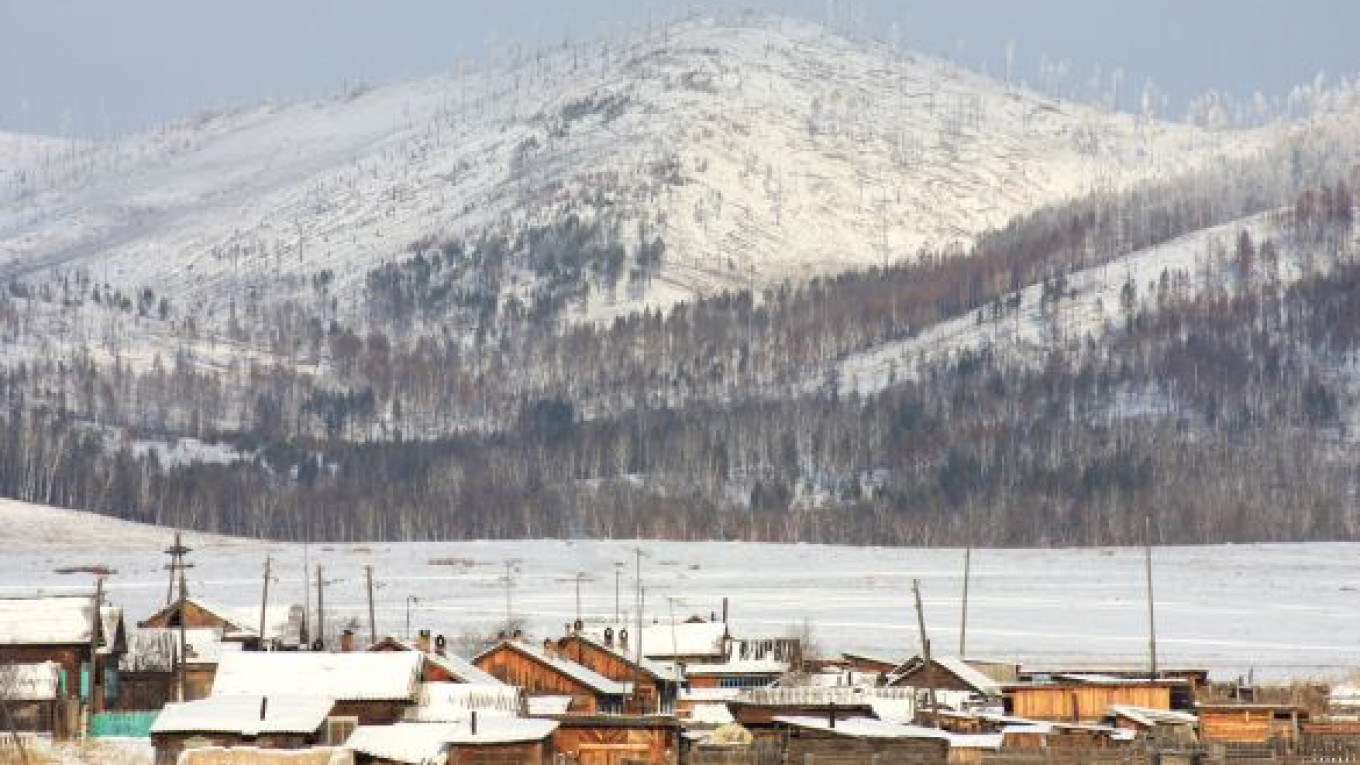
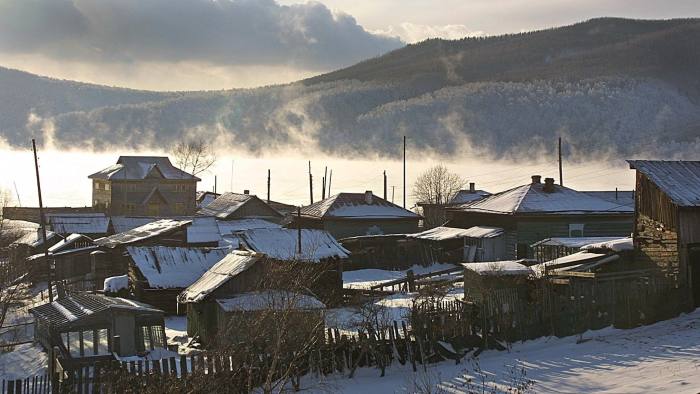
Kansk, the fourth largest city in the Krasnoyarsk krai (after the
regional capital, Norilsk, and Achinsk) hit the headlines on May 24: in a
hot spring day, a fire has broken out and destroyed 78 homes leaving
almost 300 people homeless. Two city dwellers were killed.
Upon extinguishing the fire, the regional authorities have launched an
inquest to find out who is responsible for the tragedy. It was found
soon that the devastating fire had occurred not because of somebody’s
negligence or by a coincidence. It was a logical result of practices
used by the local administration. Several timber companies, mostly
Chinese ones, had operated in Kansk on a semi-legitimate basis. They
were littering the city suburbs with sawdust; no one was controlling its
utilization. On May 24, the smoldering sawdust has finally broken into
flames. It is fortunate that such a major fire hadn’t occurred earlier –
there were plenty of smaller fire accidents in the past
China is rapacious. Hungry for natural resources, whatever they may be, wherever they may be. Its tentacles are long and determined and its diplomatic and trade and investment overtures to countries rich in natural resources and poor in infrastructure gain it opportunities throughout Asia and Africa. And elsewhere in the world. China geographically abuts Russia. In China, most of the forests have been well logged out. So China looks elsewhere.
In Siberia the rumble of logging trucks identifies China's rush to deforestation activities with Russia's permission. Trucks heaped with Siberian larch, Scots pine and birch make their way to sawmills owned and operated nearby, by Chinese; the total operation Chinese-run, the workers mostly Chinese, the products meant for the Chinese market. China may even one day, contest Russia for its Siberian land mass; it is sparsely populated by Russians and China's population continues to expand.
There are hundreds of Chinese-operated sawmills popping up the last few years alongside the Trans-Siberian Railway to help feed that populous country's appetite for wood. The Russian Siberians do benefit in jobs they can fill, working under Chinese overseers who communicate with them in Russian. The process of logging is fast making Russia a global leader in forest deforestation, a distinction of questionable value.
One that makes Siberian logging towns quiver in uneasy uncertainty for their future. All the manufacturing involved in consumer wood products is carried out not in Russia but in China which has restricted logging in China intending to preserve what is left of its own forests. Russia's central government appears to shrug off what certainly appears like exploitation.
Russia is labouring under the effects of sanctions, its economy struggling, and its timber exports to China amounted to $3.5 billion last year, a rise from 2013's $2.2 billion. Russia depleted its forests to the tune of roughly 6.6 million hectares last year alone. In the Amazon that number was 3.7 million hectares and the world frets about the climatic effect of deforestation in the Amazon.
Russia imports its own lumber from China, transformed into furniture, doors, flooring and an entire array of finished goods. The local Siberian economy has been stimulated, but at the same time Siberians feel resentment with this economic experiment where a remote region of Russia is being exposed to Chinese gluttony.
A pillar of the local economy at one time, now it is Chinese sawmills that saw raw logs into lumber. Leaving locals to process wood scraps and sawdust into particleboard, insulation and other related products. Kansk residents are upset that Chinese investors failed to revive the Kansk Biochemical Works, a factory producing ethanol from wood scraps.
Now it produces a local tipple called sawdust vodka. "There was no coniferous taste. It was pure alcohol. You threw in a little lemon and you were a happy man", explained Sergey Solovyov, a lumberjack.
Thinning
forests above the village of Katangar, about 40 kilometers outside of
Petrovsk-Zabaikalsk, testify to the depletion of the area’s natural
wealth. Photo: Howard Amos
"If we let them, the Chinese will take over. They will just steal all the money and the local people will get nothing." "They do not pay us a kopek [in business taxes]." "If they paid the 20 percent required to the local budget, we would get the infrastructure and the schools that we need." Andrei Sukhanov, 57, local business owner, Listvyanka, Siberia
“If we let them, the Chinese will take over,” said Andrei Sukhanov, who owns a small motel on Lake Baikal.CreditEmile Ducke for The New York Times
"People understand that China is a much more powerful country and its economy is producing numbers that Russia cannot hope to achieve." "We feel this breath." Yuri Pronin, editor, weekly Irkutsk newspaper
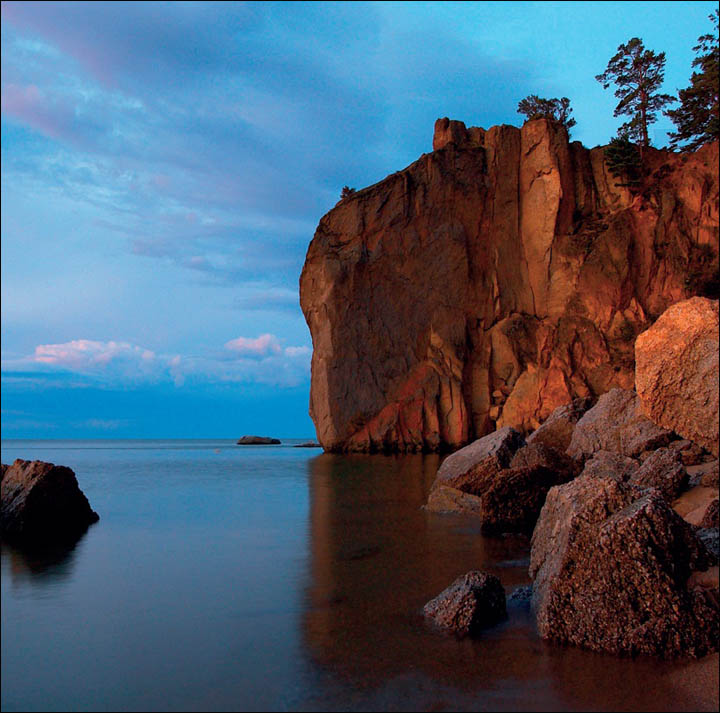
Lake Baikal, the deepest and oldest anywhere in the world. Picture: Oleg Shubarov
They come to this popular tourist area on Lake Baikal in Listvyanka, Russia, in droves. And they see business opportunities. And like the natural entrepreneurs that they are, and with the aggressive drive that is so typical of Chinese seeing a business opportunity wherever they are, they begin to build and the locals are incensed and aggrieved. They build with a heavy hand, taking much for granted; that they can dispense with permits, that they can thrive without paying taxes.
Formerly a resident of St. Petersburg, 57-year-old Andrei Sukhanov had retreated to Siberia, opting for a bucolic lifestyle decades ago, and he chose to live beside the world's largest, deepest body of fresh water, the world-famed Siberian lake, in an impoverished community of 2,122 residents. He owns and operates a small, rustic motel to serve the hospitality needs of Russians who visit the region.
He was rather upset when a new Chinese-owned hotel built next door to his establishment erected a large sign certain to obstruct the view of Lake Baikal from his motel. The expanding presence of Chinese around Lake Baikal is hugely resented by the locals. Petitions, protests and court cases hoping to block the Chinese from the lake and nearby areas have proliferated.
Baikal is the world’s largest freshwater lake by volume
When Vladimir Putin annexed Crimea from Ukraine in the ongoing conflict between the Russian Federation and one of its former satellites during the era of the USSR, relations with the West soured for Moscow and resulting sanctions bit deeply into the country's economy. In his search for a new partner, a trade, diplomatic and military cooperative venture seemed more than appropriate with China.
Just not in the resort town of Listvyanka. A wave of tourists from China and accompanying businesses has raised an atmosphere of loathing and suspicion. Fears of a Chinese land grab and pollution has fixed local attention on this vexatious problem even while local authorities view the visitors as possibly bringing jobs and economic development with them. The area saw over 1.6 million tourists visit last year, mostly Russian.
But the Chinese represented the largest foreign group, with 186,200 visitors, a leap of 37 percent from the year before. While a flight from the Lake Baikal area is six hours to Moscow, it is a mere two-hour flight from Beijing. And Russia's greater Siberia area is sparsely populated whereas China's burgeoning population has Beijing casting its covetous eye on territory that could absorb Chinese settlers ... 500 million Chinese live near the Siberian border, and possession after is nine-tenths of the law ... given time and migration.
Chinese tourists at Lake Baikal. Chinese business interests have financed hotels and guest houses around the Siberian lake.Credit Emile Ducke for The New York Times
Siberia might not be viewed as the ideal setting for some, but those who love pine forests and mountain peaks, and a huge, deep, beautiful lake, extraordinary both in summer and winter, the draw is obvious. It's just that Listvyanka does not have the type of infrastructure that can sustain a larger population where sewage and trash collection are inadequate.
The owners of ten hotels constructed with Chinese financing have been taken to court, accused of building illegally on plots designated for single-family homes. Two hotels were ordered demolished and eight more may also receive the same orders. Construction of a bottling plant for exportation of water to China from a village near Listvyanka caused 1.1 million Russian signatures on an online petition to denounce the plan.
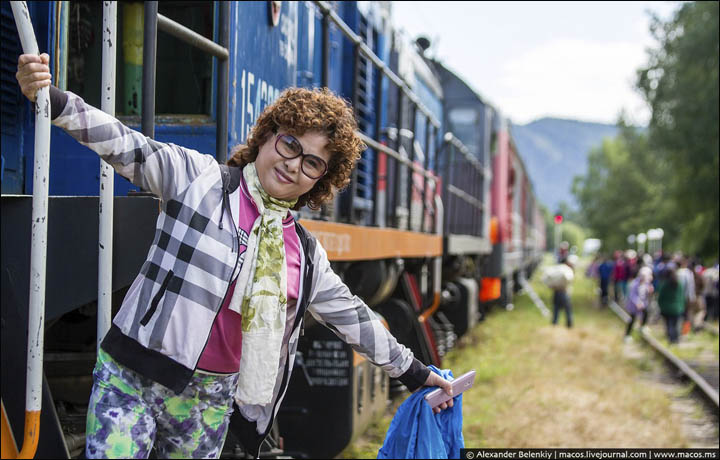
Chinese tourist on the Circum-Baikal Railway. Picture: Alexander Belenkiy/macos.livejournal.com
Environmental concerns were cited when a district court in Irkutsk looked into halting the construction of the plant. And to top everything off, no business taxes are paid by the Chinese. The mayor of Listvyanka, Aleksandr A. Shamsudinov has been accused of exceeding his authority in issuing housing permits for single-family plots many of which have grown into illegal guesthouses for Chinese tourists as three-story, 14-bedroom buildings with balconies.
There is no central water or sewage system in the town. Side roads are unpaved, a kindergarten lacks indoor plumbing, pollutants seep into the lake causing algae blooms as a result of litter piling up. On the town's main Karl Marx Street, a sign in Chinese promises gifts for anyone spending over $1,200. In China a hit pop song, "On the Shore of Lake Baikal" inspires newlyweds to visit the area. "Things are not calm in Listvyanka. There is all this nationalistic tension", commented Chinese-born businessman, Alexei Dzhao, 37, a Russian citizen who built two houses above Listvyanka. His Baikal Seal Guest House, meant to be a private home, saw the building permit revoked and he awaits a demolition order. He plans to move to Moscow.
Russian President Vladimir Putin visits a shrine to the victims in Kemerovo built up since Sunday's fire. (Alexei Druzhinin/Kremlin via Reuters)
"I started to crawl but I realized I had no strength. I had inhaled so much smoke that I was on the verge of fainting." "My daughter was ringing and ringing me. I could only shout down the phone that she should try and get out of the cinema but I couldn't do anything -- there were flames in front of me." "They [emergency services] took three minutes, three [expletive] minutes! -- to put on their masks." Alexander Lillyevyali, Kemerovo, Siberia
"The whole system of fire safety oversight has become a huge trough of corruption." Alexei Navalny, Russian opposition leader, anti-corruption activist
"I no longer have a family. The ruling regime is guilty. Every bureaucrat dreams of stealing like
Putin. Every state functionary treats people like garbage."
"[Government
investigators] will find a scapegoat, and the
issue will be done with, but the threats — incompetence, widespread
corruption, alcoholism and total degradation of society — will go
nowhere."
"We're not calling for blood. The children are dead, you can't give them back. We need justice." "They died
because they were locked in a movie theatre. They were calling from
there, asking for help: 'We're locked in, we're suffocating.' No one
helped because when the blaze broke out, everyone ran away." Igor Vostrikov lost his wife, sister and three
daughters, aged two, five and seven, in the fire
Igor
Vostrikov, centre, who lost his three daughters, wife and sister in the
fire, speaks into a microphone in a crowd gathered to pay respects for
the victims of the fire in a multi-storey shopping centre in the
Siberian city of Kemerovo. (Sergei Gavrilenko/Associated Press)
"Even if the official death toll reflects reality, at the end of the day
people know how the government lied in Beslan, Nord-Ost, Kursk and many
other places."
"So they have themselves to blame for the spiraling level
of distrust."
Twitter post, Kaloy Akhilgov, lawyer,
former government official
Utter devastation. Schoolchildren, 41 enumerated out of a total of 58 dead. The count is not complete, not yet. There are too many people listed as missing. It will take time before a realistic accounting of how many people died in the multi-storey shopping centre in Kemerovo, Siberia. School was out for Easter, and a class of 11-year-olds with their teacher went to the mall for some sports activity. Other children were in a movie theatre, like Olga Lillyevyali's three girls.
"Our children burned while we just watched", cried the stricken mother, forced to stand outside the shopping centre while the fire was razing the building, her children and her husband within. Her husband had taken their twin daughters, age 11, along with their five-year-old sister, to see the children's film Sherlock Gnomes in the afternoon. He stayed in the mall, waiting to hear from his daughters when the film was over and they would all drive home together. Never again.
The telephone call he was awaiting came much too early when one of the girls called him to inform her father that they were trapped behind a locked door with a spreading fire. And he raced up to the level they were on. The locked doors his children were faced with were pro forma where in Russia, doors to cinemas remain locked during the screening to ensure that people could not enter without buying a ticket.
From later media reports it seems that the initial blaze occurred on the fourth floor, conceivably at a trampolining centre, where it rapidly spread, with huge clouds of suffocating black smoke emitted. According to eyewitnesses, building staff did nothing to arrange for evacuation from the burning building, a conversion of a former confectionery factory, completed in 2013. After this tragedy, the office of the Prosecutor General has ordered shopping malls across Russia checked for fire safety features.
One 11-year-old boy leaped from a third-floor window to escape the fire and the smothering smoke. He is now an orphan. Both parents and a sibling died in the fire, his life completely transformed. What began as a family expedition anticipating fun and entertainment, enjoyment in being together, lively encounters and exposure to others having a good time as well, transmogrified into a ghoulish scenario straight out of a lunatic hellscene.
On a trip celebrating the end of the school term, eight children between 11 and 12 from a local village of Treschevsky died in the hellish blaze. One of the girls of the group, 12-year-old Viktoriya Pochankina, called her aunt asking her to tell her mother she loved her. What a tortured memory for the survivors, an anguishing glimpse at the end of all that matters.
Tatyana Darsaliya, 36-year-old schoolteacher, took her daughter to safety, left her then to return to the building as it burned, in an effort to save other children. Her mother, wrote Eleonora, "died like a hero".
President Vladimir V. Putin of Russia, third
from right, visited a hospital in Kemerovo where people injured in the
fire were receiving treatment on Tuesday.Credit
Alexei Druzhinin/Agence France-Presse — Getty Images
This represents a general opinion site for its author. It also offers a space for the author to record her experiences and perceptions,both personal and public. This is rendered obvious by the content contained in the blog, but the space is here inviting me to write. And so I do.