Greece's Migrant State of Emergency
"Some people do not respect the country that is hosting them, and they
strive to prove they are not looking for a passport to a better life."
"They will not leave [the island] because of the fire."
Greek government spokesman Stelios Petsas
"Under the stars, I'm going to sleep under the stars like all these
people here."
"[I've] nowhere to go since everything burned so
we slept outside and we'll continue here."
Leonie Raymon, refugee from Cameroon
"In the past few days we've been living through unprecedented
situations with daily fires."
"We've reached our limits. We're anxious, we feel insecure, we're fed up, we don't know how to act anymore."
Moria's municipal community leader Yiannis
Mastroyannis
"There is a terrible reality with these fires. Many children, women, men
are in these camps in absolutely terrible conditions. We want to show
solidarity with Greece that lives up to European values."
French President Emmanuel Macron
"I recognize the difficult conditions. However, nothing can become an
alibi for violent reactions to health checks. And, much more, for riots
of this magnitude."
"The situation in Moria cannot
continue because it is a matter of public health, humanity and national
security at the same time."
Greek Prime Minister Kyriakos Mitsotakis
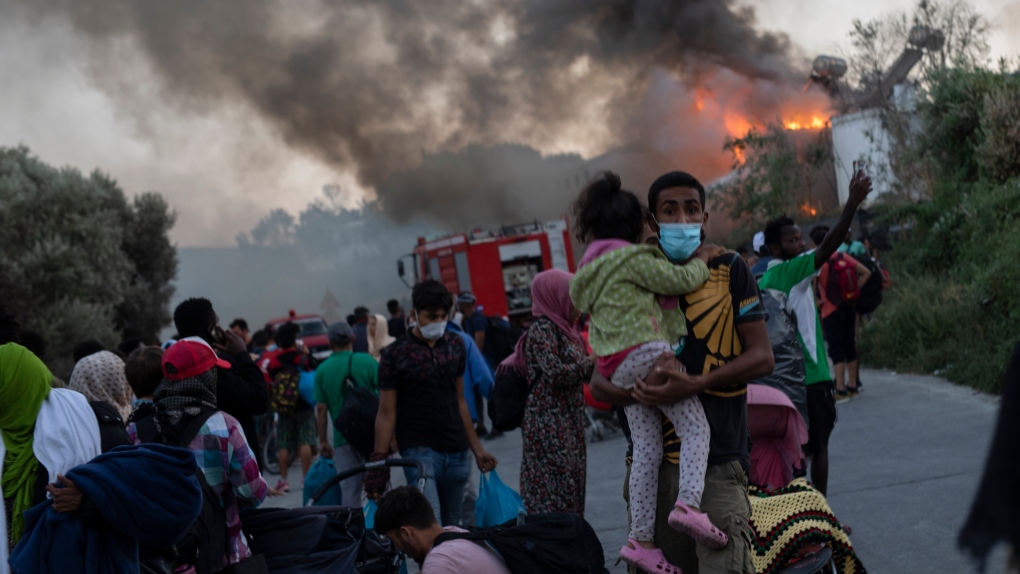 |
| Migrants flee from the Moria refugee camp during second a fire, on the
northeastern Aegean island of Lesbos, Greece, on Wednesday, Sept. 9,
2020. (AP Photo/Petros Giannakouris) |
During
a huge migration wave that swamped Europe in 2015-16, with migrants
from the Middle East, Africa and Asia who left the nearby Turkish coast
with the intention of entering Europe by way of Greece and Italy, the
camp at Moria on the Greek Island of Lesbos was set up to accommodate
several thousand people. It ended up with many more than it was intended
to service, becoming a sprawling squalid camp, condemned by human
rights groups. For those who flooded into Greece, the intention was to
move on to wealthier European countries.

Some,
like Germany, the destination of many of the migrants who knew of
German Chancellor Angela Merkel's willing absorption of a million
migrants was their target, but the state, under growing pressure from
alarmed German citizens along with violent incidents emanating from a
proportion of the migrants, reversed its earlier stance. Countries of
the European Union mandated to accept a share of the migrants to relieve
the burden on Italy and Greece, finally felt they had reached the
limits of their absorption capacity and balked at accepting additional
migrants.
Now,
in the wake of a massive fire in the largest migrant camp for asylum
seekers in Europe, 12,500 migrants formerly placed under coronavirus
quarantine are without shelter. Authorities were faced with a
humanitarian crisis that eclipsed the one that existed prior to the
fire. At the same time Greek investigators are trying to figure out
whether a connection existed between the conflagration and anger on the
part of the migrants over an erupting camp outbreak of coronavirus.
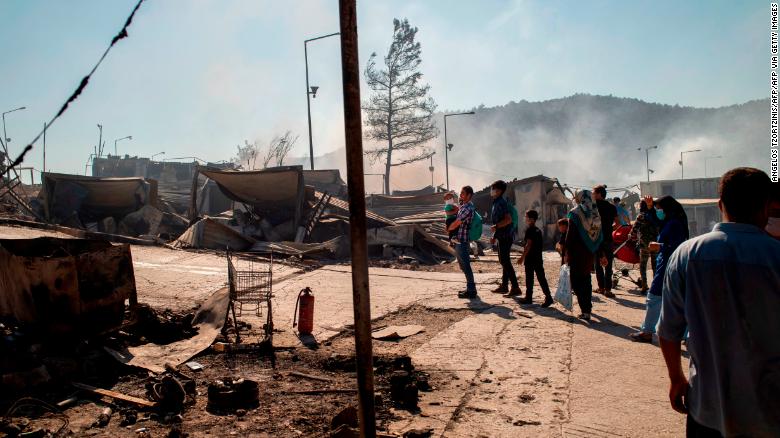 |
| Smoke rises at the burnt camp of Moria on the island of Lesbos on Wednesday the morning after a major fire broke out. |
According
to three eyewitnesses the fire began as a protest against mandatory new
quarantine measures. The blaze broke out after migrants who tested
positive for the virus or were exposed, refused to go into isolation,
according to a semi-official Greek news agency. Arson is being
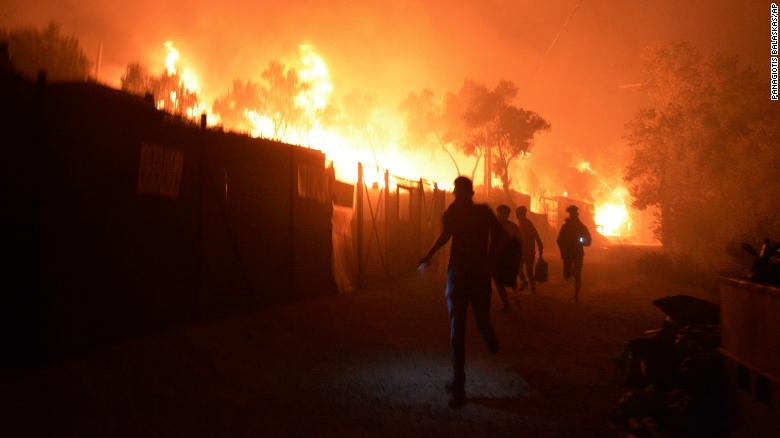
investigated as a possible cause of the blaze. Overnight, people fled
the camp, as tents and shipping containers became engulfed in flames.
There were no injuries or deaths reported. But police surrounded the
camp attempting to ensure that the migrants remained within the vicinity
of the camp.
Moria
had been a site where protests, fatal fires and chronic sickness took
place, filled well beyond capacity, cited by international aid groups as
being unsafe and inhumane. It remained in operation not because Greece
wanted to continue hosting the migrants, but because there was simply
nowhere else for them to go. They kept arriving because the previous
waves had succeeded in distributing themselves around Europe. And more
latterly, Turkey used them as a threat to coerce Europe to fund its own
refugee camps.
"Events
in Moria last night are unthinkable but, tragically, predictable as the
dire situation on the islands has gone on for far too long",
the Greece country director for the International Rescue Committee --
Dimitra Kalogeropoulou noted of the residents that had fled from the
fire, but are "now left with nothing".
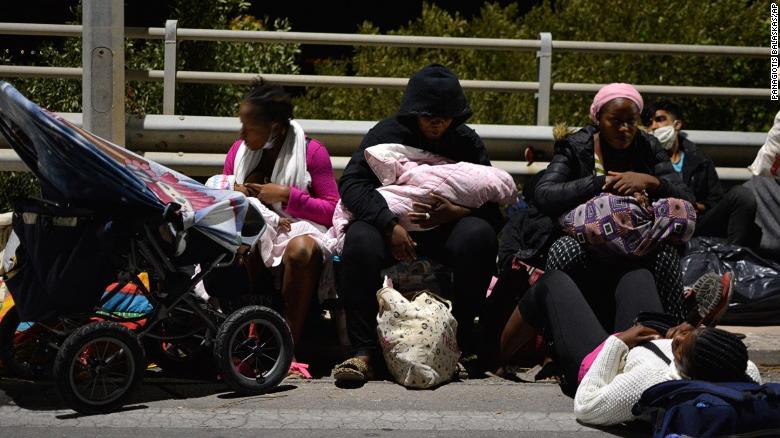 |
| Refugees and migrants with their children gather on a bridge on Wednesday after the fire at the camp. |
Last
week officials visiting the camp had identified the first three
positive cornavirus case and a testing campaign that followed detected
another 35 positive cases, leading to the camp being placed under
lockdown. The new Greek government devised a blueprint to close Moria
and other island centres to create more permanent structures, in the
face of local resistance where the new permanent structures might be
placed.
Some
asylum seekers have been gradually transferred to the mainland. Other
European Union countries have agreed to accept some of the most
vulnerable among the migrants, unaccompanied minors in particular, to
rescue them from a camp that ended up holding ten times the number of
people it was originally designed to house.
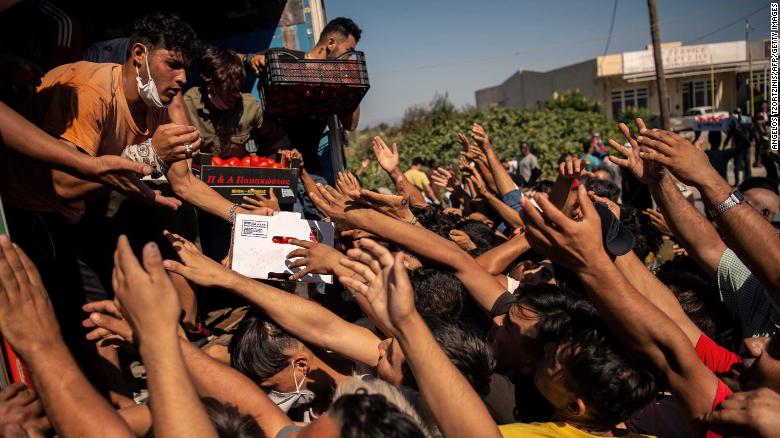 |
| People grasp for food on Thursday, September 10 after fires destroyed the Moria migrant camp on the Greek island of Lesbos |
Labels: Fire, Greece, Humanitarian Crisis, Lesbos, Migrant Camps
Notre Dame Cathedral
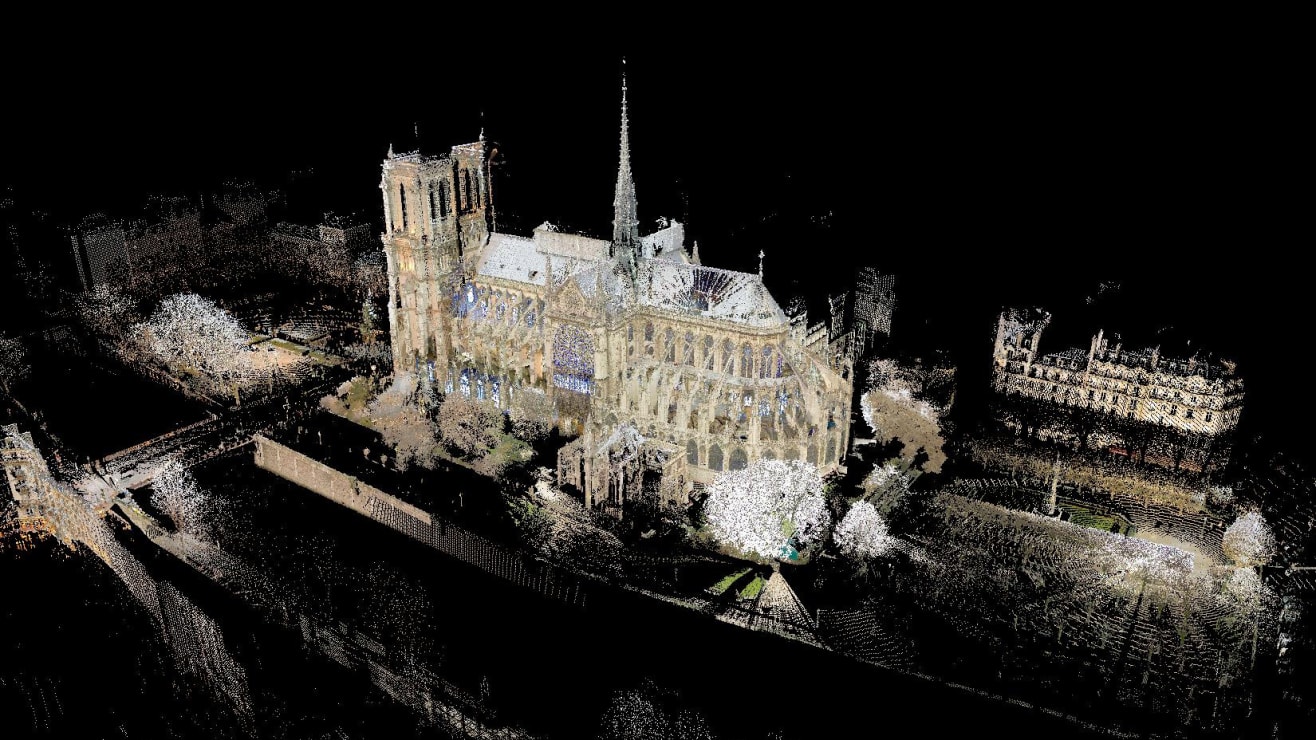
"A lot of features of this church, while not unique, were new at the time. Stained glass was new, flying buttresses were new, Gothic architecture itself was new."
"This was a site of innovation."
Samantha Herrick, medieval historian, France
"Clearly, they were damaged, but to what degree we don't yet know."
"Even if the fire didn't come all the way down into the cathedral itself, the heat itself was very intense. And the heat will have impacted the glass, as well as the material that keeps the glass panels together."
Karine Bonuanger, stained glass specialist, Sorbonne University, Paris
"If Notre Dame is a symbol of France, of its history, of its art, it is also the property of the state."
"In that sense, if we can only rejoice in the generosity of great donors, we could only be proud that the State undertakes to finance this restoration fully, in these troubled times."
Olivier Gabet, Musee des Arts decoratifs, Paris
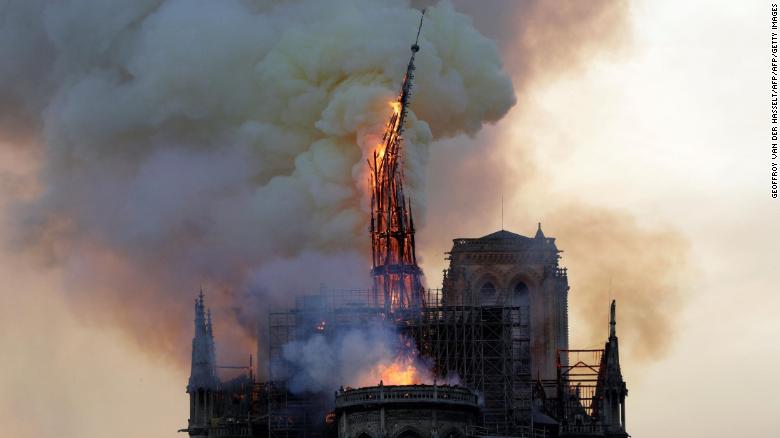
Who might have foreseen that an ancient Cathedral, one whose construction in the Medieval era between the Romanesque and the Gothic style of architecture and which took fully two centuries of painstaking design and construction to complete, might have been imperilled when a modern-day effort at remediation with the use of modern tools setting off sparks might end up causing the ancient structure to catch fire, burning swiftly through the original forest of oak holding up the lead-topped roof.
Disbelief struck everyone who either witnessed the conflagration in person or viewed what was happening through social media sites, that this could surely not really be happening. A swift check of unimpeachable news sites following an iteration of lesser-known media sites proliferated on Twitter ascertained the credibility of the news. Notre Dame Cathedral, 850 years old, a venerated edifice dedicated to the worship of the Christian faith, was sending great gushing torrents of flame into the night sky.

Within the incredibly short space of 40 minutes since the alarm went out, the trusses of the roof collapsed and the marvellously-constructed spire stretching its imposing height to the sky as though appealing to god to meet it halfway, lurched sideways and tumbled, humbling the noble structure and raising fears in onlookers that the entire Gothic marvel would be lost forever. Its brilliant stained glass windows, its panelled interior, its carvings and paintings, legendary for their beauty and pious execution; lost heirlooms.
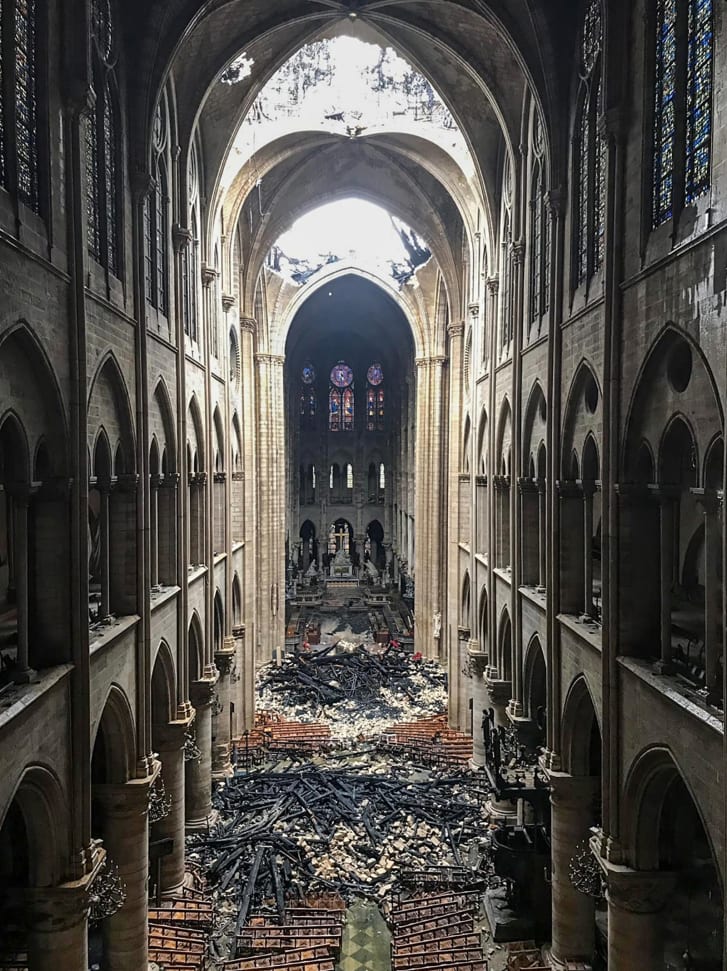 |
| The charred interior of the Notre Dame Cathedral after Monday's devastating fire. Credit: AFP/Getty Images |
As the flames fiercely licked both overhead and down into the cathedral's interior, firefighters rushed in, prepared to rescue and carry to safety whatever they could of the cathedral's treasures. The artwork, the liturgical items, the priceless religious relics placed everywhere throughout the alcoves and warrens of the cathedral as people outside held their collective breaths in disbelief, singing softly and praying fervently.
"We made a human chain, with our friends from the church ... to get, as quickly as possible, to get all the relics", the deputy mayor for tourism of Paris, Jean-Francois Martin, said. Among them the fire fighters' chaplain, Paris officials, church caretakers. The Crown of Thorns believed worn by Christ before the crucifixion, and a tunic worn once by Saint Louis in the 13th Century even as Notrre Dame was being built, were among the rescued treasures.
 |
| A
Paris official said the main risk to the cathedral is the gables above
the rose windows, which provide crucial support to the stained glass
masterpieces. (Patrick Kovarik/AFP/Getty Images) |
Paintings, suffering from smoke damage were carried out and taken for restoration to the Louvre Museum. The raging inferno that investigators will determine whether its source was the restoration work on the cathedral's roof, was stopped by the 400 firefighters deployed in a desperate bid to save the Cathedral, before total destruction occurred; another fifteen, twenty, 30 minutes might have spelled the utter end of its renowned presence altogether.
"Nothing indicates a deliberate act", Remy Heitz, the Paris prosecutor announced.
In England, London's Westminster Abbey rang to mark 24 hours since the fire at the cathedral had broken out. Fragments of the remains of Saint Genevieve and Saint Denis, portions installed in 1935 in the 19th Century spire were irretrievably lost. The stained glass masterpieces will have to be assessed for damage and then a restoration process embarked upon, along with the rest of the Cathedral which is slated for complete reconstruction; the landmark icon of transcendent architecture will live again.
 |
| Notre-Dame will be closed for up to six years following a devastating fire, the cathedral's rector announced Wednesday. (Stephanie Jenzer/CBC) |
Labels: Fire, Notre Dame Cathedral, Paris, Restoration, Treasures
Celebrating Easter to the End
Russian President Vladimir Putin visits a shrine to the victims in Kemerovo built up since Sunday's fire. (Alexei Druzhinin/Kremlin via Reuters)
"I started to crawl but I realized I had no strength. I had inhaled so much smoke that I was on the verge of fainting."
"My daughter was ringing and ringing me. I could only shout down the phone that she should try and get out of the cinema but I couldn't do anything -- there were flames in front of me."
"They [emergency services] took three minutes, three [expletive] minutes! -- to put on their masks."
Alexander Lillyevyali, Kemerovo, Siberia
"The whole system of fire safety oversight has become a huge trough of corruption."
Alexei Navalny, Russian opposition leader, anti-corruption activist
"I no longer have a family. The ruling regime is guilty. Every bureaucrat dreams of stealing like
Putin. Every state functionary treats people like garbage."
"[Government
investigators] will find a scapegoat, and the
issue will be done with, but the threats — incompetence, widespread
corruption, alcoholism and total degradation of society — will go
nowhere."
"We're not calling for blood. The children are dead, you can't give them back. We need justice."
"They died
because they were locked in a movie theatre. They were calling from
there, asking for help: 'We're locked in, we're suffocating.' No one
helped because when the blaze broke out, everyone ran away."
Igor Vostrikov lost his wife, sister and three
daughters, aged two, five and seven, in the fire
 |
| Igor
Vostrikov, centre, who lost his three daughters, wife and sister in the
fire, speaks into a microphone in a crowd gathered to pay respects for
the victims of the fire in a multi-storey shopping centre in the
Siberian city of Kemerovo. (Sergei Gavrilenko/Associated Press) |
"Even if the official death toll reflects reality, at the end of the day
people know how the government lied in Beslan, Nord-Ost, Kursk and many
other places."
"So they have themselves to blame for the spiraling level
of distrust."
Twitter post, Kaloy Akhilgov, lawyer,
former government official
Utter devastation. Schoolchildren, 41 enumerated out of a total of 58 dead. The count is not complete, not yet. There are too many people listed as missing. It will take time before a realistic accounting of how many people died in the multi-storey shopping centre in Kemerovo, Siberia. School was out for Easter, and a class of 11-year-olds with their teacher went to the mall for some sports activity. Other children were in a movie theatre, like Olga Lillyevyali's three girls.
"Our children burned while we just watched", cried the stricken mother, forced to stand outside the shopping centre while the fire was razing the building, her children and her husband within. Her husband had taken their twin daughters, age 11, along with their five-year-old sister, to see the children's film Sherlock Gnomes in the afternoon. He stayed in the mall, waiting to hear from his daughters when the film was over and they would all drive home together. Never again.
The telephone call he was awaiting came much too early when one of the girls called him to inform her father that they were trapped behind a locked door with a spreading fire. And he raced up to the level they were on. The locked doors his children were faced with were pro forma where in Russia, doors to cinemas remain locked during the screening to ensure that people could not enter without buying a ticket.
From later media reports it seems that the initial blaze occurred on the fourth floor, conceivably at a trampolining centre, where it rapidly spread, with huge clouds of suffocating black smoke emitted. According to eyewitnesses, building staff did nothing to arrange for evacuation from the burning building, a conversion of a former confectionery factory, completed in 2013. After this tragedy, the office of the Prosecutor General has ordered shopping malls across Russia checked for fire safety features.
One 11-year-old boy leaped from a third-floor window to escape the fire and the smothering smoke. He is now an orphan. Both parents and a sibling died in the fire, his life completely transformed. What began as a family expedition anticipating fun and entertainment, enjoyment in being together, lively encounters and exposure to others having a good time as well, transmogrified into a ghoulish scenario straight out of a lunatic hellscene.
On a trip celebrating the end of the school term, eight children between 11 and 12 from a local village of Treschevsky died in the hellish blaze. One of the girls of the group, 12-year-old Viktoriya Pochankina, called her aunt asking her to tell her mother she loved her. What a tortured memory for the survivors, an anguishing glimpse at the end of all that matters.
Tatyana Darsaliya, 36-year-old schoolteacher, took her daughter to safety, left her then to return to the building as it burned, in an effort to save other children. Her mother, wrote Eleonora, "died like a hero".
 |
| President Vladimir V. Putin of Russia, third
from right, visited a hospital in Kemerovo where people injured in the
fire were receiving treatment on Tuesday.
Credit
Alexei Druzhinin/Agence France-Presse — Getty Images |
Labels: Children, Fire, Siberia, Tragedy


