Monday, December 06, 2021

Transitioning? Not So Fast!

Transitioning? Not So Fast!

photo of transgender

"For years and years, people have been homophobic, transphobic."
"We're now trying to correct that, but by doing that we're putting others at risk. And those others we're putting at risk are children."
Mary, Toronto,  (last name withheld)

"No one makes these decisions lightly. They are made very slowly, very cautiously, after long discussions with these youth and their parents."
"It would be incredibly worrisome [to create additional delays in treatment]. It would harm so many kids. I would hate to think what would happen to them."
Dr.Margaret Lawson, medical director, gender-diversity clinic, Children's Hospital of Eastern Ontario

"In trans health care, patients diagnose themselves and prescribe their own treatment."
"Medical professionals are encouraged to accept a person's belief without question under the assumption that it will never change."
Michalle Zacchigna (first to be treated under the new transition model, and living with regrets)
Maciek Jasik
 
"Alarms are being sounded all over the world [against the trend to proceed in undue haste to effect transgender changes in young people]. And Canada seems completely deaf to it", stated Aaron Kimberley a transgender man living in British Columbia. He is also a registered nurse and is experiencing qualms over the current approach in Canada among medical professionals and parents to proceed with alacrity and insufficient caution to usher children into the process of gender transition; gender dysphoria is declared, minors are treated with hormones, and surgery follows soon afterward.

A government move is underway in the House of Commons, supported by all political parties, to make it illegal to subject children or adults to any form of conversion therapy. A practise that has been said to be discredited, with its goal of focusing on changing someone's sexual orientation or gender identity. The bill has passed in the House and is prepared to move to the Senate for assent before it becomes law. The bill is a reflection of the current zeitgeist, the sacred belief that children expressing discomfort in their birth gender assignment must be encouraged to transition to a more 'comfortable-fitting' gender.

Mary's daughter insisted she had to alter her sexual identity, suddenly announcing at age 16 that she was a transgender boy. The young girl had long suffered depression and uncertainty along with a deep sense of anxiety. A doctor wrote a prescription for testosterone following a few 15-minute appointments and within months the teen had a double mastectomy, to become a trans male. Her mother recalls that as her daughter was  being wheeled into the operating room for the mastectomy she expressed self-doubts about her decision.

She is now 21 and in the process of "detransitioning", a reversion to her original female identity. Her mother, Mary, has become a partner in a movement asking that the health care system now geared to affirmation of a young person's transgender feelings with drugs and surgery slow down, and seriously consider assessments of other psychological issues before declaring the young to be fully capable of making such a life-altering decision.

Outside of Canada which has embraced full transitioning for young people with scarcely enough medical and psychological examinations of their expressed feelings and emotions over the issue -- which has seen a tidal wave of children demanding they be assisted in their determination to leave the gender they were assigned at birth based on their physical characteristics, when they claim their minds and emotions are lodged in the other gender -- a reversal of social attitude is taking place.

Countries as diverse as Finland and Australia have taken steps to back up from the affirmative approach. At the same time, some leading figures in the transgender medical world have themselves begun to urge caution. A provincial bill in Ontario's legislature is set to speed up access to medical transition and to reduce the need for medical practitioners to make referrals for treatment. At both the provincial and federal level, the way is being paved for children to confuse their identities and face an uncertain future.

While there may well be a good number of legitimate instances of a psychological need to transition, the entire process has taken on a popular social-activist stance, with young children wanting to be part of the new trend. Parents and detransitioners indicate their support for improving access to medical transitions for those who really require it to be done, and feel transphobic bigotry has no place in society. While not opposing gender neutral bathrooms or public funding for transition treatment, they argue the pendulum has swung uncontrollably, and not to society's or the most vulnerables' advantage.

In some instances, gender treatment  occurs outside hospitals. The questioning newly arisen of the status quo has arrived in parallel with a boom in demand driven by patient demographics; both looking suspiciously like red flags that something is badly amiss. People presenting with gender dysphoria were predominately young boys or middle-aged men, traditionally. Now, gender-identity clinics are coming face-to-face with mostly teenagers born girls. 

Pediatric patients numbers at ten hospital clinics across Canada leaped from close to none in 2004 to over 1,000 by 2016. Some 80 percent represented natal girls, most under age 16, when first arriving at the clinics. In the U.S., a major college health study found the percentage of students identifying as transgender or gender non-conforming rose from .05 percent between 2008 and 2014 to three to four percent more recently. 
 
An American study of parents skeptical about gender treatment in 2018 hypothesized that there was a new "rapid-onset gender dysphoria" phenomenon among young girls sometimes convinced by online influencers and through social contagion. According to gender-medical professionals the explosion is a reflection of a growing acceptance of transgenderism following years of stigma and isolation, and the true number of youth in need may in fact be much higher.

The complaint from critics is that health care practitioners are too ready to place children on "puberty-blockers"; drugs to "pause" the development of puberty, and then cross-sex hormones, followed frequently by reassignment surgery. The emphasis, they feel, should lie in an exploration of the complex mental health issues of young people presenting as trans. "We feel the health-care system has been completely taken over by a political agenda at the expense of the actual evidence", said a representative of the group Gender Dysphoria Alliance.

Dr.Marci Bowers, a trans woman, a widely respected gender-reassignment surgeon herself, preparing to become president of the World Professional Association for Transgender Health (WPATH), is among top figures in the field who have expressed concerns. Concerns which led to change in recent months in some countries. Where Finland last year encouraged psychotherapy before transition treatment, and the Australia-New Zealand psychiatry regulator claimed it to be essential. In Sweden, clinics stopped prescribing puberty blocking drugs and cross-sex hormones to patients under 18 this year.

Dr.Bowers, the gender reassignment surgeon, suggested that children are sometimes placed on puberty blockers too soon, with complications arising in reassignment surgery which can deprive them potentially of sexual satisfaction for their lifetimes. Transgender women Erica Anderson and Laura Edwards-Leeper, senior officers with WPATH as psychologists, spoke of sloppy and dangerous assessment of young people presenting as transgender, the results of overly hasty prescribing of medical interventions.

W5 The Transition


Labels: , , , ,

Sunday, July 26, 2020

Stunning Justice Miscarriage

"Standing here, before all of you, I honestly thought I would be addressing you following a very different verdict."
"I am, for the second time in the space of one year, utterly shocked and appalled."
Lissie Harper, outside Old Bailey, London England
PC Andrew Harper and his wife
PC Harper got married to his fiancée Lissie just four weeks before he was killed   PA Media

Death delivered to a British police officer engaged in the line of duty, protecting the public from the human scum that also lives and works within that same society, people who prey on others, proudly perform criminal acts, defy law and order, and make life and limb unsafe for others in their pursuit of a life based on the avails of crime. Lissie Harper, wife of British Constable Andrew Harper, hoping for due justice on behalf of her husband whose "barbaric" murder shocked the country was left instead once again "shocked and appalled".

She sat in court during the trial of three teens accused of first-degree murder of her husband, at the Old Bailey. All the while the three who murdered her husband smirked, laughed, dozed off and obviously were not the least bit concerned while the trial was presented with evidence against them. One juror was removed when she was seen to be continually smiling at the three killers throughout the judge's charge to the jury.

Andrew Harper
Andrew Harper, 28, died of multiple injuries  August 2019. Photograph: PA


And when the jury returned to deliver their verdict it was not the expected conviction of murder but that of the lesser charge of manslaughter. According to a former policing minister, the jury choice was sufficiently off-kilter given the situation and the evidence, to convince him to refer the trial to the Attorney General, concerned that the jury may have been tampered with; some among them under duress of threats.

Henry Long, 19, Albert Bowers and Jessie Cole, 18, reacted after the jury delivered its verdict by hugging, laughing and displaying all the mannerisms of people completely divorced from the realities of crime and punishment.  A gang had been seen stealing a quad bike and Constable Harper responded, becoming entangled in the tow rope attached to the car driven by Henry Long. Enabling the three to conclude their exciting criminal escapade by dragging him for over a mile to his death.

Albert Bowers smiles as he arrives at court
Albert Bowers smiles arriving at court Hyde News & Pictures Ltd

"With his ankles caught in a strap that was trailing behind a car being driven at speed along a country lane, he was dragged for over a mile along the road surface, swung from side to side like a pendulum in an effort to dislodge him, losing items of his police uniform along the way, with the rest of his uniform being quite literally ripped and stripped from his body."
"When, at last, he became disentangled, he was left with the most awful injuries, from which he died there on the road, surrounded by colleagues who tried in vain to save him."
'[The jury heard that he died naked apart from his socks and boots and some shredded remnants of the trousers he was wearing]. This was a completely senseless killing of a young police officer in the line of duty."
"As [Henry] Long floored the car to make good their escape, PC Harper was lassoed around his ankles by the loop of his strap. It is the prosecution case that Long drove that car knowing full well that PC Harper was entangled in the strap, as he drove in a manner calculated to dislodge him, and to make good their escape, as had been the plan all along."
Brian Altman QC, prosecuting attorney


Albert Bowers (left) and Jessie Cole (centre) leaving Reading Magistrates' Court on September 19, 2019

Labels: , , , , ,

Monday, August 20, 2018

Youthful Rebellion and Passe Nicotine

"I've heard lots of stories from kids who've used Juul in front of teachers, and they think it's so funny that their antiquated teacher doesn't realize that it's, in fact, an addictive drug that they're using."
Benjamin Toll, chief, tobacco cessation and health behaviours, Hollings Cancer Center, Medical University of South Carolina
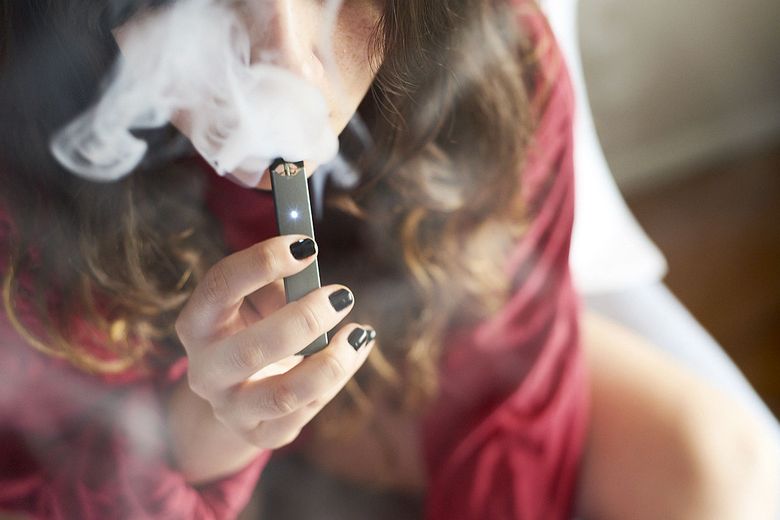
Juul e-cigarettes look like USB drives and emit no odor. (Gabby Jones / Bloomberg)

"All of our smoking actual tobacco has gone way, way down. [Kids are] very much aware of the risks and consequences of smoking [they just don't believe what they're doing is smoking]."
Brian Maslowski, instructor of alcohol, drug and tobacco seminars. Fairfax County [Virginia] Public Schools

"[Juul is anything but new and different], it represents the cultural norms and notions of the cigarette, which was very much youth-oriented."
"It was kind of forbidden; it was extremely cool."
"If you tell a youthful generation, ‘This is really for adults,’ that makes it incredibly appealing."
"I think the history of this tells me, don’t trust these industries. Juul can say, ‘We’re not interested in kids; we’re going to fight the use of this in kids'."
"’But with flavors like mango, and cool cucumber' ... "
Allan Brandt, historian and author of The Cigarette Century
Boxes of Juul pods, which come in flavors such as mango, creme brulee and cucumber.
Boxes of Juul pods, which come in flavors such as mango, creme brulee and cucumber
Next up: and it's a new product that has been advertising itself directly at that huge demographic to be exploited by unscrupulous purveyors of addictive products. A Juul is a tool with enticing flavours certain to attract the attention of experiment-prone teens who want to be with the 'cool' crowd and don't care all that much about what they're doing to themselves since they happen to be impervious to harm, and it's just so much fun to play those games where you can sneak self-destructive habits under the detection of snoopy adults who exist to spoil all fun.

Forget cigarettes -- no one is interested in them any longer; even teens know that they'd be coffin-bound to begin smoking them. E-cigarettes are fine but they're, um out of favour, unstylish, no longer cool. The Juul now, that's something else; in appearance a streamlined little brick looking awfully like a harmless USB flash drive. It's neat, flickering with coloured light. Use it to discreetly puff, and look Ma! no tobacco smell. Er, don't look, Ma.

And don't look at Instagram where models boast they're smoking mango and teens post videos of themselves briefly puffing on Juuls. What an adventure! Health professionals -- what do they know anyway -- in a conspiracy to nag on kids, claim the new popularity of Juuling is simply cigarette addiction by another name. And youth are getting hooked on nicotine by public relations campaigns that are  relentless and deceiving.

The "pods" that fit into those Juuls, tiny pure nicotine, deliciously flavoured like fruit or mint -- those death-in-waiting capsules. $70 will get you a Juul and five "pods" representing the nicotine equivalent of five packs of cigarettes. Coloured lights, juicy flavours, and hello! we're partying! Sales of Juuls have increased over 700 percent from a year earlier, or so Nielsen data tells the interested.

Across the United States, schools claim to be confiscating the things from underage students. Juul Labs has had three lawsuits recently filed against them, each of which posits users as young as 14 become addicted to Juul, a product marketed as safe.

Ashley Gould, chief administrative officer of Juul Labs states that underage Juulers "was not anticipated and completely unexpected to us". The company is now committed to ridding the Internet of social media posts of young people Juuling. "No adult who has never used nicotine should ever use our product", she insists.

Labels: , , ,

Follow @rheytah Tweet