"Her
case is a genetic predisposition to hyperovulate -- releasing multiple
eggs in one cycle -- which significantly increases the chances of having
multiple births."
"I have grown up in tears, my man has passed me through a lot of suffering."
"All my time has been spent looking after my children and working to earn some money."
"I started taking on adult responsibilities at an early stage. I have not had joy, I think, since I was born."
"I
can't say they [her children] are nagging because they are my children.
I can't say I will abandon them because they are my children, and I
love them."
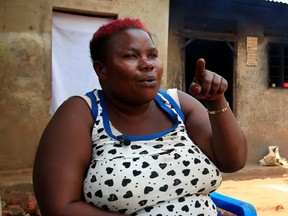
Mariam Nahatanzi
"Mum is overwhelmed; the work is crushing her."
"We help where we can, like in cooking and washing, but she still carries the whole burden for the family."
"I feel for her."
Ivan Kibuka, mid-20s, eldest child
Mariam Nabatanzi has given birth to 44 children by the age of 40.Photo by Reuters
According to the Mayo Clinic, ovarian hyperstimulation syndrome can be "life threatening". It can cause "blood clots, kidney failure, twisting of the ovary or breathing problems".
Treatment, available in wealthy first-world nations, is not available
in Uganda. Nabatanzi had an unfortunate upbringing from the very
beginning of her life, with her mother who had five boys before her,
abandoning her family when the last, the girl that would become a mother
of 44, was born.
When
she was very young, and away briefly at a relative's house, her
stepmother had conspired to kill her stepchildren by placing broken
glass in the food she served to the children. All the boys died, but
Nabatanzi, who had been away, survived. When she was 12 years of age,
she was sold into marriage. A year later she delivered twins. The
fertility rate in Uganda averages to 5.6 children per woman representing
one of Africa's highest, in comparison to the global average of 2.4
children.
Nahatanzi,
by age 40, given her rare medical condition had given birth to no fewer
than 44 babies. After the first set of twins was born she gave birth to
additional twins on three occasions. Then came five sets of triplets
and five sets of quadruplets. She gave birth on one occasion only to a
single child. Her husband absented himself for long stretches of time,
only to impregnate her again on his return. Until he finally left for
the last time taking their savings with him.
The
mother of so many children was forced to turn to her own ingenuity and
capacity for work alongside raising her brood to earn the money for
their care. She has worked at hairdressing, event decorating, collecting
and selling scrap metal, brewing local gin, and selling herbal
medicine. Every bit of money she earns is used to buy food, medical
care, clothing and to pay for her children's school fees. She cooks 25
kilograms of maize (corn) for her family daily.
She
hangs portraits of her children graduating from school on the walls of
her home with pride. Her eldest son was unable to continue secondary
school for lack of money to continue paying fees. When she reached age
23, Nabatanzi had given birth to 25 children. She had appealed to
doctors to help her stop having any more, but was advised to continue
her pregnancies resulting from her ovary count.
She had her last child three years ago at which time a doctor informed her that he had "cut my uterus from inside". "Generally,
I have tried to educate them. My dream is that my children go to
school. They can lack anything [else], but they must go to school."
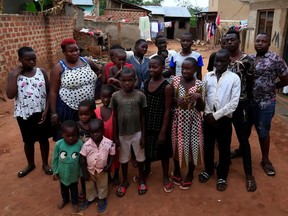
Nabatanzi (red hair) and some of her children.Photo by Reuters
"Some of us had sold our mattresses, you know. we were so ready.Now it's like, how do we even get to tomorrow?"
"So, yeah, it's sugar daddies or nothing for many of us. But even that is much harder now. How are you supposed to meet someone if bars are closed and there's a curfew? [during COVID-19 lockdown]."
"And if you met them, what if you are putting yourself at risk to get the virus? I can't bring someone home [group house for refugees] because that puts the whole house at risk."
Chris Wasswa, (Tina), 26, Ugandan refugee, Nairobi, Kenya
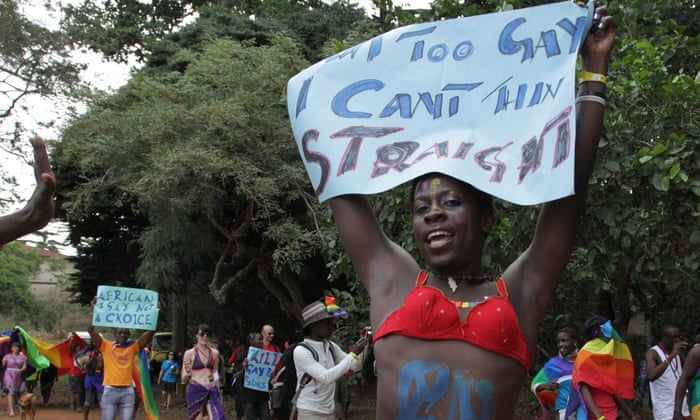
Gay and lesbian activists at Uganda’s first gay pride parade in Kampala in 2012. Photograph: Rachel Adams/EPA
He meant to be out of Kenya by now. And then the global pandemic struck, and borders closed and everything was put on hold. He had been waiting as a UN-designated refugee out of Uganda for four years, for the opportunity to be accepted elsewhere, in the West, as a refugee-victim of oppression against members of the gay and transgender community. He'd booked his airline passage: Nairobi, Frankfurt, destination Toronto.
A gay rights activist in Nairobi, Kenya. Photograph: Ben Curtis/AP
After fleeing the violent reaction and the laws against the LGBT community in his native Uganda, he discovered that his situation had improved only marginally in Kenya where there were laws against being gay or transgender, but the punishment, if applied, wasn't quite so severe. Kenya now hosts close to 500 migrants of the over 3,000 spread out across Africa and 10,000 worldwide, awaiting acceptance as refugees to a third country. All placed on indefinite hold according to the International Organization for Migration.
The IOM, an arm of the United Nations High Commissioner for Refugees, controls the travel of refugees once a country approves resettlement. The processes were suspended on March 17 when the WHO, another body of the UN, proclaimed COVID-19 a global pandemic. More months of waiting for most refugees, but for those of the gay and transgender Ugandan refugees in Kenya, it seemed intolerable, for the sexual minorities persecuted in Uganda which considered the death penalty for gay sex.
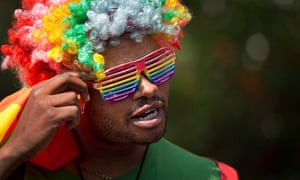
Gay man in Kampala. Photograph: Edward Echwalu/Reuters
One wonders what Mr. Wasswa and his fellow refugees hankering to arrive in Canada's most populous and largest city, Toronto, would think of the fact that the country's prime minister, Justin Trudeau, a defender of LGBTQ-2 rights and who once famously and fatuously proclaimed on Twitter that Canada would accept any and all those fleeing their countries of origin, who had, before the onset of the novel coronavirus, travelled to Uganda to lobby for a committed vote for a seat on the revolving Security Council, saying nothing whatever of human rights to Uganda's president Yoweri Museveni as he tried to ingratiate himself for a UN vote.
Living in safe houses temporarily at their disposal in Nairobi, Mr. Wasswa and others claim that Kenyans will not hire them for work, because they are refugees or because they are effeminate. And so, few of them work to support themselves. Kenya saw hundreds of thousands of South Sudanese and Somali migrants seeking asylum in Kenya, a half million registered as refugees, living in vast camps.
The UNHCR helps them to apply for resettlement to third countries. In those camps, assaults have driven the LGBT refugees to relocate from Uganada to Nairobi. If you're a refugee, and Ugandan, police in Nairobi assume you're gay, bisexual or transgender, all of which places them under Kenyan law as criminals.
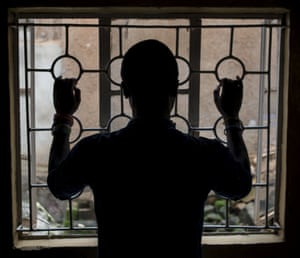
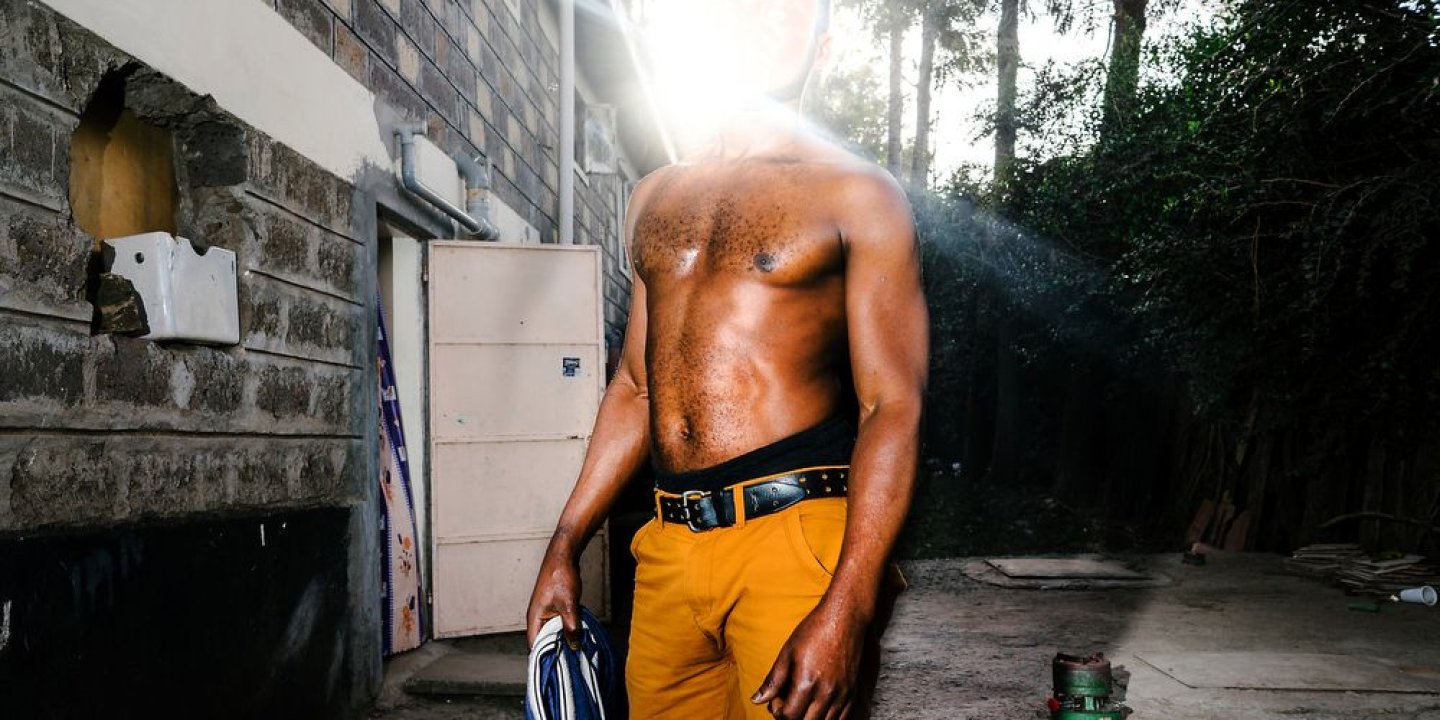
An HIV-positive, gay refugee from Uganda stands
outside the house he shared with dozens of other LGBT refugees on the
outskirts of Nairobi.Jake Naughton
"I read and understood the documents, but not the charges because they
are against the L.R.A."
"The
L.R.A. is Joseph Kony, the leader. But I am not the L.R.A." "LRA [Lord's Resistance Army] committed atrocities in northern Uganda, and I am one of the people against whom the LRA committed atrocities." "But it is not me personally who is the LRA." Dominic Ongwen, former brigadier-general, LRA
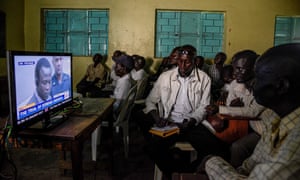
People in Lukodi, Uganda watch the screening of the ICC trial of Dominic Ongwen.
Photograph: Isaac Kasamani/AFP/Getty Images
This plea for understanding is called chutzpa. It is like a man pleading for mercy after killing his mother and his father on the basis that he is now an orphan and to be pitied and treated with grace and mercy reflecting his new parentless status. But Mr. Ongwen, who has been charged with crimes against humanity and is being tried before the International Criminal Court in The Hague, has a fairly good grasp on the sensitive sensibilities of the leading left, susceptible to compassion for the oppressed.
"This has actually polarized debate in the county, whereby there are those that think he's a victim [and] should go through the reconciliation process." "But there are also others -- especially when you get to the communities he allegedly attacked . . . who say he was vicious during the attacks, and they would like to see him face trial." Sarah Kasande Kihika, head, International Center for Transitional Justice, Uganda
"The co-operation with the Ugandan authorities is a very constructive and a very positive one." "And the co-operation that we do need in order to ensure that our judicial work will take place . . . is being provided." Herman von Hebel, registrar, International Criminal Court
A dilemma has arisen to face the International Criminal Court of late. With African countries, now including South Africa, alongside Burundi and Gambia threatening to dissolve their membership in the ICC with their claims that this international justice body targets only Africans, ignoring crimes that the West is responsible for. Of course, the fact that so many African countries engage in unspeakable atrocities committed against their own civilians or that of neighbouring countries might give one clue as to the reason why.
On the other hand, eastern Europe has had its taste of criminal justice proceedings, and the court by all accounts is preparing to get started on others; Syria, for example, Russia as another example. We should live so long. Not that it has always been successful, since African and Middle Eastern countries chose to ignore the ICC designation of Sudan's president as a refugee from justice having committed atrocities in Darfur earning the label of one who has committed crimes against humanity.
Dominic Ongwen was detained by American Special Forces in January of 2015, officials said.
Interpol
Mr. Ongwen placidly denies he is guilty of having committed any of the 70 odious war crimes he has been charged with. Let alone crimes against humanity, including murder, rape, torture and sexual slavery. Most of which were committed through violent attacks on refugees being sheltered in camps for the internally displaced while conflict raged all around them. But of course, Mr. Ongwen committed no such acts of human degradation and vile and violent abuses of human rights. It was the Lord's Resistance Army.
And he was orphaned to the LRA, torn by them from his family when he was reputed to be between the age of nine and 14. At that tender age, when most boys only fantasize they have control of deadly weaponry, he was given his own to carry and to use. The prosecutors, it seems, have seen no reason to challenge his assertion that he was forced to become an LRA member; what other choice would an abducted child, beaten, fearful and threatened have, after all, to secure his own life?
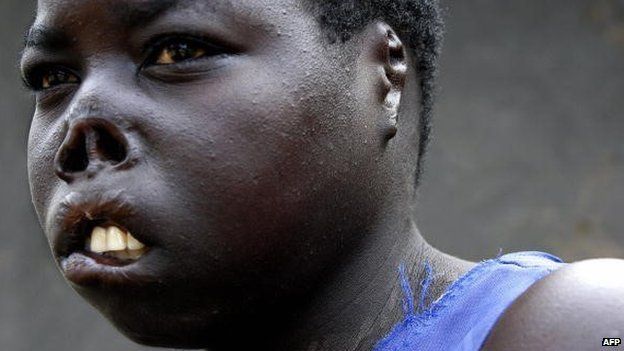
AFP The LRA is notorious for cutting off the lips, noses and ears of civilians
And he was transformed over the next 25 years, it seems, all against his will and intent, to become a conscienceless killer. And he managed to succeed to such a degree that he became notorious, feared and despised as he executed his duties, never thinking to remove himself from the carnage that deluged Uganda, then neighbouring countries. Joseph Kony's quaintly named terrorist group was responsible for killing 100,000 people while an estimated 1.7 million in Uganda were forced from their homes.
The United States had involved itself in the 2011 search for Joseph Kony and at the same time, placed a $5-million bounty on the capture of Dominic Ongwen, ample evidence of his wide-ranging criminal actions preceding his well-earned reputation as a vile and violent crusader against decency and human rights. He was eventually taken by rebels in the Central Africa Republic and passed to American Forces in 2015, a "brigadier-general" in the LRA.
"Infections are going back up again, and we need to get back to the drawing board as young people and see what relevant techniques we could use if we are going to a school outreach." "That's the reason why we are working with [reformed thief, onetime drug peddler] Hood Katende. If you don't integrate music, if you don't integrate drama into the message you are trying to carry out forward, some people may not realize how grave the situation is." Lawrence Mukiibi, youth co-ordinator, Treasure Life Center, Kampala, Uganda
"At night you find boys waiting for girls to rape, and I go to them and I try to talk to them not to do it. I used to be with them, smoking weed the whole day in the ghetto and moving around at night." "I was a member of a gang, but now they see that I have changed day and night." Hood Katende, 26, anti-AIDS activist
According to Ugandan researchers, the AIDS virus spread has been hastened among married couples in polite society, in response to the secret lovers or mistresses that Ugandan man take on, a popular 'cultural' phenonemon named "side dishes" where the mistresses are poor teenagers preyed upon by wealthy, often HIV-infected men. Such predators infect not only their own wives, but unsuspecting and helpless teens.
Each week HIV transmission infects over 500 young women between the ages of 15 and 24, according to the Uganda AIDS Commission. The number of Ugandans infected with HIV rose from 1.3 million to 1.6 over the six-year period from 2007 to 2013. This, according to the country's Ministry of Health. Although they have the statistics the government does not appear to have the will to mount an anti-AIDS campaign.
The prevalence rate in the country of HIV infection stands a 7.4 percent, an increase from around six percent a decade earlier. Activists want Ugandan President Yoweri Museveni's government to resurrect the old prevention campaigns from the 1990s that made Uganda a global leader in the control and spread of HIV.
The spiralling increase of HIV infection is hugely troubling to the Western donors contributing to the cost of IDS treatment for poor Ugandans, ensuring that a quarter-million Ugandans have access to AIDS treatment. Impoverished girls in Kampala's Kamwokya slum are accustomed to desperately scavenging for food and clothing. Many of those girls have been repeatedly raped.
Hood Katenda watched recently as a dozen children in a dance troupe perfected their hip gyrations, then accompanied him as dancers to take part in an AIDS awareness performance they plan to take across the east of the country. As a "change agent", Hood Katenda is paid to perform at UN children's agency functions, events where singers perform rap encouraging voluntary HIV testing.
Activists with street credibility and a compelling life story of their own are used to reach out to impressionable young people in communities where violent crime, poverty and sex attacks against girls and young women are prevalent, through the production of "edutainment"; public activities such meant to entertain while educating about reproductive health; a large part of the education arsenal funded by local and foreign donors.
Rebecca Vassie/The Associated Press -- Children perform a traditional courtship dance from eastern Uganda as part of a platform for changing attitudes among youth using dance, drama and popular hip hop music in the Kamwokya slum of Kanpala, Uganda, to mark World AIDS Day
This represents a general opinion site for its author. It also offers a space for the author to record her experiences and perceptions,both personal and public. This is rendered obvious by the content contained in the blog, but the space is here inviting me to write. And so I do.