Russia's Africa Corps
"The usage of plausible deniability is now replaced by managed visibility.""The transfer of Wagner assets in Mali to Africa Corps, which is a state co-ordinated mechanism of influence is more than symbolic, as it demonstrates a strategic transition from proxy to a power chain operated by the government.""It is not unlikely to expect that the Africa Corps could present a more professional approach, but the operational playbook of including violence will remain intact.""The brutal counter-insurgency tactics, such as massacres and collective punishment, are structural, not just personal."Security researcher Nicholas Chkhaidze, Tbilisi"The Kremlin will continue to provide direct support to Africa Corps, they'll continue sending in shipments of equipment and weapons.""We'll see a steady pace of violence by the al-Qaida group in resistance to the involvement of Russia."Beverly Ochieng, Africa analyst, Center for Strategic and International Studies
 |
| The Russia-backed Wagner Group says it is leaving Mali after more than three and a half years of fighting Islamic extremists and insurgents in the country ABC News |
"Africa Corps is a Russian military company that was created in early 2024 as a replacement for the Wagner Group. This organization reflects Russia’s desire to extend its military influence on the African continent and to provide legitimacy to its official and public presence in the face of the European and American presence. Africa Corps is deployed in 5 countries: Libya, Burkina Faso, Mali, Central African Republic and Niger. Libya represents the core of the corps due to the previous activity of Wagner elements in the city of Tripoli…. Another factor in the choice of Libya as the headquarters of this corps is its strategic geographical location due to its connection with the Mediterranean coast, which ensures military supply lines and movement of corps members to other countries The Africa Corps’ modus operandi is entirely dependent on providing military support to African countries such as instructors and weapons. The company also is concerns with the development of strategies in cooperation with the Ministry of Defense, such as is the case in Mali and Niger… In short, the Africa Corps represents the new incarnation of Russian military influence in Africa."Foreign Military Studies Office -- U.S. Army, Training and Doctrine Command
 |
| Russian Deputy Defence Minister Yunus-Bek Yevkurov (left) is heading the newly formed Africa Corps, which under his leadership is set to become a key entity through which the Russian state will project power in West Africa. |
Russia
now is openly expanding its military footprint in Africa with the rise
of a paramilitary force controlled by the Kremlin. The Africa Corps
force is purposefully being used by Russia to increase influence in
francophone West Africa, as France's colonialist interests are waning.
The Russian defence ministry, operating Africa Corps, is filling the gap
left by mercenary group Wagner, founded by the late Yevgeny Prigozhin,
after it announced its departure from Mali.
Expanding
its presence as Mali, Burkina Faso and Niger led by juntas after coups
between 2020 and 2023, have turned from France and moved closer to
Russia. Dmitry Peskov speaking for the Kremlin, explained Moscow's
intent to develop comprehensive cooperation with African countries: "This cooperation also extends to such sensitive areas as defence and security", he expanded.
Despite
the shift, analysts have no expectation that the Russian paramilitary
groups mean to change its tactics of human rights violations. Half of
Africa Corps' personnel are Wagner veterans, prioritizing those who had
fought in Ukraine, consisting mostly of former convicts. In its three
years in Mali, Wagner kidnapped, detained and tortured hundreds of
civilians. Victims spoke of waterboarding, beatings with electrical
cables, and being burned with cigarette butts.
"In
the eyes of the population, this is merely a name change with no
positive developments in one of the worst security situations in ten
years", stated Bakary Sambe, executive director,
Timbuktu Institute think tank in Dakar. For Malians, the distinction
between the two Russian paramilitary groups was superficial.
"The handover to Africa Corps means that Russia is comfortable having a ministry of defence asset openly operating there",
remarked Christopher Faulkner of the U.S. Naval War College. The
Central African Republic is the "last bastion" of Wagner operations in
Africa, according to the Institute for the Study of War. And there too,
the Russian defence ministry plans to replace Wagner with Africa Corps.
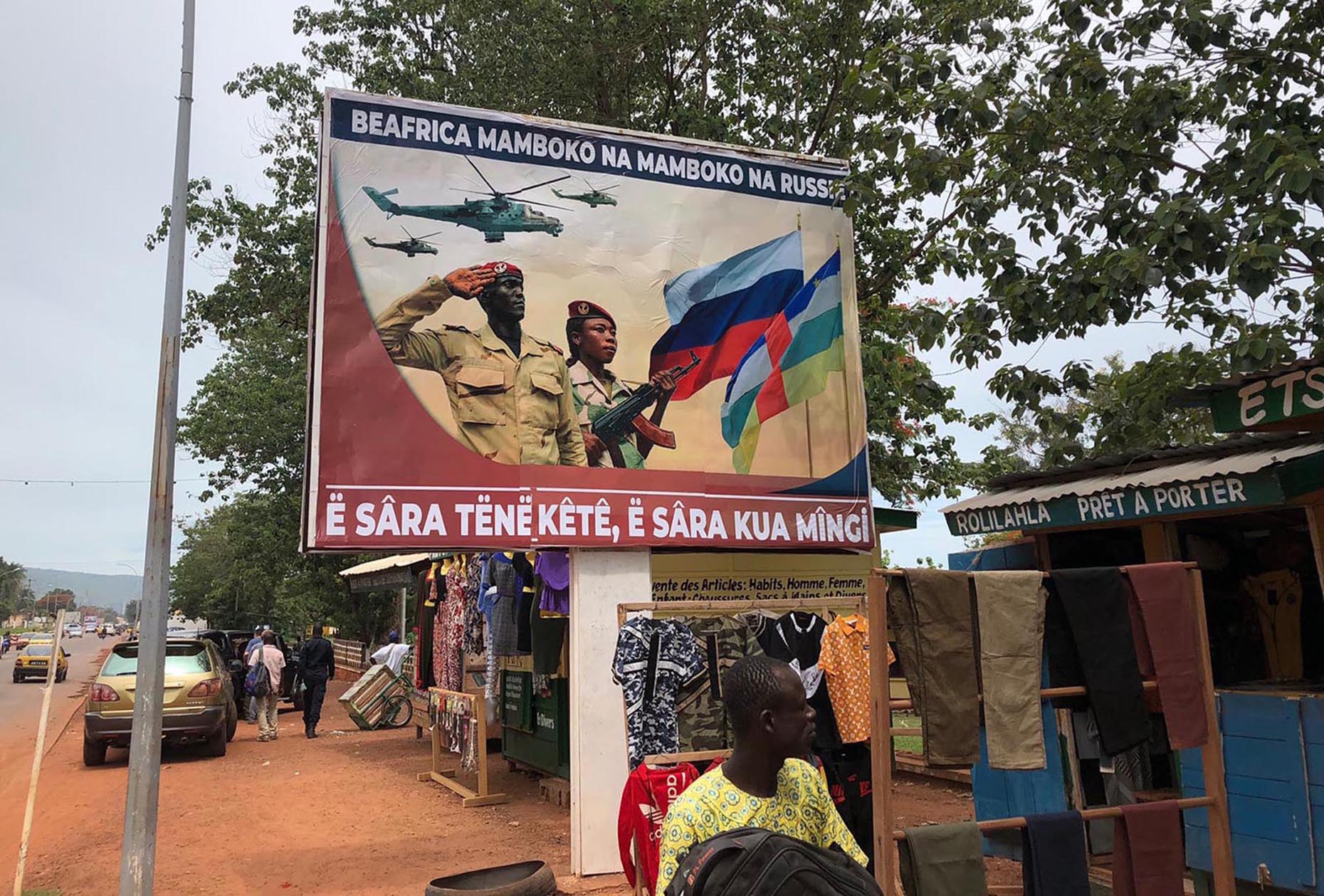 |
| Posters across Bangui are reminiscent of old Soviet propaganda. The posters read: “Central African Republic is hand in hand with Russia” and “talk a little, work a lot.” - Credit: Sebastian Shukla/CNN |
"[The shift to more overt Russian state presence in Africa could lead to] myriad domestic and geopolitical risks for the Kremlin.""The risk to Russian prestige may lead Russia to get more deeply entrenched in long-term conflicts to 'save face', which would ensnare the Kremlin in its own series of 'forever wars'.""Wagner was more immune to such long-term entanglements and even abruptly withdrew from places, such as Mozambique, when the benefits outweighed their costs."Institute for the Study of War
Labels: Africa Corps, Russia's African Involvement, State Militias, Wagner Group, West Africa
posted by Pieface @ Saturday, June 21, 2025


