"Let’s be clear about the eight men for whom the University of Alberta
maintains named endowments. They fought for the Waffen-SS, an armed wing
of the Nazi Party which was declared a criminal organization at the
Nuremberg trials because of its role in war crimes. Their division was
implicated in brutal wartime massacres of civilians, including one
atrocity in which Polish women and children were locked inside buildings
and burned alive."
"It should publish a complete list of all endowments honouring a
Waffen-SS member, together with a timeline for resolving them. It should
pursue renaming, seek legal variations where necessary, and return to
court if required. The university must make clear that those who fought
in service of the Nazis have no place of honour at a Canadian
university."
Nazi SS leader Heinrich Himmler inspects
volunteers of the Ukrainian Waffen SS division during the Second World
War. Library and Archives Canada is now reviewing whether to release the
names of alleged Nazi war criminals who fled to Canada after the war.
(File photo)
The
Waffen SS Galicia comprised of Ukrainian volunteers and overseen by
Nazi SS groups were implicated in WWII war crimes; Jewish groups as well
as the Polish government denounced the Ukrainian volunteer group for
its part in murdering civilians, as well as for massacres it was
involved with. The Nazis made use of the division in Slovakia to crush a
national uprising; another condemnation for war crimes committed by the
group.
In
the wake of receiving a legal permission to proceed with dissolving a
research trust in the name of Ukrainian SS veteran Yaroslav Hunka who
received accolades in Parliament during a visit to Canada by Ukraine's
President Volodymyr Zelenskyy in 2023 when a standing ovation honoured
the misconception that he was a war hero by Western standards by
fighting against the Soviet occupation of Ukraine, at a time when Russia
was viewed as an ally alongside the U.K., U.S. and Canada, the
University of Alberta announced it would go no further in expunging
Ukraine-centred research funding.
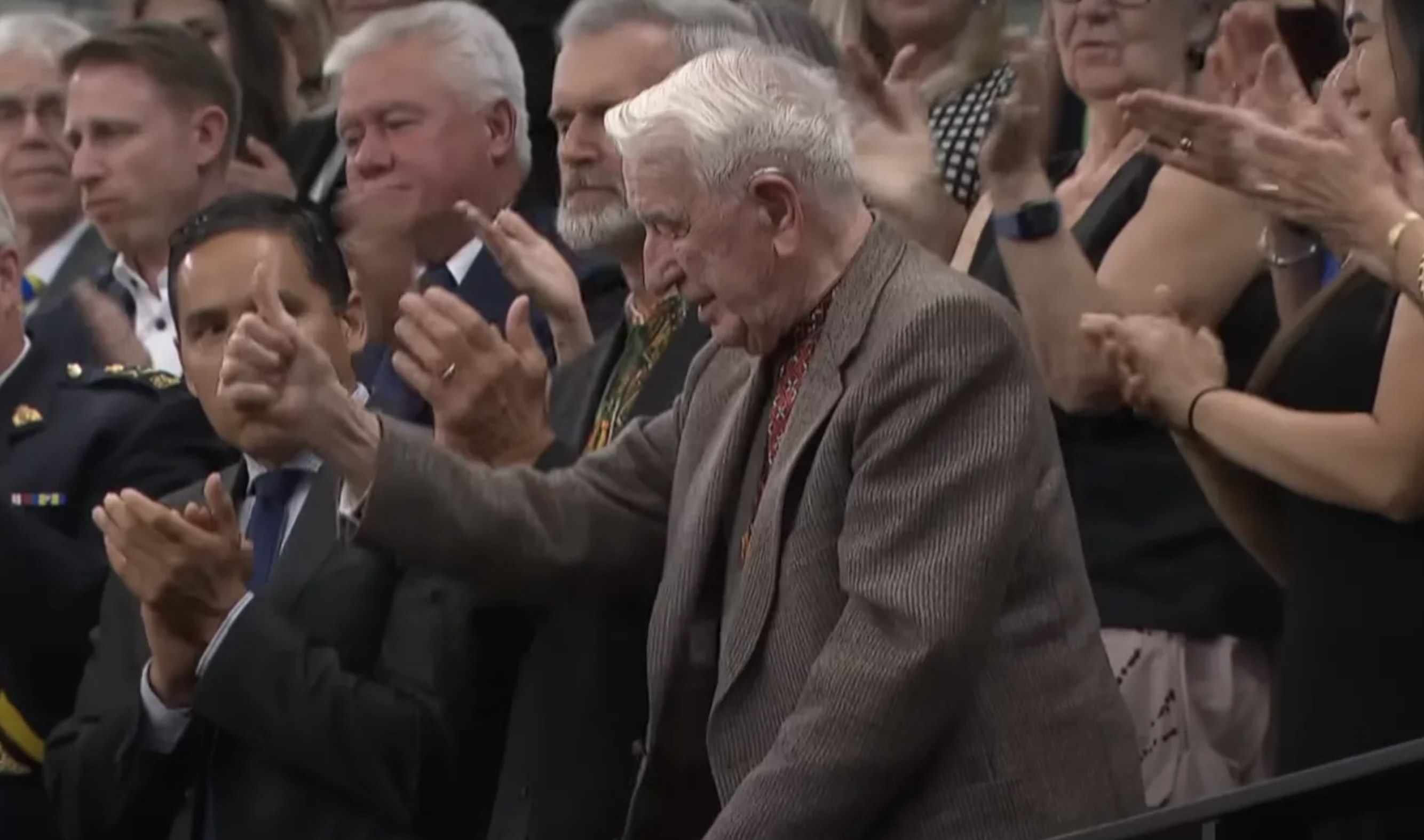
Yaroslav Hunka (giving a thumbs up) during applause in the
Canadian Parliament, September 22, 2023. Photo: YouTube/CBC News: The
National
The
university planned to retain eight other endowments involved with
Waffen-SS soldiers, claiming it would be too costly in time and legal
fees to seek court approval for termination of the endowments.
Researchers with the Friends of Simon Wiesenthal Center. a Toronto-based
Holocaust research organization, totaled a list of 12 endowments at the
University of Alberta with a value to the university of $2.2 million in
funding, linked to Nazi-allied individuals during WWII in Ukraine.
"This is dirty money and it's unconscionable they are continuing with this. It's beyond despicable",
84-year-old Andy Reti, a child survivor of the Holocaust stated in
condemnation of the university's position. An alternative, he felt
reasonable was that the Canadian Institute of Ukrainian Studies at the
university should donate the endowment funding of he Waffen-SS to the
Salvation Army so that something positive could result from the
untenably tainted funds.
Senior
director at the Friends of Simon Wiesenthal Center, Jaime
Kierzner-Roberts, stated that her group had called on a number of
occasions for the university to divest all of the Nazi-linked
endowments, including one named for Peter Savaryn, another SS-Waffen
member, who had in time become chancellor of the university. In 2023,
however, the office of the Governor General expressed its deep regret
for having awarded the Order of Canada to Savaryn in 1987. In the event,
at revelations of his wartime activities and connections, in
consequence of which the Order was revoked.
In its remediation defence, the University of Alberta revealed its intention to spend $100,000 to "deepen scholarship and education about the Galicia Division and other complex and difficult aspects of 20th-century history".
None of which can expunge the reality that the university had accepted
funds from the estate of Volodymyr Kubijovyc, a Nazi collaborator who
had helped create the Waffen-SS Galicia, and was as well an advocate for
ethnic cleansing to create an independent Ukraine without the presence
of Jews or Poles.
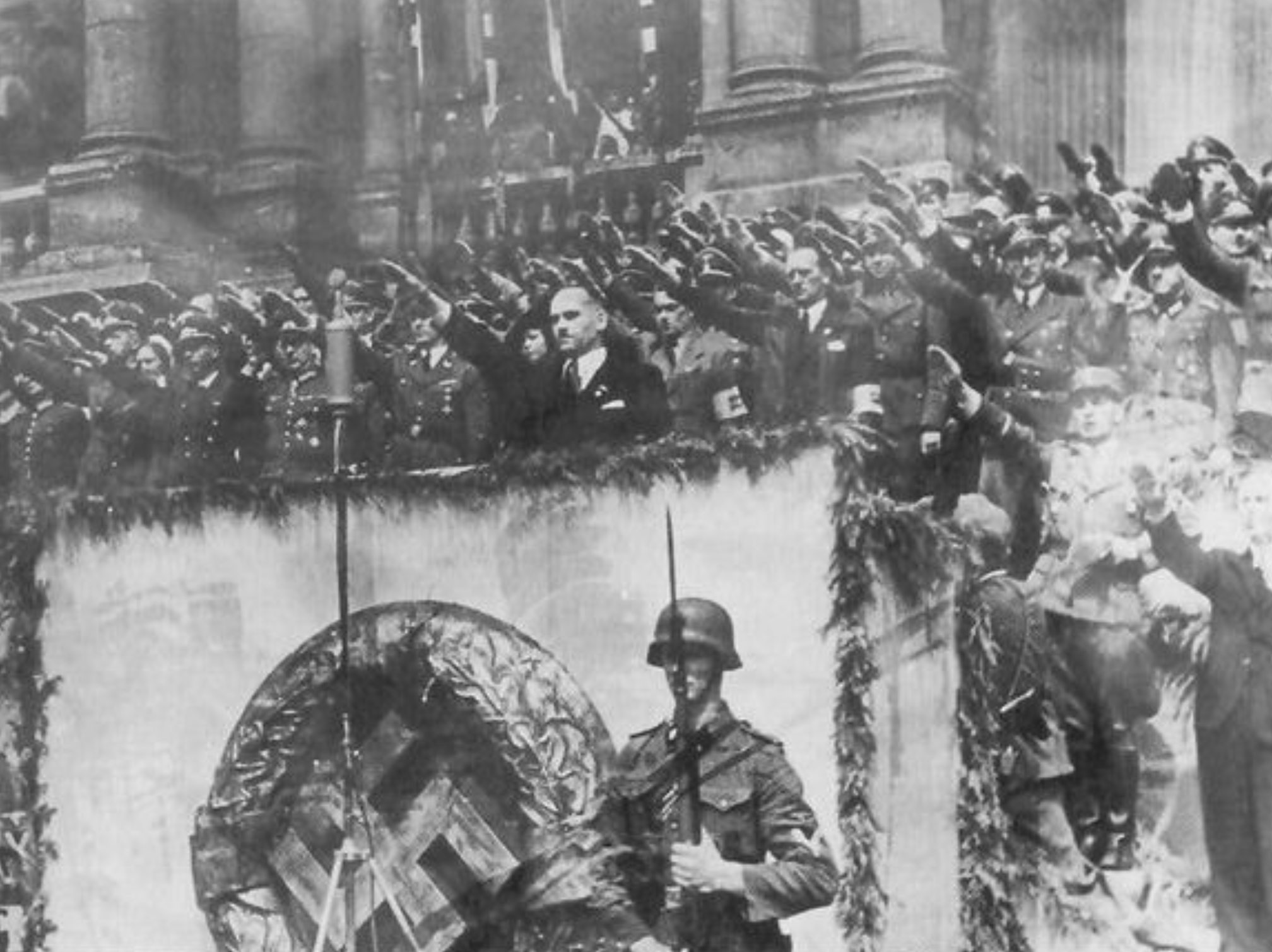
Parade of recruits of the Waffen SS “Galicia” Division in Lviv.
In the foreground is the head of the Military Administration, Col.
Bisanz. July 18, 1943. Photo: Wikimedia Commons
Members
of the Waffen SS Galicia are regarded as heroes -- who had fought
against Soviet forces -- among nationalist Ukrainian Canadians. In
summer day camps for Ukrainian children in Canada, this kind of folkhero
history is taught to the campers, where they can also view
commemorative statuary celebrating Waffen-SS WWII members for their
courageous heroism in confronting and killing Red Army servicemen.
Criticism of these heroes, they aver, represents Russian misinformation.
Critics
of the volunteer SS battalion point out that in volunteering themselves
to fight with the Nazis, Ukrainians were essentially freeing up German
soldiers to enable them to be redirected to fighting against the
British, Canadian,and American soldiers, at that time advancing toward
Berlin. Following the end of the war, the International Military
Tribunal declared the SS a criminal organization, with the inclusion of
Waffen-SS units.
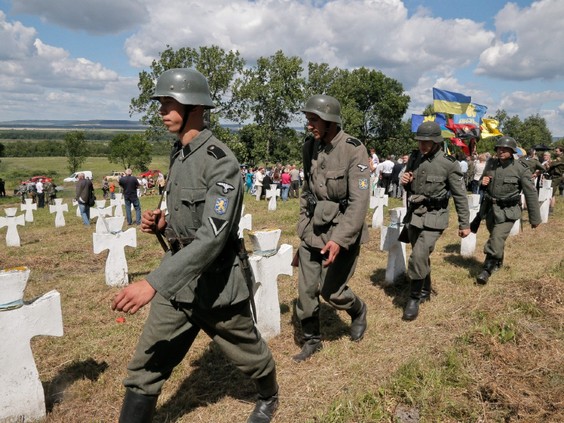
Ukrainians dressed in SS Galicia Division uniforms
march past graves during a re-burial ceremony at the SS Galicia
Division cemetery near the village of Chervone, Ukraine, in 2013.Photo by Efrem Lukatsky/AP/File
"This is like a nightmare." "This is all happening once again in the lifetime of survivors." "It has to be tearing their hearts out." Bernie Farber, former chief executive officer, Canadian Jewish Congress "[Such events as Ukraine's honouring of Nazi collaborators are] internal issues of Ukrainian politics." "[Israel's decision to condemn such parades is] counterproductive." Gennady Nadolenko, head, Ukraine diplomatic mission, Israel
"We
must challenge all those who distort the historical record on
governments, military units or organizations that fought with, supported
or sympathized with the Nazis during World War II." "This
includes government leaders who acquiesce in, or fail to condemn, a
process of Nazi glorification that amounts to Holocaust distortion." "Those who glorify the record of such organizations or units cannot dismiss criticism as 'fake news'." Michael Mostyn, CEO, B'nai Brith Canada
Veterans of the Latvian Legion, a force
that was commanded by the German Nazi Waffen SS during WWII, and their
sympathizers carry flowers as they walk to the Monument of Freedom in
Riga, Latvia on March 16, 2016 to commemorate a key 1944 battle in their
ultimately failed attempt to stem a Soviet advance. Jewish groups,
Moscow and some in Latvia's ethnic-Russian community see the parade as
glorifying Nazism because the Legion, founded in 1943, was commanded by
Germany's Waffen SS, the armed wing of the Nazi party's Schutzstaffel SS
(Protective Squadron). / AFP / afp / Ilmars ZnotinsILMARS ZNOTINS / AFP/Getty Images
For Jews around the world the 75th anniversary of the Soviet Red Army's
liberation of Poland's Auschwitz-Birkenau death camp where Nazi Germany
engineered the death of almost a million Jews, along with Roma, Soviet
POWs, Polish political dissenters, gays, the very thought that Latvians,
Lithuanians, Ukrainians and Poles would in the 21st Century, celebrate
their national heroes who were Nazi collaborators is unthinkable.
Yet the reality is that throughout Eastern Europe countries are
celebrating their nationals who collaborated with the Third Reich and
took active participation in the rounding up and murder of Jews.
Torchlight parades were held in a number of cities in Ukraine early this
month in honour of Stepan Bandera, a nationalist Ukrainian and Nazi
collaborator involved in the killing of thousands of Jews and Poles.
Despite which, Ukraine sponsors such events celebrating Nazi
collaborators with links to the Holocaust.
A school was named in Lithuania for Jonas Noreika whose own family
agrees was involved in the killing of Jews. A Ukrainian diplomat talked
about punishing "k----", while posing for photographs with a cake baked in the shape of Hitler's memoir Mein Kampf,
and blaming Jews for the Second World War. Once a minor kerfuffle
passed, when he was condemned by Jewish groups, he was reinstated to his
diplomatic position.
For the approximately 200 Canadian military trainers currently deployed
to Ukraine, it is likely that on the first of January they would have
witnessed a torch lit procession. Throughout Kiev and numerous other
towns in Western Ukraine, thousands of civilians took to the streets –
not to usher in the New Year – but to celebrate the 110th anniversary of
the birth of a man named Stepan Bandera. Scott Taylor, Canadian Military Magazine
Estonia, Latvia and Ukraine have all held parades in honour of those who
fought in Nazi SS units. The Latvian SS units who fought for the Nazis
in the Second World War were praised by Latvian Defence Minister Artis
Pabrike in December, who spoke of them as "the pride of the Latvian people and of the state".
One of the unit's officers, Viktors Arajs, participated in the murder
of 26,000 Jews with his unit. At a dinner party in Riga he entertained
guests with his method of killing Jewish babies.
Throwing the babies into the air, then shooting them would avoid any
ricochets that might occur if the babies were shot while lying on the
ground. Eastern European nations such as Latvia, Ukraine and Lithuania
are involved in rebuiilding their national identities, "rediscovering"
individuals from the 1940s to elevate them to the status of national
heroes, according to Holocaust researcher, Professor Per Anders Rudling.
Latvian Herbert Cukurs was a key member in the Arajs Kommando, known as the "Butcher of Riga".
In 2014, the Israeli government raised concerns relating to a musical
performed in Latvia celebrating his life, that of a Nazi war criminal
whom Holocaust survivors linked to the murder of Jews. Over 50 members
of the U.S. Congress in 2018 condemned Ukraine's efforts to glorify
leaders of the Ukrainian Insurgent Army, along with the 14th SS Galizien
Division, comprised of Ukrainian volunteers.
"It's particularly troubling that much of the Nazi glorification in Ukraine is government-supported",
the letter stated. Poland passed legislation to make it illegal to
accuse Poles of any complicity in the Holocaust when the simple reality
is that fascist Germany felt confident in placing a number of forced
labour and death camps in Poland, knowing there would be no popular
outcry from a country where antisemitism was well entrenched.
In Western Ukraine, thousands of civilians took to the streets to celebrate the 110th anniversary of the
birth of Nazi collaborator Stepan Bandera
Lithuania's pro-Nazi government had been involved in the rounding up and
murder of Jews, according to well-researched conclusions, yet a new law
is under consideration in Lithuania to declare that neither Lithuania
nor its leaders had ever participated in the Holocaust. Ukrainians, for
their part, push back against Israel's condemnation, insisting that
Stepan Bandera had never supported Nazi Germany, just as the Latvian
government claims the Latvian SS units hadn't fought in support of
Hitler, but to fight the Soviets.
News articles and research relating to Nazi collaborators have been
dismissed by officials in Latvia, Estonia, Ukraine and Lithuania,
claiming them to be the product of Russian disinformation campaigns
meant to cast their countries in a bad light. Canadian officials failed
to join Jewish groups condemning Latvian Defence Minister's Pabriks
praise of the Latvian SS and two months later, he met with Canadian
Minister of Defence Harjit Sajjan, while next month he returns to Ottawa
for a defence conference.
Chrystia Freeland, formerly Canada's Minister of Foreign Affairs and in
this new Liberal government named as deputy Prime Minister, is of
Ukrainian background. She has been banned from entry to Russia. Her
grandfather was a Ukrainian patriot who collaborated with Nazi Germany,
publishing a newspaper in Nazi-occupied Poland, supportive of the Third
Reich and rife with antisemitic tropes. The Ukrainian-Canadian community
has always denied that members of the 14th SS Galizien were Nazi
collaborators, many of whose members immigrated to Canada.
After Ukraine gained its independence
from the Soviet Union in 1991, their initial collaboration with the
Nazis and participation in the slaughter of Ukrainian Jews prevented
Bandera and Shukevych from being considered national role models.
However, much to the consternation of the Jews, and the Poles – whom
Bandera’s OUN also massacred in the thousands – over the past three
decades history in Ukraine has been revised.
At the time of the Maidan uprising in
2014, the spirit of Bandera was revived by the right wing,
ultra-nationalists, and, just five years later, his past crimes have
been whitewashed to the point where his date of birth is a national
holiday. Scott Taylor, Global-Politics,EU
"During
World War II, due to the demoralizing circumstances and German actions,
it is true that vile-acting individuals could be found among Poles and
Jews alike." "Yet,
we should remember that the objective of the Germans was also to
'eradicate the Polish nation' and 'completely destroy Poland'." "In his numerous publications and public statements, he [Grabowski]
falsifies the history of Poland, proclaiming the thesis that Poles are
complicit in the extermination of Jews." "The attempts to ascribe part of the responsibility for the crimes of
the World War II and the Holocaust to the Poles are evidently actions
damaging Poland and are based on Jan Grabowski’s unconfirmed estimated
figures." Polish League Against Defamation statement
Jews are loaded onto trucks in the Lodz Ghetto, to be sent to an extermination camp in 1942.
"What
is important, from my point of view, is that the militant nationalists
who nowadays hold sway in Poland be warned that they will be held to
account, that they are wrong if they think that their outrageous
statements and slanders will go unnoticed." "The more I studied these issues, I saw a level of complicity of
parts of Polish society in the destruction of Polish Jews." "From among the approximately 250,000 Polish Jews who had escaped
liquidations of the ghettos and who had fled, about 40,000 survived. We
have thus more than 200,000 Jews who fled the liquidations and who did
not survive until liberation. My findings show that in the overwhelming
majority of cases, their Polish co-citizens were – directly through
murder, or indirectly by denunciation – at the root of their deaths." "Whether they lived or died depended to a large extent on the attitude
of the Poles. [While some Poles did save Jews], Polish society demonstrated various behaviours, some of which were
horrifying." Jan Grabowski, Holocaust researcher, professor, University of Ottawa
Jews are liquidated from the Krakow Ghetto in 1943.
"[The Polish League Against Defamation] has attempted to silence Prof.
Grabowski by criticizing both his academic credibility and his personal
integrity. Most recently, the league circulated a letter to universities
in Europe and North America – including the University of Ottawa – that
questions Prof. Grabowski’s widely acclaimed scholarship and accuses
him of defaming the Polish nation."
"The HRREC affirms our confidence in the highly respected scholarship
of Prof. Grabowski and we underline his academic freedom to pursue and
publish his research without fear of attacks on his person or
reputation." "The HRREC strongly denounces the attacks on Prof. Grabowski as well as any endeavour to interfere with independent research." Human Rights Research and Education Centre (HRREC), University of Ottawa
After the Second World War, Jewish refugees who settled in Canada among
the already long-settled Jewish immigrants from Europe, became aware
that it was entirely conceivable that they might come across a former
guard from any of the extermination or forced-labour camps operating in
Eastern Europe walking the streets of Canadian cities. East Europeans,
post-war, made application to leave their countries of origin and settle
in Canada. They took steps to conceal their past during the war and
succeeded in their applications for settlement in Canada.
Among them a good number of Ukrainian and Polish nationals who had
collaborated with the Nazis taking up prison work with relish, work that
made them complicit in the deaths of millions of Europe's Jews. When
the Canadian Jewish Congress applied to the various governments of
Canada over the years to establish a commission that would root out
former war criminals living in Canada who took part in Nazi Germany's
genocide against the Jewish population of Europe, nationalist
Canadian-Ukrainian did everything they could to circumvent any such
actions, denying that Ukrainians had ever been part of Germany's
extermination plans.
Germany, by contrast, has a dreadful legacy to live down, responsible for the deaths of tens of millions of people -- among them six million Jews in a diabolical plan to exterminate European Jews -- through its plan for world domination, bringing the world to a second global conflict in the first half of the 20th Century. Had Nazi Germany with its Axis partners succeeded, there is little doubt that the Nazi killing machine would have continued to dedicate itself to a Jew-free world. Post-war Germany in its defeat had little option but to face its dreadful legacy. Successive German governments have acknowledged the horror of the nation's responsibility.
For the past few years Poland has been strenuously applying itself to
teaching the world that it is morally incorrect to refer to 'Polish'
concentration camps, though so many were located in Poland. The Nazis
knew that in establishing death camps in Ukraine and Poland they could
anticipate local complicity. Even in occupied France French police and
authorities were swift to make common cause with the Nazis, helping to
round up Jews to be dispatched to concentration camps from which they
would never return. Poland prefers the descriptive of 'Nazi'
concentration camps, never 'Polish' concentration camps. Clearly, Poland struggles with itself, unwilling to remorsefully indulge in introspection.
Dr. Grabowski, a highly internationally respected Holocaust researcher,
has been the victim of a campaign of defamation by the Polish League
Against Defamation, allied with the conservative ruling party of Poland
which claims that his research uses wholly fictional accounts in a
deliberate effort to slander Poland. History speaks for itself. There is
more than ample documentation, from meticulously-maintained German
archives, much less personal testimony of Holocaust survivors to attest
to Polish complicity in Nazi atrocities. Ukraine's defence is Poland's
as well. Most Eastern European countries lent themselves under Nazi
occupation, to the hunt for Jews.
Poland's Law and Justice party attempted to make it a criminal offence
to label the concentration camps in that country where millions were
exterminated 'Polish' installations. International indignation convinced
it to back down. Professor Grabowski wrote an historical accounting of
Poland's complicity during the Holocaust years titled Hunt for the Jews: Betrayal and Murder in German-Occupied Poland,
to document the involvement of Poles finding and killing Jews who
managed to escape from ghettoes attempting to survive by installing
themselves surreptitiously among non-Jews.
With its publication, heated debate ensued even as the book was
recognized in 2014 for an award by the Yad Vashem International Book
Prize for Holocaust Research. That award was not the only recognition
given Dr. Grabowski for his research and writing; he received numerous
death threats. A German newspaper review of the book recognized its
quality of revelations and that favourable review saw a response from a
far-right Polish website which chose to publish an article alongside a
photograph of Joseph Goebbels, Nazi propaganda minister.
"Sieg Heil, Herr Grabowski, Three times Sieg Heil"
ran the headline of the article. Leading to a successful libel suit.
Now, with this latest besmirching of the professor's scholarship and
literary and moral integrity, the Polish organization is being sued for
libel by him, in recognition of its public campaign accusing him of
slandering Poland by writing of Polish violence against Jews. Should
justice prevail, he will win this lawsuit as well.
Poland does itself no favours by their disingenuous efforts to exonerate
their wartime record. Far better to be resigned to the reality of
history, to express regret and shame and the intention to cultivate a
more humane and responsible admission of wrongs done and deplored. What
has passed is past; what is required is to ensure that there can be no
repeats of the past. This offensive defensiveness does the country no
credit whatever, other than bringing more shame upon it for denying its
part in the horrors of genocide.
An inscription
'Arbeit Macht Frei' sits above the main gate at the Auscwitz-Birkenau
concentration camp museum in Auscwitz-Birkenau, Poland, February 28,
2018. Bloomberg
This represents a general opinion site for its author. It also offers a space for the author to record her experiences and perceptions,both personal and public. This is rendered obvious by the content contained in the blog, but the space is here inviting me to write. And so I do.