"We are going to release them. That’s not an issue. But it has to be
two-way. If we take this bold step, releasing all these guys, all these bad
people, why are the Taliban not releasing our captives, which is a very
small number?" "I think it’s time for the Taliban to realize that there will be no
concession anymore. Whatever we have done so far as the
Afghan government and the peace process, that should be enough for the
Taliban to come to the negotiation table." Sediq Sediqqi, Afghanistan government spokesman
Taliban prisoners are released from Pul-e-Charkhi jail in Kabul,
Afghanistan, Thursday, Aug. 13, 2020. (Afghanistan's National Security
Council via AP)
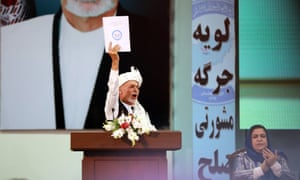
President Ashraf Ghani, Loya Jirga’s decision.
Photo: Jawad Jalali/EPA
"The Jirga approves the release of four hundred Taliban prisoners in
order to remove obstacles to the start of peace talks and stop the
bloodshed." "[Following the release of the prisoners], direct negotiations [should be] initiated immediately without any excuse." "The
Jirga also calls on the Taliban to fulfill their obligation to release
all civilians and military prisoners and release them immediately." "The relevant sides have the goal of releasing all the remaining
prisoners over the course of the subsequent three months. The United
States commits to completing this goal."Loya Jirga, resolution, Kabul
The initial release of the first batch of the final 400 Taliban prisoners agreed by the Afghan government's loya jirga, to pave the way for negotiations for peace between the Taliban and the government of President Ashraf Ghani has taken place. The agreement proceedings themselves have been negotiated by the United States on behalf of Afghanistan. The Taliban had steadfastly refused to meet directly with the government, considering it a tool of the U.S.
One of the conditions the Taliban insisted upon before it commit to talks between itself and the government is that all U.S. and foreign troops be removed from Afghanistan before talks would commence. Which is exactly what the U.S. anticipates and has been working toward; releasing itself from the responsibility of fighting Afghanistan's war against the Taliban. The Afghanistan military and police have been in training by Western forces for years to make them battle-ready to protect the country on their own, to fairly mixed results.
Now, with the democratically elected government in place and the U.S. prepared to leave, Afghanistan and its people will be left to the mercy of the Taliban, a rabid fundamentalist Islamist group given to explosive-vest suicide bombings and car bombings, completely committed to restoring its reign of terror in Islamist ideology effectively returning the population to a life of bondage to their version of fascist-spectrum Islam. Any agreements reached between the government and the Taliban will be a temporary smoke screen.
Nothing will satisfy the Taliban, no sharing of government, no acknowledgement that it can be trusted to rule in the best interests of the Afghan people, that it will abandon its stern, uncompromising hard-core sharia in favour of moving toward a humane, people-centric form of governance -- for this is not within the nature of the Taliban whose devotion to Salafist interpretation of Islam is sacred to them. Where women will be forced to return to being burqa-clad, never venturing outside the home.
"The government ... yesterday released 80 Taliban convicts out of the 400 that the Consultative Loya Jirga sanctioned for release to speed up efforts for direct talks and a lasting, nationwide ceasefire", announced Javid Faisal, spokesman for the National Security Council. It's difficult to credit that government leaders place any trust in the word given them by the Taliban. Who, throughout the time they were in bargaining sessions with the U.S. continued to send out lethal bombing missions against Afghan civilian targets.
U.S. troops have steadily removed themselves from bases leading toward ending the U.S. military involvement in Afghanistan. It is anticipated that by November fewer than five thousand troops will be left in Afghanistan, substantially decreased from the close to 13,000 that were installed at the time the U.S.-Taliban agreement had been signed at the end of February.
An agreement revolving around how Afghanistan could be governed jointly and how the Taliban could share power will certainly be time-consuming and difficult to conclude. But whatever the two sides agree upon, only one side will be sincere in its efforts to satisfy the demands of the other, while the opposing side will be intently focused on appearing to submit to a mutual agreement, preparing to abrogate it at the earliest possible moment.
Taliban prisoners at Bagram Military Base in Afghanistan before being released, in late May. Credit...Jim Huylebroek for The New York Times
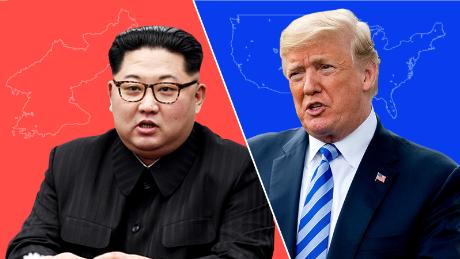
The Trump Nuclear Agreement with North Korea: What Could Go Wrong?
"I don't know that the president would ever admit that it's over." "But if the North Koreans don't move the ball forward, Bolton will argue to Trump, 'You don't have to admit you were wrong, but we need to start escalating against them to force them to keep their commitments'." Senior White House administrator
"We took the step to suspend several of the largest exercises as a good-faith measure coming out of the Singapore summit." "We have no plans at this time to suspend any more [joint U.S.-South Korea military] exercises." U.S. Defence Secretary Jim Mattis
"We're waiting for the North Koreans to begin the process of
denuclearization, which they committed to in Singapore and which they've
not yet done." "Maximum pressure on both governments to give up their pursuit of
deliverable nuclear weapons, but a willingness to talk to their leaders
to see if there's a way out." U.S. National Security Adviser John Bolton
"[North Korea was under] tremendous pressure [from China, but Beijing was also supplying
Pyongyang with] considerable aid, [including fuel, fertilizer and
commodities]. This is not helpful!” "Nonetheless, the President believes that his relationship with Kim
Jong Un is very good and warm, and there is no reason at this time to
be spending large amounts of money on joint US-South Korea war games." "Besides, the President can instantly start the joint exercises
again with South Korea, and Japan, if he so chooses. If he does, they
will be far bigger than ever before." "[U.S. trade dispute with China and
other differences] will be resolved in time by President Trump and
China’s great President Xi Jinping. Their relationship and bond remain
very strong." White House statement
Confused? Little wonder. The messages are contrary and mixed, and it's doubtful whether anyone really knows the extent of the consternation in the White House over North Korea's impudent nerve in sending a belligerent, threatening missive to President Trump, from a top North Korean official. Trump, however, never wants to admit he has been wrong about anything. And so, the pantomime continues, unwilling to draw attention to the reality that North Korea's Kim Jong-un has no intention whatever of setting aside his 'nuclear deterrence' plans any time soon.
North Korea may be strapped for cash, but it has invested untold billions in its drive to perfect long-range intercontinental ballistic missiles and the streamlining of miniaturized nuclear heads to be fitted on them to reach the U.S. Pacific coast as Kim has so frequently boasted. The attention Kim so much craved from an American president became a reality when Trump decided he would indulge the little tyrant, because a big bully recognizing one of his own knows that flattery and attention can work wonders, but in this instance his ministrations failed to soothe the nuclear beast in Kim's breast.
Predictably, most would say, given past history and the repetitive efforts to assuage North Korea's concerns of invasion and upheaval of the Kim dynasty. Kim Yong Chol, vice chairman of North Korea's ruling Workers' Party Central Committee on orders from Kim Jong-un revealed the extent of the North's continued hostility, resentment and psychotic threats that remain posed against the U.S., South Korea and Japan. Mike Pompeo, to whom the letter was aimed, recognizes the futility of further negotiations, as does Bolton and Mattis, but Trump doesn't like being poked in the eye.
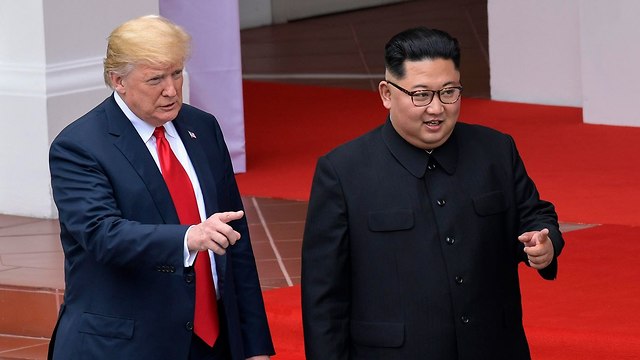
Trump and Kim(Photo: AP)
It seems clear enough that Trump's stream of communications conveyed to Kim Jong-un remonstrating with him that an acceleration of denuclearization would go a long way to complete normalization and diplomacy between the two countries, warning that backsliding would not be tolerated, all of which would have been interpreted as intolerable interference by a foreign entity in North Korea's affairs of state and defence. Kim responded in an as-good-as 'screw you' manner, failing to endear himself completely with Trump.
Still, because it was his own bold initiative to open up dialogue between Washington and Pyongyang and because he so publicly yodelled his remarkable success where all others had spectacularly failed, Trump has been placed in a position where he will feel humiliated and appear unequal to the task he himself set for himself to prove just how persuasive a personality he is, cosmopolitan, charming and irresistible. Just like Kim himself.
As for depending on the good advice of seasoned veterans like Bolton, Trump prefers his own inimitable counsel. Bolton is opposed to offering concessions inclusive of face-to-face meetings which he infers are received by the North Koreans as symptoms of weakness on the part of those attempging to convince them to do what they they have no appetite to commit to. But if any of Trump's stalwart advisers, from Mattis to Bolton to Pompeo can expect anything, it is for their firm statements of intent to be contradicted by Trump.
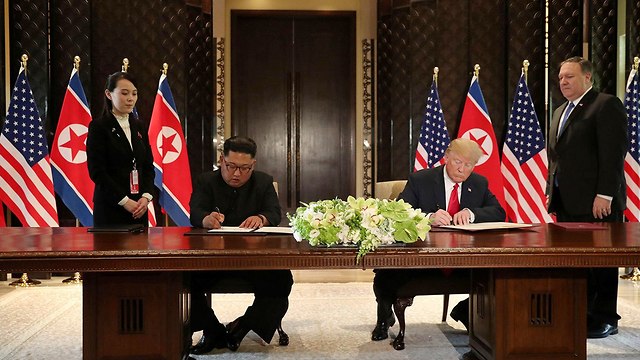
Trump and Kim sign the joint statement. Photo: Reuters
This represents a general opinion site for its author. It also offers a space for the author to record her experiences and perceptions,both personal and public. This is rendered obvious by the content contained in the blog, but the space is here inviting me to write. And so I do.
/cloudfront-us-east-1.images.arcpublishing.com/mco/QH4A2LXEMVAOTKP3JOG6Z47BSE.jpg)