Tuesday, August 04, 2020

Neolithic Age Ingenuity and Engineering

"The sarsen stones make up the iconic outer circle and central trilithon [two vertical stones supporting a horizontal stone] horseshoe at Stonehenge. They are enormous."
"How they were moved to the site is still really the subject of speculation."
"It has been really exciting to harness 21st-century science to understand the Neolithic past, and finally answer a question that archeologists have been debating for centuries."
David Nash, geomorphologist, University of Brighton

"The bluestones, we've known, come from mid-west Wales and they were easy to source because there are inclusions and quartz which you can match to the outcrop. The large stones are pretty uniform and just look like a big block, so it's difficult to interrogate them and find where they are from."
"There are no sarsens of this size left in the downs, that's why it's been such a mystery and some people have suggested they come from elsewhere as you get outcrops in other places where you have chalk land, like Devon and Kent."
"The west wood was overlooked because it's under ancient woodland and a lot of sarsens were removed in the 19th century for road stones, particularly in Swindon, but there are still sarsens buried in among the tees. To be able to pinpoint the area that Stonehenge's builders used to source their materials around 2500 BC is a real thrill."
"We can now say, when sourcing the sarsens, the overriding objective was size -- they wanted the biggest, most substantial stones they could find and it made sense to get them from as nearby as possible."
"This is in stark contrast to the source of the bluestones, where something quite different -- a sacred connection to these mountains perhaps -- was at play."
Susan Greaney, historian, archaeologist with a specialization in British prehistory, Cardiff University
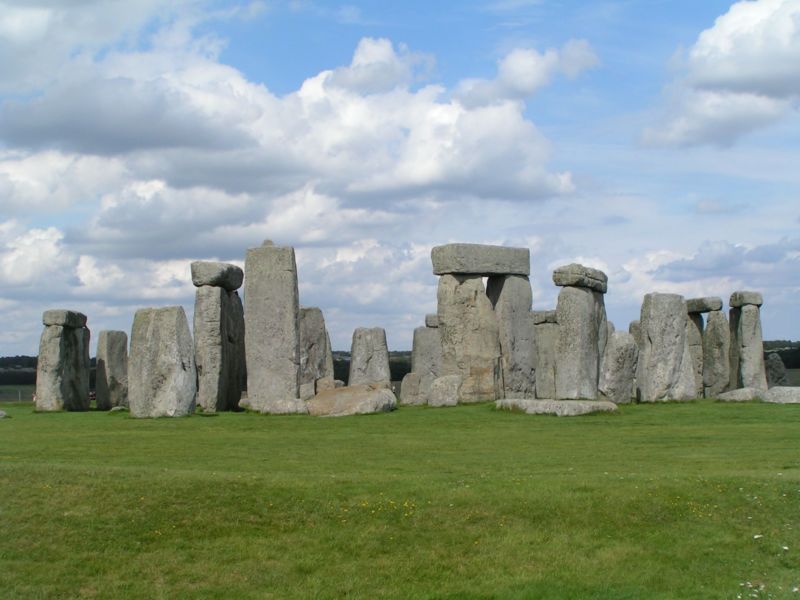
Prehistoric stone circle in the English countryside.
Stonehenge

Before there were the monumentally imposing great cathedrals of Europe, there was Stonehenge. An ancient  circle of massive stone formations dominating a landscape, where sun worship as a Druid temple of sorts spoke to an ancient belief in the divine. Humankind seems always to have had a need of faith, faith in an unknown powerful force imagined as a divine intelligence which created all that exists. The sun was the manifestation of that life-giving, life-sustaining source. One of the Egyptian dynasties was also that of sun-worship when Akhenaten reigned and named the sun Aten.

The building of the ancient Pyramids presented a conundrum just as Stonehenge has done; how massive stone blocks could have been moved to particular sites to construct gargantuan edifices of worship and burial in preparation for the afterlife. Stonehenge's megalithic bluestones were known to have been hauled 225 kilometres from Wales' Preseli Mountains to their destination on Salisbury Plain. A laborious effort of both brute strength and engineering; presumably with the use of log rollers to convey the massive stones over a demanding geology.
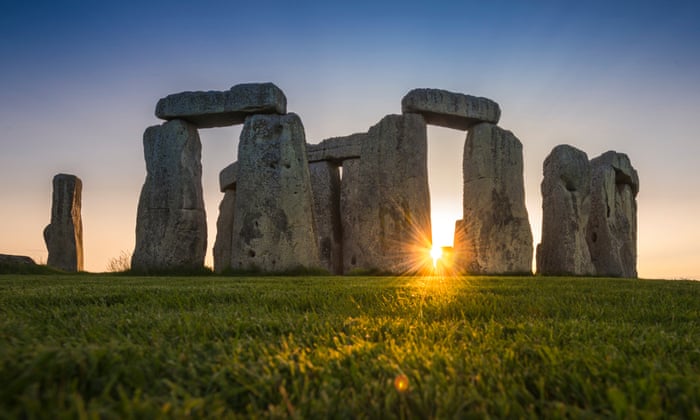
Sunset at Stonehenge. Photograph: A Pattenden
A mystery appears to have been cleared with the newfound knowledge that the 52 pale-grey sandstone megaliths known as sarsens originated in the West Woods of the Marlborough Downs, a mere 25 kilometres in comparison distance, north of Stonehenge. Not far from the Neolithic monument site at Avebury. It took the combined work of archaeologists from English Heritage and the University of Sheffield to solve this centuries-old conundrum of human effort in a divine mission of devotion overcoming massive physical effort and distance difficulty to achieve the goal.

A core sample that had been drilled during repair work undertaken in the 1950s involving the "Stone 58" had been taken as a memento to the United States, with permission, by a man who had worked for the company involved in the conservation work when the sarsen core sample was extracted and metal rods inserted to stabilize a cracked megalith. The souvenir moved with this man when he emigrated to the U.S. and was eventually returned to Britain to enable research.

When fragments of the sample were analyzed, researchers were able to establish the geochemical fingerprint of the sarsen which it was taken from, which matched sandstone at West Woods. Most of the sarsens weigh about 20 tonnes, with some as heavy as 30 tonnes; the largest is 30 feet in length. It is hazarded that the Preseli stones were selected for ritualistic purposes while the sarsens were chosen for size, according to archeological logic. Moving such 30 tonne stones would have represented an impossibly difficult prospect.
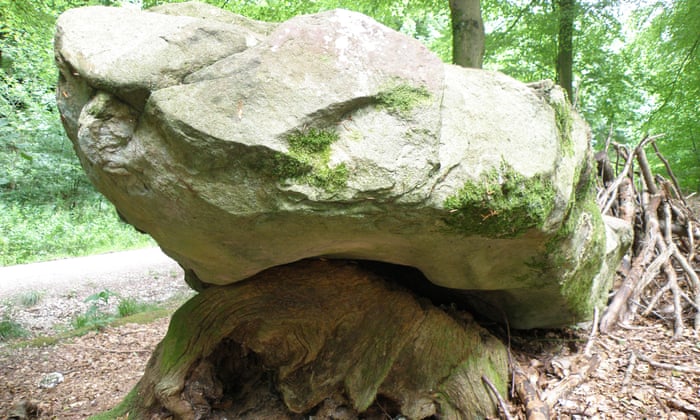
A large sarsen stone at West Woods, the probable source of most of the sarsens used to construct Stonehenge. Photograph: Katy A Whitaker

Labels: , ,

Monday, January 20, 2020

The Jews of Egypt

"If it wasn’t for [President Abdel Fattah] al-Sissi, this would have never been done. A lot of things have changed since he’s taken over."
"I have relatives who left to France, Italy and Israel and they would like to visit the synagogue now."
Yolande Mizrahi,  septuagenarian Jew born and raised in Alexandria

"This is recognition of Egypt’s Jews who were neglected for over sixty years."
"It is recognition that we have always been here and that we have contributed to a lot of things just like any other Egyptian."
"I'm very proud of what my country has done, and it symbolizes living together; today there is no difference between Egyptian Muslim , Christian and Egyptian Jew."
Magda Haroun, a leader of the dwindling Egyptian Jewish community, Cairo
People attend the opening of Eliyahu Hanavi synagogue in Alexandria, Egypt, Friday, Jan. 10, 2020, three years after the Egyptian government started the renovations of the synagogue originally built in 1354. (AP Photo/Hamada Elrasam)
During the pre- and post-Biblical era, Jews lived and prospered in Egypt, as an integral and equal part of the Egyptian population.
"From the time of the post-exilic prophets Judaism developed in three main streams, one flowing from Jerusalem, another from Babylon, the third from Egypt. Alexandria soon took precedence of existing settlements of Jews, and became a great centre of Jewish life. The first Ptolemy, to whom at the dismemberment of Alexander's empire Egypt had fallen, continued to the Jewish settlers the privileges of full citizenship which Alexander had granted them. He increased also the number of Jewish inhabitants, for following his conquest of Palestine (or Coele-Syria, as it was then called), he brought back to his capital a large number of Jewish families and settled thirty thousand Jewish soldiers in garrisons. For the next hundred years the Palestinian and Egyptian Jews were under the same rule, and for the most part the Ptolemies treated them well."
"Under their tolerant sway the Jewish community thrived, and became distinguished in the handicrafts as well as in commerce. Two of the five sections into which Alexandria was divided were almost exclusively occupied by them; these lay in the north-east along the shore and near the royal palace -- a favourable situation for the large commercial enterprises in which they were engaged."
"The Jews had full permission to carry on their religious observances, and besides many smaller places of worship, each marked by its surrounding plantation of trees, they built a great synagogue, of which it is said in the Talmud 'He who has not seen it has not seen the glory of Israel'. It was in the form of a basilica, with a double row of columns, and so vast that an official standing upon a platform had to wave his head-cloth or veil to inform the people at the back of the edifice when to say 'Amen' in response to the Reader. The congregation was seated according to trade-guilds, as was also customary during the Middle Ages; the goldsmiths, silversmiths, coppersmiths, and weavers had their own places, for the Alexandrian Jews seem to have partially adopted the Egyptian caste-system..."
Philo-Judaeus of Alexandria, Norman Bentwich, Trinity College, Cambridge, 1910
Guests visit the newly renovated Eliyahu Hanavi synagogue in the northwestern Egyptian city of Alexandria on January 10, 2020, on the day of its inauguration. (Khaled DESOUKI/AFP)
Alexandria's historic two-storey Eliyahu Hanavi synagogue was in parlous condition, having partially collapsed in 2006.The following year began restoration by the Egyptian Antiquities Department, preventing its total collapse.This is one of two remaining synagogues in Alexandria; many other have long since deteriorated with age and disuse and neglect in a city that once was host to 40,000 Jews up to 1940, descendants of Egyptian Jews who had lived there since antiquity.

This iteration of the synagogue dated only to 1881 to serve Alexandria's large and influential Jewish community. It boasted marble floors and marble, rose-coloured columns in its main hall. It stood on the very site of a much earlier synagogue, dating to 1354 a.d., to attest to its historical antecedents. Fully half of Egypt's Jewish community lived in Alexandria, a historical seat in Egypt of a portion of the Biblical diaspora.

The synagogue, now fully renovated, its opening ceremonies bringing a handful of Egyptian Jews to celebrate its resurrection together, in praise of Egypt's new warmer relationships with the State of  Israel, and the closer recognition of the role of Egyptian Jews in Alexandrian life. A small gathering of Jews, mostly elderly who had been born there and lived in the city all their lives, descendants of the original Jews who had made Alexandria their home.

When the State of Israel declared itself the reborn ancient Judea, its neighbours in the Middle East, the surrounding Arab Muslim states determined to eradicate its presence. Successive conflicts where various Arab states -- Egypt, Syria, Iraq, Lebanon and Jordan sent expeditionary armies to destroy the fledgling nation. At the same time, Jews who had lived in Arab countries such as those, as well as Algeria, Tunisia, Morocco, Libya and others expelled their Jews, confiscating their property.

Coptic priests visit Eliyahu Hanavi synagogue. (Khaled DESOUKI/AFP

Ironically, non-Arab, Aryan Persia maintained friendly relations with Israel under the Pahlavi dynasty. Now the Gulf States, Saudi Arabia, and Egypt have warmed relations with Israel under the regional threat of Persian ambitions to revisit its controlling past of the Middle East and it is from the theocratic Islamic Republic of Iran that the existential threat to Israel emanates,

Egypt and Jordan have long since signed peace agreements with Israel, despite that the Jordanian and Egyptian public retain their distrust of and animosity toward the Jewish state. But it is Egypt, under the reign of former general and now president, Abdel Fattah al-Sissi, with whom accommodation has been made between the two countries in their common battle against Islamist fundamentalism and terrorist groups and militias. "If we have Jews, we will build [synagogues] for them", the president said in 2018.

And this is just what has occurred, with the reconstruction of the Maimonides Cairo synagogue which Egypt sponsored in the 2000s. Egypt, mostly emptied of its once-numerous Egyptian-Jewish population in the 1950s, thanks mostly to bloody pogroms under then-President Nasser, has seen many synagogues in Cairo, along with a large Jewish cemetery, go into decay. The restoration of these ancient relics of sites of worship are as much a symbol of Egypt's past as they are of the Jewish presence in Egypt.

Guests visit the newly renovated Eliyahu Hanavi synagogue in the northwestern Egyptian city of Alexandria on January 10, 2020, on the day of its inauguration. (Khaled DESOUKI/AFP)
The floor of the restored Eliyahu Hanavi synagogue has left open to public view the archaeological layers of history that lie beneath the edifice. Additional Egyptian Jews vacated Egypt, turning to Israel and migrating to the West in the wake of the 1956 Suez war after the launch of a military offensive against Egypt when Israel, France and Britain stopped Egypt from closing the Suez Canal to shipping traffic, and hostility from Egyptians toward its Jews was intensified.

Labels: , , , , ,

Follow @rheytah Tweet