Neolithic Age Ingenuity and Engineering
"The sarsen stones make up the iconic outer circle and central trilithon [two vertical stones supporting a horizontal stone] horseshoe at Stonehenge. They are enormous."
"How they were moved to the site is still really the subject of speculation."
"It has been really exciting to harness 21st-century science to understand the Neolithic past, and finally answer a question that archeologists have been debating for centuries."
David Nash, geomorphologist, University of Brighton
"The bluestones, we've known, come from mid-west Wales and they were easy to source because there are inclusions and quartz which you can match to the outcrop. The large stones are pretty uniform and just look like a big block, so it's difficult to interrogate them and find where they are from."
"There are no sarsens of this size left in the downs, that's why it's been such a mystery and some people have suggested they come from elsewhere as you get outcrops in other places where you have chalk land, like Devon and Kent."
"The west wood was overlooked because it's under ancient woodland and a lot of sarsens were removed in the 19th century for road stones, particularly in Swindon, but there are still sarsens buried in among the tees. To be able to pinpoint the area that Stonehenge's builders used to source their materials around 2500 BC is a real thrill."
"We can now say, when sourcing the sarsens, the overriding objective was size -- they wanted the biggest, most substantial stones they could find and it made sense to get them from as nearby as possible."
"This is in stark contrast to the source of the bluestones, where something quite different -- a sacred connection to these mountains perhaps -- was at play."
Susan Greaney, historian, archaeologist with a specialization in British prehistory, Cardiff University
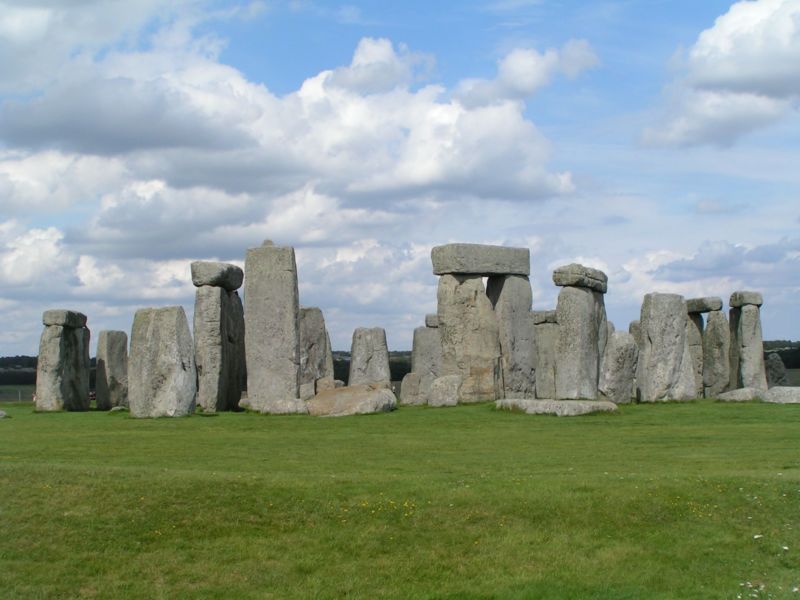 |
Stonehenge
|
Before there were the monumentally imposing great cathedrals of Europe, there was Stonehenge. An ancient circle of massive stone formations dominating a landscape, where sun worship as a Druid temple of sorts spoke to an ancient belief in the divine. Humankind seems always to have had a need of faith, faith in an unknown powerful force imagined as a divine intelligence which created all that exists. The sun was the manifestation of that life-giving, life-sustaining source. One of the Egyptian dynasties was also that of sun-worship when Akhenaten reigned and named the sun Aten.
The building of the ancient Pyramids presented a conundrum just as Stonehenge has done; how massive stone blocks could have been moved to particular sites to construct gargantuan edifices of worship and burial in preparation for the afterlife. Stonehenge's megalithic bluestones were known to have been hauled 225 kilometres from Wales' Preseli Mountains to their destination on Salisbury Plain. A laborious effort of both brute strength and engineering; presumably with the use of log rollers to convey the massive stones over a demanding geology.
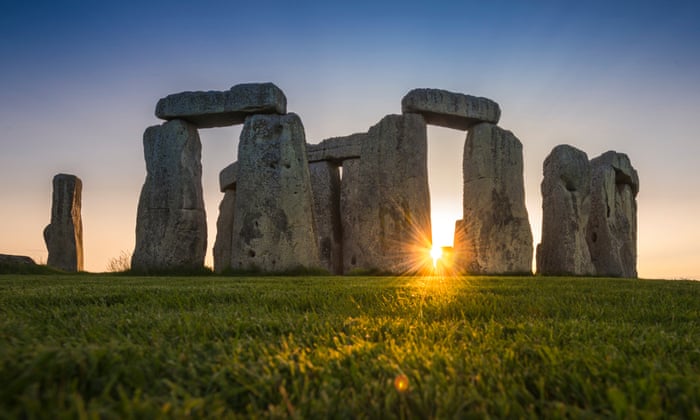 |
| Sunset at Stonehenge. Photograph: A Pattenden |
A mystery appears to have been cleared with the newfound knowledge that the 52 pale-grey sandstone megaliths known as sarsens originated in the West Woods of the Marlborough Downs, a mere 25 kilometres in comparison distance, north of Stonehenge. Not far from the Neolithic monument site at Avebury. It took the combined work of archaeologists from English Heritage and the University of Sheffield to solve this centuries-old conundrum of human effort in a divine mission of devotion overcoming massive physical effort and distance difficulty to achieve the goal.
A core sample that had been drilled during repair work undertaken in the 1950s involving the "Stone 58" had been taken as a memento to the United States, with permission, by a man who had worked for the company involved in the conservation work when the sarsen core sample was extracted and metal rods inserted to stabilize a cracked megalith. The souvenir moved with this man when he emigrated to the U.S. and was eventually returned to Britain to enable research.
When fragments of the sample were analyzed, researchers were able to establish the geochemical fingerprint of the sarsen which it was taken from, which matched sandstone at West Woods. Most of the sarsens weigh about 20 tonnes, with some as heavy as 30 tonnes; the largest is 30 feet in length. It is hazarded that the Preseli stones were selected for ritualistic purposes while the sarsens were chosen for size, according to archeological logic. Moving such 30 tonne stones would have represented an impossibly difficult prospect.
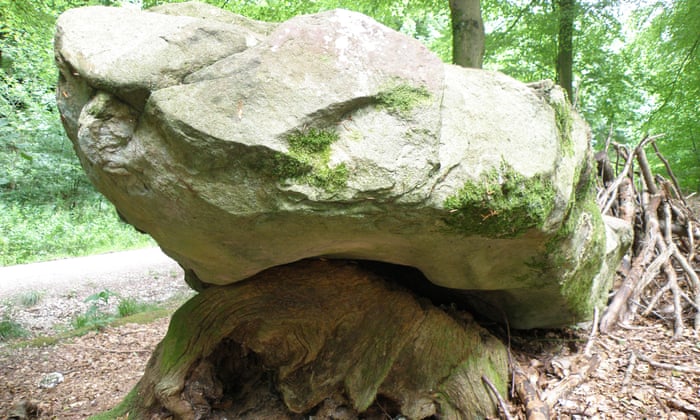 |
| A large sarsen stone at West Woods, the probable source of most of the sarsens used to construct Stonehenge.
Photograph: Katy A Whitaker
|
Labels: Antiquity, Archaeology, UK
Speleology With a Defined Purpose
"[The
research presents] uniquely preserved evidence indicating that people
were exploring underground cave systems to prospect and mine red ochre,
an iron oxide earth mineral pigment widely used by North America's
earliest inhabitants."
"[This ochre mine was a] regional-scale activity that was sustained over multiple generations."
"Whether
ochre procurement or use by Paleoindian groups and their Old World
predecessors constitutes evidence for ritual behaviour or utilitarian
purposes remains an ongoing anthropological discussion, yet consensus
suggests that the two are not mutually exclusive."
Research paper
"It's almost as if we passed through a portal. There's all sorts of stuff in these caves."
"We knew people were in there. We started seeing wide-spread destruction in what would have been a pristine cave."
"It
must be ingrained in human nature to pile rocks on top of each other.
There was no other way it could have got there other than a human
stacking it on top."
Sam Meacham, diver
 |
| A diver examines an ochre mine pit and mining debris. (CINDAQ.ORG) |
A first for archaeology, with the discovery in Mexico of the earliest
underground ochre mine in the New World. Described as a vast prehistoric
industrial complex perhaps 112 millennia old, where valuable red
iron-rich mineral was prospected by Paleoindians, representing a major
factor in enabling human evolution.
The initial discovery of the mine took place in 2017 with a Canadian
scuba diving instructor squirming through a tight passage, becoming the
first person to ever enter an unknown chamber in Quintana Roo's cave
complex on the eastern Yucatan peninsula on the Caribbean coast of
Mexico. A student of Fred Devos who taught an underwater cave survey
class noticed a tunnel lacking an exploration line.
Which led to Devos and Sam Meacham swimming into the dense black
interior which took them into an air dome, then back down into the
water, and finally through a tight restriction. The two, involved in
conservation of the local underground water systems, found themselves
submerged in a once-dry cave that had flooded roughly 8,000 years ago.
 |
A diver examines a rock pile thought to be an ancient
navigational marker inside a 12,000-year-old ochre mine in Quintana Roo,
Mexico. © CINDAQ.ORG
|
The floor of the cave had been cracked open at one time, revealing the
layer of ochre that lay beneath, the opening extended by smashing rocks,
breakage piled at the sides of the opening. Pits, stone tools, debris
cairns as directionals, hearths for charcoal, soot-blackened spots on
the ceiling were all revealed as the two explored their discovery; an
ochre mine, used when this was a dry cave.
Their discovery, with additional findings by a University of Missouri
team headed by Brandi MacDonald, with McMaster University's Eduard
Reinhardt, along with Meacham and Devos rounding out the research team,
saw their work published as new research in the journal
Science Advances.
The sheer scale of the three-cave system known as Camilo Mina, Monkey
dust and Sagitario, stretch kilometres from the Caribbean coastline.
The authors of the report describe a
"regional-scale activity that was sustained over multiple generations".
thought to have been dry from the period of the Last Glacial Maximum,
over 20,000 years ago, to the time it was flooded, theoretically 8,000
years ago, humans were already well established in North America,
arriving an estimated 14,000 years ago, from the north.
The discovery in 2018 of two infants ceremonially buried in Alaska
11,500 years ago , held as evidence for the theory that anatomically
modern humans emerged from Africa to spread across Asia, migrating from
Siberia through Alaska into the Americas, some in Pacific coastal
waters, others inland routes taken.
The various types of iron oxide mixed with clay and sand known as ochre,
have a place in humanity's historical evolution. The use of ochre spans
200,000 years, at least to the earliest days of modern Homo sapiens, to
the origin of art and sciences of creative expression and environment
control, as humans discovered how to mine and make use of it, in an
expression of symbolic thought and social behaviour.
The published paper examines the question whether ochre was valuable for
its utilitarian purposes such as use as a sunscreen, antiseptic,
pesticide, purgative, hide-tanning, or for ceremonial purposes such as
mortuary practices, and paint mixed with animal fat. Concluding that all
of these purposes both practical and religious found ochre had its
invaluable uses as an evolutionary social tool.
 |
| A diver from Centro Investigador del Sistema Acuífero de Q Roo (CINDAQ
A.C.) examines the oldest ochre mine ever found in the Americas, used
10,000-12,000 years ago by the earliest inhabitants of the Western
hemisphere to procure the ancient commodity. (CINDAQ.ORG) |
Labels: Archaeology, Evolution, Mexico, Paleoindians
The Conjunction of Ancient Oral Tradition and Science
"[There is a] growing body of evidence that people who used watercraft were able to thrive on the Pacific Coast of Canada at the end of the last Ice Age."
"It is possible that the coast was one of the means by which people entered the Americas at that time."
"We are working to collect more information on areas that were ice-free during the last Ice Age and reconstructing where sea level was at different times in different places."
Duncan McLaren, anthropologist, Hakai Institute, University of Victoria
 |
| Calvert Island, B.C. dig site (Grant Callegari, Hakai Institute) |
A line of research still "in its infancy" is being pursued by a team of archaeologists studying a prehistoric settlement on the coast of Calvert Island, British Columbia. The researchers discovered footprints etched in soft clay that date to the end of the last Ice Age, 13,000 years old, making them the earliest such findings in North America. Radiocarbon dating of two pieces of pine wood lodged in the foot imprints place the footprints in the middle Stone Age.
Published in the journal
PLOS One, these findings serve to corroborate a theory holding that some of the earliest settlers in North America arrived by boat. The 29 distinct footprints were discovered beneath a muddy surface, coated with a layer of sand, itself covered by a layer of gravel and more clay, all of which levels shielded them from erosion.
Researchers identified the footprints as those of at least two adults and one juvenile. The site was originally investigated in 2014, where the researchers hoped to find
"Ice Age sediments with archaeological remains". What they discovered appeared to be a track mark covered with bogs and dense forest. Returning in years that followed they found the buried footprints and theorize they were of people gathered around a hearth.
The sea level was six to ten feet lower, at the close of the last Ice Age -- from 11,000 to 14,000 years ago -- the footprints possibly left just above the high tide line. As popular theory has it, humans first reached North America through an ice bridge that connected Siberia and Alaska during the last Ice Age. These first people, according to the theory, entered through the small corridor that became the passage to the new world. But the new research indicates ocean-faring represented another viable path.
The remote location surrounded by thickets was reached by ferry boats since the closest road was about 40 kilometers' distance. Oral history common to the area for thousands of years where Heiltsuk Nations hold the stories of arrival since
"time immemorial" has resulted in a melding of science and archaeology matching and validating these ancient stories of arrival in a new land.
 |
| Duncan McLaren and Daryl Fedje excavate one of the footprints on Calvert Island, B.C. (Grant Callegari, Hakai Institute) |
Labels: Archaeology, British Columbia, North America
Archaeological History In A Toenail
"That zinc deficiency would explain that he [dead seaman] had a very low immune function. In the tough environment, he probably contracted infections and died from [tuberculosis]."
"We see a clear decline of meat consumption. If all the canned food [had lasted] he should not have [had] that problem. It's probably because some of the canned food was spoiled."
"We would expect, with the meat declining, he would eat a lot of seafood. But not really. Either he was not successful at getting seafood or they were just not able to do it."
"Being able to have the opportunity to work on this and try to contribute to solve this puzzle is an honour. Hopefully, we'll be able to continue working on finding more about them [the remains]."
Laurie Chan, co-author study on the fate of the Franklin Expedition

National Archives of Canada A 1945 photo of skulls, bleached white by the sun, discovered around King William Island in what is now Nunavut.
Published in the
Journal of Archaeological Science, two researchers have broken new ground in their study, scientifically discerning more of the details in an effort to understand what had occurred to the crews of the two ships, the
Erebus and the
Terror, that led to their deaths. With the use of lasers and high-energy beams the two researchers, Laurie Chan and Jennie Christensen, made their surprise discovery that it was not lead consumption from the food cans that killed the crew attempting to make their way back to civilization, out of the high Arctic.
It had always been assumed that they died of lead poisoning, but it seems that from the researchers' examination of a minute element of the remains of seaman John Hartnell, his body was shedding lead normally present in human tissues, giving previous researchers the impression that lead poisoning was the suspected cause of death. It was, instead, a severe zinc deficiency that was responsible for the deaths of the starving seamen, desperate to find their way to safety.

Hulton Archive/Getty Images From a painting by W Turner Smith depicting Franklin Expedition members attempting to leave the Arctic on foot.
Jennie Christensen contacted Laurie Chan at the University of Ottawa with the suggestion they team up to do some research. With experience in toxicology as an environmental consultant, Dr. Christensen felt they might find it useful to examine one of the corpses from the Franklin Expedition that had been discovered in 1984 on Beechey Island, with the use of the most advanced laser technology, the Canadian Light Source, in Saskatoon.
It has long been hypothesized that if explorers looking for the fabled Northwest Passage in the Arctic had abandoned their European mindset about survival in the Arctic environment with its hostile geological landscape and miserable weather conditions, to emulate the manner in which the area's inhabitants, the Inuit, adapted their lifestyle to those same conditions, they might have survived their dreadful ordeal. But the sturdy Englishmen that represented the seafaring explorations of the time could see no benefit in abandoning tradition under these extreme conditions.
From the research the two scientists conducted it became obvious that the 129 crew members were facing a challenge they were ill equipped to survive. By the time they set out to attempt to make their way on foot to safety from the unforgiving Arctic winter when their ships were caught in the ice, their leader, John Franklin, was already dead, though his body has never been recovered. The expedition had run low on its supplies well before the two ships became ice-stranded.
And they discovered this by closely examining and intuitively parsing a tiny sliver of toenail. They had made application to the Museum of History and the Inuit Heritage Trust which holds custody of the bodies, to enable them to examine one of the corpses. The researchers, as a result, were given a slender portion of toenail from the body of able seaman John Hartnell. With the use of lasers and the synchrotron of the University of Saskatchewan the toenail piece was examined.
They were able to discern three months' worth of data from that sliver. Toenails grow at the rate of about three millimetres monthly. By peering within a layer in the toenail that would have been protected from outside contaminants, they were able to determine the state of the seaman's health before his death, and what he had consumed to remain alive. Physically feeble from a lack of zinc in his system, it was revealed he had eaten very little meat.
It was assumed that the ships' store of canned meat went unconsumed because they had been contaminated, so seafood would have been the obvious replacement. Yet the sailors did not appear to have become devoted fishermen to keep themselves in health, which speedily declined as a result. There was little seafood residue in Hartnell's toenail. The assumption by the researchers was that what examining that minute portion of this man's remains revealed would also pertain to the other bodies.

Painting by J Franklin Wright The Erebus and the Terror. Ships from the 1845 Franklin expedition of Sir John Franklin.
Labels: Archaeology, Bioscience, Heritage
The Case for Jihad
"[Fellow Muslims], 314 years before Columbus, in 1178, Muslim sailors reached the American continent. Indeed, in Columbus' diaries there is a reference to a mosque on a hill near the seashore. We can have a talk with my Cuban brother here... A mosque would suit well on that hill today, if they allow it."
Turkish President Recep Tayyip Erdogan - speaking before Latin American Muslim leaders
"Dr. Barry Fell (Harvard University) introduced in his book 'Saga-America' 1980 solid scientific evidence supporting the arrival, centuries before Columbus, of Muslims from North and West Africa ... Engraved on rocks in the arid western U.S., he found texts, diagrams and charts representing the last surviving fragments of what was once a system of schools ... the language of instruction was North African Arabic written with old Kufic Arabic scripts ... the descendants of the Muslim visitors of North America are members of the present Iroquois, Algonquin, Anasazi, Hohokam and Olmec native people."
Youssef Mroueh, 1996: "Precolumbian Muslims in the Americas; the Preparatory Committee for International Festivals to celebrate the millennium of the Muslims arrival to the Americas (996-1996)."
 |
| telegraph.co.uk
Turkish President Recep Tayyip Erdogan stands inside the new Ak Saray presidential palace
|
Islamists tend to be extraordinarily defensive about the lack of civilizational, technical, scientific, social and educational progress of Islam. Modern Islam, in any event, where the nose-to-the-grindstone effort is not toward achievement in those fields, but grindingly focused on piety, the sacramental duties inherent in being a Muslim, with its five-times-daily prayer ritual and its unendingly stifling focus on Islam throughout all aspects of daily life.
Wishful thinking that compels imperialist autocrats like Turkey's Erdogan to claim precedence in all matters of foundational existence stumble against historical reality. The Hohokam and Olmec native people dated from around 2000BCE, long before Islam came into existence. Islamists counter this logic with logic of their own; that Islam is timeless and existed long before Prophet Mohammad delivered glad tidings of its existence.
Details, details; they are of the devil's making.
The ignorance and bland stupidity of total immersion in the glory of Islamic conquest breeds resentment that many of the lands conquered in Europe had a Christian revival that conquered Islam, returning those countries to their previous status and leading them to an eventual enlightenment which itself led to advances in all critical indices of knowledge and technological advancement, along with advancement in the social-religious spheres.
After Turkey's flirtation with Germany in the First World War and the defeat of the Ottoman Empire, Mustafa Kemal Ataturk -- disgusted with the stifling stultification of Islamism interfering with social and economic progress on every scale of human attainment -- took power to orchestrate the death of the caliphate. He ushered in a change in the Turkish alphabet, rousted Persian and Arabic vocabulary from the Turkish language, made it illegal for women to be veiled and men to be turbaned.
Better yet, he encouraged the study of science and engineering and founded universities. He moved Turkey in friendly tandem with Europe, emulating European advances to bring Turkey into the modern era, relinquishing the past as outmoded and unuseful. Mr. Erdogan, after almost a century of Turkey as a modern Republic, has begun the reversal of all that Ataturk established, returning the country firmly to Islamism.
Turkish historians were busy on the other hand, using Turkish anthropological studies based on pioneering 'studies' by Nazi Germany to reflect on the superiority of Turks as a master race (though not considered so by German fascists) in Asia Minor. Turks were held to be the authentic progenitors of civilizational rise in the pre-Islamic Middle East. Non-Turks were by definition subservient and lesser mortals, and treated as such.
And so, Turks have the authority to claim that Muslims discovered America. Muslims languish in misery over their loss of Andalusia, pining for that time when Europe will once again be Islamic and under Sharia law. And Mr. Erdogan has simply extended the territory meant to represent another conquest target; North and South America. Turkey is such a wonderfully useful member of NATO, and it shouldn't be long before it is looked up to as the major mover-and-shaker in any world organization.
Labels: Archaeology, Heritage, Islamism, Turkey
Islamic Waqf Revises History: 'Temple Mount, Kotel are Muslim'
Muslim group supervising Temple Mount makes new claims: King Solomon was Muslim, and the Western Wall is holy to Islam.
By Maayana Miskin --
Arutz Sheva 7
First Publish: 1/21/2014, 7:59 PM

A page from the Waqf's new guidebook
Israel news photo: Rabbi Chaim Richman
The Islamic Waqf, which supervises the Temple Mount, Judaism's
holiest site, has issued a pamphlet that makes new claims regarding the
Mount - arguing, among other things, that King Solomon was a Muslim and
that there is no Jewish connection to either the Temple Mount or the
Western Wall (Kotel).
Rabbi Chaim Richman of the Temple Institute supplied Arutz Sheva with
a copy of the pamphlet, which is currently being distributed to
visitors to the Al-Aqsa Mosque and the Temple Mount.
In one section, titled, “Al-Buraq Wall and NOT the Wailing Wall,” the
pamphlet teaches, “Al-Buraq wall is part of the western wall of the
Al-Aqsa mosque.” The pamphlet goes on to link the wall to Islam, stating
that it is known as
the site
where Mohammed “tied his winged steed, Al-Buraq.” (According to Islamic
legend Muhammed did not die but flew to heaven on a winged horse called
Al-Buraq.)
“Jews and some Christians, while falsely claiming it is part of their
so-called ‘Temple,’ have made a ritual of standing in front of it, and
wailing over the power they say was lost to Muslims. Despite the lack of
a shred of proof to support these claims, they have turned it into a
Jewish shrine since occupation in 1967, and have been conducting
so-called archaeological excavations beneath it… in preparation for
laying hands over the whole Mosque,” the pamphlet continues.
The Temple Mount is Judaism's holiest site, and is widely recognized
as the former site of the biblical Temple. The Mount is also the site of the Al-Aqsa Mosque.
The “informative” pamphlet is full of “utterly ludicrous, Kafkaesque
lies,” Richman said. He noted that guidebooks to the holy site published
by the Waqf in 1925, and again in 1950, recognized the site’s Jewish
history, including the existence of the Temple built by King Solomon.
The updated pamphlet denies historical evidence that the Biblical
King Solomon ever built a Jewish Temple, offering the following argument
as proof: “Solomon was just another prophet of Islam, and therefore, he
could not have the authority to build a structure for the worship of
any other god but Allah.”
In a section titled “Marwani Prayer hall and NOT Solomon’s Stables” the claim that King Solomon was Muslim was reiterated.
“Solomon – peace be upon
him -
was one of the prophets of Islam,” stated the pamphlet, which accused
“Jews and crusaders” of referring to an underground chamber near the
Temple Mount as “Solomon’s stables” in a deliberate attempt “to try to
lead people into believing that the structure is part of the so-called
‘temple.’”
Previous Waqf pamphlets, however, referred to Solomon’s Stables as “Solomon’s Stables.”
The pamphlet also repeatedly claimed the existence of Israeli schemes
against the holy site. Regarding a continuation of the Western Wall –
which the pamphlet claimed as a Muslim site called “Ribat al-Kurd” – the
pamphlet warned, “Occupation authorities still endanger this and other
parts of Al-Aqsa Mosque.”
Rabbi Richman, a long-time Temple Mount activist, noted that the
Waqf’s outrageous claims could indicate success in the battle for Jewish
rights at the holy site.
“The Muslim Waqf is terrified by the great increase in Jewish visits
to the Temple Mount, and by the successful media campaign that the
Temple Institute has waged in the international media clearly
demonstrating the centrality of the
location and its importance to the Jewish people,” he explained.
“In other words, we are winning, and they are trying even harder to
undermine Jewish connection to the Temple Mount” as a result, he
continued.
The latest
anti-Jewish incitement regarding the Temple Mount follows a series of recent incidents in which Jewish visitors faced discrimination.
Jews were
barred from bringing dried fruit
onto the Mount last week, apparently due to fear that they would
celebrate Tu Bishvat, and this week a religious Jewish woman was told
she
could not enter the site because her dress did not conform to Muslim standards of modesty.
On Monday, it was reported that Waqf officials have been violating Israeli laws to preserve antiquities by
planting trash cans atop the Mount.
Jewish activists have countered with a push to end rules that
discriminate against Jews at the holy site. Among other things, MKs from
the Jewish
Home party have put forth a bill that would allow Jews to
legally pray at the site for the first time since 1967.
Labels: Archaeology, Conflict, Heritage, Islam, Israel, Judaism
Archaeological Heritage
"I told them that this is property of the Egyptian people and you are destroying it. They were apparently upset with me because I am not veiled."
Monica Hanna, Egyptian archaeologist
When the Taliban held their Islamist rule in Afghanistan they infamously destroyed the giant ancient Buddhas of Bamiyan as world outcry was raised, decrying the destruction of the 1,700-year-old largest Buddhas in the world. The intention to destroy them raised the ire of archaeologists, historians and world heritage preservationists. The Taliban first tried to destroy the sandstone statues with anti-aircraft and tank fire. Then they brought dynamite from Kabul and succeeded.
 |
| Undated
photo of the world's tallest statue of Bhudda measuring 53 meters (175
feet) in Bamiyan, 125 kilometers (90 miles) west of Kabul in
Afghanistan. Supreme Commander of the Taliban Mullah Mohammad Omar had
ordered the destruction of all statues in Afghanistan, including the
centuries-old Buddha in Bamiyan, and armed Taliban troops fanned out
across the country Thursday to implement the supreme leader's order. (AP
Photo |
The operation in the Hindu Kush mountains of central Afghanistan was undertaken at the decree of Mullah Mohammed Omar, the leader of the Taliban, and collegial protector of al-Qaeda's Osama bin Laden.
By no means, however was this a one-time, unusual event undertaken by fanatical Islamists who consider the artefacts, holy sites and heritage memorials representing religions other than Islam to be disposable; in fact, requiring destruction for what they represent; faith in a religion other than Islam and by definition representing spiritual abomination. In destroying those objects of veneration, they fervently subscribe to the belief that they do service to Islam.
Whenever holy places are in contention because a prior religion had built a structure like a church or a synagogue, when the Muslim tide of conquest took possession of lands in the Middle East, North Africa, Asia or Europe, those institutions were converted to Islamic places of prayer; they were converted to mosques. In Jerusalem, the world's most famous holy site for what is often named the "Abrahamic" religions, the site of the ancient Temples of Solomon was co-opted for Islam.
Israeli archeologists feverishly seek out ancient treasures of that venerable geography where every foot of ground hosts discoveries yet to be made. Islamists deny that Judaism ever had a heritage in the Middle East, and deny the presence of ancient Jewish temples destroyed by the Assyrians and the Romans pre-dating that of Islamic mosques that stand now on the Temple Mount. If Jewish artefacts are discovered by Muslims they are destroyed; ancient sites sacred to Judaism are often defaced.
And now, in Egypt, with Islamist Muslim Brotherhood supporters running amok after the military's removal of Mohammad Morsi from the presidency and the Brotherhood from government, Egypt's antiquities and its famed museums holding national treasures of irreplaceable value are being ransacked, looted, destroyed and carried away. This is not the first time the Cairo Museum fell victim to looting and violation; the protests removing former President Hosni Mubarak also gave vent to these abhorrent actions.
 |
| FILE -- In this Saturday, Aug. 17, 2013 file photo, rows of display
cases are broken and empty at the Malawi Antiquities Museum after it was
ransacked and looted between the evening of Thursday, Aug. 15 and the
morning of Friday, Aug. 16, 2013 in Malawi, south of Minya, Egypt. The
theft of about 1,000 artifacts spanning some 3,500 years of history from
a small antiquities museum south of Cairo showcases the tenuous
security in the provinces. (AP Photo/Roger Anis, El Shorouk Newspaper,
File) EGYPT OUT |
And now, as violent clashes upend civil society in Egypt, thugs have stolen 3,500-year-old artefacts; statues, jewellery and other objects beyond value. They will likely surface on the international markets that operate underground in the sale of looted national treasures. Islamists who are involved in these actions have no respect for such antiquities of their own country, since they represent a period before Islam was revealed, when the worship of false gods and idols pre-dated Islam so these items have no redeeming value whatever to their way of thinking.

 |
| (Reuters) - Al Qaeda-linked Mali Islamists armed with Kalashnikovs and
pick-axes began destroying prized mausoleums of saints in the
UNESCO-listed northern city of Timbuktu on Saturday in front of shocked
locals, witnesses said. |
Just as in Mali insurgent Islamists destroyed precious ancient documents as trash and destroyed holy sites in Timbuktu. And just as in Libya even the sacred Sufi sites of Muslims worshipping a variant of the two major Islamic sects were destroyed by Islamist thugs.
In the Malawi Museum in the southern Nile River city of Minya, security was low as a result of police absence, permitting vandals to ransack the museum. Teenage boys overseen by older Brotherhood supporters ransacked the building, burned mummies, broke limestone sculptures too heavy to be carried off.
A statue of the daughter of the Pharaoh Akhenaten who first conceived of monotheism, though he felt the sun was god, was taken. Gold and bronze Greco-Roman coins, pottery, bronze-detailed sculptures of animals sacred to the ancient Egyptians, depictions of deities, all taken away or broken. Ancient Egyptian sarcophagi, mummies and other items too heavy to readily be removed were left, damaged, as of no value to the looters.
The head of museums for the Antiquities Ministry, Ahmed Sharaf, accused members of former president Mohammad Morsi's Muslim Brotherhood, spearheading protests against the government, of being responsible for the looting and attacks on police stations. They might also, on the other hand, have been the work of armed gangs of thieves taking advantage of the general lawlessness afflicting Egypt during this perilous time of great unrest.
Labels: Archaeology, Conflict, Egypt, Heritage, Islamism, Muslim Brotherhood
Looted Treasures
Infamously, Nazi Germany, while on the rampage to destroy all vestiges of European democracy, along with its intention to annihilate all human beings who had the misfortune of having Jewish ancestry, busied itself also in expropriating, lifting, acquiring, appropriating, stealing, valuable art works from various sources. From sources such as the museums and galleries of other countries they occupied and from private collections of undeserving art lovers, such as Jews - destined for mass murder, in any event.
Since the end of World War II, and the very public knowledge of the pains the Fascists went to, to rid Europe of its Jews through the planned and quite successful Holocaust, Germany officially rid of fascism and extremism has made strenuous efforts to redeem itself, to make amends, to secure itself back into the good graces of the international community. As a country and a nation deserving of taking an honoured place among its peers.
In the process it has indeed succeeded in putting its blemished past behind. A country that had once indulged in the most massive-scale invasions of other nations, confiscating their national authority in place of its own, netting and gathering its Jewish populations for transport to death camps, absorbing estimable items of historical and cultural value for its own displays, Germany has admitted its dreadful past, disowned it and become a trusted ally of those it once occupied and dominated.
At the initiation of WWII, Germany and Russia were allies; fascist Germany and the communist USSR, part of the Axis that included Italy, Japan and more minor countries like Iran, Finland, Hungary and Romania. But then there was a falling-out between Stalin and Hitler. And Nazi Germany sought to invade Communist Russia. It failed, but in the attempt it did manage to loot a Berlin museum of its priceless artefacts from the European Bronze Age.
 |
| The Hermitage Museum, St. Petersburg, Russia |
"I think this is a very sensitive question... So if we want any progress, we should not blow the problem out of proportion but seek ways to solve it. Probably we should not start a discussion now because people will appear on the Russian side who would evaluate the damage done to our art during World War Two."
Russian President Vladimir Putin
Germany, at a time when it has made good on its promises to return looted art to its true owners -- and at a time when museums all over the world have become sensitive to having deprived nations of their ancestral artefacts when in the 19th Century and before it was common for militaries like that of Napoleon's entering Egypt to destroy and to loot ancient treasures, as was also done by envoys, diplomats and entrepreneurs, finally returning ill-gotten treasures -- would appreciate reciprocation.
Angela Merkel, Germany's chancellor, had scheduled a joint news conference with the Russian president on the occasion of both appearing in St. Petersburg to open an exhibition at the Hermitage. An exhibition that includes a hoard of 821 ancient gold pieces: plates, rings and ornate bowls. Called the Eberswalde Hoard, the treasures were discovered by in an excavation east of Berlin in 1913.
Chancellor Merkel had planned to appeal to the Kremlin for the return of the art - reflecting international law. Germany has requested its return for decades. Russia has declined the requests, considering them to represent just and due reparations for the damage inflicted during Hitler's military invasion of the Soviet Union.
How perfectly uncivil.
Labels: Archaeology, Art, Controversy, Germany, Hypocrisy, Russia
-
 In Israel's columns, frescoes, and desert palaces, Herod the Great lives on
King Herod the Great is best known to Christians for trying to kill
the infant Jesus. But he also left his mark with stunning architectural
achievements, as seen in a new exhibit at the Israel Museum.
Archeological
excavations at Herodian, West Bank, Thursday, the artificial mountain
where Herod the Great built his largest and most lavish palace, yielded
much of the material for an immense Herod the Great exhibit at The
Israel Museum in Jerusalem.
Christa Case Bryant/The Christian Science Monitor
Herod the Great
may be best known among Christians as the cruel ruler who sought to
kill Jesus as an infant, and whose son book-ended Jesus’ earthly
travails, mocking him en route to his crucifixion.
But this shrewd politician, appointed by
Rome, left a far broader imprint on history.
From
Corinthian columns to lavish frescoes, Herod etched the latest fashions
of the Roman world into the Holy Land in rare and costly colors such as
cinnabar. Even rabbinic literature of his day recognized Herod as the
greatest builder of the land, though he was controversial among some
Jewish subjects who doubted his Judaism and saw him as a puppet of Rome.
Among
the monuments to Herod’s terrific construction are the imposing
mountain fortress of Masada, perched on a desert plateau with cliffs on
all sides;
Caesarea,
the largest artificial port of its day, complete with an amphitheater
for 10,000 spectators of chariot races; and Herodian, an artificial
mountain that punctuates the skyline just south of
Jerusalem, a palatial complex which he is believed to have built as his final resting place.
After decades of excavation at these sites by the late Israeli archeologist Ehud Netzer, The
Israel Museum in Jerusalem
recently launched a nine-month exhibit, “Herod the Great: The King’s
Last Journey.” The exhibit includes more than 30 tons of material, a
massive undertaking that required the museum to shore up its foundations
and heighten its ceilings.
While packed with eager visitors during the
Passover
holiday this week, the Herod exhibit has also received a fair amount of
negative attention. Much of the material for the exhibit was taken from
Herodian, which is located in an Israeli-controlled part of the
West Bank, drawing Palestinian accusations that
Israel is using archeology to expand its occupation.
And
Prof. Netzer's excavations and subsequent conclusions are
not universally accepted; Herod's presumed sarcophagus, for example,
has no inscription proving it was indeed his. Many details of the
exhibit have been pieced together based on the writings of 1st century
Jewish historian
Flavius Josephus.
It
is perhaps noteworthy that the exhibit is not controversial among
Israelis themselves. But why would the Jewish people seek to honor such a
leader, who murdered his own wife and children and was seen by more
than a few Jews as a Roman sellout?
“He was the last great Jewish king here,” responds Ilya Burda, an employee at Herodian.
As for his more savage exploits, well, that was par for the course in his day, Mr. Burda suggests.
“He
was a great builder, a great administrator, and a great killer, and all
these things came together,” he says, taking a break from the busy cash
register where crowds of Israelis are waiting for a ticket.
“In the
ancient world, you could not be the great something without killing
someone.”
Herod, who also built
a magnificent theater at Herodian before changing his mind and filling
it all in, was a key figure in the drama of Roman rule in ancient
Israel.
The son of a Nabatean mother and a father from an
influential Idumean family who had converted to Judaism, he was born in
73 BC and was appointed by the Roman senate in 40 BC to be “king of the
Jews.” His original patron was
Marc Antony, who ruled
Syria,
Egypt,
and Judea, with Herod as his man. But after Antony’s demise with his
Egyptian lover Cleopatra, Herod deftly switched his alliance to the
victorious Octavian.
Octavian, later known as Augustus Caesar,
accepted Herod’s continued rule and even expanded the borders of his
kingdom, which eventually stretched from
Gaza
up the coast to Caesarea, which Herod named after his new patron. Herod
also showed his strong connection to Rome in other ways, such as
sending two sons to be educated in Rome.
Ever conscious of the
importance of banquets to forge social and political ties, he sought to
reveal to his high-ranking Roman guests “not only his fondness for Roman
culture but also that he had good taste and was ‘one of them,’”
explains one plaque at The Israel Museum exhibit.
But there were
clear tensions between Herod’s loyalty to Rome and his Jewish subjects,
perhaps seen most clearly after 10,000 laborers and 1,000 priests
completed Herod’s rebuilding of the Second Temple – a huge feat of
ancient stonework, with one stone weighing more than 500 tons.
“Torn
between his desire to show respect for Jewish tradition and an equally
compelling desire to please his Roman overlords, he dedicated [the
temple] to the God of the Jews but later placed a golden eagle, a symbol
of the might of Rome, above the temple gate,” according to the exhibit.
While
the temple was considered the pinnacle of Herod’s architectural
achievement, Herodian was the largest and most lavish of his palaces.
Set atop a cone-like mountain with the top shaved off, it commands a
360-degree view of Jerusalem and the Judean hills.
Herod is
believed to have created the complex, complete with a large pool with
boats and a mausoleum for his burial, as a memorial to himself.
Today the small peak is surrounded by Palestinian villages and the Israeli settlements of Tekoa and
Nokdim, home to former Israeli Foreign Minister
Avigdor Lieberman.
Local
Palestinians say they used to frequent the site before the second
intifada broke out in 2000, but today there is heightened security.
“People
from [surrounding] neighborhoods could go and sell ice cream and
chocolate,” says Eyad Ali, a local whose father and grandfather worked
on the archeological excavations. “It’s become more difficult for them
to go there now…. It’s like a military zone, because it protects the
settlements.”
The site lies within Area C, which covers 62 percent
of the West Bank and has remained under full Israeli control according
to the 1993
Oslo
Accords. Meant to be merely an interim division of land, the accords
are but the latest in a long history of shifting political boundaries in
this ancient land.
After Herod’s death, his kingdom was divided between four of his children. Herod Antipas, who conferred with Roman prefect
Pontius Pilate
ahead of Jesus’ crucifixion, reigned the longest, until 39 AD. But by
then the Herodian kingdom had been overtaken by direct Roman rulers, who
destroyed the Second Temple in 70 AD, though much of Herod's stamp on
the land can still be seen today.
Labels: Archaeology, Culture, Heritage, Israel, Judaism
By Yolande Knell
BBC News, Jerusalem
 The Israel Museum has rebuilt what is believed to be Herod's burial place
He's
best known as a great tyrant. King Herod is said to have killed his
wife and sons as well as all the baby boys of Bethlehem.
But the first major exhibition on the Biblical ruler at the
Israel Museum sets out to prove that he also had positive qualities that
make him more deserving of the title "Herod the Great".
"We tried to show that he was not only the cruel person
described by [the Jewish historian] Josephus and the New Testament but
he was also a ruler who managed to keep this country in peace for 33
years," says curator Silvia Rosenburg.
"It was probably very difficult being a local ruler caught
between the Roman Empire and the different exigencies of Judaism, but he
did it very well. In his time there was prosperity and work for
everyone."
A main reason why there was mass employment was because of
the ambitious building projects ordered by Herod when he ruled between
37 and 4 BC.
Some of the artefacts on display at the museum come from the
Second Temple complex in Jerusalem, which he expanded. It was later
destroyed but Jews still pray at its Western Wall.
He also erected splendid palaces in the desert including
several in what is now the occupied West Bank: at Jericho, ancient
Cypros and Herodium. Fragments of frescoes and mosaics from the sites
have been pieced together at the museum.
The highlight of the exhibit is a partial reconstruction of
what is believed to be the King's burial place at Herodium. It was
discovered in 2007, by the Israeli archaeologist Ehud Netzer.
Some 30 tonnes of material were brought from Herodium
including masonry and the sarcophagus thought to have contained Herod's
body.
 Herodium is at the centre of a row between Israel and the Palestinians over cultural heritage
"The material that's never been seen before is the material
that's been excavated at Herodium just within recent years," says museum
director James Snyder.
"For the museum it's been a kind of privilege because we've
been able to bring this material here, give it quality restoration and
put it on view for the exhibition."
However, Palestinian officials say they will make a formal
complaint to the museum for removing relics from the West Bank, which
Palestinians want as part of a future state.
"This is against international law," says Rula Maayah, the Palestinian tourism and antiquities minister.
"Herodium is on land that was occupied in 1967. This is
Palestinian land and the Israelis have no right for excavations there.
They don't have any right or authority there in Herodium and they don't
have the right to take any antiquities."
Ms Maayah says Israeli authorities did not consult her
department about the exhibition even though it involves joint cultural
heritage. "Actually we only heard about it from the media," she says.
The Israel Museum says the material from Herodium - and other
West Bank locations - is on loan and will be returned to the sites, in
better condition than before, after the exhibition closes in nine
months.
 Israel Museum staff have carried out extensive conservation work on the artefacts
But the controversy serves as a powerful reminder of how modern politics is tied up with the history of the Holy Land.
"There is no respect for Palestinian history. Herod is not
just important for Jews. He is important to Christians and Muslims as
well," says Xavier Abu Eid, a spokesman for the PLO Negotiations Unit.
"Archaeology and tourism are being used as tools to justify the occupation."
The Israeli government lists Herodium, a hilltop
fortress-palace close to Bethlehem, as a national heritage site and has
opened a visitor attraction there.
It is in Area C, part of the 62% of the West Bank that has been kept under full Israeli control since the 1993 Oslo Accords.
Meanwhile, the Palestinians, who were granted full membership
of the United Nations' cultural body UNESCO in 2010, say they plan to
nominate Herodium and monasteries nearby for recognition as a world
heritage site.
Labels: Archaeology, Controversy, Culture, Heritage, Israel, Palestinian Authority
What is Beneath the Temple Mount?
As Israeli archaeologists recover artifacts
from the religious site, ancient history inflames modern-day political
tensions
- By Joshua Hammer
- Photographs by Polaris
- Smithsonian magazine, April 2011,
Subscribe

Non-Muslims use a wood ramp to enter the complex, home to the gilded
Dome of the Rock, an Islamic shrine, and the Western Wall, holy to Jews.
(Polaris)
My stint as an amateur archaeologist began one morning on the
southern slope of Mount Scopus, a hill on the northern outskirts of
Jerusalem. Inside a large hothouse covered in plastic sheets and marked
“Temple Mount Salvage Operation,” a woman from Boston named Frankie
Snyder—a volunteer turned staffer—led me to three rows of black plastic
buckets, each half-filled with stones and pebbles, then pointed out a
dozen wood-framed screens mounted on plastic stands. My job, she said,
was to dump each bucket onto a screen, rinse off any soil with water
from a garden hose, then pluck out anything of potential importance.
It wasn’t as easy as it sounded. A chunk of what looked like
conglomerate rock turned out to be plaster used to line cisterns during
the time of Herod the Great, some 2,000 years ago. When I tossed aside a
shard of green glass I thought was from a soft-drink bottle, Snyder
snatched it up. “Notice the bubbles,” she told me, holding it up to the
light. “That indicates it’s ancient glass, because during that time,
oven temperatures didn’t reach as high as they do now.”
Gradually, I got the hang of it. I spotted the handle of an ancient
piece of pottery, complete with an indentation for thumb support. I
retrieved a rough-edged coin minted more than 1,500 years ago and
bearing the profile of a Byzantine emperor. I also found a shard of
glass from what could only have been a Heineken bottle—a reminder that
the Temple Mount has also been the scene of less historic activities.
The odds and ends I was gathering are the fruits of one of Israel’s
most intriguing archaeological undertakings: a grain-by-grain analysis
of debris trucked out of the Temple Mount, the magnificent edifice that
has served the faithful as a symbol of God’s glory for 3,000 years and
remains the crossroads of the three great monotheistic religions.
Jewish tradition holds that it is the site where God gathered the
dust to create Adam and where Abraham nearly sacrificed his son Isaac to
prove his faith. King Solomon, according to the Bible, built the First
Temple of the Jews on this mountaintop circa 1000 B.C., only to have it
torn down 400 years later by troops commanded by the Babylonian king
Nebuchadnezzar, who sent many Jews into exile. In the first century
B.C., Herod expanded and refurbished a Second Temple built by Jews who
had returned after their banishment. It is here that, according to the
Gospel of John, Jesus Christ lashed out against the money changers (and
was later crucified a few hundred yards away). The Roman general Titus
exacted revenge against Jewish rebels, sacking and burning the Temple in
A.D. 70.
Among Muslims, the Temple Mount is called Haram al-Sharif (the Noble
Sanctuary). They believe it was here that the Prophet Muhammad ascended
to the “Divine Presence” on the back of a winged horse—the Miraculous
Night Journey, commemorated by one of Islam’s architectural triumphs,
the Dome of the Rock shrine. A territorial prize occupied or conquered
by a long succession of peoples—including Jebusites, Israelites,
Babylonians, Greeks, Persians, Romans, Byzantines, early Muslims,
Crusaders, Mamluks, Ottomans and the British—the Temple Mount has seen
more momentous historical events than perhaps any other 35 acres in the
world. Nonetheless, archaeologists have had little opportunity to search
for physical evidence to sort legend from reality. For one thing, the
site remains a place of active worship.
The authority
that controls the
compound, an Islamic council called the Waqf, has long forbidden
archaeological excavations, which it views as desecration. Except for
some clandestine surveys of caves, cisterns and tunnels undertaken by
European adventurers in the late 19th century—and some minor
archaeological work conducted by the British from 1938 to 1942, when the
Al-Aqsa Mosque was undergoing renovation—the layers of history beneath
the Temple Mount have remained tantalizingly out of reach.
Thus the significance of those plastic buckets of debris I saw on Mount Scopus.
Today the Temple Mount, a walled compound within the Old City of
Jerusalem, is the site of two magnificent structures: the Dome of the
Rock to the north and the Al-Aqsa Mosque to the south. In the southwest
stands the Western Wall—a remnant of the Second Temple and the holiest
site in Judaism. Some 300 feet from the Al-Aqsa Mosque, in the southeast
corner of the compound, a wide plaza leads to underground vaulted
archways that have been known for centuries as Solomon’s
Stables—probably because the Templars, an order of knights, are said to
have kept their horses there when the Crusaders occupied Jerusalem. In
1996, the Waqf converted the area into a prayer hall, adding floor tiles
and electric lighting. The Muslim authorities claimed the new
site—named the El-Marwani Mosque—was needed to accommodate additional
worshipers during Ramadan and on rain days that prevented the faithful
from gathering in the open courtyard of the Al-Aqsa Mosque.
Three years later, the Waqf, with the approval of the Israeli
government, announced plans to create an emergency exit for the
El-Marwani Mosque. But Israeli officials later accused the Waqf of
exceeding its self-stated mandate. Instead of a small emergency exit,
the Waqf excavated two arches, creating a massive vaulted entranceway.
In doing so, bulldozers dug a pit more than 131 feet long and nearly 40
feet deep. Trucks carted away hundreds of tons of soil and debris.
Israeli archaeologists and scholars raised an outcry. Some said the
Waqf was deliberately trying to obliterate evidence of Jewish history.
Others laid the act to negligence on a monstrous scale.
“That earth was saturated with the history of Jerusalem,” says Eyal
Meiron, a historian at the Ben-Zvi Institute for the Study of Eretz
Israel. “A toothbrush would be too large for brushing that soil, and
they did it with bulldozers.”
Yusuf Natsheh, the Waqf’s chief archaeologist, was not present during the operation. But he told the
Jerusalem Post
that archaeological colleagues had examined the excavated material and
had found nothing of significance. The Israelis, he told me, were
“exaggerating” the value of the found artifacts. And he bristled at the
suggestion the Waqf sought to destroy Jewish history. “Every stone is a
Muslim development,” he says. “If anything was destroyed, it was Muslim
heritage.”
Zachi Zweig was a third-year archaeology student at Bar- Ilan
University, near Tel Aviv, when he heard news reports about dump trucks
transporting Temple Mount soil to the Kidron Valley. With the help of a
fellow student he rounded up 15 volunteers to visit the dump site, where
they began surveying and collecting samples. A week later, Zweig
presented his findings—including pottery fragments and ceramic tiles—to
archaeologists attending a conference at the university. Zweig’s
presentation angered officials at the Israel Antiquities Authority
(IAA). “This is nothing but a show disguised as research,” Jon Seligman,
the IAA’s Jerusalem Region Archaeologist, told the
Jerusalem Post.
“It was a criminal deed to take these items without approval or
permission.” Soon afterward, Israeli police questioned Zweig and
released him. By that point though, Zweig says, his cause had attracted
the attention of the media and of his favorite lecturer at Bar-Ilan—the
archaeologist Gaby Barkay.
Zweig urged Barkay to do something about the artifacts. In 2004,
Barkay got permission to search the soil dumped in the Kidron Valley. He
and Zweig hired trucks to cart it from there to Emek Tzurim National
Park at the foot of Mount Scopus, collected donations to support the
project and recruited people to undertake the sifting. The Temple Mount
Sifting Project, as it is sometimes called, marks the first time
archaeologists have systematically studied material removed from beneath
the sacred compound.
Barkay, ten full-time staffers and a corps of part-time volunteers
have uncovered a wealth of artifacts, ranging from three scarabs (either
Egyptian or inspired by Egyptian design), from the second millennium
B.C., to the uniform badge of a member of the Australian Medical Corps,
who was billeted with the army of British Gen. Edmund Allenby after
defeating the Ottoman Empire in Jerusalem during World War I. A bronze
coin dating to the Great Revolt against the Romans (A.D. 66-70) bears
the Hebrew phrase, “Freedom of Zion.” A silver coin minted during the
era when the Crusaders ruled Jerusalem is stamped with the image of the
Church of the Holy Sepulchre.
Barkay says some discoveries provide tangible evidence of biblical
accounts. Fragments of terra-cotta figurines, from between the eighth
and sixth centuries B.C., may support the passage in which King Josiah,
who ruled during the seventh century, initiated reforms that included a
campaign against idolatry. Other finds challenge long-held beliefs. For
example, it is widely accepted that early Christians used the Mount as a
garbage dump on the ruins of the Jewish temples. But the abundance of
coins, ornamental crucifixes and fragments of columns found from
Jerusalem’s Byzantine era (A.D. 380–638) suggest that some public
buildings were constructed there. Barkay and his colleagues have
published their main findings in two academic journals in Hebrew, and
they plan to eventually publish a book-length account in English.
But Natsheh, the Waqf’s chief archaeologist, dismisses Barkay’s finds because they were not found
in situ
in their original archaeological layers in the ground. “It is worth
nothing,” he says of the sifting project, adding that Barkay has leapt
to unwarranted conclusions in order to strengthen the Israeli argument
that Jewish ties to the Temple Mount are older and stronger than those
of the Palestinians. “This is all to serve his politics and his agenda,”
Natsheh says.
To be sure, the Mount is a flash point in the Middle East conflict.
Israel seized East Jerusalem and the Old City from Jordan in 1967. While
Israelis saw this as the reunification of their ancient capital,
Palestinians still deem East Jerusalem to be occupied Arab land (a
position also held by the United Nations). The Temple Mount is
precariously balanced between these opposing views. Although Israel
claims political sovereignty over the compound, custodianship remains
with the Waqf. As such, Israelis and Palestinians cautiously eye each
other for any tilt in the status quo. A September 2000 visit to the
Temple Mount by the Israeli politician Ariel Sharon was interpreted by
Palestinians as a provocative assertion of Israel’s sovereignty, and
helped spark the second intifada uprising, which, by some estimates,
claimed as many as 6,600 lives, as rioting, armed clashes and terrorist
bombings erupted throughout the Palestinian territories and Israel. At
its core, the Israeli-Palestinian conflict represents rival claims to
the same territory—and both sides rely on history to make the case for
whose roots in the land run deepest.
For the Israelis, that history begins 3,000 years ago, when the
Temple Mount—believed by many biblical scholars to be the mountain in
the region of Moriah mentioned in the Book of Genesis—was an irregularly
shaped mound rising some 2,440 feet among the stark Judean Hills. The
summit loomed above a small settlement called Jebus, which clung to a
ridge surrounded by ravines. The Old Testament describes how an army led
by David, the second king of ancient Israel, breached the walls of
Jebus around 1000 B.C. David then built a palace nearby and created his
capital, Jerusalem. At the site of a threshing floor atop the mountain,
where farmers had separated grains from chaff, David constructed a
sacrificial altar. According to the Second Book of Kings and the First
Book of Chronicles, David’s son, Solomon, built the First Temple (later
known as the Beit Hamikdash) on that site.
“The Temple Mount was the Parthenon of the Jews,” says Barkay,
describing how worshipers would have climbed a steep set of stairs to
get to it. “You would feel every step of the climb in your limbs and
your lungs.”
Still, “we know nothing about the First Temple, because there are no
traces of its physical remains,” says Benjamin Kedar, a history
professor at Hebrew University and chairman of the board of directors at
the IAA. Scholars, however, have pieced together a tentative portrait
of the Beit Hamikdash from descriptions in the Bible and architectural
remains of sanctuaries elsewhere in the region built during the same
era. It is envisioned as a complex of richly painted and gilded courts,
constructed with cedar, fir and sandalwood. The rooms would have been
built around an inner sanctum—the Holy of Holies—where the ark of the
covenant, an acacia-wood chest covered with gold and containing the
original Ten Commandments, was said to have been stored.
Until recently, Palestinians generally acknowledged that the Beit Hamikdash existed. A 1929 publication,
A Brief Guide to the Haram al-Sharif,
written by Waqf historian Aref al Aref, declares that the Mount’s
“identity with the site of Solomon’s temple is beyond dispute. This too
is the spot, according to universal belief, on which David built there
an altar unto the Lord, and offered burnt and peace offerings.” But in
recent decades, amid the intensifying quarrel over the sovereignty of
East Jerusalem, a growing number of Palestinian officials and academics
have voiced doubts. “I will not allow it to be written of me that I
have...confirmed the existence of the so-called Temple beneath the
Mount,” Palestinian leader Yasir Arafat told President Bill Clinton at
the Camp David peace talks in 2000. Arafat suggested the site of the
Temple Mount might have been in the West Bank town of Nablus, known as
Shechem in ancient times.
Five years after the Camp David talks, Barkay’s sifting project
turned up a lump of black clay with a seal impression inscribed with the
name, in ancient Hebrew, “[Gea]lyahu [son of] Immer.” In the Book of
Jeremiah, a son of Immer—Pashur—is identified as chief administrator of
the First Temple. Barkay suggests that the seal’s owner could have been
Pashur’s brother. If so, it’s a “significant find,” he says—the first
Hebrew inscription from the First Temple period to be found on the Mount
itself.
But Natsheh—sipping Arabic coffee in his office at Waqf headquarters,
a 700-year-old former Sufi monastery in the Muslim Quarter of the Old
City—is dubious. He says he’s also frustrated by Israeli dismissal of
Palestinian claims to the sacred compound where, he says, the Muslim
presence
—excepting the Crusader period (A.D. 1099-1187)—“extends for
1,400 years.” Natsheh won’t say if he believes in the existence of the
First Temple, given the current political climate. “Whether I say ‘yes’
or ‘no,’ it would be misused,” he tells me, fidgeting. “I would not like
to answer.”
According to contemporary accounts, the Babylonian Army
destroyed the First Temple in 586 B.C. The ark of the covenant
disappeared, possibly hidden from the conquerors. Following the conquest
of Jerusalem by the Persians in 539 B.C., the Jews returned from exile
and, according to the Book of Ezra, constructed a Second Temple on the
site.
In the first century B.C., King Herod undertook a massive reshaping
of the Temple Mount. He filled up the slopes surrounding the mount’s
summit and expanded it to its present size. He enclosed the holy site
within a 100-foot-high retaining wall constructed of limestone blocks
quarried from the Jerusalem Hills and constructed a far more expansive
version of the Second Temple. “Herod’s attitude was, ‘Anything you can
do, I can do better and larger,’” says Barkay. “It was part of his
megalomania. He wanted also to compete with God.”
Barkay says he and his co-workers have turned up physical evidence
that hints at the grandeur of the Second Temple, including pieces of
what appear to be opus sectile floor tiles—elements of a technique in
Herod’s time that used stone of various colors and shapes to create
geometric patterns. (Describing the temple, the ancient historian
Josephus wrote of an open-air courtyard “laid with stones of all
sorts.”) Other discoveries might offer glimpses of daily religious
rituals—notably ivory and bone combs that could have been used in
preparation for a ritual mikvah, or purifying bath, before entering the
courts’ sanctified interior.
On a cloudless morning, I join historian Meiron for a tour of the
Temple Mount. We enter the Old City through the Dung Gate and then
arrive at the Western Wall plaza. When the Romans destroyed Herod’s
temple in A.D. 70, they knocked the retaining wall down piece by piece.
But the stones from the top tumbled down and formed a protective barrier
that preserved the wall’s lower portions. Today, hundreds of Orthodox
Jews are gathered in devotion before the remnant of that wall—a ritual
that perhaps first occurred in the fourth century A.D. and has been
practiced continually since the early 16th century, after the Ottoman
conquest of Jerusalem.
During the Ottoman Empire and the British Mandate, this area was a
warren of Arab houses, and Jews who wanted to pray here had to squeeze
into a 12-foot-wide corridor in front of the Herodian stones. “My father
came here as a child and he told me, ‘We used to go through alleys; we
entered a door; and there was the wall on top of us,’ ” Meiron tells me.
After Israel claimed sovereignty over East Jerusalem in 1967, it
demolished the Arab houses, creating the plaza.
Meiron and I climb a “temporary” wooden walkway that leads above the
Western Wall to the Mughrabi Gate, the only entry point to the Temple
Mount for non-Muslims—and a symbol of how any attempt to change the
site’s geography can upset the delicate status quo. Israel erected the
wooden structure after an earthen ramp collapsed in 2004, following an
earthquake and heavy snowfall. In 2007, the IAA approved the
construction of a permanent bridge that would stretch from the Old
City’s Dung Gate to the Mughrabi Gate.
But members of both the Jewish and Muslim communities opposed the
plan. Some Israeli archaeologists raised an outcry over the bridge’s
proposed path through the Jerusalem Archaeological Park—the site of
excavations conducted in the Old City—saying the construction could
damage artifacts. The late Ehud Netzer, the archaeologist who discovered
King Herod’s tomb in 2007, argued that moving the entrance ramp could
effectively cut off the Western Wall’s connection to the Temple Mount,
thereby undermining Israel’s claims to sovereignty over the sacred
compound. And the Israeli activist group Peace Now warned the project
might alarm Muslims since the new route and size of the bridge (three
times the original ramp) would increase non-Muslim traffic to the Mount.
Indeed, when Israel began a legally required archaeological survey of
the planned construction site, Palestinians and Arab Israelis joined in
a chorus of protest. They claimed the Israeli excavations—although
conducted several yards outside the walls of the sacred
compound—threatened the foundations of the Al-Aqsa Mosque. Some even
said that it was Israel’s covert plan to unearth remains of the First
and Second Temples in order to solidify its historic claim to the Mount.
For the time being, non-Muslim visitors continue to use the temporary
wooden bridge that has been in place for seven years.
Such disputes inevitably send ripples throughout the
international community. Both the Jordanian and Turkish governments
protested Israel’s plans for the new walkway. And in November 2010, the
Palestinian Authority created a diplomatic kerfuffle when it published a
study declaring the Western Wall was not a Jewish holy site at all,
but part of the Al-Aqsa Mosque. The study contended, “This wall was
never part of the so-called Temple Mount, but Muslim tolerance allowed
the Jews to stand in front of it and weep over its destruction,” which
the U.S. State Department called “factually incorrect, insensitive and
highly provocative.”
Today, the scene is calm. At various spots on the wide, leafy plaza
Palestinian men gather in study groups, reading the Koran. We ascend
steps toward the magnificent Dome of the Rock—which was built during the
same period as the Al-Aqsa Mosque to the south, between A.D. 685 and
715. The Dome of the Rock is built on top of the Foundation Stone, which
is sacred to both Jews and Muslims. According to Jewish tradition, the
stone is the “navel of the Earth”—the place where creation began, and
the site where Abraham was poised to sacrifice Isaac. For Muslims, the
stone marks the place where the Prophet Muhammad ascended to the Divine
Presence.
On the east side of the Temple Mount’s retaining wall, Meiron shows
me the Golden Gate, an elaborate gatehouse and portal. Its provenance
remains a subject of debate among historians, pitting the majority, who
claim early Muslims built it, against those who insist it is a Byzantine
Christian structure.
Historians who argue that the Byzantines didn’t build the gate point
to ancient accounts describing how early Christians turned the Mount
into a garbage heap. The Byzantines, scholars say, saw the destruction
of the Second Temple as vindication of Jesus’ prophecy that “not one
stone shall be left here upon another” and as a symbol of Judaism’s
downfall. But other historians counter that the eastern entrance to the
Mount, where the Golden Gate was built, was important to the Byzantines
because their interpretation of the Gospel of Matthew holds that Jesus
entered the Temple Mount from the Mount of Olives to the east when he
joined his disciples for the Passover meal. And in A.D. 614, when the
Persian Empire conquered and briefly ruled Jerusalem, they took back to
Persia parts of the True Cross (believed to be the cross of the
Crucifixion) from the Church of the Holy Sepulchre. Fifteen years later,
after defeating the Persians, Heraclius, a Byzantine emperor, is said
to have brought the True Cross back to the holy city—passing from the
Mount of Olives to the Temple Mount, and then to the Holy Sepulchre.
“Thus you had two triumphant entrances: Jesus and Heraclius,” says
Meiron. “That’s enough to explain why the Byzantines would invest in
building that gate.”
While Barkay is in the camp that believes the Golden Gate is an early
Muslim structure, Meiron thinks the sifting project’s discovery of
Byzantine-era crosses, coins and ornamental columns supports the theory
that the gate was built by the Byzantines. “Now we’re not so sure the
Temple Mount fell into disrepair,” Meiron says. In addition, Barkay has
found archival photographs taken during renovations of the Al-Aqsa
Mosque in the late 1930s that appear to reveal Byzantine mosaics beneath
the structure—further evidence that some sort of public building had
been constructed at the site.
I visited Barkay at his modest apartment in East Talpiot, a Jewish
suburb of East Jerusalem. The grizzled, chain-smoking archaeologist was
born in Budapest in 1944, the very day the Nazis sent his family to the
city’s Jewish ghetto. After the war his father—who had spent a year in a
Nazi forced labor camp in Ukraine—established the first Israeli
delegation in Budapest, and the family emigrated to Israel in 1950.
Barkay earned his doctorate in archaeology at Tel Aviv University. In
1979, exploring a series of ancient burial caves in an area of Jerusalem
above the Valley of Hinnom, he made a remarkable discovery: two
2,700-year-old silver scrolls delicately etched with the priestly
blessing that Aaron and his sons bestowed on the children of Israel, as
mentioned in the Book of Numbers. Barkay describes the scrolls, which
contain the earliest-known fragments of a biblical text, as “the most
important find of my life.”
Barkay and I get into my car and drive toward Mount Scopus. I ask him
about Natsheh’s charge that the sifting project is infused with a
political agenda. He shrugs. “Sneezing in Jerusalem is an intensely
political activity. You can do it to the right, to the left, on the face
of an Arab or a Jew. Whatever you do, or don’t do, is political.”
Still, some criticism of Barkay stems not from politics but from
skepticism about his methodology. Natsheh is not the only archaeologist
to raise questions about the value of artifacts not found in situ. The
dirt excavated by the Waqf is landfill from previous eras. Part of that
landfill, Barkay says, comes from the Mount’s eastern section, which the
Waqf paved over in 2001. But most of it, he says, was taken from vacant
parts of the Mount when an entrance to Solomon’s Stables was blocked,
sometime between the reign of the Fatimid and Ayyubid dynasties.
Collectively, he says, the landfill includes artifacts from all periods
of the site.
But Israeli archaeologist Danny Bahat told the
Jerusalem Post
that, since the dirt was filler, the layers do not represent a
meaningful chronology. “What they did is like putting the remains in a
blender,” adds Jerusalem region archaeologist Seligman about the Waqf
excavation. “All the layers are now mixed and damaged.” Archaeologist
Meir Ben-Dov, a specialist on the Old City, has raised doubts as to
whether all the landfill even originated on the Temple Mount. Some of
it, he suggests, was brought there from Jerusalem’s Jewish Quarter.
Barkay, not surprisingly, rejects this suggestion, citing the
frequent finds of Ottoman glazed wall-tile fragments from the Dome of
the Rock, dating back to the 16th century, when Sultan Suleiman the
Magnificent repaired and beautified the shrine. And, though the
excavated soil is not in situ, he says that, even if one were to
discount the scientific value of the artifacts by 80 percent, “we are
left with 20 percent, which is a lot more than zero.”
Barkay identifies and dates the artifacts through “typology”: he
compares his finds with similarly made objects in which a timeline has
been firmly established. For instance, the opus sectile pieces Barkay
found in the soil were precisely the same—in terms of material, shape
and dimensions—as those that Herod used in palaces at Jericho, Masada
and Herodium.
We arrive at Barkay’s salvaging operation, and he greets a handful of
staffers. Then he leads the way to a worktable and shows me a sampling
of a single day’s efforts. “Here’s a bowl fragment from the First Temple
period,” he says. “A Byzantine coin here. A Crusader arrowhead made of
iron. This is a Hasmonean coin, from the dynasty that ruled Judah in the
second century B.C.” Barkay tells me that volunteers by the hundreds
arrive each week to help with the sifting—even ultra-Orthodox Jews, who
traditionally oppose archaeological excavations in the Holy Land. “They
say all the evidence is in the [scriptural] sources, you don’t need
physical proof. But they’re willing to make an exception, because it’s
the Temple Mount.” Barkay pauses. “If I look at some of the volunteers,
and I see the excitement in their eyes, that they with their own fingers
can touch the history of Jerusalem, this is irreplaceable.” He admits
the project has attracted “very few” Palestinians or Arab Israelis.
Leading me outside the plastic-covered building, Barkay squints into
the sunlight. We can see the Temple Mount in the distance, the sunlight
glinting off the golden-topped Dome of the Rock. “We’ve been working for
six years, and we’ve gone through 20 percent of the material,” he says,
pointing to huge heaps of earth that fill an olive grove below the
tent. “We have another 15 to 20 years to go.”
Joshua Hammer wrote about the Bamiyan Buddhas in the November 2010 issue.
Kate Brooks is an Istanbul-based photojournalist who has worked in Iraq, Lebanon and Afghanistan.
Labels: Archaeology, Conflict, Heritage, Islam, Israel, Judaism


