Neolithic Age Ingenuity and Engineering
"The sarsen stones make up the iconic outer circle and central trilithon [two vertical stones supporting a horizontal stone] horseshoe at Stonehenge. They are enormous."
"How they were moved to the site is still really the subject of speculation."
"It has been really exciting to harness 21st-century science to understand the Neolithic past, and finally answer a question that archeologists have been debating for centuries."
David Nash, geomorphologist, University of Brighton
"The bluestones, we've known, come from mid-west Wales and they were easy to source because there are inclusions and quartz which you can match to the outcrop. The large stones are pretty uniform and just look like a big block, so it's difficult to interrogate them and find where they are from."
"There are no sarsens of this size left in the downs, that's why it's been such a mystery and some people have suggested they come from elsewhere as you get outcrops in other places where you have chalk land, like Devon and Kent."
"The west wood was overlooked because it's under ancient woodland and a lot of sarsens were removed in the 19th century for road stones, particularly in Swindon, but there are still sarsens buried in among the tees. To be able to pinpoint the area that Stonehenge's builders used to source their materials around 2500 BC is a real thrill."
"We can now say, when sourcing the sarsens, the overriding objective was size -- they wanted the biggest, most substantial stones they could find and it made sense to get them from as nearby as possible."
"This is in stark contrast to the source of the bluestones, where something quite different -- a sacred connection to these mountains perhaps -- was at play."
Susan Greaney, historian, archaeologist with a specialization in British prehistory, Cardiff University
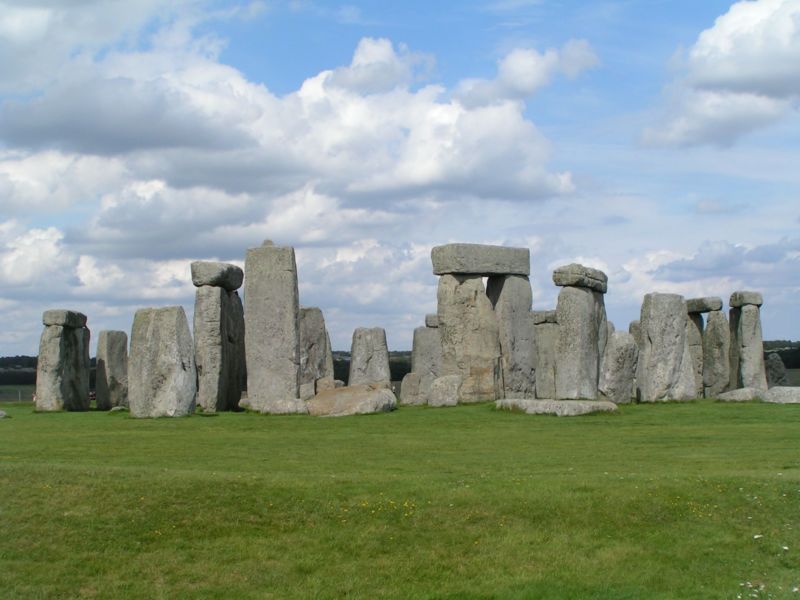 |
Stonehenge
|
Before there were the monumentally imposing great cathedrals of Europe, there was Stonehenge. An ancient circle of massive stone formations dominating a landscape, where sun worship as a Druid temple of sorts spoke to an ancient belief in the divine. Humankind seems always to have had a need of faith, faith in an unknown powerful force imagined as a divine intelligence which created all that exists. The sun was the manifestation of that life-giving, life-sustaining source. One of the Egyptian dynasties was also that of sun-worship when Akhenaten reigned and named the sun Aten.
The building of the ancient Pyramids presented a conundrum just as Stonehenge has done; how massive stone blocks could have been moved to particular sites to construct gargantuan edifices of worship and burial in preparation for the afterlife. Stonehenge's megalithic bluestones were known to have been hauled 225 kilometres from Wales' Preseli Mountains to their destination on Salisbury Plain. A laborious effort of both brute strength and engineering; presumably with the use of log rollers to convey the massive stones over a demanding geology.
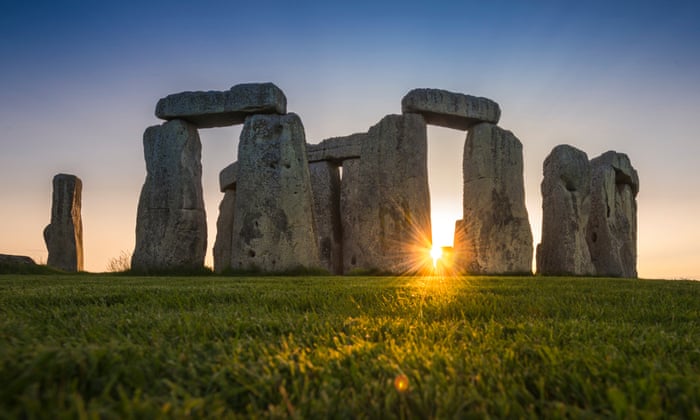 |
| Sunset at Stonehenge. Photograph: A Pattenden |
A mystery appears to have been cleared with the newfound knowledge that the 52 pale-grey sandstone megaliths known as sarsens originated in the West Woods of the Marlborough Downs, a mere 25 kilometres in comparison distance, north of Stonehenge. Not far from the Neolithic monument site at Avebury. It took the combined work of archaeologists from English Heritage and the University of Sheffield to solve this centuries-old conundrum of human effort in a divine mission of devotion overcoming massive physical effort and distance difficulty to achieve the goal.
A core sample that had been drilled during repair work undertaken in the 1950s involving the "Stone 58" had been taken as a memento to the United States, with permission, by a man who had worked for the company involved in the conservation work when the sarsen core sample was extracted and metal rods inserted to stabilize a cracked megalith. The souvenir moved with this man when he emigrated to the U.S. and was eventually returned to Britain to enable research.
When fragments of the sample were analyzed, researchers were able to establish the geochemical fingerprint of the sarsen which it was taken from, which matched sandstone at West Woods. Most of the sarsens weigh about 20 tonnes, with some as heavy as 30 tonnes; the largest is 30 feet in length. It is hazarded that the Preseli stones were selected for ritualistic purposes while the sarsens were chosen for size, according to archeological logic. Moving such 30 tonne stones would have represented an impossibly difficult prospect.
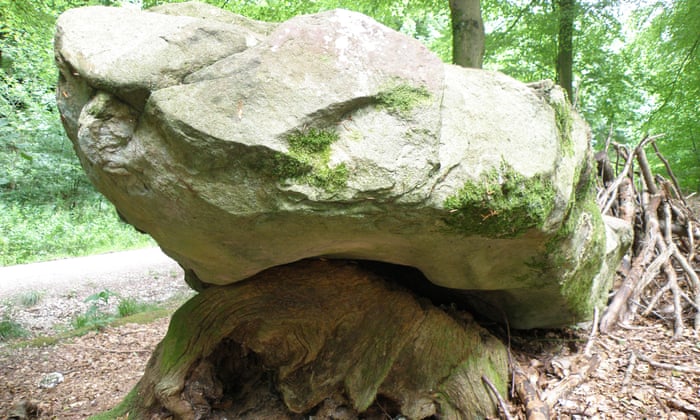 |
| A large sarsen stone at West Woods, the probable source of most of the sarsens used to construct Stonehenge.
Photograph: Katy A Whitaker
|
Labels: Antiquity, Archaeology, UK
Not Guilty: Islamic Republic of Iran
"The Islamic Republic of Iran deeply regrets this disastrous mistake. My thoughts and prayers go to all the mourning families,"
"The head of the Islamic Republic of
Iran fully acknowledges that the tragedy was due to the erroneous
actions of the military of this state."
"Further
investigation is needed to identify all the causes and roots of this
tragedy and prosecute the perpetrators of this unforgivable mistake and
inform the honorable people of Iran and the families of the victims
about it."
"It is
also necessary to adopt the required arrangements and measures to
address the weaknesses of the country's defense systems to make sure
such a disaster is never repeated."Iranian President Hassan Rouhani
"It [the long-awaited release of the Iranian report on the Ukraine airliner shootdown] raises more questions and more questions. It's very hard to believe this story."
"It's very hard to believe this story an this is the only scenario that makes it an accident. It was wrongly calibrated 107 degrees, but why were the other eight planes safe? Why?"
"It was calibrated wrong just for PS752?"
Hamed Esmaeilion, Toronto
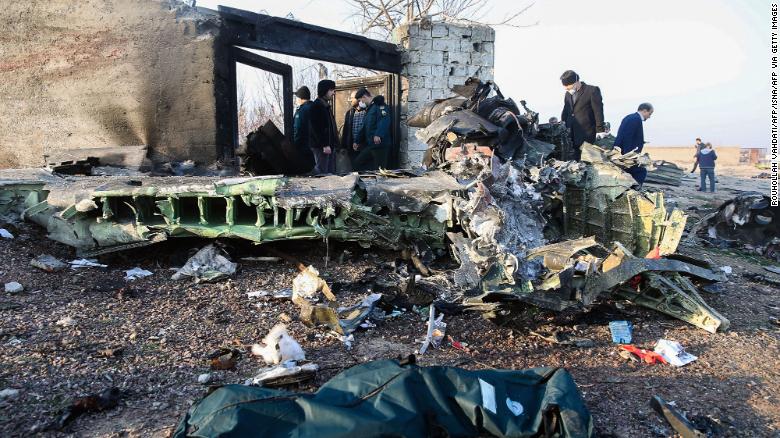 |
| People stand near the wreckage after a Ukrainian plane carrying 176 passengers crashed near Imam Khomeini airport. |
Iran's Civil Aviation Organization released its investigatory report on the shootdown of the Ukrainian airliner in January. A misaligned missile battery and associated errors in judgement enacted by the Iranian military was responsible for Ukraine International Airlines Flight PS752 being blasted out of the sky shortly after leaving Tehran when the Islamic Revolutionary Guard Corps produced a disastrous crash killing 175 people, 55 of whom were citizens of Canada, 30 permanent Canadian residents, along with dozens of other Iranians returning to Canada to pursue their studies.
While originally claiming no responsibility for the plane's midair explosion, the Islamic Republic was forced to admit culpability once extensive evidence was produced that the plane had indeed been destroyed with its attendant loss of life by Iran. Ever since, Iran, though professing its willingness to cooperate with an Ukrainian investigation and that it would provide the further incriminating evidence contained within the plane's black boxes to France for highly technical interpretation, has done nothing of the kind.
The full circumstances surrounding the crash have not yet been revealed simply because Iran keeps stalling investigative efforts. Now it has produced its own, and Ukraine, Canada, Afghanistan, Sweden, Germany and Britain all survey the explanation with a healthy dose of skepticism. The shooting down of the Ukraine airliner occurred the very night Iran launched a ballistic-missile attack meant to target American soldiers in Iraq in response to the U.S. drone strike killing IRGC General Qassem Soleimani in Baghdad earlier in the month.
Awaiting a U.S. counterstrike, the report speaks of an alteration in the
"alertness level of Iran's air defence", despite which previously scheduled air traffic was permitted resumption, and eight civilian planes left Tehran that day. Two Revolutionary Guard missiles were shot from the surface-to-air missile battery targeting the Boeing 737-800 later in the day. A battery that had been relocated and according to the report, not properly reoriented.
The missile battery was manned by a crew unable to communicate with their command centre, misidentifying the civilian flight as a threat, opening fire without approval from ranking officials.
"If each had not arisen, the aircraft would not have been targeted", points out the report. It was with the use of a Russian-made Tor system, NATO identifies as the SA-15 that Western intelligence believes was involved, a system mounted on a tracked vehicle which uses radar and a pack of eight missiles.
Mr. Esmaeilion of Toronto, is one of the founders of a group seeking justice for the Ukraine flight victims. He would like to know why it is that the plane his family was on had been targeted, leaving others that had taken flight a short time earlier, in the clear. He described the report as another in a series of attempts by Iran to describe the shootdown as an unfortunate error, hoping this will be accepted and an in-depth investigation forestalled.
According to the report, the crew of the missile battery is entirely at fault, not the administration, not the Revolutionary Guard Corps. To that end, six individuals involved in the incident were arrested, three later released on bail, the remainder held in prison. The voice and data recorders are still in Iran's possession, though claims that they will be handed over to France continue to be assured.
 |
| Rescue teams work amid plane parts and debris at the crash site outside of Tehran. (AFP via Getty Images) |
Labels: Afghanistan, Canadian Citizens, France, Iran, Revolutionary Guard Corps, Sweden, UK, Ukraine, Ukraine Passenger Flight


