Monday, April 24, 2017

The Turkish Armenian Genocide

"Until recently, the smoking gun was missing. This is the smoking gun; an earthquake in our field [historical genocide. The discovery of which should remove] the last brick in the denialist wall."
"My firm belief as a Turk is that democracy and human rights in Turkey can only be established by facing history and acknowledging historic wrong-doings."
"The past is not the past in the Middle East. This is the biggest obstacle to peace and stability in the Middle East."
Taner Akcam, Turkish historian, Clark University, Worcester, Massachusetts
Picture of the crumbling Surp (Saint) Garabed Church in Çüngüş, eastern Turkey
The archways of the crumbling Surp (Saint) Garabed Church in Çüngüş, eastern Turkey, hint at the former heights of Armenian culture here. Many old churches have fallen to ruins or been converted into mosques in the former Armenian heartland. But grassroots attempts at reconciliation, often led by Turkey’s minority Kurds, have also helped rebuild one of the largest Armenian churches in the Middle East, in the city of Diyarbakır.

As a prelude to the Armenian genocide, hundreds of thousands of Armenian men, women and children were murdered between the two years of 1893 to 1896 by the military of the Ottoman Empire tasked by their leaders to rid the world of Armenians who would not accept Turkish demands that they must integrate themselves completely into all aspects of Turkish life and identity, surrendering their entire heritage; geography, language, religion, social customs and aspirations for an independent Armenia.

There is a startling resemblance between the Turkish-Armenian polarization of over a century earlier to that which now faces Kurds living in Turkey whom the government of Turkey has for generations insisted they surrender their identity, culture, heritage, geography, language to that of Turkey. The current Islamist government of Turkey following in the tradition of an earlier era arrests, charges and imprisons political Kurds as enemies of Turkey, while attacking and killing militant Kurds who return deadly fire. And in the tradition of the Ottoman war on civilian Armenians, the Turkish military targets civilian Kurds.

When Turkey committed in the First World War alongside Germany it was with a declaration that they were engaged in jihad against the infidel and mass arrests of the Armenian intelligentsia and professionals took place with many being hanged. Systematic death marches were carried out killing Armenian men, woman and children, marched into the Syrian desert to die of exhaustion and starvation and disease. An estimated one and a half million Armenians died during these death marches or were executed en route.

Turkish historian Taner Akcam published The Young Turks' Crime Against Humanity: The Armenian Genocide and Ethnic Cleansing in the Ottoman Empire, in 2012. Accessing Turkish archives he was able to prove the deliberate, planned, coordinated genocide of the Armenian people for which the government and military of Turkey were responsible. Over the decades since, Turkey has always denied anything remotely resembling a deliberate genocide took place, insisting that during the war years, unfortunate deaths on a wide scale, simply occurred.

Turkey may have joined Germany in its conflict against Allied nations, but Turkey's exploit in slaughtering a million and a half of Europe's Armenians, killing children, raping women, executing their men, and generally leading them toward certain, excruciating death by whatever means were possible, most certainly must have impressed Adolf Hitler who had his own extermination plans for the near future in the elimination of European Jewry. Building on Turkey's exploit, Germany ambidextrously waged a massive war effort and launched an equally massive genocide.
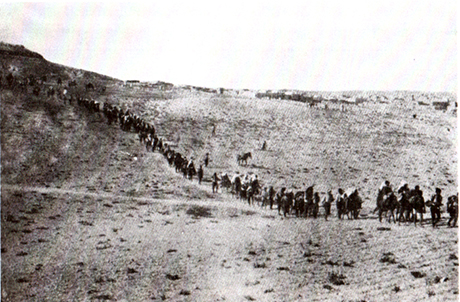
Armenian orphans evacuating from Turkey, 1922
A group of Armenian orphans evacuating from Turkey, 1922 - See more at: http://www.genocide-museum.am/eng/online_exhibition_18.php#sthash.LMWEOylL.dpuf

Historian Akcam has studied the Armenian genocide for decades, patiently putting together a damning jigsaw of documents sourced from around the world to prove state complicity in the killings. An original telegram that came out of an archive held by the Armenian Patriarchate of Jerusalem from the post WWI trials came into his possession recently. Which elaborated on a Ottoman Empire official in the Turkish city of Erzurum sending a telegram in secret code to a colleague.

Details were asked relating to the deportation and slaughter of Armenians in eastern Anatolia. Eventually a copy of the telegram, deciphered, helped in the conviction of the official, Behaeddin Shakir, who was involved in planning what historians have acknowledged and Turkey continues to deny, as the well organized extermination of up to 1.5 million Armenians by Ottoman Empire leaders, representing the first 20th Century genocide.

Mr. Akcam, diligent scholar and historian that he is, argues that attribution for a great deal of the chaotic misery roiling the Middle East of today resulted from distrust between the various communities relating to historical wrongs no one is interested in admitting to, much less to confront, discuss and understand. Which is certainly a refreshing change from the usual claims made by self-interested Middle East entities who trot out continually the accusation that the existence of Israel is to blame for all that goes awry in the Middle East.

"He has piled clue upon clue upon clue", stated Eric D. Weitz, history professor at City College of New York. Naming Mr. Akcam as "the Sherlock Holmes of Armenian Genocide". Turkey will never, certainly never under the leadership of Recep Tayyip Erdogan, accede to an admission of responsibility. Genocide is not a word nor a concept that Turkey is prepared to admit to; for as they insist, the chaos of a world war produced the Armenian deaths, and the Turks suffered difficulties, as well.
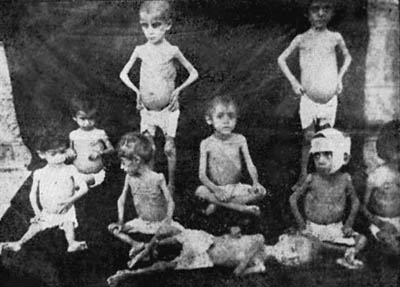
Near East Relief Society Armenian Orphans
Children taken in by Near East Relief
Collection of Near East Relief Society
Maria Jacobsen, DIARY 1907-1919, KHARPUT, TURKEY
Tessa Hofmann & Gerayer Koutcharian
Armenian Review, Spring/Summer, 1992, Vol. 45, No. 1-2/177-178, p. 119, Fig. 56
- See more at: http://www.genocide-museum.am/eng/online_exhibition_3.php#sthash.aYj0TVVa.dpuf

The Armenians were traitors, as Turkey would have it, planning to fight Turkey in concert with Russia. This is a version that Turkish culture values, long a standard explanation published in Turkish school curricula, supported by a vast majority of the Turkish population. "My approach is that as much proof as you put in front of denialists, denialists will remain denialists", stated historian Bedross Der Matossian, at the University of Nebraska, author of Shattered Dreams of Revolution: From Liberty to Violence in the Late Ottoman Empire.

Picture of villagers picnicking at the border town of Bagaran, Armenia
Picnicking at night beneath apricot trees—and a giant cross shining defiantly into Turkey—villagers in the border town of Bagaran, Armenia, belt out songs of memory, cultural endurance, and survival. The bitter dispute between Armenia and Turkey dating back four generations has paralyzed economic, diplomatic, and political progress in the region. The ancient crossroads between Turkey’s eastern highlands and the Caucasus remains in the thrall of ghosts.

Labels: , , ,

Saturday, September 17, 2016

Turkey, a Blight Among Nations

"When the Turkish authorities gave the orders for these deportations, they were merely giving the death warrant to a whole race."
"In their conversations with me, they made no particular attempt to conceal the fact."
"[Theirs is a deliberate] campaign of race extermination."
Henry Morgenthau, American ambassador, Ottoman Empire, 1915
A picture released by the Armenian Genocide Museum-Institute dated 1915 purportedly shows soldiers standing over skulls of victims from the Armenian village of Sheyxalan in the Mush valley, on the Caucasus front during the First World War. Armenians say up to 1.5 million of their forebears were killed in a 1915-16 genocide by Turkey's former Ottoman Empire. Turkey says 500,000 died and ascribes the toll to fighting and starvation during World War I.
A picture released by the Armenian Genocide Museum-Institute dated 1915 shows soldiers standing over skulls of victims from the Armenian village of Sheyxalan in the Mush valley, on the Caucasus front during the First World War. Photo: STR/AFP/Getty Images
"The brutal treatment of the deportees, most of whom were made to walk to their destinations, made it apparent that the deportations were mainly intended as death marches. Moreover, the policy of deportation surgically removed the Armenians from the rest of society and disposed of great masses of people with little or no destruction of property."
Armenian National Institute, Washington, D.C.
Armenian genocide is 'fact of history and nothing to do with election' Armenia says up to 1.5 million of its people were killed during World War I by forces belonging to Turkey's former Ottoman Empire
"I decided to present his data [papers of Talaat Pasha, one of the Young Turks in charge of the Ottoman Empire, published by a Turkish journalist in 2011], as the official view of the Armenian Genocide according to Ottoman records... It has a column showing the Armenian population of different provinces in 1914 according to official Ottoman statistics, and it has a column that has been generated from the returns to the 1917 survey. Most of these missing Armenians were probably killed."

Raffi Sarkissian, co-chairman, Armenian Genocide Centenary Commemoration Committee. 
In April of 1914 the-then government of Turkey suspicious of Armenian allegiance, arrested two hundred Armenian community leaders in Istanbul. Their arrest went on to imprisonment but not for a very prolonged stay; they were mostly put out of commission when they were executed as traitors to Turkey. Echoes of that event can be seen in the mass arrests that have taken place in Turkey of those considered by Turkish authorities to be loyal to Methullah Gulen whom President Recep Tayyip Erdogan views as a threat to his Islamist rule of the country.

In this modern era, a month ago a failed attempt at a coup instigated the ruthless crackdown on the followers of Gulen who was once a supporter of Erdogan until he became disenchanted with the virulent Islamist tack he was leading the country into. Mr. Gulen's disavowal of Erdogan's politics enraged the president of Turkey who views the self-exile as plotting against him, convincing himself that tens of thousands of civil servants of all stripes including police, military, justices, journalists are all attempting to undermine his authority.
Recep Tayyip Erdogan is planning to make Arabic-alphabet Ottoman language compulsory in high schoolsRecep Tayyip Erdogan  Photo: AFP

When the world's attention was diverted from an obscure corner of the world by the horrifying events of the First World War, Turkey felt free to dispose of its Armenian citizens by force-marching hundreds of thousands of men, women and children of all ages out of the country's borders, disowning them, leaving them to die of privation, illness and starvation in the process, and killing those who did not; an estimated total of one and a half million Armenians losing their lives. Turkey insists nothing of the kind occurred.

Turkey's leaders have a propensity to reach extremes in their denials; to even make mention of the genocide is forbidden by law. Those Armenians whose lives were forfeit were merely deportees. That they left Turkey by foot, with no provisions and no mechanical aids to their progress led them to they fall victim to unfortunate circumstances, and these were complex events that led to their unfortunate mass death, having nothing whatever to do with a Turkish plan for extermination.

That the Turks are Muslim and Armenians Christians is one of the complex circumstances of two ethnic groups living together under Ottoman rule. The Armenians have much in common with Jews; tending to be better educated and more financially well off than their Muslim counterparts. They also found much in common with Russia and at the time of the First World War, Turkey aligned itself with Germany. Turkey saw its Armenian population as a "wartime measure of military security" seeking a solution.

That solution was a forced death march through deportation. Massacres took place on the way with countless Armenians unable to defend themselves, simply shot while others became a helpless mass of famished humanity. And so, Armenians who for three millennia inhabited the highlands of their heritage lands, were forced to find a new home for those who survived. A small enclave was formed, Russian Armenia, by those who managed to evade the deportation proceedings. Late in 1920 the region was recognized under the Soviets as the Armenian Soviet Socialist Republic.

With the collapse of the USSR, the Armenian enclave was renamed to the Republic of Armenia. Armenian activists have long been involved in insisting that governments give recognition to their plight, acknowledging that they had experienced genocide before Nazi Germany undertook the systematic obliteration of European Jewry, Hitler reasoning that no one remembered or cared about the Armenian genocide, leaving him free to achieve his goal of freeing Europe from any Jewish presence.

Turkey's skill and determination in denying equality and the division of Turkey's geography to non-Turks is legendary. Its incessant quarrels with Greece over Cypress more than adequately describing Turkey's scorn for its neighbours. Recep Tayyip Erdogan's renewal of Turkey's blisteringly violent war with Kurds, the world's largest ethnic group whom European colonialist politics cheated of their own homeland, speaks volumes of Turkey's incapacity as a Muslim quasi-democracy bordering Europe to ever become a stalwart of human rights.

© Ruptly
© Ruptly
Turkish authorities accuse Kurdish militants of detonating a car bomb in the city of Van in the southeast of Turkey. 48 people injured, no fatalities confirmed.The blast took place around 200 meters from the city’s provisional governor’s office. No group has claimed responsibility for the assault.
Up to the present, 28 nations have chosen to recognize the Armenian genocide, sending Turkey into vicious spasms of rage. Those nations who have the courage to recognize the reality of history and Turkey's place in it have been threatened and slandered by Turkey. That Pope Francis has also chosen to speak of the Armenian suffering as a genocide simply confirms for Islamist Erdogan that the Christian and non-Islamic world is an enemy of both Islam and Turkey.

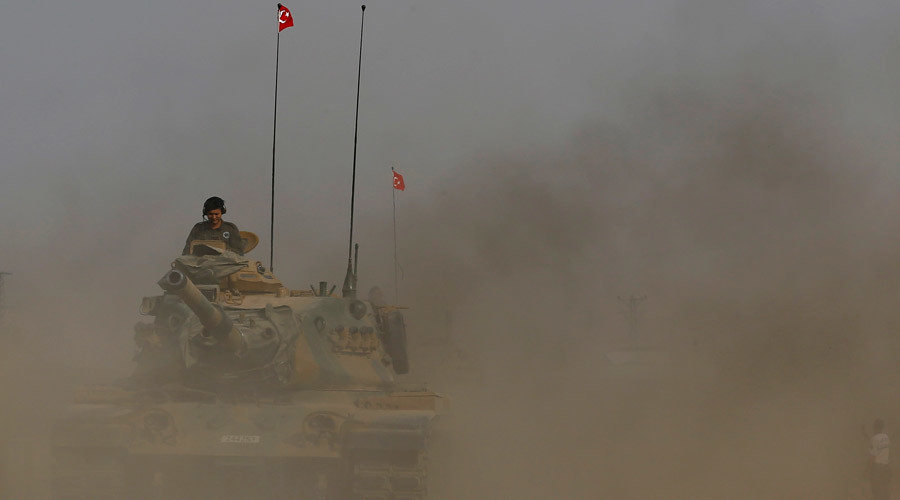
A Turkish army tank drives towards to the border in Karkamis on the Turkish-Syrian border in the southeastern Gaziantep province, Turkey, August 25, 2016. © Umit Bektas

Labels: , , , , ,

Tuesday, April 26, 2016

Transforming Turkey

"Solving ethnic and religious strife through demographic engineering is a policy of the Turkish government that goes back well over a century."
"The latest developments in Sur need to be viewed through this framework."
Taner Akcam, Turkish historian

Turkish President Tayyip Erdogan. © Adem Altan

Members of Turkey's Justice and Development party are busy doing the bidding of Recep Tayyip Erdogan; agitating to change the constitution of the country. There is a divide between religion and government; a Muslim country and a secular government; the legacy of Kemal Ataturk which brought Turkey closer to its European neighbours in outlook if not in practise. Since Erdogan's Islamist party took power a dozen years ago, much has changed in Turkey.

There is a decided divide between the Islamist Turks and the more secular-oriented, socialist, temperate Turks who decry the growing autocracy of their President, formerly Prime Minister, but planning to alter the constitution to empower the presidency to a greater degree and enable Mr. Erdogan to rule in perpetuity.

This man's popularity is on the wane, but not among Turkish Islamists. Turkey's human rights record with its Kurdish population, its Cyprus adventure, its Armenian past, the silencing of journalists and critics of the government all mitigate against membership in the European Union.
Activists hold portraits of victims during a silent demonstration to commemorate the mass killings of Armenians by Ottoman Turks in Istanbul, Turkey April 24, 2016. © Osman Orsal
But the crisis that Europe is facing with the ongoing brutalization of Syria's Sunni population by the Shiite Baathist regime of Bashar al-Assad's killing machine creating millions of Syrian refugees has given Erdogan an opportunity to sweep aside the EU's lack of enthusiasm to welcome Turkey as a new member. Even while Turkish warplanes are pounding the hell out of Kurdish villages in the country's southeast, scarring the lives of Turkish Kurds once again.

The robust Turkish economy has taken a direct hit in the last few years with the influx of millions of Syrian refugees fleeing the combustible civil war and the presence if Islamic State in a now-truncated nation of interminable battles. Russian tourists no longer flock to the holiday spots in Turkey famous for hosting them, and nor do Israelis leave behind any longer their own tourist dollars, thanks to the estrangement that Erdogan's volatile temper and malevolent views cause, exposing his credentials.

Recep Tayyip Erdogan has alienated relations between the countries most influential in aiding his own country's economy. And his projects have angered ordinary Turks, from plans to transform a popular urban park into a mega-shopping mall, to more latterly 'restoring' an area of the Kurdish city of Diyarbakir in the heart of Turkey's southeast to encourage Turks to crowd out the traditional Kurds and Armenians have caused additional palpitations in the hearts of Turkish minorities.

The historical Armenian Surp Giragos Church and a number of others along with large areas of property are being targeted for Erdogan's transformation of ruined neighbourhoods that his own bombing by his military has occasioned, in conflict with the Kurdistan Workers' Party. Armenians and Kurds fear the government's plans are to replace the neighbourhoods shared with minorities, and put in place luxury rentals and condominiums for wealthy non-minority residents.

"The government wants to seize the heart of Diyarbakir and singularize it, ridding it of its rich multifaith and multicultural structure", said Abdullah Demirbas, a former Diyarbakir mayor. The Diyarbakir Bar Association is suing the government, viewing the project of reconstruction as a work of "military and security reconstruction". And the Surp Giragos Church, one of the largest Armenian churches in the Mideast, is preparing legal action.

A video produced for the office of the prime minister reflecting the government's project vision for the area focuses on mosques and residential areas, superseding other prominent religious establishments. One narrated expression in particular drew the focus of religious minorities, that said: "The call to prayer that rises from Diyarbakir's minarets will not be quieted down".

Labels: , , , , ,

Friday, May 22, 2015

Gatestone Institute


  • The first priority of most Western governments today seems to sign a deal with Iran's Supreme Leader, Ali Khamenei, who openly calls for Israel's and America's destruction.
  • The next priority of many European governments, and apparently the Pope, is to entrust a state to the Palestinian Authority and Hamas, a movement that does not hide its genocidal intentions.
  • Unless the Obama Administration and Congress stop Iran, we are about to witness the world's next genocide, committed by Iran. By teeing up Iran's nuclear capability and triggering a Middle East nuclear arms race, the U.S. and the negotiators of the P5+1 are creating conditions that can only lead to a disastrous war with catastrophic results.
On April 28, ceremonies were held to commemorate the seventieth anniversary of the liberation of the Dachau concentration camp. It might seem not a major event, as Dachau was not an extermination camp. Auschwitz-Birkenau, the main Nazi killing center, had fallen three months earlier. The absolute horror of Nazi crimes was fully known. The end of World War II was near: ten days later, on May 8, 1945, the surrender of Germany was signed.
Dachau nevertheless has a special meaning: it was the first camp. After its doors opened in 1933, it became the model for all Nazi concentration camps.[1]

More than 30,000 Jewish men were sent to concentration camps shortly after Kristallnacht -- a wave of violent anti-Jewish demonstrations throughout Germany and Austria on the night of November 9-10, 1938. At the instigation of the Nazi party, Jewish businesses, synagogues and homes were attacked and burned, nearly a hundred Jews were murdered and thousands injured, and tens of thousands of Jews were arrested and sent to concentration camps.

The rest of the world could still have saved Jews and stopped the destruction machine. But the world did nothing. Hitler knew -- as Iran knows now -- that the world would do nothing.
Six weeks earlier, on September 30, the Munich Agreement had been signed. Britain's Prime Minister, Neville Chamberlain, had presented the agreement as "Peace for our time" -- in exchange for allowing Germany to help itself to the German-speaking part of Czechoslovakia, later known as Sudetenland. Chamberlain and France's Prime Minister, Édouard Daladier, had accepted Hitler's conditions without even mentioning the fate of the Jews.

Six months earlier, in July 1938, during the Evian Conference, no country had agreed to take in Jewish refugees.[2]

There were few consequences for Germany. Nothing had changed.

In May 1940, Auschwitz opened.

On January 20, 1942, the Wannsee Conference was held, during which high-ranking German officials coordinated what they called, "The Final Solution to the Jewish Question."[3] Auschwitz became an extermination camp a few days later.

The plight of European Jews, and the crimes at Auschwitz and other extermination camps, came as no surprise. Witold's Report, written by Captain Witold Pilecki, a secret agent of the Polish resistance, who entered and escaped from Auschwitz, had been forwarded to the British.[4] The report detailed the "selection process," the three crematoria that could burn 8,000 people a day, and the so-called "medical experiments." The British questioned the report's reliability. [5]

The recognition and commemoration of the Holocaust began in Israel several years after 1945.[6] For decades, however, the rest of the world remained silent.

Political considerations prevailed over ethical considerations. Emphasizing the responsibility of Germany would have implied that many more Germans than those tried at Nuremberg would have had to be tried. Several Western political leaders could have been considered accomplices. It was only when almost all the perpetrators and survivors were dead that the time of remembrance came. But were any lessons learned?

The crime of the Holocaust was the only attempt at the total extermination of a people by industrial means, and it was committed on a continent considered the "cradle of Western civilization."

The other horrific acts of extermination that took place during the twentieth century were treated as of little importance -- and still are.

The crimes of Communism -- including the Communist killing fields of Cambodia that took place during in the late 1970s -- were also immense. They were committed on five continents and lasted several decades. Communism killed about a hundred million people.[7] Although the crimes of Communism are public information, the world is still mostly silent. Again, political considerations prevailed over ethical consideration. The Black Book of Communism was published in 1999. The issue was then dropped. It is likely that there will never be a Day of Remembrance for the Victims of Communism.

Another genocide took place in Rwanda, in 1994: 70% of the Tutsis living there were killed. One of the most horrifying aspects of the Rwandan genocide was that international forces, sent by the UN, stood by and remained passive. France launched a military operation to evacuate French and Belgian citizens, but refused to evacuate any Tutsis. Hundreds of people were massacred a few feet away from the French forces. Once again, political considerations prevailed over ethical considerations. The responsibilities of the international forces and the responsibilities of France have been internationally ignored.[8] An International Criminal Tribunal for Rwanda was established; it will end its work soon. Only Rwandans were incriminated. Hardly anyone in the rest of the world remembers the Rwandan genocide.

A genocide also took place in the Ottoman Empire at the time of its collapse, during World War I, a quarter century before the Holocaust. Beginning in 1915, between 800,000 and 1.5 million Armenians were slaughtered by soldiers of the Ottoman army.[9] Turkey has never recognized the massacre as a genocide.[10] The world was, again, largely indifferent to the fate of the Armenians. Hitler seized on this indifference to say that if the world condoned what happened to the Armenians, it would condone what would happen to the Jews. He was proven right. Again, political considerations prevailed over ethical considerations. As Turkey was an ally of the West against the Soviet Union, any decision likely to annoy or offend the Turkish government was set aside. Since the collapse of the Soviet empire, however, Turkey has lost some of its geopolitical importance, but it contributes to new genocide-like massacres. In recent months, tens of thousands of Christians and Yazidis have been savagely murdered in Syria and Iraq by the Islamic State -- which could not exist without the support of Turkey. Much of the oil sold by the Islamic State, and its needed military supplies, pass through Turkey. The silence of the West continues. No doubt. Political considerations are at work.

Seventy years after the fall of Dachau and Auschwitz, Israeli Jews, Christians and Arabs are threatened with a second Holocaust by people who deny the existence of the first Holocaust: Iran's leadership. The West, apparently willing to vote Iran nuclear breakout capability, pays no attention and acts as if Iran's continual threats had no meaning.

The first priority of most Western governments today seems to sign a deal with Iran's Supreme Leader, Ali Hosseini Khamenei, who openly calls for Israel's and America's destruction.

Iran's Supreme Leader, Ayatollah Khamenei (center), is shown meeting in May 2014 with Iran's military chief of staff and the commanders of the Islamic Revolutionary Guards Corps. (Image source: IRNA)

The next priority of many European governments is to entrust a state to the Palestinian Authority and Hamas, a movement that does not hide its genocidal intentions. Political considerations are at work, full time and at open throttle.

Since the Armenian genocide, one hundred years have passed, marked by mass killings, massacres, and genocides. These culminated in the Holocaust, but did not end with it. The Communist killing fields of Cambodia took place during the 1970s. The Rwandan Genocide of the Tutsis was perpetrated just twenty-one years ago.

The twentieth century was appropriately described by historian Robert Conquest as a "ravaged century."[11]

It is urgent that that ethical -- not political or monetary -- considerations receive priority. If not, this will be the second "ravaged century."


[1] The Dachau Concentration Camp, 1933 to 1945: Text and Photo Documents from the Exhibition, with CD. Dachau: Comité International De Dachau, 2005.
[2] William R. Perl, The Holocaust Conspiracy: An International Policy of Genocide, Shapolsky Publishers, Inc, 1989.
[3] Mark Roseman, The Villa, The Lake, The Meeting: Wannsee and the Final Solution, Allen Lane, 2002.
[4] Witold Pilecki, The Auschwitz Volunteer: Beyond Bravery, Aquila Polonica, 2012.
[5] There were three other reports about the conditions in Auschwitz as well: The "Polish Major's Report" by Jerzy Tabeau; the "Vrba-Wetzler Report" by Rudolf Vrba and Alfred Wetzler in April, 1944, and a short report by Arnst Rosin and Czelaw Mordowicz, who escaped from Auschwitz in May, 1944.
[6] Yom HaShoah ("Day of the Holocaust") became an annual memorial in Israel in 1953. The Days of Remembrance of the Victims of the Holocaust were held in the US for the first time in 1979, twenty-six years after 1945. The French government acknowledged France's responsibility in the deportation of Jews in 1995. A Day of Remembrance of the Victims of National Socialism was established in Germany in 1996. Holocaust Memorial Day was established in the UK in 2001.
[7] Stephane Courtois, Nicolas Werth, Jean-Louis Panné, Andrzej Paczkowski, Karel Bartosek, Jean-Lous Margolin, The Black Book of Communism, Harvard University Press, 1999.
[8] Gerard Prunier, The Rwanda Crisis, Fountain Publishers Limited, 1999; Romeo Dallaire, Shake Hands with the Devil: The Failure of Humanity in Rwanda, Arrow, 2004
[9] James Nazer, The first genocide of the 20th century: the story of the Armenian massacres in text and pictures, T&T Publishing inc., 1968.
[10] Fatma Müge Göçek, Denial of Violence: Ottoman Past, Turkish Present, and Collective Violence Against the Armenians, Oxford University Press, 2014.
[11] Robert Conquest, Reflections on a Ravaged Century, W. W. Norton & Company, 1999.

Labels: , , , , , , ,

Friday, April 24, 2015

A Tale of Two Assassins

When a young Yiddish poet killed a Ukrainian leader who allowed pogroms, he helped forge a lasting link between Jews and Armenians

By Jeffrey Veidlinger|April 24, 2015   TABLET magazine

The trial of Sholem Schwartzbard. (YIVO Institute of Jewish Research, New York)
Soghomon Tehlirian, a 24-year-old Armenian student in Berlin, was a melancholy man—his former landlady would testify at his murder trial that he would sit in his room in the dark playing sad songs on his mandolin. She had learned that his entire family had been killed in 1915, but thought it best not to ask too many questions about it. She would often hear him waking up in the middle of the night with nightmares and had recommended to him a doctor who specialized in nervous disorders. Lately, he had taken up dance lessons to help calm his nerves and started to practice his German by flirting with girls. Occasionally he suffered fainting spells. 
 
Tehlirian’s landlady was surprised when, in early March 1921, he suddenly announced he was leaving her flat to move into a new apartment on Hardenbergstrasse near Berlin’s zoo in the upscale Charlottenburg neighborhood. Tehlirian explained that he was moving because his doctor had recommended that he find an apartment with more natural sunlight. But in truth Tehlirian moved because he had learned that a man he had never met who went by the name of Ali Salih was living across the street from the apartment he had just rented, and Tehlirian had decided to murder him.
Ali Salih was the assumed name of Talaat Pasha, the former interior minister and last grand vizier of the Ottoman Empire. One hundred years ago today, on April 24, 1915, Talaat oversaw the arrest of hundreds of leading Armenian community members, a step generally regarded as the first salvo in the Ottoman campaign to deport Armenians from the Anatolian Peninsula, thus beginning the Armenian genocide.

On March 15, as Tehlirian was reading in his room, he glanced out his window and saw Talaat on the balcony of his apartment. He explained to the court that he recognized the man from having seen his picture in the newspapers. He kept watching and then, “I saw Talaat, the man who was responsible for the deaths of my parents, my brothers, and my sisters.” Tehlirian grabbed the loaded pistol he kept with his underclothes in a trunk, ran after Talaat, and fatally shot him. At the sound of gunfire, a crowd descended upon Tehlirian, beating him and holding him down. Witnesses reported that Tehlirian tried to break free, declaring, “I am an Armenian. He is a Turk. It is no loss to Germany.” Tehlirian would later tell the court that he remembered little about what happened after he fired the gun. But he did remember the sense of elation he felt upon hearing in the police station hours later that his shot had been fatal.

Armenians around the world are commemorating the genocide of their people today: Jews, who have just commemorated Holocaust Remembrance Day last week, should be doing so as well.
Armenians around the world are commemorating the genocide of their people today: Jews, who have just commemorated Holocaust Remembrance Day last week, should be doing so as well. Not only because of a shared humanity. Not only because Jews and Armenians are the two victims of genocide that gave this crime its name. But also because of the stark parallels between our experiences.
Writing in the racialized language of the time, U.S. Ambassador to the Ottoman Empire Henry Morgenthau, who was also a prominent Jewish activist, noted of the Armenians: “There has been considerable intermarrying with Jews and that by this time there is a decided strain of Jewish blood in them. I asked about this because they all look like Jews and have the same characteristics, the same stubborn adherence to their past and religion and a strong race pride.” Morgenthau was the first major international figure to alert the world to the Armenian genocide. In 1919 he would also head a commission to Poland to investigate the pogroms against Jews.

***
In that same year, on the opposite bank of the Black Sea, in newly independent Ukraine, anti-Jewish pogroms erupted in a manner parallel to what had happened in Anatolia. The list of pogrom perpetrators was expansive and diverse, encompassing foreign armed fighters, Ukrainian nationalist paramilitary organizations, ordinary Ukrainian peasants, military units loyal to the deposed Russian tsar, and Red Army soldiers. But popular memory put the blame for the bloodshed on the figure of Symon Petliura, the leader of the so-called “Directory” government that tried in vain to rule over Ukraine and establish a left-leaning national republic. Despite offering broad autonomy to the Jewish population—the Directory even printed currency in Yiddish and promised Yiddish-speaking telephone operators—the government was unable or unwilling to stem the violence. In total, over one thousand separate incidents of anti-Jewish violence were recorded; a Soviet investigation put the death toll at over 100,194. Other observers estimated that up to 200,000 Jews were murdered.

Last known portrait of Sholem Schwartzbard. (YIVO Institute of Jewish Research, New York)
In an eerie echo of Tehlirian’s assassination of Talaat Pasha, the Yiddish poet and watchmaker Sholem Schwartzbard took his revenge on Petliura, who had fled Ukraine and was living in Parisian exile. Throughout the spring of 1926, Schwartzbard would wander through the streets of Paris’ Latin Quarter with a pistol in his pocket and a photo of Petliura he had clipped out of the Grand Larousse encyclopédique. The blond 31-year-old poet, who courtroom reporters would later comment looked more like a clerk than a murderer, short and “undistinguished in appearance,” drew no attention to himself as he sought out Petliura from among the crowd, comparing the features of likely candidates to the photo in his hands. Schwartzbard found his target on several occasions, but each time Petliura was surrounded by his wife and children.

Finally, on May 25, Schwartzbard encountered Petliura alone on the corner of Rue Racine and Boulevard St. Michel. Still unsure if he matched the photo, Schwartzbard asked the man, “Are you Petliura?” He didn’t answer. The poet took a chance and shot the former head of state five times. When police arrived at the scene, Schwartzbard was waiting for them: “I have killed a great assassin,” he declared. The crowd began running toward Schwartzbard, beating him, but the gendarme took Schwartzbard by cab to the station. Upon learning that the man he had shot was, in fact, Petliura, Schwartzbard was overjoyed.

Sholem Schwartzbard had been a struggling Yiddish writer and anarchist activist. Born in 1886 in Bessarabia, Schwartzbard was raised in the Podolian town of Balta, a town with a history of pogroms. Three of his siblings and his mother died when Sholem was a child; Sholem was apprenticed to a watchmaker soon after his bar mitzvah. As a youth, he became involved in anarchist circles, agitating for the overthrow of the tsar. Once, when he was distributing literature inside a beit midrash, the pious Jews trying to pray got fed up with him and denounced him to the authorities. He was arrested but managed to flee in 1906 across the Austro-Hungarian border, where he continued his anarchist activities.

He was arrested again in Vienna on the charge of robbing a small wine bar. He was found in the bar at opening time, having apparently locked himself inside at closing the night before. The till was short, and Schwartbard was carrying a tool kit and cash. Nevertheless, he claimed it was a case of misidentification. After serving four months for the crime, he moved to Budapest where he was again arrested, this time for distributing radical literature. He relocated to Paris in 1910, where, during World War I, he served first in the Foreign Legion and then in a regular French infantry brigade. He was injured in the war and awarded the Croix de Guerre.

But the revolutionary cause remained dear to his heart. Upon hearing news of the overthrow of the tsar in Russia, Schwartzbard returned to Ukraine in the summer of 1917, just as the Russian Empire was breaking up in a bloody civil war. He floated through several revolutionary fighting brigades, eventually finding his way to Odessa, which was from November 1918 to April 1919 under French occupation. Soon after the French abandoned the city, Schwartzbard joined the Bolsheviks and traveled with a brigade to the pogrom-devastated regions around Cherkasy. Disillusioned and traumatized, he returned to Paris, where, under the penname of Bal-Khaloymes (the Dreamer), he published vignettes about the pogroms and a series of poems about the war. He seemed to give up his anarchism and devoted himself to fixing clocks in a small shop—until he found the photo of Petliura in the encyclopedia and became obsessed with the idea of killing him.

Schwartzbard’s obsession, though, was somewhat misplaced. Although Petliura had been nominally in charge during the period of the most rampant anti-Jewish pogroms, his responsibility for them was, at best, indirect. Various warlords controlled most of Ukraine for much of 1919. Petliura’s government could hardly retain control of a single city let alone the entire Ukraine. At times he and his top officials lived in a railway car so they could relocate at a moment’s notice to whichever region his troops controlled at the moment. His proclamations condemning pogroms were as toothless as the secret orders his critics believed—but could never prove—he issued permitting them.
Schwartzbard’s act of vengeance threw him into headlines around the world and brought global attention to the pogroms and the fate of the Jewish people in Ukraine. Emma Goldman published appeals on behalf of Schwartzbard and urged American Jews to contribute to his legal defense.

Historians Simon Dubnow and Elias Tcherikower compiled information on the pogroms to provide to Schwartzbard’s lawyers. Yiddish writer Sholem Asch, already known for his controversial hagiography of Jesus of Nazareth, wrote that Schwartzbard’s sin was “a redemption for us all.”

Hannah Arendt was more sympathetic to the lone assassin. Both Tehlirian and Schwartzbard, she argued, sought justice, not revenge. Rather than run from the police, she continued, they waited to be caught in order to force a trial and establish a public record of the genocide. Both courts obliged, putting Talaat and Petliura on trial as much as Tehlirian and Schwartzbard.

Juries acquitted both the Armenian student and the Jewish poet, and the public trials of the two brought the crimes they were avenging to global attention.

One Jewish law student in Warsaw at the time, Raphael Lemkin, followed both trials with rapt attention. Tehlirian, he wrote, “upheld the moral order of mankind,” and Schwartzbard’s act was “a beautiful crime.” Lemkin, who later coined the term “genocide” and lobbied for its recognition at the United Nations, was one of the first to publicly link the Ottoman attacks against Armenians with both the pogroms and the Holocaust. When CBS commentator Quincy Howe asked him in 1949 how he became interested in the topic, Lemkin replied, “Because it happened so many times. It happened to the Armenians, and after the Armenians, Hitler took action.”
***


Labels: , , , ,

Follow @rheytah Tweet