"After George Floyd's
murder a year ago, Atlanta’s mayor scolded the rioters who were
smashing up parts of her city. “This is not a protest…This is chaos,”
Keisha Lance Bottoms said. “If you care about this city, then go home.”
The speech was so well pitched that some overexcited pundits wondered
whether she might one day run for president. One year on, Ms Lance
Bottoms has declined even to run for re-election as mayor, in part
because Atlanta is suffering from a violent-crime wave which she has
been unable to calm. One affluent neighbourhood is keen to secede from
the city altogether."
"What is true in Atlanta is also true in other American cities. Property crimes are down, but violent crime has risen.
Murders increased by about 30% between 2019 and 2020, a rise that shows
little sign of slowing. This change puts at risk what has been perhaps
the most benign social trend in America so far this century: the great
crime decline. It also threatens liberal reforms."
The Economist
Major
urban centres in the United States, most of them under Democratic
governments are recording murder rates at unprecedented numbers. And
there are fears that the rates may continue to mount and accelerate over
the summer months in lock-step with the receding of pandemic
restrictions. New York City saw its murder rate rise 45 percent last
year -- a rate that has since steadily increased. The murder rate in
Atlanta went skyward by 60 percent in 2021.
In
the country, 275 mass shootings have taken place thus far in 2021
representing a 40 percent rise over a like period the year before. Ten
of those mass shootings have taken place in Chicago alone. And many
cities have fresh memories of violent social clashes, torchings and
looting that took place last summer, causing billions in damages to
retail establishments and government facilities. Police forces all over
the country are in wary contemplation of a renewal of that social
dysfunction in violent public disorder.
"Defund the police"
demands echoed everywhere in the wake of the death of George Floyd.
Violent street protests took place across the country, incited by the
movement for Black Lives Matter, unleashing civil disobedience events
and criminally violent physical attacks to round out the shrill
accusations of systemic, ongoing racism. Black Lives Matter was on a
roll, publicly supported by Congressional Democrats lending it heft and
legitimacy.
In
many urban centres black mayors and black police chiefs presided over
the violence in a triple-bind of duty, past injustices and the 'woke'
public mood. In some urban centres police see the benefits of early
retirement, while others pursue the 'do less policing' potential
inherent in countering public distrust and disdain alongside threats of
public violence aimed directly at police.
The
stridently vocal left wing of the Democratic party exerts its influence
on the governing Democratic White House openly advocating police
defunding in response to their views of police as "systematically
racist". This, while the violence and negative acting-out issues impact
largely on the poorer black communities who voted for the Democratic
nominee for president. Gun ownership has been targeted by the Biden
administration as a solution to the murderous violence roiling America's
streets.
After demonstrations like this there was a deliberate drawback of policing. CNN
Inconvenient
truths such as Chicago having the most stringent gun control laws and
regulations in the country, yet it is the epicentre of the bloody crime
wave, is largely ignored. And then there is the Democratic journey to
reverse all the initiatives taken by the predecessor Republican
government under Donald Trump, and two issues; 'the wall', and the
surging influx of migrants and refugee claimants at the Mexican border
are front and centre.
Illegal
migrants game the American asylum process, and in addressing the issue
of burgeoning illegals melting into the general U.S. population, Trump
as president shut everything down. And then President Biden turned it
back on, suspending the "Remain in Mexico" policy of the Trump
administration that sought to prevent asylum claims without merit. With
the wall construction stopped, would-be refugee claimants considered
those changes represented a hearty welcome to their prospects.
Enthusiastic
new contingents of would-be refugees from Mexico, Central America,
Venezuela, Cuba and even Europe and Nigeria have swelled the ranks of
the migrant-minded. Now, being swamped with migrants has resulted in
mass apprehensions; 173,358 in March; 178,622 in April; and 180,034 in
May. Closing in on a million since January; historically unprecedented
numbers beyond which are those who successfully escaped apprehension.
Single
males, unaccompanied children escorted to the border by "coyotes" are
fulfilling the "open border" approach the Democrats have espoused.
Although some of their humanitarian impulses are aimed directly at
convincing segments of the population that a vote for Democrats is an
assurance of a kinder, freer America, the message doesn't always
resonate; Large numbers of Hispanic residents in Texas border cities
tend to support "law and order" mayoralty candidates of the Republican
breed.
Chicago police officers investigate an officer-involved shooting outside its 25th district station Antonio Perez/Chicago Tribune via Getty Images
"The increase in homicides is large and widespread enough
to raise serious alarms for criminologists and other experts. So what’s
going on?"
"Some experts have cited the protests over the
police killings of George Floyd and others — which could’ve had a range
of effects, from officers pulling back from their duties to greater
community distrust in police, leading to more unchecked violence. Others
point to the bad economy."
"Another
potential factor is a huge increase in gun purchases this year. Still
others posit boredom and social displacement as a result of physical
distancing leading people to cause more trouble."
"It creates a big vacuum in Venezuela. If this situation is prolonged it will be even more difficult to think about the reset of Venezuela." "It will for sure change the profile of Latin America, this movement of people. We are speaking about six million people." "It will have an impact no doubt on the future of Venezuela proper and in the receiving countries." "These countries seem to be willing to integrate Venezuelans, but they cannot do it alone."
Renata Dubini, U.S. director, United Nations High Commissioner for Refugees
"It's the largest human migration in the history of this hemisphere since the arrival of Europeans." "For fifty years it was Colombia that was the unstable country with extraordinary levels of violence and organized crime activity. And Colombians were voting with their feet as well and they established themselves in all kinds of Latin American countries." "The Venezuelans of 2019 are starting to occupy the role that Colombians have played for so many years. I suspect that Venezuelan communities are going to become relatively permanent fixtures of so many other Latin American countries over the generations to come." "I'm painting a rather bleak notion of Venezuela being the new Haiti. Over the years and years to come, decades to come, there's going to be a requirement for a very significant economic and humanitarian support." Ben Rowswell, former Canadian ambassador to Venezuela
"When you have four and a half million people leaving a country, you get a brain drain, you get a deterioration in basic services because medical staff, teaching staff, businesspeople leave." "It contributes to the degradation of that society." Dr. Hugo Slim, head, policy and human diplomacy, International Committee of the Red Cross, Geneva
The tragic dissolution of a country. The world saw it happening in slow motion in Zimbabwe, and it is repeating itself in Venezuela. The outflow of over four and a half million Venezuelans, choosing refuge outside their own country, driven by violence, crime, corruption, medical emergencies, food shortages, unemployment, financial crisis, sees the collapse of a country well endowed with natural resources, that was once one of the wealthiest nations in Latin America. The social revolution that Hugo Chavez brought to the country began its long slide into insolvency and irreparable disarray.
Before his death, however, it might have been difficult to foresee just how rapidly the disintegration of the country would proceed under the stewardship of his chosen successor, a man as qualified, as a bus driver, to lead the country, as Chavez was, a former low-level military man. Had Nicolas Maduro remained a bus driver the country would unquestionably have been far better off than the wreckage the world looks in on today. According to new estimates released by the United Nations, by the end of 2020, the number of Venezuelan refugees could top 6 million.
And though the country itself is groaning under the sheet weight of its incompetent, corrupt ruling body, its neighbours are straining mightily to honour their duty to give haven to the oppressed and the indigent. Venezuela's neighbours are taking up the slack of millions of Venezuelan lives left in the limbo of statelessness and concern for the future. The entire continent is in the grip of change in their political and social order, and must cope as well with the overflow of Venezuelan refugees.
Mass protests have rocked Chile, forcing it to cancel major international summits;
Bolivia has undergone a contested election that has seen its first and perhaps only Indigenous president, Evo Morales sent into exile in Mexico;
Argentina has once again elected a left-leaning government;
Brazil is governed by a controversial populist.
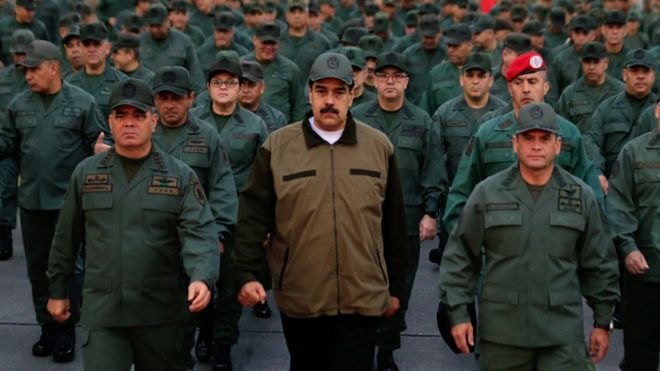
The Venezuelan military has been called upon by the international community to give their support to opposition leader Juan Guaido as a legitimate interim president in the wake of an election held to be wildly corrupt, and to oust the government of Nicolas Maduro. The Lima Group of the hemisphere, (with the exception of the U.S.), along with four dozen other countries have thrown their support to Juan Guaido. Nothing, however, has changed. Maduro has his supporters, primarily from other socialist countries who will brook no interference in Venezuela.
Venezuela's economy continues to flounder, the health and education systems have seen a major collapse in the once oil-rich state with hyperinflation and food and medicine shortages persuading Venezuela's educated elite, its professionals, to look elsewhere for their future, alongside those for whom poverty has been a lifelong affliction. Even Venezuelans who decamp their country to hope for haven and opportunity elsewhere have no illusions that their country of birth will ever recover from its current crisis; it is too far gone, and they harbour no aspirations to return.
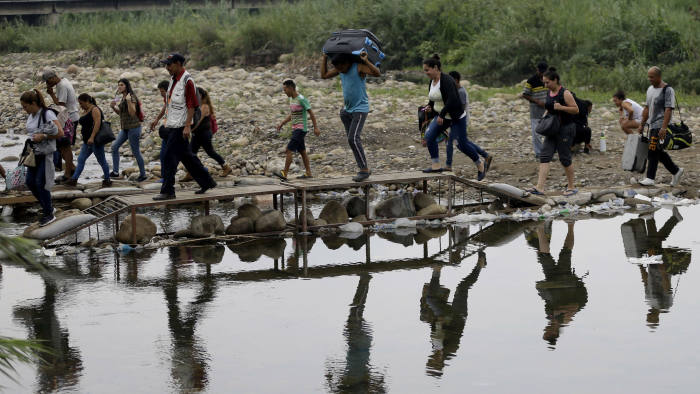
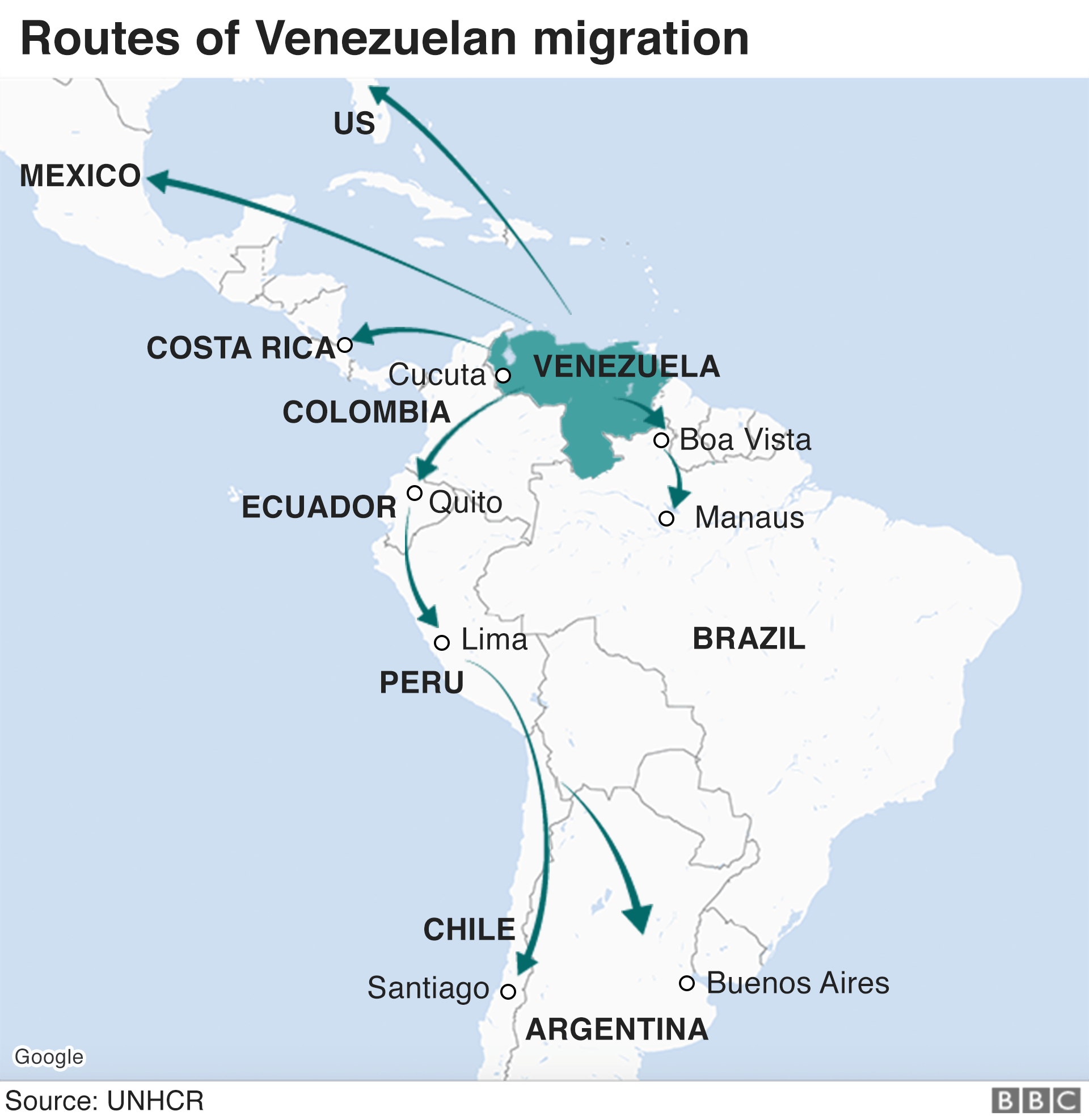
Peru's foreign ministry took a survey recently of new arrivals, to discover that 90 percent claimed they had no wish to return to Venezuela. Peru now hosts 861,000 Venezuelan refugees, a number that is expected to grow to an estimated 978,00 by the closing of 2020. Colombia has absorbed 1.4 million Venezuelans, in the anticipation that even that number will inevitably increase by another million by the end of 2020.
Many Venezuelan refugees represent an elite, educationally qualified as professionals in the field of medicine and engineering. Canada has requested of the World Bank that Colombia, Peru and Ecuador be granted new and stable economic assistance to help them cope with the infusion of refugees; loans that would have no-payment grace periods of several years' duration to provide long-term support to enable Colombia and Peru to pay for education and health care for their new residents.
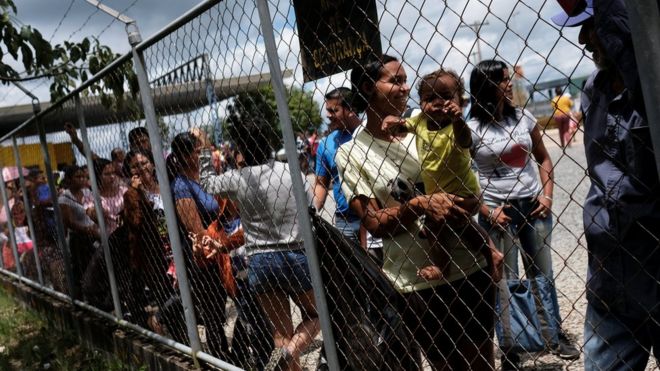
Latin American countries host the vast majority of Venezuelan migrants and refugees Reuters
"People
of Venezuela, the end of usurpation has arrived. At this moment, I am
with the main military units of our armed forces, starting the final
phase of Operation Liberty." "People
of Venezuela, we will go to the street with the armed forces to
continue taking the streets until we consolidate the end of usurpation,
which is already irreversible." "The
armed forces have taken the right decision. With the support of the
Venezuelan people and the backing of our constitution they are on the
right side of history." Venezuelan opposition leader and declared President, Juan Guaido
"Steel nerves." "I
have talked to commanders in all the regions of the country and they've
manifested their total loyalty to the People, the Constitution, and the
Homeland." "I call for maximum popular mobilization to ensure the victory of peace." "We will win!" Nicholas Maduro, contested Venezuelan president "If
Guaido and Lopez fail to split the military and rally top brass to
their cause, then a big question is what happens to them personally, and
to the opposition cause more broadly." "They could end up tonight in jail or worse. They are taking a huge leap today." Shannon O'Neil, Venezuela expert, Council on Foreign Relations
Venezuelan opposition leader Juan Guaidó greets
supporters in Caracas, Venezuela, Tuesday. He took to the streets with a
small contingent of armed troops and called for the military to rise up
and oust President Nicolás Maduro.
Fernando Llano/AP
Opposition leader and head of Venezuela's national assembly Juan Guaido,
who has declared himself the true president of the country, and whose
claim has been supported by neighbouring countries along with an
estimated 50 other national heads of state worldwide launched a
military-backed challenge to reigning Nicolas Maduro. He has called on
Venezuelans to take to the streets in mass popular demonstrations
against Maduro.
Those majority members of the military who remain loyal to the socialist
Chavista government have responded with rubber bullets and tear gas.
Local hospitals have been busy in response. A video captured an armoured
vehicle in Caracas running into a crowd of protesters and people were
being detained, taken away on motorcycles by military personnel. "Operation Liberty" has drawn the attention of the world community. "There is no other way out of this",
Hamilton Mourao, vice-president of Brazil noted, other than that either
opposition leader Guaido and the Venezuelan Defence Minister Vladimir
Padrino Lopez would "be prisoners" or Maduro "would be leaving".
Surrounded by armed men in military uniforms, Guaido urged other troops
to join Operation Liberty, to enable the opposition to force Maduro
from power.
Leopoldo Lopez, Guaido's political mentor, the opposition leader placed
under house arrest had, with the help of the military personnel guarding
him, escaped to stand beside Guaido, a powerful support from a popular
opposition figure. "I want to tell the Venezuelan people: This is the moment to take to the streets and accompany these patriotic soldiers", he announced, even while Maduro claimed the military was loyal to him.
An anti-government protester walks near a bus that was
set on fire by other protesters during clashes between rebel and
loyalist soldiers in Caracas, Venezuela, on Tuesday.
Fernando Llano/AP
Cuba has denied American claims that it has dispatched 20,000 of its own
military to Venezuela in aid of Maduro, instead it said the 20,000
figure was correct, but they were all Cuban medical personnel. And if
so, they'll have their work cut out for them in hospitals where
equipment has failed and basic drugs and items as elemental as bandages
and anaesthetics are in critically short supply.
Moscow has warned Washington to stop meddling in Venezuela's affairs. "This is our hemisphere. It's not where the Russians should be interfering. this was a mistake on their part",
responded national security adviser John Bolton, raising the potential
of sanctions. The Kremlin responded by accusing America of supporting an
attempted "coup", that Washington's interference represented a "gross violation of international law".
At the street gatherings mostly young men armed themselves with
makeshift shields and tossed rocks at state security forces. It was
expected that Guaido's stirring cries to the populace would result in a
number of high-ranking defections to ultimately loosen Maduro's grip on
power, while some analysts predicted Maduro would emerge more
emboldened, even as the chief of Venezuela's intelligence agency broke
ranks, while others remained with Maduro.
According to John Bolton, Venezuela's defence minister, the chief
justice of the Supreme Court and head of the presidential guard were
preparing to usher the peaceful transfer of power to Guaido; none of
those defections, however, took place. Leopoldo Lopez took refuge in the
Spanish embassy, along with his family. A number of Venezuelan troops
applied for asylum in the Brazilian embassy.
A rumour circulated that Maduro planned to leave the country, that an
airplane had been in readiness on the tarmac, but that Russia convinced
him to remain. The Russian foreign ministry characterized the rumour as "absolute disinformation and fake news", something that Russia knows a great deal about.
The armed forces did not appear to heed Mr Guaidó's call to defect EPA
"When someone is uncivil to you, it forces you to spend a lot of mental energy trying to figure out what's going on, what caused the rudeness, what it means." "All that thinking lessens your capacity for impulse control. So you become more prone to be rude to others ... People in a way 'pay it forward'." "When you experience incivility, it's important to take a step back and not act on your impulses. Do things that help you recover your ability to self-regulate, like exercise or taking a break." "Our research shows people are often not even aware of their reactions and the way they spread negativity. So some of these recommendations for how to stop it are easier said than done." Christopher Rosen, organizational scientist, University of Arkansas
"When it comes to incivility there's often a snowballing effect. The more you see rudeness, the more likely you are to perceive it from others and the more likely you are to be rude yourself to others." "Rudeness is interesting in that it's often ambiguous and open to interpretation. If someone punches you, for example, we would all agree that it's abusive. But if someone comes up to you and says in a neutral voice 'nice shoes', is that an insult? Is it sarcasm or something else?" "[The more someone has witnessed rudeness] the more likely you are to interpret 'nice shoes' as deliberately rude." "What is so scary about this effect is that it's an automatic process -- it takes place in a part of your brain that you are not aware of, can't stop, and can't control." Trevor Foulk, researcher, organizational behaviour, University of Maryland
The virulent nature of rudeness and the speed with which its presence grips society has been demonstrated of late since the election of Donald J. Trump to the U.S. presidency. This is a man with a fairly coarse vocabulary and thought process, who speaks before thinking and whose thoughts are all too often not worth expressing, much less hearing, since they mark him as an individual whose grasp for the jugular reveals a not very nice character. The depth of his reasoning leaves much to be desired. His disdain for others and his casual dismissal of other people's values reveal his barbaric manners.
In 2016 a study undertaken by Christopher Rosen saw him along with fellow researchers track employees through their work days to conclude that individuals experiencing a perceived insult at some point in their working day would tend at a later time to reciprocate in a similar manner at their co-workers. With the use of psychological tests, researchers made a link that unconscious reaction to ill treatment tends to lower one's level of awareness of self-control.
The rise in recent years of incivility, condescension, dismissiveness and the issuance of insults have led social scientists and psychologists to invest in time and effort leading to increasing research on the matter. Experimental research has pointed out that the more frequently that people are exposed to rudeness either by witnessing it or becoming the target of it, the more possessed they become with their own need to act in kind, to be as rude as others, venting frustration and courting the satisfaction of dealing to others as they have been dealt with.
A new study has found experiencing rudeness in the office makes people
more likely to perceive rude behaviour in others, and exhibit impolite
behaviour in return spreading like a 'virus'
Even when workers in one study were exposed to videos demonstrating an uncivil interaction, it meant that in turn they themselves were likelier to perceive interactions throughout the course of their day as rude; and the stage has been set. Other studies yet conclude that when supervisors or managers behave in an uncivil manner this has a tendency to influence uncivil behaviour in those working under them in a chain reaction of rudeness.
Increasingly, research demonstrates how deeply rudeness can affect people in causing employees to experience chronic distractedness, to be less productive and less prone to creativity. Incivility has the potential to decrease trust, to spark anger, fear and sadness, becoming the cause of depression. Incivility in the workplace, according to one study's conclusion, had implications for one's personal life interactions and could potentially lead as well to marital dissatisfaction.
In 2015 and 2017, two studies found doctors and nurses in neonatal intensive care units who had been criticized by an actress role-playing as the mother of an ill infant reacted to her excoriating criticism by performing inadequately in comparison to those of their medical cohorts who hadn't been exposed to the scolding. They ended up misdiagnosing the medical condition of the infant in question. Which led one of the researchers to comment on the result and its consequences as a serious breach of professionalism.
"The results were scary. The teams exposed to rudeness gave the wrong diagnosis, didn't resuscitate or ventilate appropriately, didn't communicate well, gave the wrong medications and made other serious mistakes."
"People trust us because we don't use the people as customers or voters." "Every failure of the system proves the idea of the anarchists to be true." "They [refugees in dire need] are living organisms: Kids go to school, some wee born in the squat, we've had weddings inside." Tasos Sagris, 45, Void Network anarchist group, Athens, Greece
"We decided to do
something in Athens about the refugee crisis. We had a full summer of experience under our belts and felt that
refugees needed a safe space when they get to Athens, especially as the
weather gets worse. From Athens, they still have a long journey ahead of
them." "The act of squatting in this building was a message to the government:
It is failing everywhere and we are putting a spotlight on it." "We are anti-authoritarians. We reject the assistance of the
state, NGOs, charities and businesses." "This is a project by the people. We believe that these are the key
principles of self-organisation, and we want to take the struggle into
our own hands." Mimi, 34, anarchist, squat member
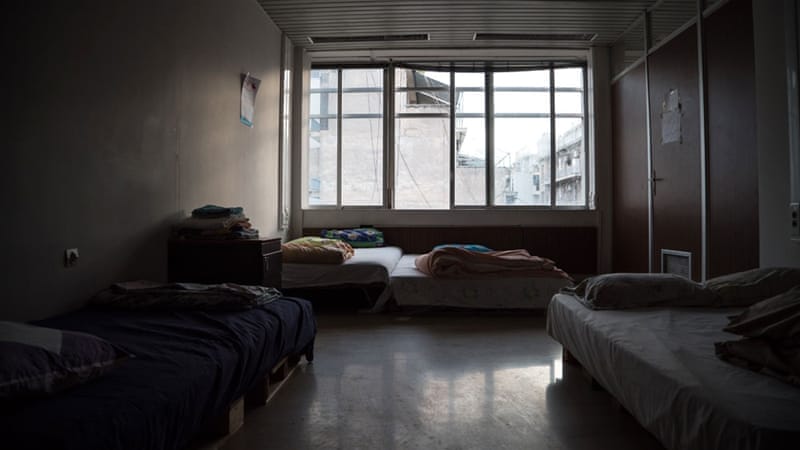
Greek anarchists provide a shelter for refugees at an abandoned government building in Athens [Sorin Furcoi/AL Jazeera)
Greeks may be living in parlous economic times, as one of the European Union's most financially troubled states, forced to live in a kind of austerity that harms Greek pride leading the population to wonder whether they'd be further ahead out of the EU, yet the country is also challenged with a huge influx of refugees and migrants from the Middle East and North Africa, and is doing what it can to cope. Even so, there are some among its citizens who are critical of what the state provides for the refugees.
State-run refugee camps are cramped and crowded, holding over 60,000 migrants and asylum seekers. They are seen to be hugely inadequate, so much so that human rights groups have condemned the camps, characterizing them as squalid and unsafe. A situation which has led Greek's anarchists to take action of their own. And that action has resulted in the anarchists responding to the plight of the refugees by providing food and shelter.
Shelter that has arisen out of their propensity to defy the norms of civil law by occupying buildings no longer in use and transforming them into squats that they now operate as abodes for refugees, alongside catering to their own needs. Refugees who are grateful for the generous space they are given and the dignity they are afforded by the privacy and concern for their well-being that the anarchists have devoted themselves to.
Austerity policies forced upon Greece by global circumstances whose recession in 2008 left the country in worse shape than many of its EU counterparts has left a government with scarce resources, where dwindling social benefits offered to citizens fail their needs. In that failing many citizens no longer have faith in their government. And so, the ranks of the anarchist class have swelled as people decide to take matters concerning them into their own hands.
Among concerns they have is the well-being of people worse off than they happen to be. Social activism perhaps serves as a restorative balm for people who discover that their dreams and aspirations have been compromised by circumstances beyond their control. And what they can control, they are dedicated to. Citizen action has now resulted in "self-managing social centers" cropping up across the country supported through private donations, from the proceeds of concerts, exhibitions and bars open to the public.
Some 250 of these "self-managing social centers" have now been established across Greece. Some of those involved have focused their attention on the provision of food and medicine handouts to alleviate poverty and the collapse of public services. Leftists and anarchists have found common cause in focusing on housing refugees which Greece became host to in 2015 since the European Union and the Balkan nations tightened their borders, leaving refugees stranded.
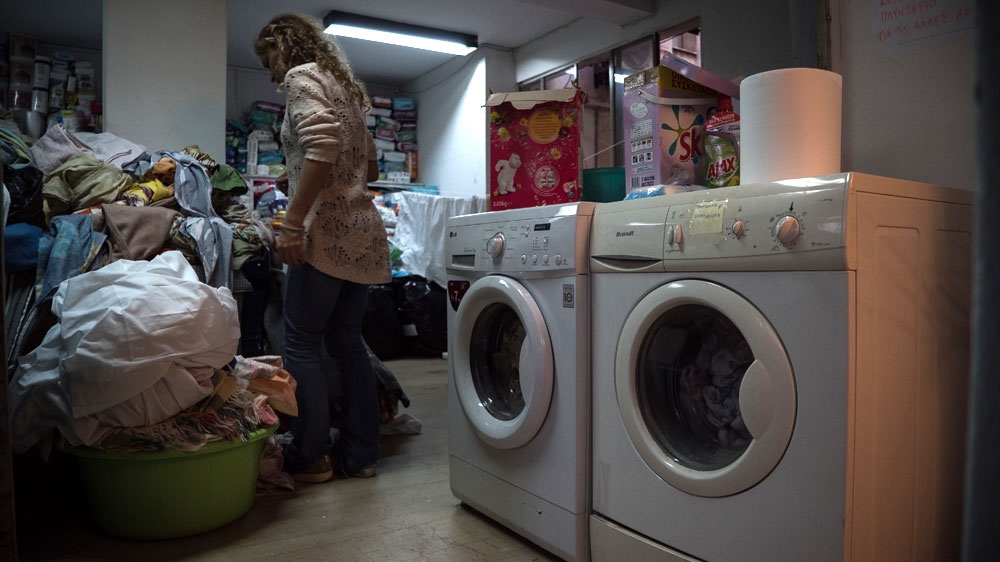
Even volunteers' duties at Notara are divided up
according to anarchist principles and everyone participates in the
work [Sorin Furcoi/AL Jazeera]
But living in 15 buildings, abandoned and now under the charge of anarchists in a burst of citizen action, the role of the anarchists has changed in reflection of what the times require. And at the present time Greeks have developed a deep distrust of authority, mostly thanks to the austerity imposed on the country wracked with debt to international creditors.
So in Athens, the centre of much of the anarchists' attention, in the bohemian neighbourhood of Exarchia squats have bee developed. Police do raid some of those squats operated by anarchists in Thesaloniki, on the Isle of Lesbos and in Athens, but not destructively, stopping short of a full crackdown, reflecting the Syriza party of leftist Prime Minister Alexis Tsipras's values.
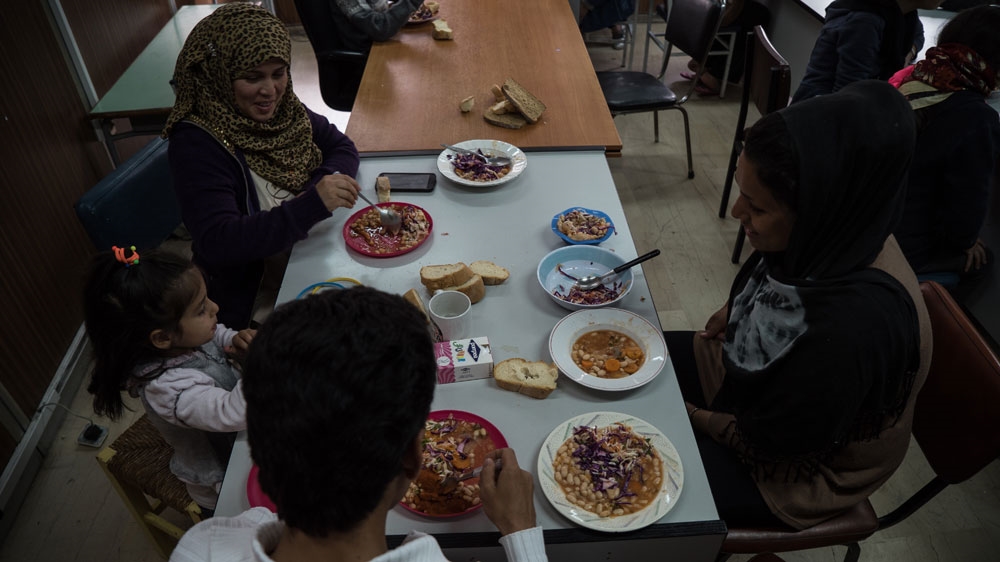
The anarchists contend their squats are badly needed as a humane alternative to the state-operated camps. One of the Exarchia squats, a former state secondary school abandoned as a result of structural problems, is home now to 240 refugees from Syria. A chicken coop has been established on the roof. The squats become self-organized communities independent from any state enterprise and nongovernmental organizations.
Notara 'is far more organised than the camps run by the government', say volunteers [Sorin Furcoi/AL Jazeera]
"Each tear gas canister costs more
than the minimum [monthly] salary, the government spends more on tear
gas than providing food." "I'm here
for the youth, the students, those who are going onto the streets. We've
lived our lives so we should be at the front." Francisco
Viveros, 67, university professor, Caracas, Venezuela
Riot security forces uses a pepper spray
as elderly opposition supporters confront them while rallying against
President Nicolas Maduro in Caracas, Venezuela, May 12, 2017.
REUTERS/Carlos Garcia Rawlins
"We ask the world to look at what's happening right now in Venezuela." "A deranged regime that represses and kills its people." Maria Corina Machado, opposition leader, Venezuela
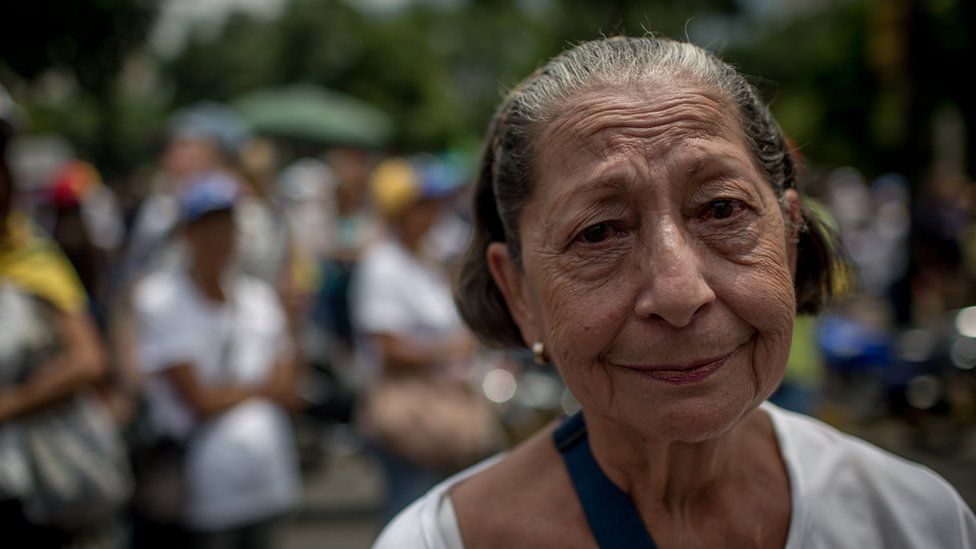
"We're fighting for our children! There's no freedom of expression here in Venezuela. There's no freedom of any kind. On top of that you have shortages of medicines, of goods." "This crisis is affecting my entire family. We have gone from being middle class to being much lower down. Every day we're worse off and our children don't have a future. They're killing our children [at the protests]" "I'm
here as a mother, not just for the sake of my own children but for the
sake of all Venezuelan children and youths who are being unjustly
repressed because this dictatorship wants to take over the country." "The government portrays the opposition as terrorists. We're really tired of this and that's why we'll keep protesting. There
are people who think that just another march won't change anything but I
don't think that's true. I believe that if all of us gathered here
think that way, we can achieve something." "I will continue marching
as long as my health allows it. I'm a breast cancer survivor - I've
just come from my check-up and I'm fine, so I will carry on fighting for
my children, for my country." María Alvarez, 57, Caracas
The protests in Venezuela continue unabated despite the government's response, setting the military and police against the protesters with tear gas canisters being lobbed back and forth. "Sit-ins" have a tendency to begin peacefully but they soon deteriorate as demonstrators clash with soldiers and police, rocks are thrown and official vehicles set on fire. In response, state security officers fire volleys of rubber bullets and tear gas.
Rubber bullets yes, but some protesters have been shot to death, with real, live bullets to the chest, to the head. Over three dozen people have been killed over the past months with the near-daily demonstrations refusing to be quelled. Up to two thousand protesters were detained throughout the seven weeks of protests. There are shortages of food, of elemental consumer goods, of medical supplies. But there is no shortage of crime, and of violence.
'I don't feel safe at the protests, but I have to be courageous!' - Alba Fernández Torres, 74, medical doctor -- Photo ejandro Cegarra
Last month Venezuela stated its intention to leave the OAS because President Nicolas Maduro accuses it of interfering in Venezuela's domestic affairs, of infringing on the nation's sovereignty, and intriguing to remove him from the presidency. The Organization of American States has voted to hold a foreign ministers' meeting later in the month for the purpose of discussing the crisis in Venezuela; meetings are only convened in an effort to address critically urgent affairs.
Maduro plans to address Venezuela's crisis himself through convening a special assembly for the specific purpose of rewriting the national constitution even while the opposition demands the immediate holding of a new presidential election at a time when polls indicate that the majority of Venezuelans are anxious to see Maduro gone. They are confronting the issues of rising violent crime and their nation descending into economic ruin.
The president's move to nullify the authority of the country's Congress controlled y the opposition had been restrained by the huge outcry and condemnation that followed the announcement. That issue and the public involvement in demonstrating outrage led to a continuing wave of protests against the socialist administration whose gross ineptitude had considerably inflamed the country's economic descent and led to rising crime rates.
Henrique Capriles, former presidential candidate who had lost to Maduro in the last presidential election amidst voter fraud and a generalized air of corruption at the polling booth, has warned the opposition is prepared to raise protests "to the next stage", even as Maduro remains determined to rewrite the constitution. "We are against this fraudulent process", Capriles announced to his radio listeners.
"We're going to distribute bread at a much cheaper price and in larger quantities than before." "It's no longer going to be about the exploited and exploiter, no more boss and chief. We're all going to become productive, living and producing in equality." Venezuelan Vice-President Tareck El Aissami
"Seeing all this makes me want to cry." "I want to eat a sweet roll but there aren't any and what products exist are too expensive. I guess I'll have to settle for a coffee." Antonio Medina, 77, retiree, eastern Caracas
"What I have at home is enough to give them [her children] a plain arepa [traditional white corn cake], and it's very
little for each one." "And for me, I don't care
about going without eating. As a mother you're always thinking about
feeding [your children]." Grecia Gonzalez, Caracas, Venezuela
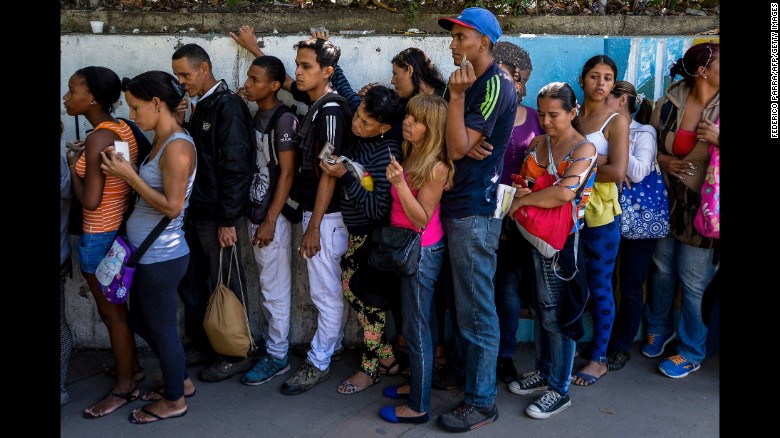
People line up to buy basic food and household items outside a supermarket in Caracas, on September 28, 2016. CNN
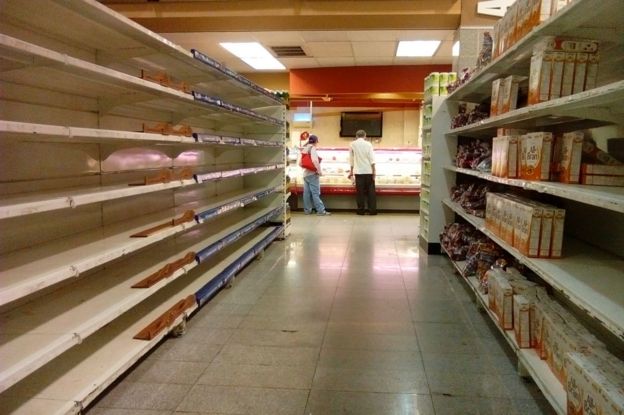
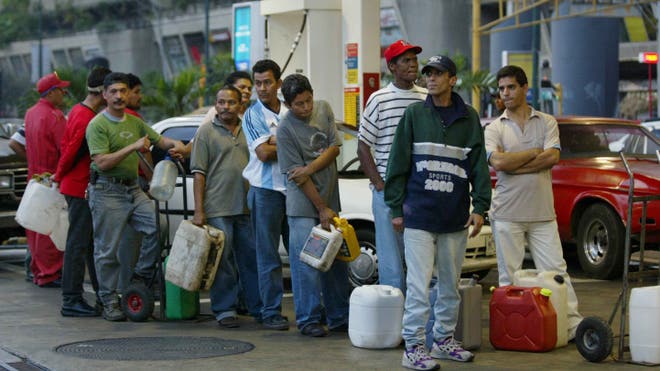
In Venezuela, vegetables and tubers have taken the place of meat and chicken, which used to represent the most sought-after items in most shoppers' grocery carts; the former available in modest quantities, the latter rarely seen for sale, and out of the financial reach of most Venezuelans. There is an acute shortage of basic food staples, and household items like toilet paper, as well. The socialist government that once boasted of itself as generous to the nation's poor and able, through its oil riches, to subsidize heating oil for its neighbours and even poor Americans, can no longer feed its people.
Venezuelans now report that they have taken to skipping meals and when they do eat, they eat less. A recent survey had respondents reporting that they now eat two or fewer meals every day. The number has tripled from a similar survey undertaken the year before when in 2015, 11.3 percent reported eating less, and in 2015 that number had risen to 32.5 percent cutting out meals. The authors of the study, using the collected data, estimated that 9.6-million Venezuelans eat two or fewer daily meals.
The result of which is that malnutrition is on a steady rise.
The government of Venezuela must import much of the food supply for its population, where once agriculture provided the nation with much of the food they needed. The agrarian revolution that accompanied the Bolivarian Revolution of Hugo Chavez had laid desolate a once-thriving economy, and a country that has oil riches failed to reinvest in infrastructure and updated refineries. Taking as its model the Communist Manifesto, the failures that were seen in revolutionary socialism in Russia have been replicated in Venezuela.
Boxes of bran cereal were available in this Caracas supermarket in June Getty Images
The government has taken to invading bakeries, coopting them from their owners to turn control over to neighbourhood committees sympathetic to the government, who are then expected to bake bread from the government-distributed bags of imported flour. Bread, under these new arrangements, is theoretically supposed to be ready for sale at the crack of dawn in a "bread war" enforcing price controls where a loaf sells for roughly 28 cents and less than ten cents on the black market.
Bakeries that presume to try to bake unauthorized types of luxury breads to sell at higher prices in an effort to earn a modest profit are subjected to spot checks by government agents visiting around 700 bakeries, and if deviation from the government-ordered production schedule is detected, those responsible are arrested. Two people were arrested for producing brownies instead of bread, for sale, to people willing to pay slightly more for food items out of the ordinary.
Where fresh milk and regular rice are regulated to be available to the public, fancy yogurts and precooked rice have made their discreet appearance at higher cost, provoking government rage, since such specialty products are out of the financial reach of most Venezuelans and protests by hungry people are not popular with government sensitivity. Bakeries were recently ordered to set aside 90 percent of the flour they are apportioned for the production of French bread and a European style of baguette popular with Venezuelans called "canilla".
The price controls that President Nicolas Maduro inherited from his predecessor, Hugo Chavez, who introduced them to hurt businesses owned by political opponents of his regime who attempted a national strike to force him from office, are seen to have initiated the failure of Venezuelan industries. The government, with its lower revenues with the collapse of oil prices, is incapable of importing as much food as the country requires to keep the population hale.
Representatives of the baking industry accuse the government of importing a quarter of the 120,000 metric tons of what the nation's ten thousand bakeries require monthly to keep pace with demand from hungry Venezuelans.
Predicting the Collapse of North Korea's Dictatorship
"I am sure that more defections of my colleagues will take place since North Korea is already on a slippery slope." "The traditional structures of the North Korean system are crumbling." "[The Kim government] can be held in place and maintained only by idolizing Kim Jong-un like a god." "I am quite confident that without sacrifice to any individual or any group . . . reunification or the elimination of the Kim Jong-un regime cannot be achieved." Thae Yong-Ho, North Korean defector in South Korea
He represents the highest-ranking North Korean official yet to decamp from the threatening fantasy world of North Korea. As a high-rankjing official he and his family would have wanted for nothing. Quite unlike the majority of North Koreans who often face food shortages, and certainly face stark life in prison camps if they attempt to defy the dictatorial government of their Dear Leader who has held the world in dread apprehension each time he orders a ballistic missile or nuclear bomb test.
Kim Jong-un's adolescent tantrums and need for adulation from a captive public is legendary, along with his penchant for posturing and boasting. Let alone his very real threats that erupt from time to time aimed at South Korea, Japan and the United States. His brutality in ridding himself of those who fail to retain his trust was amply demonstrated when he had his uncle by marriage arrested, charged with being "dissolute and depraved" and summarily executed.
Jang Song Thaek (left) Kim Jong-un (right)
This pompous little tyrant funds research into advanced technological weaponry while failing to provide his nation with an adequate food supply, leading to episodes of mass starvation. The second-highest-ranking diplomat in London when he defected to South Korea last summer with his family, Thae Yong-Ho has been labeled "human scum" by the regime he now claims has "numbered" days before it crumbles.
His very defection however, is now fuelling speculation that North Korean elites are becoming increasingly disillusioned with their volatile, spectacularly unhinged leader. The career diplomat so eager now to share his rejectionist view of North Korea's dictator served in Britain, Denmark and Sweden, and as he did, upholding the glorious Kim family as a loyal subject of a regime that brooked no acquaintance with human rights.
Thae Yong-Ho feels that as long as North Koreans have no exposure to the outside world, they they will continue to support the dynastic regime that persecutes and bedevils them, keeping them in a dark age of demi-god worship and acceptance that the world outside North Korea is so envious of their good fortune that their country is ruled by one appointed from on high, it wishes to destroy them and thus their government is credited with protecting the 'rights' and the future of North Korea.
The former diplomat, now associated with South Korea's Institute for National Security Strategy, a think tank aligned with the National Intelligence Service, had the good fortune to be permitted to bring his sons with him to London wheres generally most North Korean diplomats' family members remain at home as "hostages" guaranteeing their return once the diplomatic assignment comes to an end.
Once his sons became familiar with British life they asked their father why North Korea executed people without legal procedures, and why the Internet was not accessible to North Koreans. Based on these enquiries Mr. Thae felt his sons would never be able to successfully adjust to life back home again and would be vulnerable to accusations of disloyalty if they returned to North Korea.
He concluded he had little option but to exile himself and his family, as a result.
"The call to prayer is a symbol of Islam. This is something that's existed for 1,426 years." Imam Adel Elfar, Lod mosque, Israel "The goal of the law is to prevent people's sleep from being disturbed." Col Motti Yogev, Knesset parliamentarian "We don't say they can't do it, but not so loud." Naama Reichman, 32, Lod, Israel "There's hate for Arabs. There are people who are against Islam." Muhyi Sharabati, 22, Lod, Israel
The four minarets of a new mosque are seen in the Israeli-Arab village
of Abu Ghosh, near Jerusalem, Nov. 22, 2013. (photo by REUTERS/Ronen
Zvulun)
"In some places, like [the mixed Arab-Jewish towns of] Jerusalem, Lod,
Ramla and Jaffa, due to the sensitivity of the issue, local authorities
preferred to handle it through quiet talks with the muezzins and local
Arab leaders. The dialogue often resulted in
solutions such as turning down the volume of the loudspeakers or, in the
case of Jaffa, an agreement to install a central wireless system
connecting all the mosques to one uniform call aired at the same time
and at the same sound level."Parliamentary report recommending dialogue
The very notion of Islam's traditional call to the faithful to attend prayer sessions at their local mosques five times daily has a romantic feel to it. Quaint and endearing to those visiting Muslim-majority countries where the call of the muezzin adds to the exotic flair of the environment. When, however, mosques are ensconced in mixed towns of Muslims, Jews and Christians, non-Muslims may not feel so appreciative of the 'romantic' aspect somehow missing when they are awakened by loudspeakers at 4:45 a.m.
Not everyone wants to rouse themselves at that, pardon the pun, 'ungodly' hour. The calls to prayer are broadcast at 4:45 a.m., 11:25 a.m., 2:21 a.m., 4:47 a.m., and finally 6:04 p.m., daily. Which is when the faithful are exhorted to rouse themselves and separate themselves from whatever else that they may be engaged in to enter the mosque to pray. It is their duty. It is their way of life. It is inextricably intertwined with their lifestyle, it is ingrained in them from childbirth to maturity
In Lod, about a third of the close to 73,000 residents are Arab. Reflecting the fact that about 20 percent of the citizens of Israel are Arab Palestinians. The two-thirds of the population of Lod who are not Arab, not Muslim, would very much like to be able to sleep longer than to 4:45 a.m., and many find it difficult to return to sleep once they have been awakened by the six loudspeakers that top a giant metal structure resembling the Eiffel Tower, above the Lod mosque.
A Likud proposal introduced to Parliament by Col Motti Yogev has been approved by Prime Minister Benjamin Netanyahu and by his Knesset ministers. And it has been sent to Parliament for final approval. Jordan and the Palestinian Authority have, unsurprisingly, condemned the move. Even the ultra-Orthodox Jews are perturbed by it, concerned its passage might presage protest over the use of sirens to announce the once-weekly start of the Jewish Sabbath.
Most Jews in Lod state they don't find the muezzin calls offensive, when they regularly occur during daylight hours. But that the first one so early in the morning is a frustratingly unwelcome intrusion into their lives. And that efforts on their part, in their homes, to attempt muffling the sounds are useless. Lod Muslims on the other hand, claim the proposal limiting the muezzin represents a dreadful personal insult and an assault on their religion.
"We're at the start of an unprecedented humanitarian crisis in this part of the Amazon." "We're already seeing Venezuelan lawyers working as supermarket cashiers, Venezuelan women resorting to prostitution, indigenous Venezuelans begging at traffic intersections." Col. Edvaldo Amaral, civil defense chief, State of Roraima, Brazil "It's hard to see a solution to this problem because hunger is involved." "Venezuela doesn't have enough food for its people, so some are coming here." Altemir Campos, mayor, Pacaraima, Brazil
"It was worth the risk. [We Venezuelans] are going after one thing -- food." "They all [people of Curacao] say, 'You are from Venezuela. You are from a rich country that has everything." "And I say, 'No longer'." Roymar Bello, 30, Willemstad, Curacao
Venezuelan migrants boarding a smuggler’s boat that will take them to the island of Curaçao.Credit
Meridith Kohut for The New York Times
It's difficult for the people on small Caribbean islands close to Venezuela who were accustomed to seeing better-off Venezuelans spend tourism dollars on Aruba and Curacao, to understand that the people they once envied are now starving. That wealthy Venezuela, that once represented as the most economically favoured in their region is no longer to be envied, but pitied. They have lately been inundated by desperate Venezuelan refugees, hoping to find food, employment.
Where once they hosted people able to generously pay their way, both island states have now sealed their borders to Venezuelans who are newly poor. They may enter, but only once they can show they have $1,000 in cash to enable them to fend for themselves. That $1,000 represents over five years of earnings reflecting a minimum-wage job. Patrols and deportations have increased, with Aruba using a stadium to hold up to 500 Venezuelan migrants caught by authorities.
Getty Images
Socialist Venezuela has fallen into total ruin, people are hungry and there is no food to be had for people with scant money to spend it on. An estimated 200,000 Venezuelans have departed their country in the past year and a half in hopes of finding a place for themselves where there is food available, where they can find work, where medicine can be relied upon, and where they can escape the endemic crime waves and violence roiling their country.
Venezuelans are taking to the sea to undergo perilous journeys, away from their oil-rich country where poverty reigns supreme. "It has all totally changed", Ivan de la Vega, a sociologist at Simon Bolivar University in Caracas stated. "The earnings of these people are low. The only option left to them is the nearby countries, ones they can get to on foot, or by rafts, or go on boats with tiny motors."
Hundreds of Venezuelans lined up at a grocery store in La Vela in September to see if food would be delivered.Credit
Meridith Kohut for The New York Times
Those tiny motors are no match for the open water, and some never make it to their destination, and are mourned by those left behind. In Venezuela, inflation is set to hit 500 percent this year, 1,600 percent in 2017. The International Monetary Fund estimates that shrinking salaries have created a new demographic of poor Venezuelans, their professional careers abandoned for lives abroad working at menial tasks for scant reward, yet an improvement over their lives in their home country.
Migrants leaving Venezuela on a smuggler’s boat.Credit
Meridith Kohut for The New York Times
Reinier Salazar, a 30 year old Venezuelan industrial engineer, moved to Brazil where he now cooks at a fast-food restaurant, earning about $400 monthly, a substantial increase from what he earned in his profession in Venezuela. "Venezuelans like myself are coming to Brazil for a simple reason; it's easier to survive here", he explained.
Since 2014, 30,000 Venezuelans migrated to the region bordering Venezuela where the Brazilian state of Roraima lies. Some migrants pay smugglers $1,000 each person to take them to Manaus and Sao Paulo. Others are just able to cross the border into Brazil. In a small Brazilian border town, entire families sleep on the town's streets, while their children enrol in local schools.
There was a time in Israel's early history as a Jewish State that the United States kept its distance, while France stepped in to help. France was in fact responsible for giving Israel help with establishing the Dimona nuclear plant. France supplied Israel with the plans, the expert personnel, with the material it would need to build the nuclear plant. And France also partnered with Israel, supplying it with military materiel it required to defend itself from the various attempts by its neighbours to destroy the nascent state before it could fully establish itself.
The French city of Marseille has an estimated 30 to 40 percent Muslim population and has been ranked as the most dangerous city in Europe -- FrontpageMag
Things began to change when General Charles De Gaulle assumed power, viewing Israel with hostile suspicion and stopping the exchanges between France and Israel. At that time Jews had lived in France for many hundreds of years, through the diaspora where Jews had been scattered throughout the world for millennia. Gradually France began absorbing Muslims from its former colonial era in the Middle East and Africa when former colonies shed the mantle of French oversight and war with Algeria took place.
Now, France, like Germany, has an Muslim population of six million dominating the country's concerns and they represent ten percent of the population. It is a growing population, despite the fact that Muslims have failed to integrate into French society and have never fully accepted its values and its laws. Instead, a full one-third of French Muslims await the installation of Islamic Sharia law. An even more disturbing reality is that the overwhelming majority of France's Muslim population is in support of jihad. More precisely they are enthusiastic about jihad against Israel.
There is an estimated 572 "no go zones", the infamous banlieues, squalid, dangerous ghettoes crowded with French Muslims where a brooding anger against France and non-Muslims simmers and where French police dare not venture, knowing the danger and the consequences should they defy the reality that presents itself at their presence where they are not welcome. Apart from the normal immigration from the Muslim world, there has been a flood of "migrants" coming along from Africa and the Middle East, creating discord and insecurity in French cities.
A woman poses in front of the French National
Assembly to protest against ban on wearing full-face niqab veils in
public, in Paris in 2011. Time
And that aside, there is another reality, that France is one of the European nations providing large numbers of Muslims who travelled abroad to arrive in Turkey en route to Syria and Iraq, to fight the good fight of jihad with Islamic State of Iraq and the Levant. And since ISIL has been facing shrinkage of its caliphate and military opposition to its presence in both countries, ISIL terrorists of European derivation have been returning to their countries of origin which now have to contend with the manner in which they follow the activities of the returnees in hopes they will not attack at home.
French police officers are advised by their superiors that it is government policy that they not react to situations; if attacked they are not to retaliate but to absent themselves in fear of accelerating any such incidents into mob violence. In reaction to these orders police have organized protest demonstrations. French intelligence services appear to realize that jihadists have returned from the battlefield in the Middle East, prepared to act out their hostilities at home, fearing that riots may flare reflecting general Muslim discontent with the status quo.
Turkey's Recep Tayyip Erdogan, angry with the European Union's condemnation of his disproportionate overreaction to the attempted military coup he claims was the work of the Gulenist movement, by arresting tens of thousands of Turkish civil servants, members of the police, the judiciary, the military, has warned Europe that it has some poisoned arrows in its quiver of retaliation. While some members of the EU have no wish to see Turkey invited to join their membership, France has been vocal in denying membership to Turkey.
Erdogan reminds Europe that his country has given temporary haven to three million Syrians. And those refugees would all love to depart Turkey for another destination entirely. So that despite Turkey's agreement with the EU that it would continue to detain the refugees to ensure that they are unable to continue their voyages across the Mediterranean heading for Europe, he may just encourage that passage as payback for the EU's evasion of Turkey's membership. France would face even greater numbers clamouring for entry.
In the corridors of the United Nations, France prefers to align itself with the Arab bloc. As it has done with the Organization of Islamic Cooperation, the 56 Islamic countries, along with the Palestinians. It is France which outstandingly encourages the Palestinian Authority to seek the legitimacy of United Nations membership, and to carry on from there to work for accommodation for full agreement that it be declared a state, side-stepping negotiating toward a two-state arrangement with Israel.
If France still nurses aspirations to become a world power in the class of the United States even with its Obama years of declining prestige, recognition, international action and intervention as the world's super-power, should it ever assume the mantle of next-in-line behind Russia and China, it will be as a semi-Muslim power, having shed its proud heritage as a Western democratic, secular nation whose pride in Liberty, Fraternity and Equality will have been horribly diminished.
This represents a general opinion site for its author. It also offers a space for the author to record her experiences and perceptions,both personal and public. This is rendered obvious by the content contained in the blog, but the space is here inviting me to write. And so I do.


/cdn.vox-cdn.com/uploads/chorus_image/image/67148890/GettyImages_1227843980.0.jpg)